
Morocco Mineral Processing Equipment Market Size and Share
Market Overview
| Study Period | 2019 - 2031 |
|---|---|
| Forecast Data Period | 2026 - 2031 |
| Base Year Market Size (2025) | USD 200.12 Million |
| Market Size (2026) | USD 210.65 Million |
| Market Size (2031) | USD 272.19 Million |
| Growth Rate (2026 - 2031) | 5.26 % |
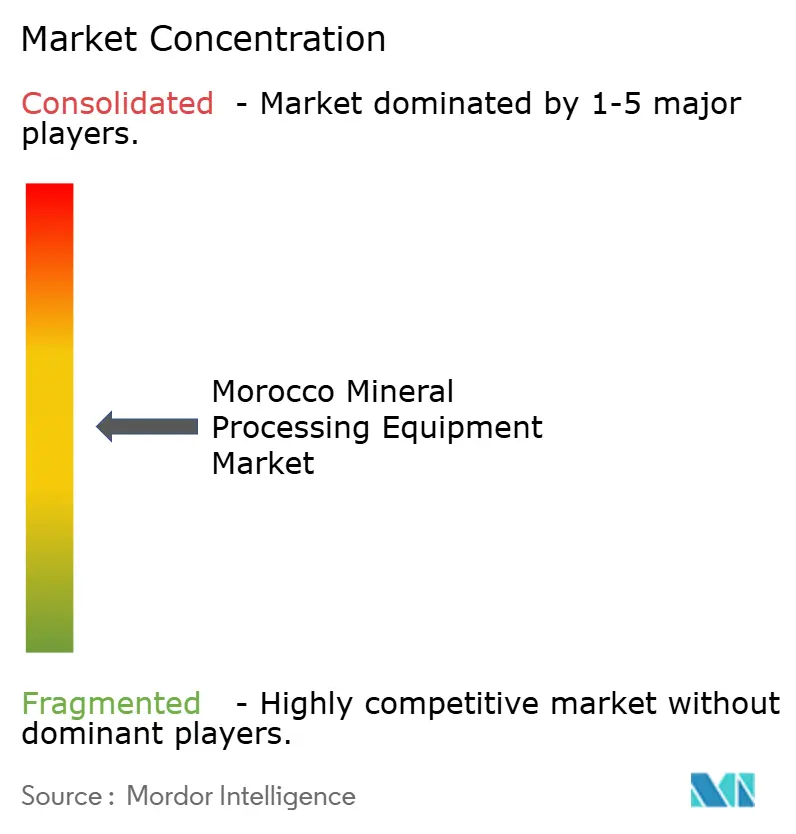
| Market Concentration | Medium |
Major Players *Disclaimer: Major Players sorted in no particular order Image © Mordor Intelligence. Reuse requires attribution under CC BY 4.0. | |
Morocco Mineral Processing Equipment Market Analysis by Mordor Intelligence
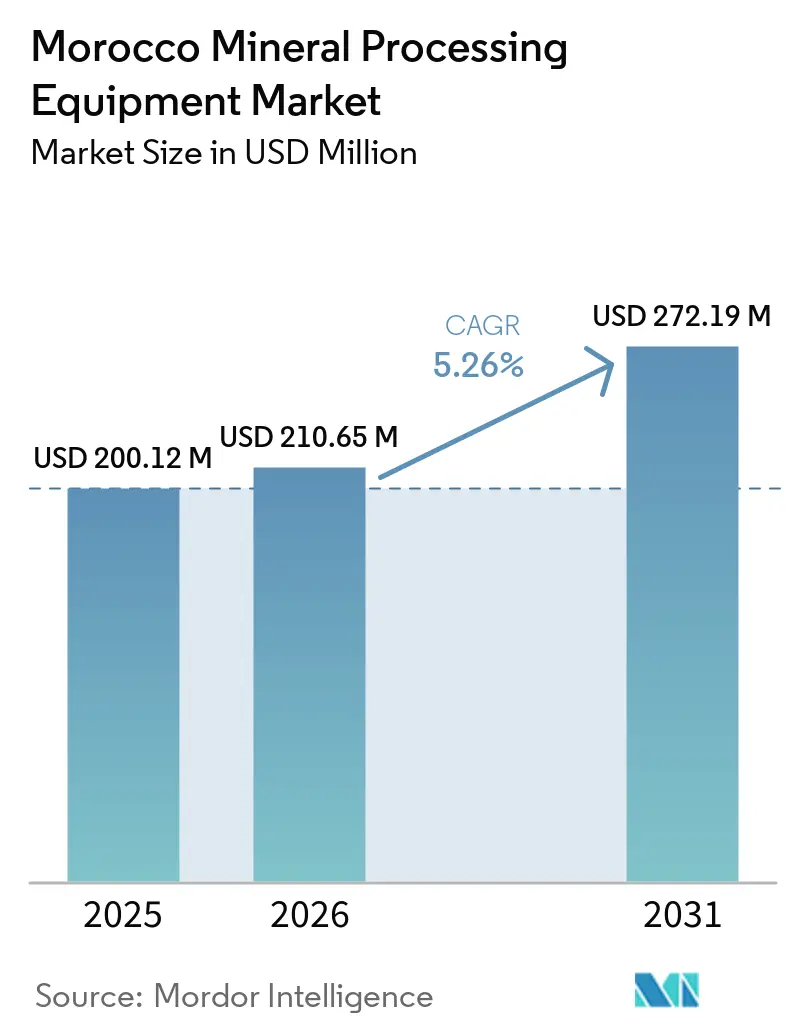
The Morocco mineral processing equipment market size was valued at USD 200.12 million in 2025 and is projected to expand from USD 210.65 million in 2026 to USD 272.19 million by 2031, registering a CAGR of 5.26% between 2026 and 2031. A continued build-out of phosphate capacity, the rise of cobalt refining, and a progressive wave of plant modernization are the three most visible forces shaping demand for crushing, grinding, flotation, and automation solutions across the Moroccan mineral processing equipment market. The EU Critical Raw Materials Act is channeling European capital into battery-mineral projects and lifting environmental compliance requirements[1]. Equipment buyers are therefore prioritizing modular configurations that shorten installation windows, remote-monitoring functionality that stretches scarce technical labor, and water-efficient flowsheet options that help operators satisfy tightening discharge limits. Competitive intensity remains moderate because global original-equipment manufacturers (OEMs) dominate high-complexity categories. Yet, regional integrators are gaining share in conveyor frames, structural steelwork, and spare-parts logistics by leveraging faster delivery and localized fabrication.
Key Report Takeaways
- By mineral sector, phosphate rock held 66.31% of the Moroccan mineral processing equipment market share in 2025, while cobalt processing is forecast to advance at a 7.56% CAGR through 2031.
- By equipment type, crushers commanded 36.67% of the Moroccan mineral processing equipment market share in 2025, whereas flotation cells are projected to post the fastest CAGR of 7.32% over 2026-2031.
- By mining method, surface operations accounted for 79.42% of the Moroccan mineral processing equipment market in 2025, yet underground mining equipment is expected to grow the fastest at a 7.86% CAGR through 2031.
- By automation level, manual solutions captured 60.34% of the Moroccan mineral processing equipment market share in 2025, and semi-automated systems are set to register an 11.34% CAGR during the forecast period.
Note: Market size and forecast figures in this report are generated using Mordor Intelligence’s proprietary estimation framework, updated with the latest available data and insights as of January 2026.
Competitive positioning in Morocco includes both locally based firms and those operating across multiple regions. The market landscape in the global mineral processing equipment industry research shows how these players are arranged internationally.
Morocco Mineral Processing Equipment Market Trends and Insights
Drivers Impact Analysis*
| Driver | (~) % Impact on CAGR Forecast | Geographic Relevance | Impact Timeline |
|---|---|---|---|
| Battery-Grade Cobalt and Manganese Refining | +1.5% | Tangier and Casablanca zones | Long term (≥ 4 years) |
| Surging Phosphate-Rock Output | +1.2% | Khouribga and Gantour basins | Medium term (2-4 years) |
| Upgrade Cycle Beneficiation Plants | +0.9% | Existing OCP facilities | Short term (≤ 2 years) |
| Government-Backed Industrial Acceleration Plan | +0.8% | Casablanca-Settat and Tangier-Tetouan | Medium term (2-4 years) |
| EU Critical Raw Materials Act | +0.6% | Nationwide with North-Africa spillover | Long term (≥ 4 years) |
| Switch to Water-Efficient Flotation Reagents | +0.4% | Water-stressed districts | Medium term (2-4 years) |
| Source: Mordor Intelligence | |||
Ramp-up of Battery-Grade Cobalt and Manganese Refining Projects
Morocco’s pivot toward battery minerals is redrawing traditional procurement maps within the Moroccan mineral processing equipment market. Cobalt expansions around Jorf Lasfar require precision flotation, solvent extraction, and leaching systems that offer higher margins than bulk phosphate gear[2]. European offtakers now insist on auditable supply chains, which in turn pushes plant owners to adopt sensor-rich circuits that log energy, reagent, and emissions data in real time. Vendors with ISO-certified quality and environmental management systems are therefore winning preferred-bidder status. Equipment lifetime-service contracts are also proliferating because cobalt projects rely on strict uptime guarantees to protect cathode-active-material delivery schedules. Finally, the clustering of cobalt and manganese projects along Morocco’s Atlantic coast is unlocking logistics infrastructure for suppliers to centralize commissioning teams and bonded spares near deep-water ports.
Surging Domestic Phosphate-Rock Output
OCP’s incremental capacity additions reinforce the Morocco mineral processing equipment market’s heavy exposure to high-tonnage primary crushing, slurry-pipeline pumping, and screen-media replacement. Continuous upgrades to pipeline and beneficiation infrastructure oblige OEMs to meet tougher wear-life specifications, favoring proprietary alloys and predictive-maintenance software. The prevalence of silica-rich ore also sustains replacement demand for mill liners and hydrocyclones. Phosphate price swings, however, create a lumpy ordering pattern, so suppliers that scaffold sales with flexible payment plans and rental fleets are best positioned. Equipment modularity is prized because it reduces tie-in downtime during operator retrofits of existing trains.
Upgrade Cycle of Legacy Beneficiation Plants
Many Moroccan beneficiation facilities date back to the 1980s, so operators are replacing energy-intensive ball mills with modern comminution and classification technologies that unlock power savings and higher recovery. Thickener drives designed for faster bearing swaps shorten shutdowns, while coarse-particle flotation lines recover fines previously lost to tailings. Environmental permits now require water-balance audits, so suppliers offering bundled engineering support with hardware are seeing rising demand. The upgrade wave also accelerates the adoption of life-cycle service agreements because on-site maintenance skills remain scarce. Remote-monitoring dashboards that flag torque spikes, ragging, or pH excursions are therefore moving from nice-to-have to standard specification.
Government-Backed Industrial Acceleration Plan
The Moroccan government is linking targets for localizing mineral processing equipment to tax incentives, training grants, and faster permit reviews, which materially affect sourcing decisions in the Moroccan mineral processing equipment market. OEMs that establish assembly lines in Casablanca-Settat or the Oriental region gain duty exemptions and scorecard advantages in public tenders. The plan’s digital cadastre initiative simplifies ore-body mapping and de-risks greenfield feasibility studies, thereby pulling forward demand for complete flowsheets. Upcoming hydrogen and renewable-energy projects may also echo through future metals circuits, nudging product managers to plan for nickel, platinum-group-metal, and rare-earth beneficiation modules.
Restraints Impact Analysis*
| Restraint | (~) % Impact on CAGR Forecast | Geographic Relevance | Impact Timeline |
|---|---|---|---|
| Phosphate-Price Volatility | -1.1% | All mining basins | Short term (≤ 2 years) |
| Strict Discharge-Water Salinity Limits | -0.7% | Coastal operations | Short term (≤ 2 years) |
| Sensor-Integration Skill Set Shortage | -0.5% | Rural mining areas | Medium term (2-4 years) |
| Delayed Customs Clearance | -0.3% | Major ports | Short term (≤ 2 years) |
| Source: Mordor Intelligence | |||
Capital-Expenditure Squeeze Amid Phosphate-Price Volatility
Spot-price fluctuations lead operators to toggle rapidly between expansionary and defensive capex postures. When prices retreat, discretionary spending on crushers, mills, and digital control upgrades stalls, elongating sales cycles for OEMs. Lease-style life-cycle service contracts are emerging as a hedge because they spread payments over operating budgets rather than front-loaded capex. Suppliers that stock critical wear parts locally cushion customers against stock-out downtime, which can erode free cash flow faster than headline price movements alone. Hedging tools remain limited, so procurement teams value modular equipment that can be phased with available liquidity rather than built in one lump.
Strict Discharge-Water Salinity Limits
Regional water agencies impose total-dissolved-solids and sulfate thresholds that obligate plants to thicken or treat tailings liquor before release. High-density paste solutions reduce the amount of water trapped in residues, but they require high-torque drives and larger footings, raising initial cost. Reverse-osmosis add-ons secure compliance yet lift power demand, nudging buyers toward energy-efficient pumps. Because limit values differ by watershed, engineering houses must tailor flowsheets mine by mine, extending basic-design timelines. OEMs that furnish turnkey water-management packages earn premium margins by offloading environmental-compliance risk from operators.
*Our forecasts treat driver/restraint impacts as directional, not additive. The impact forecasts reflect baseline growth, mix effects, and variable interactions.
Segment Analysis
By Mineral Sector: Phosphate Strength Finances the Battery Transition
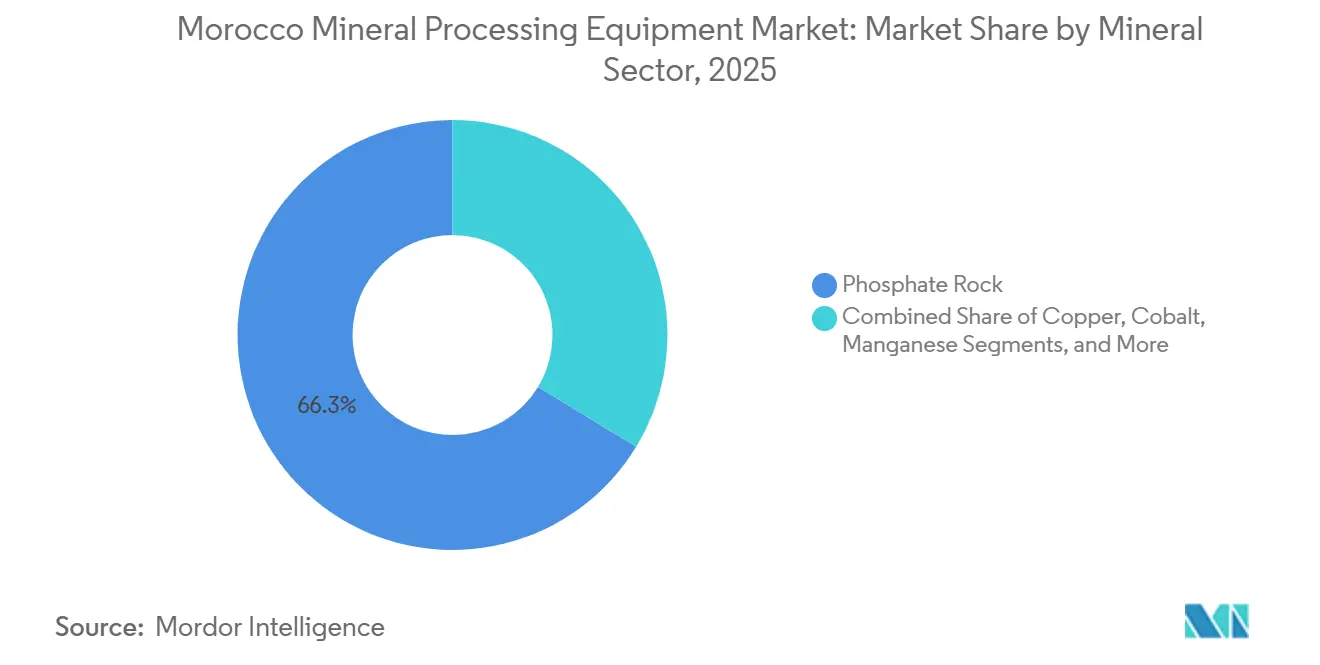
Phosphate rock retained 66.31% of the Moroccan mineral processing equipment market share in 2025, underscoring its status as the anchor revenue stream financing broader flowsheet upgrades. Most of the installed crushing and conveying lines still feed phosphate beneficiation trains, and their high tonnage sustains a recurring replacement cycle for liners, belts, and screens. Cobalt processing sits on the other end of the maturity curve, and its 7.56% CAGR to 2031 positions it as the single fastest-growing end use. Plant owners view cobalt circuits as technology showcases and therefore specify premium flotation and solvent-extraction packages designed for battery-grade purity, setting a template that manganese and nickel projects will likely copy. The mid-tier copper segment, represented by underground projects in the Oriental region, drives demand for compact loaders and conveyors, but volume remains secondary to that of sedimentary phosphates.
A widening investor base supports diversification beyond fertilizers. European battery groups offer offtake prepayments that improve project bankability for cobalt and manganese ventures, thereby indirectly boosting capital expenditure on high-spec equipment. Government concessions also encourage integrated precious-metal hubs, where by-products such as silver and tellurium can be recovered, but these initiatives remain niche relative to bulk phosphates. Suppliers consequently align segmentation strategies around a twin-track model: high-volume phosphate packages on one side and high-margin battery-mineral suites on the other. This duality encourages flexible manufacturing footprints able to pivot capacity between wear-intensive phosphate items and precision cobalt modules as demand cycles evolve.

By Equipment Type: Crushing Still Dominates but Flotation Gains Momentum
Crushers accounted for 36.67% of the Moroccan mineral processing equipment market share in 2025, reflecting their indispensability across all mine types, especially in sedimentary phosphate pits. Continuous improvement in liner metallurgy and drive efficiency keeps owners focused on total cost of ownership metrics rather than the headline purchase price. Meanwhile, flotation cells are forecast to clock a 7.32% CAGR through 2031, mirroring the rising purity requirements of cobalt and copper concentrates destined for battery supply chains. Forced-air and coarse-particle technologies are penetrating both brownfield and greenfield sites because they recover value previously trapped in fine fractions, strengthening the replacement argument even where ore grades remain stable.
Grind-circuit conversations now revolve around energy intensity, with owners benchmarking high-pressure grinding rolls against legacy ball mills. However, the capital premium of next-generation mills tempers rapid switch-out, so retrofit liner packages that extend mill life see healthy uptake as an interim step. Thickening and dewatering equipment inches upward in share as ESG audits assign monetary credit to water recycling, while digital control systems are on a steeper adoption curve as plants chase traceability. Screens, hydrocyclones, and conveyors hold steady because every orebody, regardless of mineralogy, must classify, transport, and size material, anchoring demand for these standard modules.
By Mining Method: Surface Dominates but Underground Gains Investment Focus
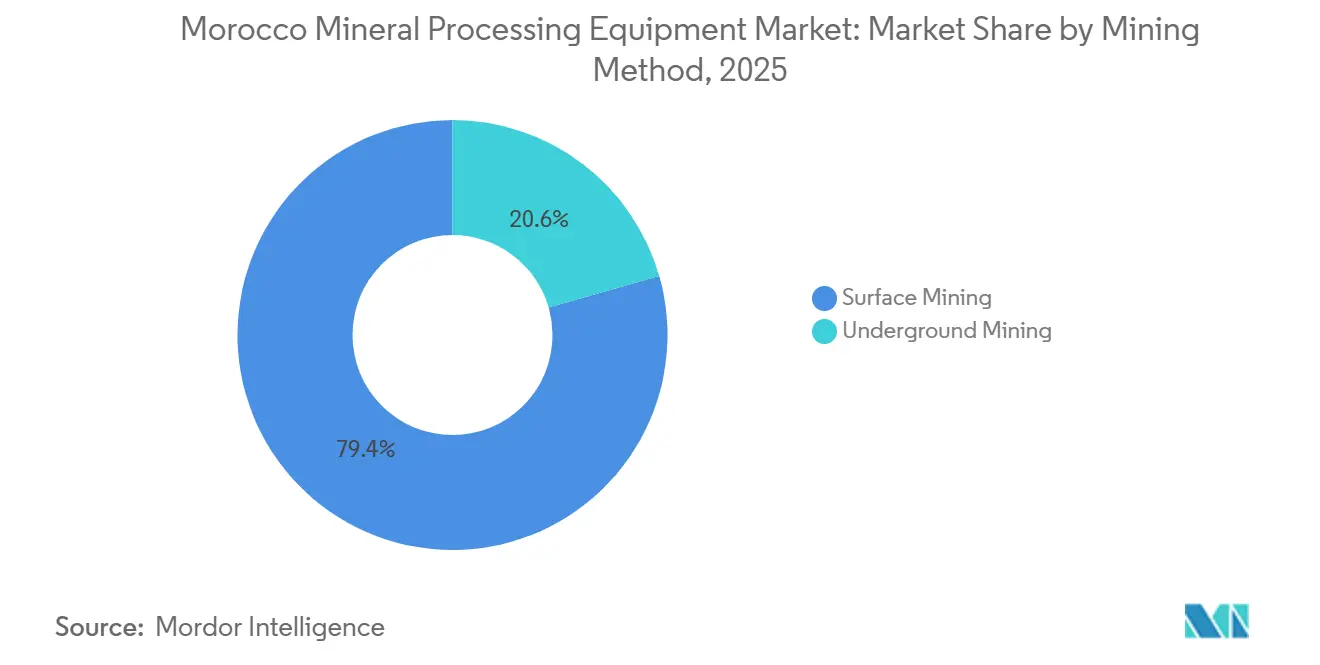
Surface operations represented 79.42% of the Moroccan mineral processing equipment market size in 2025, a legacy of Morocco’s vast shallow phosphate seams. Open-pit fleets consume high-capacity drills, shovels, and primary crushers, all of which underpin OEMs' service-part revenues. Nonetheless, underground equipment is set for a 7.86% CAGR to 2031 as deeper orebodies come into economic reach. Plant designers now specify low-profile crushers, flame-retardant belt conveyors, and advanced ventilation packages for copper and deeper phosphate stopes. This shift requires suppliers to master a different product matrix that prioritizes compact form factors, battery or tethered-electric drives, and real-time geolocation solutions that support autonomous tramming.
New underground approvals also carry stricter safety-case requirements, amplifying demand for fire-suppression, gas-monitoring, and rock-support consumables that layer on top of primary equipment sales. Consequently, some surface-focused distributors are forming joint ventures with specialist tunnel and shaft-sinking contractors to smooth entry into the subterranean arena. Technology spillovers from global deep-ore hubs arrive swiftly because Moroccan operators benchmark against best-practice jurisdictions, accelerating knowledge transfer. As open-pit stripping ratios rise, the economic calculus tilts further toward block-cave or sublevel-open-stoping alternatives, prolonging the growth runway for underground wares.
By Automation Level: Semi-Automated Systems Bridge Cost and Control
Manual equipment captured 60.34% of the Moroccan mineral processing equipment market share in 2025 because many beneficiation plants were commissioned before advanced instrumentation became mainstream. Operators, however, recognize the productivity lost to manual intervention and see semi-automated packages as a realistic first upgrade. The category is therefore poised to post an 11.34% CAGR, as sensor kits, variable-frequency drives, and basic supervisory control rank highly on new-purchase checklists. Semi-automated circuits strike a compromise: they deliver measurable gains in water efficiency and metal recovery without demanding the full network infrastructure and specialist staff needed for end-to-end autonomy.
Fully automated flowsheets remain concentrated in showcase battery-mineral plants where high unit value justifies higher spend, yet even here, owners stage implementation by modularizing control layers. Remote monitoring centers in Casablanca or Rabat oversee clusters of plants, providing economies of scale in analytics and cybersecurity. Vendors embed data-science teams inside service contracts to interpret sensor feeds and recommend optimization tweaks, binding owner and supplier interests over multi-year horizons. Over time, success stories from semi-automated retrofits lay the cultural groundwork for broader acceptance of autonomous hauling, AI-driven grinding, and closed-loop flotation control, ensuring a gradual but resolute evolution of plant control philosophies across Morocco.
Geography Analysis
The Khouribga-Benguerir-Youssoufia phosphate axis forms the gravitational center of the Moroccan mineral processing equipment market, funneling the majority of crusher, conveyor, and pipeline orders into a relatively compact geographic footprint. Casablanca-Settat, host to Jorf Lasfar’s refineries and export jetties, layers beneficiation with downstream chemical processing, tightening equipment specifications around slurry handling, corrosion resistance, and traceability. Contractors prefer to stage fabrication close to these clusters because proximity to roads, railways, and ports reduces logistics risk and simplifies after-sales service. The government’s cadastre digitization now maps infrastructure corridors alongside resource blocks, helping OEMs predict where the next wave of plant construction, and therefore demand for modular packages, is likely to emerge.
The Oriental region, anchored by underground copper projects, has become a test bed for compact, battery-ready loaders and real-time ventilation controls. Still underserved by technical colleges, the zone sees OEMs back vocational-training initiatives that align with their product roadmaps. Equipment footprints here often combine hard-rock copper with smaller lead-zinc circuits, prompting suppliers to fine-tune the flexibility of their flowsheets. Inland logistics remains a constraint, so distributors carry extra critical spare stock to counter road disruptions during seasonal weather or customs holdups. As digital single-window customs trials expand, operators anticipate shorter lead times, which could allow leaner inventories and higher adoption of just-in-time maintenance philosophies.
Southern regions such as Souss-Massa and Guelmim-Oued Noun align mineral ambitions with renewable energy megaprojects, positioning themselves for integrated value chains linking green power, hydrogen, and metals. While equipment spending here remains low in absolute terms, early-stage feasibility studies tend toward complete greenfield flowsheets rather than incremental upgrades, benefiting suppliers offering turnkey design-and-build packages. The presence of a coastline and ambition to scale port capacity signal long-run opportunities for marine-capable bulk-handling systems. However, water-stress considerations in arid basins incentivize the adoption of paste-thickening and dry-stacked tailings from day one, differentiating procurement patterns from those in legacy phosphate heartlands.
Mordor Intelligence tracks the mineral processing equipment market with additional country-level coverage spanning Egypt, South Africa, Saudi Arabia, Australia, China, Canada, Germany, France, and Spain, each reflecting localized structural drivers, restraints and more.
Competitive Landscape
Global OEMs retain a technology edge in high-complexity equipment lines, but market fragmentation persists because localized fabrication and service form a powerful counterweight. Multinational vendors build Moroccan assembly hubs to secure local-content credits, reduce import paperwork, and position spare-parts hubs near major mines. Their strategies center on life-cycle service agreements that lock in customers for the full wear-part and upgrade curve, thus smoothing revenue across commodity cycles. Regional integrators push into niches the giants overlook, such as enclosed belt conveyors tailored for dusty desert environments or the refurbishment of decade-old mills that still populate many phosphate concentrators.
Strategic alliances increasingly knit together disparate capabilities: a flotation OEM may partner with a reagent supplier to guarantee metallurgy, while a mill manufacturer teams with an automation startup for predictive-maintenance overlays. Customers value such ecosystems because they shift performance risk off the balance sheet and reduce interface management. Growth in brownfield optimization also gives engineering consultants, EPC contractors, and audit firms a place in the value chain, but direct hardware providers remain the primary revenue winners. As digital twins and simulation-led design migrate from demonstrator to standard practice, software vendors without hardware heritage look to embed code inside OEM-supplied control cabinets, adding a new competitive dimension around data ownership.
Morocco’s local-content regulations nudge suppliers to joint-venture with domestic steel fabricators and machine shops. The arrangement reduces lead time and avoids port delays, yet requires strict quality‐assurance oversight by the OEM to protect against warranty exposure. For global brands, the balancing act centers on safeguarding intellectual property while nurturing an indigenous supplier ecosystem that meets policy requirements. Medium-sized Moroccan firms, once content to supply civil foundations or structural modules, now eye higher-value categories such as pump casing, hydrocyclone shells, and even low-end automation enclosures, gradually eroding the lower tiers of imported equipment.
Morocco Mineral Processing Equipment Industry Leaders
-
Metso Oyj
-
FLSmidth A/S
-
Sandvik AB
-
The Weir Group plc
-
Thyssenkrupp AG
- *Disclaimer: Major Players sorted in no particular order
Recent Industry Developments
- June 2026: Steadright Critical Minerals Inc. entered into a definitive Share Purchase Agreement to acquire a 50% interest in a Moroccan company that owns crushing, grinding, and quarrying assets. These assets are essential to Steadright’s expanding operational footprint in the Kingdom of Morocco.
- April 2025: Morocco launched new mining tenders for 328 blocks in the Eastern High Atlas and Tafilalet-Maider regions for lead and zinc exploration. The country’s mining sector generates annual revenue of more than USD 54 million.
- September 2024: Weir Group secured USD 33.5 million in process-equipment orders for OCP’s Benguerir and Louta phosphate projects, supplying Warman slurry pumps and Cavex hydrocyclones.
Morocco Mineral Processing Equipment Market Report Scope
The Moroccan Mineral Processing Equipment market is segmented by mineral sector, equipment type, mining method, and automation level. By Mineral Sector, the market is segmented into Phosphate, Copper, Cobalt, Manganese, Precious Metals, and Others. By Equipment Type, the market is segmented into Crushers, Mills and Grinding, Screens and Feeders, Flotation Cells, Thickening and Dewatering, Conveyors, and Process Control. By Mining Method, the market is segmented into Surface Mining and Underground Mining. By Automation Level, the market is segmented into Manual, Semi-Autonomous, and Fully-Autonomous. Market forecasts are provided in terms of Value (USD) and Volume (Units).
| Phosphate Rock |
| Copper |
| Cobalt |
| Manganese |
| Precious Metals (Gold, Silver) |
| Others |
| Crushers |
| Mills and Grinders |
| Screens and Classifiers |
| Flotation Cells |
| Thickening and Dewatering Equipment |
| Conveyors and Feeders |
| Process Control and Automation Systems |
| Surface Mining |
| Underground Mining |
| Manual |
| Semi-Automated |
| Fully-Automated |
| By Mineral Sector | Phosphate Rock |
| Copper | |
| Cobalt | |
| Manganese | |
| Precious Metals (Gold, Silver) | |
| Others | |
| By Equipment Type | Crushers |
| Mills and Grinders | |
| Screens and Classifiers | |
| Flotation Cells | |
| Thickening and Dewatering Equipment | |
| Conveyors and Feeders | |
| Process Control and Automation Systems | |
| By Mining Method | Surface Mining |
| Underground Mining | |
| By Automation Level | Manual |
| Semi-Automated | |
| Fully-Automated |
Key Questions Answered in the Report
What is the current market size and growth rate of the Moroccan mineral processing equipment market?
The Morocco mineral processing equipment market size was valued at USD 200.12 million in 2025 and is projected to expand from USD 210.65 million in 2026 to USD 272.19 million by 2031, registering a CAGR of 5.26% between 2026 and 2031.
Which mineral segment will expand the fastest by 2031?
Cobalt processing equipment is projected to record the highest 7.56% CAGR, driven by battery-grade refinery expansions.
Which equipment category currently dominates spending?
Crushers hold the largest share at 36.67% of 2025 revenue because every major phosphate and copper circuit relies on large primary comminution units.
How significant is automation adoption in Moroccan plants?
Manual systems still lead at 60.34% share in 2025, but semi-automated solutions are advancing quickly with an 11.34% CAGR as operators pursue incremental efficiency gains.