
South Africa Mining Equipment Market Size and Share
Market Overview
| Study Period | 2019 - 2031 |
|---|---|
| Forecast Data Period | 2026 - 2031 |
| Base Year Market Size (2025) | USD 1.28 Billion |
| Market Size (2026) | USD 1.35 Billion |
| Market Size (2031) | USD 1.78 Billion |
| Growth Rate (2026 - 2031) | 5.66 % |
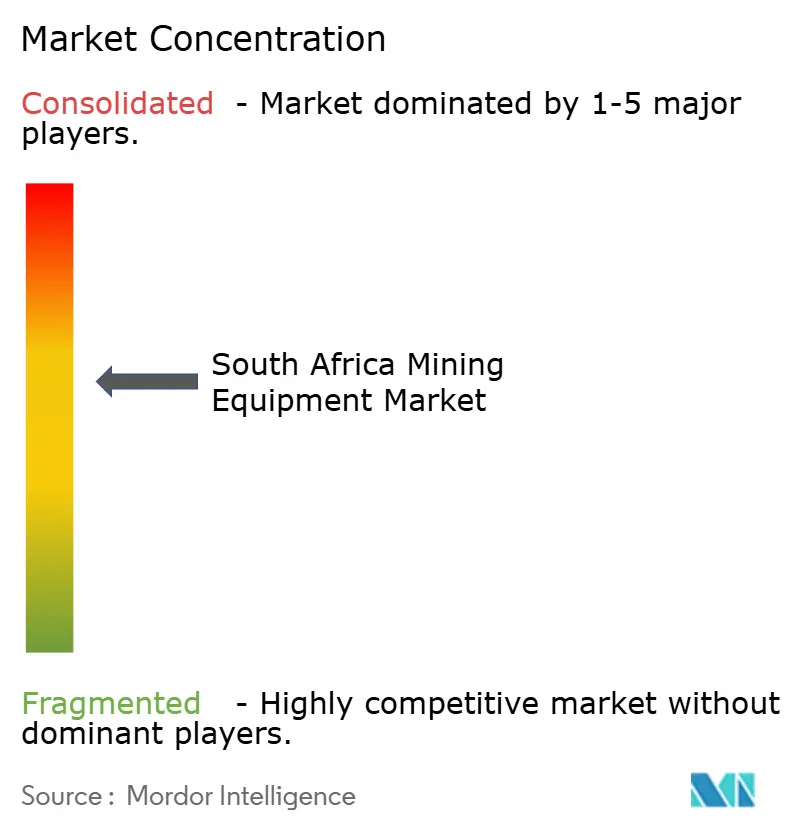
| Market Concentration | Medium |
Major Players *Disclaimer: Major Players sorted in no particular order Image © Mordor Intelligence. Reuse requires attribution under CC BY 4.0. | |
South Africa Mining Equipment Market Analysis by Mordor Intelligence
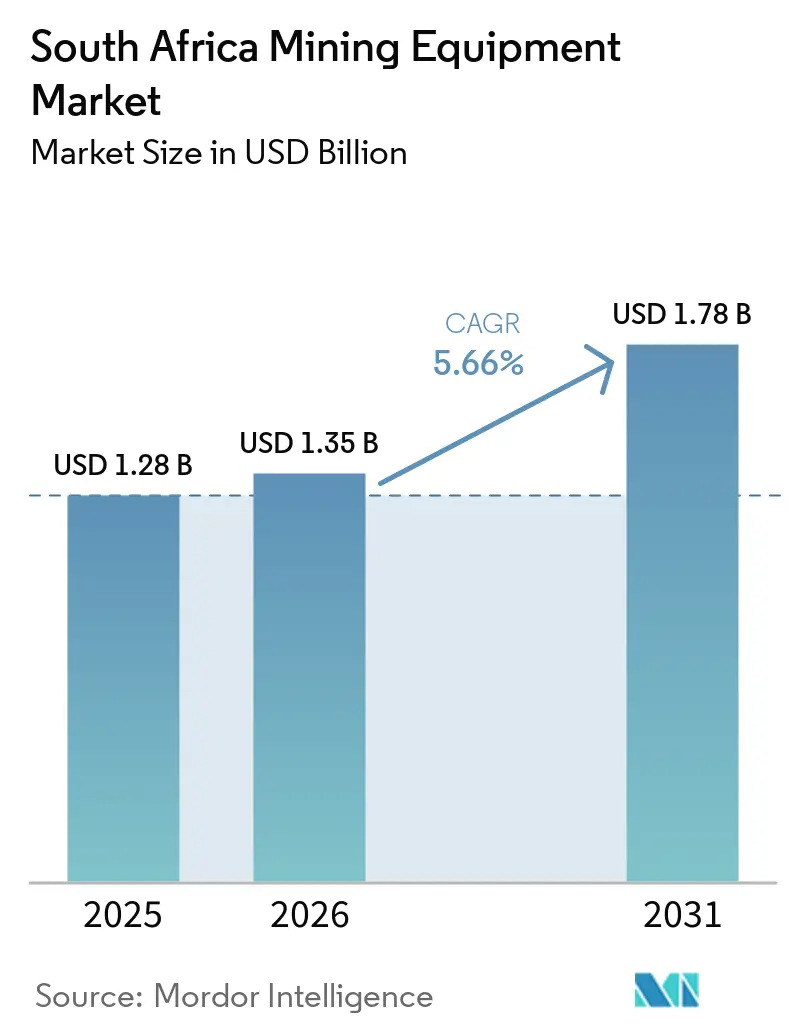
The South African mining equipment market was valued at USD 1.28 billion in 2025, is estimated at USD 1.35 billion in 2026, and is projected to reach USD 1.78 billion by 2031, growing at a CAGR of 5.66% from 2026 to 2031. Surging commodity-price-driven cash flows are being funneled into brownfield mechanization, safety upgrades, and emissions-cutting fleets rather than greenfield capacity, reshaping product demand toward autonomous-ready loaders, drill rigs, and energy-efficient haulage. Cabinet approval of the Critical Minerals and Metals Strategy in May 2025 elevated platinum, manganese, iron ore, coal, and chrome to high-critical status, unlocking exploration budgets and stimulating downstream beneficiation hubs that require advanced processing plants. Rebounding surface operations preserved a 51.36% equipment share in 2025, yet underground mechanization is accelerating to offset unit labor cost inflation and new Mine Health and Safety Regulations published in May 2025. Performance-Based Standards haulage reforms, localization incentives under the Industrial Policy Action Plan, and green-bond financing for battery-electric vehicles are widening opportunities for domestic assemblers and international OEMs offering turnkey low-emission solutions.
Key Report Takeaways
- By equipment type, surface mining equipment led with 51.36% of the South African mining equipment market share in 2025, while underground mining equipment is forecast to register the fastest CAGR at 6.68% through 2031.
- By automation level, manual equipment accounted for 76.57% of the South African mining equipment market share in 2025, whereas fully autonomous machines are projected to grow at a 6.71% CAGR over 2026-2031.
- By powertrain type, internal combustion engine vehicles held an 83.37% of the South African mining equipment market share in 2025, while battery-electric vehicles are expected to expand at a 6.73% CAGR through 2031.
- By power output, sub-500 HP equipment captured 48.75% of the South African mining equipment market in 2025 and represents the fastest-growing band, with a 6.75% CAGR to 2031.
- By application, coal mining contributed 41.25% of the South African mining equipment market share in 2025, while metallic mineral mining is set to grow at the highest CAGR of 6.81% during the forecast period.
Note: Market size and forecast figures in this report are generated using Mordor Intelligence’s proprietary estimation framework, updated with the latest available data and insights as of January 2026.
South Africa Mining Equipment Market Trends and Insights
Drivers Impact Analysis*
| Driver | (~) % Impact on CAGR Forecast | Geographic Relevance | Impact Timeline |
|---|---|---|---|
| Escalating Commodity-Price Driven CAPEX Rebound | +1.2% | National, with concentration in Limpopo (platinum), Mpumalanga (coal), Northern Cape (manganese) | Medium term (2-4 years) |
| Streamlined Critical-Minerals Licensing Program | +0.8% | National, prioritizing lithium/REE exploration in Northern Cape and Limpopo | Long term (≥ 4 years) |
| PBS Haulage Legislation Unlocking Fleet Upgrades | +0.6% | Mpumalanga, Limpopo, Northern Cape mining corridors | Short term (≤ 2 years) |
| Localization Incentives Under IPAP | +0.5% | National, with manufacturing hubs in Richards Bay (KwaZulu-Natal) and Gauteng | Medium term (2-4 years) |
| Green-Bond Financing | +0.4% | National, early adoption at greenfield projects (Platreef) and large producers | Long term (≥ 4 years) |
| Mandatory EMESRT Level 9 Safety Adoption | +0.3% | National, underground operations in deep-level gold and PGM mines | Short term (≤ 2 years) |
| Source: Mordor Intelligence | |||
Escalating Commodity-Price Driven CAPEX Rebound
In 2025, gold prices reached new highs, while platinum also recorded a substantial increase. Despite these price surges, physical output declined, allowing cash to be redirected toward modernization projects rather than capacity expansion [1]“Facts and Figures 2025,” Minerals Council South Africa, mineralscouncil.org.za . Miners are prioritizing modular equipment, autonomous retrofits, and energy-efficiency upgrades that lower unit costs per tonne. In late 2024, Bell Equipment's finished-machine inventory reached a significant level, indicating a cautious approach to domestic procurement, even as the company gained ground against northern hemisphere competitors amid waning overseas demand [2]“Integrated Report 2024,” Bell Equipment Limited, bellequipment.com. The cash-rich yet cautious environment supports the South African mining equipment market by stimulating high-spec replacement orders rather than large greenfield packages.
Streamlined Critical-Minerals Licensing Program
The Critical Minerals Strategy has identified several commodities, categorizing them into three priority tiers and linking periodic reviews to shifts in the market and geopolitical landscape. The draft Mineral Resources Development Bill 2025 introduces a streamlined licensing approach that harmonizes licensing with environmental and water regulations. This initiative aims for a notable stake in global exploration spending, backed by a significant Junior Exploration Fund. While demand for exploration equipment is expected to lag reforms for a period as permitting backlogs are cleared, there's substantial long-term potential for drills, survey equipment, and sample labs as risk capital returns.
PBS Haulage Legislation Unlocking Fleet Upgrades
Implementing Performance-Based Standards could significantly reduce truck trips along coal and manganese corridors, decrease road crashes, and lead to substantial savings in annual road-wear costs, even with minimal fleet penetration. Fleet operators are increasingly turning to tridem-axle tractors, B-double combinations, advanced telematics, and specialized maintenance tools. These enhancements drive the demand for higher-payload haul trucks and related workshop equipment in South Africa's mining equipment market.
Localization Incentives Under IPAP
The Manufacturing Support Program provides reimbursements for a portion of project expenditures, with higher incentives for projects predominantly owned by youth or women. The program aims to achieve significant import substitution in the short term. Bell Equipment has expanded its contract manufacturing operations in Richards Bay, highlighting the domestic capability for precision fabrication that supports global OEMs. While local content thresholds emphasize rebuilds, components, and aftermarket parts, a lack of skilled workers in welding and CNC operations limits the pace of expansion.
Restraints Impact Analysis*
| Restraint | (~) % Impact on CAGR Forecast | Geographic Relevance | Impact Timeline |
|---|---|---|---|
| Chronic Electricity and Rail Constraints | -1.1% | National, acute in Mpumalanga (coal export), Northern Cape (iron ore/manganese export) | Short term (≤ 2 years) |
| Regulatory and Permitting Uncertainty | -0.6% | National, with exploration delays in Northern Cape, Limpopo | Medium term (2-4 years) |
| Influx of Low-Cost Chinese Second-Hand Units | -0.4% | National, concentrated in coal and construction-mining contractors | Short term (≤ 2 years) |
| Skilled Technician Shortage for Automation | -0.3% | National, most acute in remote operations (Limpopo, Northern Cape) | Long term (≥ 4 years) |
| Source: Mordor Intelligence | |||
Chronic Electricity and Rail Constraints
In April 2025, Eskom significantly increased tariffs. Simultaneously, mining's electricity input costs rose substantially year-on-year. Transnet's coal rail volumes dropped to their lowest level in decades, marking a significant decline. This downturn caused severe economic losses over recent years. As a result, miners are channeling funds into self-generation and road haulage fleets. This shift curtails potential gains for core extraction equipment, especially until there's noticeable progress in rehabilitating the grid and rail systems.
Regulatory and Permitting Uncertainty
Artisanal miners face considerable approval backlogs due to adjustments in licensing frameworks, more comprehensive community consultations, and increasingly stringent compliance requirements for residue stockpiles. These regulatory changes have introduced complexities in the approval process, causing delays that disrupt procurement cycles. As a result, miners are compelled to adopt alternative solutions, such as relying on rental or modular equipment, to maintain operations while awaiting clearer regulatory guidance. This shift highlights the growing need for streamlined processes and transparent policies to effectively support the artisanal mining community.
*Our forecasts treat driver/restraint impacts as directional, not additive. The impact forecasts reflect baseline growth, mix effects, and variable interactions.
Segment Analysis
By Equipment Type: Surface Stability, Underground Upside
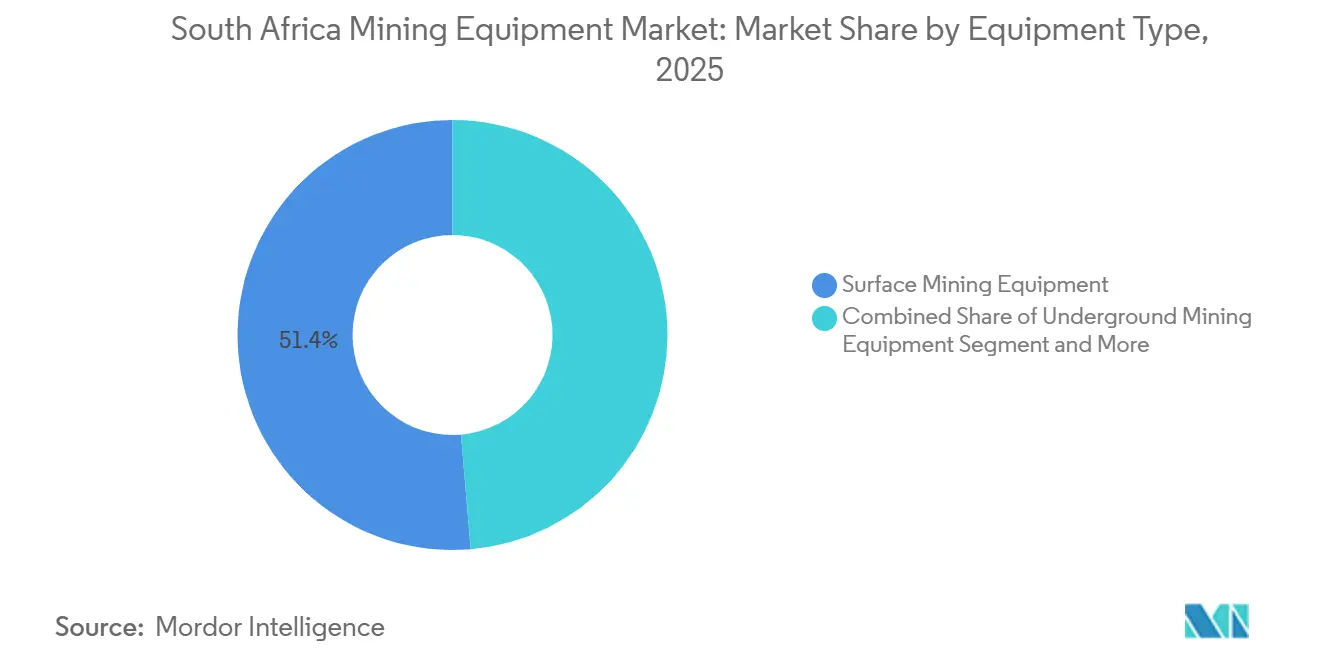
Surface equipment accounted for 51.36% of the South African mining equipment market in 2025, driven by opencast coal, manganese, and chrome operations. Underground units are forecast to grow at a 6.68% CAGR as platinum and gold mines mechanize. The South African mining equipment market size for underground machines is projected to rise steadily as deep-level operations adopt battery-electric loaders, autonomous drills, and enhanced safety systems.
Processing plants, crushers, and screening equipment will benefit from beneficiation hubs planned as part of the Critical Minerals Strategy. At the same time, specialized underground OEMs such as Sandvik and Atlas Copco are positioned to expand their share as smaller manufacturers exit capital-intensive development. Bell Equipment’s retreat from a stand-alone underground line highlights the high barriers to entry. Compliance mandates for fire-retardant belting and conveyor guarding continue to influence specifications for mineral processing gear.



By Automation Level: Manual Persistence, Autonomy Momentum
Manual units accounted for 76.57% of the South African mining equipment market in 2025, reflecting the prevalence of legacy diesel assets. Fully autonomous machines are expected to post a 6.71% CAGR to 2031, helped by safety mandates, labor shortages, and proven productivity gains. Semi-autonomous systems serve as a bridge by delivering remote operation without a full infrastructure overhaul and by minimizing training gaps. Komatsu’s FrontRunner platform surpassed 700 global deployments, but South African uptake is pacing skills availability.
Bell positions its articulated dump trucks as autonomous-ready, enabling third-party control integration. The combination of mandatory collision avoidance, aging operator demographics, and rising labor costs is moving procurement toward autonomy despite lingering maintenance skill gaps. Epiroc’s acquisition of Eventspec in March 2026 has strengthened local service capabilities for drill rig and loader automation, supporting the continued adoption of autonomous solutions in the South African mining equipment market.
By Powertrain Type: Diesel Predominance, Battery Uptick
Internal-combustion engines held an 83.37% share of the South African mining equipment market in 2025 due to diesel’s high energy density and entrenched fueling infrastructure. Battery-electric vehicles are projected to grow at a 6.73% CAGR from 2026 to 2031, supported by renewable energy rollouts, green bond financing, and lower maintenance costs. The South African mining equipment market size for battery-electric underground loaders is set to climb as Platreef and similar greenfield mines commit to emissions-free fleets.
Hybrid solutions, including regenerative-braking trucks, provide a gradual path for surface operations, cutting fuel consumption by 10% to 15% without a full charging infrastructure. Bell’s E-series trucks accept HVO fuel, offering an immediate emissions-cut option while grid capacity and tariff structures evolve. OEM portfolios that span diesel, hybrid, and battery platforms can address bifurcated customer needs.
By Power Output: Sub-500 HP Flexibility
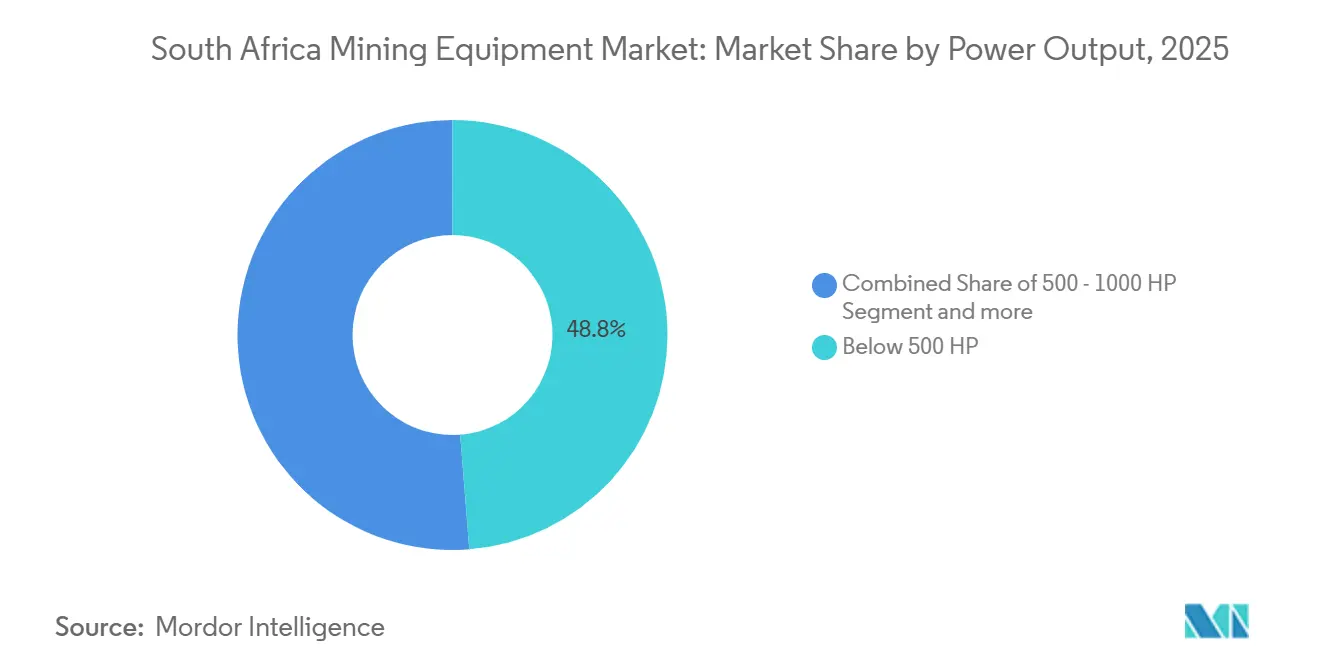
Equipment under 500 HP captured 48.75% share of the South African mining equipment market in 2025, the highest among power bands, and is expected to grow at a 6.75% CAGR as small-scale miners and contract operators opt for modular, financeable machinery. The South African mining equipment market share for the sub-500 HP class will rise because these units suit formalized artisanal mining supported by new licensing regimes.
The 500-1,000 HP category services mid-size haulage and primary crushing, where established producers seek productivity gains. Ultra-class gear above 1,000 HP remains essential for opencast coal, iron ore, and manganese operations, yet faces slower growth due to its capital intensity. Battery-electric conversion is currently most viable for lower horsepower segments, reinforcing demand in the sub-500 HP bracket.
By Application: Coal Volume, Mineral Mining Growth
Coal accounted for 41.25% of the South African mining equipment market in 2025, driven by demand from Eskom and export contracts. Metallic mineral mining is set to grow at the highest CAGR of 6.81% during the forecast period. The South African mining equipment market for metallic mineral mining applications will expand as manganese and chrome ore production increases year on year.
Beneficiation initiatives are shifting capital toward crushers, mills, and electrochemical plants that convert ore into battery-grade inputs. Coal equipment demand is defensive, focusing on replacement and compliance with PBS haulage legislation, while mineral mining rides critical-mineral tailwinds that incentivize processing investments in special economic zones.
Geography Analysis
Mpumalanga, Limpopo, Northern Cape, and North West host most extraction activity and thus dominate equipment demand. Mpumalanga coal producers adopt PBS-compliant heavy trucks to mitigate rail shortfalls, while Limpopo platinum mines invest in underground mechanization and proximity detection. Northern Cape manganese and chrome exporters rely on mobile crushing and screening, as well as high-payload road trains, to offset rail bottlenecks.
Gauteng and KwaZulu-Natal function as manufacturing and service hubs, housing Bell’s Richards Bay plant, Epiroc’s Eventspec operation, and Chinese OEM distribution centers. Industrial parks and special economic zones under the Strategic Plan aim to deepen local capacity for component fabrication and beneficiation, thereby reinforcing regional value chains.
Cross-border demand from SADC neighbors funnels through South African service networks. Yet, electrification progress is uneven because transmission expansion to integrate 37 GW of new generation is scheduled to begin after 2030, limiting near-term BEV adoption in remote provinces without grid redundancy. Safety regulation enforcement by 10 regional Mine Health and Safety Inspectorate offices standardizes equipment compliance despite geographic differences in mining methods and commodity profiles.
Competitive Landscape
Global giants like Caterpillar, Komatsu, Sandvik, Epiroc, Hitachi, Liebherr, Volvo CE, and Atlas Copco face competition from domestic player Bell Equipment and Chinese entrants XCMG and SANY. The market exhibits moderate fragmentation.
In recent years, Bell Equipment experienced a decline in revenue. Despite this, the company upheld competitive BBBEE levels and introduced a new motor grader line, capitalizing on localization credits. At Mining Indaba 2026, Chinese brands inked cooperation agreements, heightening price pressures, especially in the wheel loader and excavator segments. To counteract this, premium OEMs are bundling features like automation, safety compliance, and predictive maintenance to defend their market share.
Local contract manufacturers, tapping into IPAP incentives and grants, are fabricating components and refurbishing equipment. This strategy allows them to encroach upon aftermarket margins. Meanwhile, tailings retreatment and rare-earth recovery are emerging as lucrative opportunities for specialized process-plant suppliers.
South Africa Mining Equipment Industry Leaders
Caterpillar Inc.
Komatsu Ltd.
Sandvik AB
Epiroc AB
Bell Equipment
- *Disclaimer: Major Players sorted in no particular order

Recent Industry Developments
- August 2026: Epiroc AB completed the acquisition of Johannesburg-based Eventspec Proprietary Limited. The company specializes in manufacturing replacement parts for drill rigs, mine trucks, and loaders, as well as rebuilding heavy equipment. The acquisition provides Epiroc with advanced local reverse-engineering, fabrication, and machining capabilities, supporting the expansion of its lifecycle service revenue across South Africa.
- June 2025: Bell Equipment unveiled its latest motor grader lineup in Ballito, KwaZulu-Natal, South Africa. The launch event targeted audiences beyond the earthmoving and surface mining sectors.


South Africa Mining Equipment Market Report Scope
The Scope of the Report Includes Equipment Type (Surface Mining Equipment and More), Automation Level (Manual Equipment and More), Powertrain Type (Internal-Combustion Engine Vehicles and More), Power Output (Less than 500 HP and More), and Application (Metallic Mineral Mining and Coal Mining). The Market Forecasts are Provided in Terms of Value (USD) and Volume (Units).
| Surface Mining Equipment |
| Underground Mining Equipment |
| Mineral Processing Equipment |
| Drills & Breakers |
| Crushing, Pulverizing & Screening |
| Loaders & Haul Trucks |
| Manual Equipment |
| Semi-Autonomous Equipment |
| Fully Autonomous Equipment |
| Internal-Combustion Engine Vehicles |
| Battery-Electric Vehicles |
| Hybrid Vehicles |
| Less than 500 HP |
| 500 - 1,000 HP |
| Above 1,000 HP |
| Metallic Mineral Mining |
| Coal Mining |
| By Equipment Type | Surface Mining Equipment |
| Underground Mining Equipment | |
| Mineral Processing Equipment | |
| Drills & Breakers | |
| Crushing, Pulverizing & Screening | |
| Loaders & Haul Trucks | |
| By Automation Level | Manual Equipment |
| Semi-Autonomous Equipment | |
| Fully Autonomous Equipment | |
| By Powertrain Type | Internal-Combustion Engine Vehicles |
| Battery-Electric Vehicles | |
| Hybrid Vehicles | |
| By Power Output | Less than 500 HP |
| 500 - 1,000 HP | |
| Above 1,000 HP | |
| By Application | Metallic Mineral Mining |
| Coal Mining |


Key Questions Answered in the Report
What is the forecast value of the South African mining equipment market by 2031?
The market is projected to reach USD 1.78 billion by 2031, expanding at a 5.66% CAGR over 2026-2031.
Which equipment segment is expected to grow the fastest through 2031?
Underground mining equipment is forecast to register the highest 6.68% CAGR as platinum and gold mines mechanize.
How large is the surface segment in the current market?
Surface mining gear held 51.36% South Africa mining equipment market share in 2025.
What powertrain shift is underway among South African miners?
Battery-electric vehicles are set for a 6.73% CAGR, buoyed by green-bond financing and improved grid reliability, although diesel still dominates in 2026.
Which driver has the greatest positive impact on future growth?
Escalating commodity-price driven CAPEX rebound contributes an estimated +1.2% to forecast CAGR as miners reinvest windfall revenues into mechanization.
Page last updated on:





