
South Korea Mineral Processing Equipment Market Size and Share
Market Overview
| Study Period | 2019 - 2031 |
|---|---|
| Forecast Data Period | 2026 - 2031 |
| Base Year Market Size (2025) | USD 6.25 Million |
| Market Size (2026) | USD 6.66 Million |
| Market Size (2031) | USD 9.12 Million |
| Growth Rate (2026 - 2031) | 6.51 % |
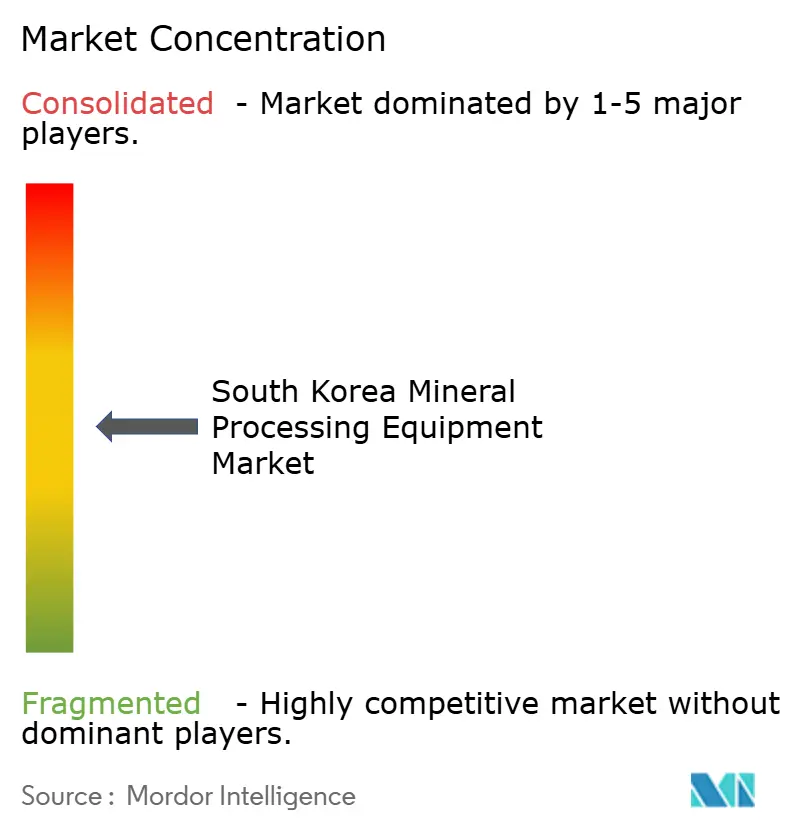
| Market Concentration | Medium |
Major Players *Disclaimer: Major Players sorted in no particular order Image © Mordor Intelligence. Reuse requires attribution under CC BY 4.0. | |
South Korea Mineral Processing Equipment Market Analysis by Mordor Intelligence
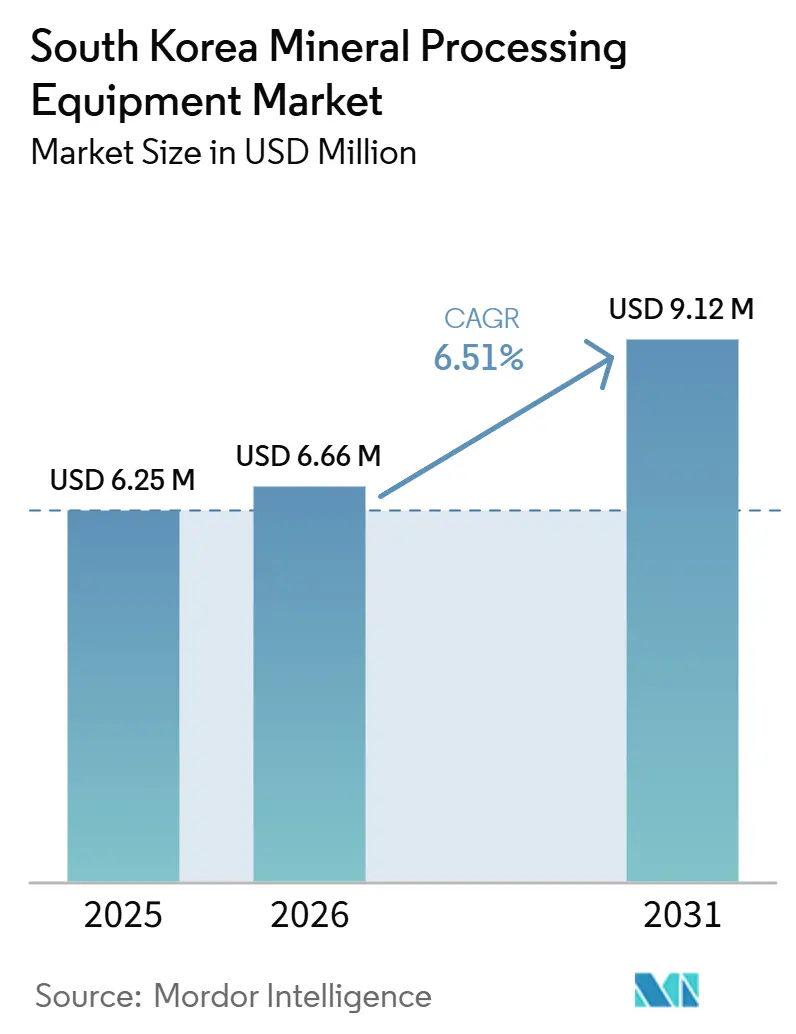
The South Korea mineral processing equipment market size was valued at USD 6.25 million in 2025 and is estimated to grow from USD 6.66 million in 2026 to reach USD 9.12 million by 2031, at a CAGR of 6.51% over 2026-2031. Seoul's push for self-sufficiency in battery metals, the revival of the Sangdong tungsten mine, and the government's fiscal incentives—aimed at significantly reducing advanced processing line costs—are driving this growth. As new capacities for lithium, rare earths, and battery recycling emerge, there's a surging demand for high-pressure grinding rolls, electrostatic separators, and solvent-extraction cascades. Additionally, mandatory upgrades to tailings dams are spurring a boom in dewatering systems. On another front, a sharp rise in electricity tariffs is accelerating the transition to fully automated, energy-efficient plants, emphasizing AI-driven condition monitoring and lights-out operations.
Key Report Takeaways
- By mineral type, lithium processing led with 35.34% of South Korea's mineral processing equipment market share in 2025, while rare-earth oxides posted the fastest growth, advancing at a 9.46% CAGR through 2031.
- By equipment type, crushers commanded 28.72% of 2025 turnover, while tailings dewatering systems are forecast to grow at a 9.23% CAGR through 2031.
- By mining method, surface operations accounted for 64.26% of revenue share in 2025, whereas underground mining is forecast to grow at a 10.28% CAGR to 2031.
- By automation level, semi-automated units commanded 47.74% of 2025 spending, but fully automated systems are set to register a 10.37% CAGR over 2026-2031.
- By procurement model, new equipment accounted for 71.19% of 2025 revenue, and the aftermarket segment is projected to rise at a 9.43% CAGR during the forecast period.
Note: Market size and forecast figures in this report are generated using Mordor Intelligence’s proprietary estimation framework, updated with the latest available data and insights as of January 2026.
Relative standing becomes clear only when country-level and regional contributions are evaluated alongside one another at a global level. Mordor Intelligence's mineral processing equipment market share coverage captures this comparative structure.
South Korea Mineral Processing Equipment Market Trends and Insights
Drivers Impact Analysis*
| Driver | (~) % Impact on CAGR Forecast | Geographic Relevance | Impact Timeline |
|---|---|---|---|
| Battery-Metal Boom | +1.8% | Gyeonggi and Gangwon provinces | Medium term (2-4 years) |
| Fiscal Incentives | +1.2% | Nationwide, strategic mining regions | Short term (≤2 years) |
| Recycling Demand | +0.9% | Industrial clusters in Gyeonggi and South Chungcheong | Medium term (2-4 years) |
| Tailings Upgrades | +0.7% | Active mining areas, notably Gangwon Province | Long term (≥4 years) |
| Strategic Stockpiling | +0.6% | National reserves and processing facilities | Long term (≥4 years) |
| AI Condition Monitoring | +0.4% | Advanced mining operations nationwide | Medium term (2-4 years) |
| Source: Mordor Intelligence | |||
Growing Mineral Production for Battery-Metal Supply
South Korea’s electrification strategy triggers a cascade of mineral-processing investments, especially in lithium hydroxide, nickel sulfate, and rare-earth extraction lines. POSCO’s KRW 760 billion lithium-hydroxide complex in Gwangyang targets 43,000 tons per year and relies on robust crushing, milling, and hydrometallurgical modules[1]“Gwangyang Lithium Hydroxide Project Update,”, POSCO Holdings, posco.com. National procurement programs prioritizing 10 strategic minerals ensure multi-year demand visibility for separation, filtration, and drying units. Also, each additional battery-precursor refinery stimulates parallel orders for feeders, conveyors, and bagging stations, creating a multiplier effect across the South Korean mineral processing equipment market. Government targets to cut critical mineral import dependence from 80% to 50% by 2030, further cementing a stable pipeline of green-field and brown-field equipment contracts.
Expansionary Fiscal Incentives for Domestic Mining Modernization
The updated tax code introduces significant incentives, including substantial equipment credits, full first-year depreciation for AI-related gear, and generous R&D deductions. These measures significantly lower the cost of transitioning to smart factories. Start-ups operating in RE100 industrial complexes benefit from extended income-tax exemptions, followed by partial relief in subsequent years. These fiscal advantages are driving investments in digital crushers, IoT-enabled feeders, and cloud-linked conveyors. Consequently, mid-tier quarry owners are entering capital expenditure cycles earlier than anticipated.
Surge in Demand for Industrial By-Product Recycling Plants
Government support for the Chungbuk battery-recycling hub is driving increased demand for essential equipment, including shredders, magnetic separators, and hydromet reactors. SK Ecoplant’s collaborations with companies such as BMW, Ascend Elements, and the LG-Toyota joint venture highlight how recyclers are sourcing scrap materials internationally and processing them domestically. This approach ensures feedstock security while fostering a steady demand for modular processing systems.
Mandatory Tailings-Dam Upgrades Boosting Equipment Retrofits
New rules under the Water Environment Conservation Act mandate real-time water-quality monitoring and stricter effluent standards. As a result, limestone and graphite quarries are now required to invest in dewatering screens, thickeners, and paste-fill plants, leading to a significant increase in their greenfield capital expenditures. While these regulations temporarily divert funds from productivity-enhancing investments, they also ensure a consistent long-term revenue stream for water-management OEMs [2]“Water Management Solutions for Mines,”, Veolia Korea, veolia.com.
Restraints Impact Analysis*
| Restraint | (~) % Impact on CAGR Forecast | Geographic Relevance | Impact Timeline |
|---|---|---|---|
| GHG and Water Rules | -0.8% | National, stricter enforcement in industrial zones | Short term (≤ 2 years) |
| High Power Tariffs | -0.5% | National, particularly affecting energy-intensive processing | Medium term (2-4 years) |
| Shortage of Mechatronics Technicians | -0.4% | Industrial clusters in Gyeonggi, Gangwon, and Chungcheong provinces | Medium term (2-4 years) |
| Import-Dependence Risk | -0.3% | National, affecting equipment maintenance and replacement cycles | Long term (≥ 4 years) |
| Source: Mordor Intelligence | |||
Tightening GHG and Water-Discharge Regulations
Korea's Integrated Environmental Management System, through its unified permits, significantly extends project timelines. These permits mandate the use of dust-suppression gear, enclosed conveyors, and closed-loop water circuits. While compliance strains working capital and slows replacement cycles at smaller sites, it simultaneously drives up sales of environmental-control equipment.
Elevated Industrial Electricity Tariffs
Industrial tariffs have significantly increased, reducing crush-and-grind margins and discouraging upgrades to energy-intensive machinery. Operators are now prioritizing high-efficiency drives, variable-frequency feeders, and lights-out milling to manage power costs. However, the rise in operational expenses (opex) is constraining discretionary capital expenditures (capex) at older quarries.
*Our forecasts treat driver/restraint impacts as directional, not additive. The impact forecasts reflect baseline growth, mix effects, and variable interactions.
Segment Analysis
By Mineral Type: Battery-metal Demand Sustains Value While Rare-earths Quicken Pace
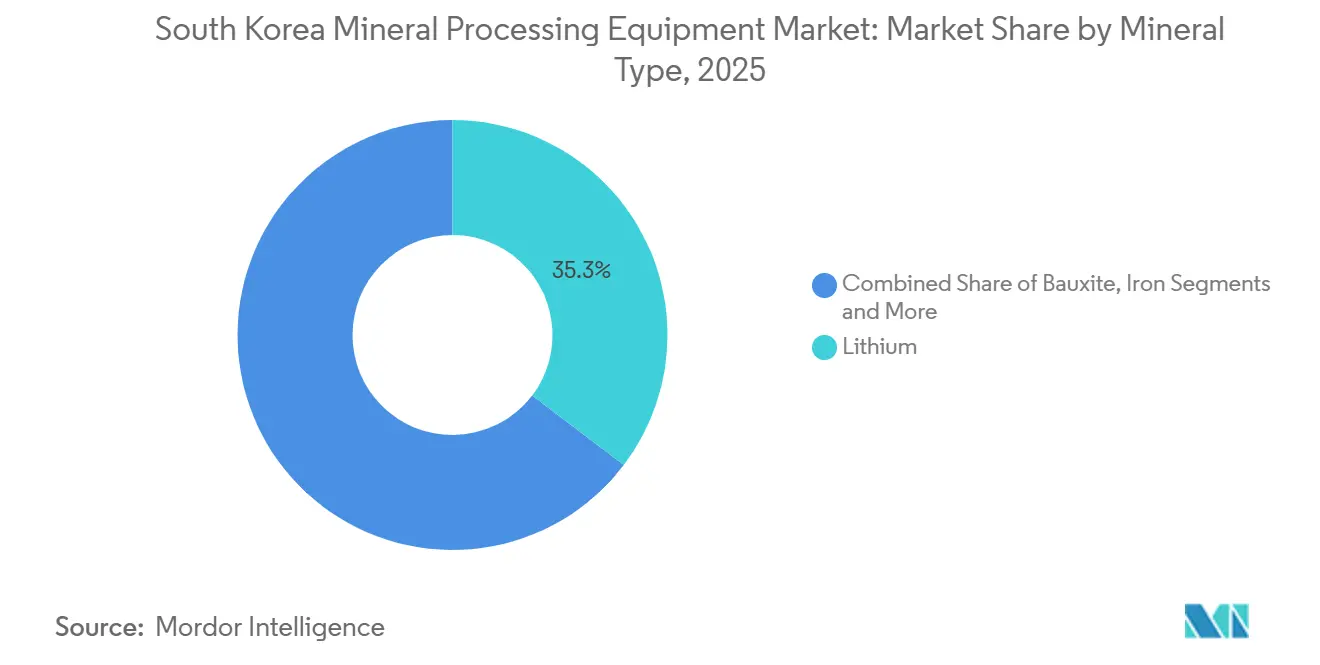
Lithium facilities commanded 35.34% of 2025 revenue, buoyed by POSCO Future M’s Saemangeum project and CNP New Materials’ cathode plans. Rare-earth oxides are on track for a 9.46% CAGR, supported by Korea's designation of rare-earth minerals within its strategic critical minerals list. Iron ore handling remains stable, and tungsten output from the Sangdong mine is reshaping the South Korean mineral processing equipment market size for high-density comminution circuits.
Policy support for battery-recycling hubs is spawning a nascent sixth category that relies more on shredders and leach reactors than on crushers, further diversifying the South Korean mineral processing equipment market.



By Equipment Type: Primary Crushers Dominate Spend as Tailings Technologies Outstrip Growth
Crushers commanded 28.72% of 2025 turnover, cementing their role as the first-stage workhorse across iron, lithium, and tungsten flowsheets. Open-pit operations favored heavy-duty gyratory units rated above 10,000 t/h, whereas underground projects opted for compact jaw crushers fitted with dust-suppression hoods to meet ventilation limits. Power-draw optimization via variable-speed drives reduced kWh-per-metric-ton indices, encouraging retrofits that extend equipment lifecycles beyond 20 years. Standardized crusher modules eased spare-parts logistics for remote mines, enabling distributors to stock universal wear liners and eccentric bushings.
Tailings dewatering systems post the fastest 9.23% CAGR, driven by stricter water-recycle mandates and dam-stability codes. High-pressure plate filters delivering cakes with moisture below 15 % displace traditional thickener-pond architectures, shrinking footprints, and freeing land for reclamation. Facilities upgrade to smart sensor suites that log underflow density and feed pump vibration, allowing real-time adjustments which cut polymer costs. Dewatered tailings find secondary use in cemented paste backfill, tying dewatering investments to underground productivity gains. As mines seek insurer compliance with global stewardship standards, vendors bundling monitoring software with mechanical packages gain competitive advantage.
By Mining Method: Surface Operations Sustain Volume While Automated Underground Mines Accelerate
Surface mining retained a 64.26% share in 2025 because iron-ore, limestone, and aggregate pits rely on cost-efficient truck-and-shovel fleets and fixed crushing stations. Equipment orders center on high-capacity apron feeders, overland conveyors, and mobile in-pit sizing units that match strip-ratio economics. Environmental upgrades, such as fog-based dust suppression and low-emission diesel engines, enable operators to comply with local ordinances without curtailing production rates. Fleet-management software overlays GPS dispatching and payload weighing, improving haul-road cycle times and reducing fuel burn.
Underground mining is expanding fastest, with a 10.28% CAGR, as tungsten, molybdenum, and rare-earth deposits move from care-and-maintenance to commercialization. Battery-electric load-haul-dump vehicles with fast-swap packs shrink ventilation power draws, justifying investment in charger banks and automated traffic-management beacons. Drill-and-blast faces deploy LiDAR-guided jumbo booms, cutting overbreak and saving explosives. Conveyorized ore-handling systems replace diesel trucking in narrow veins, boosting throughput consistency. Autonomous survey drones transmit 3-D cavity scans to mine-planning suites, enabling rapid geotechnical decisions that keep ore extraction aligned with mill feed targets.
By Automation Level: Semi-automated Lines Dominate Today; Full Autonomy Captures Future Gains
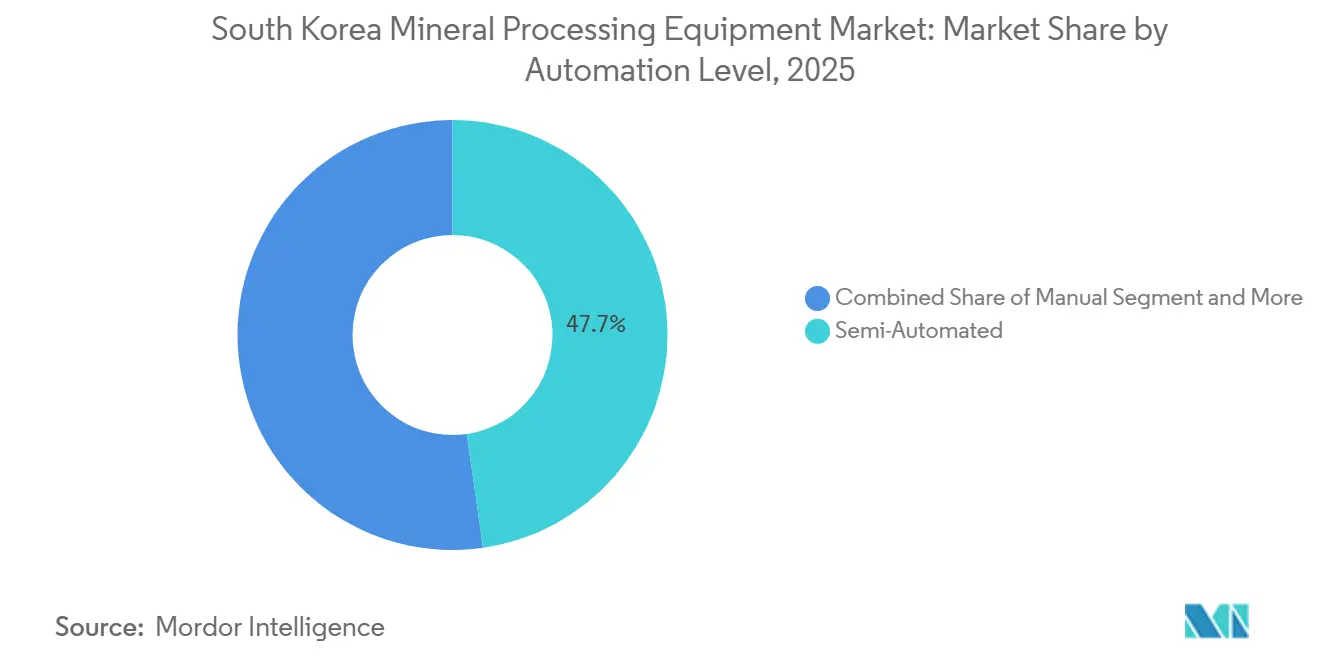
Semi-automated plants accounted for 47.74% of 2025 revenue, as operators blend human oversight with programmable-logic control of crushers, float cells, and filter presses. Touch-screen HMIs streamline start-up sequences, while plant-wide SCADA dashboards alert teams to bearing-temperature anomalies, containing unscheduled downtime. Hybrid staffing models let firms train technicians for higher-value data roles, easing resistance to technology adoption. Retrofit kits, such as optical ore-sorting add-ons and AI condition-monitoring servers, extend equipment life without wholesale replacement.
Fully automated configurations grow at a 10.37% CAGR, spearheaded by greenfield lithium refineries and rare-earth separation hubs that value process repeatability. Closed-loop advanced-process-control algorithms balance pH, reagent dosage, and pulp density within narrow windows, protecting product purity needed for battery and semiconductor customers. Robotic sampling labs deliver sub-hour assay turnarounds, accelerating grind-size and reagent adjustments. Digital twins simulate wear profiles for liners and cyclones, enabling just-in-time parts dispatch and reducing inventory costs. As labor scarcity and safety regulations intensify, the justification for capex in lights-out operations strengthens, lifting demand for integrated automation suites.
By Procurement Model: New Equipment Anchors Spend Yet Lifecycle Services Outpace Growth
New equipment purchases accounted for 71.19% of 2025 spend, reflecting a wave of capacity expansions across lithium conversion, iron-ore beneficiation, and tungsten restart projects. Turnkey EPC contracts bundle engineering, procurement, and commissioning services that fast-track project timelines to meet tight battery-supply milestones. Capital goods benefit from tax holidays and state subsidies, lowering hurdle rates for mine developers. High-throughput primary grinders and flotation cells represent the largest single-line items, often financed under vendor-backed deferred-payment schemes.
Aftermarket and spare-parts services are projected to grow at a faster 9.43% CAGR through 2031 as operators prioritize uptime over outright replacement. Predictive-maintenance platforms feed vibration and oil analysis data into cloud-based analytics, triggering the autoreplenishment of critical components such as screen panels, pump impellers, and crusher mantles. OEM field teams execute mill-reline campaigns during scheduled shutdowns, capturing labor, tooling, and liner supply in bundled contracts. Performance-based service agreements guarantee throughput or energy-consumption targets, aligning vendor incentives with plant economics. This shift converts once-cyclical capex to steady recurring revenue, deepening supplier–operator collaboration throughout the asset life cycle.
Geography Analysis
In Korea's coastal industrial triangle—comprising Pohang, Saemangeum, and Gwangyang Bay—new battery-metal plants are springing up. These hubs are centralizing orders for fine-grinding, spheronization, and solvent-extraction packages. Meanwhile, the interior limestone belts around Danyang, Taebaek, and Chungbuk are pivotal, as they house crushers, screens, and dewatering equipment. These interior sites are expected to account for the majority of surface-mining expenditure.
Gangwon Province is emerging as a leader in underground automation. It's home to the Sangdong tungsten mine and is piloting early 5G-enabled smart-mining initiatives. The region's proximity to a skilled labor pool and LTE infrastructure facilitates the integration of fully automated drilling rigs and loaders, thereby boosting demand for AI-driven control rooms.
Southern ports like Ulsan and Yeosu, designated for RE100 complexes, are reaping the benefits of enhanced tax incentives. These perks are attracting mid-tier recyclers, who prefer modular, containerized process units with minimal installation costs. This trend is diversifying the South Korean mineral processing equipment market, all while maintaining a steady growth trajectory.
Analysis of the mineral processing equipment market by Mordor Intelligence is supported by country-level insights for Australia, China, Mexico, Oman, Egypt, Morocco, South Africa, Italy, and Brazil, wherein local market conditions keep varying from one country to another.
Competitive Landscape
Global OEMs like Metso, Sandvik, Weir, FLSmidth, and Komatsu Ltd. lead in large-scale comminution and separation technologies. Meanwhile, local firms Wellcron Hantec and HAEIN, with their extensive branch networks, swiftly address service gaps. In a strategic move, Weir upgraded its ESCO foundry in China, reducing casting costs and enhancing its competitive edge in Korea's price-sensitive aggregate market.
Sandvik's AutoMine success at Asia Cement not only highlights its expertise in drill automation but also secures a steady stream of service income. Metso's strategic placement of SAG and ball mills at Sangdong positions it advantageously for future expansion phases. Emerson Korea is establishing itself in the retrofit sensors and analytics domain, offering solutions that integrate with legacy lines and promise quick returns.
Government cluster funding is steering future orders towards suppliers with local manufacturing or R&D partnerships. In response, multinational OEMs are increasingly pursuing joint ventures and licensing agreements to tap into these subsidies. This strategic shift is poised to heighten competition while simultaneously enriching the technological landscape of South Korea's mineral processing equipment sector.
South Korea Mineral Processing Equipment Industry Leaders
Metso Oyj
FLSmidth A/S
Sandvik AB
Weir Group PLC
Komatsu Ltd.
- *Disclaimer: Major Players sorted in no particular order

Recent Industry Developments
- February 2026: MOTIE identified all 17 rare earths as critical, secured overseas resource-development loans amounting to KRW 67.5 billion, and established a dedicated R&D fund for rare earths to enhance domestic capabilities and reduce reliance on imports. This initiative aims to strengthen the supply chain and ensure the sustainable availability of these critical materials.
- March 2025: Atlas Copco bolstered its local compressor production by acquiring Kyungwon Machinery Industry Co., a move aimed at enhancing its manufacturing capabilities and strengthening its presence in the regional market.


South Korea Mineral Processing Equipment Market Report Scope
The South Korea mineral processing equipment market report is segmented by mineral type (bauxite, iron, lithium, rare-earth oxides, and others), equipment type (crushers, mills and grinders, feeders, conveyors, drills & breakers, separators (magnetic, electrostatic), screens and cyclones, tailings dewatering systems, and others), mining method (surface mining, underground mining, and marine and dredge mining), automation level (manual, semi-automated, and fully automated), and procurement model (new equipment and aftermarket/spare parts). The market forecasts are provided in terms of value (USD).
| Bauxite |
| Iron |
| Lithium |
| Rare-earth Oxides |
| Others |
| Crushers |
| Mills & Grinders |
| Feeders |
| Conveyors |
| Drills & Breakers |
| Separators (Magnetic, Electrostatic) |
| Screens & Cyclones |
| Tailings Dewatering Systems |
| Others |
| Surface Mining |
| Underground Mining |
| Marine & Dredge Mining |
| Manual |
| Semi-Automated |
| Fully Automated |
| New Equipment |
| Aftermarket / Spare Parts |
| By Mineral Type | Bauxite |
| Iron | |
| Lithium | |
| Rare-earth Oxides | |
| Others | |
| By Equipment Type | Crushers |
| Mills & Grinders | |
| Feeders | |
| Conveyors | |
| Drills & Breakers | |
| Separators (Magnetic, Electrostatic) | |
| Screens & Cyclones | |
| Tailings Dewatering Systems | |
| Others | |
| By Mining Method | Surface Mining |
| Underground Mining | |
| Marine & Dredge Mining | |
| By Automation Level | Manual |
| Semi-Automated | |
| Fully Automated | |
| By Procurement Model | New Equipment |
| Aftermarket / Spare Parts |


Key Questions Answered in the Report
How big is the South Korea mineral processing equipment market in 2026?
The South Korea mineral processing equipment market size is estimated at USD 6.66 million in 2026, on track for a CAGR of 6.51% to 2031.
Which mineral drives the highest equipment demand?
Lithium facilities led 2025 demand, capturing 35.34% of revenue as new spherical-graphite and LFP cathode plants came onstream.
Why is underground mining expected to grow faster than surface mining?
Automation advances lower subsurface extraction costs, driving a forecast 10.28% CAGR for underground operations.
How do fiscal incentives support equipment modernization?
Subsidies covering up to 80% of capital spend and seven-year tax holidays accelerate replacement of legacy machinery.
Which procurement model shows stronger growth?
Aftermarket and spare-parts services are expanding at a 9.43% CAGR, reflecting the shift toward lifecycle-service revenue.
Page last updated on:





