
Moringa Ingredients Market Size and Share
Market Overview
| Study Period | 2021 - 2031 |
|---|---|
| Market Size (2026) | USD 7.52 Billion |
| Market Size (2031) | USD 11.83 Billion |
| Growth Rate (2026 - 2031) | 9.47 % |
| Fastest Growing Market | Asia Pacific |
| Largest Market | North America |
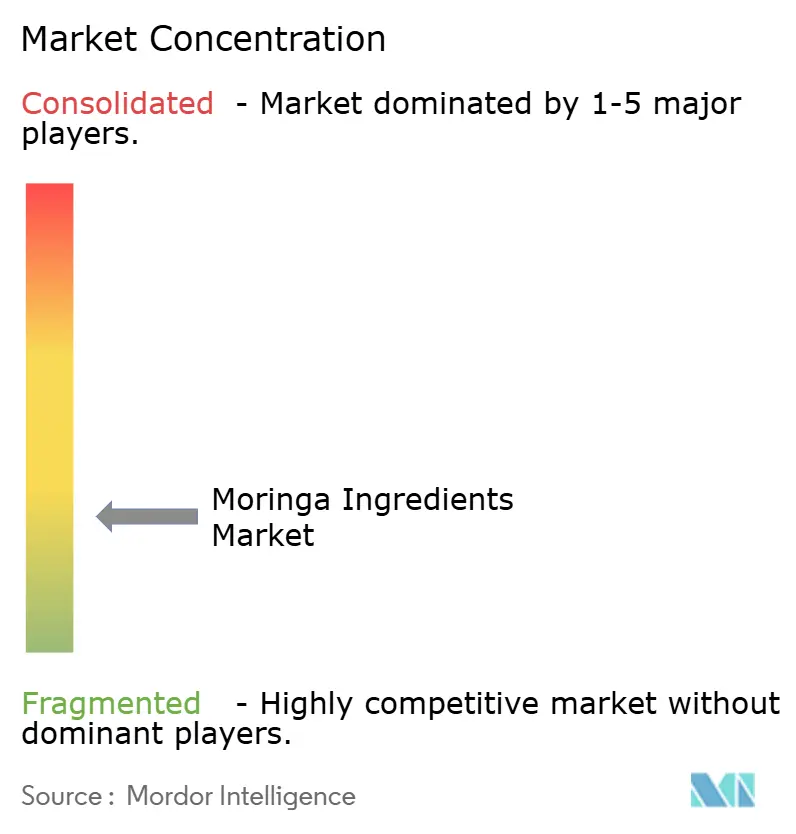
| Market Concentration | Low |
Major Players *Disclaimer: Major Players sorted in no particular order Image © Mordor Intelligence. Reuse requires attribution under CC BY 4.0. | |
Moringa Ingredients Market Analysis by Mordor Intelligence
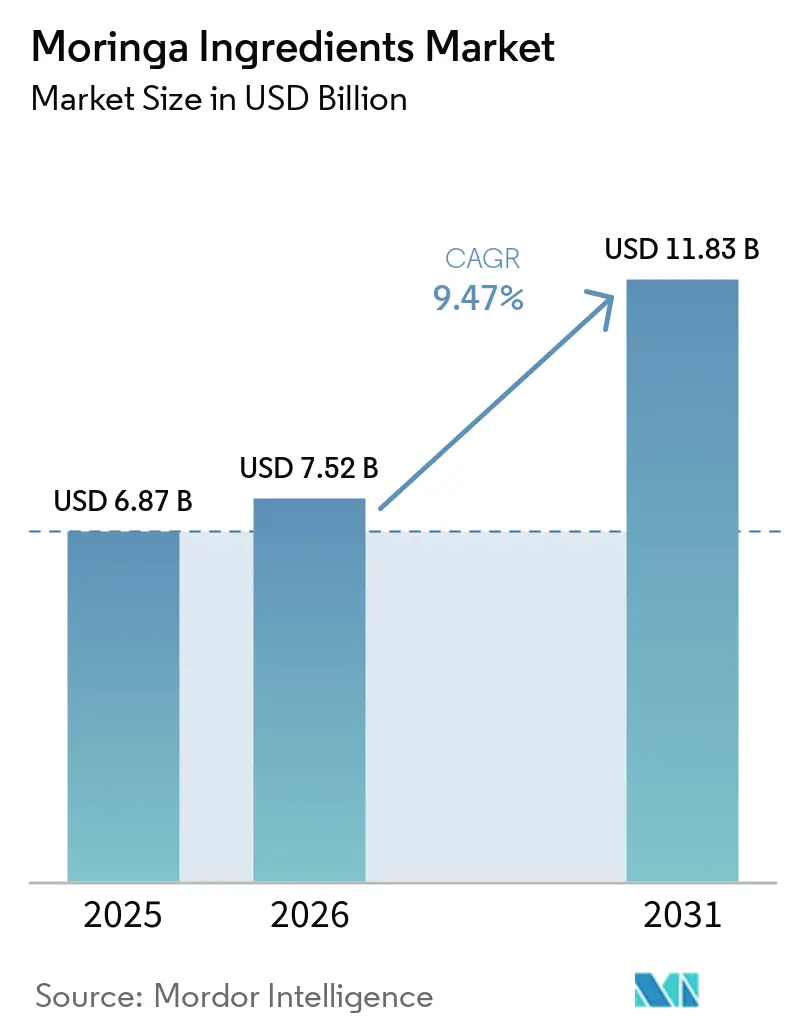
The moringa ingredients market size was valued at USD 6.87 billion in 2025 and estimated to grow from USD 7.52 billion in 2026 to reach USD 11.83 billion by 2031, at a CAGR of 9.47% during the forecast period (2026-2031). Momentum reflects steady downstream pull from dietary supplements and food formulators who prioritize clean-label plant proteins and natural bioactives for energy, immunity, and active-lifestyle nutrition. The growth path accelerated as cosmetics and personal care applications moved from early-stage pilots to standardized actives such as upcycled seed-cake extracts that support premium, traceable positioning in Europe and North America. Near-term risk centers on microbiological compliance following a string of Salmonella-linked recalls in late 2025 and early 2026, which triggered stronger supplier verification and environmental monitoring across U.S. buyers. Despite that disruption, the moringa ingredients market continues to benefit from rising retail penetration, clinical substantiation for targeted functions, and policy tailwinds in producing countries that are scaling cultivation and post-harvest infrastructure for export-grade quality. Regionally, North America remains the revenue anchor on the back of strong per-capita supplement spend, while Asia-Pacific shows the fastest trajectory as India advances cultivation programs and nutrition missions that incorporate moringa into public health channels. Regulatory signals are mixed, with Australia’s FSANZ rejecting a moringa novel-food application in 2025, reinforcing that new formats and species still face case-by-case safety scrutiny even as common forms like leaf powder and seed oil see broader use in global markets[1].
Key Report Takeaways
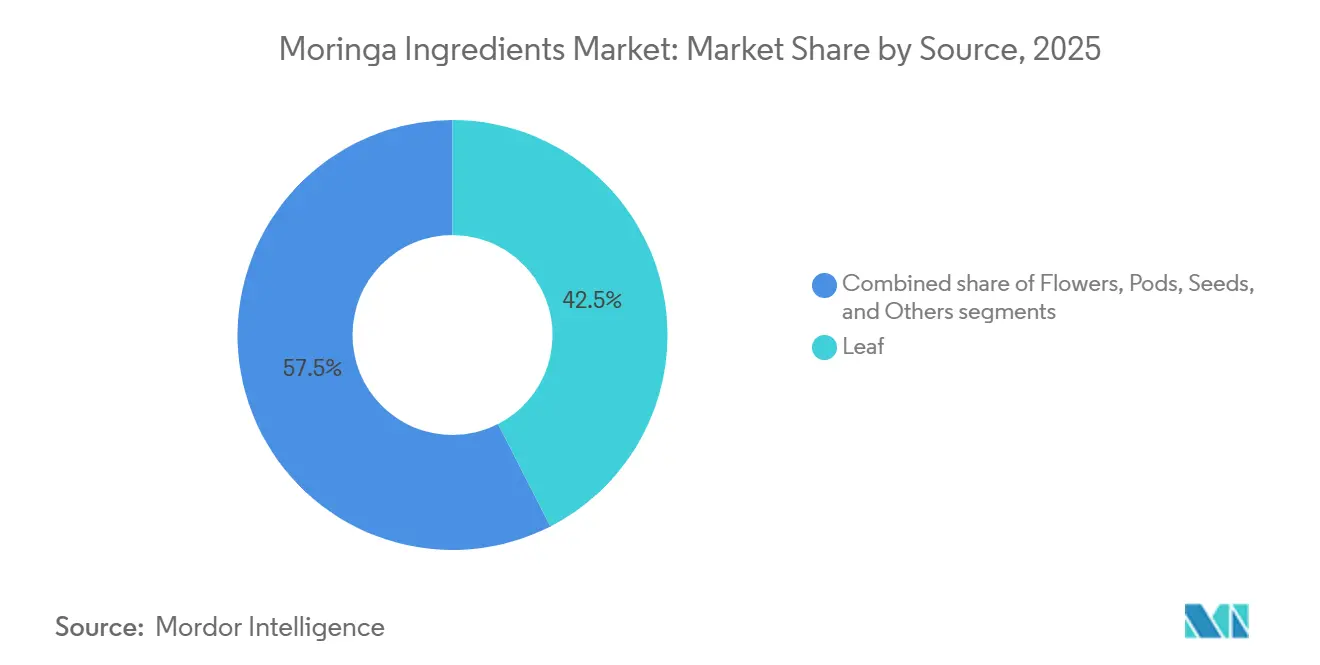
- By source, leaf powder led with 42.47% revenue share in 2025, while seed-derived ingredients are projected to expand at a 10.47% CAGR through 2031.
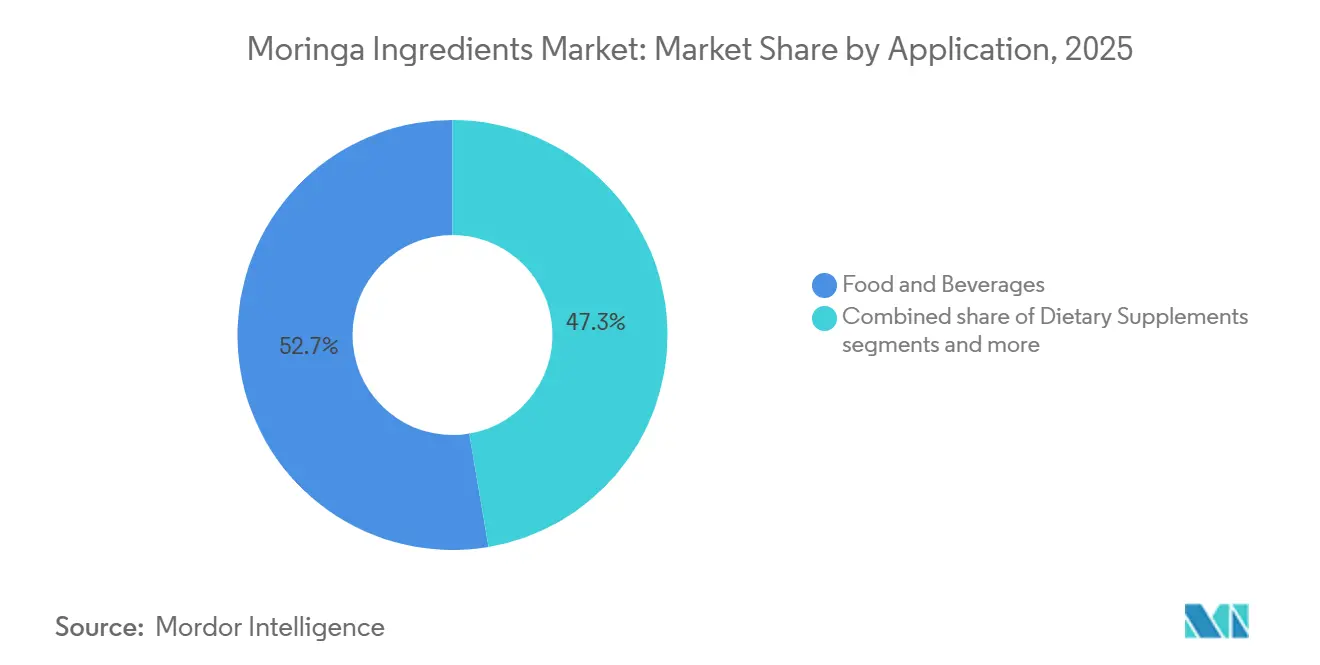
- By application, Food and Beverages accounted for 52.68% of 2025 revenue, while Dietary Supplements are forecast to grow at an 11.64% CAGR through 2031.
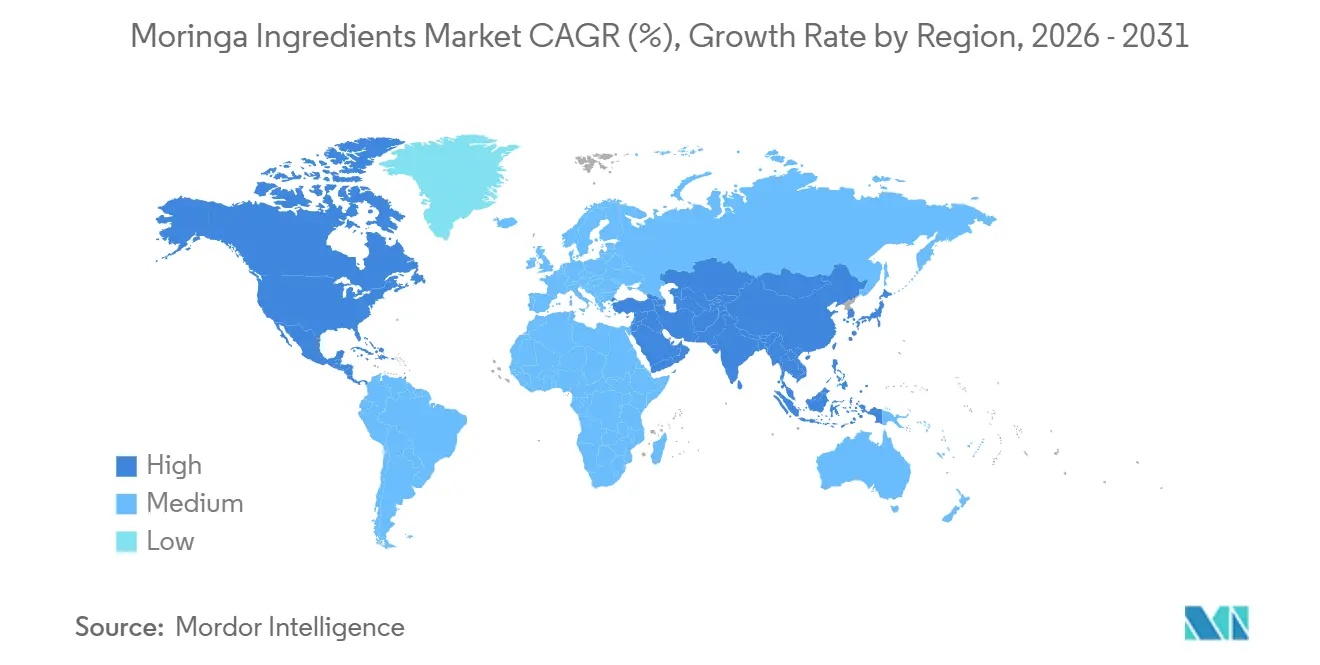
- By geography, North America held 37.87% of revenue in 2025, while Asia-Pacific is projected to record the fastest growth at a 12.85% CAGR through 2031.
Note: Market size and forecast figures in this report are generated using Mordor Intelligence’s proprietary estimation framework, updated with the latest available data and insights as of January 2026.
Market Trends and Insights
Drivers Impact Analysis of Moringa Ingredients Market*
| Driver | (~) % Impact on CAGR Forecast | Geographic Relevance | Impact Timeline |
|---|---|---|---|
| Rising Consumer Preference for Natural and Nutrient-Rich Superfoods | +2.1% | Global, strongest in North America and Europe | Medium term (2-4 years) |
| Strong Demand for Herbal and Ayurvedic Wellness Solutions | +1.8% | APAC core, spillover to MEA | Long term (≥ 4 years) |
| Increasing Adoption of Moringa Extracts in Cosmetic and Personal Care Products | +1.6% | Europe and North America premium segments | Medium term (2-4 years) |
| Rising Awareness of Moringa's Antioxidant and Immunity-Boosting Benefits | +1.5% | Global | Short term (≤ 2 years) |
| Growing Demand for Plant-Based Proteins and Clean-Label Ingredients | +2.3% | North America, Western Europe | Medium term (2-4 years) |
| Technological Advancements in Moringa Processing and Ingredient Extraction | +0.9% | National, with early gains in Tamil Nadu, Karnataka, Kenya | Long term (≥ 4 years) |
| Source: Mordor Intelligence | |||
Rising consumer preference for natural and nutrient-rich superfoods
Growing consumer preference for plant-based and clean-label nutrition is driving demand for moringa ingredients, as increasing skepticism toward synthetic additives and ultra-processed foods fuels demand. Moringa’s high nutritional density, containing 7 times more vitamin C than oranges, 17 times more calcium than milk, and 25 times more iron than spinach on a gram-for-gram basis, positions it as a functional whole-food ingredient rather than a standalone nutrient extract. However, formulators continue to face flavor challenges, as inclusion levels above 3-4% can introduce noticeable bitterness, encouraging the use of encapsulation technologies and blending with complementary botanicals such as spirulina and baobab. Sustainability positioning is also strengthening market appeal; for example, True Moringa announced in August 2025 that it had planted its 10 millionth tree across 300 acres in Ghana, reportedly sequestering more than 35,000 metric tons of CO₂, highlighting the growing role of regenerative agriculture narratives in premium retail channels.
Strong demand for herbal and ayurvedic wellness solutions
Traditional wellness systems such as Ayurveda are increasingly being repositioned within evidence-based nutraceutical frameworks, particularly across South Asia and diaspora-driven markets. India’s NutriBharat@2047 initiative identifies moringa, turmeric, and ashwagandha as priority botanicals for the country’s nutraceutical ambitions, supported by government-backed crop corridors and bioactive processing hubs to ensure standardized extract quality. This strategy is reflected in regional programs such as Uttar Pradesh’s “Moringa Mission,” launched in 2025, which distributed free saplings under the Ghar-Bagiya scheme and incorporated moringa into school meal programs to address anemia, affecting 67% of children aged 6 months to 5 years and 50% of women aged 15-49 in the state, according to NFHS-5 data. Commercially, established Ayurvedic companies are expanding into digital and clean-label channels; for instance, Baidyanath Ayurved launched Certified Organic Moringa Powder in February 2026 at INR 215 for 200 grams through Amazon, Flipkart, and JioMart. At the same time, regulatory scrutiny is increasing, with India’s Ministry of AYUSH requiring randomized controlled trials for health-related claims, raising compliance expectations for manufacturers.
Increasing adoption of moringa extracts in cosmetic and personal care products
Moringa seed oil is gaining traction in cosmetic and personal care applications due to its high oxidative stability, with an Oxidative Stability Index (OSI) of 130 hours, which significantly exceeds those of oils such as argan and marula. Its 65-80% oleic acid content and antioxidant compounds, including quercetin, chlorogenic acid, and tocopherols, support positioning as a natural anti-aging and skin-conditioning ingredient in clean beauty products. Product innovation is accelerating; Lipoid Kosmetik’s MorinGuard®, launched in March 2025, uses upcycled moringa seed cake and demonstrated improvements in post-microneedling recovery and skin barrier performance, while securing COSMOS and NATRUE certifications. Patent activity also reflects growing commercial interest, including U.S. Patent No. 12,303,587 granted in May 2025 for a Moringa peregrina peptide hydrolysate with demonstrated collagenase inhibition and melanin suppression properties for anti-aging and depigmenting applications. Regulatory clarity is supporting market expansion, with the EU CosIng database recognizing Moringa Oleifera Seed Oil as compliant under Regulation 1223/2009 and exempt from REACH registration when non-chemically modified (O&3/2026). Additionally, All Moringa’s January 2026 launch of a whole-plant infusion oil combining leaf powder with cold-pressed seed oil demonstrates increasing product differentiation in premium retail channels such as Whole Foods.
Rising awareness of moringa's antioxidant and immunity-boosting benefits
Post-pandemic preventive healthcare trends continue to support moringa demand, particularly in immune health and wellness categories. Moringa contains more than 40 antioxidant compounds, including flavonoids, phenolic acids, and isothiocyanates, making it a multifunctional botanical ingredient. A 2025 systematic review covering 22 clinical trials and 9 case reports identified promising immunomodulatory and antidiabetic potential for Moringa oleifera, although researchers emphasized the need for larger randomized clinical trials to validate dosage and safety standards. Brands are increasingly leveraging this scientific positioning; for example, Kuli Kuli Foods introduced Pure Organic Moringa Capsules in January 2026, delivering over 1,000 mg of organic moringa leaf powder per serving at USD 19.99, targeting consumers seeking caffeine-free energy and immune support. Institutional demand is also expanding, with Tamil Nadu’s Moringa Export Promotion Board established in 2025 to coordinate export-grade production for North American and European nutraceutical markets[2]. Nevertheless, regulatory oversight remains stringent, as illustrated by the FDA’s September 2025 warning letter to The Moringa Tree regarding disease-related claims associated with Amygdalin Vitamin B17 products.
Restraints Impact Analysis of Moringa Ingredients Market*
| Restraint | (~) % Impact on CAGR Forecast | Geographic Relevance | Impact Timeline |
|---|---|---|---|
| High Production and Processing Costs Associated with Moringa Cultivation | -1.2% | India, Sub-Saharan Africa | Medium term (2-4 years) |
| Regulatory Challenges Related to Ingredient Approval and Labeling Standards | -0.9% | Europe, Australia/New Zealand | Short term (≤ 2 years) |
| Risk of Adulteration and Contamination in Low-Quality Moringa Products | -1.4% | Global, with acute North America impact post-2025 recalls | Short term (≤ 2 years) |
| Lack of Standardization in Product Quality and Active Ingredient Content | -1.1% | Global | Long term (≥ 4 years) |
| Source: Mordor Intelligence | |||
High production and processing costs associated with moringa cultivation
Despite moringa’s reputation as a low-input and climate-resilient crop, achieving export-grade quality remains cost-intensive, creating barriers for smallholder producers. Organic certification required for premium Western markets can cost between USD 1,200 and USD 3,500 annually per farm, while organic yields are estimated to be 15-20% lower than conventional output due to limited pest-control options. Post-harvest infrastructure also requires significant investment, with controlled-temperature drying systems costing approximately INR 18–19 lakh (~USD 22,000) for mid-scale operations, leading many farmers to rely on lower-quality sun-drying methods. Although schemes such as India’s National Horticulture Mission and PM-Kisan can subsidize 30-40% of capital costs, access remains uneven, and IndexBox estimates that only 30-40% of Indian moringa leaf production meets international export standards. Price disparities further complicate the market, with export-grade organic moringa powder selling for INR 700-1,200 per kg internationally compared to INR 180-250 domestically. Financial pressure is particularly visible among integrated players such as Ancient GreenFields, which reported a 22% revenue decline in FY25 to INR 9.86 crore due to rising certification and quality-control expenses combined with competition from lower-cost African suppliers.
Risk of adulteration and contamination in low-quality moringa products
Food safety concerns have emerged as a major restraint for the moringa ingredients market, particularly following multiple Salmonella contamination incidents linked to moringa leaf powder. Between October 2025 and March 2026, the FDA reported three separate Salmonella outbreaks associated with organic moringa powder, resulting in 97 illnesses across 32 U.S. states and recalls involving brands such as Why Not Natural, Live it Up (Superfoods Inc.), Africa Imports, and Food To Live[3]. Investigations traced the contamination to raw materials sourced from Vallon Farmdirect PVT LTD in India, exposing weaknesses in upstream quality control and HACCP implementation. The issue is compounded by post-harvest losses in India, estimated at 15–25% due to inadequate drying and storage infrastructure in humid regions such as Tamil Nadu and Karnataka. Adulteration remains another concern, with a 2023 e-commerce audit cited in an Alibaba guide reporting that more than 68% of “organic moringa oil” products lacked verifiable certification and that nearly half contained solvent residues or were diluted with cheaper oils. In response, premium brands including Kuli Kuli and Organic India are investing in vertical integration, blockchain traceability, and certifications such as BRC and ISO 22000 to differentiate on safety and quality. Regulatory oversight is also expected to tighten further, with the FDA anticipated to introduce enhanced supplier verification and environmental monitoring requirements for high-risk botanicals by 2027.
*Our forecasts treat driver/restraint impacts as directional, not additive. The impact forecasts reflect baseline growth, mix effects, and variable interactions.
Moringa Ingredients Market Segment Analysis
By Source:
Leaf Commands Volume, Seed Oil Captures PremiumLeaf-derived formats remain the workhorse of the category, led by capsules, smoothie blends, and fortification systems in bars and beverages, and leaf powder held 42.47% of the moringa ingredients market share in 2025. Companies that lean into organic certifications, third-party testing, and transparent sourcing have found receptive retail partners for everyday green blends and on-the-go stick packs, which sustain household-level penetration in the United States and Europe. In the moringa ingredients industry, protein enrichment and particle-size control help brands manage taste and dispersibility for hydration beverages and cereal-based snacks, creating consistent user experiences without masking agents. Volume still clusters in leaf formats because multi-category use cases, from smoothies to savory seasonings, keep demand consistent across channels and seasons. In the moringa ingredients industry, integrated suppliers who control harvest maturity, drying curves, and final milling can deliver powders with reliable moisture, color, and bioactive fingerprints that scale across brands’ global portfolios.
Seed-derived ingredients are projected to grow at 10.47% CAGR to 2031 as clinical and sustainability narratives reinforce willingness to pay for serums, post-procedure care, and barrier-support products that incorporate moringa-based actives. For seed-derived formats, the value proposition tilts toward premium cosmetics, where high-purity seed oil and upcycled seed-cake actives appeal to formulators who need stability, texture, and clean sustainability stories. Cosmetics-facing seed actives draw their premium from reproducible performance in stability testing and from verified smallholder sourcing that aligns with European retail demands, which places upcycled extracts at the center of new product briefs. Within this context, seed-derived formats help expand the moringa ingredients market size because their 2026-2031 growth outlook is linked to higher ticket prices and multi-country launches in dermocosmetic lines. As brands push for complete traceability and documented sustainability, suppliers that integrate agronomy, post-harvest controls, and validated extraction will keep outpacing commodity-only models in both growth and profitability.

By Application:
Supplements Surge as Food and Beverage MaturesFood and Beverages accounted for 52.68% of 2025 revenue as tea blends, shakes, bars, and culinary seasonings established moringa as a versatile, everyday ingredient in North America and Europe. That footprint now complements higher-convenience delivery systems, and the moringa ingredients market size for supplements is set to expand as capsules and botanically paired gummies build on clean-label expectations for daily energy, digestion, and immunity support. Food formulators continue to refine inclusion rates to balance flavor and color, relying on decolorization and particle engineering as needed to meet sensory thresholds without sacrificing nutrient density or label simplicity. Meanwhile, supply programs that satisfy contaminant limits and cGMP documentation make it easier for national grocers and specialty retailers to expand shelf space, keeping the moringa ingredients market on a steady path across pantry and refrigerated categories.
Dietary Supplements are projected to grow at a 11.64% CAGR to 2031, driven by convenience, dose accuracy, and retail familiarity with capsule and gummy sets. In the moringa ingredients industry, brands that pair moringa with complementary botanicals and traceable supply stories stand out in crowded sets where consumers rely on trust markers like organic seals and lot-level testing. Clinical evidence is improving for targeted functions, but compliant marketers still emphasize generalized structure-function language and avoid disease terms to protect long-term channel access in the United States. Food and beverage formats will continue to carry the most units thanks to approachable price points and habitual use occasions, while supplements will account for a growing share of category value. As result, the moringa ingredients market size expands across both tracks, with food formats anchoring distribution and supplements catalyzing margin growth in health and wellness aisles.
Geography Analysis
North America Moringa Ingredients Market
North America accounted for 37.87% of revenue in 2025, underscoring a mature retail ecosystem in which organic and clean-label claims are well understood by shoppers and category buyers. The United States drives scale through national grocers, natural food chains, and specialty retailers that list moringa-forward capsules, blends, and culinary-use formats, and this retail reach supports household penetration and repeat usage among mainstream audiences. The moringa ingredients market also benefits from regional emphasis on preventive health, which aligns with capsule formats that promise simple dosing and credible testing as table stakes in planograms. The recalls of 2025 and 2026 intensified buyers’ focus on supplier verification, environmental monitoring, and validated kill steps, which have immediate implications for importer diligence and favored sourcing relationships. Brands that treat cGMP, HACCP documentation, and lot-level testing as core differentiators gained leverage with retailers during restocking cycles, and that dynamic should continue to shape listing decisions through 2026. The moringa ingredients market share in North America remains anchored by trusted brands and integrated suppliers who can balance scale with documentation and responsive quality management.
Europe Moringa Ingredients Market
Europe advances under stricter regulatory expectations and premiumization trends that reward standardized actives, certified-organic status, and smallholder traceability. While moringa leaf powder and seed oil are familiar to formulators and specialty retailers, new ingredient forms and species still pass through rigorous novel-food and safety reviews, which influence launch timing and cost-of-compliance calculations. Brands pursuing clean beauty have validated moringa-derived oils and upcycled extracts in barrier-support and anti-inflammatory storylines, a path that rewards documented origin and repeatable in-vitro or in-use signals for premium SKUs. Across food categories, contaminant and pesticide-residue rules are non-negotiable, so exporters that invest in upstream controls and testing have an edge in winning European distribution. The moringa ingredients market in Europe therefore skews toward higher-value formats where traceability and sustainability resonate with retailers and shoppers who expect rigorous product stories. That configuration translates to slower unit growth than North America but stronger price realization, particularly in cosmetics and premium wellness.
APAC and MEA Moringa Ingredients Market
Asia-Pacific is the fastest-growing region, with a projected 12.85% CAGR through 2031 as India advances cultivation, aggregation, and nutrition missions that normalize moringa in public programs and domestic retail. State-level planting initiatives and nutrition schemes are expanding supply and building farmer participation, while export bodies define procedures for documentation and quality that prepare producers for EU and U.S. requirements. The moringa ingredients market also benefits from growing domestic interest in functional foods and supplements, which encourages processors to upgrade drying, milling, and testing capacity for export-grade powder and standardized extracts. Beyond APAC, the Middle East and Africa have begun to scale integrated projects that target export markets, with large-scale plantings and processing footprints designed around North American and European compliance and sustainability mandates. These projects anchor the moringa ingredients market where climate resilience, job creation, and regenerative agriculture targets align with premium buyer expectations on traceability and social impact. As regional capabilities mature, more lots from APAC and MEA should clear premium import thresholds, accelerating the category’s shift from commodity powder to certified, standardized ingredients.
Competitive Landscape
The moringa ingredients market is fragmented, with a handful of vertically integrated producers, Ancient GreenFields (Grenera), Kuli Kuli Foods, Organic India, and Moringa Initiative Ltd., while hundreds of small- and medium-sized exporters compete on price in commodity powder segments. The moringa ingredients market has several vertically integrated players that aggregate cultivation, post-harvest handling, and processing to supply compliant powder and oils to North American and European buyers, while many smaller exporters continue to serve price-sensitive channels without full documentation. Given recent U.S. recalls, procurement teams increasingly look for proof of environmental monitoring, validated preventive controls, and kill steps at the origin, creating a competitive moat for operators who integrated these systems before 2025. Regulatory nuance is a factor in product strategy as well, because new forms or species can face protracted reviews in markets like Australia or under EU novel-food rules, encouraging larger suppliers to prioritize tried-and-true formats even as they explore standardized extracts for higher-margin lines.
Recent launches give a clear read on positioning. In 2026, a leading U.S. brand expanded capsules and functional mixes across national chains, pointing to a strategy that rides clean-label trends while supporting convenience and dose consistency in daily use. In cosmetics, upcycled seed-cake actives secured industry recognition and sustainability credentials, a path that locks in premium pricing and elevates moringa beyond commodity status in European clean beauty. Ingredient and surface-treatment innovation is also widening the usability of moringa-derived materials in color and skin-care formats, supporting compatibility and stability targets across high-performance portfolios. As a result, the moringa ingredients market increasingly reflects a two-speed reality, with standardized, story-rich inputs accruing margin and commodity powder remaining a volume play.
Partnerships continue to shape volume and visibility. A co-development approach between established ingredient suppliers and consumer brands has delivered retail presence across mass channels, which is critical for familiarizing mainstream shoppers with moringa’s use in everyday foods. On the supply side, large-scale cultivation and processing investments in the Gulf aim to serve export demand with a built-for-compliance model that includes sustainability metrics and job creation, which helps meet retailer and consumer expectations in destination markets. Post-2025, product safety and labeling discipline will remain decisive competitive factors, since structure-function rules and pathogen-control expectations are now central to how U.S. and EU buyers vet suppliers. These dynamics collectively point to continued maturation of the moringa ingredients market as premium formats grow share and compliance-driven consolidation favors operators that can satisfy global retailers’ documentation and audit regimes.
Moringa Ingredients Industry Leaders
-
Ancient GreenFields Pvt Ltd
-
Bio Moringa Oleifera GmbH
-
HNCO Organics Pvt Ltd
-
Jedwards International Inc.
-
Moringa Initiative Ltd.
- *Disclaimer: Major Players sorted in no particular order
Moringa Ingredients Market Companies Covered in this Report
- Ancient GreenFields (Grenera) Pvt Ltd
- HNCO Organics Pvt Ltd
- Bio Moringa Oleifera GmbH
- Jedwards International Inc.
- Moringa Initiative Ltd.
- Holistic Solutions Ltd
- Earth Expo Company
- Grenera Nutrients PVT
- PT Moringa Indonesia Fangardana (MORIFA)
- Green Virgin Products LLC
- Moringa Malawi
- Mevive International
- Moringa Farms
- NaturaleBio
- Now Foods
- Sunfood Superfoods
- Aduna Superfoods
- Dominate Industries
- Bio Nutrients India Pvt. Ltd.
- Only Natural Inc.
Recent Industry Developments in Moringa Ingredients Market
- April 2026: Farm 360, in partnership with Barka Capital Funds, launched a moringa seedling project in Adelakope, Ghana, training 23 women and planting over 2,500 seedlings on the first day. The five-year initiative, supported by the Bezos Earth Fund and the World Resources Institute, aims to plant over 1 million trees across Ghana's cocoa belt by 2030.
- February 2026: Kuli Kuli Foods unveiled its largest product expansion, launching five new products: Pure Moringa Capsules for energy and digestion, Pumpkin Seed Oil & Baobab Hair Growth Capsules, Sea Moss & Blue Spirulina Superfood Gummies (NEXTY Finalist in Sustainable Supplement category), Crave Reset Superfood Drink Mix for GLP-1 support, and Her Power Superfood Drink Mix for hormone balance.
- February 2026: Baidyanath Ayurved expanded its superfoods portfolio with the launch of Certified Organic Moringa Powder, a daily nutrition supplement rich in iron, calcium, and antioxidants.
- January 2026: All Moringa introduced Moringa Leaf + Seed Synergy Oil, described as the world's first whole-plant moringa infusion for skin. The product combines organic moringa leaf powder slowly infused over 30 days into organic cold-pressed moringa seed oil, creating a minimalist, two-ingredient, organic, and fragrance-free skincare product for face and body use.
Global Moringa Ingredients Market Report Scope
Moringa is a nutrient-dense "superfood" derived from the leaves, seeds, bark, or roots of the drumstick tree, commonly used as a nutritional powder, tea, or supplement. The moringa ingredients market is segmented by source, by application, and by geography. By source, the market includes leaf, flowers, seeds, pods, and others. Based on application, the market is categorized into food and beverages, dietary supplements, pharmaceuticals, personal care, cosmetics, animal feed, and others. By geography, the report covers North America, Europe, Asia-Pacific, South America, and the Middle East and Africa, with market sizes and forecasts provided for each region. The market forecasts are provided in terms of value (USD) and volume(Tons).
| Leaf |
| Flowers |
| Seeds |
| Pods |
| Others |
| Food and Beverages |
| Dietary Supplements |
| Pharmaceuticals |
| Personal Care and Cosmetics |
| Animal Feed |
| Others |
| North America | United States |
| Canada | |
| Mexico | |
| Rest of North America | |
| Europe | Germany |
| United Kingdom | |
| Italy | |
| France | |
| Spain | |
| Netherlands | |
| Rest of Europe | |
| Asia-Pacific | China |
| India | |
| Japan | |
| Australia | |
| Rest of Asia-Pacific | |
| South America | Brazil |
| Argentina | |
| Rest of South America | |
| Middle East and Africa | South Africa |
| Saudi Arabia | |
| United Arab Emirates | |
| Rest of Middle East and Africa |
| By Source | Leaf | |
| Flowers | ||
| Seeds | ||
| Pods | ||
| Others | ||
| By Application | Food and Beverages | |
| Dietary Supplements | ||
| Pharmaceuticals | ||
| Personal Care and Cosmetics | ||
| Animal Feed | ||
| Others | ||
| By Geography | North America | United States |
| Canada | ||
| Mexico | ||
| Rest of North America | ||
| Europe | Germany | |
| United Kingdom | ||
| Italy | ||
| France | ||
| Spain | ||
| Netherlands | ||
| Rest of Europe | ||
| Asia-Pacific | China | |
| India | ||
| Japan | ||
| Australia | ||
| Rest of Asia-Pacific | ||
| South America | Brazil | |
| Argentina | ||
| Rest of South America | ||
| Middle East and Africa | South Africa | |
| Saudi Arabia | ||
| United Arab Emirates | ||
| Rest of Middle East and Africa | ||
Key Questions Answered in the Report
What is the projected CAGR for the moringa ingredients market through 2031?
The moringa ingredients market is projected to grow at a 9.47% CAGR over 2026-2031, moving from USD 6.87 billion in 2025 to USD 11.83 billion by 2031.
Which region currently leads revenue in the moringa ingredients market?
North America led with 37.87% of revenue in 2025, supported by strong supplement spend, national retail distribution, and tightening safety protocols that favor compliant suppliers.
What applications are expanding the fastest within the moringa ingredients market?
Dietary supplements are forecast to post the fastest growth at an 11.64% CAGR to 2031 as capsule and gummy formats add convenience and dose accuracy across mainstream retail.
How are safety and regulatory actions shaping the moringa ingredients market in 2026?
U.S. recalls and outbreak investigations in late 2025 and early 2026 raised the bar on supplier verification, environmental monitoring, and validated kill steps, which consolidates demand around compliant processors.