
Mining Remanufacturing Components Market Size and Share
Market Overview
| Study Period | 2019 - 2030 |
|---|---|
| Market Size (2025) | USD 6.33 Billion |
| Market Size (2030) | USD 8.18 Billion |
| Growth Rate (2025 - 2030) | 5.27 % |
| Fastest Growing Market | Middle East and Africa |
| Largest Market | Asia Pacific |
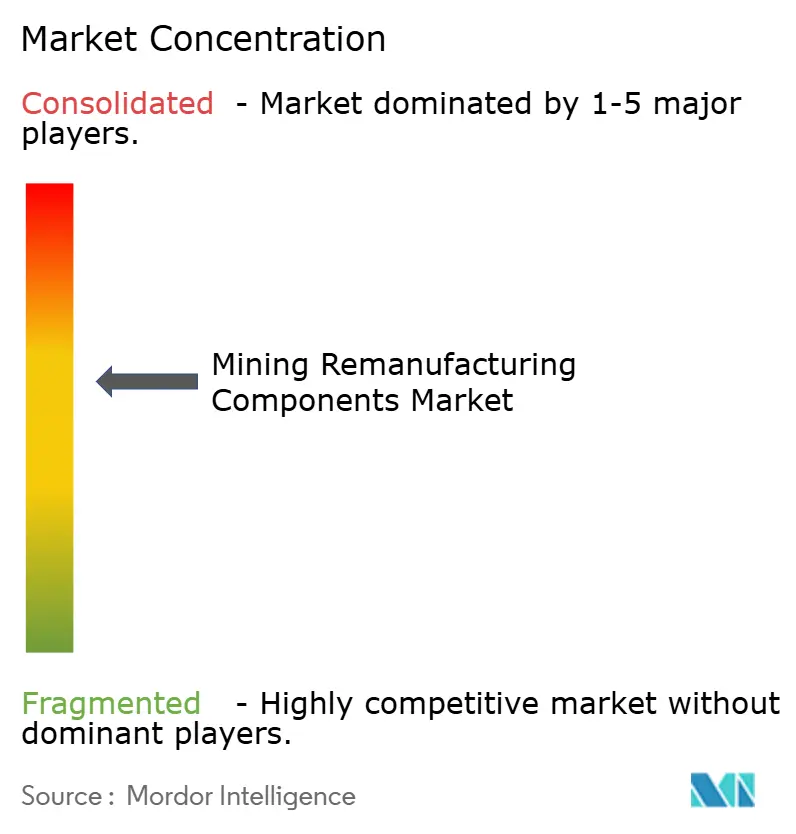
| Market Concentration | Medium |
Major Players *Disclaimer: Major Players sorted in no particular order Image © Mordor Intelligence. Reuse requires attribution under CC BY 4.0. | |

Mining Remanufacturing Components Market Analysis by Mordor Intelligence
The mining remanufacturing components market size stands at USD 6.33 billion in 2025 and is projected to grow at a 5.27% CAGR, reaching USD 8.18 billion by 2030. Rising pressure to lower operating costs and shrink carbon footprints propels the adoption of remanufactured parts that deliver significant savings versus new components while meeting the same performance benchmarks[1]“Component Verification Agreements and Remanufacturing Programs,” Caterpillar Inc., Caterpillar.com. Asia-Pacific maintains clear leadership thanks to a vast original-equipment manufacturing base and expanding mineral extraction across China, India, and Southeast Asia. The Middle East and Africa recorded the fastest regional expansion as large-scale iron-ore and critical-mineral projects ramped up, attracting global suppliers and capital inflows. Competitive momentum favors original-equipment manufacturers (OEMs) that offer certified reman programs, warranty parity, and data-driven core forecasting tools, positioning them ahead of local refurbishers that struggle with quality compliance.
Key Report Takeaways
- By component type, hydraulic systems led with 39.64% of the mining remanufacturing components market share in 2024; electrical components are forecast to expand at a 9.56% CAGR through 2030.
- By equipment type, excavators captured 43.82% of the mining remanufacturing components market size in 2024; conveyors are projected to grow at an 8.39% CAGR to 2030.
- By mining industry type, surface operations accounted for 53.21% share of the mining remanufacturing components market size in 2024, while underground operations are advancing at a 7.71% CAGR through 2030.
- By ownership type, contractor-owned fleets held 66.77% of the mining remanufacturing components market share in 2024, while lease and rental fleets show the highest projected CAGR at 7.91% through 2030.
- By geography, Asia-Pacific dominated with a 42.77% of the mining remanufacturing components market share in 2024; the Middle East and Africa are poised to record a 7.17% CAGR to 2030.
Note: Market size and forecast figures in this report are generated using Mordor Intelligence’s proprietary estimation framework, updated with the latest available data and insights as of January 2026.
Market Trends and Insights
Drivers Impact Analysis of Mining Remanufacturing Components Market*
| Driver | (~) % Impact on CAGR Forecast | Geographic Relevance | Impact Timeline |
|---|---|---|---|
| Cost-Savings | +2.1% | Global | Short term (≤ 2 years) |
| Aging Mining Fleets | +1.8% | North America, Europe, Australia | Medium term (2-4 years) |
| ESG-Linked Finance | +1.2% | Europe, North America, APAC core | Long term (≥ 4 years) |
| Commodity-Price Upswing | +0.9% | Global, concentrated in resource-rich regions | Short term (≤ 2 years) |
| Warranties and Exchange Programs | +0.7% | Global, led by developed markets | Medium term (2-4 years) |
| AI-Driven Core Forecasting | +0.4% | Asia-Pacific, North America, Europe | Long term (≥ 4 years) |
| Source: Mordor Intelligence | |||
Cost-Savings of 30–60% Versus New Parts
Mining companies intensify the shift toward remanufactured components because savings accrue immediately in high-wear assemblies such as hydraulic cylinders and transmissions. Caterpillar’s Component Verification Agreements demonstrate how standardized inspection and warranty parity address concerns over reliability while preserving cash. The economic edge widens in open-pit operations where undercarriage parts experience accelerated abrasion and replacement frequency. OEM-grade processes now include ultrasonic testing, plasma spray resurfacing, and end-of-line dynamometer validation that replicate new-part performance. As volatile commodity pricing squeezes margins, operators increasingly redirect capital toward ore-body development, making the mining remanufacturing components market an essential lever for cost containment.
Aging Global Mining Fleets Boost Replacement Demand
Haul trucks, loaders, and drills installed during the 2010 commodity boom are reaching critical overhaul windows, pushing average fleet age above recommended maintenance thresholds. Component failure rates grow sharply once equipment exceeds a decade in service, causing unplanned downtime on large sites. Remanufactured transmissions and final drives mitigate this risk by restoring 90–100% of original performance at a fraction of the cost. North American and European operators particularly benefit from exchange programs that preload refurbished stock, trimming lead times from months to days. These conditions sustain a steady flow of cores and reinforce the mining remanufacturing components market over the medium term.
ESG-Linked Finance Rewards Circular Components
Lenders now integrate lifecycle metrics into loan covenants, granting lower interest margins to miners that prove material reuse and carbon reduction. European Union taxonomy rules classify certified remanufacturing as an environmentally sustainable economic activity, unlocking eligibility for green bonds. Studies show each remanufactured wheel loader engine can avoid 194 tCO₂-equivalent over its service extension, a figure that resonates with investors targeting portfolio-level emission cuts[2]“Annual Report 2024,” Epiroc AB, Epiroc.com. Similar mechanisms surface in North America, where sustainability-linked revolving credit facilities tie pricing grids to circularity KPIs. The dynamic accelerates adoption and supports a consistent CAGR uplift for the mining remanufacturing components market through 2030.
Commodity-Price Upswing Spurs Equipment Life-Extension
When metal prices climb, miners prioritize maximizing existing output rather than incurring multiyear lead times for new machinery. Refurbished hydraulic systems, electrical drives, and crusher liners enable swift capacity ramp-ups and protect free cash flow during price peaks. Predictive maintenance algorithms guide replacement intervals, ensuring remanufactured parts are installed before catastrophic failure. The strategy prevails in large copper and iron-ore pits where every hour of uptime yields significant revenue. Consequently, the mining remanufacturing components market experiences demand spikes that correlate with commodity cycles yet maintain structural growth as best-practice maintenance embeds.
Restraints Impact Analysis of Mining Remanufacturing Components Market*
| Restraint | (~) % Impact on CAGR Forecast | Geographic Relevance | Impact Timeline |
|---|---|---|---|
| Safety-Code Barriers | -1.4% | Global, stringent in developed markets | Medium term (2-4 years) |
| Low-Cost Local Refurbishers | -1.1% | Emerging markets, price-sensitive segments | Short term (≤ 2 years) |
| Core-Return Unpredictability | -0.8% | Global, acute in remote mining regions | Long term (≥ 4 years) |
| Cross-Border Tariffs | -0.6% | Trade-dependent regions, US-China corridor | Medium term (2-4 years) |
| Source: Mordor Intelligence | |||
Certification and Safety-Code Barriers
Mining authorities tighten rules on rebuilt parts, subjecting them to the same destructive-testing and documentation regimes as new products. The United States Mine Safety and Health Administration mandates traceable serial numbers, weld-procedure qualification records, and full-scale pressure tests before reinstallation[3]“Compliance Guidelines for Rebuilt Mining Components,” Mine Safety and Health Administration, Msha.gov. Smaller workshops often lack the instrumentation to comply, limiting their addressable market. International shipments face further hurdles as customs officials classify reman components under used-machinery codes that trigger quarantine inspections and fees. These frictions extend lead times and compel some operators to default to new parts despite cost penalties.
Low-Cost Local Refurbishers Dilute Quality Perception
In several emerging markets, uncertified operators promote “like-new” components at steep discounts yet skip critical steps such as hardness restoration and non-destructive testing. Subsequent in-field failures tarnish the broader practice of remanufacturing, forcing OEMs to invest in awareness campaigns and serialized authentication labels. Mines with stringent uptime targets increasingly block non-certified suppliers, but the reputational damage slows new customer onboarding. Governments in Indonesia and South Africa are drafting standards to separate legitimate remanufacturing from basic refurbishment, signaling gradual mitigation of this restraint.
*Our forecasts treat driver/restraint impacts as directional, not additive. The impact forecasts reflect baseline growth, mix effects, and variable interactions.
Mining Remanufacturing Components Market Segment Analysis
By Component Type:
Hydraulics Maintain Command while Electronics AccelerateHydraulic systems generated 39.64% of the mining remanufacturing components market size in 2024, as cylinders, pumps, and valves undergo high-cycle fatigue in excavators, loaders, and drills. The segment thrives on standardized rebuild kits and readily available cores, enabling throughput scalability at OEM workshops. Electrical components contributed a smaller share yet posted the fastest 9.56% CAGR through 2030, reflecting the adoption of autonomous haulage and condition-monitoring platforms that rely on robust control boards and sensors. Transmission assemblies rank third in volume, bolstered by fleet-wide overhauls timed at 20,000-hour intervals.
Growing digitalization widens the addressable pool of remanufactured electronics, from motor inverters to high-voltage connectors, raising aftermarket revenue density per machine. Meanwhile, undercarriage parts such as idlers and track shoes display stable replacement cadence, supported by certified hard-facing techniques that extend service life. Engines remain viable for legacy diesel units approaching Tier 4 standards where full replacement is cost-prohibitive. Collectively, sustained demand across categories keeps the mining remanufacturing components market on a steady upward trajectory.




By Equipment Type:
Excavators Dominate as Conveyors SurgeExcavators captured 43.82% of the mining remanufacturing components market share in 2024, mirroring their extensive use in overburden removal and ore loading. Uniform component architecture across leading brands simplifies teardown, inspection, and rebuild, resulting in competitive pricing and short turnaround. Loaders and bulldozers follow, backed by predictable wear patterns and high-value hydraulic content. Although smaller today, Conveyors forecast an 8.39% CAGR through 2030 as continuous-haul systems replace truck fleets in large open-pit operations.
Growth in conveyors translates into rising orders for remanufactured gearboxes, pulleys, and condition-monitoring sensors that integrate predictive analytics. Drilling rigs, particularly underground applications, require specialized hydraulic and rotary components that command premium rebuild margins. Haul trucks sustain steady demand for transmissions and axles as load factors intensify in more bottomless pits. In sum, diversified equipment exposure protects the mining remanufacturing components market from cyclical swings in any machinery class.
By Mining Industry Type:
Surface Mining Leads while Underground Gains PaceSurface mining accounted for 53.21% of the mining remanufacturing components market size in 2024 because of extensive fleets, straightforward component access, and abrasive environments that accelerate wear. Open-pit operators favor planned component exchange during scheduled shutdowns, aligning with supply-chain predictability. Underground mining, in contrast, will deliver the fastest 7.71% CAGR through 2030, as operations advance to greater depths, necessitating specialized, compact equipment with costly sub-assemblies. Processing plants exhibit consistent but moderate demand for high-precision pumps and crusher liners.
Metal mining, especially copper, gold, and lithium, underpins component turnover due to abrasive ore characteristics and elevated utilization rates. Coal remains a contributor in select geographies yet faces long-term consumption headwinds that temper component growth. Environmental, social, and governance pressures are amplifying across all industry types, encouraging circular economy strategies that underpin the mining remanufacturing components industry.

By Ownership Type:
Contractors Hold Majority while Leasing Gains TractionContractor-owned fleets controlled 66.77% of the mining remanufacturing components market size in 2024 because specialized service providers assume maintenance risk and seek low-cost yet reliable component options. Their procurement teams negotiate volume-based reman contracts, securing favorable turnaround and warranty terms. Lease and rental fleets, though smaller, are projected to grow at a 7.91% CAGR through 2030, as mining houses reallocate capital toward exploration and digital systems rather than equipment ownership.
Leasing models embed component lifecycle management into monthly fees, aligning incentives for optimal maintenance and remanufacturing. Predictive analytics platforms share data among lessors, OEMs, and mine sites to pre-position rebuilt stock, minimizing unplanned outages. The convergence of asset-light strategies and certified remanufacturing validates the structural growth pathway for the mining remanufacturing components market.
Geography Analysis
APAC Mining Remanufacturing Components Market
Asia-Pacific retained 42.77% of the mining remanufacturing components market size in 2024, as China’s extensive OEM ecosystem and India’s mineral demand generated a large installed base of serviceable equipment. Collaborative ventures among regional suppliers streamline the collection of used cores, lowering logistics costs and shortening rebuild cycles. Major Chinese manufacturers integrate remanufacturing into new-equipment sales agreements, bundling total-cost-of-ownership guarantees that resonate with cost-sensitive operators. India’s public-sector miners increasingly favor remanufacturing to stretch procurement budgets and accelerate component availability amid persistent supply-chain disruptions.
MEA Mining Remanufacturing Components Market
The Middle East and Africa represent the fastest-growing region, with a 7.17% CAGR through 2030, owing to multi-billion-dollar iron ore, gold, and battery-mineral projects. Rio Tinto’s Simandou development anchors sustained equipment demand and obligates comprehensive aftermarket support. Governments in Ghana, Namibia, and Saudi Arabia introduce local-content rules that promote regional reman workshops, stimulating job creation and technology transfer. OEMs respond by forming joint ventures with local distributors, ensuring warranty alignment and quality assurance for reman components supplied to remote mine sites.
The Americas and Europe Mining Remanufacturing Components Market
North America and Europe continue to provide steady volumes due to mature yet aging fleets and strict environmental statutes favor reuse over new-part production. OEM facilities in Illinois, Texas, and Bremen handle high-throughput teardown lines while adhering to ISO 9001 quality management, reinforcing customer confidence. South America shows accelerating adoption as Chile and Argentina ramp up copper and lithium extraction to meet global electrification demand. Rugged terrain and long transport distances make remanufacturing economically compelling because core exchange can occur without waiting for new-part imports, safeguarding uptime for pit-to-port supply chains.


Competitive Landscape
The mining remanufacturing components market features moderate concentration. Leadership is anchored in established manufacturing footprints, proprietary technical data, and multi-channel distribution networks. Competition pivots toward warranty parity, quality certification, and analytics-enabled service packages rather than simple price discounts. Caterpillar collaborates with analytics providers to refine core return forecasts and has expanded stock-holding hubs near major copper belts to curtail downtime.
Komatsu invests in regional reman centers that pair robotic welding with laser-cladding, reinforcing component integrity and shrinking turnaround. Liebherr enhances its portfolio with eco-labeled “second life” hydraulic cylinders, including electronic service records accessible via QR code. Mid-tier players like Sandvik broaden reach through targeted bolt-on acquisitions that add niche expertise in drivetrains and material-handling components. Smaller specialists carve defensible positions in conveyor gearboxes and underground drilling consumables, often partnering with OEMs to secure technical documentation and warranty alignment.
Barriers to entry rise as mines demand ISO, MSHA, and CE certifications that require capital-intensive testing rigs, metallurgy labs, and traceability software. Concurrently, digital solutions, including AI-driven core-allocation platforms, differentiate players by minimizing inventory costs while maximizing fleet availability. This convergence of capital scale, regulatory compliance, and digital competency solidifies the existing mining remanufacturing components industry hierarchy.
Mining Remanufacturing Components Industry Leaders
Caterpillar Inc.
Komatsu Ltd.
Liebherr‑International AG
Hitachi Construction Machinery Co., Ltd.
Volvo Construction Equipment AB (AB Volvo)
- *Disclaimer: Major Players sorted in no particular order
Mining Remanufacturing Components Market Companies Covered in this Report
- Caterpillar Inc.
- Komatsu Ltd.
- Liebherr‑International AG
- Volvo Construction Equipment AB (AB Volvo)
- Hitachi Construction Machinery Co., Ltd.
- Epiroc AB
- Sandvik AB
- The Weir Group PLC
- Cummins Inc.
- Metso Corporation
- FLSmidth and Co. A/S
- Bosch Rexroth AG
- Danfoss A/S
- SRC Holdings Corporation
- Swanson Industries inc.
- J.C. Bamford Excavators Limited
- H-E Parts International, LLC
- Dana Incorporated

Recent Industry Developments in Mining Remanufacturing Components Market
- September 2025: Concord Access Solutions inaugurated a remanufacturing facility in Johannesburg to bolster after-sales support for lifting equipment across Southern Africa.
- June 2025: Hitachi completed a USD 25 million expansion of its reman and engine facility in Lusaka Province through a partnership with a leading copper operation.
- November 2024: H-E Parts acquired Brake Supply’s mining machinery component business to strengthen its Americas remanufacturing footprint.


Global Mining Remanufacturing Components Market Report Scope
| Engines |
| Transmission Components |
| Hydraulic Systems |
| Undercarriage Components |
| Electrical Components |
| Axles and Differentials |
| Others |
| Excavators |
| Loaders |
| Bulldozers |
| Drilling Rigs |
| Haul Trucks |
| Crushers |
| Graders |
| Conveyors |
| Others |
| Surface Mining |
| Underground Mining |
| Mineral Processing |
| Coal Mining |
| Metal Mining |
| Contractor-Owned Fleets |
| Lease/Rental Fleets |
| North America | United States |
| Canada | |
| Rest of North America | |
| South America | Brazil |
| Argentina | |
| Rest of South America | |
| Europe | United Kingdom |
| Germany | |
| Spain | |
| Italy | |
| France | |
| Russia | |
| Rest of Europe | |
| Asia-Pacific | India |
| China | |
| Japan | |
| South Korea | |
| Rest of Asia-Pacific | |
| Middle East and Africa | United Arab Emirates |
| Saudi Arabia | |
| Turkey | |
| Egypt | |
| South Africa | |
| Rest of Middle East and Africa |
| By Component Type | Engines | |
| Transmission Components | ||
| Hydraulic Systems | ||
| Undercarriage Components | ||
| Electrical Components | ||
| Axles and Differentials | ||
| Others | ||
| By Equipment Type | Excavators | |
| Loaders | ||
| Bulldozers | ||
| Drilling Rigs | ||
| Haul Trucks | ||
| Crushers | ||
| Graders | ||
| Conveyors | ||
| Others | ||
| By Mining Industry Type | Surface Mining | |
| Underground Mining | ||
| Mineral Processing | ||
| Coal Mining | ||
| Metal Mining | ||
| By Ownership Type | Contractor-Owned Fleets | |
| Lease/Rental Fleets | ||
| By Geography | North America | United States |
| Canada | ||
| Rest of North America | ||
| South America | Brazil | |
| Argentina | ||
| Rest of South America | ||
| Europe | United Kingdom | |
| Germany | ||
| Spain | ||
| Italy | ||
| France | ||
| Russia | ||
| Rest of Europe | ||
| Asia-Pacific | India | |
| China | ||
| Japan | ||
| South Korea | ||
| Rest of Asia-Pacific | ||
| Middle East and Africa | United Arab Emirates | |
| Saudi Arabia | ||
| Turkey | ||
| Egypt | ||
| South Africa | ||
| Rest of Middle East and Africa | ||


Key Questions Answered in the Report
What level of cost savings can operators expect when switching to remanufactured components for mining equipment?
Certified reman parts typically deliver 30–60% spending reductions compared with new components while matching OEM performance standards.
Which component category is expanding the fastest in the remanufactured mining-equipment space?
Electrical components are projected to rise at a 9.56% CAGR through 2030 thanks to the growing use of autonomous haulage and digital control systems.
How much of global demand does Asia-Pacific represent for remanufactured mining components?
Asia-Pacific accounts for 42.77% of worldwide revenue, driven by China’s large OEM base and India’s expanding mineral extraction activities.
What factors are accelerating adoption of remanufactured parts in underground mining operations?
Deeper ore bodies, specialized compact machinery, and a 7.71% CAGR forecast for underground equipment combine to make cost-efficient, warranty-backed reman components attractive.
In what ways does green financing influence decisions on component remanufacturing for mines?
Sustainability-linked loans and EU taxonomy rules reward circular practices, enabling miners to secure preferential financing by proving carbon-cutting benefits from remanufactured parts.
Page last updated on:





