
Germany Mining Equipment Market Size and Share
Market Overview
| Study Period | 2019 - 2031 |
|---|---|
| Forecast Data Period | 2026 - 2031 |
| Base Year Market Size (2025) | USD 1.56 Billion |
| Market Size (2026) | USD 1.62 Billion |
| Market Size (2031) | USD 1.93 Billion |
| Growth Rate (2026 - 2031) | 3.58 % |
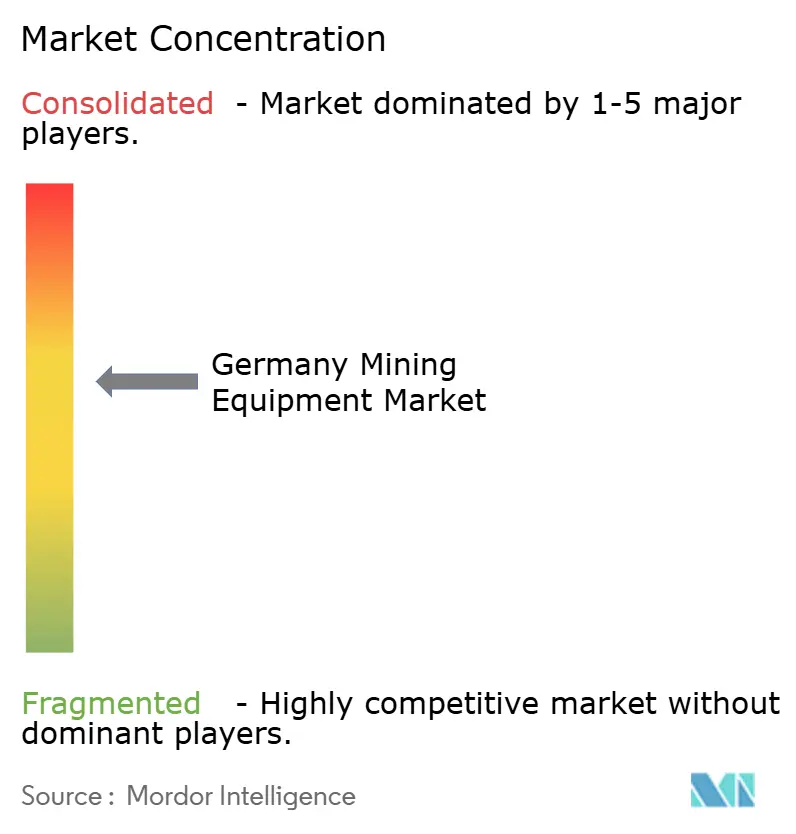
| Market Concentration | Medium |
Major Players
*Disclaimer: Major Players sorted in no particular order Image © Mordor Intelligence. Reuse requires attribution under CC BY 4.0. |
|
Germany Mining Equipment Market Analysis by Mordor Intelligence
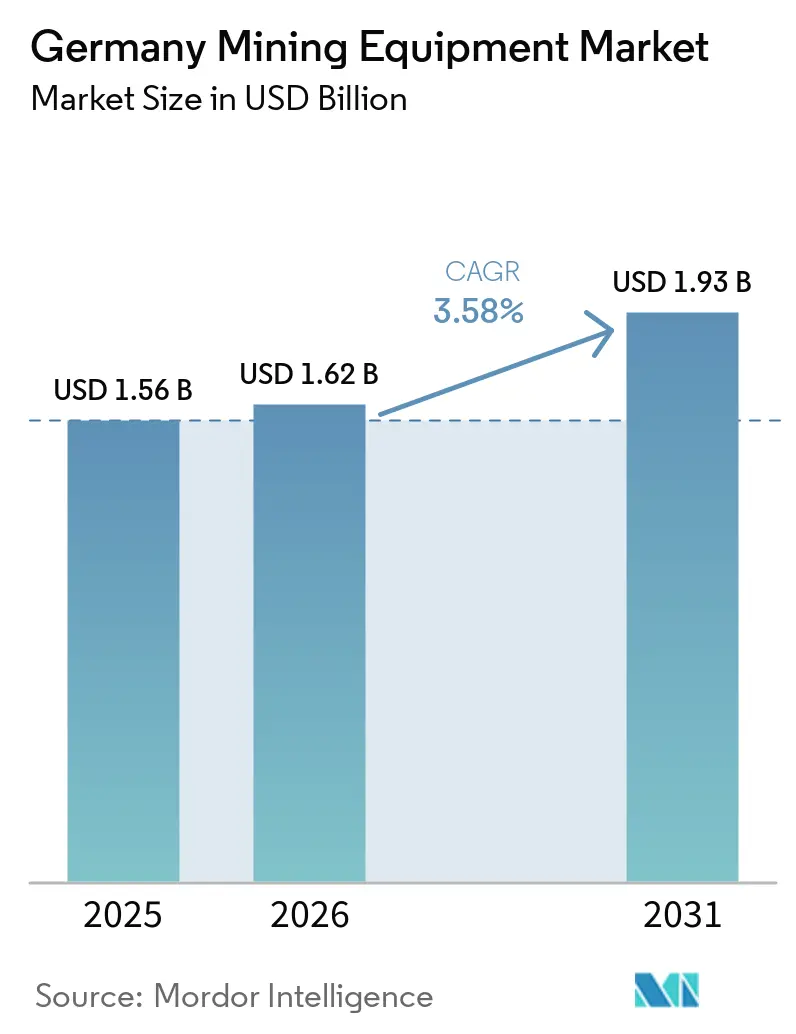
The Germany mining equipment market size was valued at USD 1.56 billion in 2025, and is projected to grow from USD 1.62 billion in 2026 to USD 1.93 billion by 2031, growing at a CAGR of 3.58% over 2026-2031. Rising critical-mineral projects, ongoing coal phase-out activity, and federal incentives for zero-emission machinery drive growth while tempering overall capital intensity. Automation solves a widening skilled-labor gap, and electrification aligns with EU Stage V rules that restrict diesel emissions. Digital-twin rollouts shorten maintenance cycles and allow multi-site fleet control, reshaping procurement priorities toward software-centered ecosystems. Mid-sized equipment dominates in value, but high-power rigs are gaining relevance for salt-cavern hydrogen storage and geothermal shaft re-use, creating space for specialist German suppliers to complement global OEMs.
Key Report Takeaways
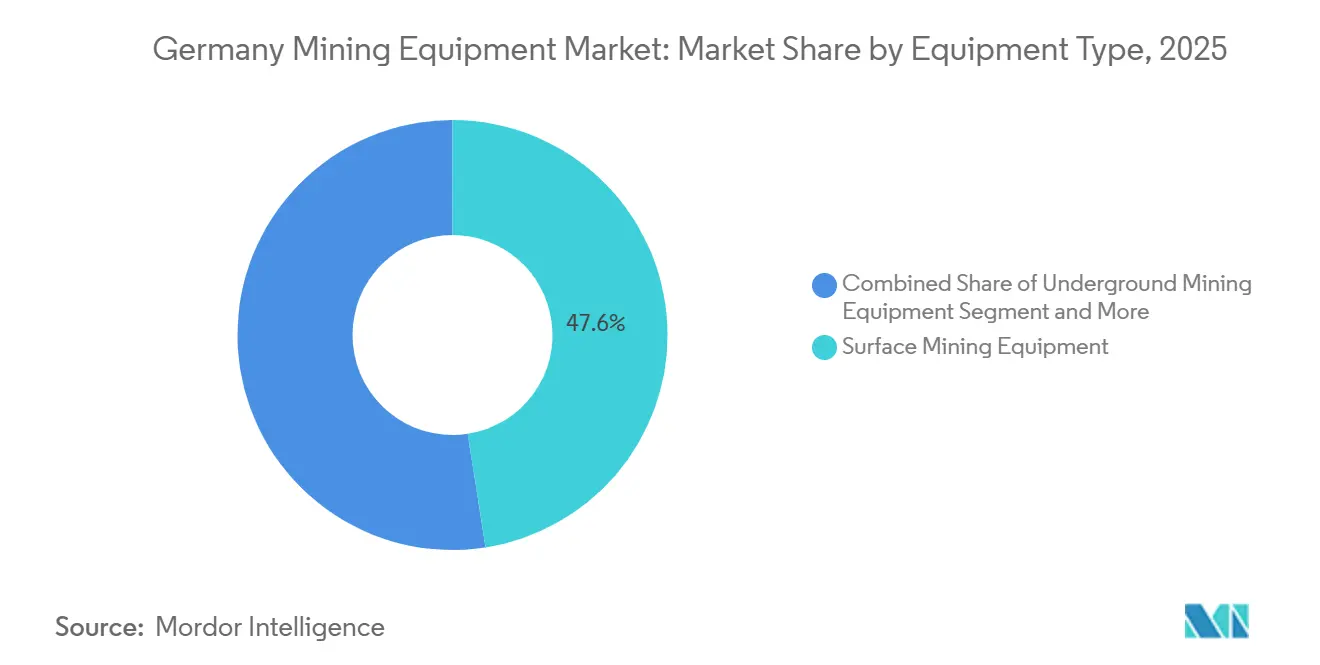
- By equipment type, surface mining equipment accounted for 47.55% of the German mining equipment market share in 2025, while underground equipment is projected to expand at a 5.35% CAGR through 2031.
- By automation level, manual machines commanded 65.33% of the German mining equipment market share in 2025, but fully autonomous units are forecast to grow fastest at an 18.89% CAGR to 2031.
- By powertrain type, internal combustion powertrains accounted for 86.24% of the German mining equipment market in 2025. Yet, battery-electric equipment is projected to post the highest growth, at a 7.26% CAGR during the same period.
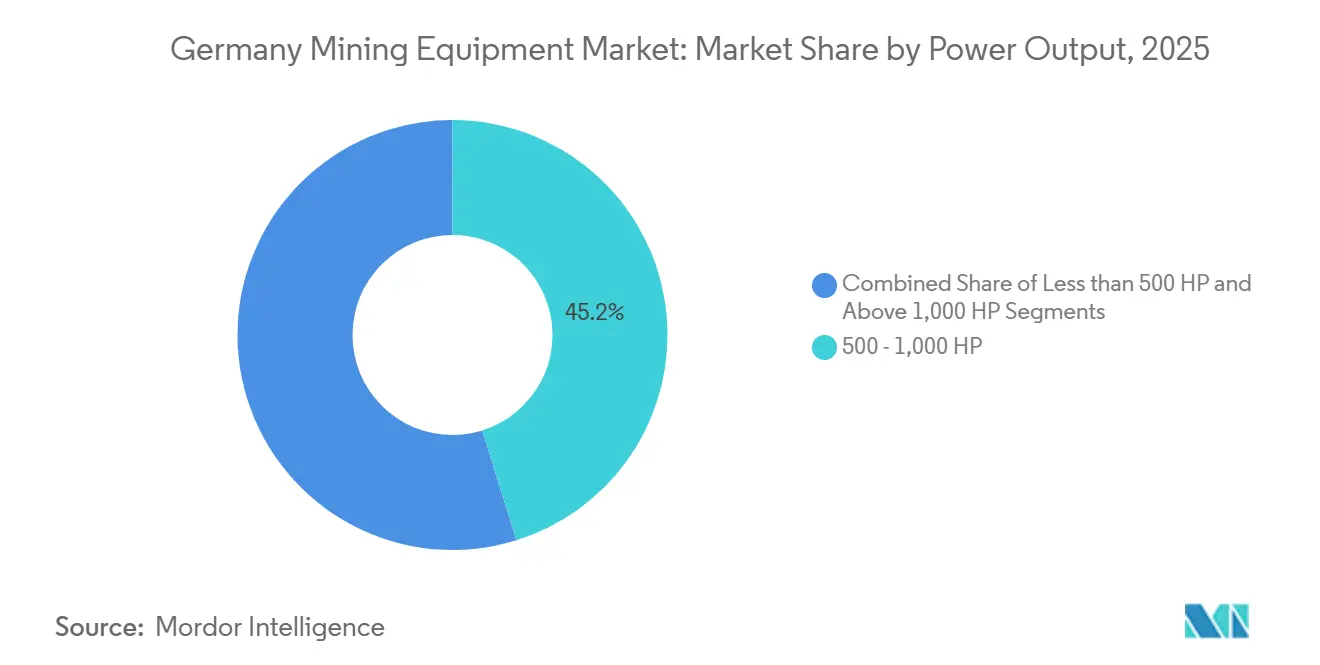
- By power output, the 500–1,000 HP class held a 45.18% of the German mining equipment market in 2025, whereas rigs above 1,000 HP are expected to register the fastest expansion at a 4.43% CAGR through 2031.
- By application, metal mining accounted for 54.35% of the German mining equipment market in 2025, but mineral mining will grow at a 4.92% CAGR through 2031.
Note: Market size and forecast figures in this report are generated using Mordor Intelligence’s proprietary estimation framework, updated with the latest available data and insights as of January 2026.
Germany Mining Equipment Market Trends and Insights
Drivers Impact Analysis*
| Driver | ( ~ ) % Impact on CAGR Forecast | Geographic Relevance | Impact Timeline |
|---|---|---|---|
| Demand for Critical Minerals | +1.2% | Saxony, Baden-Württemberg, Saxony-Anhalt | Medium term (2-4 years) |
| Automation and Digitalization | +0.9% | North Rhine-Westphalia, Saxony, Brandenburg | Short term (≤ 2 years) |
| Federal R&D Incentives | +0.7% | Baden-Württemberg, Bavaria, Lower Saxony | Medium term (2-4 years) |
| Underground Salt and Potash Projects | +0.5% | Lower Saxony, North Rhine-Westphalia, Brandenburg | Long term (≥ 4 years) |
| Lignite and Hard-Coal Mine Modernization | +0.4% | Brandenburg, Saxony-Anhalt, North Rhine-Westphalia | Short term (≤ 2 years) |
| Geothermal Shaft Repurposing | +0.3% | North Rhine-Westphalia, Bavaria, Baden-Württemberg | Long term (≥ 4 years) |
| Source: Mordor Intelligence | |||
Surge in Demand for Critical Minerals for EU Battery Supply Chain
Federal geology data place Germany’s lithium resources among the world’s top ten, underpinning domestic ambitions to meet EU sourcing targets. Public financing secured in 2026 demonstrates investor confidence in integrated geothermal-lithium ventures that prioritize zero-carbon extraction processes. Flowsheets favor modular crushers, flotation cells, and conveyors that already comply with Stage V limits. Cross-border projects in Saxony-Bohemia promote shared infrastructure and spur demand for mobile processing equipment. Pilot plants adopting direct-lithium-extraction pumps and heat-exchanger arrays also reshape supplier requirements toward corrosion-resistant materials.
Automation and Digitalization to Mitigate Skilled-Labor Crunch
Quarry operators cite workforce scarcity as a top productivity risk, accelerating trials of retrofitted autonomous haul trucks and loaders. Early deployments rely on 3D fleet-orchestration software that prevents traffic deadlocks in narrow drifts, important for Germany’s potash and salt caverns. University-led digital-twin programs report double-digit uptime gains, validating cloud-based maintenance alerts. OEM telematics now bundles predictive analytics, enabling a single supervisor to monitor multiple sites from a central hub. As safety directives tighten, remote-operation readiness becomes a procurement prerequisite.
Federal R&D Incentives for Battery-Electric Mining Equipment
National programs subsidize the development of battery packs, trolley-assist interfaces, and hydrogen-compatible drivetrains. Recent showings of modular-battery haul trucks prove that sub-20-minute swaps are viable in open-pit duty cycles. Underground pilots combine fixed trolley lines with onboard diesel for last-mile flexibility, cutting particulate levels in confined spaces. Funding also targets hybrid systems that shave fuel peaks without full electrification, broadening adoption among mid-sized quarries. The convergence of autonomy and electrification reduces lifecycle costs and improves regulatory compliance.
Expansion of Underground Salt and Potash Projects for Hydrogen Storage
Seasonal energy balancing drives cavern construction activity in Lower Saxony and North Rhine-Westphalia [1]"Germany explores underground caverns as seasonal heat storage sites," Clean Energy Wire, cleanenergywire.org. High-pressure pumps, automated brine-management skids, and real-time geomechanical sensors differ markedly from conventional potash gear. German tunneling specialists adapt large-diameter boring machines to sink shafts with tight circularity tolerances essential for hydrogen integrity. Continuous monitoring technologies detect micro-fractures before gas seals fail, creating a new service niche for equipment vendors. These projects attract global attention as blueprints for large-scale subsurface storage.
Restraints Impact Analysis*
| Restraint | ( ~ ) % Impact on CAGR Forecast | Geographic Relevance | Impact Timeline |
|---|---|---|---|
| Stricter EU Emissions & Noise Rules | -0.5% | All German mine sites | Short term (≤ 2 years) |
| Commodity Price Volatility | -0.4% | Global, reflected in German projects | Medium term (2-4 years) |
| Refurbished Eastern-European Equipment Influx | -0.3% | Germany | Short term (≤ 2 years) |
| Tough Permitting & Local Opposition | -0.2% | Saxony, Bavaria, North Rhine-Westphalia | Long term (≥ 4 years) |
| Source: Mordor Intelligence | |||
Stricter EU Emissions and Noise Limits Raising Equipment Costs
Stage V engine rules and updated outdoor-noise directives force OEMs to integrate after-treatment hardware and acoustic enclosures, raising sticker prices[2]"Decarbonizing combustion: Tier 4, Stage V and beyond," Cummins Inc., cummins.com. Small operators grapple with retrofit kits that often cost more than the machine's residual value, nudging them toward electric or hybrid options. Funding partially offsets premiums, yet capital hurdles persist for family-owned quarries. Suppliers that bundle compliance, financing, and maintenance into a single contract gain a competitive edge. Long-term benefits include lower ventilation expenses and higher resale value for compliant fleets.
Commodity-Price Volatility Delaying CAPEX
Sharp swings in lithium, copper, and nickel prices over the past two years have prompted mine developers to postpone final investment decisions. Extended European permitting cycles magnify exposure to price downturns, lifting the effective cost of capital and shrinking equipment budgets. Developers prefer staged construction plans that match cash flow with market signals, reducing order sizes for new rigs and loaders. Modular plant designs that scale with demand find favor under uncertain price environments. Suppliers must therefore balance inventory risks with the need for quick delivery.
*Our forecasts treat driver/restraint impacts as directional, not additive. The impact forecasts reflect baseline growth, mix effects, and variable interactions.
Segment Analysis
By Equipment Type: Underground Gains on Hydrogen and Lithium
Surface equipment held the largest share, at 47.55%, in Germany's mining equipment market in 2025, yet underground units are projected to post the fastest CAGR, at 5.35%, through 2031. Underground demand benefits from salt-cavern hydrogen storage and narrow-vein lithium activity, both of which require compact loaders, drilling jumbos, and ventilation packages. Operators favor modular utility vehicles that can switch cassettes between service, scaling, and rock-haul functions within a single shift. Such flexibility maximizes machine utilization in tight headings and reduces fleet size requirements. OEMs embed autonomous-ready sensors so customers can enable driverless features via software upgrades rather than purchasing new iron. Given strict noise ceilings, battery-electric loaders find early adoption underground where reduced ventilation offsets higher acquisition costs.
Meanwhile, surface-mine operators invest selectively in fleet upgrades that pair diesel haul trucks with trolley-assist lines to curb fuel burn on uphill hauls. Mid-sized quarries adopt digital payload monitoring that links shovels, crushers, and conveyor belts, trimming idle times. Lifecycle service contracts replace one-off machine sales, ensuring OEM involvement throughout rebuild cycles. German engineering firms that specialize in high-pressure grinding rolls and in-pit crushing-and-conveying systems gain traction as customers seek lower emissions and smaller footprints.



By Automation Level: Fully Autonomous Surges Despite High Manual Share
Manual machines retained 65.33% of the German mining equipment market share in 2025, yet fully autonomous systems are forecast to expand at an 18.89% CAGR through 2031. Autonomy addresses Germany’s labor shortage and stringent safety expectations. Retrofit kits allow existing haul trucks and loaders to navigate predefined routes using lidar and AI-enhanced perception. Early adopters report improved cycle-time consistency and reduced shift-change downtime—regulations such as ISO 17757 mandate functional-safety redundancies, steering buyers toward vendors with long operating records.
Semi-autonomous features, collision avoidance, and operator-assist dig cycles act as a bridge for conservative fleets while delivering immediate productivity gains without a full infrastructure overhaul. Tele-operation hubs located off-site create new job profiles that appeal to tech-oriented workers, partially offsetting disadvantages associated with rural locations. Data collected by autonomous fleets feeds into predictive maintenance algorithms, reducing unplanned outages. In response, equipment suppliers bundle software licenses, analytics dashboards, and cybersecurity updates into multiyear service packages that smooth revenue visibility.
By Powertrain Type: Battery-Electric Gains Traction Amid Diesel Dominance
Internal combustion engines accounted for 86.24% of the German mining equipment market share in 2025, but battery-electric units will record the fastest CAGR of 7.26% through 2031. Diesel remains entrenched owing to existing fueling networks and high energy density. However, EU emissions caps and rising carbon prices tilt total cost-of-ownership equations toward electric alternatives, particularly in underground headings, where ventilation cost savings are immediate. Early electric haul trucks feature modular batteries that enable quick swaps, mitigating range anxiety.
Hybrids serve operations where grid connection is limited, capturing regenerative braking energy and shaving fuel peaks. Suppliers collaborate on open-interface charging standards to avoid vendor lock-in, a concern voiced by fleet managers evaluating long-term compatibility. Financing models evolve: power-as-a-service contracts bundle battery leases, energy supply, and charging infrastructure under per-tonne or per-hour rates. As battery chemistries shift toward higher-manganese and sodium-ion options that lower upfront cost, adoption curves steepen. Meanwhile, improved inverter efficiency narrows performance gaps between diesel torque curves and electric drivetrains, broadening application scopes.
By Power Output: Mid-Range Dominates, High-Power Segment Accelerates
The 500–1,000 HP class commanded the largest share of the German mining equipment market at 45.18% in 2025, yet equipment rated above 1,000 HP is set to grow the fastest, with a 4.43% CAGR to 2031. Mid-range machines offer a sweet spot between payload and maneuverability for quarries and small underground operations. High-power rigs, however, are vital for deep geothermal drilling, large-diameter shaft sinking, and cavern excavation associated with hydrogen projects. OEMs integrate active-cooling systems and high-temperature hydraulics to withstand continuous duty under demanding geologies.
Electric variants of large loaders deliver instant torque that surpasses that of diesel counterparts despite lower rated horsepower, reframing procurement criteria toward tonnes moved per kilowatt-hour rather than peak power alone. Compact sub-500 HP units now feature plug-and-play autonomy kits and battery options, enabling smaller contractors to experiment with advanced technologies without incurring significant capital risk. Refurbished imports from Eastern Europe place price pressure on new sales, prompting OEMs to emphasize uptime guarantees, parts availability, and compliance certificates that used equipment cannot match.
By Application: Metal Mining Leads, Mineral Mining Accelerates
Metal mining held 54.35% of the German mining equipment market share in 2025, while mineral mining is slated to expand fastest at a 4.92% CAGR through 2031. Lithium, copper, and specialty metals underpin Germany’s battery and electronics supply chains, driving sustained demand for crushing mills, flotation cells, and concentrate thickening systems. Yet mineral operations, potash, salt, and aggregates, benefit directly from the energy transition via hydrogen storage caverns and infrastructure backfill. Equipment suited to corrosive brines and fine-salt particulates differs from metal-mine gear, opening opportunities for niche suppliers.
Coal’s decline shifts focus toward reclamation dozers and water-treatment plants, diversifying the equipment mix. Government-backed remediation funds channel work to contractors specializing in land-restoration machinery. Geothermal shaft repurposing further blurs lines between mining and energy infrastructure, requiring drilling rigs that tolerate high temperatures and handle variable lithologies. Vendors able to cross-sell across metal, mineral, and energy projects secure resilient order books.
Geography Analysis
Germany’s mining equipment demand clusters around regions transitioning from fossil fuels to critical minerals and clean-energy storage. Saxony tops lithium exploration, with projects near existing road and rail links easing heavy-equipment logistics. Underground headings in the Erzgebirge call for narrow-vein loaders and lightweight utility vehicles that keep ground pressure low on fragile host rock. Cross-border collaboration with Czech sites harmonizes equipment safety standards and streamlines cross-licensing of spare parts.
North Rhine-Westphalia illustrates how coal-legacy regions pivot to hydrogen storage and geothermal energy. Cavern-expansion contractors procure high-pressure pumps, corrosion-resistant tubing, and 3D sonar mapping systems, signaling a shift from overburden-stripping gear toward precision subsurface tools. Universities in Aachen and Bochum partner with OEMs to trial sensor-laden drilling rigs capable of real-time rock-property feedback, reducing costly bit changes.
Lower Saxony hosts major salt-cavern projects, reinforcing demand for large-diameter boring machines adapted from civil-tunnel applications. The state’s proximity to North Sea wind farms supports hybrid power solutions that pair on-site renewables with battery-electric haul trucks. Brandenburg and Saxony-Anhalt grapple with lignite closures; equipment orders tilt toward reclamation dozers, soil stabilizers, and water-remediation units rather than production shovels. Financing channels increasingly mix public just-transition funds with private equity, directing spending toward modern, low-emission fleets.
Competitive Landscape
The German mining equipment market remains moderately concentrated; the top five OEMs have sufficient scale while leaving room for agile local players. European suppliers leverage their proximity to and familiarity with EU regulations to win contracts that require rapid customization. Liebherr’s multi-year order for zero-emission haul trucks demonstrates how modular battery packs and trolley-assist lines meet both decarbonization and productivity targets. Komatsu’s milestone of 1,000 commercial autonomous trucks underscores the growing importance of software ecosystems over pure hardware features.
German engineering houses such as TAKRAF specialize in revamping aging bucket-wheel excavators with variable-frequency drives and cloud-based monitoring, extending asset lives while embedding digital services. Sensor-and-AI startups integrate with established fleets to unlock autonomy in mid-market quarries, lowering barriers for family-owned operators. The influx of refurbished machinery from Eastern Europe intensifies price competition in sub-500 HP categories, but OEMs counter with warranty length, telematics, and guaranteed Stage V compliance.
R&D alliances between equipment makers, energy utilities, and research institutes foster rapid prototyping of electric-drive systems. Joint test beds at converted lignite pits trial battery-powered rigs under real-world duty cycles, feeding learnings back into production models. Supply-chain localization gains traction as geopolitical tensions spotlight raw-material risks: component sourcing shifts toward European foundries, and software teams bolster on-shore cybersecurity measures.
Germany Mining Equipment Industry Leaders
-
Caterpillar Inc.
-
Komatsu Ltd.
-
Liebherr-International AG
-
Epiroc AB
-
Sandvik AB
- *Disclaimer: Major Players sorted in no particular order

Recent Industry Developments
- April 2026: Komatsu launched the PC9000-12 hydraulic excavator globally, signaling its readiness to supply ultra-class machines for European critical-mineral projects.
- April 2026: Germany approved an EUR 85 million package to support the transformation of former mining zones into clean-energy and industrial hubs.
- December 2025: Hitachi Construction Machinery established LANDCROS Development Center Europe GmbH to accelerate R&D on battery-powered excavators in Germany.


Germany Mining Equipment Market Report Scope
The German mining equipment market is segmented by equipment type, automation level, powertrain type, power output, and application. By Equipment Type, the market is segmented into Surface Mining Equipment, Underground Mining Equipment, Mineral Processing Equipment, Drills and Breakers, Crushing, Pulverizing, and Screening Equipment, and Loaders and Dozers. By Automation Level, the market is segmented into Manual, Semi-Autonomous, and Fully Autonomous Equipment. By Powertrain Type, the market is segmented into Internal-Combustion Engine (ICE), Battery-Electric Vehicle (BEV), and Hybrid Vehicle. By Power Output, the market is segmented into Less than 500 HP, 500 to 1,000 HP, and above 1,000 HP. By Application, the market is segmented into Metal Mining, Mineral Mining, and Coal Mining. Market forecasts are provided in terms of Value (USD) and Volume (Units).
| Surface Mining Equipment |
| Underground Mining Equipment |
| Mineral Processing Equipment |
| Drills and Breakers |
| Crushing, Pulverizing and Screening |
| Loaders and Haul Trucks |
| Manual Equipment |
| Semi-Autonomous Equipment |
| Fully Autonomous Equipment |
| Internal-Combustion Engine Vehicles |
| Battery-Electric Vehicles |
| Hybrid Vehicles |
| Less than 500 HP |
| 500 – 1,000 HP |
| Above 1,000 HP |
| Metal Mining |
| Mineral Mining |
| Coal Mining |
| By Equipment Type | Surface Mining Equipment |
| Underground Mining Equipment | |
| Mineral Processing Equipment | |
| Drills and Breakers | |
| Crushing, Pulverizing and Screening | |
| Loaders and Haul Trucks | |
| By Automation Level | Manual Equipment |
| Semi-Autonomous Equipment | |
| Fully Autonomous Equipment | |
| By Powertrain Type | Internal-Combustion Engine Vehicles |
| Battery-Electric Vehicles | |
| Hybrid Vehicles | |
| By Power Output | Less than 500 HP |
| 500 – 1,000 HP | |
| Above 1,000 HP | |
| By Application | Metal Mining |
| Mineral Mining | |
| Coal Mining |


Key Questions Answered in the Report
How large is the Germany mining equipment market?
It is valued at USD 1.62 billion in 2026 and is forecasted to reach USD 1.93 billion by 2031.
Which equipment category currently dominates spending?
Surface mining machines held 47.55% of Germany mining equipment market share in 2025, led by loaders and haul trucks for quarry operations.
What technology will grow the fastest through 2031?
Fully autonomous equipment is projected to expand at an 18.89% CAGR through 2031, driven by labor shortages and safety regulations.
How is electrification progressing in German mines?
Battery-electric units still occupy a small base but are set to rise at 7.26% CAGR as Stage V rules and federal R&D funds shorten payback periods.
Page last updated on:





