
India Mining Equipment Market Size and Share
Market Overview
| Study Period | 2020 - 2032 |
|---|---|
| Forecast Data Period | 2027 - 2032 |
| Base Year Market Size (2026) | USD 8.35 Billion |
| Market Size (2027) | USD 8.81 Billion |
| Market Size (2032) | USD 11.53 Billion |
| Growth Rate (2027 - 2032) | 5.52 % |
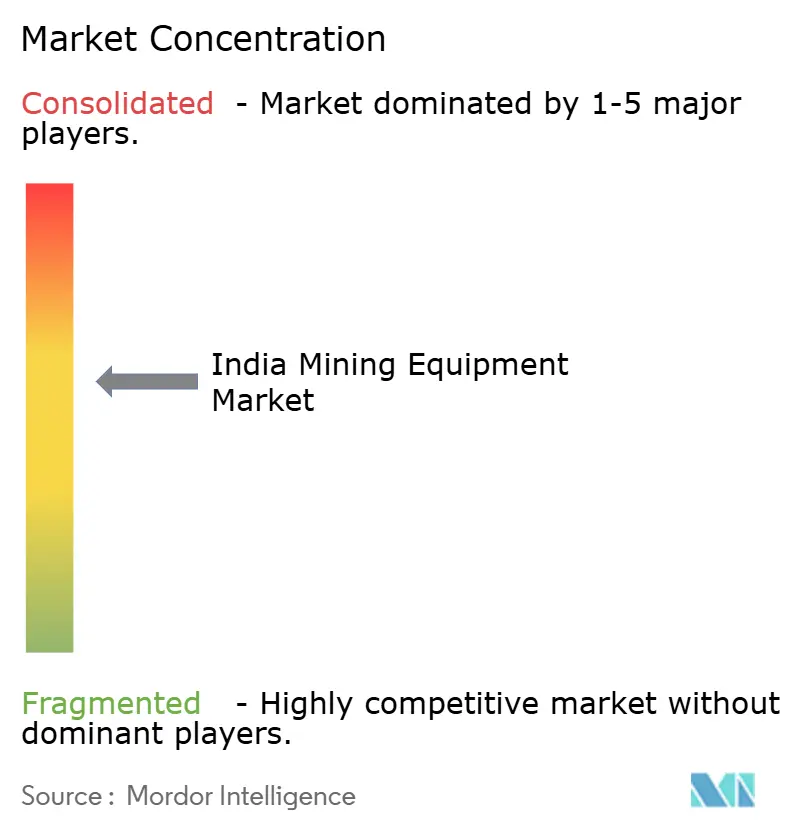
| Market Concentration | Medium |
Major Players *Disclaimer: Major Players sorted in no particular order Image © Mordor Intelligence. Reuse requires attribution under CC BY 4.0. | |
India Mining Equipment Market Analysis by Mordor Intelligence
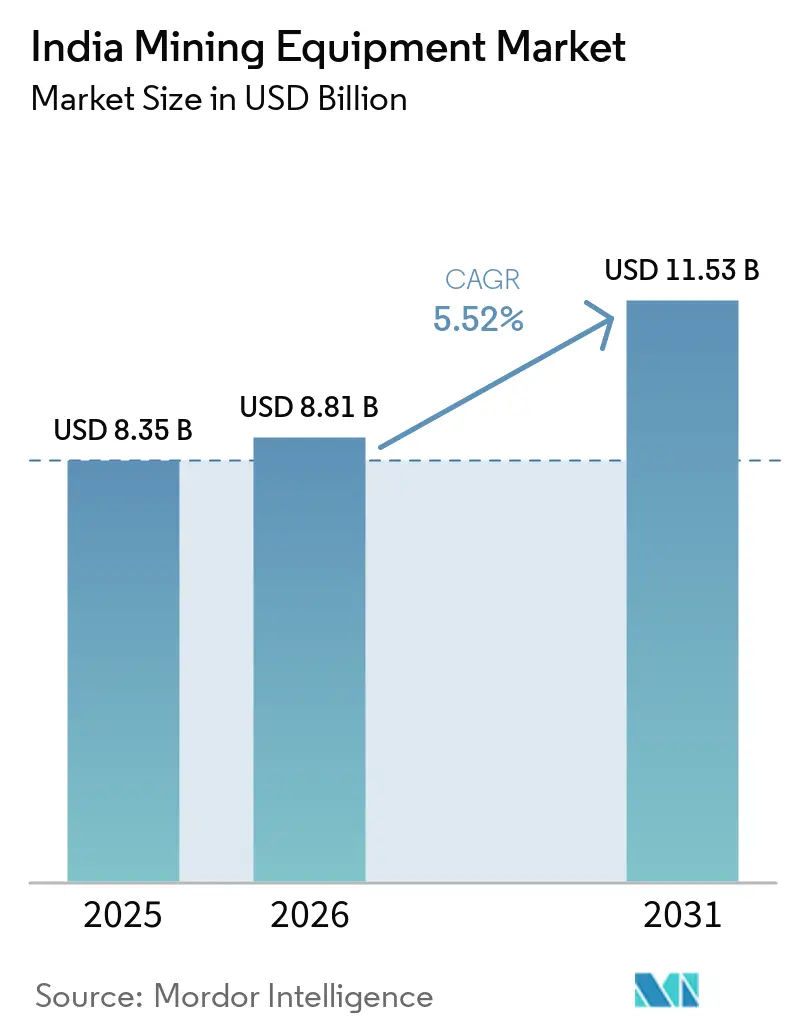
The Indian Mining Equipment Market size was valued at USD 8.35 billion in 2026, is expected to reach USD 8.81 billion in 2027, and reach USD 11.53 billion by 2032, growing at a CAGR of 5.52% from 2027 to 2032. Mechanization programs in large coal mines, ministry-led critical-mineral auctions, and policies favoring domestically manufactured fleets are supporting steady market growth. Stricter safety regulations that mandate real-time monitoring are encouraging buyers to adopt automation-ready equipment with enhanced monitoring and operational control capabilities. Private rental models are also improving access to modern mining machinery, enabling mid-tier miners to use advanced equipment without substantial upfront capital expenditure. Electric and hydrogen-powered prototypes indicate that the industry’s technology roadmap is gradually shifting toward lower-emission mining solutions. However, diesel-powered equipment continues to account for the majority of orders, as charging and hydrogen refueling infrastructure remains limited across mining locations. Production-linked incentives for underground mining equipment, along with increased infrastructure spending, are expected to further support equipment demand throughout the forecast period.
Key Report Takeaways
- By equipment type, surface mining equipment led with 50.51% of the Indian mining equipment market share in 2026, while underground mining equipment is projected to grow at a 6.73% CAGR through 2032.
- By automation level, manual equipment held a 73.66% share of the Indian mining equipment market in 2026; fully autonomous equipment is forecast to expand at a 7.99% CAGR through 2032.
- By powertrain, internal combustion engine vehicles commanded 94.79% of the Indian mining equipment market share in 2026, whereas battery electric vehicles are expected to grow at an 8.56% CAGR through 2032.
- By power output, the 500-1,000 HP bracket accounted for 56.02% of the Indian mining equipment market share in 2026, while machines above 1,000 HP are expected to register a 6.84% CAGR through 2032.
- By application, metal mining captured 47.13% of the Indian mining equipment market share in 2026, and mineral mining is poised to grow at a 7.45% CAGR during the forecast period.
- By region, Eastern India accounted for 46.11% of the Indian mining equipment market share in 2026; Southern India is set for the fastest regional upswing, at a 7.15% CAGR through 2032.
Note: Market numbers in this report are based on Mordor Intelligence's proprietary estimation framework, which combines nine months of actuals with Q4 projections for base year 2026.
India Mining Equipment Market Trends and Insights
Drivers Impact Analysis*
| Driver | (~) % Impact on CAGR Forecast | Geographic Relevance | Impact Timeline |
|---|---|---|---|
| Government Infrastructure Build-Out | +1.2% | National, Eastern and Central | Medium term (2-4 years) |
| Coal India Mechanization and Capacity Expansion | +0.9% | Eastern core, Central spillover | Short term (≤ 2 years) |
| Stricter Safety Norms | +0.7% | National, early uptake in East and West | Long term (≥ 4 years) |
| Lithium-Copper Exploration Boom | +0.5% | Central and Northern | Long term (≥ 4 years) |
| “Make in India” Push | +0.4% | National, West and South hubs | Medium term (2-4 years) |
| Rise of Rental Models | +0.3% | Tier-1 cities | Short term (≤ 2 years) |
| Source: Mordor Intelligence | |||
Government Infrastructure Build-Out Spurring Mineral Demand
India’s record infrastructure allocation (~USD 134 billion) for fiscal 2026 raises steel and cement consumption, which in turn lifts demand for high-capacity earthmoving and processing machines[1]. Highway, metro, and port projects add fresh tonnage for limestone and aggregates, compelling miners to upgrade crushers and screens to keep pace. National coking-coal targets foster interest in longwall equipment that improves recovery in deeper seams. Each incremental tonne of raw material translates into additional engine hours and shorter replacement cycles, creating a multiplier effect for the Indian mining equipment market. Rental firms are scaling fleets in mineral-rich belts so that mid-sized operators can deploy modern gear without heavy upfront outlays.
Coal India’s Mechanization and Capacity Expansion Roadmap
Coal India’s pipeline of mechanized continuous-miner projects replaces drill-and-blast workflows with integrated cutting, conveying, and silo loading. The program shortens cycle time, improves safety, and anchors long-term orders for loaders, belt systems, and automated haulage units. Subsidiaries targeting higher silo-loading ratios are standardizing truck sizes and adopting dispatch software, a shift that is percolating across supplier tiers. Domestic fabricators are entering turnkey packages to capture rising localization incentives, while global majors bundle telemetry with hardware to secure full-life support contracts. The roadmap, therefore, remains a decisive catalyst for the Indian mining equipment market through the late 2020s.
Stricter Safety Norms Accelerating Automation Adoption
Draft Occupational Safety, Health and Working Conditions regulations mandate real-time monitoring of gas, dust, and proximity in underground and opencast sites [2]. Machines lacking collision-avoidance or operator-fatigue alerts risk shutdowns, encouraging buyers to specify semi- or fully autonomous options. Insurance premiums already reward fleets fitted with telematics that feed continuous safety data. Early adopters report fewer incidents and measurable productivity gains, validating the automation business case. Over time, compliance pressure converts even manually driven units into sensor-rich platforms, tightening the feedback loop between regulation and equipment design.
Lithium-Copper Exploration Boom Requiring Specialty Gear
Critical-mineral auctions covering lithium, copper, and rare-earth tracts stimulate orders for diamond core rigs, portable XRF units, and pilot beneficiation circuits. Lithium pegmatites need selective crushing, dense-media separation, and specialized flotation equipment, not found in legacy iron-ore fleets. Copper prospects demand deeper drilling and downhole logging tools, and shortlist suppliers with hard-rock expertise. Exploration firms often prefer rental or lease arrangements, creating a parallel demand stream for high-mobility rigs. As discoveries progress to pilot plants and specialty crushing and separation lines scale up, the Indian mining equipment market is poised to grow over the long term.
Restraints Impact Analysis*
| Restraint | (~) % Impact on CAGR Forecast | Geographic Relevance | Impact Timeline |
|---|---|---|---|
| High Capex and Financing Hurdles | -0.8% | Nationwide, acute for SMEs | Short term (≤ 2 years) |
| ESG Compliance Costs | -0.6% | National, strict in West and South | Medium term (2-4 years) |
| Skilled-Operator Deficit | -0.4% | Nationwide, severe East and Central | Long term (≥ 4 years) |
| Patchy Mine-Site Connectivity | -0.3% | Remote Eastern and Central belts | Medium term (2-4 years) |
| Source: Mordor Intelligence | |||
High Upfront CAPEX and Financing Hurdles
A single ultra-class haul truck or continuous miner commands a multimillion-dollar price tag, and lenders now offer lower loan-to-value ratios, which raise equity requirements. Smaller leaseholders often postpone mechanization or settle for pre-owned machines with higher downtime, delaying efficiency gains. Equipment rental offsets part of the burden, yet fragmented suppliers and interstate logistics hinder penetration. The financing gap thus slows fleet modernization among mid-tier firms, especially for underground units that carry higher sticker prices and longer payback periods.
Tightening Emission and ESG Compliance Costs
India’s BS-IV norms for non-road engines require additional filtration and catalytic hardware, thereby raising unit prices and operating costs [3]. Retrofitting older fleets is frequently uneconomical, leading to early retirement or penalties. Dust-control rules require spray systems and covered conveyors, which further strain thin margins. Miners eye electric or hybrid powertrains to satisfy ESG audits, yet limited charging infrastructure and cost premiums constrain rollout. The combined weight of emission and disclosure mandates, therefore, tempers the growth tempo of the Indian mining equipment market.
*Our forecasts treat driver/restraint impacts as directional, not additive. The impact forecasts reflect baseline growth, mix effects, and variable interactions.
Segment Analysis
By Equipment Type: Surface Strength, Underground Momentum
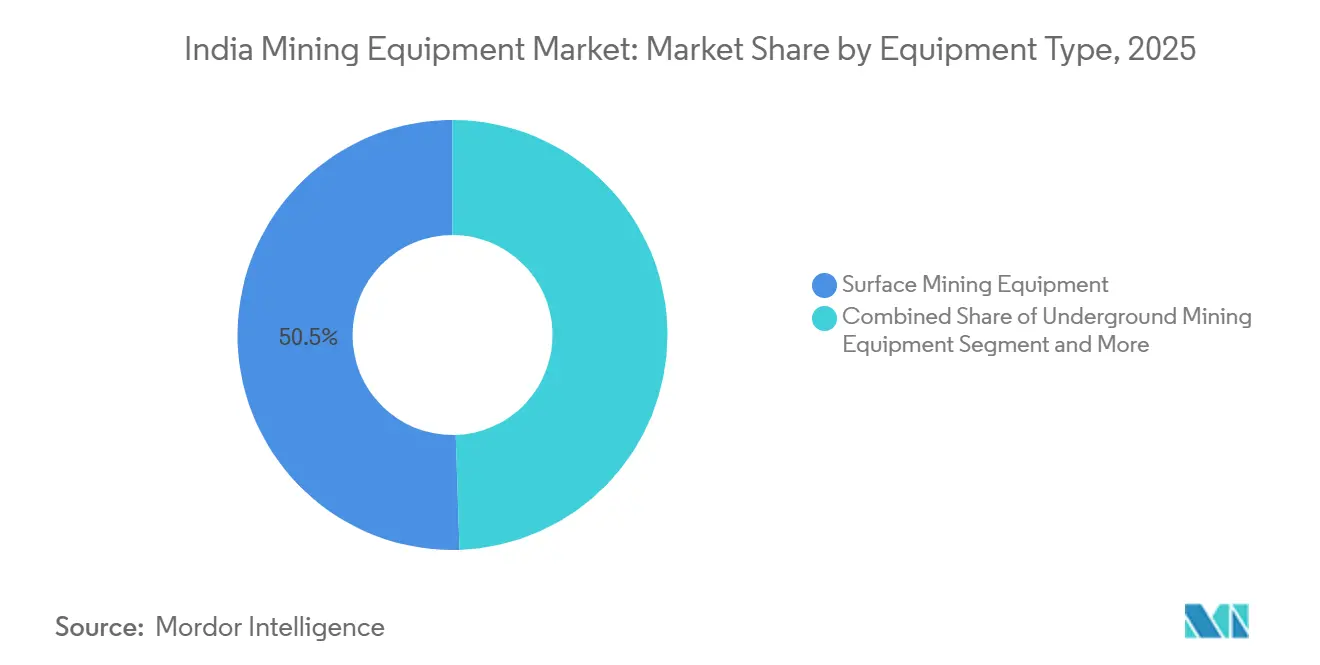
Surface mining equipment accounted for 50.51% of the Indian mining equipment market share in 2026. Strong opencast output in coal, iron ore, and limestone keeps draglines, shovels, and rigid-frame trucks central to mine plans. The replacement of manual loading with hydraulic excavators gains pace as operators seek faster cycle times. Local assemblers expand capacity for body fabrication and engine packaging, improving lead times and after-sales reach. Second-hand imports continue but face growing competition from subsidy-eligible domestic models.
Underground mining equipment is projected to see the fastest expansion at a 6.73% CAGR through 2032. Continuous miners, shuttle cars, and roof-support systems move center stage as deeper seams enter production. Automation features such as tele-remote drilling and real-time strata monitoring shift procurement toward digital-ready platforms. Government incentives for indigenously built bolters and loaders nudge buyers toward local prototypes. Global brands still hold technological edges in battery-electric and autonomous variants, prompting tie-ups with Indian fabricators. Concerted safety enforcement further accelerates the turnover of underground equipment.

By Automation Level: Manual Legacy, Autonomous Upswing
Manual equipment commanded 73.66% of the Indian mining equipment market share in 2026, reflecting the entrenched dominance of operator-driven trucks and excavators. Local workshops retrofit basic telematics and safety sensors to extend compliance at low cost. Training deficits and patchy connectivity keep many fleets in manual mode despite interest in upgrades. Miner education programs are starting to close the skills gap, smoothing the transition to higher automation tiers.
Fully autonomous equipment is set to grow at 7.99% CAGR and represents the fast lane for productivity gains. Pilot deployments demonstrate collision-free operation and lower fuel burn, encouraging wider adoption. Software-as-a-service models let mines pay a monthly autonomy fee instead of a heavy upfront investment. Network operators are testing private 5G cells in remote pits, promising the latency control needed for unmanned fleets. Interoperability standards emerge to enable mixed-brand trucks and drills to share a single command center.
By Powertrain Type: Diesel Rule, Electric Rise
Internal combustion engine vehicles held 94.79% of the Indian mining equipment market share in 2026. Ready access to diesel, familiar maintenance routines, and flexible refuel points anchor their dominance. Tier-4 engines improve particulate and NOx control, supporting compliance without radical shifts in infrastructure. Operators focus on dynamic idle reduction and fuel-management software to trim consumption.
Battery electric vehicles will expand at an 8.56% CAGR through 2032. Early use cases concentrate in underground mines where exhaust ventilation costs are high, and haul distances are short. Domestic OEMs launch 35-70-tonne prototypes, backed by government grants that offset battery premiums. Studies show lower total energy costs over the machine's lifetime, though high upfront costs slow mass adoption. Renewable micro-grids with storage are popping up at isolated sites, creating charging islands for future fleets.
By Power Output: Mid-Range Sweet Spot, Ultra-Class Edge
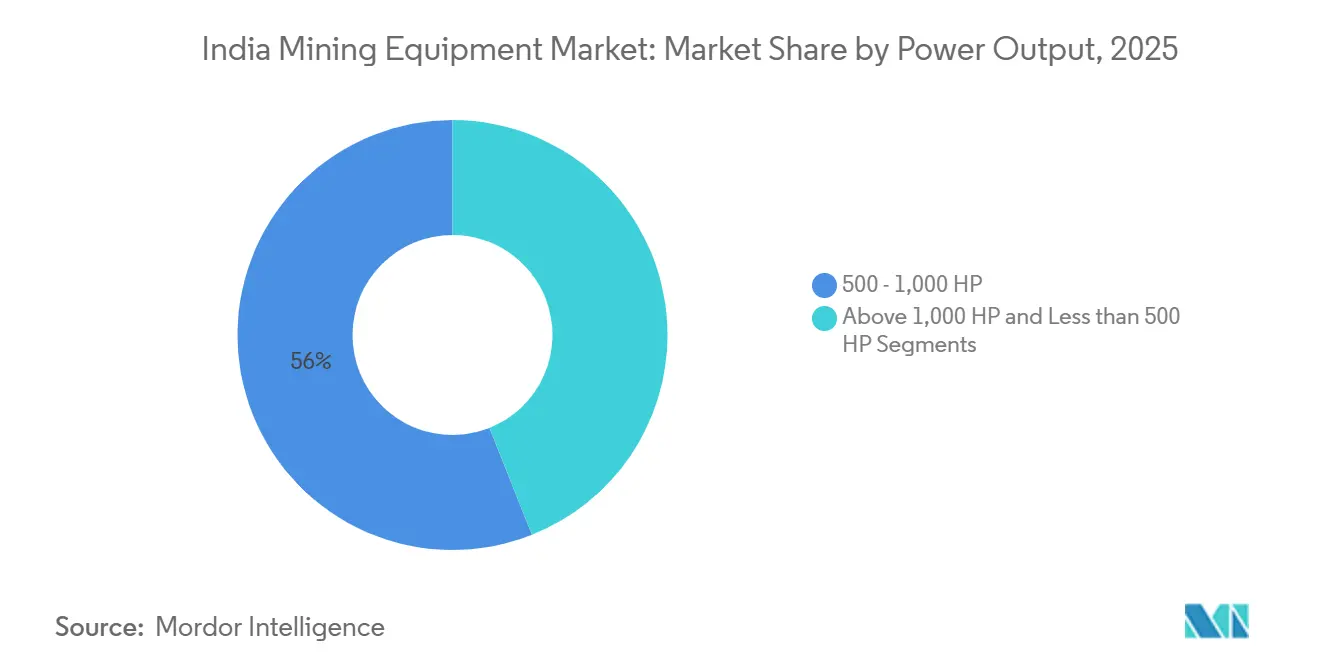
The 500-1,000 HP band accounted for 56.02% of the Indian mining equipment market share in 2026, making it ideal for shovel-truck pairs that dominate exports of iron ore and domestic thermal coal pits. These machines benefit from standardized components, which improve parts availability and make operator training more efficient. Additionally, aftermarket providers play a crucial role by offering extended warranties and predictive diagnostics, helping operators manage lifecycle costs more effectively and ensuring smoother operations over time.
Machines above 1,000 HP are projected to grow at a 6.84% CAGR. Mega-pits justify the use of large excavators and 240-tonne haulers, delivering economies of scale. Autonomous haulage kits debut first at this horsepower tier because payload sensors and drive-by-wire controls come factory-installed. Road-width, bridge-load, and ramp-grade constraints limit deployment to a handful of ultra-high-volume mines, but fleet managers value the per-ton cost advantage when volumes exceed break-even thresholds.
By Application: Metals Lead, Minerals Surge
Metal mining held 47.13% of the Indian mining equipment market share in 2026, anchored by iron ore, bauxite, and zinc operations. Stringent export-grade and moisture limits have heightened demand for high-throughput crushers and dewatering screens. Additionally, plant-level digital twins are being utilized to schedule preventive maintenance, effectively curbing unplanned downtime in bulk-tonnage pits.
Mineral mining is forecast to grow at a 7.45% CAGR, the fastest among applications. Orders for selective mining and multi-stage beneficiation lines are on the rise, driven by lithium pegmatites and rare-earth placers. To sidestep lengthy import lead times, early movers are securing equipment slots well in advance of block commissioning. Furthermore, pilot plants are proving instrumental, offering runtime data that informs the scaling up of full commercial circuits anticipated in the early 2030s.
Geography Analysis
Eastern India accounted for 46.11% of the 2026 value and continues to anchor the Indian mining equipment market. Dense clusters of iron ore and coking coal pits drive 24-hour utilization for excavators, crushers, and long conveyor links. State-run majors align procurement with First-Mile Connectivity targets, shifting truck loading to silos that require precise automation. Local colleges supply a steady stream of mechanics and operators, keeping wage inflation moderate. Rail sidings and inland waterways shorten raw-material haul cycles and improve equipment uptime.
Southern India is projected to grow at 7.15% CAGR, the fastest regional growth rate. Karnataka’s swift license approvals turn exploration plots into operational mines on compressed timelines, driving demand for modular processing skids and rental earthmovers. Andhra Pradesh’s emerging rare-earth corridor imports pilot separators that will later scale up to commercial capacity. Manufacturers from Tamil Nadu and Telangana are expanding their fabrication sheds to reduce freight distances and speed up service response times. Policy clarity and digital clearance portals help reduce approval lag, further supporting equipment uptake.
Central, Northern, and Western regions post moderate but uneven growth. Madhya Pradesh and Rajasthan offer sizeable reserves yet face rail bottlenecks that slow the mobilization of heavy equipment. Gujarat’s bauxite and limestone belts buy mid-sized loaders and screening units, reflecting smaller pit geometry. Highwall and surface miners are gaining traction at coal edges where draglines are uneconomical, and this technology crossover is migrating westward. Limited grid capacity in remote districts nudges buyers toward diesel-hybrid gensets that power drills and conveyors without full electrification.
Competitive Landscape
Global majors such as Caterpillar, Komatsu, Sandvik, and Epiroc share the headline tier and leverage autonomy, telemetry, and underground innovation to protect margins. Domestic firms, including BEML and Tata Hitachi, defend their share through life-cycle cost advantages and localized support networks, aided by tariff buffers and Make in India incentives. The proposed production-linked incentive package for underground gear tilts future orders toward indigenous assembly and shortens supply chains.
Partnership models shape the mid-decade battlefield. Leading miners sign multi-year maintenance and technology agreements that bundle parts, analytics, and operator retraining. Smaller contenders differentiate through rental pools and quick-turn refurbishment of used assets, tapping markets where credit remains tight. Component suppliers build domestic casting and battery-pack lines, aiming to localize 70% of bill-of-materials content and secure eligibility for policy rebates.
Autonomy rollouts divide players. Early projects pair high-horsepower trucks with centrally managed haulage software that promises double-digit productivity gains. Vendors that integrate safety sensors at the factory win compliance-driven tenders. Meanwhile, battery-electric prototypes open a new flank in underground and short-haul niches. Scale-up hinges on local cell manufacturing and standardized charging, arenas where alliances between equipment builders and energy firms become decisive.
India Mining Equipment Industry Leaders
-
Caterpillar Inc.
-
Komatsu Ltd.
-
Sandvik AB
-
Epiroc AB
-
BEML Limited
- *Disclaimer: Major Players sorted in no particular order
Recent Industry Developments
- April 2026: Eimco Elecon unveiled two battery-powered underground vehicles, expanding the availability of domestically manufactured electric vehicles for underground mining operations.
- April 2026: South Eastern Coalfields commissioned a highwall miner at the Sharda Open Cast Mine to increase coal production and improve coal extraction from the mine’s highwall areas.
- December 2025: Sany India launched three electric machines at EXCON 2025, including a 70-ton mining truck and a 65-ton excavator, highlighting its focus on electric heavy equipment for construction and mining applications.
India Mining Equipment Market Report Scope
The scope of the report includes Equipment Type (Surface Mining Equipment, Underground Mining Equipment, and More), Automation Level (Manual Equipment, Semi-Autonomous Equipment, and More), Powertrain Type (Internal-Combustion Engine Vehicles, Battery-Electric Vehicles, and More), Power Output, Application, and Region. The Market Forecasts are Provided in Terms of Value (USD) and Volume (Units).
| Surface Mining Equipment |
| Underground Mining Equipment |
| Mineral Processing Equipment |
| Drills and Breakers |
| Crushing, Pulverizing and Screening |
| Loaders and Haul Trucks |
| Manual Equipment |
| Semi-Autonomous Equipment |
| Fully Autonomous Equipment |
| Internal-Combustion Engine Vehicles |
| Battery-Electric Vehicles |
| Hybrid Vehicles |
| Less than 500 HP |
| 500 to 1,000 HP |
| Above 1,000 HP |
| Metal Mining |
| Mineral Mining |
| Coal Mining |
| Northern India |
| Eastern India |
| Western India |
| Southern India |
| Central India |
| By Equipment Type | Surface Mining Equipment |
| Underground Mining Equipment | |
| Mineral Processing Equipment | |
| Drills and Breakers | |
| Crushing, Pulverizing and Screening | |
| Loaders and Haul Trucks | |
| By Automation Level | Manual Equipment |
| Semi-Autonomous Equipment | |
| Fully Autonomous Equipment | |
| By Powertrain Type | Internal-Combustion Engine Vehicles |
| Battery-Electric Vehicles | |
| Hybrid Vehicles | |
| By Power Output | Less than 500 HP |
| 500 to 1,000 HP | |
| Above 1,000 HP | |
| By Application | Metal Mining |
| Mineral Mining | |
| Coal Mining | |
| By Region | Northern India |
| Eastern India | |
| Western India | |
| Southern India | |
| Central India |
Key Questions Answered in the Report
How large could the India mining equipment space become by 2032?
It is expected to reach about USD 11.53 billion by 2032, expanding at a 5.52% CAGR from 2027 to 2032.
Which equipment line is recording the quickest growth in India?
Underground mining machines lead the pace, with a forecasted 6.73% CAGR through 2032 as deeper seams and new safety rules push operators below ground.
What adoption rate is projected for battery-electric fleets used at Indian mines?
Battery-electric units are on track for an 8.56% CAGR, driven by conversions at Hindustan Zinc and new EV dump-truck launches.
Why does Eastern India remain the country’s biggest buyer of heavy mining gear?
Dense iron ore and coking coal belts in Odisha, Jharkhand, and Chhattisgarh support round-the-clock equipment utilization and account for 46.11% of total equipment demand in 2026.