
China Mining Equipment Market Size and Share
Market Overview
| Study Period | 2019 - 2031 |
|---|---|
| Forecast Data Period | 2026 - 2031 |
| Base Year Market Size (2025) | USD 33.78 Billion |
| Market Size (2026) | USD 35.52 Billion |
| Market Size (2031) | USD 45.63 Billion |
| Growth Rate (2026 - 2031) | 5.14 % |
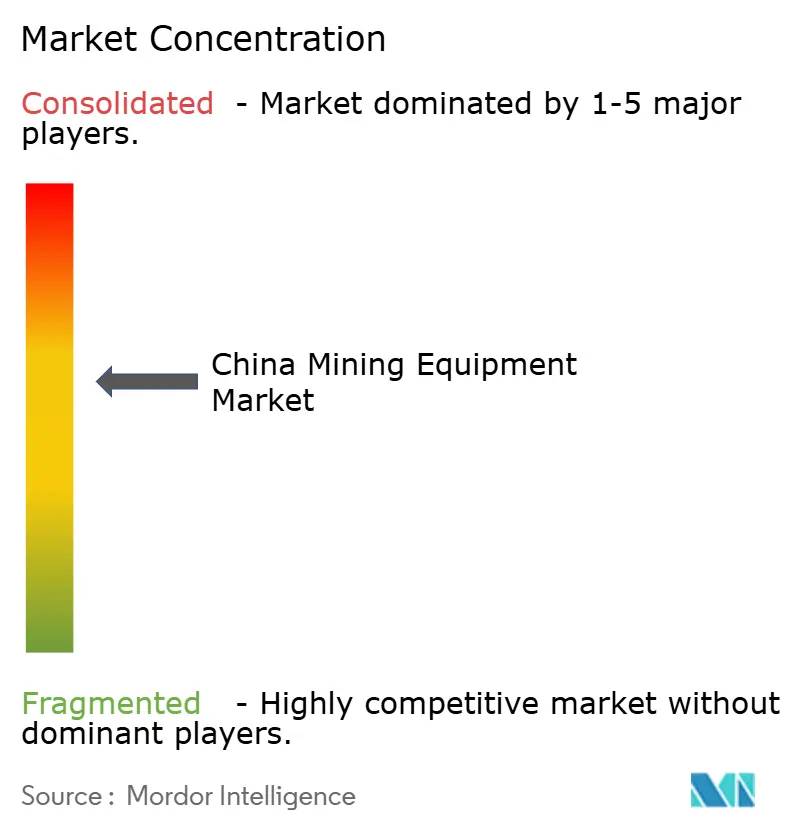
| Market Concentration | Medium |
Major Players *Disclaimer: Major Players sorted in no particular order Image © Mordor Intelligence. Reuse requires attribution under CC BY 4.0. | |
China Mining Equipment Market Analysis by Mordor Intelligence
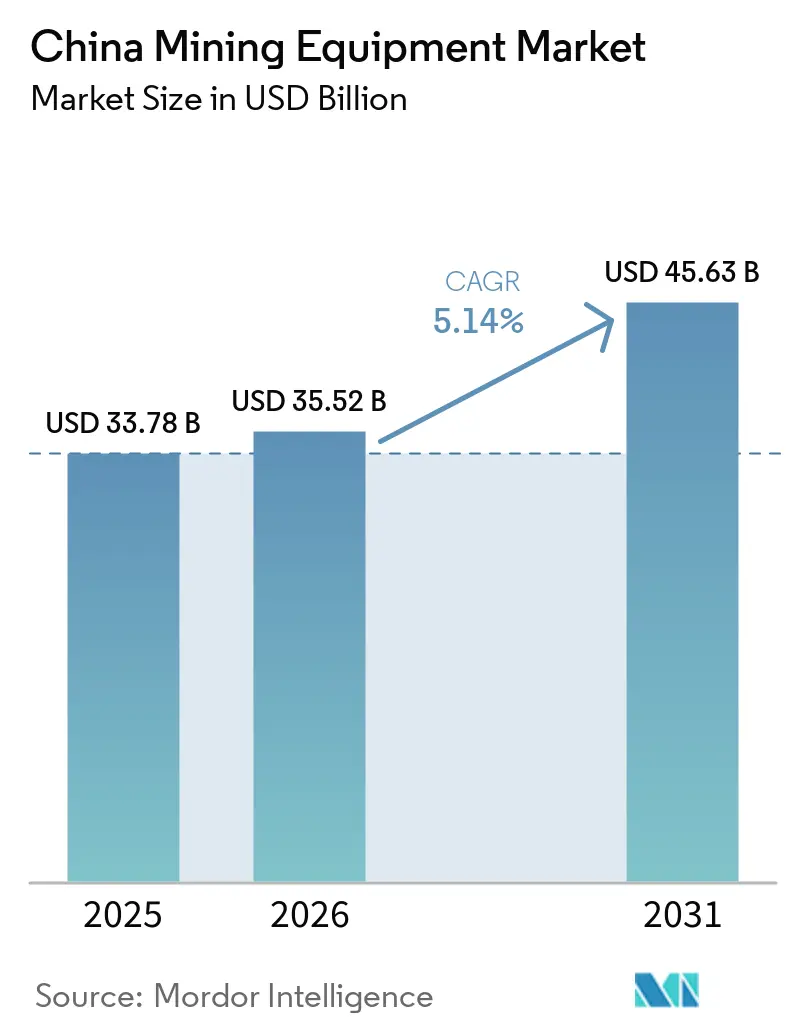
The China mining equipment market size was valued at USD 33.78 billion in 2025, and is projected to grow from USD 35.52 billion in 2026 to USD 45.63 billion by 2031, growing at a CAGR of 5.14% over 2026-2031. Continued policy support for domestic mineral self-sufficiency, rapid fleet electrification, and a step-change in automation underpin this expansion. Operators are prioritizing battery-electric trucks and underground robots to meet tighter safety rules and carbon-peaking targets, while central and provincial subsidies shorten payback periods for new technologies. At the same time, cyclical swings in commodity prices and emerging chip shortages temper near-term capital spending. Equipment suppliers, therefore, balance aggressive innovation with flexible service models to capture the next wave of growth in the Chinese mining equipment market.
Key Report Takeaways
- By equipment type, surface mining machines led with 48.33% of the China mining equipment market share in 2025, while loaders and haul trucks are set to post the fastest CAGR of 6.43% to 2031.
- By automation level, manual equipment captured 61.09% of the China mining equipment market share in 2025, whereas fully autonomous fleets are projected to advance at an 8.33% CAGR through 2031.
- By powertrain, internal combustion engines accounted for 70.42% of the China mining equipment market share in 2025, while battery-electric vehicles will post a sector-leading 9.17% CAGR over 2026-2031.
- By power output, 500–1,000 HP units captured 45.37% of the China mining equipment market share in 2025; units below 500 HP are set to record a 6.06% CAGR through 2031.
- By application, coal mining accounted for 54.61% of China's mining equipment market share in 2025, while mineral mining of non-metallic ores is forecast to grow at a 7.24% CAGR through 2031.
- By region, North China captured 30.14% of the China mining equipment market share in 2025; Southwest China is expected to expand at 6.26% CAGR through 2031 as lithium projects multiply.
Note: Market size and forecast figures in this report are generated using Mordor Intelligence’s proprietary estimation framework, updated with the latest available data and insights as of January 2026.
China Mining Equipment Market Trends and Insights
Drivers Impact Analysis*
| Driver | (~) % Impact on CAGR Forecast | Geographic Relevance | Impact Timeline |
|---|---|---|---|
| Strategic Metals Infrastructure Spend | +1.2% | National, North China and Inner Mongolia | Medium term (2-4 years) |
| Shift to Battery-Electric Fleets | +0.9% | Nationwide, early uptake in Inner Mongolia & Xinjiang | Medium term (2-4 years) |
| Automation for Safety & Productivity | +0.8% | National; pilots in Shanxi & Inner Mongolia | Long term (≥ 4 years) |
| Rare-Earth Expansion for Clean Tech | +0.7% | Southwest China | Long term (≥ 4 years) |
| “Intelligent Mine” Pilot Subsidies | +0.6% | Coal-producing provinces | Medium term (2-4 years) |
| LFP Battery Recycling Demand | +0.4% | East and South-Central China | Short term (≤ 2 years) |
| Source: Mordor Intelligence | |||
Government Infrastructure Spend on Strategic Metals
Beijing’s latest five-year plan earmarks targeted spending to expand domestic supplies of lithium, rare earths, and tungsten[1]. Public funding supports mine power-supply upgrades, access roads, and digital command centers, lowering execution risks for greenfield projects. Equipment suppliers serving these deposits benefit from predictable tenders aligned with national stockpiling objectives. The intensified hunt for strategic metals, therefore, provides a durable floor for demand and a testing ground for advanced crushing, grinding, and flotation technologies.
Shift Toward Battery-Electric Mine Fleets
Battery-electric haulage is reshaping fleet economics as operators pursue carbon-peaking commitments and comply with provincial emission caps. Subsidies under the intelligent-mine program reduce upfront costs, prompting large open-pit coal and rare-earth projects to pilot electric trucks en masse. Improvements in lithium-iron-phosphate chemistry have brought energy-density gains that extend duty cycles and cut charging downtime. On-board analytics also enable real-time route optimization, further lowering operating costs. As a result, the Chinese mining equipment market is seeing a surge in orders for purpose-built electric models and modular conversion kits that repurpose existing diesel assets.
Automation Push for Safety and Productivity
Regulators now link mine licensing to demonstrable reductions in accident rates, spurring the adoption of driverless trucks, autonomous drilling jumbos, and remote longwall systems. Early movers report double-digit improvements in asset utilization and a marked decline in lost-time injuries. AI-enabled dispatch platforms learn haul-cycle patterns and coordinate charging or refueling to avoid peak-tariff periods. The cultural shift toward zero-entry operations is paving the way for integrated underground-surface control centers that supervise multiple sites. Consequently, autonomy is transitioning from pilot to production phase in the Chinese mining equipment market.
Rare-Earth Expansion for Clean-Tech Supply Chains
Beijing’s decision to prioritize rare-earth self-reliance is reshaping equipment demand from pit to processing plant. Provincial plans in Inner Mongolia and Jiangxi call for new rotary drills, magnetic separators, and flotation circuits to boost recovery rates while meeting stricter environmental rules. Downstream magnet and battery manufacturers now co-locate pilot beneficiation lines near the mines to shorten logistics and ensure traceability, creating steady call-offs for crushing and grinding systems engineered for fine particle control. Export-control updates covering rare-earth oxides and tungsten compounds further push mine operators to add domestic value, spurring orders for high-purity calcination kilns and solvent-extraction columns. Equipment suppliers with turnkey automation packages gain an edge because integrated sensors simplify compliance reporting under the green-mine accreditation scheme.
Restraints Impact Analysis*
| Restraint | (~) % Impact on CAGR Forecast | Geographic Relevance | Impact Timeline |
|---|---|---|---|
| Commodity Price Volatility | -0.8% | Export-oriented regions | Short term (≤ 2 years) |
| High Environmental Compliance Costs | -0.6% | Nationwide, eastern provinces | Medium term (2-4 years) |
| Chip Shortages for Autonomy Systems | -0.5% | Nationwide, global supply chains | Short term (≤ 2 years) |
| Carbon Pricing Increasing OPEX | -0.4% | Key industrial provinces | Medium term (2-4 years) |
| Source: Mordor Intelligence | |||
Commodity-Price Volatility Dampening CAPEX
Sharp swings in iron ore and thermal coal prices make cash flow planning difficult, particularly for privately owned mines with limited hedging tools. Delayed project sanctions ripple through the supply chain, slowing original-equipment orders and stretching overhaul intervals. To cope, vendors emphasize pay-per-ton contracts and flexible rental fleets that defer ownership decisions. This service shift cushions the Chinese mining equipment market against abrupt procurement freezes while preserving upgrade momentum when prices recover.
Stringent Environmental Compliance Costs
The China Environmental Law Code 2026 consolidates multiple regulations into a single framework that mandates dust control, tailings-pond safety, and progressive land restoration[2]. Compliance raises capital intensity for new pits and accelerates the replacement of diesel machinery with low-emission alternatives. While larger state-owned enterprises absorb these costs, smaller mines face tighter margins, lengthening adoption cycles for premium equipment. Vendors offer modular packages that embed monitoring sensors and analytics, easing audit requirements and facilitating the transition to greener operations.
*Our forecasts treat driver/restraint impacts as directional, not additive. The impact forecasts reflect baseline growth, mix effects, and variable interactions.
Segment Analysis
By Equipment Type: Surface Machines Retain the Lead, Loaders & Trucks Accelerate
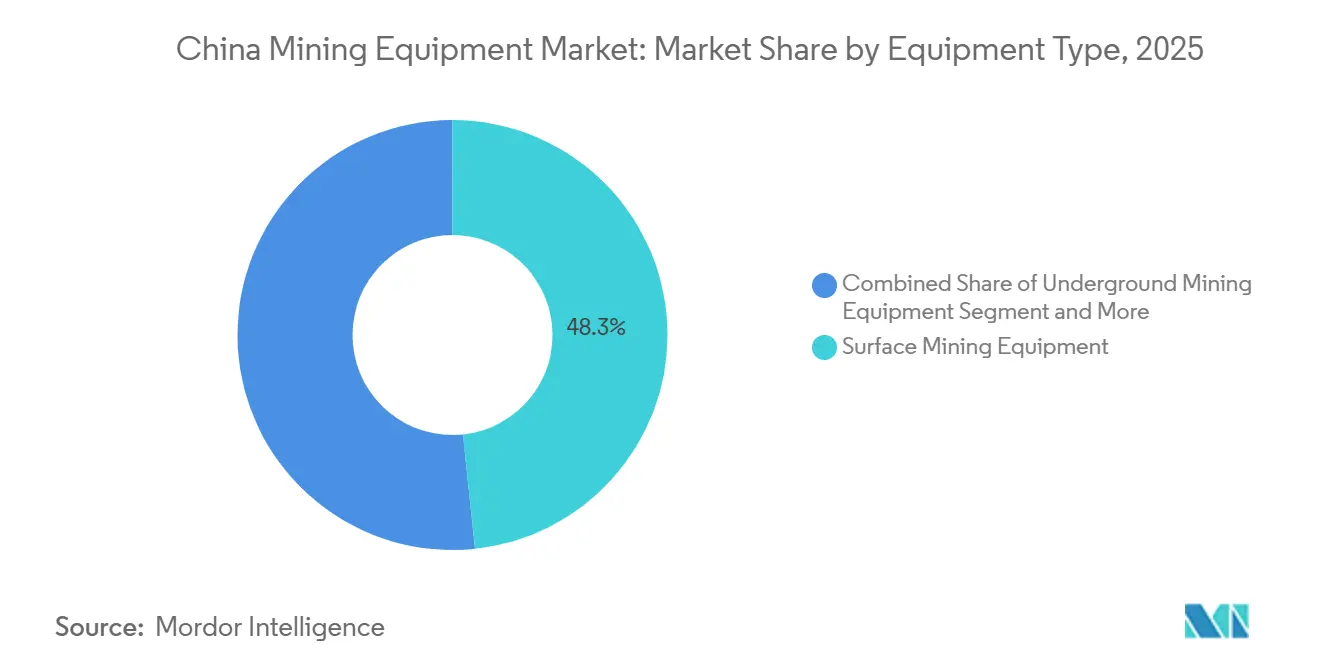
Surface mining equipment captured 48.33% of China's mining equipment market share in 2025, underscoring the prevalence of shallow coal and iron ore deposits. Second-generation electric excavators, draglines, and high-capacity dumpers now enter production as operators target zero-diesel benches. Integrated payload-monitoring and collision-avoidance systems further boost utilization. Meanwhile, OEMs bundle training and predictive-maintenance software, anchoring customers to long-term service plans.
Loaders and haul trucks are slated to grow at a 6.43% CAGR through 2031, the quickest within this category. Growth stems from favorable duty cycles for battery packs and ready access to grid power in major basins. Provincial tenders increasingly specify emissions ceilings that only electric or hybrid platforms can meet. Local firms co-develop driveline and thermal-management components, hastening time-to-market and protecting intellectual property within the China mining equipment market ecosystems.

By Automation Level: Manual Dominance Gives Way to Driverless Haulage
Manual fleets accounted for 61.09% of China's mining equipment market share in 2025, as legacy diesel assets remain serviceable and amortized. Supervisory control retrofits, however, allow operators to phase in autonomy while retaining familiar cab designs. Standardized data buses support over-the-air updates that gradually expand automation functionality. At many sites, the first touchpoint is remote drilling or dozing, providing early wins without disrupting production.
Fully autonomous units are projected to post an 8.33% CAGR, the fastest across automation tiers. Their appeal lies in predictable shift scheduling, reduced liability for accidents, and alignment with China’s national AI strategy. In-house operating systems trained on domestic road and geotechnical data deliver highly localized performance. Supply-chain bottlenecks in lidar and high-end GPUs remain a headwind, yet state-backed consortia aim to scale domestic production, safeguarding the Chinese mining equipment market from external shocks.
By Powertrain Type: Battery-Electric Momentum Outpaces Diesel
Internal-combustion-engine vehicles held 70.42% of China's mining equipment market share in 2025, benefiting from broad fuel availability and established maintenance regimes. Diesel equipment continues to dominate deep-pit haulage where grid connectivity is limited. Even so, stringent carbon-pricing pilots elevate operating costs, creating headroom for cleaner alternatives. Manufacturers thus refine high-efficiency engines and the compatibility of hydrotreated vegetable oil to prolong the platform’s relevance.
Battery-electric vehicles are poised to clock a 9.17% CAGR, the highest among powertrains. Cost curves for lithium-iron-phosphate cells align with heavy-duty cycle requirements, extending range without exotic chemistries. Fast-swap battery bays shorten idle time, while regenerative braking captures downhill energy in steep pits. Financing programs bundle charging infrastructure with vehicle leases, translating capital outlays into predictable service fees and cementing the value proposition of electrification in the Chinese mining equipment market.
By Power Output: Mid-Range Engines Dominate, Sub-500 HP Units Rise
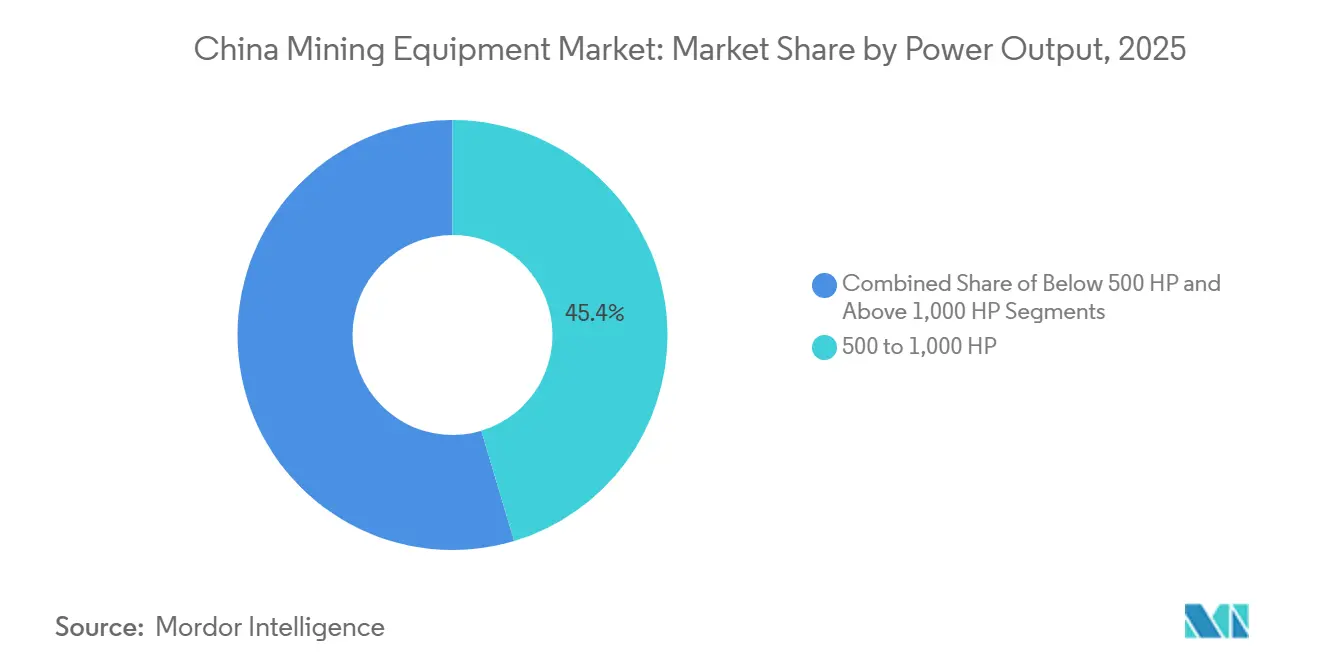
Equipment rated between 500 HP and 1,000 HP accounted for 45.37% of China's mining equipment market share in 2025, a sweet spot that balances payload capacity against operating cost. This bracket spans mid-size shovels, blast-hole drills, and loaders designed for China’s average bench geometries. Ongoing engine upgrades squeeze extra efficiency without major design overhauls, extending the commercial life of proven frames.
Units below 500 HP are set to expand at a 6.06% CAGR as underground coal and narrow-vein metal deposits retreat deeper and require agile machines. Battery-electric and tethered electric variants thrive in these confined headings because they reduce ventilation loads and operator exposure. In addition, local manufacturers leverage standardized chassis to roll out multiple duty-cycle variants, lowering entry barriers for emerging mines and widening supplier diversity across the Chinese mining equipment market.
By Application: Coal Still Rules, Non-Metallic Ores Surge
Coal mining contributed 54.61% of China's mining equipment market share in 2025 on the back of Inner Mongolia and Shanxi’s gigantic open-pits and longwall complexes. Productivity upgrades focus on real-time strata scanning and automated roof support, squeezing more tonnage from maturing seams. Integrated control rooms consolidate multiple shafts, optimizing workforce and spare-parts logistics.
Mineral mining for non-metallic ores will expand at a 7.24% CAGR, the quickest among applications. Lithium-carbonate brine fields and phosphate zones in Sichuan, Tibet, and Guizhou absorb specialized pumps, crushers, and membrane systems that strip impurities and boost recovery. Strategic metal policy incentives guarantee offtake, de-risking supplier investments in bespoke process lines. Consequently, the Chinese mining equipment market diversifies beyond its historical coal dependence.
Geography Analysis
North China accounted for 30.14% of China's mining equipment market share in 2025, reflecting its extensive surface coal operations and adjacent steelmaking hubs. The investment emphasis now shifts toward low-emission haulage corridors and autonomous overburden removal to comply with particulate matter rules. Local governments bundle rail spur upgrades with mine permits, thereby tightening integration between extraction and transport.
Southwest China is poised for a 6.26% CAGR, the strongest regional trajectory, as spodumene and brine-lithium ventures in Tibet and Sichuan move from pilot to commercial scale. Remote topography necessitates modular crushing plants and containerized power units that shorten setup time. Provincial authorities are fast-tracking grid extensions to integrate high-altitude renewable power with new battery-grade chemical plants, fostering a virtuous cycle of clean-energy equipment orders in the Chinese mining equipment market.
Eastern, South-Central, and Northeast regions show moderate growth driven by gold, phosphate, and deep-seam coal operations. Here, the adoption of automation often begins with teleoperation to address labor scarcity and stringent safety targets. Government vocational academies partner with OEMs to certify remote-control operators, broadening the talent pipeline. The coastal grid’s stability favors battery-electric rollouts, yet aging portside smelters still rely on diesel yard machinery, creating a two-speed decarbonization landscape. Overall, geographic diversity cushions national demand cycles and underscores why suppliers tailor offerings to distinct regulatory and topographic contexts within the China mining equipment market.
Competitive Landscape
The top five suppliers—Sany, XCMG, Caterpillar China, Komatsu China, and Zoomlion—collectively anchor the sector yet leave meaningful headroom for emerging specialists. Domestic champions leverage central procurement programs and after-sales footprints that extend deep into county-level industrial parks. Their modular design philosophy allows shared driveline and control components across excavators, loaders, and trucks, reducing inventory and boosting uptime. At the same time, tight integration with steelmakers and energy majors yields co-development opportunities that channel R&D toward practical field needs.
Global brands defend their share through advanced autonomy software, high-reliability subsystems, and lifetime performance guarantees. To navigate local-content mandates, they form manufacturing joint ventures and technology-transfer deals that embed intellectual property within Chinese legal entities. This collaboration accelerates market access for specialized sensors and power electronics while satisfying policymakers’ localization benchmarks. Meanwhile, service agreements shift from parts resale to analytics subscriptions that forecast component wear, deepen customer stickiness, and smooth revenue.
Niche innovators focus on battery-swap systems, mixed-fleet dispatch platforms, and AI-driven ore-sorting units. Their success attracts venture capital and occasionally triggers strategic minority investments from incumbents seeking low-cost technology options. Government pilot funds further de-risk scale-up, pulling innovations from lab to pit at record speed. With new entrants tackling pain points such as rapid charging in -30 °C climates, the China mining equipment market continues to exhibit vibrant competition despite moderate concentration.
China Mining Equipment Industry Leaders
-
Sany Heavy Equipment
-
Xuzhou Construction Machinery Group Co., Ltd. (XCMG)
-
Caterpillar Inc. (China)
-
Komatsu Ltd. (China)
-
Zoomlion Heavy Industry
- *Disclaimer: Major Players sorted in no particular order
Recent Industry Developments
- August 2026: Zijin Longking launched the 230-ton-class ZL230E battery-electric mining truck and signed an autonomous mining partnership with EACON. The truck has a gross vehicle weight of 350 t, an empty weight of 120 t, a maximum payload of 230 t, and a heaped body capacity of 125 m. It features a multi-axle, centrally distributed independent-drive architecture with dual 800 kW motors.
- April 2026: China introduced a 500-ton vertical-shaft drilling machine capable of excavating to depths exceeding 1,000 meters, reflecting the country’s efforts to access deeper resources while minimizing surface disturbances.
- February 2026: Under a zero-emission supply framework, XCMG unveiled the world’s largest all-electric wheel loader and dozer. This equipment represented the first of more than 100 machines destined for Fortescue’s Pilbara mines.
China Mining Equipment Market Report Scope
The China Mining Equipment market is segmented by equipment type, automation level, powertrain type, power output (HP), application, and region (China). By Equipment Type, the market is segmented into Surface Mining Equipment, Underground Mining Equipment, Mineral Processing Equipment, Drills and Breakers, Crushing, Pulverizing, and Screening Equipment, and Loaders and Dozers. By Automation Level, the market is segmented into Manual, Semi-Autonomous, and Fully Autonomous Equipment. By Powertrain Type, the market is segmented into Internal-Combustion Engine (ICE), Battery-Electric Vehicle (BEV), and Hybrid Vehicle. By Power Output (HP), the market is segmented into Below 500 HP, 500 to 1,000 HP, and Above 1,000 HP. By Application, the market is segmented into Metal Mining, Mineral Mining, and Coal Mining. By Region (China), the market is segmented into East China, North China, South-Central China, Northeast China, Southwest China, and Northwest China. Market forecasts are provided in terms of Value (USD) and Volume (Units).
| Surface Mining Equipment |
| Underground Mining Equipment |
| Mineral Processing Equipment |
| Drills and Breakers |
| Crushing, Pulverizing and Screening Machines |
| Loaders and Haul Trucks |
| Manual Equipment |
| Semi-Autonomous Equipment |
| Fully Autonomous Equipment |
| Internal-Combustion Engine Vehicles |
| Battery-Electric Vehicles |
| Hybrid Vehicles |
| Below 500 HP |
| 500 to 1,000 HP |
| Above 1,000 HP |
| Metal Mining |
| Mineral Mining (Non-metallic) |
| Coal Mining |
| East China |
| North China |
| South-Central China |
| Northeast China |
| Southwest China |
| Northwest China |
| By Equipment Type | Surface Mining Equipment |
| Underground Mining Equipment | |
| Mineral Processing Equipment | |
| Drills and Breakers | |
| Crushing, Pulverizing and Screening Machines | |
| Loaders and Haul Trucks | |
| By Automation Level | Manual Equipment |
| Semi-Autonomous Equipment | |
| Fully Autonomous Equipment | |
| By Powertrain Type | Internal-Combustion Engine Vehicles |
| Battery-Electric Vehicles | |
| Hybrid Vehicles | |
| By Power Output (HP) | Below 500 HP |
| 500 to 1,000 HP | |
| Above 1,000 HP | |
| By Application | Metal Mining |
| Mineral Mining (Non-metallic) | |
| Coal Mining | |
| By Region (China) | East China |
| North China | |
| South-Central China | |
| Northeast China | |
| Southwest China | |
| Northwest China |
Key Questions Answered in the Report
How large is the China mining equipment market today and where is it headed?
The China mining equipment market size stood at USD 33.78 billion in 2025 and is projected to reach USD 45.63 billion by 2031, translating into a 5.14% CAGR.
Which segment currently holds the biggest share of equipment demand?
Surface mining machines accounted for 48.33% of nationwide demand in 2025, reflecting the scale of open-pit coal and iron-ore operations.
What is driving adoption of battery-electric haul trucks
Provincial emission caps, intelligent-mine subsidies, and declining lithium-iron-phosphate battery costs together make electric haulage cheaper to run over a truck’s life cycle.
Where is the fastest regional growth expected?
Southwest China, fueled by lithium and rare-earth developments, is forecast to expand equipment demand at 6.26% CAGR through 2031.