
Middle East Fixed Wireless Access Market Size and Share
Market Overview
| Study Period | 2019 - 2030 |
|---|---|
| Forecast Data Period | 2025 - 2030 |
| Historical Data Period | 2019 - 2023 |
| Market Size (2025) | USD 6.16 Billion |
| Market Size (2030) | USD 11.66 Billion |
| Growth Rate (2025 - 2030) | 13.62 % |
| Market Concentration | Medium |
Major Players
*Disclaimer: Major Players sorted in no particular order Image © Mordor Intelligence. Reuse requires attribution under CC BY 4.0. |
|

Middle East Fixed Wireless Access Market Analysis by Mordor Intelligence
The Middle East fixed wireless access market size is estimated to be USD 6.16 billion in 2025 and is expected to reach USD 11.66 billion by 2030, growing at a CAGR of 13.62% during the forecast period (2025-2030). Strong sovereign-fund backing, generous spectrum allocations, and payback models of less than two years keep capital flowing into network upgrades and customer-premises equipment. Operators monetize capacity that would otherwise remain idle on 5G standalone networks, while governments raise minimum broadband speed mandates as part of their national transformation agendas. Saudi Arabia and the United Arab Emirates, already among the most fiber-ready economies in the region, are repurposing 5G spectrum to bridge the last-mile gap in newly developed residential and industrial districts. Equipment vendors accelerate the cycle by releasing Wi-Fi 7-capable indoor gateways and high-gain outdoor units that lower installation times and total cost of ownership for operators.
Key Report Takeaways
- By type, services commanded 73.31% of the Middle East fixed wireless access market share in 2024, while the hardware category trailed at 14.69%.
- By application, residential held 65.08% of the Middle East fixed wireless access market size in 2024, whereas the industrial segment is projected to expand at a 15.59% CAGR through 2030.
- By frequency band, Sub-6 GHz captured 82.51% of deployments in the Middle East fixed wireless access market in 2024; the mmWave tier is expected to carry the fastest growth outlook at a 15.13% CAGR.
- By deployment mode, indoor CPE devices accounted for 70.15% share of the Middle East fixed wireless access market in 2024, and outdoor CPE shipments are forecast to grow at 16.06% CAGR to 2030.
- By country, Saudi Arabia led the Middle East fixed wireless access market in 2024 with a 29.69% share, while the Rest of Middle East cluster posted the strongest 17.24% CAGR, driven by infrastructure catch-up programs.
Note: Market size and forecast figures in this report are generated using Mordor Intelligence’s proprietary estimation framework, updated with the latest available data and insights as of January 2026.
Global valuation is built by aggregating outputs from multiple regions, with Middle east forming one of the important contributors. Mordor Intelligence's global fixed wireless access market size report represents that cumulative total.
Market Trends and Insights
Drivers Impact Analysis of Middle East Fixed Wireless Access Market*
| Driver | (~) % Impact on CAGR Forecast | Geographic Relevance | Impact Timeline |
|---|---|---|---|
| Rapid 5G SA roll-outs and generous C-band allocations | +3.2% | Saudi Arabia, UAE, Qatar core with spillover to Kuwait, Bahrain | Medium term (2-4 years) |
| Government gigabit-society broadband mandates | +2.8% | GCC countries, with Saudi Vision 2030 and UAE Digital Government Strategy leading | Long term (≥ 4 years) |
| Mobile-capacity monetisation and <2-yr FWA payback models | +2.1% | Urban centers across Saudi Arabia, UAE, Qatar | Short term (≤ 2 years) |
| Rising home-broadband demand for fibre-like speeds | +1.9% | Residential markets in major cities: Riyadh, Dubai, Doha, Kuwait City | Medium term (2-4 years) |
| 5.5G gamer / 3-D media rate-based FWA bundles | +1.4% | Premium consumer segments in UAE, Saudi Arabia | Medium term (2-4 years) |
| Sovereign-fund backed tower / DC M&A freeing FWA capex | +1.8% | Regional, with PIF Saudi Arabia and sovereign funds driving consolidation | Long term (≥ 4 years) |
| Source: Mordor Intelligence | |||
Rapid 5G SA roll-outs and generous C-band allocations
Standalone architecture removes legacy LTE anchors, enabling network slicing and ultra-low latency profiles that are essential for differentiated fixed-wireless propositions. In Saudi Arabia, the national regulator auctioned wide C-band blocks that allowed stc to build 45.7% population coverage inside three years.[1]Communications and Information Technology Commission, “Spectrum Auction Results 2024,” citc.gov.sa du and Nokia delivered the first commercial 5G standalone cloud RAN in the Gulf, which slashes core-network signaling overhead and speeds up service activation. [2]Nokia, “du and Nokia Launch First Cloud RAN in MEA,” nokia.comOoredoo’s 98.92% 5G coverage in Qatar underscores how contiguous mid-band holdings shorten rural deployment timelines. Consistent with ITU-R and 3GPP Release 16 guidelines, national authorities now release harmonized channel plans that reduce cross-border interference and ease roaming for enterprise devices. Together these factors add roughly 3.2 percentage points to the forecast CAGR in the medium term.
Government gigabit-society broadband mandates
Digital transformation roadmaps, such as Saudi Vision 2030 and the UAE Digital Government Strategy, obligate operators to meet or exceed minimum-speed obligations. stc connected 3.7 million Saudi homes using a mix of fiber and fixed wireless solutions, closing coverage gaps in desert suburbs where trenching costs remain prohibitive. The UAE regulator reinforces performance targets via crowdsourced speed-test audits, creating financial incentives for quick FWA turn-ups. Egypt linked spectrum-fee rebates to rural buildouts, accelerating adoption within the Decent Life program. Such policy alignment guarantees a stable demand floor and supports multiyear investment payback, contributing an estimated 2.8 percentage-point lift to the regional CAGR.
Mobile-capacity monetization and < 2-year FWA payback
Operators reuse macro-cell assets and idle spectrum to deliver fixed wireless at one-third the cost of fiber in suburban belts. GSMA modeling shows urban deployments achieve operating breakeven inside 24 months when loading ratios exceed 20 connected homes per sector. Zain KSA’s 5G Home Premium plan, offering 300 Mbps and router bundling, exemplifies aggressive pricing aimed at high-volume uptake. Cash-flow visibility has encouraged sovereign-wealth funds to bankroll tower-sale-and-leaseback deals that unlock capital for CPE subsidies. The result is a 2.1 percentage-point boost to aggregate growth in the short term.
Rising residential demand for fiber-like speeds
Average Middle Eastern mobile data use climbed to 44 GB per user per month in 2024, driven by streaming, cloud gaming, and hybrid work patterns. Nokia’s FastMile Gateway 4, with Wi-Fi 7 and 4 Gbps throughput, mitigates in-home signal loss and sustains gigabit-class experiences. D-Link projects 150,000 5G CPE units shipping to the region in 2025, confirming the pull from middle-income households upgrading from DSL. Operators layer value-added media bundles, including edge-rendered VR games, to support premium pricing. Residential appetite, therefore, contributes nearly 1.9 percentage points to medium-term CAGR expansion.
Restraints Impact Analysis of Middle East Fixed Wireless Access Market*
| Restraint | (~) % Impact on CAGR Forecast | Geographic Relevance | Impact Timeline |
|---|---|---|---|
| Aggressive fibre build-outs cannibalising FWA | -2.4% | Urban centers in UAE, Qatar, Saudi Arabia with high fiber penetration | Medium term (2-4 years) |
| Mid-band spectrum congestion in dense GCC cities | -1.8% | Dubai, Riyadh, Doha, Kuwait City metropolitan areas | Short term (≤ 2 years) |
| Premium pricing of 5G mmWave CPE | -1.2% | Regional, affecting mmWave adoption across all markets | Medium term (2-4 years) |
| Rooftop / façade aesthetic bans on outdoor CPE | -0.9% | Urban residential areas with strict building regulations | Long term (≥ 4 years) |
| Source: Mordor Intelligence | |||
Aggressive fiber build-outs cannibalizing FWA
Ooredoo, stc, and Etisalat push multi-gigabit PON deeper into affluent districts, trimming the addressable base for wireless alternatives. Ooredoo Qatar moved to 50G-PON in 2024, delivering speeds no current FWA product can match. [3]Ooredoo, “50G-PON Launch Announcement,” ooredoo.comIn the UAE, open-access duct policies have reduced civil work costs, enabling fiber to be deployed deeper into high-rise corridors. As fiber footprints widen, mobile operators reposition 5G fixed wireless as a stop-gap or a multi-access backup product rather than a full substitute, shaving 2.4 percentage points off regional CAGR expectations.
Mid-band spectrum congestion in dense GCC cities
Multi-operator traffic peaks in Riyadh, Dubai, and Doha strain limited 3.5 GHz holdings, forcing dynamic spectrum sharing between mobile broadband and fixed wireless use cases. Egypt’s USD 150 million spectrum award underlines rising asset valuations, which deter regulators from releasing additional contiguous blocks. Operators respond with carrier aggregation across C-band and millimeter-wave, but cell-edge rates still sag during evening peaks, dampening quality-of-service perceptions for enterprise clients. The constraint trims 1.8 percentage-points from the CAGR in the short term.
*Our forecasts treat driver/restraint impacts as directional, not additive. The impact forecasts reflect baseline growth, mix effects, and variable interactions.
Middle East Fixed Wireless Access Market Segment Analysis
By Type:
Services Drive Recurring Revenue ModelsIn 2024, services captured 73.31% of the Middle East fixed wireless access market share, reflecting operator preference for subscription-based income and customer lifetime value. Hardware filled the remaining 26.69%, but declining CPE prices continue to narrow the gap. Services revenue is projected to grow at a 14.69% CAGR to 2030, driven by managed security, edge computing, and slice-as-a-service offerings that leverage standalone 5G cores. The segment benefits from network slicing experimentation, enabling operators to offer differentiated latency or throughput tiers without incurring additional radio spending. Femto and picocell rollouts, although booked under hardware, amplify service ARPU by improving indoor link quality in high-rise clusters.
Hardware demand nevertheless stays resilient as vendors integrate Wi-Fi 7, dual-SIM fallback, and advanced beamforming into customer-premises units. D-Link’s 2025 projection of 150,000 regional CPE shipments underscores the replacement cycle from LTE routers to 5G equipment. Nokia’s FastMile Gateway 4 achieves a peak downlink of 4 Gbps and supports application-level QCI mapping, enabling premium residential plans. With CPE average selling prices trending toward parity with LTE variants, hardware retains relevance, but the services layer remains the primary monetization engine for operators.



By Application:
Industrial Segment Accelerates Smart-City DeploymentsResidential lines accounted for 65.08% of the Middle East's fixed wireless access market size in 2024, driven by the adoption of household streaming and the work-from-anywhere trend. Operators bundle unlimited data tiers with gaming platforms and over-the-top video to lift monthly ARPU beyond USD 70 in Saudi Arabia. The industrial slice, although smaller, records the fastest 15.59% CAGR to 2030 as Gulf smart-city budgets exceed USD 1 trillion. Logistics firms, such as CJ Logistics, reduced capital expenditure by 15% by swapping Wi-Fi grids for 22 small 5G cells in their automated warehouses. Energy majors, including Aramco Digital, which holds a 450 MHz private license, pursue dedicated wireless solutions for pipeline and refinery telemetry.
Commercial use cases, which branch connectivity for retail and banking, sit between the two extremes, taking a share when fiber rollouts stall at property borders. Private-network proofs of concept show latency under 5 milliseconds, enabling time-sensitive automation. Nevertheless, the bulk of revenue remains household broadband until enterprise-grade service-level agreements mature and a broader device ecosystem arrives.
By Frequency Band:
mmWave Adoption AcceleratesSub-6 GHz deployments held an 82.51% share in 2024, favored for wide-area coverage and indoor building penetration. mmWave bands above 24 GHz, which currently represent only 17.49%, are projected to grow at the fastest rate, with a 15.13% CAGR. Du and Ericsson achieved 16.7 Gbps using 10-carrier aggregation, which combined mmWave and mid-band blocks, validating the capacity for premium residential tiers. Falling unit costs, GSMA forecasts mmWave CPE at USD 100 parity with Sub-6 devices, clear the path for dense apartment zones where spectrum reuse is critical.
Operators deploy Sub-6 for base coverage, layering mmWave on lamp posts and façades to boost cell-edge rates. Beamforming and high-gain antennas on Nokia’s new gateways extend the practical coverage of 28 GHz signals to over 700 meters in line-of-sight tests. Regulators maintain technology neutrality across auctions, letting licensees trade off contiguous bandwidth versus propagation needs.

By Deployment Mode:
Indoor CPE Dominance Reflects Installation SimplicityIndoor devices secured 70.15% of 2024 shipments, driven by self-install models that cut truck-roll costs and speed revenue recognition. Operators guide users through augmented-reality apps to locate the optimal placement, minimizing the need for return visits. Indoor dominance, however, faces performance limits in low-signal zones. Outdoor units therefore post 16.06% CAGR, particularly in suburban villas and industrial perimeters where roof-mount panels overcome foliage and concrete attenuation. Regulatory façade restrictions in Dubai’s heritage quarters limit outdoor space but prompt vendors to reduce their form factors.
Wi-Fi 7 multi-link operation inside new indoor gateways mitigates local congestion and maximizes the capacity delivered over the last radio hop. Some operators experiment with hybrid kits, which combine an outdoor antenna with an indoor Wi-Fi hub, offering the best of both coverage and convenience while staying within aesthetic guidelines.
Geography Analysis
Saudi Arabia Fixed Wireless Access Market
Saudi Arabia leads regional revenue with a 29.69% share in 2024. stc taps 21,000-plus towers managed by TAWAL across five nations, enabling rapid street-level densification. Vision 2030 earmarked USD 8.7 billion in public-sector contracts for digital infrastructure, ensuring predictable demand flows. Zain KSA’s unlimited 5G Home packages, priced at USD 70 per month, have attracted early adopters, and public-sector digitalization pipelines are sustaining subscriber momentum.
United Arab Emirates Fixed Wireless Access Market
The United Arab Emirates holds the second-largest installed base, propelled by du’s 16.7 Gbps field demonstration and the first regional 5G standalone cloud RAN. Fixed-subscriber lines increased 12.7% year-over-year in 2025, driven by e-government services that require seamless home connectivity. The national regulator ties spectrum-fee discounts to crowdsourced speed-test compliance, an approach now emulated by Bahrain and Oman. Fiber penetration already exceeds 90% in many Dubai districts, so operators pitch fixed wireless as a rapid-activation alternative and as a disaster-recovery secondary link.
MEA Fixed Wireless Access Market
Qatar shows near-universal 5G coverage at 98.92%, with Ooredoo investing in Wi-Fi 7 and 50G-PON hybrids that merge fixed wireless and fiber backbones. Kuwait, Bahrain, and Oman register steady subscriber gains as sovereign funds co-finance data-center expansions that require high-bandwidth last-mile options. The Rest of the Middle East cluster, comprising Egypt, Jordan, Iraq, Tunisia, and Algeria, experiences the fastest growth rate, with a 17.24% CAGR. Egypt’s first 5G spectrum award in 2024 and Jordan’s 50% population-coverage mandate by 2026 unlock pent-up demand, particularly where trenching costs and right-of-way disputes impede fiber rollouts.
Coverage of the fixed wireless access market by Mordor Intelligence spans a wide geographic footprint, with regional analysis available for North America, Asia, and South America, alongside detailed country-level intelligence for France and Germany, each shaped by local operating conditions.
Competitive Landscape
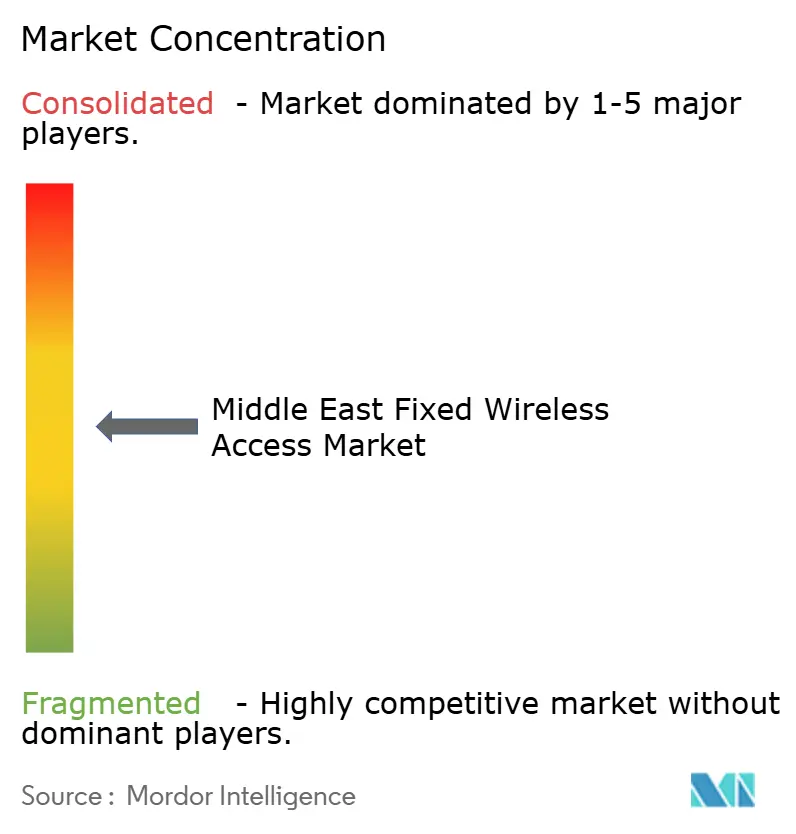
Market concentration remains moderate. Incumbent mobile operators stc, Etisalat, du, Ooredoo, Zain, and Mobily control legacy spectrum holdings that new entrants cannot easily replicate. Hybrid FWA-fiber bundles increase switching barriers by tying wireless service to IPTV and fixed-voice plans. Equipment vendor rivalry intensifies over carrier aggregation, antenna gain, and cost curves: Nokia’s Wi-Fi 7 gateway sets a 4 Gbps benchmark, while Huawei and ZTE push sub-USD 200 outdoor units that appeal to price-sensitive emerging markets. Samsung pursues smart-city deals with modular small cells that integrate edge compute.
Industrial private networks present a white-space segment. CJ Logistics, Batelco, and Aramco Digital pilots signal a shift toward dedicated spectrum leases that bypass public network congestion. Cloud-native core suppliers court operators with slice orchestration tools that monetize low-latency tiers. Regulators enforce performance-based licensing; fines are canceled out if operators meet crowdsourced coverage and speed thresholds, pressuring laggards to buy or lease additional spectrum. With the top five operators estimated to hold roughly 75% combined revenue share, the competitive score tilts toward disciplined yet dynamic rather than monopoly-like behavior.
Middle East Fixed Wireless Access Industry Leaders
-
Saudi Telecom Company
-
Mobily
-
Zain
-
Emirates Integrated Telecommunications Company P.J.S.C (du)
-
Ooredoo
- *Disclaimer: Major Players sorted in no particular order
Middle East Fixed Wireless Access Market Companies Covered in this Report
- Saudi Telecom Company
- Etihad Etisalat Company (Mobily)
- Mobile Telecommunications Company K.S.C.P. (Zain)
- Emirates Integrated Telecommunications Company P.J.S.C (du)
- e&
- Ooredoo Q.P.S.C.
- Bahrain Telecommunications Company B.S.C.
- Oman Telecommunications Company S.A.O.G.
- Huawei Technologies Co., Ltd.
- ZTE Corporation
- Inseego Corp.
- Sagemcom Broadband SAS (Sagemom)
- NETGEAR, Inc.
- Sercomm Corporation
- Vantiva S.A
- Zyxel Communications Corporation
- Samsung Electronics Co., Ltd.
- TP-Link Technologies Co., Ltd.
- Nokia Corporation

Recent Industry Developments in Middle East Fixed Wireless Access Market
- June 2025: D-Link projected 150,000 Middle East 5G CPE shipments for the year .
- May 2025: Regional regulators highlighted crowdsourced data for 5G performance monitoring.
- March 2025: Nokia launched the FastMile Gateway 4 featuring Wi-Fi 7 integration and 4 Gbps throughput.
- December 2024: du and Nokia activated the first commercial 5G standalone cloud RAN in the Middle East.


Middle East Fixed Wireless Access Market Report Scope
The Middle East Fixed Wireless Access Market Report segments the market by Type, encompassing Hardware (including Consumer Premise Equipment (CPE) and access units, such as femtocells and Picocells) and Services. Applications are further divided into Residential, Commercial, and Industrial segments; Frequency Bands are categorized into Sub-6 GHz and mmWave (> 24 GHz); and Deployment Modes are split into Indoor CPE and Outdoor CPE. The report spans geographically across Saudi Arabia, the United Arab Emirates, Israel, Turkey, Qatar, Kuwait, Oman, Bahrain, and the broader Middle East. All market forecasts are expressed in terms of value (USD).
| Hardware | Consumer Premise Equipment (CPE) |
| Access Units (Femto and Picocells) | |
| Services |
| Residential |
| Commercial |
| Industrial |
| Sub-6 GHz |
| mmWave (> 24 GHz) |
| Indoor CPE |
| Outdoor CPE |
| Saudi Arabia |
| United Arab Emirates |
| Israel |
| Turkey |
| Qatar |
| Kuwait |
| Oman |
| Bahrain |
| Rest of Middle East |
| By Type | Hardware | Consumer Premise Equipment (CPE) |
| Access Units (Femto and Picocells) | ||
| Services | ||
| By Application | Residential | |
| Commercial | ||
| Industrial | ||
| By Frequency Band | Sub-6 GHz | |
| mmWave (> 24 GHz) | ||
| By Deployment Mode | Indoor CPE | |
| Outdoor CPE | ||
| By Country | Saudi Arabia | |
| United Arab Emirates | ||
| Israel | ||
| Turkey | ||
| Qatar | ||
| Kuwait | ||
| Oman | ||
| Bahrain | ||
| Rest of Middle East |


Key Questions Answered in the Report
How large is the Middle East 5G fixed wireless access market in 2025?
The market is valued at USD 6.16 billion in 2025 and is projected to grow to USD 11.66 billion by 2030.
Which application is expanding the fastest in regional 5G FWA deployments?
Industrial use cases post the quickest 22.59% CAGR to 2030, fueled by smart-city budgets and private 5G networks.
What share does Sub-6 GHz hold in current Middle East 5G FWA rollouts?
Sub-6 GHz frequencies account for 82.51% of active deployments as of 2024.
Why do operators prefer indoor CPE devices?
Indoor units dominate because self-installation lowers truck-roll costs and meets building-code aesthetics in high-rise zones.
Which country leads Middle East 5G FWA revenue?
Saudi Arabia holds 29.69% of regional revenue, supported by 45.7% 5G population coverage and strong Vision 2030 mandates.
How quickly can operators recoup FWA investment compared with fiber?
Payback models indicate operators recover costs in under two years thanks to spectrum reuse and existing tower assets.
Page last updated on:





