
Middle East and Africa ITSM Market Size and Share
Market Overview
| Study Period | 2020 - 2031 |
|---|---|
| Forecast Data Period | 2026 - 2031 |
| Base Year Market Size (2025) | USD 0.66 Billion |
| Market Size (2026) | USD 0.77 Billion |
| Market Size (2031) | USD 1.82 Billion |
| Growth Rate (2026 - 2031) | 18.77 % |
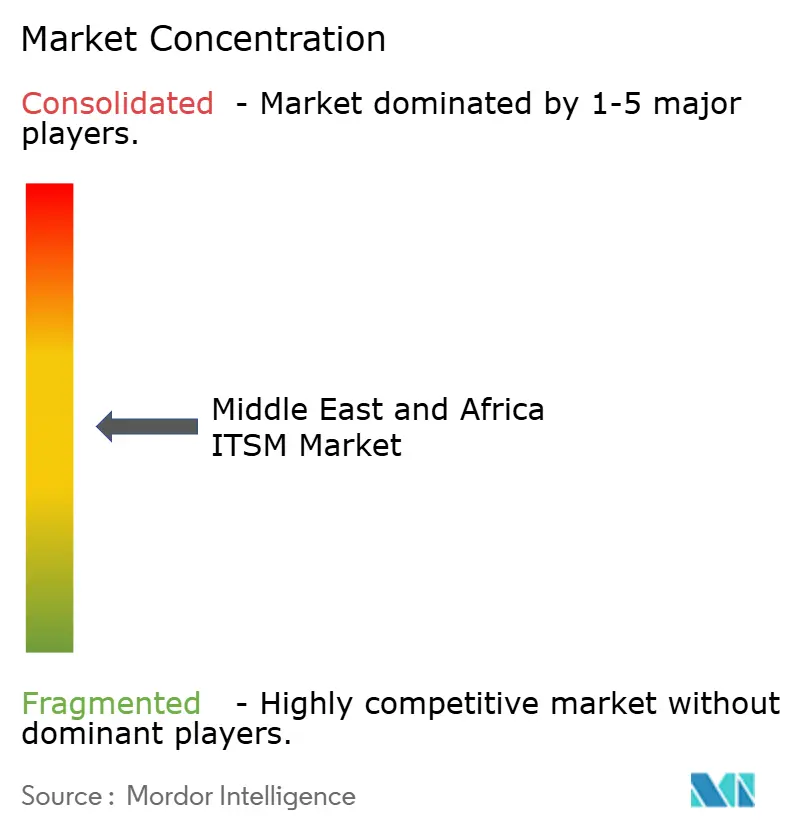
| Market Concentration | Medium |
Major Players *Disclaimer: Major Players sorted in no particular order Image © Mordor Intelligence. Reuse requires attribution under CC BY 4.0. | |
Middle East and Africa ITSM Market Analysis by Mordor Intelligence
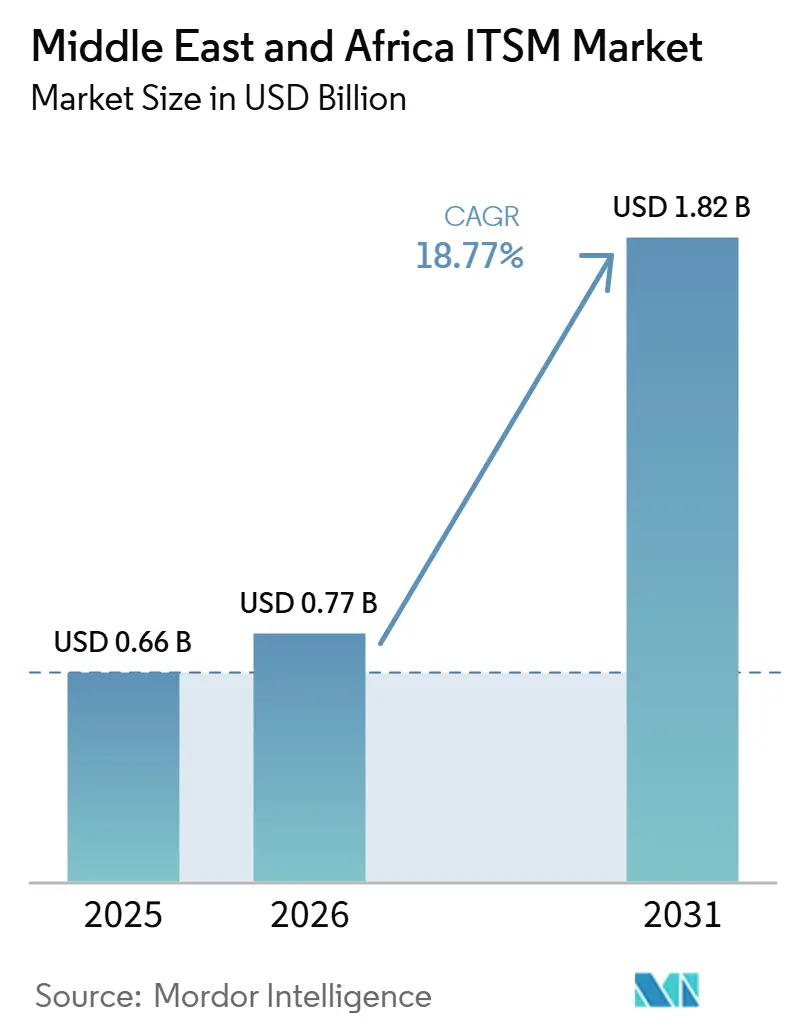
The Middle East And Africa ITSM Market size was valued at USD 0.66 billion in 2025 and is estimated to grow from USD 0.77 billion in 2026 to reach USD 1.82 billion by 2031, at a CAGR of 18.77% during the forecast period (2026-2031).
The market is expanding because sovereign digital programs in the GCC and wider public-sector cloud adoption across Africa are pushing organizations to formalize service delivery, governance, and workflow control inside unified platforms. The role of ITSM has moved beyond ticket handling, as buyers increasingly use these platforms to support AI workloads, knowledge-driven resolution, and cross-functional workflow automation across IT, HR, facilities, and procurement. Competitive behavior is also shifting, with vendors now differentiating themselves more through AI capability, localized delivery, and in-country hosting readiness than through broad feature lists alone. Growth opportunities remain strongest where cloud delivery lowers entry barriers for SMEs, where healthcare digitization raises workflow complexity, and where government-linked modernization programs lift service-management maturity across connected suppliers and regulated entities. The main constraints remain uneven cloud-ready talent, stricter data residency rules in several African and GCC markets, migration risk from fragmented legacy estates, and budget friction among mid-market buyers, yet these barriers are not strong enough to offset the region’s long-term shift toward cloud-native operations.
Key Report Takeaways
- By component, solutions held 62.35% of revenue in 2025, while services are projected to expand at a 16.85% CAGR through 2031.
- By deployment, cloud accounted for 64.50% of revenue in 2025 and is projected to grow at a 17.10% CAGR through 2031.
- By application, service desk and incident management led with 29.10% of revenue in 2025, while knowledge management is projected to expand at a 16.65% CAGR through 2031.
- By end-user industry, BFSI held 20.60% of revenue in 2025, while healthcare is projected to grow at a 17.30% CAGR through 2031.
- By enterprise size, large enterprises held 64.67% of revenue in 2025, while SMEs are projected to expand at a 16.50% CAGR through 2031.
- By country, Saudi Arabia held 21.75% of the Middle East and Africa ITSM market share in 2025, while the UAE is projected to record the fastest country-level CAGR of 17.80% through 2031.
Note: Market size and forecast figures in this report are generated using Mordor Intelligence’s proprietary estimation framework, updated with the latest available data and insights as of January 2026.
Market Trends and Insights
Drivers Impact Analysis of Middle East and Africa ITSM Market*
| Driver | (~) % Impact on CAGR Forecast | Geographic Relevance | Impact Timeline |
|---|---|---|---|
| Cloud-First Enterprise Modernization | +4.5% | GCC core, spill-over to South Africa and Egypt | Short term (≤ 2 years) |
| AI-Enabled Service Desk Automation | +3.8% | Global, with MEA enterprise and GCC government adoption | Medium term (2-4 years) |
| Government Digital Service Programs | +3.2% | Saudi Arabia and UAE primarily, broader GCC | Short term (≤ 2 years) |
| Expansion of Remote and Hybrid Workflows | +2.5% | Global, with concentrated MEA enterprise impact | Medium term (2-4 years) |
| Growth of Managed IT and Outsourced Service Operations | +2.0% | GCC core, spill-over to Sub-Saharan Africa | Medium term (2-4 years) |
| Increased Demand for Cross-Functional Enterprise Service Management | +1.5% | Global, with MEA large enterprise adoption | Long term (≥ 4 years) |
| Source: Mordor Intelligence | |||
Cloud-First Enterprise Modernization Fuels Platform Consolidation
Enterprises across the GCC are retiring older on-premise ITSM estates and moving toward cloud-native platforms that can support AI workloads, API-led integrations, and real-time operational visibility. This shift matters for the Middle East and Africa ITSM market because cloud delivery now solves not only scalability needs, but also the speed and flexibility required for broader digital operations. ServiceNow’s announced USD 500 million regional investment, including Saudi data center infrastructure scheduled for 2026, showed that large vendors are now building for in-country deployment rather than relying only on remote provisioning[1]. That change lowers a major procurement barrier for government and regulated buyers, and it also makes hybrid service-management models more practical for organizations that still need partial local hosting. Mid-market firms are responding by rationalizing fragmented point tools and shifting toward unified platforms that are easier to scale, support, and govern across multiple workflows. The result is that the Middle East and Africa ITSM market is seeing a deeper structural migration, not a short-lived upgrade cycle.
AI-Enabled Service Desk Automation Transforms IT Operations
Agentic AI moved from pilot programs into real production environments during 2025 and 2026, and that shift is changing how buyers evaluate the Middle East and Africa ITSM market. Freshworks launched Freddy AI Agent Studio in Freshservice in May 2026 as a no-code environment for building and deploying domain-specific AI agents, while Ivanti also released its Neurons AI Self-Service Agent as an autonomous ITSM capability. Freshworks stated that independent analysis pointed to a 168% ROI over 3 years for enterprises migrating from legacy platforms, which gives procurement teams a direct operating-cost case for automation-led modernization. AI deployment is also improving knowledge-base discipline because autonomous agents quickly expose documentation gaps, obsolete workflows, and missing resolution logic that older service desks could tolerate. This creates a self-reinforcing cycle in which better content improves both automated and human-assisted service resolution. Organizations that delay AI-ready architecture are likely to face a widening performance and cost gap as automation effects compound across higher ticket volumes and broader service windows.
Government Digital Service Programs Create Structural ITSM Demand
Public-sector modernization is one of the most durable demand anchors in the Middle East and Africa ITSM market because these programs are tied to multi-year service delivery, accountability, and digital operating-model targets. Saudi Arabia’s Digital Government Strategy 2025-2030 links digital service quality, operational efficiency, and user satisfaction to execution across government entities, which raises the need for auditable service-management frameworks. In the UAE, Abu Dhabi’s Government Digital Strategy 2025-2027 is backed by an AED 13 billion (USD 3.54 billion) investment, and it aims for full AI integration and 100% sovereign cloud adoption across government services. Those programs matter beyond direct government contracts because suppliers, delivery partners, and regulated entities that interact with public systems usually need to raise their own service-management maturity in response. That cascade expands the addressable base for platform vendors, services firms, and managed providers across connected ecosystems. It also explains why the Middle East and Africa ITSM market is increasingly influenced by national execution agendas rather than by isolated enterprise software budgets.
Expansion of Remote and Hybrid Workflows Elevates Platform Requirements
Distributed work models continue to raise the operational burden on enterprise service desks, and that change is strengthening demand across the Middle East and Africa ITSM market. Service teams now support a wider mix of endpoints, locations, time zones, and workflow dependencies, which makes manual coordination and fragmented tools harder to sustain at scale. Freshworks reported in May 2026 that 47% of IT tickets were submitted outside standard business hours, which is especially relevant for MEA organizations that operate across several geographies and extended service windows. Large enterprises are responding by consolidating onto broader suites with built-in AI and stronger orchestration, while SMEs are leaning toward lightweight SaaS tools with mobile-first interfaces and prebuilt workflow templates. That split is commercially healthy because it supports clear product tiers instead of forcing all buyers into a single buying model. As a result, the Middle East and Africa ITSM market is benefiting from both premium-suite expansion and entry-level SaaS adoption at the same time.
Restraints Impact Analysis of Middle East and Africa ITSM Market*
| Restraint | (~) % Impact on CAGR Forecast | Geographic Relevance | Impact Timeline |
|---|---|---|---|
| Data Residency and Compliance Complexity | -1.8% | Saudi Arabia, UAE, South Africa, Nigeria, Kenya | Short term (≤ 2 years) |
| Budget Constraints Among Mid-Market Buyers | -1.5% | Pan-MEA, concentrated in Sub-Saharan Africa | Medium term (2-4 years) |
| Legacy Tool Fragmentation and Migration Risk | -1.2% | Global, with MEA large enterprise exposure | Medium term (2-4 years) |
| Shortage of ITSM and Process Automation Skills | -0.9% | Pan-MEA, acute in East and West Africa | Long term (≥ 4 years) |
| Source: Mordor Intelligence | |||
Data Residency and Compliance Complexity Raise Architecture Costs
Compliance remains one of the most difficult scaling issues in the Middle East and Africa ITSM market because legal and policy requirements still differ sharply across jurisdictions. Nigeria’s National Cloud Policy 2025 introduced mandatory localization requirements for higher categories of sovereign data, while Kenya’s Cloud Policy 2025 established sector-specific residency rules that make multi-country platform design more expensive and less standardized[2]. South Africa’s National Data and Cloud Policy adds another layer of sovereign handling expectations for sensitive data, which further increases the cost of regional deployment templates. These requirements do not remove demand, but they do slow rollout timelines, complicate contract design, and raise the value of vendors with local hosting, stronger governance controls, and proven compliance documentation. Qualification thresholds also rise when buyers expect alignment with cloud, privacy, and operational security standards before procurement can proceed. The net effect is that larger incumbents remain structurally advantaged in complex public-sector and regulated-sector deals across the Middle East and Africa ITSM market.
Budget Constraints Among Mid-Market Buyers Slow Platform Rollout Velocity
Mid-market buyers across the Middle East and Africa ITSM market still face a persistent gap between the long-term productivity gains of full-suite platforms and the near-term budget flexibility needed to adopt them. This issue is stronger in parts of Sub-Saharan Africa, where public-sector and quasi-public technology spending often follows annual approval cycles instead of continuous software investment planning. Vendors are starting to address that gap through managed-service delivery, subscription packaging, and lighter deployment models that shift costs from upfront commitment toward operating expense. ServiceNow’s LEAP 2025 partnership with Salam, which targeted AI-embedded services for Saudi SMEs, showed how large vendors are adapting their commercial approach for smaller buyers that were previously outside the practical reach of enterprise pricing. Lower-entry SaaS bundles and regional managed-service partners are helping these organizations access structured service management without taking on full implementation complexity at once. Even so, budget friction still slows decision cycles and rollout speed, which keeps this as one of the more material restraints on the Middle East and Africa ITSM market.
*Our forecasts treat driver/restraint impacts as directional, not additive. The impact forecasts reflect baseline growth, mix effects, and variable interactions.
Middle East and Africa ITSM Market Segment Analysis
By Component:
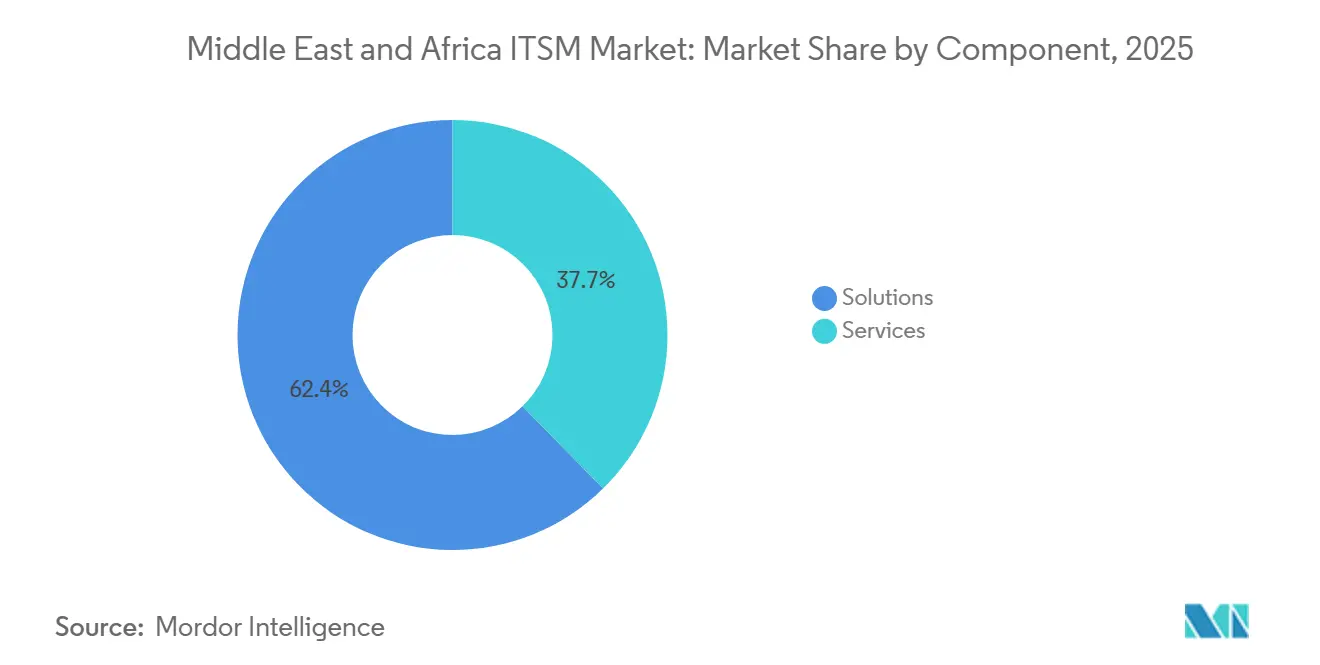
Solutions Anchor Revenue While Services Gain Strategic WeightSolutions held 62.35% of component revenue in 2025, which kept this segment at the center of the Middle East and Africa ITSM market. That lead came from platform licensing tied to incident management, change management, asset tracking, and service catalog workflows that remain core requirements across enterprise IT operations. The segment also reflects the weight of governance-led buying, because organizations in regulated and large-scale environments still view platform ownership and service catalog structure as foundational controls. In many deployments, solution selection shapes not only the operating model but also later choices around AI enablement, workflow extension, and vendor lock-in. For that reason, buyers in the Middle East and Africa ITSM industry often assess the solution layer first, and then build services and integration spending around it.
Services are projected to grow at a 16.85% CAGR through 2031, which makes them the fastest-moving component category within the Middle East and Africa ITSM market. Demand is being driven by implementation work, managed ITSM operations, AI configuration, and workflow tailoring that many regional IT teams still prefer to source externally. Atlassian’s Team ’26 launch of the Service Collection also reflected how platform value is increasingly tied to delivery, onboarding, and cross-functional rollout support rather than license cost alone[3]. The Dammam proximity center established through the NextEra joint venture in September 2025 showed that local services capacity is becoming a core differentiator rather than a supporting feature. That matters because delayed go-lives in public-sector and large-enterprise projects often trace back to limited in-region implementation depth, not to platform functionality itself.
By Deployment:
Cloud Leads Adoption While Hybrid Supports Sovereign TransitionCloud held 64.50% share of the Middle East and Africa ITSM market size in 2025, and it is also projected to grow at a 17.10% CAGR through 2031. That combination of scale and speed shows that cloud is not simply winning new projects; it is also pulling demand away from existing hybrid and on-premise estates. Buyers are moving because cloud delivery reduces upgrade friction, improves AI feature access, and makes it easier to connect service-management workflows across distributed operations. The shift has accelerated as hyperscaler and vendor infrastructure expansion across the GCC reduced some of the sovereignty concerns that had previously delayed full migration. The Middle East and Africa ITSM market is therefore seeing cloud become the regional default, especially in organizations that want faster deployment and lower administration overhead.
ServiceNow’s Saudi infrastructure plan, announced with a broader USD 500 million regional investment, directly addressed the sovereign hosting barrier that had limited some government and regulated-sector migrations. On-premise deployment still matters in defense, intelligence, and critical-infrastructure settings where classification and control requirements remain non-negotiable. Hybrid environments are also retaining importance because many large enterprises cannot replace older service-management estates in a single step without operational risk. Instead, they are using hybrid as a transition architecture that lets legacy systems coexist with new SaaS or sovereign-cloud environments under one governance structure. Vendors that can orchestrate across private cloud, on-premise, and SaaS layers are therefore gaining ground in the Middle East and Africa ITSM market where multi-tier infrastructure remains common.
By Application:
Service Desk Holds The Base While Knowledge Management Becomes A Growth LeverService desk and incident management commanded 29.10% of application revenue in 2025, which kept it as the largest workflow category in the Middle East and Africa ITSM market. That position reflects its role as the first entry point for most deployments and the most visible service layer for users across enterprise environments. Asset and configuration management, along with change and release management, continue to build around this base because they typically follow the initial service desk rollout in phased implementations. The segment remains commercially important because high ticket volume makes service desk workflows central to user experience, productivity, and operational reporting. It also remains the area where buyers most clearly measure platform value through response speed, resolution quality, and workflow standardization.
Knowledge management is projected to expand at a 16.65% CAGR through 2031, and that makes it the fastest-growing application category in the Middle East and Africa ITSM market. AI agents now depend on structured, current, machine-readable content, which turns knowledge assets into an active operating layer instead of a passive repository. SysAid’s January 2026 release added Confluence integration to its AI chatbot, allowing firms to activate existing documentation libraries for AI-led resolution without rebuilding their content architecture from the ground up. This shift means that documentation quality now affects automation performance, ticket deflection, and escalation efficiency much more directly than before. The Middle East and Africa ITSM industry is also seeing service request management and adjacent enterprise service workflows expand steadily as buyers extend common governance patterns into HR, facilities, and procurement.
By End-User Industry:
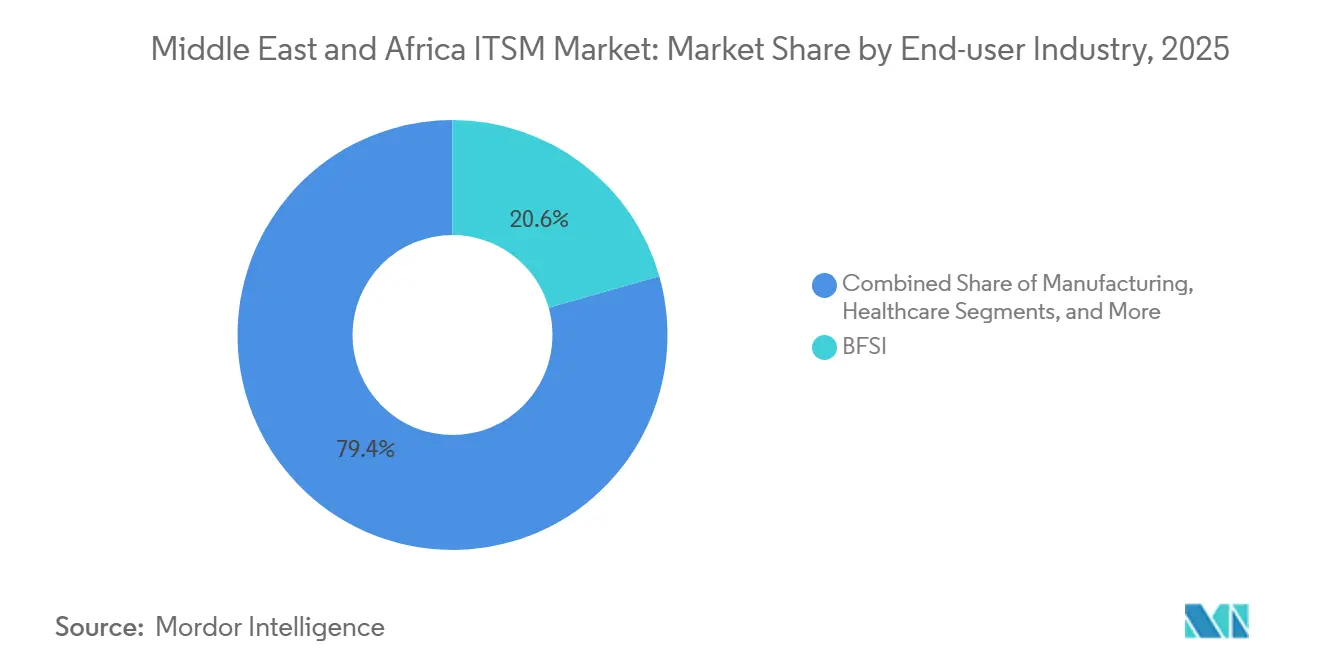
BFSI Sustains Core Spending While Healthcare Expands FastestBFSI held 20.60% of end-user revenue in 2025, giving it the largest vertical position in the Middle East and Africa ITSM market. The sector’s lead reflects long-established investment in auditability, incident control, change governance, and structured service processes across banks and financial institutions. Financial organizations often move earlier than other sectors because outage costs, regulatory scrutiny, and workflow traceability requirements are more immediate and more measurable. That makes BFSI a stable anchor for premium deployments, renewals, and multi-module expansion across the region. It also helps explain why vendors with strong governance credentials and integration depth continue to defend their position in this part of the Middle East and Africa ITSM market.
ServiceNow’s November 2025 agreement with Al Rajhi Bank and ejada Systems showed that leading financial institutions are now using these platforms across HR, IT, and financial services operations rather than only for traditional incident workflows. Healthcare is projected to grow at a 17.30% CAGR through 2031, making it the fastest-growing end-user segment in the Middle East and Africa ITSM market. Saudi Arabia’s Health Sector Transformation Program targets the privatization of 290 hospitals and 2,300 primary health centers by 2030, which raises the need for structured and commercially governed IT service operations. In the UAE, health-information-exchange initiatives such as NABIDH, Malaffi, and Riayati are pushing providers toward end-to-end service traceability and broader system coordination. Because clinical environments carry higher workflow complexity and stronger interoperability requirements, healthcare remains one of the more defensible specialization areas within the Middle East and Africa ITSM market.

By Enterprise Size:
Large Enterprises Lead Spend While SMEs Open The Next Growth LayerLarge enterprises held 64.67% share of the Middle East and Africa ITSM market size in 2025, reflecting the stronger alignment between organizational complexity and full-suite ITSM spending. Large firms manage broader application estates, wider vendor ecosystems, more distributed workforces, and heavier change volumes, all of which support investment in advanced service-management platforms. In the GCC especially, these buyers are adopting AI-augmented ITSM as part of wider digital operations programs that connect IT, HR, and business workflows. Their scale also gives them a stronger capacity to absorb implementation effort, process redesign, and multi-module expansion over time. For these reasons, large enterprises remain the main revenue base for the Middle East and Africa ITSM market even as the buyer mix gradually broadens.
SMEs are projected to grow at a 16.50% CAGR through 2031, which makes them the most dynamic expansion pocket by growth rate within the Middle East and Africa ITSM market. ServiceNow’s LEAP 2025 partnership with Salam validated the Saudi SME opportunity by packaging AI-embedded services for a more commercially accessible delivery model. Freshworks and ManageEngine are also active in this tier across Africa because lighter SaaS deployment, lower price points, and faster activation reduce the barriers that historically kept smaller firms outside the category. Pre-configured workflow templates are proving especially important because they reduce customization cost and simplify first-time adoption for firms with smaller IT teams. Managed-service packaging is adding another layer of support by converting capital-style project decisions into predictable monthly operating expense, which broadens practical access across the Middle East and Africa ITSM market.
Geography Analysis
Saudi Arabia ITSM Market
Saudi Arabia held 21.75% of regional revenue in 2025, which made it the largest country market in the Middle East and Africa ITSM market. The Kingdom’s position rests on the depth of Vision 2030-linked modernization and the way national digital policy keeps raising execution expectations across ministries and connected entities. Saudi Arabia’s Digital Government Strategy 2025-2030 continues to support service delivery improvement, operational efficiency, and more measurable digital execution across government bodies. ServiceNow’s announced USD 500 million regional investment, including Saudi infrastructure scheduled for 2026, further reinforced the country’s role as the main commercial anchor for vendor expansion. Buyers in Saudi Arabia, therefore, shape not only demand volume, but also vendor qualification standards around local hosting, delivery depth, and auditable workflow control.
United Arab Emirates ITSM Market
The UAE is projected to record the fastest country-level CAGR at 17.80% through 2031, which keeps it as the strongest growth engine in the Middle East and Africa ITSM market. Abu Dhabi’s Government Digital Strategy 2025-2027 is backed by AED 13 billion (USD 3.54 billion), and it is centered on sovereign cloud and AI-native public services[4]. The UAE Digital Government Strategy 2025 also reinforces digital-by-design service delivery and wider institutional adoption of structured digital operating models. Because the UAE and Saudi Arabia move faster than most other regional markets, their technology standards and procurement patterns often spread outward across the wider region after an initial adoption lag.
MEA ITSM Market
South Africa remains the largest Sub-Saharan market in the Middle East and Africa ITSM market because it combines a mature enterprise base with an active public digital agenda. The country’s digital transformation roadmap moved into implementation from 2025, which supports the case for more standardized service delivery frameworks across government systems. Egypt is emerging as the strongest North African opportunity, with the Digital Egypt platform expanding from 170 to 210 government services between 2024 and 2025, while users grew 28% and request volume rose more than 300% to exceed 25 million. Those figures point to heavier back-end service orchestration needs as digital service volume rises across ministries and citizen-facing systems. The rest of the region, including Nigeria, Kenya, Qatar, Kuwait, Bahrain, and Oman, presents a mixed but expanding base where managed-service models are gaining traction as cloud governance frameworks become more formalized.
Competitive Landscape
The Middle East and Africa ITSM market remains moderately fragmented, with ServiceNow holding the clearest premium-tier leadership position across major regional transformation programs. That leadership is being reinforced through infrastructure investment, partner expansion, and larger account penetration rather than through product breadth alone. The company’s announced Saudi data center plan and USD 500 million regional commitment signaled a long-term effort to align sovereign hosting, localized delivery, and enterprise credibility in one proposition. Its November 2025 agreement with Al Rajhi Bank and ejada Systems further showed how flagship regional accounts are using the platform across HR, IT, and financial services operations, not only for core service desk activity. The September 2025 NextEra partnership, including a Dammam proximity center and a local capability program, added another layer of in-country execution capacity that matters in large public-sector and regulated deployments.
The competitive gap is narrowing most clearly in AI functionality, which is changing how buyers compare established leaders and mid-market challengers in the Middle East and Africa ITSM market. Freshworks introduced Freddy AI Agent Studio in May 2026 with no-code AI-agent creation and experience-level metrics that push the category beyond conventional SLA-centered positioning. Atlassian’s Service Collection broadened Jira Service Management into customer service, assets, and cross-functional enterprise workflows, which gives it a stronger position in organizations that prefer flexible deployment and developer-led adoption models. Ivanti also moved deeper into autonomous workflow execution with the Neurons AI Self-Service Agent, showing that mid-tier vendors now have a more credible AI narrative in competitive evaluations.
White-space opportunity remains strongest in healthcare workflows, the African SME base, and cross-functional enterprise service management for government entities that have already matured their IT service disciplines. These areas remain open because localized specialization, data-hosting readiness, and regional delivery capacity are still uneven across the vendor field. SysAid’s documentation-led AI enhancements, including Confluence integration and new prebuilt AI agents, show how challengers are trying to compete through fast activation and practical workflow enablement rather than through enterprise-scale sales presence alone. Vendors with verified local hosting, Arabic-language readiness, and stronger in-region services are structurally advantaged in GCC public-sector and regulated deals because procurement often depends on execution confidence as much as on platform capability. That is why the Middle East and Africa ITSM market continues to reward vendors that combine product evolution with regional operating depth.
Middle East and Africa ITSM Industry Leaders
-
ServiceNow Inc.
-
BMC Software, Inc.
-
Atlassian Corporation Plc
-
Ivanti, Inc.
-
IBM Corporation
- *Disclaimer: Major Players sorted in no particular order
Middle East and Africa ITSM Market Companies Covered in this Report
- ServiceNow Inc.
- BMC Software, Inc.
- Atlassian Corporation Plc
- Ivanti, Inc.
- IBM Corporation
- ManageEngine (Zoho Corporation Pvt. Ltd.)
- Freshworks Inc.
- Open Text Corporation
- Broadcom Inc.
- Hewlett Packard Enterprise Company
- SolarWinds Corporation
- TOPdesk Nederland B.V.
- EasyVista SA
- SysAid Technologies Ltd.
- Hornbill Service Management Limited
- InvGate S.R.L.
- 4me, Inc.
- Efecte Plc
- Matrix42 AG
- TeamDynamix, Inc.
Recent Industry Developments in Middle East and Africa ITSM Market
- June 2026: Inspira Enterprise and ServiceNow announced a global strategic partnership, positioning Inspira as a trusted delivery partner across the full ServiceNow portfolio, including AICT, Veza identity governance, and Armis asset intelligence, with direct implications for MEA enterprise clients seeking integrated IT and security governance under a single ServiceNow delivery partner.
- May 2026: Freshworks unveiled Freddy AI Agent Studio within Freshservice at its annual Refresh conference, launching a no-code platform enabling IT and business teams to build, customize, and deploy bespoke AI agents across service workflows in weeks. The launch also introduced Experience Level Agreements and AI Insights as performance metrics, moving the industry beyond traditional SLA-only measurement.
- November 2025: ServiceNow signed a multi-year agreement with Al Rajhi Bank and ejada Systems to deploy the ServiceNow AI Platform across the bank’s full operations spanning HR, IT, and financial services, in what the parties described as one of the largest enterprise ITSM transformation agreements in the MEA region.
- September 2025: NextEra, the joint venture of LTIMindtree and Aramco Digital, partnered with ServiceNow to accelerate large-scale digital transformation across Saudi Arabia and MENA. NextEra established a proximity center at Imam Abdulrahman Bin Faisal University in Dammam while ServiceNow launched a Centre of Excellence for local workforce capability development, focusing on generative AI, agentic automation, and Arabic-language deployment.
Middle East and Africa ITSM Market Report Scope
IT Service Management (ITSM) is the set of repeatable practices, processes, and enabling technologies used by organizations to plan, provision, operate, secure, and optimize IT‑delivered services for internal and external customers. It covers the full service lifecycle service strategy, design, transition, operation, and continual improvement, and includes core domains such as incident, problem, change, configuration, request, asset, and knowledge management, plus service-catalog and SLA governance.
The Middle East And Africa ITSM Market Report is Segmented by Component (Solutions and Services), Deployment (Cloud, On-premise, and Hybrid), Application (Service Desk and Incident Management, Asset and Configuration Management, Change and Release Management, Service Request Management, Knowledge Management, and Other Applications), End-user Industry (BFSI, Manufacturing, Government and Public Sector, IT and Telecommunications, Retail and E-commerce, Healthcare, Travel and Hospitality, and Other End-user Industries), Enterprise Size (Large Enterprises and Small and Mid-size Enterprises (SME)), and Country. The Market Forecasts are Provided in Terms of Value (USD).
Segmentation Overview
| Solutions |
| Services |
| Cloud |
| On-premise |
| Hybrid |
| Service Desk and Incident Management |
| Asset and Configuration Management |
| Change and Release Management |
| Service Request Management |
| Knowledge Management |
| Other Applications |
| BFSI |
| Manufacturing |
| Government and Public Sector |
| IT and Telecommunications |
| Retail and E-commerce |
| Healthcare |
| Travel and Hospitality |
| Other End-user Industries |
| Large Enterprises |
| Small and Mid-size Enterprises (SME) |
| Saudi Arabia |
| United Arab Emirates |
| South Africa |
| Egypt |
| Rest of Middle East and Africa |
| By Component | Solutions |
| Services | |
| By Deployment | Cloud |
| On-premise | |
| Hybrid | |
| By Application | Service Desk and Incident Management |
| Asset and Configuration Management | |
| Change and Release Management | |
| Service Request Management | |
| Knowledge Management | |
| Other Applications | |
| By End-user Industry | BFSI |
| Manufacturing | |
| Government and Public Sector | |
| IT and Telecommunications | |
| Retail and E-commerce | |
| Healthcare | |
| Travel and Hospitality | |
| Other End-user Industries | |
| By Enterprise Size | Large Enterprises |
| Small and Mid-size Enterprises (SME) | |
| By Country | Saudi Arabia |
| United Arab Emirates | |
| South Africa | |
| Egypt | |
| Rest of Middle East and Africa |
Key Questions Answered in the Report
What is the Middle East and Africa ITSM market size in 2026 and where is it heading by 2031?
The Middle East and Africa ITSM market size stands at USD 0.77 billion in 2026 and is forecast to reach USD 1.82 billion by 2031 at an 18.77% CAGR.
Which deployment model leads adoption across the region?
Cloud leads adoption with 64.50% of revenue in 2025 and is also the fastest-growing deployment model with a 17.10% CAGR through 2031.
Which countries are shaping regional demand the most?
Saudi Arabia led with 21.75% of regional revenue in 2025, while the UAE is projected to post the fastest growth at a 17.80% CAGR through 2031.
Which application area is growing fastest as AI adoption increases?
Knowledge management is growing fastest at a 16.65% CAGR because AI agents depend on structured and searchable content for autonomous resolution.
Which end-user sector is creating the strongest new opportunity?
Healthcare is projected to expand at a 17.30% CAGR through 2031 as privatization, interoperability, and hospital system complexity increase demand for formal IT service workflows.
Why are SMEs becoming more important in this space?
SMEs are projected to grow at a 16.50% CAGR as SaaS delivery, managed services, and pre-configured workflows reduce cost and implementation barriers.