
Middle East and Africa CRM Marketing Services Market Size and Share
Market Overview
| Study Period | 2020 - 2031 |
|---|---|
| Forecast Data Period | 2026 - 2031 |
| Base Year Market Size (2025) | USD 1.30 Billion |
| Market Size (2026) | USD 1.49 Billion |
| Market Size (2031) | USD 2.92 Billion |
| Growth Rate (2026 - 2031) | 14.40 % |
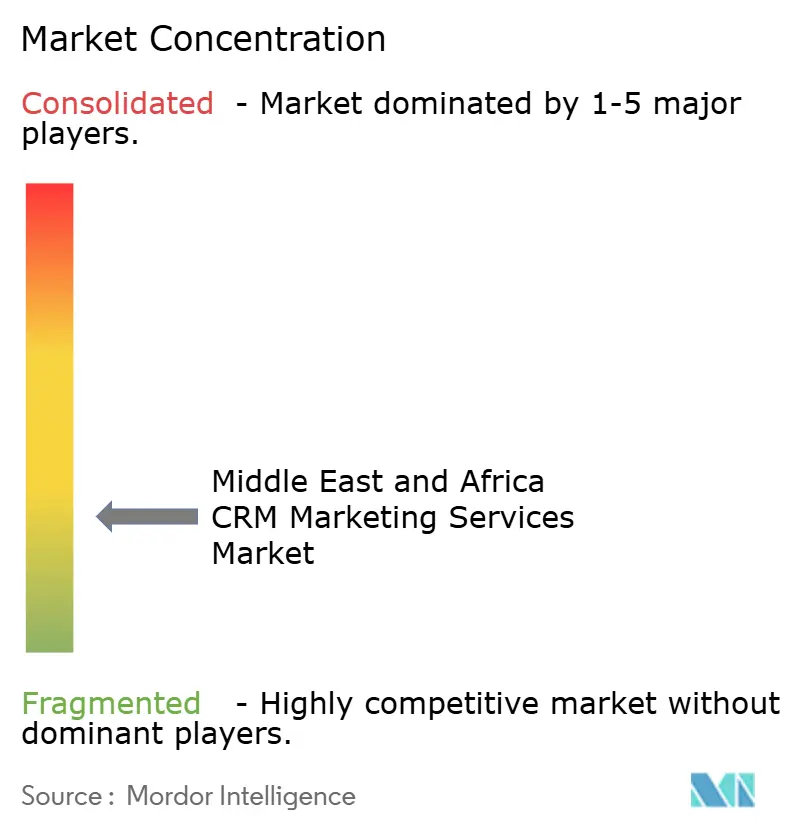
| Market Concentration | Low |
Major Players *Disclaimer: Major Players sorted in no particular order Image © Mordor Intelligence. Reuse requires attribution under CC BY 4.0. | |
Middle East and Africa CRM Marketing Services Market Analysis by Mordor Intelligence
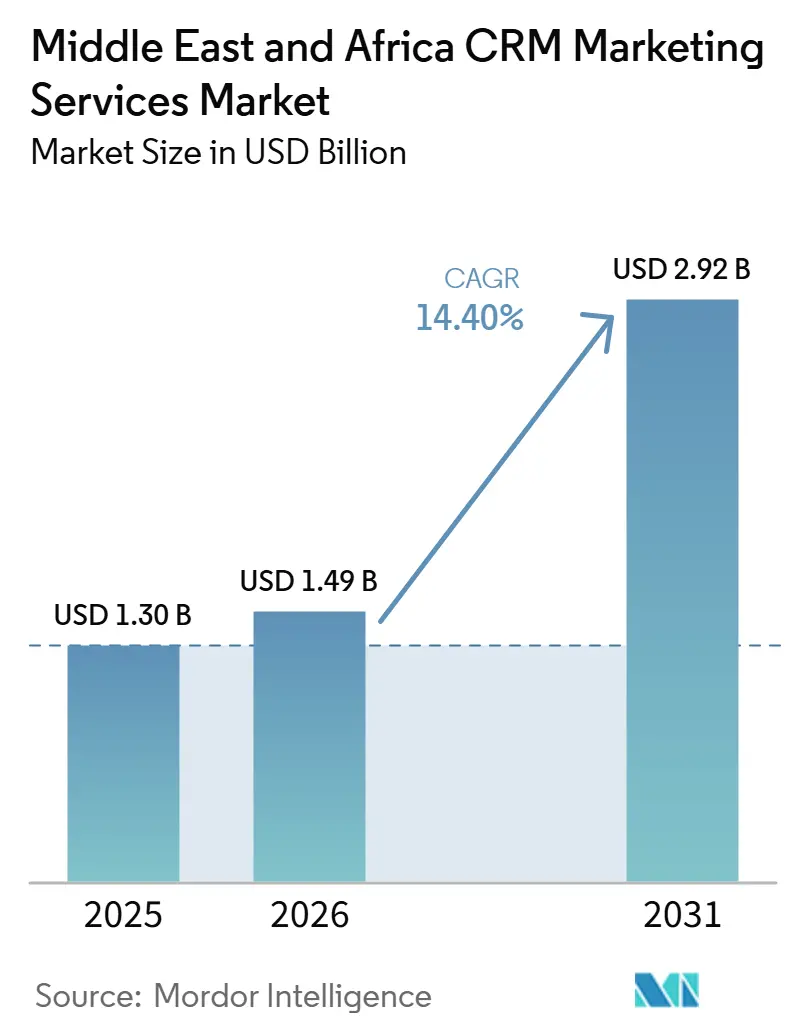
The Middle East and Africa CRM marketing services market size is projected to expand from USD 1.30 billion in 2025 and USD 1.49 billion in 2026 to USD 2.92 billion by 2031, registering a CAGR of 14.40% between 2026 and 2031. National digital agendas in Saudi Arabia and the UAE are turning CRM spending into a required operating priority for enterprises and public-facing institutions across the region. Demand is also changing because buyers now want service partners that can localize delivery, manage in-country data rules, and connect CRM platforms with finance, billing, and analytics systems already in place. The Middle East and Africa CRM marketing services market is also gaining from cloud-first deployment patterns, because every new rollout creates follow-on work in implementation, training, managed services, and later-stage migration. Competition is tightening as global vendors expand regional infrastructure while local specialists win projects that need Arabic-first configuration, sovereign data alignment, and faster execution. The strongest openings remain in AI-linked modernization, omnichannel engagement design, and compliance-heavy migration programs where firms need to close the gap between digital ambition and delivery.
Key Report Takeaways
- By service type, CRM Implementation and Integration led with a 26.92% revenue share of the Middle East and Africa CRM marketing services market in 2025, while CRM Migration and Modernization is projected to expand at a 15.51% CAGR through 2031.
- By enterprise size, Large Enterprises held 57.84% share in 2025, while SMEs are expected to record the fastest growth at a 15.62% CAGR through 2031.
- By service application, Customer Acquisition accounted for a 20.07% share in 2025, while Omnichannel Customer Engagement is projected to advance at a 15.73% CAGR through 2031.
- By end-user industry, BFSI held a 16.08% share in 2025, while Healthcare and Life Sciences are projected to expand at a 15.84% CAGR through 2031.
- By geography, the Middle East held 34.11% of the Middle East and Africa CRM marketing services market share in 2025, while Africa is projected to expand at a 15.95% CAGR through 2031.
Note: Market size and forecast figures in this report are generated using Mordor Intelligence’s proprietary estimation framework, updated with the latest available data and insights as of January 2026.
Market Trends and Insights
Drivers Impact Analysis of Middle East and Africa CRM Marketing Services Market*
| Driver | (~) % Impact on CAGR Forecast | Geographic Relevance | Impact Timeline |
|---|---|---|---|
| Rapid Digitization of Customer Engagement Workflows | +3.8% | Global, concentrated in UAE and Saudi Arabia, with spillover to South Africa and Nigeria | Short term (≤ 2 years) |
| Rising Demand for Arabic-First Personalization and Localization | +2.9% | MENA core, including UAE, Saudi Arabia, Egypt, and Kuwait, expanding to North Africa | Medium term (2-4 years) |
| Expansion of Cloud-First Marketing and CRM Stacks | +2.7% | GCC core, with spillover to South Africa and Nigeria | Short term (≤ 2 years) |
| Omnichannel Commerce Growth Across Retail and Telecom | +2.4% | GCC and South Africa, emerging in East Africa | Medium term (2-4 years) |
| SME Shift Toward Subscription-Based Customer Engagement Tools | +2.2% | GCC and East Africa, with early adoption in West Africa | Short term (≤ 2 years) |
| Sovereign Data Hosting and Compliance-Led Platform Replacement | +1.8% | UAE and Saudi Arabia primarily, expanding to Nigeria and Kenya | Long term (≥ 4 years) |
| Source: Mordor Intelligence | |||
Rapid Digitization of Customer Engagement Workflows
National digitization mandates are moving CRM services from optional technology upgrades to core operating requirements across the region. The MENA digital advertising market reached USD 8.185 billion in 2025, up 17.8% year on year, and that scale is pushing enterprises to capture and act on customer data across more channels than before.[1] Public programs in the Gulf are also shaping procurement behavior, because firms that want to serve regulated sectors increasingly need stronger digital customer engagement infrastructure. Adobe reported in January 2026 that 24% of Middle East business leaders ranked digital transformation as their top five-year strategic priority, ahead of AI and automation as stand-alone goals. This gives the Middle East and Africa CRM marketing services market a steadier demand base, because spending is tied to operating change rather than short-term technology sentiment.
Rising Demand for Arabic-First Personalization and Localization
Buyers across the Gulf are placing more weight on Arabic-native workflows than they did in earlier CRM purchasing cycles. Basic translation is no longer enough when service teams need right-to-left interfaces, localized campaign logic, and better sentiment handling for Gulf dialects. This is raising the value of service partners that can configure language models, templates, and data structures to align with local customer behavior rather than global defaults. The same shift is also influencing vendor selection, because regionally adapted deployments can move faster and create less friction during user adoption. For the Middle East and Africa CRM marketing services market, this demand is widening the gap between general implementation capacity and higher-value localization capability.
Expansion of Cloud-First Marketing and CRM Stacks
Cloud migration is creating one of the clearest service demand streams across the region, because every move away from on-premise systems requires implementation, integration, and ongoing support. Salesforce committed USD 500 million to Saudi Arabia in February 2025, including the deployment of Hyperforce on AWS and the establishment of a new regional headquarters in Riyadh, which strengthened local capacity for compliant cloud CRM programs.[2] SAP also stated in January 2026 that cloud ERP and CRM are central to helping African businesses, including SMEs, access enterprise-grade systems without the heavy upfront infrastructure burden. As cloud delivery becomes standard, clients are also expecting service providers to manage integration, governance, training, and later-stage modernization within a single lifecycle. That broadens the addressable market for CRM marketing services in the Middle East and Africa beyond first-time deployment alone.[3]
Omnichannel Commerce Growth Across Retail And Telecom
Retail and telecom firms are investing in customer engagement systems that can link mobile, in-store, and digital messaging channels with service channels into a single operating view. IAB MENA reported that retail media in the region grew by up to 40.5% year-on-year in 2025, showing how quickly customer interaction is moving into data-rich digital environments. In telecom, Netcracker and e& UAE reached production readiness on a full-stack BSS transformation program in October 2025 that tied onboarding, omnichannel CRM delivery, and AI-driven personalization into a single stack. Infobip and Digitas Middle East then expanded their strategic partnership in June 2026 to build a joint AI-driven customer engagement practice around AgentOS, with rollout across MENA and APAC. In the Middle East and Africa CRM marketing services market, this is driving more spending toward providers that can unify campaign, service, and messaging layers rather than treating them as separate projects.[4]
Restraints Impact Analysis of Middle East and Africa CRM Marketing Services Market*
| Restraint | (~) % Impact on CAGR Forecast | Geographic Relevance | Impact Timeline |
|---|---|---|---|
| High Data Residency and Sovereignty Complexity Across Countries | -1.9% | All MEA geographies, most acute in UAE and Saudi Arabia, with rising complexity in Nigeria and Kenya | Medium term (2-4 years) |
| Integration Friction with Legacy ERP and Call Center Systems | -1.5% | GCC and South Africa, where legacy enterprise systems are most deeply embedded | Short term (≤ 2 years) |
| Shortage of Skilled CRM Administrators and Marketing Operations Talent | -1.0% | UAE and Saudi Arabia most acute, with an emerging gap in Nigeria and East Africa | Medium term (2-4 years) |
| Budget Sensitivity Among Small Businesses and Mid-Market Buyers | -0.8% | Sub-Saharan Africa and smaller GCC markets where discretionary IT budgets remain constrained | Short term (≤ 2 years) |
| Source: Mordor Intelligence | |||
High Data Residency and Sovereignty Complexity Across Countries
Data residency rules now shape CRM architecture decisions across much of the region, especially in regulated sectors. Organizations operating across several countries often need separate hosting, governance, and access structures for each jurisdiction rather than one regional design. That adds cost at the start of a project and also slows implementation because legal, security, and data teams need to approve more conditions before go-live. It also reduces the appeal of one-size-fits-all delivery models from vendors that rely on remote regional hubs. For the Middle East and Africa CRM marketing services market, this means compliance capability is becoming as important as technical delivery in larger cross-border programs.
Integration Friction with Legacy ERP and Call Center Systems
Many large buyers in banking, telecom, government-linked entities, and industrial groups still operate legacy ERP and call center platforms that were not built for real-time CRM orchestration. This creates complex integration work before firms can reach a unified customer view across billing, service, campaign, and analytics systems. The challenge is greater in groups that expanded through acquisitions, because they often carry multiple disconnected technology estates. Service partners with tested connectors and stronger middleware skills can shorten timelines, but they still face longer design and testing cycles than clients usually expect. In the Middle East and Africa CRM marketing services market, this friction keeps implementation demand high while also stretching delivery schedules and margin discipline.
*Our forecasts treat driver/restraint impacts as directional, not additive. The impact forecasts reflect baseline growth, mix effects, and variable interactions.
Middle East and Africa CRM Marketing Services Market Segment Analysis
By Service Type:
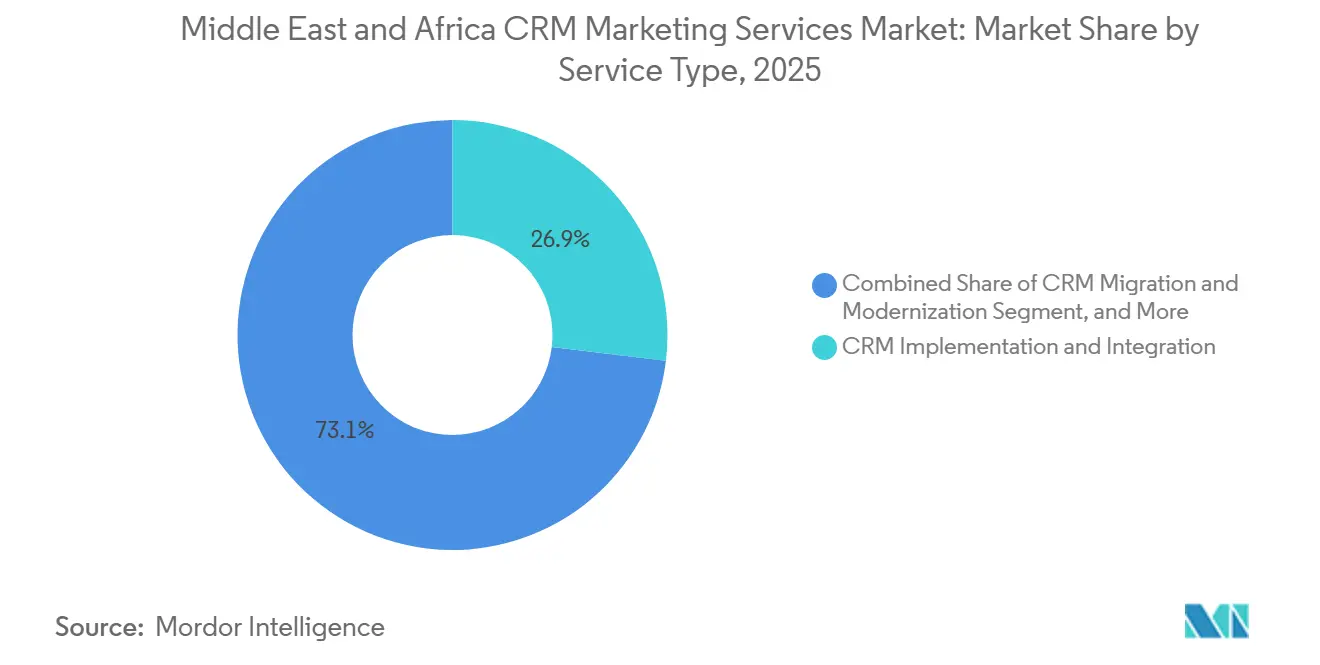
Implementation Work Leads Revenue While Migration Gains SpeedCRM Implementation and Integration held the largest service-type share at 26.92% in 2025, which kept it at the center of spending across the region. This part of the portfolio absorbs the largest budgets because enterprises often need to connect CRM with ERP, billing, data warehouse, and service applications before business teams can use the platform fully. Large programs in BFSI and telecom also raise contract values because delivery usually spans design, workflow setup, data mapping, user training, and post-launch stabilization. Strategy and consulting remain important because clients want help with vendor choice, rollout sequencing, and governance before they commit to large builds. Managed Services then extends the client relationship after launch, since many enterprises prefer external support for optimization, administration, and release management.
CRM Migration and Modernization is projected to advance at a 15.51% CAGR through 2031, making it the fastest-growing service type in the portfolio. That growth reflects a new phase in which organizations that installed earlier CRM environments are revisiting them to support AI functions, align with sovereign data requirements, and better integrate with modern cloud applications. Training and support remain the smallest service type by revenue, but it is becoming more important because many buyers lack enough certified administrators to run new environments on their own. The service mix, therefore, forms a cycle in which consulting feeds implementation, implementation creates managed service work, and managed service relationships later uncover migration needs. This cycle provides the Middle East and Africa CRM marketing services market with a deeper revenue base than a project-only model, and CRM Implementation and Integration accounted for 26.92% of the Middle East and Africa CRM marketing services market in 2025.

By Enterprise Size:
Large Enterprises Lead While SME Demand BroadensLarge Enterprises accounted for 57.84% of total demand in 2025, which reflected the scale and complexity of their deployments across multiple business units and countries. These clients usually buy several workstreams at once, including architecture design, integration, migration, governance, and managed support. They also tend to operate in heavily regulated sectors where documentation, security, and workflow control matter as much as front-end functionality. As a result, enterprise deals remain the primary source of revenue stability for the Middle East and Africa CRM marketing services market. Large buyers also influence partner ecosystems, since vendors often build local delivery teams and certified networks around the requirements of these accounts first.
SMEs are projected to expand at a 15.62% CAGR through 2031, which makes them the fastest-growing enterprise segment. Their growth is tied to subscription-based CRM platforms that reduce infrastructure barriers and allow phased adoption rather than one large capital project. SAP noted in January 2026 that cloud ERP and CRM are widening access to enterprise-grade systems for African businesses without heavy upfront spending, and that logic also supports SME adoption across the wider region. Government-backed SME enablement programs in the Gulf are also helping demand by pushing more firms toward digitized customer operations and formal software procurement. As a result, the Middle East and Africa CRM marketing services industry is no longer driven only by very large accounts, because smaller firms are entering the pipeline with needs for onboarding, localization, integration, and support.
By Service Application:
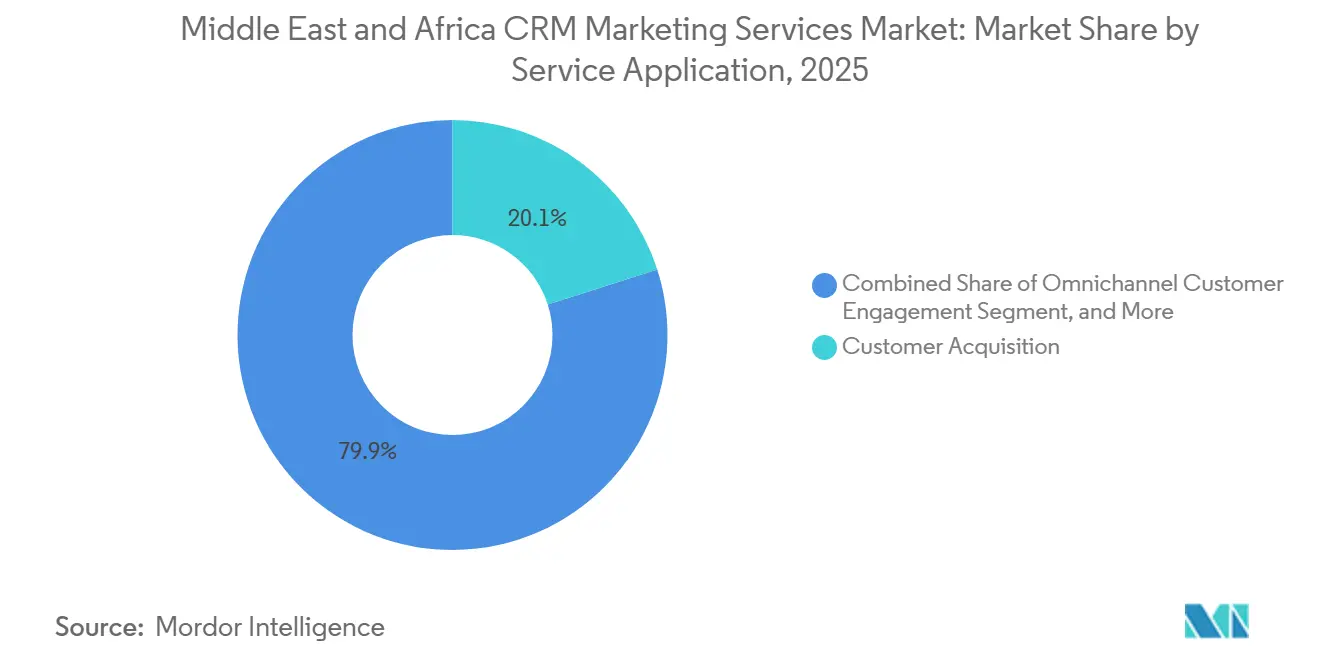
Customer Acquisition Leads While Omnichannel Gains MomentumCustomer Acquisition held the largest service application share at 20.07% in 2025, showing that many buyers still begin CRM programs with lead capture, onboarding, and conversion goals. This is especially visible in BFSI, telecom, and e-commerce, where firms depend on high-volume digital acquisition funnels and need faster customer response cycles. Campaign Management, Marketing Automation, and Customer Analytics are then built around that base as organizations seek better use of the data created during acquisition. Retention and Loyalty work is also rising because firms are paying closer attention to lifetime value after the first sale or signup. Personalization remains the smallest application segment, but it is becoming more relevant as buyers ask for localized content flows and stronger audience logic.
Omnichannel Customer Engagement is projected to expand at a 15.73% CAGR through 2031, which makes it the fastest-growing service application. This growth stems from the need to connect mobile apps, messaging platforms, contact centers, digital storefronts, and in-person touchpoints into a single journey design. IAB MENA reported that digital customer-facing channels continued to expand rapidly in 2025, underscoring demand for systems that can orchestrate communication across multiple formats. The Netcracker and e& UAE transformation milestone in October 2025 and the Infobip and Digitas Middle East partnership expansion in June 2026 both reflect stronger investment in linked engagement stacks rather than isolated channel tools. In the Middle East and Africa CRM marketing services market, this is shifting application demand toward providers that can join customer data, response logic, and workflow execution across the full engagement chain.
By End-User Industry:
BFSI Leads Spending While Healthcare Builds FastBFSI retained the largest end-user industry share at 16.08% in 2025, reflecting strong demand for digital banking, compliance-driven recordkeeping, and multi-channel service improvements. Financial institutions tend to move early because they handle high customer volumes, strict documentation needs, and rising pressure to personalize communication without weakening control. Telecom and retail also remain active users of CRM-linked services because both sectors rely on frequent customer interaction and need better campaign and service coordination. Industrial manufacturing is growing from a smaller base as connected assets and service agreements create more structured customer data flows. Government and public administration still lag behind more mature verticals, but the push toward digital citizen engagement is opening the door for future deployments.
Healthcare and Life Sciences is projected to expand at a 15.84% CAGR through 2031, which makes it the fastest-growing end-user segment. Growth is being supported by larger hospital networks, stronger patient engagement requirements, and the need to manage communication across more digital care pathways. The segment also demands greater data sensitivity than many other verticals, which underscores the value of service partners that can align customer platforms with compliance and workflow controls. At the same time, providers and life sciences companies are looking for better coordination across outreach, scheduling, support, and relationship management rather than stand-alone contact tools. This makes healthcare one of the clearest specialist opportunities inside the Middle East and Africa CRM marketing services industry, even while BFSI remains the largest spending base today.
Geography Analysis
Middle East CRM Marketing Services Market
The Middle East accounted for 34.11% of revenue in 2025, making it the largest sub-region by current value and keeping Saudi Arabia and the UAE at the center of demand. Salesforce committed USD 500 million to Saudi Arabia in February 2025 and formally launched Salesforce Saudi Arabia in November 2025, which strengthened local cloud, talent, and delivery capacity for enterprise CRM programs. Adobe research released in January 2026 also showed that business leaders in the Middle East were placing digital transformation at the top of their strategic priorities, which supports continued demand for enterprise CRM services. In the Middle East and Africa CRM marketing services market, the Middle East is the more mature sub-region, as large buyers are already moving from first deployment to optimization, AI enablement, and replacement decisions.
Africa CRM Marketing Services Market
Africa is projected to grow at a 15.95% CAGR through 2031, making it the faster-growing sub-region in the forecast period. The demand pattern there is different because a larger part of the opportunity still comes from first-generation CRM adoption among SMBs, telecom players, and expanding enterprise groups. SAP stated in January 2026 that cloud and AI adoption in Africa is being driven by easier access to enterprise software without the high infrastructure costs, which supports the case for broader CRM service uptake. SAP also announced a major strategic digital transformation partnership at GITEX Africa in April 2026, highlighting continued public and private investment in digital infrastructure across the continent. In the Middle East and Africa CRM marketing services market, Africa offers a faster runway because adoption is expanding from a smaller base, and service intensity should rise as these deployments mature.
MEA CRM Marketing Services Market
The Middle East held the larger 2025 revenue base, while Africa posted the stronger 15.95% growth profile through 2031. This creates two distinct demand models: Middle Eastern buyers are more focused on platform replacement, AI augmentation, and data residency alignment, while many African buyers are still building initial customer systems and service layers. Freshworks had already opened a UAE data center in June 2024 to serve customers across the wider region, which showed that vendors were preparing regional infrastructure ahead of broader demand growth. In the Middle East and Africa CRM marketing services market, providers that can serve both mature replacement demand and first-time adoption demand are likely to compete more effectively across the full region.
Competitive Landscape
The Middle East and Africa CRM marketing services market is fragmented, with global platform vendors benefiting from strong brands and partner ecosystems while regional specialists compete on localization, responsiveness, and in-country delivery. Global players still hold structural advantages because they can combine software, cloud infrastructure, and formal certification paths within a single commercial model. Regional firms, however, are winning attention where buyers need Arabic-native configuration, tighter compliance handling, and lower-friction support after deployment. This balance keeps the competitive field active rather than locked around a few dominant service providers.
Competition is shifting beyond pure implementation capacity and toward infrastructure depth, ecosystem reach, and delivery specialization. Salesforce raised the barrier to entry through its USD 500 million Saudi Arabia commitment and the later operational launch of its local business, which tied cloud architecture, training, and customer acquisition more closely to the Kingdom. Creatio also expanded partner-led coverage in 2026 through agreements with ASSET Technology Group, Reyada, and AWJ Techx LLC, enabling it to broaden its sector reach without building a large, direct regional workforce. Infobip and Digitas Middle East added another competitive signal in June 2026 by creating a joint service practice focused on AI-driven customer engagement, reflecting demand for broader orchestration capabilities rather than point solutions. In the Middle East and Africa CRM marketing services market, providers now need a clearer operating proposition because buyers are comparing not only technology expertise but also ecosystem access, compliance readiness, and post-go-live support.
White-space opportunities remain strongest in Arabic-first AI configurations, sovereign-compliant migration work, and managed services for firms that lack sufficient internal CRM talent. SAP’s April 2026 strategic partnership announcement at GITEX Africa also showed that ERP-linked transformation programs still create a viable route for CRM services expansion across African markets. Freshworks’ earlier UAE data center launch highlighted how regional infrastructure can support wider enterprise service penetration when data location becomes part of the buying criteria. The Middle East and Africa CRM marketing services market should therefore continue to reward firms that combine platform alignment, local execution, and vertical-specific service models rather than those that rely solely on generic implementation scale.
Middle East and Africa CRM Marketing Services Industry Leaders
-
Salesforce, Inc.
-
Microsoft Corporation
-
Oracle Corporation
-
SAP SE
-
Adobe Inc.
- *Disclaimer: Major Players sorted in no particular order
Middle East and Africa CRM Marketing Services Market Companies Covered in this Report
- Salesforce, Inc.
- Microsoft Corporation
- Oracle Corporation
- SAP SE
- Adobe Inc.
- HubSpot, Inc.
- Zoho Corporation Private Limited
- Freshworks Inc.
- Zendesk, Inc.
- Pipedrive OU
- Creatio Ltd.
- SugarCRM Inc.
- Pegasystems Inc.
- Vtiger Systems Private Limited
- Bitrix24 Ltd.
- Apptivo Inc.
- Insightly, Inc.
- Accenture plc
- ActiveCampaign, LLC
- Veeva Systems Inc.
Recent Industry Developments in Middle East and Africa CRM Marketing Services Market
- June 2026: Infobip and Digitas Middle East signed an expansion of their strategic partnership to build a joint service practice around the Infobip AgentOS platform, combining Infobip's enterprise communications infrastructure with Publicis Groupe's AI, data, and customer experience expertise. The collaboration, with initial rollout across MENA and APAC, directly addresses the convergence of marketing transformation, AI-driven personalization, and real-time business messaging into a unified customer engagement architecture.
- April 2026: SAP Francophone Africa signed a major strategic continental partnership at GITEX Africa 2026 in Marrakech to support public and private sector digital transformation across Africa. The partnership joins SAP to a major continental digital transformation initiative focused on infrastructure modernization, data-driven decision-making, and digital skills development across African economies.
- March 2026: Creatio announced a strategic partnership with ASSET Technology Group, a digital transformation provider with over 34 years of MEA government and enterprise experience, to expand agentic CRM and workflow automation across financial services, public sector, education, healthcare, and telecom verticals in the region.
- March 2026: Creatio announced a partnership with Reyada Business Services and Consulting, a Cairo-based digital experience company, to expand agentic CRM and workflow automation capabilities across more than 20 industry verticals throughout MEA, adding to Creatio's regional partner network.
Middle East and Africa CRM Marketing Services Market Report Scope
The Middle East and Africa CRM Marketing Services market refers to solutions and services that enable organizations to design, implement, and optimize customer relationship management strategies to enhance acquisition, retention, and engagement across diverse industries. These services include consulting, integration, modernization, managed services, and training, supporting applications such as campaign management, marketing automation, customer analytics, omnichannel engagement, and personalization. Driven by rapid digital transformation, increasing adoption of cloud-based CRM platforms, and the growing need for customer-centric strategies, industries such as BFSI, healthcare, IT, retail, manufacturing, and government are leveraging these services to improve customer loyalty, operational efficiency, and business growth. The primary objective of this market is to empower enterprises in the Middle East and Africa with scalable, data-driven CRM marketing solutions that strengthen customer relationships and drive sustainable competitive advantage.
The Middle East and Africa CRM Marketing Services market report is segmented by Service Type (CRM Strategy and Consulting, CRM Implementation and Integration, CRM Migration and Modernization, CRM Managed Services, CRM Training and Support), Enterprise Size (Large Enterprises, and Small and Medium Enterprises), Service Application (Customer Acquisition, Customer Retention and Loyalty, Campaign Management Services, Marketing Automation Services, Customer Analytics and Insights, Omnichannel Customer Engagement, Personalization Services), End-user Industry (Banking, Financial Services, and Insurance (BFSI), Healthcare and Life Sciences, Information Technology and Telecom, Retail and E-commerce, Industrial Manufacturing, Government and Public Administration, and Other End-user Industries), and Geography (Middle East, and Africa). The Market Forecasts are Provided in Terms of Value (USD).
Segmentation Overview
| CRM Strategy and Consulting |
| CRM Implementation and Integration |
| CRM Migration and Modernization |
| CRM Managed Services |
| CRM Training and Support |
| Large Enterprises |
| Small and Medium Enterprises |
| Customer Acquisition |
| Customer Retention and Loyalty |
| Campaign Management Services |
| Marketing Automation Services |
| Customer Analytics and Insights |
| Omnichannel Customer Engagement |
| Personalization Services |
| Banking, Financial Services, and Insurance (BFSI) |
| Healthcare and Life Sciences |
| Information Technology and Telecom |
| Retail and E-commerce |
| Industrial Manufacturing |
| Government and Public Administration |
| Other End-user Industries |
| Middle East | Saudi Arabia |
| United Arab Emirates | |
| Rest of Middle East | |
| Africa | South Africa |
| Nigeria | |
| Rest of Africa |
| By Service Type | CRM Strategy and Consulting | |
| CRM Implementation and Integration | ||
| CRM Migration and Modernization | ||
| CRM Managed Services | ||
| CRM Training and Support | ||
| By Enterprise Size | Large Enterprises | |
| Small and Medium Enterprises | ||
| By Service Application | Customer Acquisition | |
| Customer Retention and Loyalty | ||
| Campaign Management Services | ||
| Marketing Automation Services | ||
| Customer Analytics and Insights | ||
| Omnichannel Customer Engagement | ||
| Personalization Services | ||
| By End-user Industry | Banking, Financial Services, and Insurance (BFSI) | |
| Healthcare and Life Sciences | ||
| Information Technology and Telecom | ||
| Retail and E-commerce | ||
| Industrial Manufacturing | ||
| Government and Public Administration | ||
| Other End-user Industries | ||
| By Geography | Middle East | Saudi Arabia |
| United Arab Emirates | ||
| Rest of Middle East | ||
| Africa | South Africa | |
| Nigeria | ||
| Rest of Africa | ||
Key Questions Answered in the Report
What is the 2026 value and 2031 outlook for Middle East and Africa CRM marketing services?
The market stands at USD 1.49 billion in 2026 and is projected to reach USD 2.92 billion by 2031 at a 14.40% CAGR.
Which service type currently leads regional spending?
CRM Implementation and Integration led the service mix with a 26.92% share in 2025, supported by large integration-heavy enterprise programs.
Which customer application is growing the fastest across the region?
Omnichannel Customer Engagement is the fastest-growing application, with a projected 15.73% CAGR through 2031 as firms unify digital and in-person channels.
Why does BFSI remain the largest end-user segment?
BFSI held 16.08% share in 2025 because banks and financial institutions need stronger digital onboarding, compliance-ready records, and multi-channel customer service.
Why is healthcare becoming a stronger growth area?
Healthcare and Life Sciences is projected to grow at 15.84% CAGR through 2031 as providers and life sciences companies expand patient engagement and digital relationship workflows.
Which geography offers the faster growth runway through 2031?
Africa is the faster-growing sub-region with a 15.95% CAGR, while the Middle East remains larger by current value with a 34.11% revenue share in 2025.