
Market Overview
| Study Period | 2020 - 2031 |
|---|---|
| Forecast Data Period | 2026 - 2031 |
| Base Year Market Size (2025) | USD 1.08 Billion |
| Market Size (2026) | USD 1.12 Billion |
| Market Size (2031) | USD 1.31 Billion |
| Growth Rate (2026 - 2031) | 3.28 % |
| Market Concentration | Medium |
Major Players *Disclaimer: Major Players sorted in no particular order Image © Mordor Intelligence. Reuse requires attribution under CC BY 4.0. | |
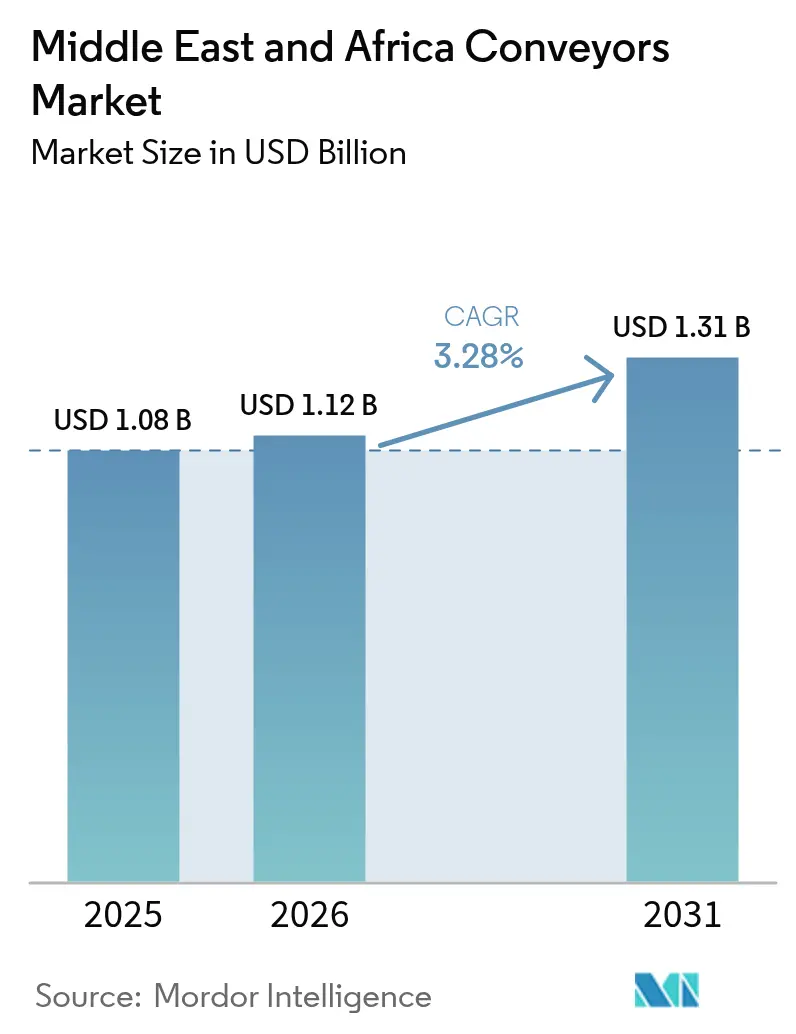
Middle East And Africa Conveyors Market Analysis by Mordor Intelligence
The Middle East and Africa conveyors market size is expected to grow from USD 1.08 billion in 2025 to USD 1.12 billion in 2026 and is forecast to reach USD 1.31 billion by 2031 at 3.28% CAGR over 2026-2031. Expansion is aligned with sovereign infrastructure agendas, airport capacity additions, and e-commerce fulfillment build-outs, catalyzing steady equipment demand even as input-cost volatility and technician shortages temper the overall uptake. Robust pipeline activity across Saudi Arabia’s megaprojects and the United Arab Emirates’ logistics-hub strategy is driving equipment standardization toward energy-efficient, sensor-rich conveyor platforms that integrate easily with warehouse management software. At the same time, mining modernization in South Africa and Morocco is propelling large-scale belt installations, while quick-commerce players are embracing vertical conveyor solutions to maximize cubic space in urban settings. Global integrators are responding with modular designs and predictive-maintenance suites that cut unplanned downtime and sharpen the total cost-of-ownership value proposition.
Key Report Takeaways
- By product type, belt conveyors led with 48.12% of the Middle East and Africa conveyors market share in 2025, whereas overhead conveyors are forecast to advance at a 5.18% CAGR through 2031.
- By end-user, airport applications accounted for 34.85% of the Middle East and Africa conveyors market size in 2025, while retail and e-commerce segments are poised for the fastest 6.33% CAGR to 2031.
- By conveyor orientation, horizontal systems captured 64.05% share of the Middle East and Africa conveyors market size in 2025, and vertical conveyors will expand at a 6.52% CAGR through 2031.
- By conveyor location, floor-mounted captured 78.65% share of the Middle East and Africa conveyors market size in 2025, and vertical conveyors will expand at a 5.71% CAGR through 2031.
- By country, Saudi Arabia held 25.05% of the Middle East and Africa conveyors market share in 2025; the United Arab Emirates is set to record the highest 5.29% CAGR during 2026-2031
Note: Market size and forecast figures in this report are generated using Mordor Intelligence’s proprietary estimation framework, updated with the latest available data and insights as of 2026.
Market Trends and Insights
Drivers Impact Analysis of Middle East And Africa Conveyors Market*
| Driver | (~) % Impact on CAGR Forecast | Geographic Relevance | Impact Timeline |
|---|---|---|---|
| Rapid Growth of E-Commerce | +1.2% | UAE, Saudi Arabia, Egypt; spillover to Qatar and Kuwait | Medium term (2-4 years) |
| Rise of Infrastructure Megaprojects Across GCC | +1.0% | Saudi Arabia (NEOM, Qiddiya), UAE (Dubai South), Qatar | Long term (≥ 4 years) |
| Accelerating Warehouse Automation Investments by 3PLs | +0.8% | UAE, Saudi Arabia, South Africa; emerging in Egypt and Kenya | Short term (≤ 2 years) |
| Surge in Airport Baggage Handling System Upgrades | +0.7% | UAE (Dubai, Abu Dhabi), Saudi Arabia (Riyadh, Jeddah), Qatar (Doha), Egypt (Cairo) | Medium term (2-4 years) |
| Mining Sector Modernization in Africa | +0.5% | South Africa, Egypt, Morocco; nascent in Nigeria and Kenya | Long term (≥ 4 years) |
| Greenfield Electric-Vehicle Assembly Plants | +0.4% | Saudi Arabia, UAE, Egypt, Morocco | Medium term (2-4 years) |
| Source: Mordor Intelligence | |||
Rapid Growth Of E-Commerce
Online retail penetration in the UAE and Saudi Arabia rose to 15% of total sales in 2024, magnifying the gap between consumer demand and fulfillment capacity.[1] Amazon’s 100,000-square-meter Riyadh facility and Noon’s 200,000-square-meter Dubai expansion both rely on modular belt, roller, and goods-to-person conveyors capable of processing more than 5,000 orders per hour in peak periods. Cross-border parcel inflows via Jebel Ali climbed 40% year over year, forcing 3PLs to deploy high-speed merge conveyors and automated customs sortation. Conveyors equipped with RFID readers and vision-guided diverters deliver 99.9% sort accuracy, ensuring compliance with same-day delivery promises. As fulfillment operators adopt multi-level mezzanines, conveyor intensity per square meter is rising, further amplifying demand for sensor-rich modular platforms that can be re-scaled quarterly rather than annually.
Rise Of Infrastructure Megaprojects Across GCC
Saudi Arabia’s USD 500 billion NEOM and USD 35 billion King Salman International Airport projects require more than 50 kilometers of aggregate, baggage, and construction conveyors engineered for 50 °C ambient temperatures and desert sandstorms. Similar large-scale developments in Dubai South and Qatar’s tourism corridors specify ISO 50001 energy management, catalyzing uptake of variable-frequency drives and regenerative braking. OEMs are building solar-ready power trains and offering hybrid electric-pneumatic drives to meet embodied-carbon reduction targets of up to 40%. Tender cycles that run through 2030 necessitate flexible local assembly capacity so suppliers avoid foreign-exchange swings and import-duty spikes. These projects cement long-term conveyor demand yet create lumpy order patterns that favor vendors with robust regional partnerships.
Accelerating Warehouse Automation Investments By 3PLs
Third-party logistics providers invested more than USD 1 billion in conveyor-centric warehouse automation between 2024 and 2025, a 60% jump from the previous biennium. CEVA Almajdouie Logistics plans to retrofit five Saudi distribution centers with conveyor-fed automated storage and retrieval systems by 2026, while Asyad’s acquisition of Skybridge Freight Solutions embeds conveyor platforms in a new Duqm Port distribution hub. Operators now view conveyors as data-generating assets that feed WMS dashboards with throughput metrics and predictive-maintenance alerts, slicing order cycle times by up to 30%. Demand is shifting toward Ethernet/IP-ready conveyors equipped with embedded sensors and OPC-UA gateways, a capability present in less than half of the installed base, signaling a sizable retrofit opportunity.
Surge In Airport Baggage-Handling System Upgrades
Dubai International, Al Maktoum International, and King Salman International airports collectively allocate USD 10 billion for next-generation baggage systems through 2030, each targeting 15,000 bags per hour per terminal. Specifications include RFID-enabled tracking, redundant loops for transfer passengers, and dynamic re-sort capabilities that inflate installed cost per linear meter by 40% compared with origin-destination layouts. Cairo International’s 8-kilometer belt upgrade cut mishandling by 35% within six months, demonstrating the operational payoff of standardized, sensor-rich conveyors. Integrators with proven hub-airport credentials remain well-positioned owing to complex routing algorithms and stringent IATA traceability standards.
Restraints Impact Analysis of Middle East And Africa Conveyors Market*
| Restraint | (~) % Impact on CAGR Forecast | Geographic Relevance | Impact Timeline |
|---|---|---|---|
| High Initial Capital Expenditure | -0.6% | Africa (South Africa, Egypt, Nigeria, Kenya); secondary impact in GCC for SME adopters | Short term (≤ 2 years) |
| Limited Skilled Maintenance Workforce | -0.4% | Sub-Saharan Africa (Nigeria, Kenya, Morocco); isolated GCC sites (Oman, Bahrain) | Medium term (2-4 years) |
| Volatile Raw Material Prices | -0.3% | Global, with acute impact on Africa due to currency depreciation and import dependency | Short term (≤ 2 years) |
| Fragmented OEM and After-Sales Network in Africa | -0.2% | Sub-Saharan Africa (Nigeria, Kenya, Rest of Africa); minimal impact in North Africa and GCC | Long term (≥ 4 years) |
| Source: Mordor Intelligence | |||
High Initial Capital Expenditure
Typical conveyor installations cost USD 800–2,500 per linear meter for standard belt and roller systems, escalating to USD 8,000 per meter for overhead power-and-free lines. African operators incur an extra 15–25% because of import duties and currency depreciation, stretching payback periods beyond five years for companies running on sub-10% EBITDA margins. Financing gaps persist as local banks offer limited equipment-leasing products, nudging SMEs toward low-cost gravity rollers or manual handling. OEMs that provide vendor financing and pay-per-use models are beginning to unlock the “missing-middle” segment representing nearly one-third of untapped demand.
Limited Skilled Maintenance Workforce
Vacancy rates for industrial maintenance roles exceed 20% in Nigeria, Kenya, and Morocco, forcing operators to fly in expatriate technicians at daily rates approaching USD 1,200 plus travel. Downtime penalties rise accordingly, eroding ROI for capital-intensive conveyor lines. In response, equipment makers are embedding remote diagnostics and augmented-reality troubleshooting that lowers mean-time-to-repair from eight hours to two. Kanoo Machinery’s partnership with Combilift incorporates a training academy targeting 500 certified technicians by 2026, illustrating how service contracts bundled with skills development can command premiums and reinforce brand loyalty.
*Our forecasts treat driver/restraint impacts as directional, not additive. The impact forecasts reflect baseline growth, mix effects, and variable interactions.
Middle East And Africa Conveyors Market Segment Analysis
By Product Type:
Overhead Conveyors Gain Traction In Space-Constrained FacilitiesBelt conveyors represented 48.12% of the Middle East and Africa conveyors market in 2025, entrenched in mining, airport baggage, and food processing applications where load limits reach 500 kg per meter. Roller conveyors dominate carton and pallet flows in general manufacturing, while pallet conveyors serve heavy automotive sub-assemblies exceeding 1,000 kg. Overhead systems, although smaller in absolute terms, will post a 5.18% CAGR through 2031 as pharmaceutical clean rooms and multi-level automotive plants target contamination-free routing and floor-space optimization.
Interroll’s modular conveyor platform, installed across multiple UAE and Saudi fulfillment hubs in 2024, underscores the pivot toward plug-and-play sections that maintenance teams can reconfigure within four-hour windows, cutting total lifecycle costs by up to 25% . Overhead power-and-free lines are slated for Lucid Motors’ EV plant and Ceer’s Saudi assembly campus, where body panels must traverse painting, welding, and final-assembly zones without obstructing floor traffic. The embedded trend is a migration to sensor-enabled, IoT-ready platforms that allow predictive health monitoring and software-driven throughput optimization, aligning with regional mandates for ISO 50001 compliance.


By End-User Industry:
Retail And E-Commerce Overtake Traditional SegmentsAirport operators accounted for 34.85% of 2025 demand in the Middle East and Africa conveyors market, reflecting historic investment in hub-airport baggage infrastructure. Yet retail and e-commerce fulfillment centers will record the fastest 6.33% CAGR through 2031 as online penetration climbs and same-day delivery expectations spread from the GCC to Egypt and Kenya.
Food and beverage producers led by Almarai and Nestlé are retrofitting stainless-steel hygienic conveyors to satisfy HACCP protocols, raising average spend per facility by 40%. Meanwhile, pharmaceutical clean rooms demand overhead power-and-free systems engineered for FDA 21 CFR Part 11 traceability, driving per-meter costs to USD 10,000 but radically reducing contamination risk. The blurring of segment boundaries is evident as e-commerce operators adopt pharmaceutical-grade vision inspection for shrinkage control, while beverage plants install e-commerce-style tote conveyors for mixed-SKU kitting. Suppliers with cross-sector case studies hold a competitive edge as convergence accelerates.
By Conveyor Orientation:
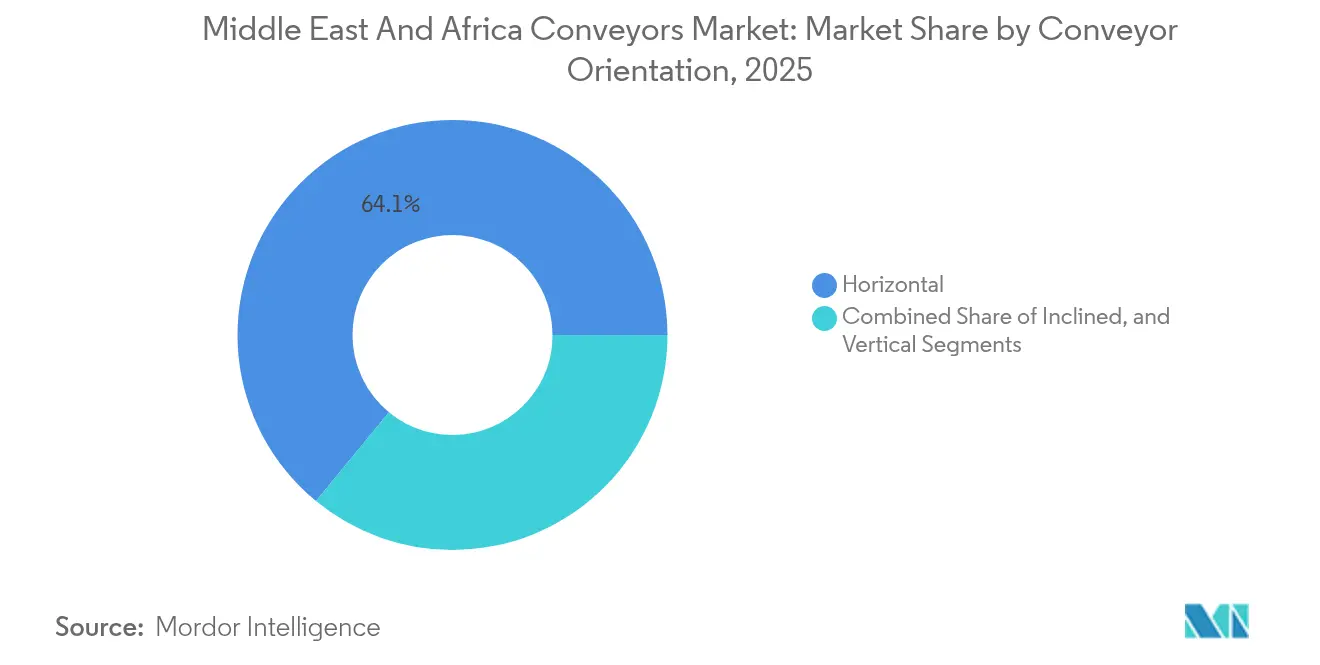
Vertical Systems Enable Cubic UtilizationHorizontal conveyors held 64.05% of 2025 installations, reflecting simple, single-level warehouse design norms relevance in the Middle East and Africa conveyors market. Inclined belts account for another 15-20% in truck-loading docks and multi-level plants. Vertical spiral and reciprocating lifts will grow at a 6.52% CAGR through 2031 as land prices in Jebel Ali and Riyadh industrial zones climbed 30% from 2022 to 2024.
Spiral conveyors occupy up to 30% less floor area than inclined belts for the same elevation change, making them attractive in clean rooms where square-meter construction costs surpass USD 5,000. They also serve as key interchange nodes for autonomous mobile robots, allowing three-dimensional goods flow that slashes horizontal travel distances by 50%. Integrated control architectures ensure seamless hand-offs between AMRs and vertical lifts, supporting lights-out fulfillment operations that raise picks per hour while curbing labor overhead.
By Conveyor Location:
Overhead-Mounted Systems Capture Automotive And Pharma GrowthFloor-mounted conveyors made up 78.65% of 2025 deployments, favored for easy maintenance access in airports, mining, and general distribution. Overhead installations will expand at a 5.71% CAGR through 2031, driven by automotive paint shops, pharmaceutical packaging, and apparel fulfillment hubs demanding gravity-assisted accumulation and uncluttered aisles in the Middle East and Africa conveyors market.
Power-and-free variants facilitate buffer management, enabling carriers to pause at workstations without stalling the loop, thereby lifting overall equipment effectiveness by around 15 percentage points. Nestlé’s forthcoming 117,000-square-meter Jeddah facility will deploy overhead conveyors integrated with robotic palletizers and stretch wrappers, proof that overhead layouts now anchor Industry 4.0 factory floor design. As wage inflation averages 8–10% annually, fulfillment centers are also adopting overhead garment-on-hanger systems for apparel and overhead tote routes for small-parts picking to offset labor costs, giving OEMs further runway for technological differentiation.
Geography Analysis
Saudi Arabia Conveyors Market
Saudi Arabia contributed 25.05% of 2025 revenue, propelled by the conveyor-intensive NEOM and King Salman International Airport projects, both scheduled for major equipment awards between 2025 and 2027. Public Investment Fund backing assures financing resilience, although order flow will remain cyclical as mega-projects move from civil works to fit-out phases.
United Arab Emirates and Africa Conveyors Market
The United Arab Emirates, while starting from a smaller base, is forecast to have the highest 5.29% CAGR, underpinned by Dubai South’s airport expansion and the widening of Khalifa Port, which collectively double fulfillment square footage and stimulates conveyor demand in ground-handling and cross-docking facilities. AD Ports Group’s crane investments in Congo and Angola signal an outward push that will export UAE conveyor demand into Africa via EPC contracts overseen from Abu Dhabi.
MEA Conveyors Market
South Africa anchors African bulk-material conveyor activity with multi-kilometer belt lines in gold and platinum operations. Egypt and Morocco add phosphate and cement flows, while Nigeria and Kenya show early signs of conveyor adoption in port and general manufacturing upgrades. Import duties and currency swings inflate landed costs by up to 30%, but local assembly partnerships and aftermarket hubs are emerging to counteract pricing pressure, setting the stage for gradual Middle East and Africa conveyors market formalization.
Regulatory Landscape
Conveyor projects in the GCC are shaped by product conformity and technical-regulation regimes that affect import clearance and commissioning schedules. In Saudi Arabia, the Saudi Standards, Metrology and Quality Organization (SASO) administers the SABER platform for product conformity for imported industrial and machinery equipment, while in the UAE the Ministry of Industry and Advanced Technology (MoIAT) uses National Quality Infrastructure (NQI) processes and e-services to issue conformity documentation for industrial equipment shipments.
Beyond product safety and electrical compliance, industrial sites are tightening requirements for logistics and operational technology governance. Saudi Arabia's National Cybersecurity Authority applies Operational Technology Cybersecurity Controls (OTCC-1:2022) to industrial systems, influencing specifications for sensor-rich conveyors and connected controls, and ZATCA's Authorized Economic Operator (AEO) program provides customs facilitation pathways for qualified logistics operators handling high-volume automated flows. Regional harmonization also matters, with the Gulf Standardization Organization (GSO) aligning technical requirements across member states and supporting cross-border standardization for machinery and electrical equipment used in conveyor installations.
Value Chain Analysis
The regional conveyor value chain covers design and engineering (system integrators and EPCs), component supply (belts, rollers, motors, gearboxes, drives, controls, sensors), fabrication and assembly (increasingly localized where possible), and installation and commissioning at end-user sites such as airports, ports, warehouses, and mines. Large turnkey awards typically bundle mechanical conveyance with controls, safety systems, and software interfaces to WMS and plant systems, while regional distributors and service firms tailor applications for harsh environments and maintain spare parts availability and maintenance coverage.
Demand pull from megaprojects and industrial expansions is reinforcing integrated delivery models that connect equipment supply with logistics execution and documentation workflows. Oman-based Asyad positions itself as an end-to-end logistics operator across ports and free zones, while UAE platforms such as ADEED and AI-driven tools like NunarIQ focus on automating customs and procurement paperwork that supports conveyor-centric operations. Project-linked procurement also ties the chain upstream: Meranti Green Steel's Duqm project selected Bedeschi for material handling and conveying systems (June 2026), and Dubai airport expansion-related concrete production commissioned equipment featuring integrated screw conveyors (May 2026), showing conveyors embedded within broader construction and industrial supply chains rather than sourced as standalone hardware.
Competitive Landscape
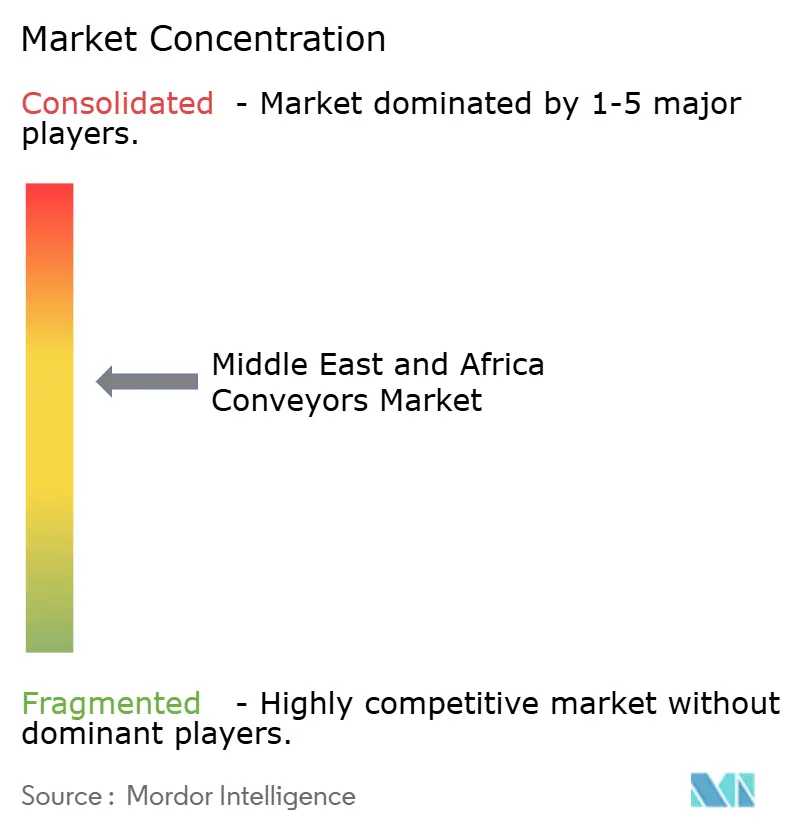
Global integrators Daifuku, Swisslog, Siemens Logistics, and Vanderlande account for roughly half of large turnkey awards, leveraging sensor-rich platforms and multiyear service agreements that lock in software revenues. Regional distributors such as Melco Conveyor Equipment, CITCOnveyors, and Kanoo Machinery fill retrofit and mining niches through spare-parts proximity and customization for harsh environments. This dual-track ecosystem offers OEMs the opportunity to marry modular hardware with open-architecture analytics, building hybrid packages that resonate with both global 3PLs and mid-market manufacturers.
Autonomous mobile robot vendors like AutoStore and Geek+ are eroding pure-play conveyor footprints in 20-30% of new fulfillment centers, prompting conveyor makers to add AMR interfaces and develop mixed-mobility workflows that preserve share of wallet. Siemens’s decision to divest its airport logistics unit in early 2025 highlights ongoing portfolio realignment as integrators navigate margin compression and lengthening project cycles in the Middle East and Africa conveyors market.
Local content is emerging as a decisive edge in Africa: distributors who can stock critical spares and provide 24-hour on-site support capture premium contracts even when competing against bigger brands. Kanoo Machinery’s 2024 partnership with Combilift, encompassing a technician academy, typifies the blend of product, service, and training that fortifies customer stickiness in skill-scarce environments
Middle East And Africa Conveyors Industry Leaders
-
Daifuku Co. Ltd
-
SSI Schaefer AG
-
Mecalux SA
-
BEUMER Group GmbH and Co. KG
-
Swisslog Holding AG
- *Disclaimer: Major Players sorted in no particular order
Middle East And Africa Conveyors Market Companies Covered in this Report
- Daifuku Co. Ltd.
- SSI Schaefer AG
- Swisslog Holding AG
- BEUMER Group GmbH and Co. KG
- Mecalux SA
- KNAPP AG
- Kardex Holding AG
- Interroll Holding AG
- CITCOnveyors SRL
- Melco Conveyor Equipment (Pty) Ltd.
- Fives Intralogistics SAS
- Vanderlande Industries B.V.
- Bastian Solutions LLC
- Dematic Corp.
- FlexLink AB
- Siemens Logistics GmbH
- Dorner Manufacturing Corp.
- Continental AG
- Hytrol Conveyor Company Inc.
- TGW Logistics Group GmbH
- Honeywell Intelligrated
Market Opportunities and Future Outlook
Port and inland logistics build-outs across the Middle East and Africa create equipment and retrofit whitespace for conveyors integrated with sortation, yard workflows, and digitally managed warehousing. Recent investments point to capacity additions rather than abstract demand signals: DP World opened an integrated Logistics Distribution Centre at Sokhna Logistics Park in Egypt (July 2026), Gulftainer expanded operations at Sharjah's Khor Fakkan port to lift capacity from 3.5 million to 5 million TEUs (July 2026), and Saudi Ports Authority (Mawani) announced a USD 170 million program at Jeddah Islamic Port (July 2026). These programs add more sites where conveyors, transfer systems, and interface equipment are specified alongside inventory management and terminal operations systems.
Industrial diversification and mining and minerals modernization create a parallel opportunity set in bulk handling, factory intralogistics, and compliance-driven upgrades. Meranti Green Steel's planned HBI plant in Duqm contracted Bedeschi for material handling systems (June 2026), indicating ongoing capex on heavy-duty conveying and port transfer. In North and West Africa, projects such as Cavotec's supply to TAKRAF for a bulk handling phosphate/sulphur processing project in Morocco (January 2026) and Metso's feeder deliveries for the Koné gold project in Côte d'Ivoire (January 2026) highlight needs for upstream feeders and transfer conveyors, alongside service capabilities that can sustain uptime in remote sites. As manufacturers push connected operations, upgrades also extend to plant software platforms such as Rockwell Automation's Plex at Hadaf Foods' KEZAD facility (July 2026), supporting conveyor systems with OT-ready controls, diagnostics, and traceability integration.
Recent Industry Developments in Middle East And Africa Conveyors Market
- July 2026: Mecalux supported Herba Ricemills (Ebro Foods) in implementing an automated warehouse system aimed at scaling operations across the Middle East and Africa. The project reinforces demand for integrated intralogistics designs where conveyors interface with automated storage and software controls to raise throughput and reduce handling variability.
- June 2025: Swisslog announced the automation of Chalhoub Group's logistics hub in the SILZ Free Trade Zone in Riyadh, Saudi Arabia. The deployment highlights continued investment in conveyor-enabled distribution infrastructure for e-commerce and premium retail fulfillment, strengthening the role of turnkey integrators that combine mechanical flow with control software and service support.
- April 2024: SSI Schaefer completed a mobile pallet racking system installation for Noatum Logistics Middle East at the KLP21 warehousing hub in Khalifa Economic Zone Abu Dhabi (KEZAD). The expansion in high-density storage capacity increases pull-through for conveyor, shuttle, and picking interfaces used in cold-chain and general logistics operations in the UAE.
Middle East And Africa Conveyors Market Report Scope and Research Methodology
Market Definition and Coverage
This market covers revenue generated from conveyors used to move bulk materials or unit loads within facilities across the Middle East and Africa. It includes new equipment sales and system supply across common conveyor formats used in industrial and commercial material flow.
Scope exclusions: we exclude upstream raw material production for conveyor components and any purely internal labor or maintenance work that is not billed as a market service.
Segments Covered in This Report
- By Product Type
- Belt Conveyors
- Roller Conveyors
- Pallet Conveyors
- Overhead Conveyors
- Screw Conveyors
- Chain Conveyors
- By End-User Industry
- Airport
- Retail and E-Commerce
- Automotive
- General Manufacturing
- Food and Beverage
- Pharmaceuticals
- Mining and Minerals
- By Conveyor Orientation
- Horizontal
- Inclined
- Vertical
- By Conveyor Location
- Floor-Mounted
- Overhead-Mounted
- By Country
- Middle East
- United Arab Emirates
- Saudi Arabia
- Qatar
- Oman
- Kuwait
- Bahrain
- Turkey
- Israel
- Rest of Middle East
- Africa
- South Africa
- Egypt
- Nigeria
- Kenya
- Morocco
- Rest of Africa
- Middle East
Data Sources, Market Sizing, and Validation
Desk Research
Desk work starts with building a fact base on where conveyor demand is coming from in the Middle East and Africa, and how quickly key end uses are expanding. We typically lean on public sources such as UN Comtrade for trade flows, national statistics agencies for industrial output, customs and port authority releases, and central bank publications for macro indicators and exchange-rate context.
To keep the market logic grounded, we also review sources such as transport and logistics ministry updates, mining and minerals directorate publications, and airport authority project announcements, and then cross-check with company annual reports, investor presentations, and credible business press. Where available, we supplement with paid subscriptions for company financials and news, import and export shipment-level records, and patent databases to understand product direction and local manufacturing intensity. These desk research sources are illustrative and not exhaustive, and many other public and paid references were also used for data collection, validation, and clarification.
Primary Interviews and Surveys
Primary work is used to pressure-test demand assumptions and pricing logic that are hard to observe from public sources, especially where projects are announced but timelines move. We speak with a mix of manufacturers, system integrators, distributors, and large buyers across logistics, mining, food processing, and general manufacturing, and we cover the Middle East and Africa demand centers so the model reflects real procurement behavior.
Distribution of primary research fieldwork respondents
| Company type | Respondent position |
|---|---|
| Top tier: 35% | CXOs: 15% |
| Mid tier: 50% | Functional/Unit leaders: 37% |
| Smaller Players: 15% | Managers: 48% |
Market-Sizing & Forecasting
For sizing, we use a top-down and bottom-up approach where a demand pool is first reconstructed from industrial activity and project pipelines, and then the totals are checked against what suppliers and channels say is realistic for the region. In practice, the top-down build links conveyors demand to indicators like mining output and expansions, warehouse and fulfillment build-outs, airport and baggage handling investments, manufacturing output trends, and import patterns for conveyor equipment and parts.
Once the demand pool is shaped, the value is translated using practical price bands by conveyor type and installation context, and then adjusted for typical mix shifts such as higher automation in logistics sites or heavy-duty systems in mining. To corroborate the outputs, selective bottom-up approximations are created using sampled supplier revenues in the region, distributor channel checks, and volume assumptions multiplied by average selling prices, which helps us spot areas where public signals may be overstating near-term delivery. Forecasts are built using scenario analysis with a short list of drivers that interviewees can validate, including capex cycles in mining, logistics real estate starts, and country-level infrastructure timing, and then we sanity-check the implied growth against known capacity and project execution constraints.
Data Validation & Update Cycle
Before finalizing, outputs are validated through several steps so large jumps do not slip through unnoticed. We compare the market totals against independent signals such as trade movements, announced project counts, and the implied equipment intensity per facility type, and then investigate variances when a country or end-use looks out of line.
Assumptions that drive the biggest value swings, like price progression and mix share between heavy-duty and light-duty systems, are reviewed by another analyst and are rechecked with select respondents if needed. The report is refreshed annually, and interim updates are made when a material event changes demand timing, pricing, or supply conditions. Right before delivery, a final pass is completed so clients receive the most current view available at that time.
Mordor Intelligence's Middle East Africa Conveyors Market Size Compared Against Other Published Estimates
Different studies can show different market sizes even when they talk about conveyors in the same region, because they do not always count the same products, years, and pricing assumptions. The year chosen as the base, the way installed systems are treated versus equipment-only sales, and the currency conversion timing can all change the final value.
By tracking import signals, project execution timing, and price bands by conveyor format, Mordor Intelligence keeps the MEA total aligned to equipment categories like belt, roller, pallet, overhead, screw, and chain conveyors, rather than blending in adjacent material-handling spend that is not a conveyor sale. Gaps also come from whether a publisher includes only the Middle East, uses a shorter forecast window, or reports a conservative scenario that assumes delayed mining and logistics capex cycles.
Benchmark comparison
| Source | Market Size | Gaps in Research Methodology |
|---|---|---|
| Mordor Intelligence | USD 1.08 B (2025) | |
| Regional Consultancy A | USD 1.03 B (2023) | Uses an earlier base year and a narrower definition centered on a few conveyor types, which can understate newer logistics and airport-linked demand that picked up later in the cycle. |
| Industry Publisher B | USD 0.77 B (2029) | Reports a single forward-year point within a shorter horizon and appears to apply tighter capex assumptions, which can reduce the implied installed value in markets where projects are staged across multiple years. |
The table shows that timing, scope, and scenario choices are usually what create the spread, not a single arithmetic difference. When the counted product boundary is kept clear and the drivers are tied back to observable activity like trade, projects, and end-use investment, the final market size becomes easier to explain and repeat.
Key Questions Answered in the Report
How large is the Middle East and Africa conveyors market in 2026?
The market is valued at USD 1.12 billion in 2026, with steady growth forecast through 2031.
What CAGR is expected through 2031 for conveyor sales in the region?
The market is projected to expand at 3.28% per year from 2026 to 2031.
Which country will grow fastest in conveyor demand?
The United Arab Emirates is anticipated to post the highest 5.29% CAGR, propelled by logistics-hub investments.
Which segment is expanding most rapidly?
Retail and e-commerce fulfillment centers are set for a 6.33% CAGR as online shopping penetration accelerates.
Why are vertical conveyors becoming more popular?
Rising urban land prices make multi-level warehouses economical, and vertical lifts enable cubic storage without enlarging footprints.
What is the main challenge for conveyor operators in Africa?
A shortage of skilled maintenance technicians increases downtime and service costs, prompting OEMs to embed remote diagnostics and local training programs.