
South America Green IT Software Market Size and Share
Market Overview
| Study Period | 2020 - 2031 |
|---|---|
| Forecast Data Period | 2026 - 2031 |
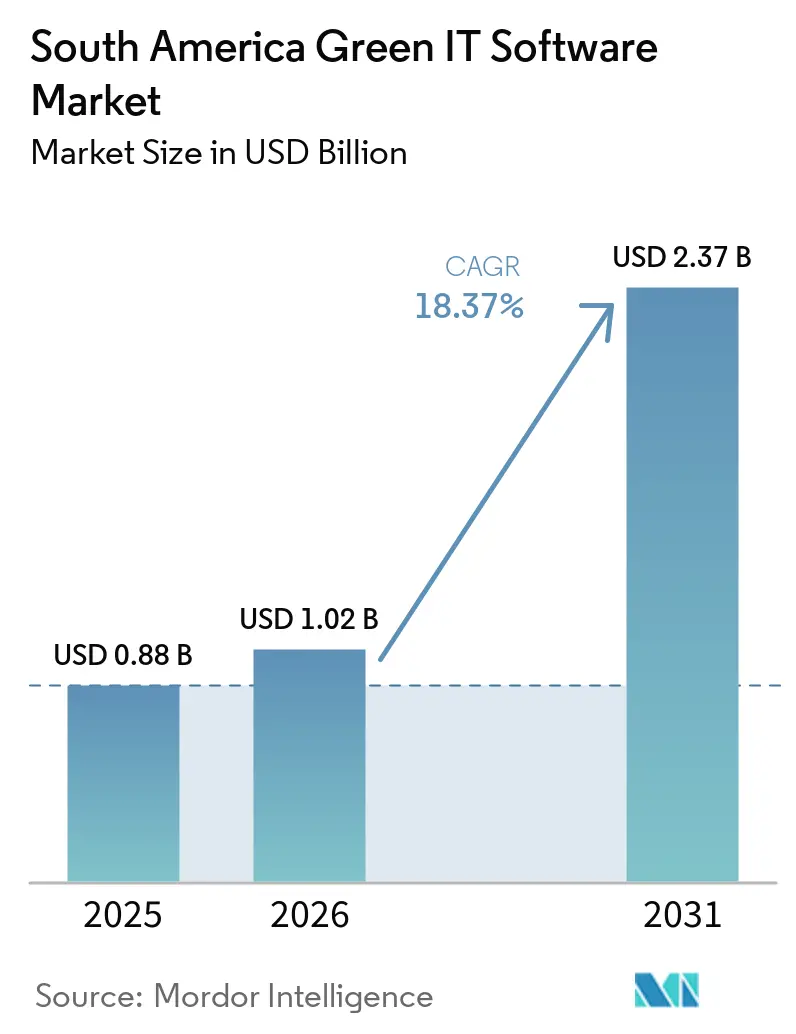
| Base Year Market Size (2025) | USD 0.88 Billion |
| Market Size (2026) | USD 1.02 Billion |
| Market Size (2031) | USD 2.37 Billion |
| Growth Rate (2026 - 2031) | 18.37 % |
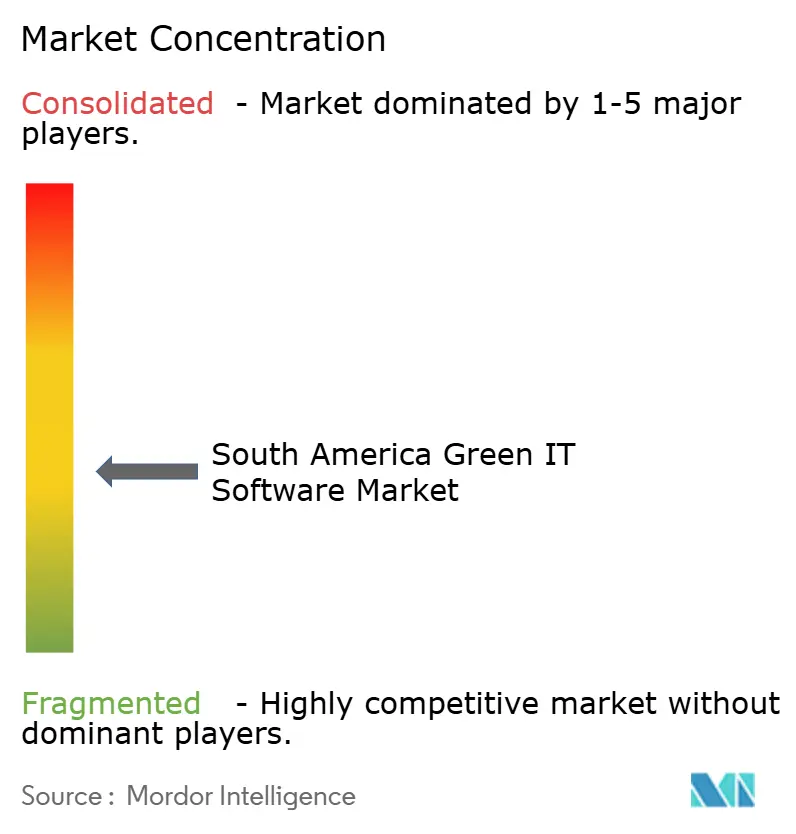
| Market Concentration | Medium |
Major Players *Disclaimer: Major Players sorted in no particular order Image © Mordor Intelligence. Reuse requires attribution under CC BY 4.0. | |
South America Green IT Software Market Analysis by Mordor Intelligence
The South America green IT software market size was valued at USD 0.88 billion in 2025 and estimated to grow from USD 1.02 billion in 2026 to reach USD 2.37 billion by 2031, at a CAGR of 18.37% during the forecast period (2026-2031). The market is moving from broad sustainability intent to software-led execution because companies now need tools that can organize emissions data, energy records, and audit-ready reporting in one system. Demand is also shifting from narrow reporting use cases toward daily operational needs, especially as IT teams seek to reduce wasted workload, improve utilization, and lower power consumption across digital infrastructure. Cloud and hybrid delivery models are widening the addressable base because buyers expect frequent product updates, flexible rollouts, and easier integration with existing enterprise systems. AI-enabled automation is reducing the manual work tied to data capture, validation, and disclosure preparation, making these platforms more practical for a broader set of users. The strongest opportunity in the South America green IT software market remains with vendors that can link compliance, energy efficiency, and integration support into a single commercial offer.
Key Report Takeaways
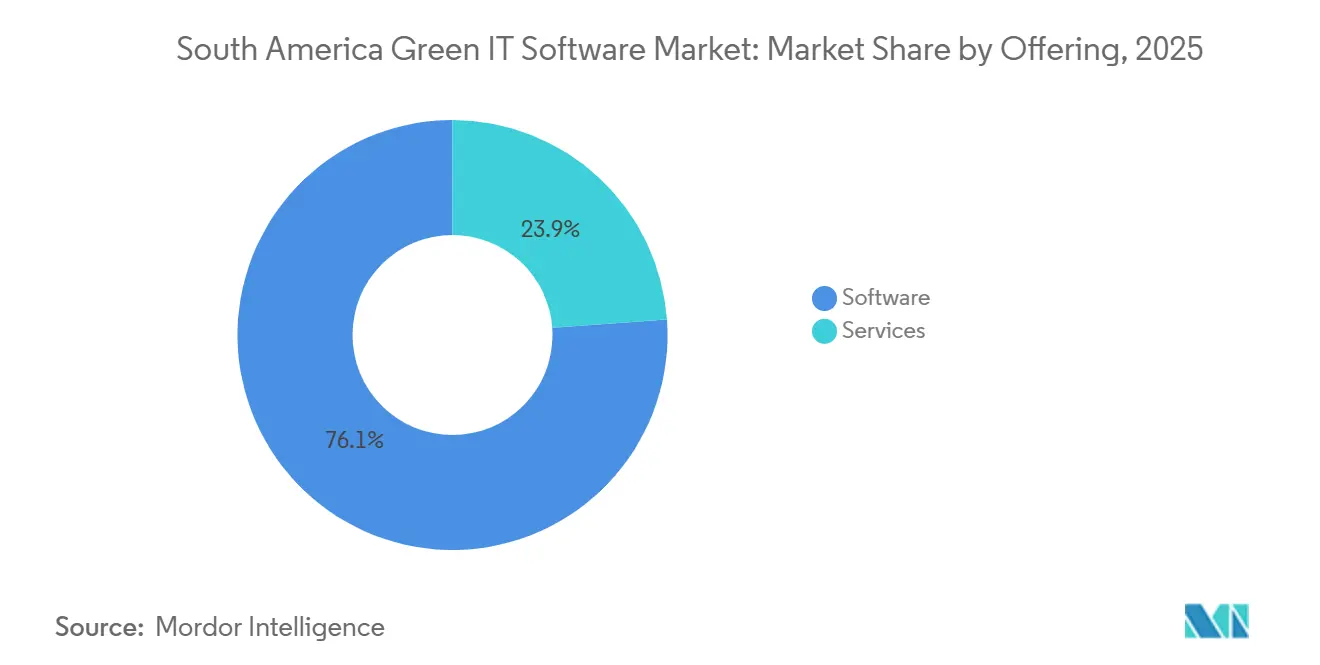
- By offering, software led with a 76.14% revenue share of the South America green IT software market in 2025, while services are projected to expand at an 18.43% CAGR through 2031.
- By deployment, cloud-based solutions held a 64.17% share in 2025, while hybrid deployment is expected to record the highest CAGR at 18.52% through 2031.
- By enterprise size, large enterprises accounted for 69.12% of revenue in 2025, while SMEs are projected to post the fastest growth at an 18.63% CAGR through 2031.
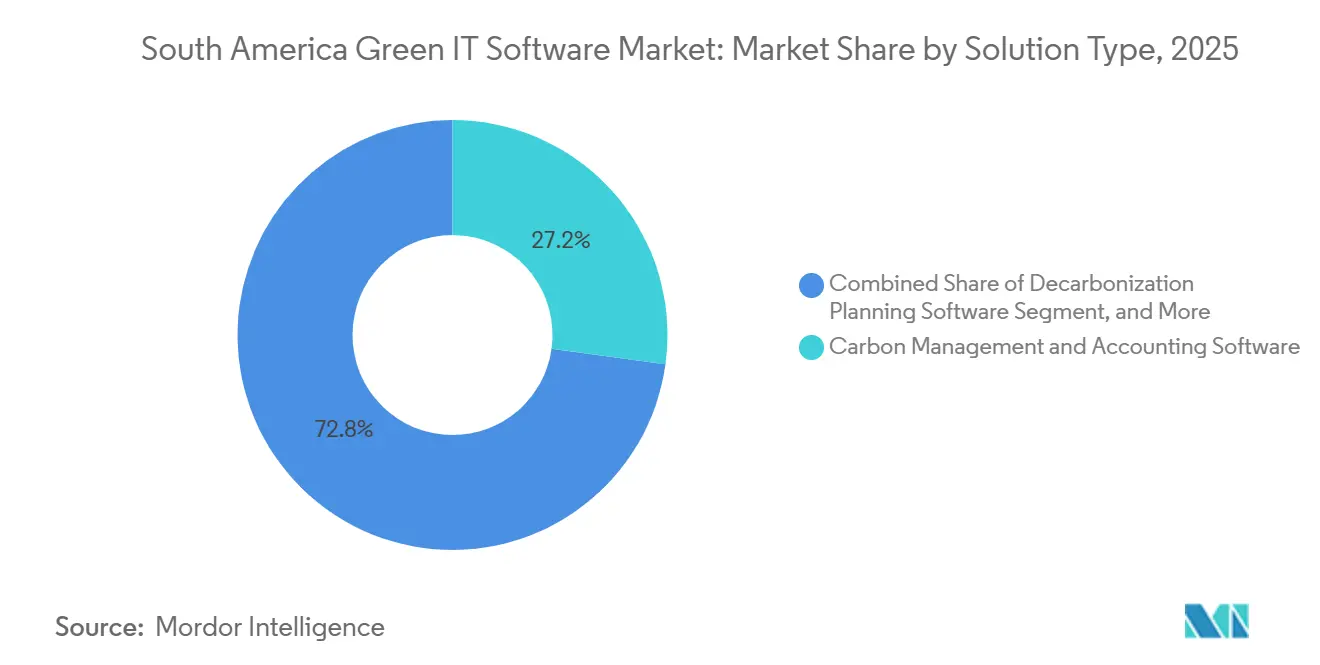
- By solution type, carbon management and accounting software captured a 27.18% share in 2025, while decarbonization planning software is expected to expand at an 18.74% CAGR through 2031.
- By end user, IT and telecom represented 22.13% of the South America green IT software market in 2025, while energy and utilities are projected to grow at an 18.91% CAGR through 2031.
- By geography, Brazil held 38.12% share of the South America green IT software market in 2025, while Chile is expected to record the fastest regional growth at a 19.07% CAGR through 2031.
Note: Market size and forecast figures in this report are generated using Mordor Intelligence’s proprietary estimation framework, updated with the latest available data and insights as of January 2026.
Market Trends and Insights
Drivers Impact Analysis of South America Green IT Software Market*
| Driver | (~) % Impact on CAGR Forecast | Geographic Relevance | Impact Timeline |
|---|---|---|---|
| Growing Carbon Reporting and ESG Compliance Requirements | +4.0% | Brazil and Chile primarily, with regulatory influence extending to Colombia and Argentina | Short term (≤ 2 years) |
| Rising Enterprise Focus on Energy-Efficient IT Operations | +3.3% | Brazil, Chile, Colombia, with spillover to the rest of South America | Medium term (2-4 years) |
| Expansion of Cloud and Virtualized Infrastructure Management | +2.6% | Regional relevance, with concentrated traction in São Paulo, Santiago, and Bogotá | Short term (≤ 2 years) |
| Wider Adoption of AI-Based IT Asset and Workload Optimization | +2.0% | Brazil and Chile core markets, with emerging uptake in Colombia | Medium term (2-4 years) |
| Increasing Data Center Power Optimization Initiatives | +1.5% | Brazil and Chile, with early gains in Uruguay and Argentina | Long term (≥ 4 years) |
| Public Sector Digital Sustainability Programs | +1.0% | Brazil, Chile, and Colombia | Long term (≥ 4 years) |
| Source: Mordor Intelligence | |||
Growing Carbon Reporting and ESG Compliance Requirements
Compliance remains the clearest near-term buying trigger for the South America green IT software market. Enterprises are no longer looking only for dashboards; they now need platforms that support traceable data capture, repeatable calculations, and structured reporting workflows. This change matters most for larger companies, where sustainability, finance, legal, and IT teams now need shared systems rather than disconnected spreadsheets and one-off consulting exercises. It also helps explain why carbon management and accounting software continues to act as the first purchase in many deployment journeys. Once an enterprise implements a reporting core, it often adds adjacent modules for data management, target tracking, and workflow controls in the next stage. This pattern is giving the South America green IT software market a more durable revenue base than a short project cycle would provide.
Rising Enterprise Focus on Energy-Efficient IT Operations
Energy efficiency is becoming an operating priority rather than a side benefit in the South America green IT software market. As digital workloads grow, IT teams are under pressure to monitor utilization, identify idle capacity, and improve performance without increasing power consumption. That is changing the buyer profile, because software selection is moving beyond sustainability teams and into infrastructure, operations, and platform engineering groups. The value case is also easier to defend when energy optimization can show measurable effects on operating costs, uptime planning, and asset life. This makes green IT software relevant even for firms that are not yet under direct reporting pressure. Over time, that broader utility should help the South America green IT software market deepen adoption across both compliance-led and efficiency-led accounts.
Expansion of Cloud and Virtualized Infrastructure Management
The growth of cloud environments and virtualized infrastructure is widening the data footprint that enterprises need to track in the South America green IT software market. When workloads shift across cloud, on-premises, and hybrid environments, reconciling sustainability data becomes harder unless a dedicated platform can normalize usage, emissions, and resource records. Buyers are also favoring software that can adapt to changing templates and reporting rules without lengthy upgrade cycles. That preference supports cloud-based delivery, while still leaving room for hybrid models where data control and residency remain important. Virtualization adds another layer of demand because companies increasingly want visibility at the workload level rather than only at the facility level. As a result, the South America green IT software market is becoming more closely tied to broader infrastructure modernization programs.
Wider Adoption of AI-Based IT Asset and Workload Optimization
AI is starting to reshape both product design and buyer expectations in the South America green IT software market. ServiceNow expanded Now Assist for ESG with an updated release that adds sustainability reporting and workflow automation capabilities within its enterprise platform.[1] Salesforce introduced Agentforce for Net Zero Cloud to automate sustainability data collection and related actions, showing how major vendors are embedding AI into carbon and ESG workflows. HPE added predictive sustainability forecasting, workload carbon tracking, and hybrid IT optimization through GreenLake Intelligence, extending AI‑led sustainability management further into the infrastructure layer. These developments reduce manual effort and improve the usefulness of software for teams that need faster data preparation and exception handling. They also improve the long‑term outlook for the South America green IT software market because lower workflow friction can help move adoption beyond the largest enterprises.
Restraints Impact Analysis of South America Green IT Software Market*
| Restraint | (~) % Impact on CAGR Forecast | Geographic Relevance | Impact Timeline |
|---|---|---|---|
| High Integration Complexity Across Legacy IT Environments | -3.0% | Across South America, with the highest strain in markets where legacy ERP and siloed operational systems remain common | Short term (≤ 2 years) |
| Budget Constraints Among Small and Mid-Sized Enterprises | -2.4% | Rest of South America, Colombia, and Argentina, with moderate pressure in Brazil and Chile | Medium term (2-4 years) |
| Limited Standardization in Sustainability Measurement | -1.7% | Brazil and Chile, with stronger exposure in energy and manufacturing | Medium term (2-4 years) |
| Data Security and Data Residency Concerns | -1.3% | Brazil, Chile, and Colombia | Long term (≥ 4 years) |
| Source: Mordor Intelligence | |||
High Integration Complexity Across Legacy IT Environments
Integration difficulty is still one of the main barriers to faster adoption in the South America green IT software market. Many enterprises run old ERP, procurement, logistics, facilities, and service management systems that were never designed to feed standardized carbon or energy reporting tools. That creates long deployment cycles because buyers must map data across different formats, owners, and quality levels before the software can produce trusted outputs. It also raises the importance of implementation support, prebuilt connectors, and local partner capability during vendor selection. Global platforms can lose momentum when they underestimate the extent of operational data fragmentation across large regional organizations. For this reason, integration readiness often matters as much as product breadth in the South America green IT software market.
Budget Constraints Among Small and Mid-Sized Enterprises
Budget discipline continues to limit how quickly smaller accounts convert in the South America green IT software market. SMEs are interested in lower‑cost tools, but many still view sustainability software as discretionary unless a customer, regulator, or lender pushes it onto the operating agenda. Pricing models based on users, data connections, or emissions volume can also create hesitation where business value is not immediately visible. Vendors that offer modular entry points are therefore in a stronger position than those pushing large suite deployments from the start. TOTVS stated that Carbono IA by DEEP had been deployed across more than 400 clients in Brazil, suggesting that simpler, more accessible products can reach meaningful scale when the fit is clear. The SME opportunity remains large, but the South America green IT software market will capture it unevenly unless cost structures stay flexible.[2]
*Our forecasts treat driver/restraint impacts as directional, not additive. The impact forecasts reflect baseline growth, mix effects, and variable interactions.
South America Green IT Software Market Segment Analysis
By Offering:
Software Leads While Services Gain From ComplexitySoftware held 76.14% of South America's green IT software market share in 2025, which shows that buyers still prefer platforms they can configure and expand over time. That position reflects a practical need, as enterprises want tools that can manage emissions data, workflow rules, reporting templates, and audit trails within a single, repeatable environment. The software layer also aligns with the market's direction, as disclosure expectations and internal governance needs are changing faster than static reporting processes can keep pace. Buyers value the ability to update categories, adjust calculation logic, and add new modules without rebuilding the operating model each time requirements change. This gives software a structural advantage in the South America green IT software market because it supports scale, continuity, and internal ownership.
Services are projected to grow at a 18.43% CAGR through 2031, indicating that implementation work remains essential even in a software-led market. Enterprises still need support to connect legacy systems, clean historical records, define ownership, and set governance rules for recurring reporting cycles. Advisory and managed services also become more relevant after deployment, because many organizations need help adapting templates and controls as internal maturity improves. The service layer is likely to rise in importance as the green IT software industry moves from first purchase to ongoing optimization across broader business functions. Even so, the strongest service opportunities are likely to sit beside platform rollouts rather than replace them, which keeps software at the center of the commercial model for the South America green IT software market.
By Deployment:
Cloud Holds The Largest Base While Hybrid Gains Strategic WeightCloud‑based solutions accounted for 64.17% share of the South America green IT software market size in 2025, reflecting the appeal of scalable delivery and continuous product updates. This model works well for enterprises that want new reporting templates, workflow features, and analytics releases without lengthy internal upgrade projects. It also meets the needs of companies standardizing their technology estates and preferring subscription‑based software that can be deployed across regions and functions. In the South America green IT software market, cloud deployment is also helped by the fact that many buyers begin with reporting and data management use cases before extending the platform into operations. That sequence reduces the initial burden and accelerates time-to-value.
Hybrid deployment is expected to expand at a 18.52% CAGR through 2031, underscoring that control and flexibility must often coexist. Companies handling sensitive operating data still want cloud‑based analytics and reporting speed, but they may prefer to retain selected records or connectors within controlled internal environments. This structure also appeals to enterprises that are modernizing in stages rather than replacing all systems at once. HPE's GreenLake Intelligence launch reflects the wider push toward hybrid IT management that combines operational visibility with sustainability‑focused optimization. On‑premise deployments are likely to persist in a narrower set of accounts, yet the South America green IT software market is clearly moving toward architectures that balance update speed, auditability, and data control.[3]
By Enterprise Size:
Large Enterprises Set The Pace While SMEs Expand The Addressable BaseLarge enterprises captured 69.12% of revenue in 2025, giving them the clearest influence over product direction in the South America green IT software market. Their lead comes from stronger budgets, larger reporting burdens, and broader needs across climate data, governance, internal controls, and supplier engagement. These buyers often require multi‑entity rollouts, role‑based workflows, and integration with finance, procurement, operations, and risk systems. They also shape vendor roadmaps by requesting deeper configurability, stronger audit support, and scalable user governance. For that reason, large enterprises continue to define the commercial center of the South America green IT software market even as adoption begins to spread.
SMEs are projected to grow at a 18.63% CAGR through 2031, indicating a widening opportunity beyond the largest organizations. The shift is supported by lower SaaS entry costs, simpler product packaging, and rising pressure from supply chains that want better visibility into upstream emissions and energy practices. Smaller firms also benefit when software automates repetitive tasks that would otherwise require additional staffing or the hiring of outside consultants. TOTVS stated that its Carbono IA by DEEP solution had reached more than 400 clients in Brazil, which supports the case for accessible, locally relevant tools in this segment. The green IT software industry can grow more broadly from here, but vendors will need practical pricing, faster onboarding, and simple workflows to convert SME interest into sustained revenue in the South America green IT software market.[4]
By Solution Type:
Carbon Accounting Forms The Core While Planning Tools AdvanceCarbon management and accounting software held the largest solution‑type share at 27.18% in 2025, which makes it the operational entry point for much of the South America green IT software market. Most enterprises begin here because they need a system of record before they can manage targets, disclosures, or reduction programs with confidence. This category supports the basic work of collecting activity data, applying calculation logic, organizing evidence, and producing repeatable outputs that management can trust. It also lays the foundation for subsequent purchases, as reporting, planning, and optimization tools rely on a reliable underlying dataset. That is why carbon accounting remains the anchor category in the South America green IT software market.
Decarbonization planning software is projected to expand at a 18.74% CAGR through 2031, suggesting that buyers are moving from measurement to action. Once organizations complete a first emissions baseline, they usually want scenario analysis, target setting, abatement sequencing, and progress tracking that spreadsheets cannot handle well. The market is also broadening around related categories such as ESG reporting and compliance, sustainability data management, and energy and resource optimization. As these layers become more closely connected, the South America green IT software market shifts from isolated reporting to continuous management across planning and execution. This evolution should keep the solution mix dynamic, but foundational accounting software is still likely to remain the first step in most adoption paths.

By End User:
IT And Telecom Maintains The Lead While Energy And Utilities Accelerate FastestIT and telecom accounted for 22.13% of the South America green IT software market in 2025, reflecting the sector's direct exposure to infrastructure efficiency and digital operations. These organizations often have large technology estates, measurable energy use, and internal teams that can evaluate software from both operational and reporting angles. They also act as early adopters because many already run advanced monitoring environments and can extend those capabilities into sustainability management. That gives IT and telecom a natural advantage in the South America green IT software market, especially where platform performance and energy intensity are tightly linked. The segment is likely to remain important because it influences both internal adoption and broader enterprise awareness.
Energy and utilities are projected to grow at an 18.91% CAGR through 2031, indicating that directly regulated and energy-intensive sectors are moving up the demand curve. These companies have strong reasons to improve monitoring, reporting, and planning, as both emissions visibility and operational efficiency matter for long-term performance. BFSI and manufacturing also remain meaningful contributors, with banks focused on governance and risk workflows and manufacturers facing pressure from customers and export-linked sustainability expectations. Retail and e-commerce, government, healthcare, construction, and other user groups add depth to the demand base as sustainability software becomes easier to implement and justify. The South America green IT software market is therefore widening across verticals, even though the heaviest spending still comes from sectors with large digital footprints or higher compliance exposure.
Geography Analysis
Brazil and Argentina Green IT Software Market
Brazil held 38.12% of South America green IT software market share in 2025, making it the largest country market in the region. Its lead reflects the scale of its enterprise base, the concentration of large listed companies, and the stronger commercial readiness of buyers that can fund software, services, and integration together. Brazil also benefits from a broader local technology ecosystem, which improves access to implementation partners and regionally adapted products. Argentina remains smaller in current revenue terms, yet it is building relevance as more companies face investor scrutiny and rising expectations around structured sustainability reporting. The South America green IT software market, therefore, remains anchored in Brazil, while Argentina shows selective growth as digital maturity and reporting needs strengthen.
Chile and Colombia Green IT Software Market
Chile is expected to record the fastest growth, with a 19.07% CAGR through 2031, giving it an outsized role in shaping regional momentum. The country combines a relatively advanced sustainability agenda with active digital infrastructure development, which creates demand for both reporting software and energy-focused IT optimization tools. Chile also stands out because enterprises there are often early adopters of systems that can organize environmental data in a more formal and auditable way. Colombia adds a complementary growth path, supported by enterprise modernization and increasing attention to climate-related governance and reporting processes. Together, Chile and Colombia broaden the South America green IT software market beyond the largest economy and help distribute growth more evenly across the region.
Broader South America Green IT Software Market
The rest of South America remained in an earlier stage of adoption in 2025, but that does not mean the opportunity is weak. Uruguay offers a stable digital foundation and can support specialized green IT services for buyers seeking reliable infrastructure and manageable operating conditions. Paraguay has relevance because large-scale power availability can support future data-focused investment, which may later require more structured sustainability software adoption. Peru, Ecuador, Bolivia, and Venezuela are likely to move at different speeds, depending on their enterprise investment capacity, local regulations, and progress in digital infrastructure. This means the South America green IT software market will continue to develop in layers, with a few leading countries driving near-term revenue and a broader set of smaller markets contributing to the longer-term pipeline.
Competitive Landscape
The South America green IT software market remains moderately fragmented, with a mix of global platform vendors, regional specialists, and local software providers competing for different buyer profiles. Large vendors have an advantage in brand strength, product breadth, and the ability to bundle sustainability functions with wider enterprise software relationships. Regional and local players remain relevant because they often move faster on language support, implementation speed, and local process alignment. This is especially important in mid‑market accounts, where ease of deployment and cost control matter more than the widest possible feature set. The competitive balance in the South America green IT software market, therefore, depends as much on execution and fit as on product scope.
Recent product moves show that vendors are competing through automation, intelligence, and operational relevance rather than reporting alone. Salesforce launched Agentforce for Net Zero Cloud to automate sustainability data tasks and support action‑oriented workflows, which strengthens its position with enterprises seeking broader platform integration. ServiceNow updated Now Assist for ESG, reinforcing its strategy of embedding sustainability into enterprise workflow management rather than treating it as a standalone point product. HPE introduced GreenLake Intelligence, with predictive sustainability and workload-level carbon features, showing that infrastructure‑focused vendors are also pushing into this competitive space. These moves raise the standard across the South America green IT software market because buyers increasingly expect automation, analytics, and operational integration within a single product set.
Local relevance remains a clear point of differentiation in the South America green IT software market. TOTVS has shown that domestic familiarity, practical packaging, and an established enterprise base can help local vendors compete effectively, especially in Brazil. Specialist providers can also defend space where customers want focused tools for carbon accounting, supplier engagement, or sector‑specific energy optimization. At the same time, enterprise buyers are likely to narrow their vendor lists to platforms that combine credible reporting capabilities with manageable integration effort. The result is a market where no single supplier dominates, but competitive pressure is rising as buyers become more selective about usability, data trust, and long‑term platform value.
South America Green IT Software Industry Leaders
-
ServiceNow, Inc.
-
SolarWinds Corporation
-
Freshworks Inc.
-
Ivanti Software, Inc.
-
Flexera Software LLC
- *Disclaimer: Major Players sorted in no particular order
South America Green IT Software Market Companies Covered in this Report
- ServiceNow, Inc.
- SolarWinds Corporation
- Freshworks Inc.
- Ivanti Software, Inc.
- Flexera Software LLC
- Dynatrace, Inc.
- Progress Software Corporation
- Open Text Corporation
- New Relic, Inc.
- Workiva Inc.
- ScienceLogic, Inc.
- Schneider Electric SE
- N-able, Inc.
- IBM Corporation
- IFS AB
- BMC Software, Inc.
- NinjaOne, LLC
- Dakota Software Corporation
- EcoVadis SAS
- Salesforce Inc
Recent Industry Developments in South America Green IT Software Market
- June 2026: Elea Data Centers and Hyphen announced Rio AI City in Rio de Janeiro, a sustainable hyperscale campus designed for 1.5 GW of renewable capacity scalable to 3.5 GW. The campus commits to 100% certified renewable energy and waterless cooling systems, setting a new sustainability benchmark for South America's AI infrastructure sector and generating downstream demand for IT energy management software at hyperscale.
- May 2026: Brazil's Finance Ministry submitted a phased sector coverage proposal for the SBCE to the Permanent Technical Advisory Committee (CTCP), designating pulp and paper, iron and steel, cement, aluminum, oil and gas, refining, and aviation as the first cohort of mandatory MRV reporters from 2027. This proposal crystallizes the demand signal for enterprise carbon accounting and MRV software across 7 high-emission industries.
- May 2026: Ascenty commenced a USD 1.2 billion investment program to build 4 AI-focused data centers in São Paulo state, including Sumaré 3, described as the first hyperscale AI facility in South America designed with 100% renewable energy and closed-circuit cooling systems. The project signals that hyperscale operators are embedding sustainability metrics into construction specifications rather than retrofitting them post-deployment.
- May 2026: ISG published the 2026 Provider Lens ServiceNow Ecosystem Partners report for Brazil, confirming that Brazilian enterprises are migrating from fragmented digital tools to integrated ServiceNow-based environments that unify compliance, sustainability, and IT workflows. The report noted significant traction in financial services, healthcare, and telecommunications verticals.
South America Green IT Software Market Report Scope
The South America Green IT Software market comprises platforms and services that enable organizations across the region to embed sustainability into IT operations by managing carbon emissions, optimizing energy and resource use, and ensuring compliance with ESG frameworks. These solutions include carbon management and accounting, ESG reporting and compliance, sustainability data management, decarbonization planning, and energy optimization software. By integrating sustainability intelligence into IT workflows, these platforms help enterprises in Brazil, Argentina, Chile, Colombia, and other South American countries reduce environmental impact, enhance operational efficiency, and align with regional and global decarbonization goals. The market’s primary objective is to provide transparency, automate sustainability reporting, and support the transition toward greener, more resilient digital infrastructure across diverse industries.
The South America Green IT Software market report is segmented by Offering (Software, and Services), Deployment (Cloud-Based, On-Premise, and Hybrid), Enterprise Size (Large Enterprises, and Small and Medium Enterprises), Solution Type (Carbon Management and Accounting Software, ESG Reporting and Compliance Software, Sustainability Data Management Platforms, Decarbonization Planning Software, and Energy and Resource Optimization Software), End User (IT and Telecom, BFSI, Manufacturing, Energy and Utilities, Retail and E-Commerce, Government, Healthcare, Construction and Infrastructure, and Other End-User Industries), and Geography (Brazil, Argentina, Chile, Colombia, and Rest of South America). The Market Forecasts are Provided in Terms of Value (USD).
Segmentation Overview
| Software |
| Services |
| Cloud-Based |
| On-Premise |
| Hybrid |
| Large Enterprises |
| Small and Medium Enterprises |
| Carbon Management and Accounting Software |
| ESG Reporting and Compliance Software |
| Sustainability Data Management Platforms |
| Decarbonization Planning Software |
| Energy and Resource Optimization Software |
| IT and Telecom |
| BFSI |
| Manufacturing |
| Energy and Utilities |
| Retail and E-Commerce |
| Government |
| Healthcare |
| Construction and Infrastructure |
| Other End-User Industries |
| Brazil |
| Argentina |
| Chile |
| Colombia |
| Rest of South America |
| By offering | Software |
| Services | |
| By Deployment | Cloud-Based |
| On-Premise | |
| Hybrid | |
| By Enterprise Size | Large Enterprises |
| Small and Medium Enterprises | |
| By Solution Type | Carbon Management and Accounting Software |
| ESG Reporting and Compliance Software | |
| Sustainability Data Management Platforms | |
| Decarbonization Planning Software | |
| Energy and Resource Optimization Software | |
| By End User | IT and Telecom |
| BFSI | |
| Manufacturing | |
| Energy and Utilities | |
| Retail and E-Commerce | |
| Government | |
| Healthcare | |
| Construction and Infrastructure | |
| Other End-User Industries | |
| By Geography | Brazil |
| Argentina | |
| Chile | |
| Colombia | |
| Rest of South America |
Key Questions Answered in the Report
What is the current and forecast value of the South America green IT software space?
The South America green IT software market size was USD 0.88 billion in 2025, reached USD 1.02 billion in 2026, and is forecast to reach USD 2.37 billion by 2031 at an 18.37% CAGR.
Which segment leads by offering in South America green IT software?
Software led the market with a 76.14% share in 2025 because enterprises prefer configurable platforms that can handle reporting, governance, and workflow needs over time.
Why are cloud and hybrid deployments gaining traction across this space?
Cloud led with a 64.17% share in 2025 because buyers want regular updates and scalable delivery, while hybrid is growing fastest at 18.52% CAGR because many firms want both analytics flexibility and stronger data control.
Which enterprise group is driving most revenue today?
Large enterprises held 69.12% of revenue in 2025 due to stronger budgets, broader compliance exposure, and more complex reporting and integration requirements.
What solution category is attracting the strongest demand?
Carbon management and accounting software led with 27.18% share in 2025 because it acts as the starting point for emissions measurement and structured reporting.
Which countries are shaping regional growth most strongly?
Brazil remained the largest country market with 38.12% share in 2025, while Chile is projected to grow fastest through 2031 with a 19.07% CAGR.