
Saudi Arabia CRM Marketing Services Market Size and Share
Market Overview
| Study Period | 2020 - 2031 |
|---|---|
| Forecast Data Period | 2026 - 2031 |
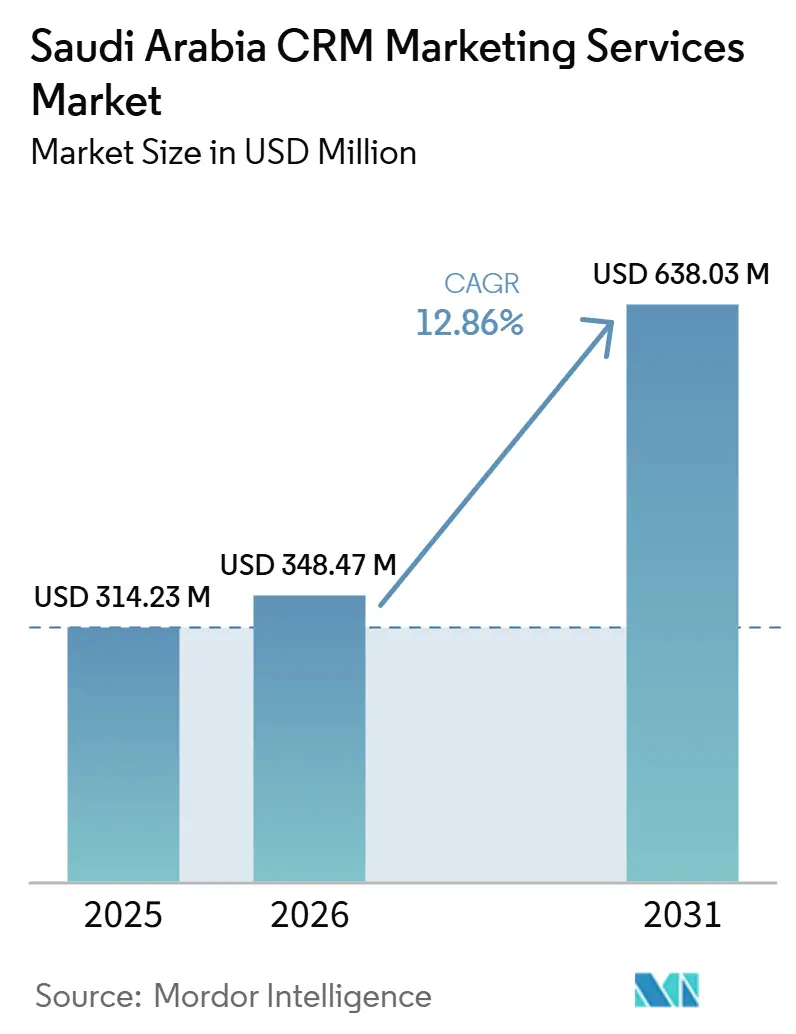
| Base Year Market Size (2025) | USD 314.23 Million |
| Market Size (2026) | USD 348.47 Million |
| Market Size (2031) | USD 638.03 Million |
| Growth Rate (2026 - 2031) | 12.86 % |
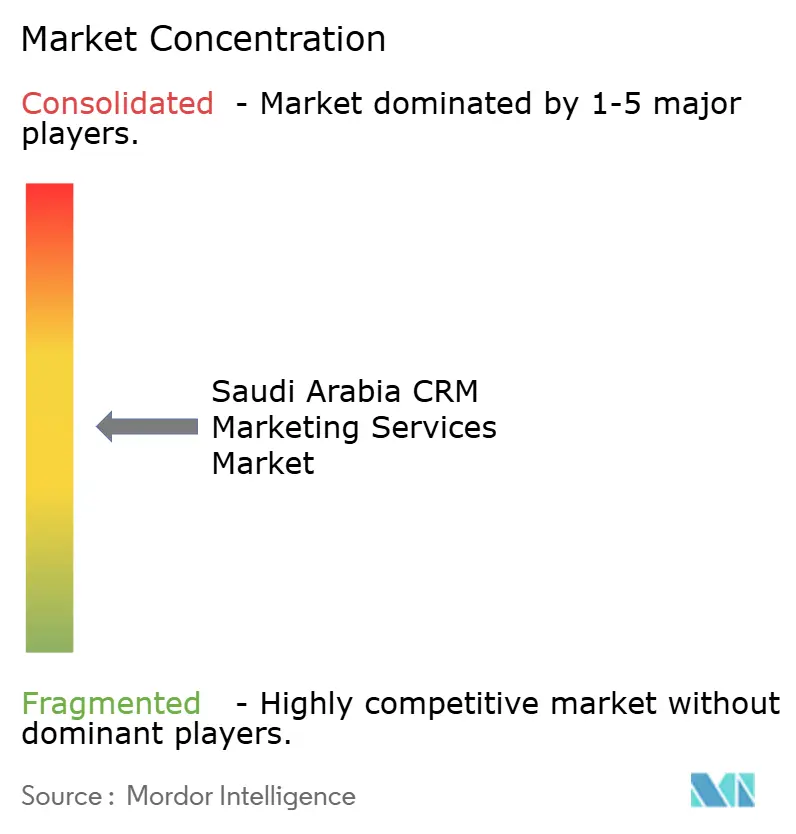
| Market Concentration | Medium |
Major Players *Disclaimer: Major Players sorted in no particular order Image © Mordor Intelligence. Reuse requires attribution under CC BY 4.0. | |
Saudi Arabia CRM Marketing Services Market Analysis by Mordor Intelligence
The Saudi Arabia CRM marketing services market size was valued at USD 314.23 million in 2025 and estimated to grow from USD 348.47 million in 2026 to reach USD 638.03 million by 2031, at a CAGR of 12.86% during the forecast period (2026-2031). The Saudi Arabia CRM marketing services market is expanding as enterprise digitization is increasingly tied to national modernization goals, stricter data-handling expectations, and faster cloud adoption among business users. Demand is moving beyond software deployment alone, as buyers increasingly want consulting, implementation, localization, workflow design, and ongoing service support within the same engagement. Large regulated organizations still shape spending patterns, but the broader demand base is also broadening as customer-facing sectors place greater emphasis on retention, personalization, and multichannel engagement. Competition is strengthening around providers that can support Arabic workflows, align with in-Kingdom hosting preferences, and translate compliance requirements into practical customer management processes. Project delays linked to legacy integration and limited implementation talent are also lifting the value of service firms that can combine platform expertise with process redesign and long-term support.
Key Report Takeaways
- By service type, CRM Implementation and Integration captured 57.34% of the Saudi Arabia CRM marketing services market revenue in 2025, while CRM Managed Services is projected to expand at 14.78% CAGR through 2031.
- By enterprise size, large enterprises held 70.21% of the Saudi Arabia CRM marketing services market share in 2025, while SMEs are projected to expand at 15.19% CAGR through 2031.
- By service application, Customer Acquisition accounted for 32.16% of the Saudi Arabia CRM marketing services market revenue in 2025, while Personalization Services is projected to expand at 14.05% CAGR through 2031.
- By end-user industry, BFSI accounted for 33.44% of the Saudi Arabia CRM marketing services market size in 2025, while retail and e-commerce are projected to expand at 14.47% CAGR through 2031.
Note: Market size and forecast figures in this report are generated using Mordor Intelligence’s proprietary estimation framework, updated with the latest available data and insights as of January 2026.
Saudi Arabia CRM Marketing Services Market Trends and Insights
Drivers Impact Analysis*
| Driver | (~) % Impact on CAGR Forecast | Geographic Relevance | Impact Timeline |
|---|---|---|---|
| Vision 2030-Led Enterprise Digitization | +3.2% | Riyadh, Jeddah, Dammam | Medium term (2-4 years) |
| Rising Demand for Personalized Customer Journeys | +2.8% | Riyadh, Jeddah | Medium term (2-4 years) |
| Cloud First CRM Procurement Across Mid-Market Firms | +2.1% | Riyadh, Jeddah, Eastern Province | Short term (≤ 2 years) |
| Omnichannel Customer Engagement in Retail and Telecom | +1.9% | Riyadh, Jeddah | Short term (≤ 2 years) |
| Arabic Language Workflow Automation and Localization | +1.5% | National, with early gains in Riyadh, Jeddah | Medium term (2-4 years) |
| PDPL-Driven Demand for Consent and Audit Ready CRM Workflows | +1.3% | National, concentrated among BFSI, healthcare, and retail | Short term (≤ 2 years) |
| Source: Mordor Intelligence | |||
Vision 2030-Led Enterprise Digitization
The Saudi Arabia CRM marketing services market is benefiting from a policy environment that treats digital transformation as an operational requirement across public and private institutions. The National Transformation Program links the expansion of the digital economy with the wider adoption of enterprise systems, which supports long-cycle demand for implementation, advisory, and process redesign services.[1] This matters because organizations in regulated and government-linked sectors tend to move in parallel once policy direction is clear, which places more projects into the market at the same time. The result is a stronger pipeline for vendors that can convert broad digitization goals into customer engagement systems that support acquisition, service, and retention. The Saudi Arabia CRM marketing services market, therefore, gains from both direct software deployment activity and the follow-on need for managed support around those deployments.
Rising Demand For Personalized Customer Journeys
The Saudi Arabia CRM marketing services market is also moving toward more individualized customer engagement rather than relying solely on broad campaign execution. As enterprises collect more first-party customer data through digital channels, they need service providers that can organize consent, segment users, and connect customer actions to timely outreach. This shift increases the value of implementation work because personalization depends on cleaner data structures, stronger workflow logic, and tighter links between marketing and service functions. It also favors providers that can localize experiences for Arabic-speaking users and adapt timing, content, and routing to Saudi customer behavior. In practice, the Saudi Arabia CRM marketing services market is seeing personalization shift from an optional add-on to a core driver of expanding CRM service scope.
Cloud First CRM Procurement Across Mid-Market Firms
The Saudi Arabia CRM marketing services market is gaining from a clear shift toward cloud-led procurement among mid-market firms. Cloud delivery lowers entry barriers for buyers who previously delayed CRM programs because they could not justify large up-front infrastructure spending. This matters for service providers because subscription adoption usually drives demand for configuration, integration, onboarding, and recurring optimization, rather than just one-time technical setup. The National Transformation Program also supports a broader business digitalization agenda, helping normalize software-as-a-service buying behavior across a wider enterprise base. The Saudi Arabia CRM marketing services market is therefore widening beyond top-tier accounts as more organizations adopt cloud systems with service support built into the engagement model.
Omnichannel Customer Engagement in Retail and Telecom
The Saudi Arabia CRM marketing services market is further supported by the need to manage customer interactions across multiple channels simultaneously. Retail and telecom users are asking for systems that connect campaigns, service messages, loyalty activity, and digital conversations within a single workflow. That need expands project scope because vendors must align front-end engagement tools with customer data, automation logic, and reporting structures. It also pushes the market toward longer service relationships, since multichannel programs need ongoing tuning after the first deployment goes live. The Saudi Arabia CRM marketing services market is therefore growing not only through system installation but also through the steady expansion of orchestration work after installation.
Restraints Impact Analysis*
| Restraint | (~) % Impact on CAGR Forecast | Geographic Relevance | Impact Timeline |
|---|---|---|---|
| High Integration Cost With Legacy ERP and Call Center Stacks | -1.8% | National, acute in large enterprises and government | Short term (≤ 2 years) |
| Shortage of Saudi CRM Implementation and RevOps Talent | -1.4% | National, worst in Riyadh and emerging Vision 2030 corridors | Medium term (2-4 years) |
| Data Residency, Consent, and Cross-Border Transfer Complexity | -0.9% | National, concentrated in BFSI, healthcare, and government | Short term (≤ 2 years) |
| Budget Concentration in Large Enterprises and Government Accounts | -0.7% | Riyadh | Long term (≥ 4 years) |
| Source: Mordor Intelligence | |||
High Integration Cost With Legacy ERP and Call Center Stacks
The Saudi Arabia CRM marketing services market faces a major constraint: the cost of integrating with older enterprise systems. Many large organizations still operate legacy ERP environments, custom internal tools, or older contact center stacks that were not built for fast CRM connectivity. This means service providers often spend substantial effort on interfaces, data mapping, and process alignment before business users can realize value from the new platform. The problem is especially important in large accounts because they often require CRM systems to connect with finance, service, billing, and customer support processes simultaneously. The Saudi Arabia CRM marketing services market, therefore, grows more slowly when integration complexity extends delivery timelines and raises project budgets beyond initial expectations.
Shortage of Saudi CRM Implementation and RevOps Talent
The Saudi Arabia CRM marketing services market is also constrained by a limited pool of locally available implementation specialists and revenue operations talent. Salesforce stated that it planned to upskill 30,000 Saudi citizens in AI by 2030 through local partnerships, which reflects the scale of the capability gap that large digital programs still need to address. Talent shortages affect both project delivery and post-launch support, as CRM programs increasingly require business process design, data governance, and automation skills in addition to software expertise. This can favor larger ecosystem players that already have certified partner networks and structured training capacity in the Kingdom. The Saudi Arabia CRM marketing services market, therefore, remains attractive, but growth is moderated when the volume of projects outpaces the available delivery workforce.
*Our forecasts treat driver/restraint impacts as directional, not additive. The impact forecasts reflect baseline growth, mix effects, and variable interactions.
Segment Analysis
By Service Type: Implementation Revenue Leads While Managed Services Gain Depth
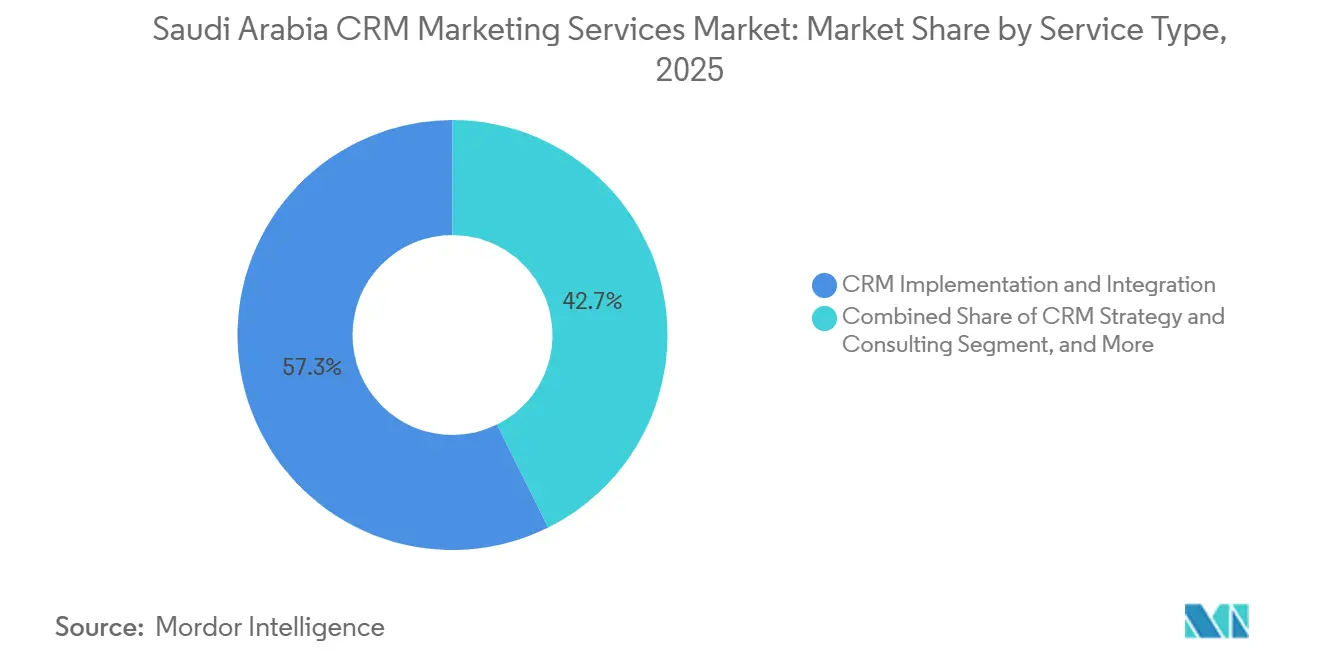
CRM Implementation and Integration accounted for 57.34% of total revenue in 2025, indicating that the Saudi Arabia CRM marketing services market is still heavily shaped by first-wave deployment activity. This mix reflects broad demand from organizations that are still building customer management foundations rather than refining mature installed systems. Strategy and consulting remain important because buyers often need help with platform selection, workflow design, and data architecture before full deployment begins. The Saudi Arabia CRM marketing services market also gives implementation specialists an advantage, as many projects still include system integration, localization, and operational model changes alongside software setup.
CRM Managed Services is projected to expand at a 14.78% CAGR from 2026 to 2031, indicating a clear shift toward recurring support after the initial deployments are completed. This pattern is supported by stricter data governance expectations under the Saudi Personal Data Protection Law, which increases the need for continued review of customer data handling, consent tracking, and workflow controls.[2] As a result, the Saudi Arabia CRM marketing services industry is moving from project-led revenue toward service relationships that continue after go-live. Providers that can combine implementation knowledge with steady support, optimization, and compliance-aware process updates are likely to retain more value over the forecast period.

By Enterprise Size: Large Accounts Hold Scale While SMEs Drive Faster Expansion
Large enterprises retained 70.21% of revenue in 2025, which indicates that the Saudi Arabia CRM marketing services market still depends heavily on high-value contracts from major corporate and government-linked buyers. These accounts usually involve a broader scope, more stakeholders, and deeper integration requirements, which keeps contract values high even when deal volumes are lower than in the SME segment. Existing relationships with major platform vendors also support this concentration because large buyers prefer proven ecosystems, formal governance, and long support horizons. In practical terms, the Saudi Arabia CRM marketing services market remains anchored by large organizations that can commit to enterprise-wide programs and longer implementation cycles.
SMEs are projected to expand at a 15.19% CAGR through 2031, indicating that the addressable customer base is widening rapidly at the lower end of the market. Cloud delivery models lower cost barriers for smaller firms, while national digital transformation efforts make customer systems more relevant to daily sales and service operations. SME demand also rewards simpler deployment models, stronger onboarding, and lighter support structures than those used in large enterprise accounts. The Saudi Arabia CRM marketing services industry is therefore broadening in structure, even though revenue concentration still favors large buyers in the current period.
By Service Application: Acquisition Holds Today While Personalization Builds Future Growth
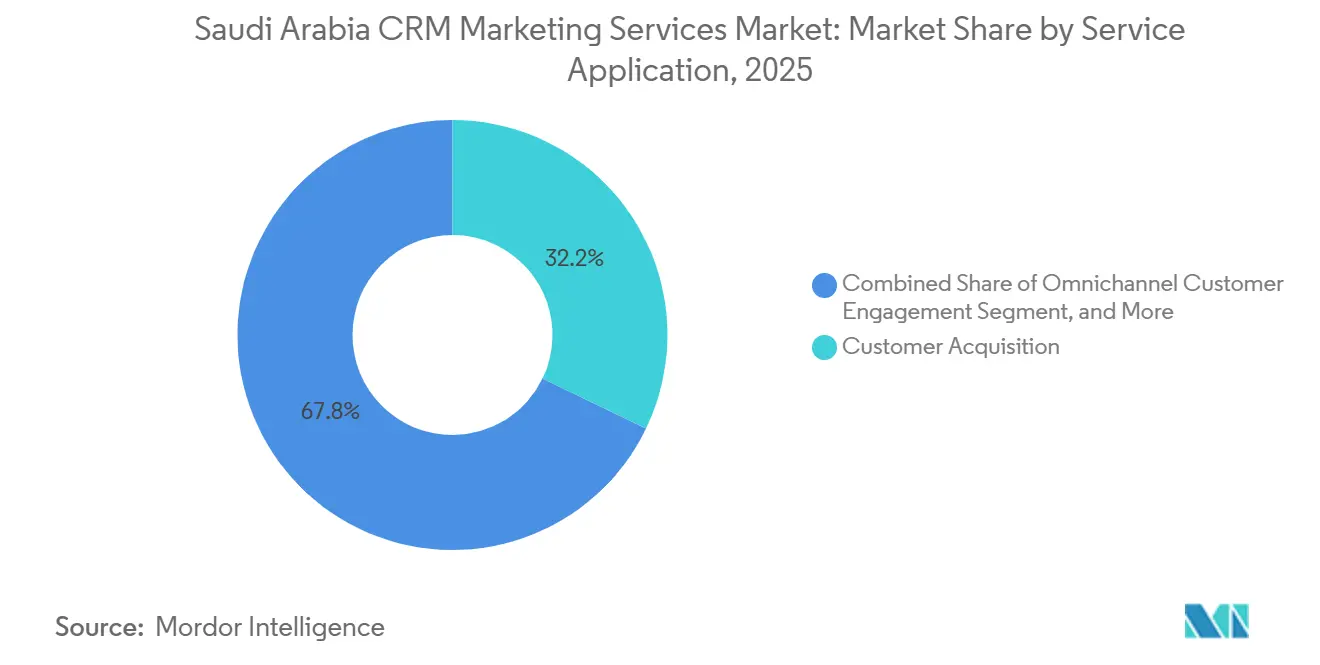
Customer Acquisition accounted for 32.16% of service application revenue in 2025, indicating that lead generation and pipeline building still account for a large share of current spending in the Saudi Arabia CRM marketing services market. This is consistent with sectors that are expanding digital customer bases and need scalable ways to identify, route, and convert prospects across channels. Campaign management, automation, and analytics also remain central because acquisition programs depend on cleaner execution and better measurement than older broadcast marketing models allowed. The Saudi Arabia CRM marketing services market is therefore still rooted in customer growth use cases, even as buyers become more selective about how leads are qualified and followed through the funnel.
Personalization Services is projected to expand at a 14.05% CAGR from 2026 to 2031, suggesting that enterprises are moving from broad outreach to more tailored interaction design. Klaviyo announced a strategic partnership with Google in February 2026 to connect real-time customer data and decisioning with Google's AI, search, and advertising infrastructure, highlighting how personalization is becoming more central to CRM value creation. That direction increases demand for vendors that can manage data models, automation logic, content timing, and customer segmentation in a coordinated way. It also means the Saudi Arabia CRM marketing services market is likely to see higher service depth in applications that depend on individual-level relevance rather than channel volume alone.
By End-User Industry: BFSI Leads Revenue While Retail and E-Commerce Set the Growth Pace
BFSI accounted for 33.44% of end-user revenue in 2025, which confirms that the Saudi Arabia CRM marketing services market draws a large share of its spending from regulated financial institutions. Banks, insurers, and related firms place high weight on customer data controls, consent handling, process traceability, and structured engagement design, thereby increasing the value of CRM services tied to governance and customer experience. The Saudi Personal Data Protection Law reinforces this demand, as financial organizations need customer workflows that align with formal data management requirements. This keeps the Saudi Arabia CRM marketing services market closely linked to sectors where both service quality and compliance discipline are essential.
Retail and e-commerce are projected to expand at a 14.47% CAGR through 2031, pointing to stronger demand from businesses focused on acquisition, loyalty, and repeat engagement. Vision 2030 programs continue to support digital commerce, tourism, and consumer-facing service modernization, which expands the need for customer engagement systems across these activities. Compared with BFSI, retail demand is less centered on control architecture and more centered on campaign speed, personalization, and multichannel coordination. The Saudi Arabia CRM marketing services market is therefore seeing a wider split between compliance-led buying in finance and growth-led buying in consumer-facing sectors.
Geography Analysis
Riyadh remains the center of the Saudi Arabia CRM marketing services market because it brings together government entities, large enterprises, and multinational regional headquarters in one location. This concentration gives the city the deepest pipeline for consulting, implementation, and managed support contracts tied to enterprise-wide programs. Salesforce officially launched its Saudi Arabia operations in Riyadh in November 2025, reinforcing Riyadh's role as a leading platform and partner hub for local CRM deployments. Salesforce had also announced its regional headquarters in Riyadh earlier in 2025 and linked that move with local hiring, training, and ecosystem development plans.[3] Riyadh also benefits from the strongest alignment between policy direction, enterprise budget availability, and provider presence, which keeps it at the front of high-value project flow.
Jeddah plays a major role in demand because it is a major commercial center with strong retail, hospitality, and service activity. This profile makes the city important for customer acquisition, personalization, and guest engagement use cases that require faster campaign and service coordination. Salesforce cited its work with Red Sea Global and other Saudi organizations during its Saudi launch, underscoring the growing importance of western Saudi development corridors for customer experience platforms. The Saudi Arabia CRM marketing services market, therefore, gains a second demand engine in Jeddah, where commercial and tourism-linked activity supports a different mix of service applications than Riyadh.
The Eastern Province contributes steady demand from industrial and enterprise operations that need more structured customer, service, and account management systems. Microsoft and Oracle both announced cloud region investments in Saudi Arabia during 2025, which strengthens the wider case for in-Kingdom infrastructure support across regulated and enterprise deployments. The Saudi Arabia CRM marketing services market is also gaining long-term geographic support from Vision 2030 development programs, which extend digital infrastructure and customer-facing services beyond the traditional business centers. As these new corridors mature, the demand mix is likely to include more greenfield implementations where customer systems are designed from the start rather than added onto older operating models.
Competitive Landscape
The Saudi Arabia CRM marketing services market is moderately concentrated in large-enterprise work, where Salesforce, Microsoft, SAP, and Oracle benefit from established ecosystems and higher switching barriers. That concentration is weaker in the mid-market and SME tiers, where service models, localization quality, and ease of deployment matter more than platform scale alone. Salesforce's USD 500 million investment announcement in February 2025 showed how major vendors are building local infrastructure, partnerships, and language support to strengthen their position in Saudi Arabia. Its November 2025 Saudi launch then turned that commitment into local operating presence, partner engagement, and customer delivery activity in the Kingdom. These moves matter because they deepen implementation capacity around the platform layer and raise the standard that smaller rivals need to match.
Localization is a major point of competition because buyers want Arabic-ready workflows, local hosting confidence, and support models that align with Saudi business practices. Providers that can combine customer data structure, process configuration, and language-sensitive engagement design are better placed to win long-term contracts. Creatio's partner network includes Qeema in Riyadh, which shows that locally based implementation capability has become part of the competitive equation rather than a secondary add-on. The Saudi Arabia CRM marketing services market, therefore, rewards platform strength, but it also rewards delivery networks that can adapt global technology to local operational needs.
A second line of competition is forming around AI-enabled customer engagement and campaign decisioning. Klaviyo's February 2026 partnership with Google illustrated how platform vendors are pushing more intelligence into personalization and customer journey execution. Microsoft and Oracle cloud region investments in Saudi Arabia also support the broader competitive push toward local infrastructure readiness for enterprise applications.[4] The Saudi Arabia CRM marketing services market is therefore likely to remain moderately concentrated at the top, while execution quality and service specialization continue to shape competition in the wider field.
Saudi Arabia CRM Marketing Services Industry Leaders
-
Salesforce, Inc.
-
Microsoft Corporation
-
Oracle Corporation
-
SAP SE
-
Adobe Inc.
- *Disclaimer: Major Players sorted in no particular order
Recent Industry Developments
- February 2026: Klaviyo announced a strategic partnership with Google to deliver autonomous AI-driven customer experiences from product discovery through purchase, service, and loyalty. The integration connects Klaviyo's real-time customer data and decisioning with Google's AI, search, and advertising infrastructure.
- November 2025: Salesforce officially launched its Saudi Arabia operations, operationalizing its USD 500 million commitment with a regional headquarters in Riyadh, a partnership with Princess Nourah University to develop AI talent for women (450 women enrolled as of September 2025), and CRM implementations for Red Sea Global, Almosafer, Cenomi, and SRMG.
- September 2025: Oracle and Microsoft each announced new cloud regions in Saudi Arabia, with Microsoft building three data centers in the Eastern Province and Oracle expanding beyond its existing Jeddah and Riyadh regions. Both expansions directly support CRM data residency requirements under PDPL for regulated enterprises across BFSI, healthcare, and government sectors.
- February 2025: Salesforce announced a USD 500 million, five-year investment in Saudi Arabia at LEAP 2025, introducing Hyperforce on AWS for local workload processing, Arabic-language support for Agentforce, and partnerships with Capgemini, Deloitte, Globant, IBM, and PwC for enterprise CRM deployments.
Saudi Arabia CRM Marketing Services Market Report Scope
The Saudi Arabia CRM Marketing Services Market includes consulting, implementation, managed, and support services that help organizations utilize customer relationship management (CRM) solutions for customer relationship management and marketing optimization. These services cover customer analytics, marketing automation, campaign management, omnichannel engagement, and personalization programs. The Kingdom’s digital transformation initiatives, expanding adoption of cloud technologies, and growing focus on customer experience across key industries drive the market. These services help enterprises improve customer acquisition, retention, and overall business performance.
The Saudi Arabia CRM Marketing Services Market Report is Segmented by Service Type (CRM Strategy and Consulting, CRM Implementation and Integration, CRM Migration and Modernization, CRM Managed Services, and CRM Training and Support), Enterprise Size (Large Enterprises, and Small and Medium Enterprises), Service Application (Customer Acquisition, Customer Retention and Loyalty, Campaign Management Services, Marketing Automation Services, Customer Analytics and Insights, Omnichannel Customer Engagement, and Personalization Services), and End-user Industry (Banking, Financial Services, and Insurance (BFSI), Healthcare and Life Sciences, Information Technology and Telecom, Retail and E-commerce, Industrial Manufacturing, Government and Public Administration, and Other End-user Industries). The Market Forecasts are Provided in Terms of Value (USD).
| CRM Strategy and Consulting |
| CRM Implementation and Integration |
| CRM Migration and Modernization |
| CRM Managed Services |
| CRM Training and Support |
| Large Enterprises |
| Small and Medium Enterprises |
| Customer Acquisition |
| Customer Retention and Loyalty |
| Campaign Management Services |
| Marketing Automation Services |
| Customer Analytics and Insights |
| Omnichannel Customer Engagement |
| Personalization Services |
| Banking, Financial Services, and Insurance (BFSI) |
| Healthcare and Life Sciences |
| Information Technology and Telecom |
| Retail and E-commerce |
| Industrial Manufacturing |
| Government and Public Administration |
| Other End-user Industries |
| By Service Type | CRM Strategy and Consulting |
| CRM Implementation and Integration | |
| CRM Migration and Modernization | |
| CRM Managed Services | |
| CRM Training and Support | |
| By Enterprise Size | Large Enterprises |
| Small and Medium Enterprises | |
| By Service Application | Customer Acquisition |
| Customer Retention and Loyalty | |
| Campaign Management Services | |
| Marketing Automation Services | |
| Customer Analytics and Insights | |
| Omnichannel Customer Engagement | |
| Personalization Services | |
| By End-user Industry | Banking, Financial Services, and Insurance (BFSI) |
| Healthcare and Life Sciences | |
| Information Technology and Telecom | |
| Retail and E-commerce | |
| Industrial Manufacturing | |
| Government and Public Administration | |
| Other End-user Industries |
Key Questions Answered in the Report
What is the current and future size of Saudi Arabia CRM marketing services?
The Saudi Arabia CRM marketing services market was valued at USD 314.23 million in 2025, is generating USD 348.47 million in 2026, and is forecast to reach USD 638.03 million by 2031 at a 12.86% CAGR.
Which service type leads spending in Saudi Arabia CRM marketing services?
CRM Implementation and Integration led the market with 57.34% revenue share in 2025, showing that deployment work still accounts for most current spending.
Which enterprise group is growing fastest in Saudi Arabia CRM marketing services?
SMEs are the fastest-growing enterprise segment, with a projected 15.19% CAGR through 2031, as cloud delivery lowers entry barriers and expands adoption.
Which application area is expanding fastest in Saudi Arabia CRM marketing services?
Personalization Services is forecast to grow at 14.05% CAGR through 2031, reflecting stronger demand for customer-specific engagement and workflow design.
Which end-user sector creates the most demand for Saudi Arabia CRM marketing services?
BFSI held the largest end-user share at 33.44% in 2025 because financial institutions need structured customer data management, compliance support, and coordinated engagement.
Why is Riyadh central to Saudi Arabia CRM marketing services demand?
Riyadh concentrates government entities, large enterprises, and multinational headquarters, which makes it the main center for high-value CRM consulting, implementation, and managed services contracts.