
Market Overview
| Study Period | 2020 - 2031 |
|---|---|
| Forecast Data Period | 2026 - 2031 |
| Historical Data Period | 2020 - 2024 |
| Market Size (2026) | USD 12.13 Billion |
| Market Size (2031) | USD 21.59 Billion |
| Growth Rate (2026 - 2031) | 12.21 % |
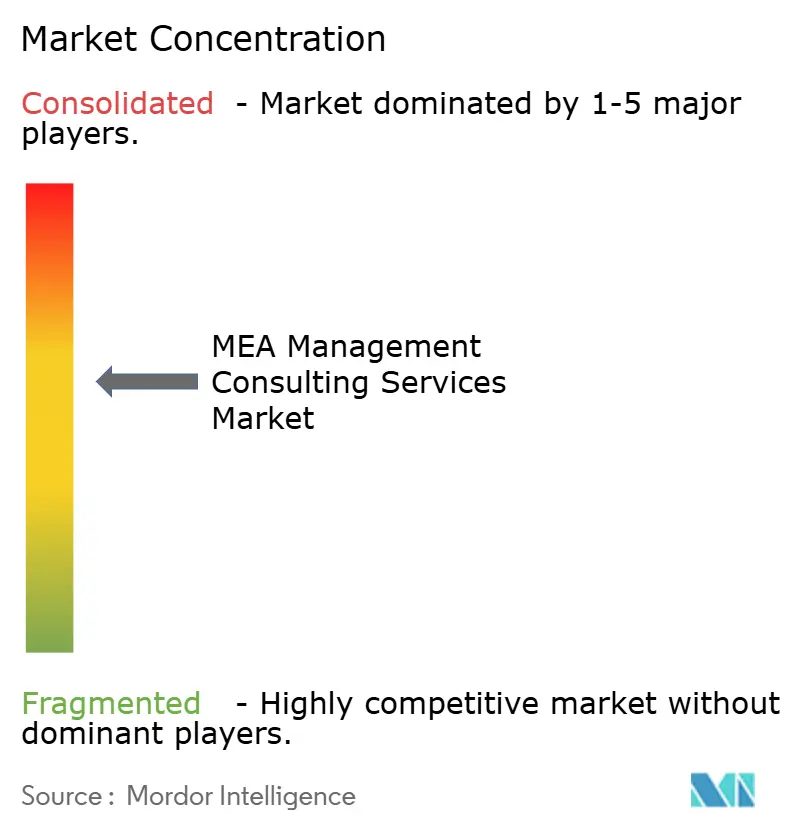
| Market Concentration | Medium |
Major Players *Disclaimer: Major Players sorted in no particular order Image © Mordor Intelligence. Reuse requires attribution under CC BY 4.0. | |
Middle East and Africa Management Consulting Services Market Analysis by Mordor Intelligence
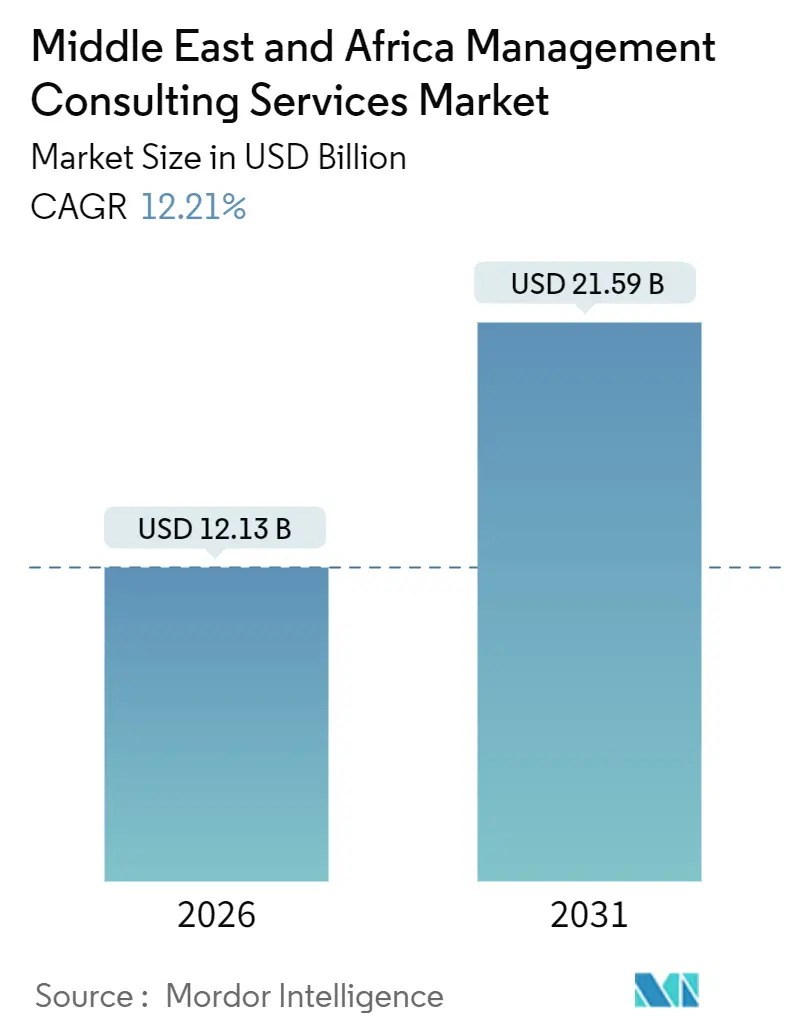
The Middle East and Africa management consulting services market size is USD 12.13 billion in 2026 and is forecast to reach USD 21.59 billion by 2031, translating into a CAGR of 12.21% over the period. Robust public-sector transformation programs across the Gulf Cooperation Council, a sharp rise in private-equity deployment in sub-Saharan Africa, and widening adoption of environmental, social, and governance reporting frameworks form the backbone of this expansion. A widening digital-skills gap, growing demand for artificial-intelligence use cases, and stricter data-protection mandates are pushing clients to seek external expertise, thereby enlarging the addressable pool for the MEA management consulting services market. Competitive strategies revolve around sector specialization, in-country delivery capacity, and proprietary technology platforms, all aimed at securing long-term, multi-function mandates with sovereign entities and multinational corporations. Saudi Arabia and the United Arab Emirates remain the spending epicenter, yet Nigeria, South Africa, and Egypt are emerging as growth nodes on the back of private-capital inflows and infrastructure build-outs.
Key Report Takeaways
- By service type, technology advisory captured 29.11% of revenue share in 2025 and is also projected to post a 12.67% CAGR through 2031.
- By theme, digital transformation accounted for 38.29% of spending in 2025; the AI-driven transformation subset is set to accelerate at a 12.88% CAGR through 2031.
- By end-user industry, government and public-sector clients retained 26.54% of the MEA management consulting services market share in 2025; energy and utilities are projected to expand at a 12.93% CAGR between 2026-2031.
- By enterprise, large organizations accounted for 78.31% of 2025 billings, yet small and medium enterprises are forecast to grow at a 13.54% CAGR through 2031.
- By country, Saudi Arabia held 51.23% of the revenue share in 2025 and is also expected to log the fastest 13.15% CAGR to 2031.
Note: Market size and forecast figures in this report are generated using Mordor Intelligence’s proprietary estimation framework, updated with the latest available data and insights as of January 2026.
Market Trends and Insights
Drivers Impact Analysis of Middle East and Africa Management Consulting Services Market*
| Driver | (~) % Impact on CAGR Forecast | Geographic Relevance | Impact Timeline |
|---|---|---|---|
| Digital-transformation budgets rise under GCC vision programs | +3.2% | Saudi Arabia, United Arab Emirates, Qatar, Bahrain, Oman, Kuwait | Medium term (2-4 years) |
| Public-sector outsourcing of strategy formulation accelerates | +2.8% | Saudi Arabia, United Arab Emirates, Egypt, South Africa | Medium term (2-4 years) |
| Private-equity deployment into Africa boosts demand for due-diligence advisory | +2.1% | Nigeria, South Africa, Egypt, Kenya, Ghana | Short term (≤ 2 years) |
| Race for ESG and green-finance compliance consulting | +1.9% | GCC and South Africa | Long term (≥ 4 years) |
| Global capability centers relocating to Middle East drive multi-function consulting needs | +1.5% | United Arab Emirates, Saudi Arabia, Qatar | Short term (≤ 2 years) |
| SME uptake of online and virtual consulting platforms expands TAM | +0.7% | United Arab Emirates, South Africa, Egypt and wider MEA | Long term (≥ 4 years) |
| Source: Mordor Intelligence | |||
Digital-Transformation Budgets Rise Under GCC Vision Programs
Saudi Arabia has earmarked SAR 120 billion (USD 32 billion) for information-technology infrastructure between 2024-2029, including a mandate that 70% of government services migrate to cloud platforms by 2025. KPMG’s 2024 assurance workshops and PwC-Strategy&-UnifyApps’ 2025 MOU on AI-driven sustainability demonstrate how the Qatar management consulting services market is embedding tech platforms into ESG offerings North Field West, integrating 1.1 million tpa carbon-capture and solar power, amplifies demand for life-cycle assessments and carbon-credit structuring. Ministries, therefore, turn to advisors for enterprise architecture design, legacy system migration, and change management. The United Arab Emirates is pursuing 100% digital service delivery under its Digital Government Strategy 2025, prompting complex tenders that favor firms with deep public-sector credentials. Qatar’s Digital Agenda 2030 allocates QAR 8 billion (USD 2.2 billion) to smart-city pilots and AI-enabled citizen services, again bringing in consultants for multi-year strategic roles. Localization clauses that require in-country data residency and a nationalized workforce further tilt awards toward practices with local delivery hubs. Together, these initiatives ensure a steady pipeline for the Middle East and Africa management consulting services market.
Public-Sector Outsourcing of Strategy Formulation Accelerates
The Public Investment Fund in Saudi Arabia has engaged external advisors on more than 40 gigaprojects with combined capital outlays exceeding USD 500 billion[1]. In 2024, the United Arab Emirates directed all federal entities with budgets above AED 500 million (USD 136 million) to conduct independent strategic reviews triennially, instantly creating a recurring need for third-party consultants. Egypt’s Sovereign Fund outsourced feasibility studies for infrastructure and healthcare assets worth EGP 200 billion (USD 6.5 billion), while South Africa now obliges state-owned enterprises seeking turnaround funds to procure external advice. Although price-weighted procurement compresses margins, the volume and complexity of these mandates enlarge total spending, thereby widening the Middle East and Africa management consulting services market.
Private-Equity Deployment into Africa Boosts Demand for Due-Diligence Advisory
African private-equity fundraising touched USD 6.1 billion in 2024, with 68% of capital committed to South Africa, Nigeria, and Egypt. Sponsors increasingly seek commercial, operational, and ESG diligence to secure quality assets. Nigeria’s fintech sector logged 12 PE-backed deals in 2025 requiring regulatory assessments under revised Central Bank guidelines. South Africa drew USD 1.8 billion into renewables, driving advisory demand for technical and social-impact evaluations. Egypt’s privatization pipeline also relies on advisors for valuation and investor readiness, reinforcing the expansion of the Middle East and Africa management consulting services market.
Race for ESG and Green-Finance Compliance Consulting
The United Arab Emirates raised USD 2 billion through its inaugural green bond in 2024 and rolled out a Sustainable Finance Framework that obliges listed firms to publish annual ESG disclosures[2]. Saudi Arabia’s Capital Market Authority introduced phased ESG reporting requirements in 2024. South Africa aligned its stock-exchange guidance with IFRS S1 and S2 in 2025, while Egypt rolled out a green taxonomy the year prior. Consultants have therefore become essential for gap analyses, data management systems, and assurance readiness, further expanding the Middle East and Africa management consulting services market.
Restraints Impact Analysis of Middle East and Africa Management Consulting Services Market*
| Restraint | (~) % Impact on CAGR Forecast | Geographic Relevance | Impact Timeline |
|---|---|---|---|
| Shortage of senior bilingual consultants inflates fee rates | -1.8% | Saudi Arabia, United Arab Emirates, Qatar, Egypt | Short term (≤ 2 years) |
| Procurement-led price compression at state-owned enterprises | -1.4% | Saudi Arabia, United Arab Emirates, Egypt, South Africa | Medium term (2-4 years) |
| Cross-border data localisation rules complicate multi-country projects | -0.9% | United Arab Emirates, Saudi Arabia, South Africa, Nigeria | Medium term (2-4 years) |
| Fragmented regulatory licensing for foreign-owned boutiques | -0.6% | GCC states, Nigeria, Egypt | Long term (≥ 4 years) |
| Source: Mordor Intelligence | |||
Shortage of Senior Bilingual Consultants Inflates Fee Rates
Demand for Arabic-English bilingual directors outpaces supply by roughly 30%, forcing firms to raise billing rates by up to 20% year on year. Emiratisation quotas in the United Arab Emirates require 2% of skilled roles to be held by nationals by 2026, spurring signing bonuses of AED 200,000 (USD 54,000). Saudi Arabia’s Nitaqat program tightens domestic hiring targets, compelling firms to establish costly training academies. Higher fee structures and delivery delays temper the addressable demand for Middle East and Africa management consulting services.
Procurement-Led Price Compression at State-Owned Enterprises
Saudi Arabia’s 2024 procurement law mandates that price account for 60% of bid evaluation, prompting aggressive discounting and margin squeeze. Egypt aims to trim advisory spend by 25% over three years, while South Africa caps daily consulting rates for senior staff at ZAR 8,000 (USD 440). The resulting price pressure restrains overall value growth in the MEA management consulting services market.
*Our forecasts treat driver/restraint impacts as directional, not additive. The impact forecasts reflect baseline growth, mix effects, and variable interactions.
Middle East and Africa Management Consulting Services Market Segment Analysis
By Service Type:
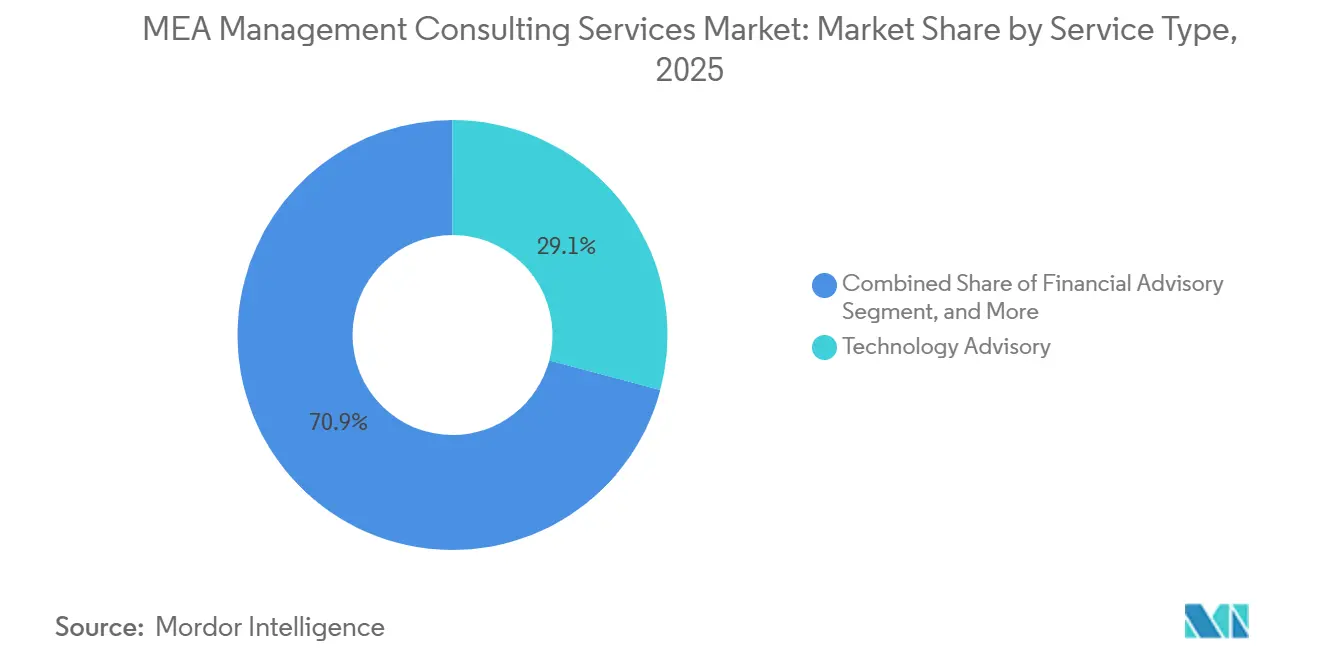
Technology Advisory Maintains LeadershipThe technology-advisory segment accounted for 29.11% of 2025 revenue, securing the largest share of the MEA management consulting services market. It is also projected to compound at 12.67% through 2031, marking it a cornerstone driver of the MEA management consulting services market size in absolute terms. Saudi Arabia’s National Cybersecurity Authority mandated that all government agencies localize sensitive workloads by 2027, sparking USD 800 million in architecture and compliance engagements. The United Arab Emirates’ AI Strategy 2031 aims to deploy machine learning across nine sectors, fueling high-margin advisory on data governance and bias testing.
Strategy consulting accounted for just under one-quarter of 2025 spend, buoyed by economic diversification agendas and African turnaround projects. Financial-advisory mandates clustered around privatizations and distressed-asset restructurings, securing an 18% share. Human-capital consulting supports workforce nationalization and hybrid-work transitions, while operations consulting attends to supply-chain and procurement redesign. Collectively, these service lines underscore the multi-disciplinary nature of the MEA management consulting services market.

By Consulting Theme:
Digital Transformation DominatesDigital transformation accounted for 38.29% of thematic revenue in 2025, making it the largest pillar in the MEA management consulting services market. Within that umbrella, AI-driven transformation is poised to grow 12.88% a year to 2031, reflecting clients’ shift from digitization to algorithmic automation. The MEA management consulting services market for operational-excellence programs remains sizable, though lean initiatives are plateauing as low-hanging efficiencies are realized.
Risk and compliance consulting thrives on proliferating data-protection statutes, while ESG mandates propel sustainability advisory. In 2025, the United Arab Emirates recorded the highest enterprise adoption rate for generative AI in the region at 42%. Saudi Arabia’s USD 40 billion AI investment vehicle further inflates opportunity pipelines. These developments amplify demand for consultancies able to synthesize technology, regulatory, and change-management competencies.
By End-User Industry:
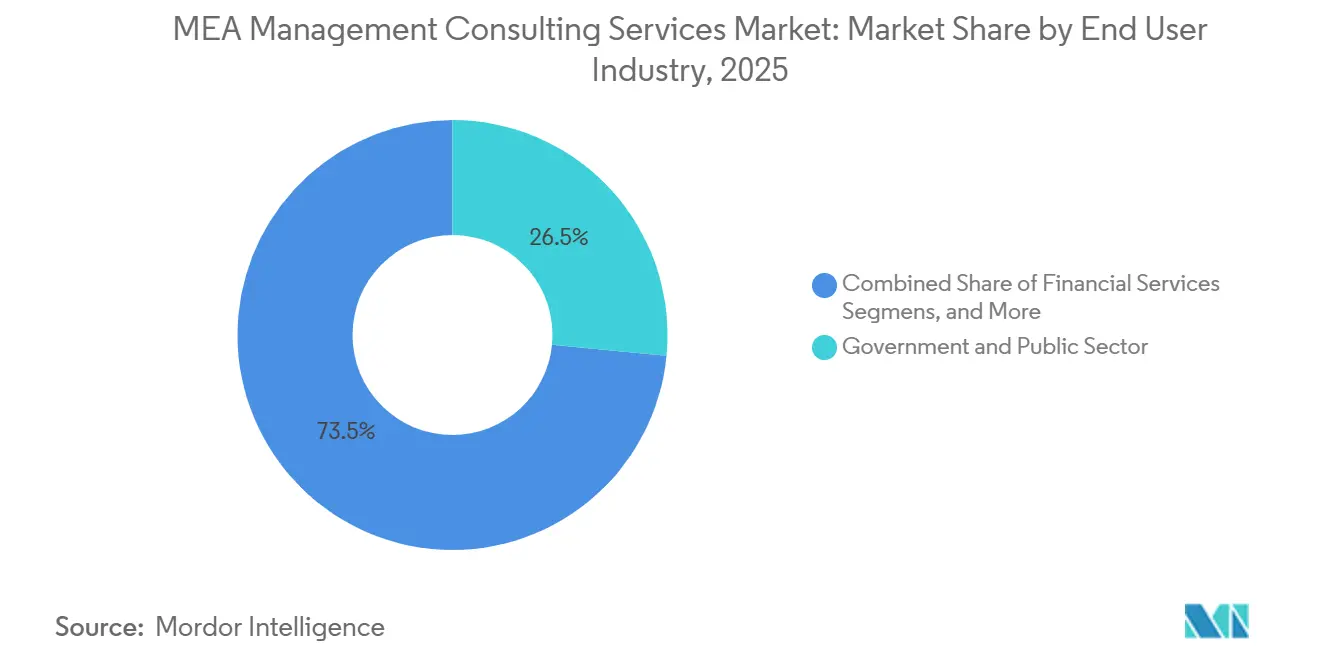
Government Remains Anchor, Energy Races AheadGovernment and public-sector entities accounted for 26.54% of 2025 billings, the largest share in the MEA management consulting services market. The segment continues to commission multi-year programs for digital government, macroeconomic diversification, and performance management. Energy and utilities, though smaller in absolute terms, are growing fastest at a 12.93% CAGR, underpinned by renewable generation targets and grid modernization.
Saudi Arabia intends to increase renewable capacity to 58.7 GW by 2030, a leap that catalyzes project-finance advisory and grid-integration studies. The United Arab Emirates’ clean-energy push and Egypt’s solar and wind contracts broaden the opportunity set. Financial services, telecom, and healthcare round out the mix, each facing sector-specific technology and regulatory disruptions that necessitate advisory support.
By Enterprise:
Large Clients Dominate, SMEs Catch Up through Virtual DeliveryLarge enterprises accounted for 78.31% of 2025 revenue, anchoring the MEA management consulting services market. They commission broad, multi-function engagements spanning strategy, technology, and organizational redesign. Yet small and medium enterprises will expand at 13.54% CAGR to 2031 as virtual consulting platforms slash engagement thresholds by 30-40%. Programs such as Saudi Arabia’s Monsha’at voucher scheme and the Khalifa Fund in the United Arab Emirates subsidize advisory fees, nudging smaller firms toward professional consulting services and enlarging the MEA management consulting services market.
The rising SME contribution brings shorter project cycles but higher client counts, increasing operational complexity for providers. Firms able to package modular, cloud-delivered toolkits are positioned to capture this incremental growth without diluting margins.
Geography Analysis
Saudi Arabia Management Consulting Services Market
Saudi Arabia’s consulting demand rests on its transition from operator to investor and regulator. Projects such as NEOM and The Red Sea are stand-alone economic zones with separate legal and tax regimes, each necessitating advisory on regulatory design and performance metrics[3]. The Public Investment Fund’s USD 700 billion portfolio, therefore, requires continuous sector selection and capital-allocation counsel.
United Arab Emirates Management Consulting Services Market
The United Arab Emirates spreads spending across federal and emirate-level programs. Abu Dhabi’s economic vision emphasizes heavy-industry diversification, while Dubai remains committed to tourism, logistics, and knowledge-economy agendas. The interplay of overlapping jurisdictions complicates procurement but enlarges the scope for governance and integration consulting.
Qatar Management Consulting Services Market
Qatar’s consulting market is tightly linked to three anchor clients, QatarEnergy, Qatar Investment Authority, and the Ministry of Finance, making revenue sensitive to hydrocarbon cycles. Nonetheless, the North Field East expansion and the National Development Strategy trigger recurring mandates in joint venture structuring and digital government.
Africa Management Consulting Services Market
South Africa relies on advisory for state-owned-enterprise reform and renewable-energy procurement. Egypt’s privatization roadmap through 2027 invites valuation and investor-marketing engagements, while Nigeria’s fintech and telecom ecosystems dominate spending even as security and currency volatility curb on-the-ground expansion by foreign firms. Kenya, Morocco, and Ghana offer niche opportunities, especially in automotive and aerospace supply chains, but currently lack the scale to shift the overall MEA management consulting services market.
Regulatory Landscape
The MEA management consulting services market operates within a tightening web of public-sector procurement rules, data protection, and technology governance requirements that shape how advisory work is scoped and delivered. In Saudi Arabia, the Digital Government Authority (DGA) is advancing a 2026-2030 digital government roadmap that uses AI-driven assessments for government-service performance, while localization and data-residency clauses increasingly influence vendor selection and delivery models. ESG disclosure mandates are also becoming a compliance-driven workstream, including the Saudi Capital Market Authority's phased ESG reporting requirements introduced in 2024.
Across the UAE, governance is moving from broad digitalization to more formal AI oversight. In May 2026, the UAE Cabinet approved a governance framework for the National Agentic AI Project, assigning responsibilities across federal ministries and entities and tying deployment to government-service operations. These regulatory and governance shifts increase demand for consultants that can combine compliance interpretation with implementation support in cloud, cybersecurity, data management, and AI controls, particularly for public-sector and regulated-industry clients.
Competitive Landscape
The top ten global firms together account for about 60% of revenue, indicating a medium concentration in the MEA management consulting services market. Accenture acquired Inspirage in 2024 to bolster cloud-consulting capacity in Riyadh and Dubai, adding sector expertise in manufacturing and supply chain[4]. Deloitte opened a Riyadh office in 2025, focused on ESG and sovereign wealth advisory. PwC partnered with the Saudi Digital Government Authority to craft an AI-governance framework and, in turn, secured preferred-advisor status for AI policy design.
Regional boutiques thrive in niches such as Islamic finance, sovereign-wealth structuring, and francophone Africa. Technology platforms also drive differentiation, with firms deploying proprietary data analytics engines that shorten engagement cycles by 25% and improve margin capture. Meanwhile, ISO 20700 adoption by GCC governments benchmarks delivery quality, pushing low-cost offshore entrants to invest in certification or risk exclusion. The ability to marry sector depth, local talent, and digital delivery is becoming decisive in winning complex, multi-year mandates within the MEA management consulting services market.
Middle East and Africa Management Consulting Services Industry Leaders
-
Accenture plc
-
Boston Consulting Group
-
Bain and Company
-
Deloitte Touche Tohmatsu Ltd
-
McKinsey and Company
- *Disclaimer: Major Players sorted in no particular order
Middle East and Africa Management Consulting Services Market Companies Covered in this Report
- Accenture plc
- McKinsey & Company, Inc.
- The Boston Consulting Group, Inc.
- Bain & Company, Inc.
- Deloitte Touche Tohmatsu Limited
- Ernst & Young Global Limited
- PricewaterhouseCoopers LLP
- KPMG International Limited
- Strategy& LLC
- Oliver Wyman Group LLC
- Roland Berger GmbH
- Alvarez & Marsal Holdings, LLC
- Booz Allen Hamilton Inc.
- Arthur D. Little, Inc.
- L.E.K. Consulting LLC
- Arif Kitchlew Management Consultancy L.L.C.
- Proclipse Consulting Pvt. Ltd.
- Várri Consultancy OÜ
- Decision Management Consultants, Inc.
- Alpha Equity Management Consultancy L.L.C.
- Kaizen Consulting Group DMCC
- A&Z Management Consultants LLC
- Affility Consulting Ltd.
- NH Management Consulting LLC
- Kearney, Inc.
Market Opportunities and Future Outlook
A key whitespace is full-stack AI and digital foundation delivery that combines strategy, architecture, governance, and execution for sovereign and regulated clients. In Saudi Arabia, HUMAIN (a Public Investment Fund company) announced collaborations in May 2026 with Accenture and with McKinsey to accelerate AI transformations at scale, spanning infrastructure elements such as data centers, cloud platforms, and large language model enablement across sectors including government, energy, finance, and manufacturing. This kind of platform-led program supports multi-year mandates that blend technology advisory, operating model redesign, and change management.
Another near-term opportunity is government-wide adoption of agentic AI and the operating changes needed to make it auditable and secure. The UAE Cabinet's May 2026 governance framework for the National Agentic AI Project, together with a civil-service training push, points to demand for policy-to-implementation support: AI governance design, workforce upskilling, process redesign, and data quality programs across ministries. In parallel, telecom operators pursuing digital platform monetization and advanced analytics, as referenced in 2026 industry work on Middle East telcos, suggest a pipeline for consulting tied to revenue diversification, data operating models, and efficiency programs that integrate AI into network and customer operations.
Recent Industry Developments in Middle East and Africa Management Consulting Services Market
- June 2026: Boston Consulting Group (BCG) Platinion launches Qatar practice to support Digital Agenda 2030 and National AI Strategy. The launch expands BCG Platinion's footprint in Qatar to bolster AI and digital initiatives for regional clients. The shift strengthens delivery capacity for public and private sector digital transformation in Qatar.
- May 2026: Humain and McKinsey collaborate to accelerate AI transformations across Saudi Arabia. The alliance drives AI transformation engagements with Saudi public and private sector entities. The collaboration expands McKinsey footprint in Saudi through the Humain alliance.
- February 2026: Accenture acquires advanced AI technology from Avanseus to support autonomous network capabilities. The acquisition broadens Accenture's telecom AI stack in the region. The deal enhances AI enabled network modernization offerings across MEA.
Middle East and Africa Management Consulting Services Market Report Scope and Research Methodology
Market Definition and Coverage
For this methodology, the market counts revenues earned from management consulting engagements delivered to public and private organizations across the Middle East and Africa, including strategy, operations, and transformation advisory work, reported in USD.
Scope exclusions: It excludes outsourced business process services, staff augmentation, and pure IT implementation work that is billed as delivery rather than advisory.
Segments Covered in This Report
- By Service Type
- Operations Consulting
- Strategy Consulting
- Financial Advisory
- Technology Advisory
- Human-Capital and Change Management
- By Consulting Theme
- Digital Transformation
- ESG / Sustainability
- Operational Excellence
- Risk and Compliance
- Other Themes
- By End-user Industry
- Financial Services
- Life Sciences and Healthcare
- IT and Telecommunications
- Government and Public Sector
- Energy and Utilities
- Retail and E-commerce
- By Enterprise
- Large Enterprises
- Small and Medium Enterprises
- By Country
- Saudi Arabia
- United Arab Emirates
- Qatar
- South Africa
- Egypt
- Nigeria
- Rest of the Middle East and Africa
Data Sources, Market Sizing, and Validation
Desk Research
Desk research started by mapping the regional demand pool for consulting, then checking where spend is likely to show up by sector and country. We used public indicators that connect to advisory needs, such as World Bank and IMF macro series (GDP, investment, public finance), and statistics from national planning and statistics authorities in key MEA countries where available.
To tighten assumptions, we also referenced sources such as UN Comtrade for trade patterns that signal industrial activity, the WTO and UNCTAD for services and investment context, and ILO labor data for white collar employment and wage movement. These were complemented with company annual reports and investor presentations, reputable business press, and limited use of paid subscriptions for company financials, news, contract and tender tracking, and patent databases where relevant to digital and analytics-led consulting themes. The desk source list above is illustrative only, and many other public and paid references were used for collection, validation, and clarification.
Primary Interviews and Surveys
Primary work was used to pressure-test pricing, utilization, and the mix of projects across government transformation, energy, financial services, telecom, and other large buyers. We spoke with delivery leaders, practice heads, and client-side managers across the Gulf, North Africa, and Sub-Saharan Africa, so assumptions like billing rates, project length, and the local delivery mix could be corrected before finalizing totals.
Distribution of primary research fieldwork respondents
| Company type | Respondent position |
|---|---|
| Top tier: 28% | CXOs: 16% |
| Mid tier: 50% | Functional/Unit leaders: 35% |
| Smaller Players: 22% | Managers: 49% |
Market-Sizing & Forecasting
Sizing was built using a top-down approach where services demand is reconstructed from sector spend capacity, major transformation program intensity, and enterprise activity levels across MEA, then converted into consulting revenue pools using penetration and pricing logic. We cross-checked the totals using selective bottom-up approximations, including rolling up sampled advisory revenues for local and regional firms, and using an average billing rate by role multiplied by estimated billable effort for common project types to correct outliers.
Key inputs in the model included government modernization budgets and public procurement signals, large-capex project pipelines that typically need program management support, the pace of digital and data transformation adoption, and regulatory and ESG reporting requirements that create governance work. We also incorporated inflation and FX trends that affect realized USD revenues. Where country or sector data had gaps, we used proxy indicators and then calibrated them using interview feedback, so the implied spend per large organization remained realistic.
For forecasting, scenario analysis was applied because consulting demand in MEA moves with policy cycles, mega-project timing, and private investment sentiment. We used variable-level expectations from primary experts to set base, conservative, and accelerated paths for project starts, pricing progression, and utilization, then translated those paths into annual market values.
Data Validation & Update Cycle
Outputs were validated through multiple checks so they do not rely on one data series or one viewpoint. We compared implied consulting intensity against independent signals such as public tender activity, major program announcements, and corporate investment patterns, and then reworked anomalies until the drivers matched what respondents described.
Before sign-off, the model and assumptions pass through internal analyst reviews where country totals, growth rates, and pricing logic are tested for variance and internal consistency. The report is refreshed annually, with interim updates when material events shift the spending outlooks, and a final pre-delivery pass is done so clients receive a current view.
Mordor Intelligence's Middle East and Africa Management Consulting Services Market Estimate Compared With Other Published Estimates
Published market sizes for MEA management consulting services often differ because firms do not treat geography, service boundaries, and USD conversion timing in the same way. Differences also come from how much of implementation-heavy work is counted as consulting, and whether public sector programs are captured through announced budgets or through realized spending.
The key gap drivers in this market are usually the handling of digital transformation work (advisory versus delivery), the share assigned to large government programs versus private sector engagements, and the assumed billing rate progression during inflation and currency swings. When these inputs are not aligned to a consistent demand pool by country and end-use, the total can shift even if the story around growth sounds similar.
Benchmark comparison
| Source | Market Size | Gaps in Research Methodology |
|---|---|---|
| Mordor Intelligence | USD 12.13 B (2026) | |
| Regional Consultancy A | USD 10.90 B (2026) | Uses a narrower view that strips out a portion of transformation advisory tied to public sector programs, and applies more conservative billing-rate uplift, which lowers the USD total for the same year. |
| Industry Association B | USD 14.80 B (2026) | Rolls in adjacent professional services and a larger share of implementation-led digital work, and may use average FX rates that inflate USD conversion versus realized consulting invoices. |
The table shows a visible spread around the 2026 value, and in Mordor Intelligence's model the counted revenue is limited to advisory-led management consulting billed for MEA delivery, while adjacent outsourcing and pure implementation revenues are kept out. After those scope and pricing checks, the remaining differences mostly trace back to how public programs are converted into realized consulting spend and how FX timing is applied across volatile currencies.
Key Questions Answered in the Report
How fast is consulting spend growing in the Middle East and Africa?
The MEA management consulting services market is projected to register a 12.21% CAGR between 2026 and 2031, outpacing global averages.
Which country accounts for the largest share of advisory fees?
Saudi Arabia led with 51.23% of regional revenue in 2025 and is forecast to keep expanding at a 13.15% CAGR.
Which service line brings in the most revenue?
Technology advisory held a 29.11% share of 2025 billings and remains the highest-earning segment.
What is driving the surge in energy-sector consulting?
National renewable-energy targets and grid-modernization programs across Saudi Arabia, the United Arab Emirates, and South Africa are lifting demand for strategy, financing, and implementation support.
Are small firms benefiting from the consulting boom?
Yes, SME engagement is expected to grow at 13.54% a year through 2031 as virtual consulting platforms lower cost and access barriers.
How concentrated is the market among global majors?
The top ten firms capture about 60% of regional revenue, leaving room for specialized local practices to address niche mandates.