
Japan Mining Equipment Market Size and Share
Market Overview
| Study Period | 2019 - 2031 |
|---|---|
| Forecast Data Period | 2026 - 2031 |
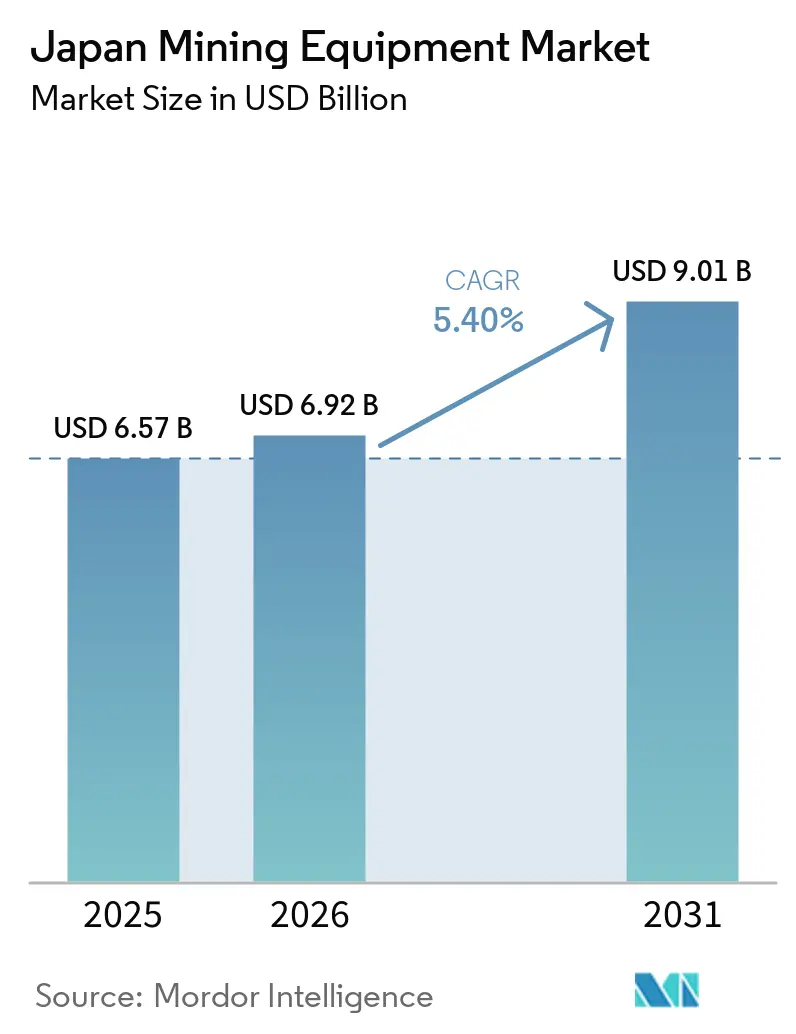
| Base Year Market Size (2025) | USD 6.57 Billion |
| Market Size (2026) | USD 6.92 Billion |
| Market Size (2031) | USD 9.01 Billion |
| Growth Rate (2026 - 2031) | 5.40 % |
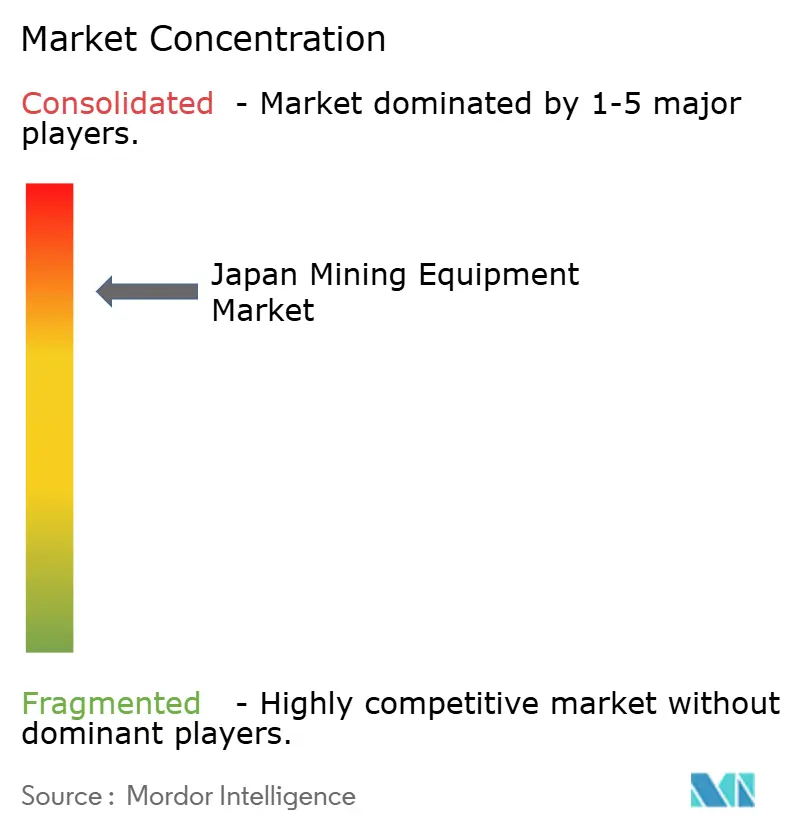
| Market Concentration | High |
Major Players *Disclaimer: Major Players sorted in no particular order Image © Mordor Intelligence. Reuse requires attribution under CC BY 4.0. | |
Japan Mining Equipment Market Analysis by Mordor Intelligence
The Japan mining equipment market size was valued at USD 6.57 billion in 2025 and is estimated to grow from USD 6.92 billion in 2026 to reach USD 9.01 billion by 2031, at a CAGR of 5.40% during the forecast period (2026-2031), growing at a CAGR of 5.40% over 2026-2031. In Japan's mining equipment market, government incentives are pushing for self-sufficiency in critical minerals. There's a swift shift towards battery-electric fleets, and rapid automation upgrades are changing where capital is spent. Operators are now channeling funds previously set aside for thermal-coal projects into rigs designed to extract rare-earth minerals, especially from narrow-vein and offshore deposits. Due to the Green Transformation Emissions Trading Scheme's carbon pricing, diesel haulage costs have surged. This shift in economics now favors battery-electric and hybrid platforms. Concurrently, with ongoing labor shortages and an aging workforce, AI-driven autonomous systems have become crucial for maintaining output levels.
Key Report Takeaways
- By equipment type, surface mining equipment accounted for 37.22% of the Japan mining equipment market in 2025, while drills and breakers are projected to grow fastest at an 8.24% CAGR through 2031.
- By automation level, manual rigs still accounted for 54.07% of installed units in 2025, while fully autonomous systems are projected to post the highest CAGR at 9.22% through 2031.
- By powertrain, internal-combustion models accounted for 73.58% of the Japan mining equipment market size in 2025, whereas battery-electric vehicles are advancing at a 9.12% CAGR to 2031.
- By power output, the 500 to 1,000 HP band commanded 47.01% of the Japan mining equipment market in 2025, and sub-500 HP units are set to grow at a 6.19% CAGR.
- By application, metal mining accounted for 55.31% of the Japan mining equipment market in 2025, and rare-earth metal mining is advancing at a 7.28% CAGR through 2031.
Note: Market size and forecast figures in this report are generated using Mordor Intelligence’s proprietary estimation framework, updated with the latest available data and insights as of January 2026.
Japan Mining Equipment Market Trends and Insights
Drivers Impact Analysis*
| Driver | (~) % Impact on CAGR Forecast | Geographic Relevance | Impact Timeline |
|---|---|---|---|
| Government Incentives for Critical-Mineral Self-Sufficiency | +1.8% | National, with concentration in Minami-Torishima and Nankai Trough regions | Medium term (2–4 years) |
| Surging EV-Battery Metal Demand | +1.5% | National, with spillover to ASEAN supply chains | Long term (≥ 4 years) |
| Tech Advances in AI-Enabled Exploration Rigs | +1.2% | National, with early adoption in Hokkaido and Kyushu mining regions | Medium term (2–4 years) |
| National Push for Methane-Hydrate and Deep-Sea Resources | +0.9% | Coastal regions, particularly Nankai Trough and Pacific EEZ | Long term (≥ 4 years) |
| Ageing Workforce Spurring Remote-Operation Uptake | +0.6% | National, with higher impact in rural mining areas | Short term (≤ 2 years) |
| Carbon-Neutral Targets Favouring Battery-Electric Rigs | +0.5% | National, aligned with industrial decarbonization zones | Medium term (2–4 years) |
| Source: Mordor Intelligence | |||
Government Incentives for Critical-Mineral Self-Sufficiency
Japan's Economic Security Promotion Act has designated key metals and mining equipment as "critical," paving the way for preferential financing, tax relief, and expedited permitting. The act mandates supply-chain resilience, guaranteeing multi-year purchasing pipelines for essential equipment like loaders, crushing circuits, and offshore robotics. This initiative aims to reduce dependency on imports and bolster domestic production capabilities [1]“Critical Minerals Policy and Exploration Grants,”, Ministry of Economy, Trade and Industry, METI, meti.go.jp. Additionally, fiscal support and swift regulatory processes provide a stable outlook for brownfield upgrades and new greenfield projects, fostering long-term growth in the mining sector.
Surging EV-Battery Metal Demand
Japan's electric-vehicle production experienced significant growth, driven by Toyota's expansion into solid-state batteries and Panasonic's ambitious gigafactory development[2]“Solid-State Battery Expansion 2025,” TOYOTA, toyota.com. As demand for cathode materials accelerates, there's a surge in the procurement of high-throughput crushers and flotation cells, steering Japan's mining equipment market towards more advanced mineral-processing lines. Sumitomo Metal Mining, leveraging a 5G underground network, is remotely operating Sandvik AutoMine fleets to achieve a substantial productivity boost. Trials of Hitachi's ABB-powered battery-electric haul truck in Hokkaido achieved a notable reduction in diesel consumption. On the geopolitical front, China's export restrictions on gallium and germanium led to a spike in drilling-component costs, underscoring the strategic importance of domestic extraction investments.
Tech Advances in AI-Enabled Exploration Rigs
Machine-learning modules embedded in drill masts now automate trajectory planning, torque control, bit-wear prediction, lifting penetration rates, and curbing downtime. Komatsu’s acquisition of Octodots Analytics injects cloud-based image recognition into its fleet, allowing real-time rock-face classification. Similar systems inform explosives dosing, optimizing fragmentation, and reducing processing energy. IoT sensors relay high-frequency vibration and gas data via 5G, enabling predictive maintenance that lifts asset availability. The cumulative result is that drill-and-blast costs fall, safety margins widen, and demand concentrates on software-defined, upgradeable rigs.
National Push for Methane-Hydrate and Deep-Sea Resources
Beyond polymetallic nodules, Japan investigates methane hydrates in the Nankai Trough, a frontier demanding hybrid energy–mineral solutions. Engineering firms rush to supply corrosion-resistant alloys, high-power optical tether cables, and low-temperature drilling fluids suitable for hydrate stability. Such projects rely on winch systems calibrated for dynamic vessel motion, generating incremental orders for marine-grade actuation kits. The exploration timeline crosses a decade, yet prototype contracts for pumps, risers, and mud-gases separators have already surfaced, signaling a multiyear tail of specialized equipment demand.
Restraints Impact Analysis*
| Restraint | (~) % Impact on CAGR Forecast | Geographic Relevance | Impact Timeline |
|---|---|---|---|
| Stringent Environmental Permitting | -0.8% | National, with stricter enforcement in coastal and protected areas | Short term (≤ 2 years) |
| Commodity-Price Volatility | -0.6% | Global impact with domestic amplification through currency effects | Short term (≤ 2 years) |
| Fragile Supply Chain for High-Precision Components | -0.5% | National, with critical dependencies on European and North American suppliers | Medium term (2–4 years) |
| Land Scarcity Versus Urban Development | -0.4% | Metropolitan areas and industrial corridors | Medium term (2–4 years) |
| Source: Mordor Intelligence | |||
Environmental Permitting Challenges Constrain Project Timelines
Environmental Impact Assessment law imposes sequential studies on biodiversity, water quality, and cultural heritage, extending the timeline for risk assessment for both onshore and offshore mines. Deep-sea schemes face heightened scrutiny due to limited baselines for benthic ecosystems. Mining promoters must show rehabilitation funding at financial close, raising up-front capex. These conditions push equipment orders into later project phases and incentivize modular, redeployable plants that minimize permanent seabed alteration. The additional compliance workload raises soft-cost ratios and tempers the velocity of new fleet installations.
Commodity Price Volatility Impacts Investment Decisions
Construction equipment manufacturing grapples with global supply chain disruptions. Fueled by price volatility in aluminum and steel, these disruptions lead to unpredictable cost structures for producing and maintaining crawler machinery. U.S. tariff policies on steel and aluminum imports further tighten global supply chains. This directly impacts equipment assembly operations in Singapore and the availability of aftermarket parts. The cascading effects of these challenges are evident across the supply and value chain. As a result of this supply volatility, inventory management costs have surged for dealers and rental companies. Some operators now maintain parts inventories for 18 months, a significant jump from the traditional 6-month buffer. This shift increases working capital requirements and adds to operational complexity. The extended inventory periods also necessitate enhanced storage solutions and robust forecasting models to mitigate risks associated with fluctuating demand and supply constraints [3] “Rare-Earth Supply Disruption Scenarios,” MOF, mof.go.jp.
*Our forecasts treat driver/restraint impacts as directional, not additive. The impact forecasts reflect baseline growth, mix effects, and variable interactions.
Segment Analysis
By Equipment Type: Surface Dominance With Processing Momentum
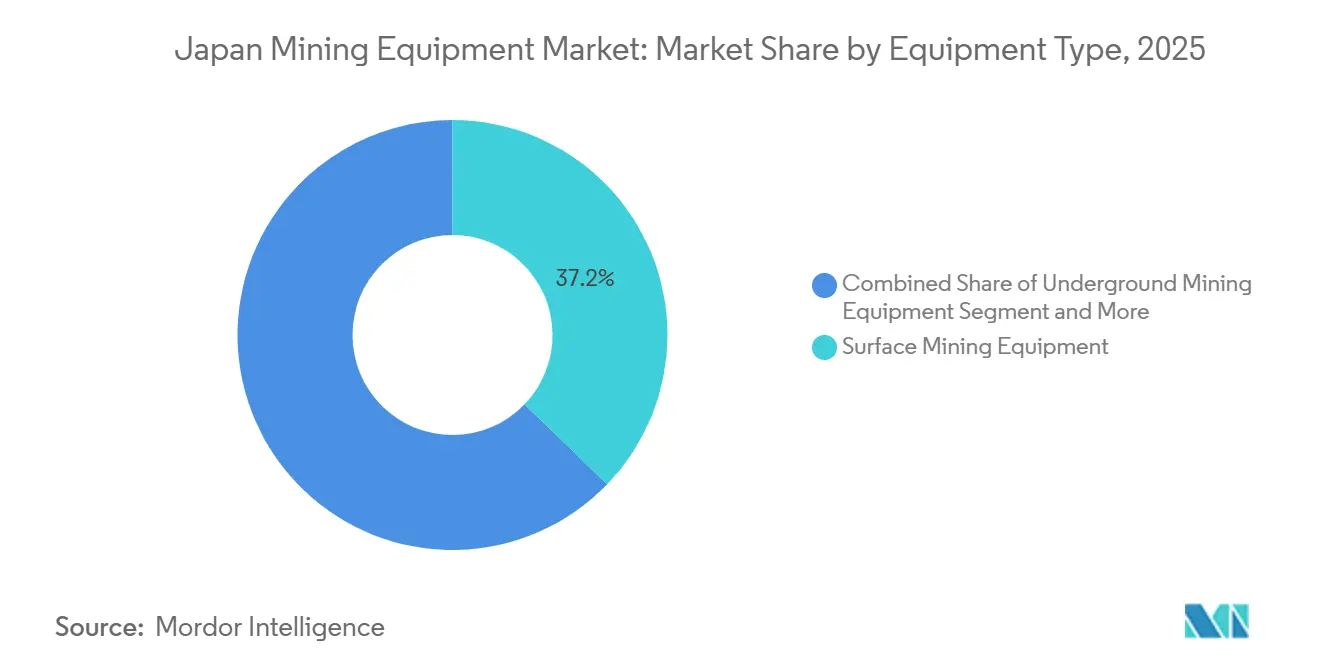
Surface mining equipment accounted for 37.22% of 2025 revenues in the Japan mining equipment market, with operations anchored in Hokkaido and Kyushu. As several coal sites shuttered, underground units have found newfound significance. These closures have opened tunnels for the extraction of rare-earth elements, a process now heavily reliant on compact loaders and advanced ventilation equipment. The mineral-processing systems segment is witnessing the swiftest growth. This surge is driven by the need for enhanced crushing and flotation capacities to handle low-grade ores. Notably, Sumitomo's upgrade to its Hishikari line achieved a remarkable reduction in cost-per-tonne.
Drills and breakers are poised for an 8.24% CAGR to 2031 as operators pursue narrow-vein deposits where bulk excavation is unviable. Komatsu's FrontRunner haulage boosts autonomous haul performance, significantly reducing labor costs. Meanwhile, Hi ROBOROCK's jumbos lead in tunnel expansion, leveraging predictive-maintenance IoT. Ongoing retrofits aimed at sidestepping carbon taxes are driving both new and replacement orders in Japan's mining equipment market.



By Automation Level: Manual Prevalence Confronts Rapid Autonomous Growth
Manual rigs still account for 54.07% of installed units, yet labor scarcity and safety rules are catalyzing a shift toward semi- and fully autonomous platforms. Caterpillar’s Command for Hauling allows a single controller to oversee multiple trucks, delivering a workable bridge solution in environments with strict CAPEX discipline.
Fully autonomous systems post a 9.22% CAGR, the highest among all categories, as the i-Construction tax credit reimburses up to 30% of purchase costs. Under the Mine Safety Act, certification mandates the use of dual-redundant sensors and fail-safe logic. This requirement introduces a lengthy validation cycle, solidifying Komatsu, Sandvik, and Epiroc's positions as trusted suppliers in Japan's mining equipment market. In artisanal operations, manual rigs continue to dominate, especially when annual throughput is low, making autonomy economically unfeasible.
By Powertrain Type: Electrification Gains Pace Amid Dominant ICE
Internal-combustion engines accounted for 73.58% of 2025 sales. Yet, with battery-electric vehicles rising at a 9.12% CAGR, significant retrofit aid and GX-ETS carbon levies, the push for greener solutions is evident. Hybrids, such as Hitachi’s ZX200X-7, are not just fuel-efficient, boasting substantial savings, but also act as bridge assets as charging grids evolve.
Battery-electric systems are proving their worth by significantly reducing underground ventilation costs. This is crucial in scenarios where extracting diesel exhaust is expensive. Meanwhile, Komatsu’s hydrogen-combustion prototype emerges as a game-changer for remote mines without power lines, matching diesel's horsepower. In a notable shift, the Japanese mining equipment market is now valuing rigs based on their life-cycle carbon impact, rather than just their initial price, reshaping tender criteria for both public and private buyers.
By Power Output: Mid-Range Engines Dominate, Compact Units Surge
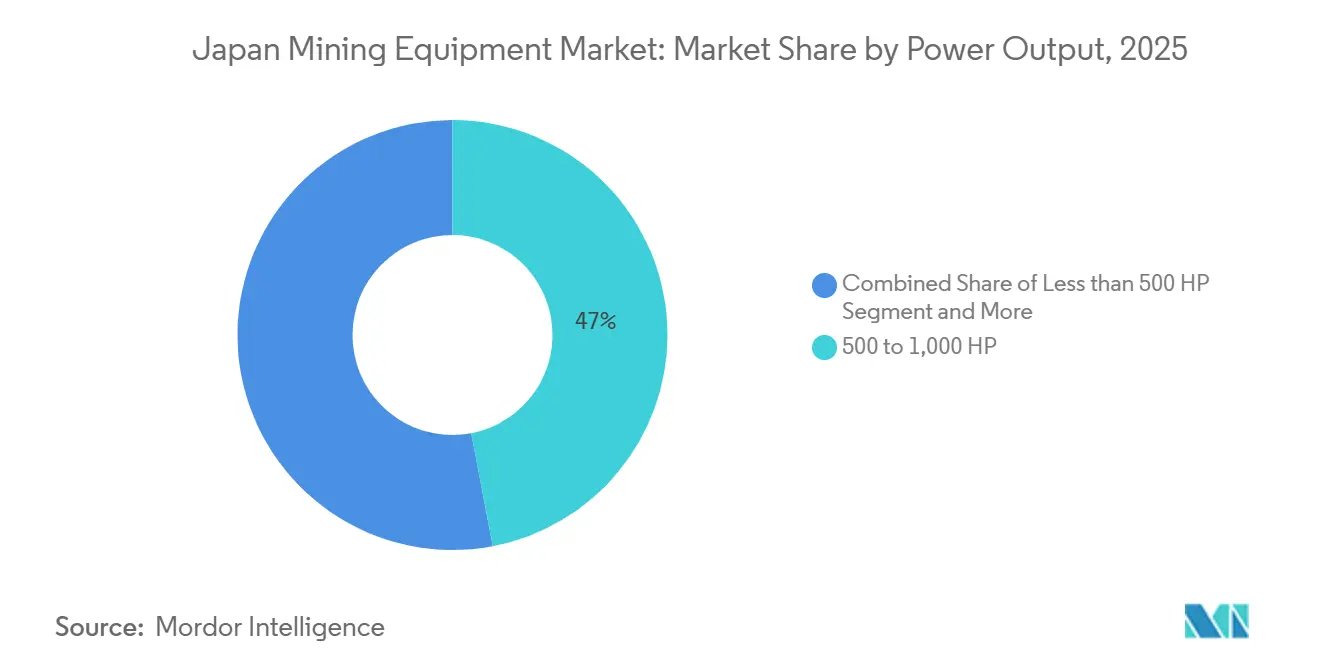
Mid-range 500 to 1,000 HP rigs accounted for 47.01% of 2025 revenue in the Japan mining equipment market, due to terrain-fit versatility. As coal closures diminish demand for giant haulage, ultra-class rigs with over 1,000 HP are seeing a decline. Meanwhile, Caterpillar's 777G, operating at 938 HP, achieved notable fuel-efficiency gains during trials in Australia, piquing the interest of Japanese limestone quarry operators.
Less than 500 HP units grow 6.19% per year because compact drills better exploit narrow-vein and subsea targets, including the Minamitorishima mud field. Electric drivetrains deliver immediate torque, letting smaller motors match the drawbar of mid-diesel variants and supporting a democratization of horsepower tiers inside the Japanese mining equipment market.
By Application: Metal Mining Leads, Rare-Earth Extraction Soars
Metal mining captured 55.31% share in 2025, driven by copper, gold, and zinc output, and continues to anchor procurement budgets. Operators retrofit idle coal drifts for polymetallic extraction, spurring loaders and ventilation buys.
Rare-earth metal mining is expanding at a 7.28% CAGR, the fastest slice of the Japan mining equipment market, underwritten by the US-Japan Critical Minerals Framework and JOGMEC’s 1.6 million t offshore discovery. Mineral mining for cement and glass stays flat, while coal equipment demand collapses in line with mine closures. The long-run mix shift pushes OEM roadmaps toward subsea excavators and offshore-rated automation suites.
Geography Analysis
Hokkaido, Kyushu, and offshore exclusive economic zones dominate equipment demand in Japan. In Hokkaido, limestone quarries have swiftly adopted battery-electric dump trucks, achieving cost parity with diesel within a decade. Facing labor shortages, quarries have turned to Komatsu and Hitachi's remote-control excavators to maintain output levels even with a significant drop in workforce. Meanwhile, Kyushu’s Kagoshima Prefecture leads a surge in rare-earth drilling, favoring compact rigs tailored for narrow-vein ore.
Offshore, the Minamitorishima EEZ is at the forefront of deep-sea resource procurement. JOGMEC's discovery of rare-earth mud at extreme depths signals a demand for remotely operated vehicles in the sub-500 HP range, marking a pivotal moment for Japan's mining equipment sector. Additionally, pilot wells for methane hydrates in the Nankai Trough necessitate specialized pressure-tight pumps and risers made from corrosion-resistant alloys.
In Honshu's urban areas, stringent land-use regulations push brownfield operators to prioritize AI-driven upgrades over expanding their physical footprint. A case in point is Sumitomo's 5G underground network in Kagoshima, a digital enhancement that boosts recovery rates without disturbing new land. Furthermore, regional policy incentives under the i-Construction initiative are now reimbursing digital equipment for infrastructure projects in Tohoku and Chubu, indirectly spurring a heightened demand for autonomous rigs in Japan's mining equipment landscape.
Competitive Landscape
Domestic leaders Komatsu and Hitachi Construction Machinery are now on par with global giants like Caterpillar, Sandvik, and Epiroc. Komatsu's mining-equipment revenue came primarily from aftermarket software and services. This shift underscores a broader industry trend, favoring subscription-based income over traditional hardware margins. Meanwhile, Caterpillar, through its joint venture with Mitsubishi Heavy Industries, is strategically positioning itself for electrification retrofits. This move is particularly timely, given the backdrop of a sales dip in the Asia-Pacific region, largely attributed to price volatility.
Sandvik supplied AutoMine-ready surface drills to Vale Base Metals, achieving a remarkable reduction in operator headcount. This achievement underscores the growing resonance of automation within the Japanese mining equipment landscape. Epiroc's series of BEV loader orders highlights the importance of ventilation economics in shaping underground fleet decisions. Meanwhile, niche players like Terra Drone are swiftly addressing survey-equipment voids, capitalizing on their nimble product cycles. Furukawa Rock Drill, boasting a dominant share in crawler drills, owes its success to a strong local supply chain and deep-rooted contractor ties. Furthermore, stringent standards such as ISO 14001 certification and autonomy certification under the Mine Safety Act create formidable entry barriers, solidifying the positions of established players in Japan's mining equipment market.
Japan Mining Equipment Industry Leaders
Komatsu Ltd.
Epiroc AB
Caterpillar Inc.
Sandvik AB
Hitachi Construction Machinery
- *Disclaimer: Major Players sorted in no particular order

Recent Industry Developments
- April 2025: ABB inked a memorandum of understanding with Japan’s Sumitomo Corporation's construction and mining systems unit, focusing on net-zero emissions solutions for mining equipment. Their teams aim to conceptualize and integrate their systems for a greener mining future.
- February 2025: Komatsu introduced a dump truck concept powered by hydrogen combustion, targeting zero tailpipe emissions. This innovative concept aligns with the company's commitment to sustainability and reducing environmental impact. By using hydrogen as a fuel, the dump truck aims to eliminate carbon emissions during operation, contributing to the decarbonization of the construction and mining industries.


Japan Mining Equipment Market Report Scope
The Japan Mining Equipment Market Report is Segmented by Equipment Type (Surface Mining Equipment, Underground Mining Equipment, Mineral Processing Equipment, Drills and Breakers, and More), Automation Level (Manual Equipment, and More), Powertrain Type (ICE, BEV, and More), Power Output (less Than 500 HP, and More), and Application (Metal Mining and More). The Market Forecasts are Provided in Terms of Value (USD).
| Surface Mining Equipment |
| Underground Mining Equipment |
| Mineral Processing Equipment |
| Drills and Breakers |
| Crushing, Pulverizing and Screening |
| Loaders and Haul Trucks |
| Manual Equipment |
| Semi-Autonomous Equipment |
| Fully Autonomous Equipment |
| Internal-Combustion Engine Vehicles |
| Battery-Electric Vehicles |
| Hybrid Vehicles |
| Less than 500 HP |
| 500 to 1,000 HP |
| Above 1,000 HP |
| Metal Mining |
| Mineral Mining |
| Coal Mining |
| By Equipment Type | Surface Mining Equipment |
| Underground Mining Equipment | |
| Mineral Processing Equipment | |
| Drills and Breakers | |
| Crushing, Pulverizing and Screening | |
| Loaders and Haul Trucks | |
| By Automation Level | Manual Equipment |
| Semi-Autonomous Equipment | |
| Fully Autonomous Equipment | |
| By Powertrain Type | Internal-Combustion Engine Vehicles |
| Battery-Electric Vehicles | |
| Hybrid Vehicles | |
| By Power Output | Less than 500 HP |
| 500 to 1,000 HP | |
| Above 1,000 HP | |
| By Application | Metal Mining |
| Mineral Mining | |
| Coal Mining |


Key Questions Answered in the Report
How large is the Japan mining equipment market in 2025?
It is valued at USD 6.57 billion, with projections reaching USD 8.55 billion by 2030 on a 5.40% CAGR.
Which equipment category is growing the fastest?
Drills and breakers post the highest 11.84% CAGR, propelled by deep-sea pilot programs and AI-enhanced exploration.
What share do battery-electric vehicles hold?
Although internal-combustion rigs still dominate, BEV units expand rapidly and are forecast to top USD 1 billion in sales by 2030.
Why is rare-earth mining important to Japan?
Seabed rare-earth deposits secure long-term supplies for EV and electronics manufacturing, cutting reliance on external sources.
Which region leads Japan’s mining activity?
Hokkaido remains the heart of traditional mining, while the offshore Minami-Torishima area anchors new deep-sea ventures.
Who are the key market players?
Domestic majors Komatsu and Hitachi Construction Machinery dominate, with Epiroc and Sandvik supplying advanced drilling and electrification technologies.
Page last updated on:





