
Mexico Mineral Processing Equipment Market Size and Share
Market Overview
| Study Period | 2019 - 2031 |
|---|---|
| Forecast Data Period | 2026 - 2031 |
| Base Year Market Size (2025) | USD 147.65 Million |
| Market Size (2026) | USD 157.71 Million |
| Market Size (2031) | USD 219.23 Million |
| Growth Rate (2026 - 2031) | 6.81 % |
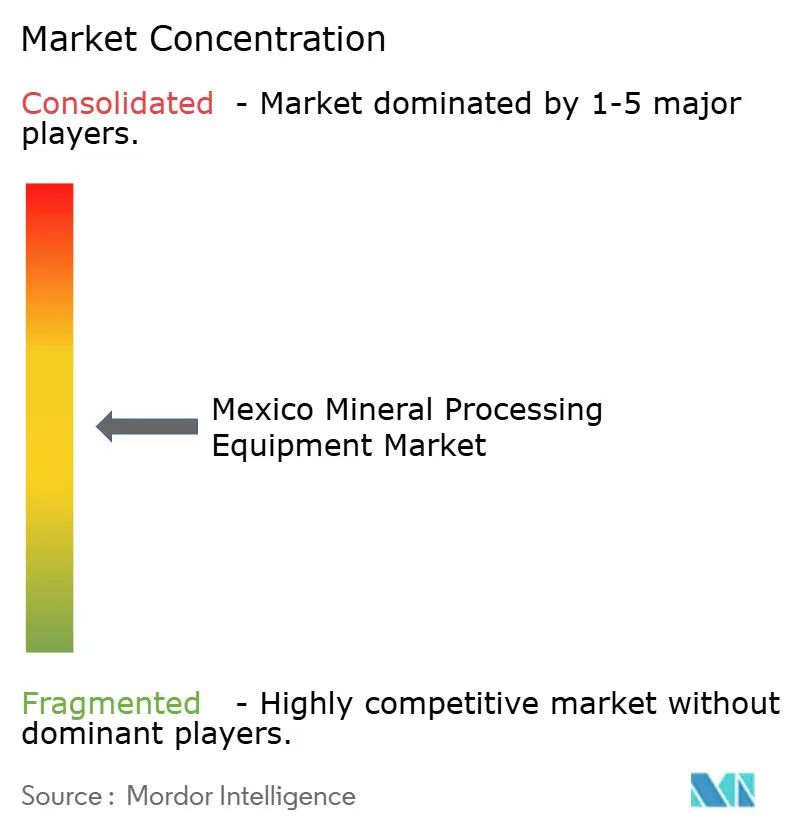
| Market Concentration | Medium |
Major Players *Disclaimer: Major Players sorted in no particular order Image © Mordor Intelligence. Reuse requires attribution under CC BY 4.0. | |
Mexico Mineral Processing Equipment Market Analysis by Mordor Intelligence
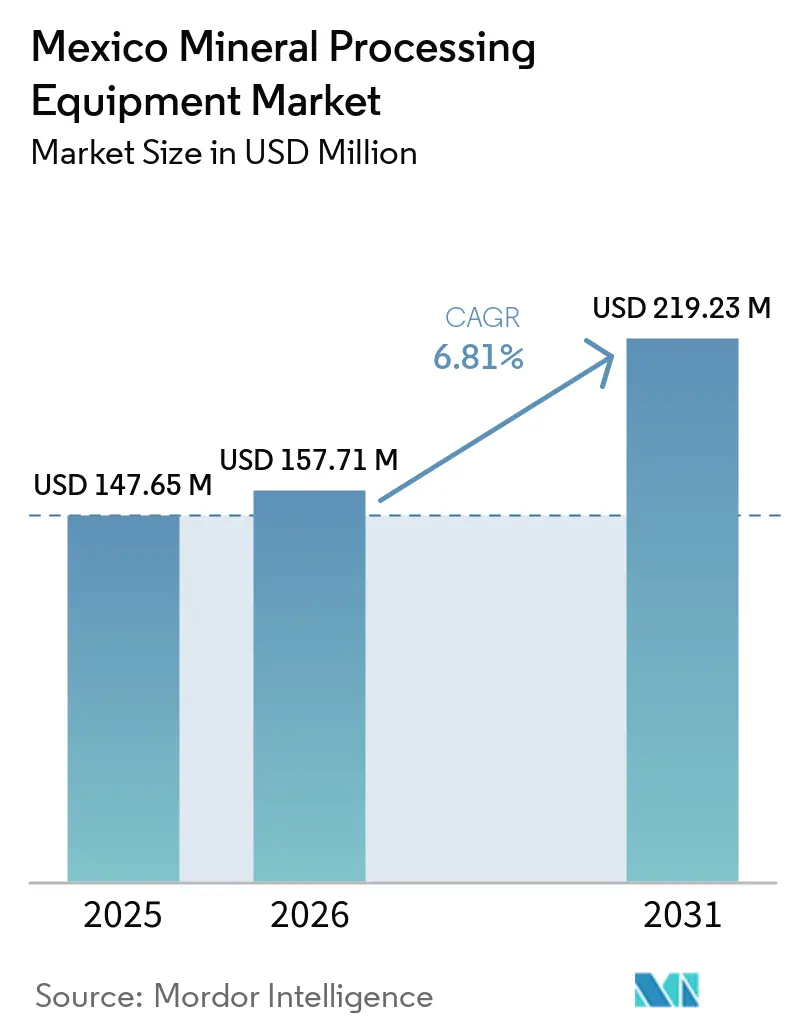
The Mexico mineral processing equipment market size was valued at USD 147.65 million in 2025 and is estimated at USD 157.71 million in 2026, and is projected to reach USD 219.23 million by 2031, at a CAGR of 6.81% during the forecast period (2026-2031). Rising local demand for battery-grade lithium and high-purity copper, the 2025 federal royalty reform that lowered import duties on modernization projects, and aggressive automation programs at large mines are together giving the Mexican mineral processing equipment market durable momentum. Growth is no longer tied only to global commodity cycles; instead, it is being pulled by structural shifts such as near-shored electric-vehicle supply chains centered in Sonora and Nuevo León, a wave of brownfield plant upgrades prompted by favorable depreciation rules, and stricter tailings-safety standards that require dry-stack or filtered solutions. Vendors able to deliver modular equipment, predictive-maintenance software, and local service teams are earning premium pricing because operators now replace crushers, mills, and conveyors every 12-14 years instead of the historical 18-20-year cycle.
Key Report Takeaways
- By mineral mining sector, the iron sector equipment captured 38.16% of the Mexican mineral processing equipment market share in 2025, while the lithium-processing gear is forecast to post the fastest 6.83% CAGR through 2031.
- By equipment type, drills and breakers will record the highest 6.85% CAGR among equipment types, whereas crushers commanded 31.23% of 2025 revenue.
- By mining method, surface-mining operations accounted for a 67.71% slice of the Mexican mineral processing equipment market size in 2025; underground methods are advancing at a 6.88% CAGR to 2031 as high-grade silver veins move extraction deeper.
- By automation level, semi-automated systems held 48.85% of 2025 revenue, and fully automated solutions are projected to grow at a 6.91% CAGR to 2031, supported by Fresnillo’s autonomous haul-truck fleet that cut unit hauling cost minimal.
Note: Market size and forecast figures in this report are generated using Mordor Intelligence’s proprietary estimation framework, updated with the latest available data and insights as of January 2026.
Mexico contributes to a system defined not by any single country or region but by the interaction of many. The global mineral processing equipment market data by Mordor Intelligence represents that combined structure.
Mexico Mineral Processing Equipment Market Trends and Insights
Drivers Impact Analysis*
| Driver | (~) % Impact on CAGR Forecast | Geographic Relevance | Impact Timeline |
|---|---|---|---|
| Surging Iron-Ore, Copper and Lithium Output in Mexico | +1.8% | National, with concentration in Sonora, Durango, Zacatecas | Medium term (2-4 years) |
| Strong Pipeline of Brown-Field Plant Expansions | +1.4% | National, focused on Sonora, Sinaloa, Durango | Medium term (2-4 years) |
| Near-Shoring of EV Supply Chains Boosting Local Beneficiation | +1.3% | Northern states: Sonora, Coahuila, Nuevo León | Long term (≥ 4 years) |
| Federal Tax Incentives and Mining-Friendly Reforms | +1.2% | National, early gains in Coahuila, Chihuahua | Short term (≤ 2 years) |
| Digital-Automation Retrofits for Legacy Mills | +0.9% | National, pilot deployments in Zacatecas, Guerrero | Medium term (2-4 years) |
| Tailings-Dam Failure Risk Driving Demand for Re-Processing Solutions | +0.7% | National, priority in Guanajuato, Chihuahua | Short term (≤ 2 years) |
| Source: Mordor Intelligence | |||
Surging Iron-Ore, Copper, and Lithium Output in Mexico
In 2024, copper mine production experienced a notable increase compared to the previous year. Peña Colorada and Las Truchas contributed significantly to iron ore shipments, supporting domestic steel mills and facilitating exports to international markets such as Japan [1]“Informe Anual 2024,” Cámara Minera de México (CAMIMEX),camimex.org.mx . Bacanora’s Sonora Clay Project, after securing substantial financing in 2025, is targeting a significant production milestone for lithium-carbonate equivalent within a few years. Operators, facing challenges with declining ore quality, are adopting advanced technologies like high-pressure grinding rolls and coarse-particle flotation to maintain concentrate quality, which has led to an increase in equipment intensity per unit of payable metal. Collaborating with state-owned Litio para México, joint ventures have unlocked considerable plant commitments. These plants require specialized equipment, such as calcination kilns and ion-exchange lines, which are not available from traditional copper-equipment vendors. As ore mixes become more fragmented, suppliers offering modular, ore-agnostic designs are gaining traction across multiple sectors, while single-commodity specialists are losing their pricing advantage.
Strong Pipeline of Brownfield Plant Expansions
In 2024-2025, brownfield projects secured the majority of mining investments, thanks to quicker permit approvals for capacity additions—averaging significantly less time compared to greenfield projects. Pan American Silver expanded its La Colorada, boosting milling capacity with multiple vibrating screens, ball mills, and new flotation banks. Orla Mining's Camino Rojo oxide plant, which went commercial in 2024, promptly initiated engineering on a substantial sulfide circuit. Operators at brownfield sites, retrofitting automation and emissions controls, achieve considerably higher equipment revenue per ton of added capacity.
Near-Shoring of EV Supply Chains Boosting Local Beneficiation
In 2024, Tesla announced its Monterrey Gigafactory, while BYD unveiled its Saltillo battery plant. These moves have shifted Mexico's lithium and copper focus from mere exports to vital components for North American industries. Electric vehicle (EV) drivetrains require significantly more copper compared to traditional internal-combustion engines. This heightened demand has led operators to adopt additional flotation stages and magnetic separators, ensuring they meet the stringent arsenic specifications for automotive wiring. In Sonora, authorities are enticing cathode-precursor companies with tax incentives. However, these firms would need conversion plants equipped with rotary kilns and spray dryers, technologies that are notably missing from Mexico's current infrastructure.
Federal Tax Incentives and Mining-Friendly Reforms
In early 2025, a royalty overhaul reduced rates significantly for operators who reinvest a substantial portion of their after-tax income into exploration or processing upgrades. Under Plan México, operators can also benefit from full first-year depreciation on crushing, grinding, and flotation equipment, provided it's installed within a specified timeframe [2]“Decreto de Estímulos Fiscales al Sector Minero 2025,” Diario Oficial de la Federación, dof.gob.mx . During the first quarter of 2025, quote requests increased notably as miners hurried to secure these advantages. Thanks to import-duty waivers on tailings-reprocessing equipment, dry-stack filters have become feasible for smaller-scale plants. This development has sped up replacement cycles and given an edge to OEMs with warehouses in Mexico.
Restraints Impact Analysis*
| Restraint | (~) % Impact on CAGR Forecast | Geographic Relevance | Impact Timeline |
|---|---|---|---|
| Commodity-Price Volatility Curbing CAPEX Plans | -1.1% | National, with spillover to equipment-leasing markets | Short term (≤ 2 years) |
| Chronic Water Scarcity in Northern States | -0.9% | Sonora, Chihuahua, Coahuila | Long term (≥ 4 years) |
| Tightening SEMARNAT Air and Water Emission Standards | -0.8% | National, acute in Mexico City airshed, Gulf Coast watersheds | Short term (≤ 2 years) |
| Heightened Community and Indigenous Permit Challenges | -0.6% | Southern states: Oaxaca, Guerrero, Chiapas | Medium term (2-4 years) |
| Source: Mordor Intelligence | |||
Commodity-Price Volatility Curbing CAPEX Plans
Between mid-2024 and early 2026, copper prices experienced significant fluctuations. This volatility prompted Southern Copper to postpone substantial mill upgrades at its Buenavista site, leading to the cancellation of multiple orders for SAG mills and flotation cells. In the following year, silver prices also declined notably, prompting Fresnillo to reduce its sustaining budget for the subsequent year. Such price fluctuations have led to a rise in equipment-as-a-service contracts, where payments are tied to metal prices, thereby transferring the residual-value risk to OEMs.
Chronic Water Scarcity in Northern States
In Sonora and Chihuahua, CONAGUA has reported that aquifer depletion significantly surpasses recharge rates annually. Grupo México’s Buenavista mine, which consumes a substantial amount of water each year, is at risk of losing its concession renewal in the near future. While operators are now mandated to use high-pressure grinding rolls—reducing water consumption considerably—and dry-stack filters, the latter come with a significant cost for each circuit, especially in most northern basins.
*Our forecasts treat driver/restraint impacts as directional, not additive. The impact forecasts reflect baseline growth, mix effects, and variable interactions.
Segment Analysis
By Mineral Mining Sector: Lithium Drives Fastest Growth
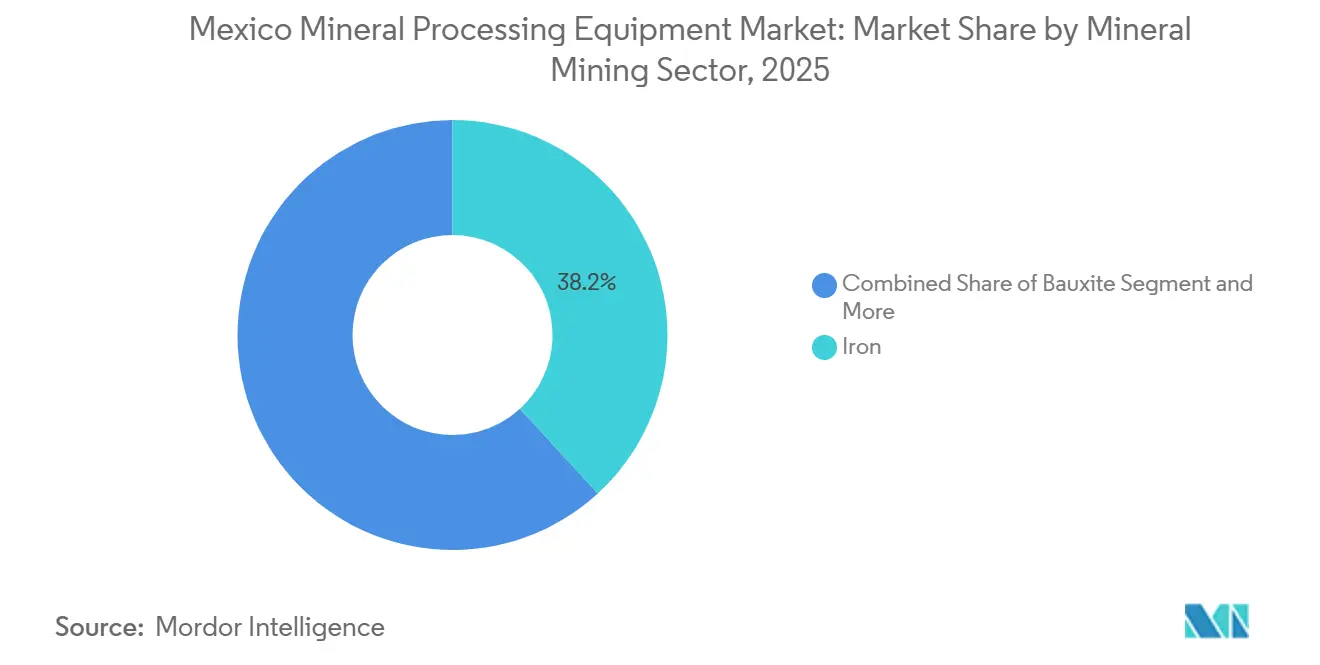
Iron processing delivered 38.16% of 2025 revenue as Altos Hornos de México upgraded Monclova pelletizing lines. The Mexico mineral processing equipment market size tied to lithium will rise fastest at a 6.83% CAGR to 2031 because Bacanora and Ganfeng are scaling Sonora clay operations from pilot to 35,000 t/y lithium carbonate, demanding rotary kilns and spray dryers that local suppliers do not yet build. Copper remains core, with Grupo México’s Buenavista and Cananea relying on high-throughput SAG mills and large flotation banks maintained under multiyear service deals. Silver, lead, zinc, and gold equipment sales persist because Mexico supplied 23% of global silver in 2024, sustaining gravity concentrator and cyanide-circuit demand.
Lithium’s ascent is fragmenting vendor share: clay deposits require acid leach and ion-exchange systems unfamiliar to traditional copper-equipment specialists. Iron’s dominance is vulnerable to Chinese steel cycles; a 10% drop in Chinese rebar output during H2 2025 idled 1.2 million t of Mexican pellet capacity and deferred USD 18 million of pellet-disc replacements. Copper equipment intensity is climbing because falling head grades force 15-20% more ore through mills for the same metal output, lifting near-term orders for crushers and conveyors.



By Equipment Type: Drills Accelerate Amid Automation
Crushers commanded 31.23% of 2025 revenue because every plant needs primary and secondary comminution. Drills and breakers will post the strongest 6.85% CAGR to 2031 as continuous miners and battery-electric jumbo drills penetrate deeper silver and gold zones. Conveyors and feeders follow crusher replacement cycles every 12-15 years, creating lumpy but predictable demand. The Mexico mineral processing equipment market share of grinding mills, flotation cells, and filters remains sizeable, and technology shifts such as high-pressure grinding rolls and column flotation are shortening replacement intervals.
Automation is also reshaping orders: Komatsu’s battery-electric continuous miner introduced at Velardeña in 2024 cuts dilution in 2.5 m-wide veins while lowering ventilation load, supporting underground expansion economics. Chinese crushers priced 30-40% below Western equivalents are gaining adoption for non-critical secondary stages, but primary gyratory demand still favors Sandvik and Metso because unplanned downtime at Mexico’s mega-pits can cost USD 300,000 per hour in lost production.
By Mining Method: Underground Gains on Grade Imperatives
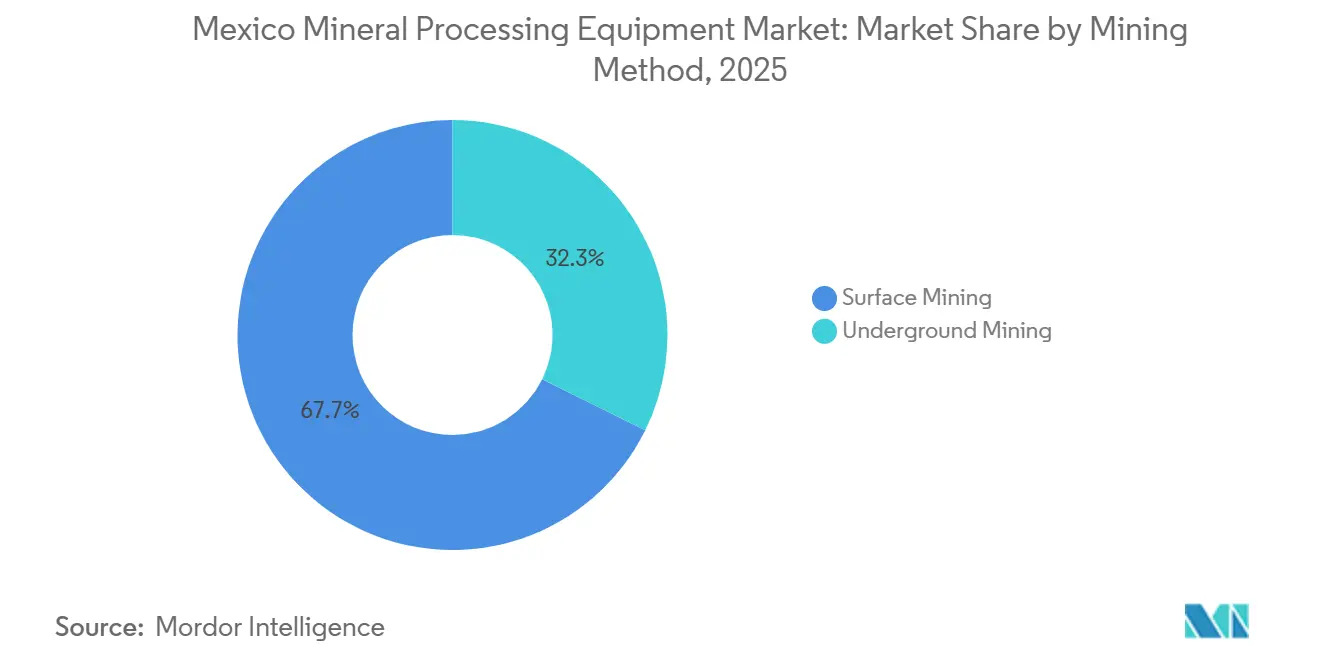
Surface mining generated 67.71% of 2025 revenue because Buenavista, Cananea, and Peña Colorada together move hundreds of thousands of tons per day. The share tied to underground methods will climb as high-grade silver in Zacatecas and Chihuahua and gold in Guerrero drives mines below 400 m. Equipment requirements differ: underground projects favor compact jaw crushers on skids, battery-electric load-haul-dump units, and paste-fill plants; surface pits prioritize high-capacity shovels, 300-t haul trucks, and 6,000 t/h crushers.
Underground methods are rising with a CAGR of 6.88% till 2031 because near-surface oxides are largely depleted. Fresnillo’s Juanicipio mine reached full output in 2024 after spending USD 68 million on underground-specific machinery, including ventilation and paste-fill. Surface operators still invest heavily; Grupo México increased its Buenavista haul-truck fleet by 38% between 2023 and 2025 to offset lower ore grades, illustrating how falling grades lift equipment intensity even when total tonnage is flat.
By Automation Level: Full Autonomy Justified by Labor Costs
Semi-automated machines held 48.85% of 2025 revenue, reflecting widespread SCADA retrofits on legacy mills. Fully automated systems will grow fastest at 6.91% CAGR to 2031, led by autonomous haulage and drilling that cut operating costs and help mines comply with new occupational-health rules limiting worker exposure to dust and vibration. Manual equipment is eroding as mining wages rose 22% in real terms from 2020-2025, reducing the labor-arbitrage incentive to avoid automation.
ABB’s retrofit kit, released in 2025, can turn existing haul trucks into autonomous units for USD 600,000 each, blurring the line between semi and full automation and expanding the addressable market. Remote-operated and tele-remote solutions remain niche but are indispensable in seismically active stopes where human entry poses excessive risk.
Geography Analysis
In 2025, Sonora, Chihuahua, Durango, and Zacatecas collectively held a significant share of Mexico's total installed milling capacity, solidifying their dominance in the country's mineral processing equipment market. Sonora, a leader in copper production, is also emerging as a key player in the lithium sector. Over the forecast period, Buenavista and Cananea made substantial investments in crushers, mills, and flotation equipment. Meanwhile, Bacanora and Ganfeng, with their clay-lithium plants, are set to introduce kilns and spray dryers to the region for the first time.
Chihuahua, home to Pan American Silver’s Dolores and Santa Eulalia, is pivoting to underground extraction as its oxide caps deplete. This shift is driving up the demand for continuous miners and battery-electric LHDs. In a bid to combat water stress, Zacatecas and Durango are adopting dry-stack tailings. Fresnillo’s Juanicipio made waves recently by installing a state-of-the-art filter-press system, setting a new state standard. Proximity to vendors is crucial: Metso operates a warehouse in Hermosillo, while Sandvik has established a hub in Chihuahua, both ensuring swift parts delivery and bolstering premium pricing.
While coastal states like Baja California Sur and Guerrero account for a smaller portion of the nation's equipment demand, they're trailblazing in seawater desalination processing. Baja Mining’s Boleo stands testament to this, showcasing that corrosion-resistant grinding media and flotation cells can thrive in high-salinity environments. Southern states face hurdles with extended permitting processes. Yet, Guerrero's stake in the market is set to rise temporarily, thanks to Torex Gold’s Media Luna project, which will demand a substantial amount of underground plant and mining equipment.
The mineral processing equipment market is analyzed by Mordor Intelligence across multiple other geographies. This is complemented by country-specific insights for Canada, Argentina, Egypt, Morocco, South Africa, Italy, Brazil, Saudi Arabia, and Australia, reflecting various localized market behavior and policy environments' coverage.
Competitive Landscape
In the Mexican mineral processing equipment market, a handful of players dominate. By bundling hardware with wear-parts optimization and financing services, industry giants Metso Outotec, FLSmidth, Sandvik, Weir, and Komatsu captured a significant share of the revenue, a feat smaller firms struggle to match. These leaders focus on total cost of ownership, leveraging predictive-maintenance analytics and performance guarantees to shift operational risks from miners to themselves.
Chinese firms like CITIC Heavy Industries and Shenyang Metallurgy are making waves by offering secondary crushers at substantial discounts, especially in areas where downtime risks are minimal. Technology sets the leaders apart. Metso secured a major contract with its Planet Positive line, showcasing high-pressure grinding rolls and ore-sorting sensors that demonstrated notable energy savings.
Sandvik’s AutoMine® system significantly improved truck utilization at Herradura. Meanwhile, FLSmidth expanded its emissions-control portfolio through its acquisition of thyssenkrupp Mining, coinciding perfectly with NOM-157's nationwide baghouse upgrade mandate. Regional fabricators, by offering modular, skid-mounted plants adaptable for brownfield retrofits, are capturing a notable portion of sales. Grupo México's establishment of a refurbishment center in Sonora hints at a trend: major miners might start internalizing parts supply, a move that could potentially reduce OEM aftermarket revenues.
Mexico Mineral Processing Equipment Industry Leaders
Metso Outotec
FLSmidth A/S
Sandvik AB
The Weir Group PLC
Komatsu Ltd.
- *Disclaimer: Major Players sorted in no particular order

Recent Industry Developments
- April 2026: MacLean Engineering announced the acquisition of a 72,000-square-foot (7,000-square-meter) industrial facility within its existing industrial park in Querétaro, Mexico. Located adjacent to MacLean's current operations, the new site will support the continued expansion of the company's manufacturing and service capabilities in the region.
- April 2025: Sandvik clinched a record USD 71 million contract to supply battery-electric trucks, loaders, bolters, and drills to the Hermosa critical-minerals project, with phased deliveries through 2030.
- April 2025: Luca Mining started commercial production at the Tahuehueto underground mine, completing a plant that can ramp to 1,000 t/d and signaling a fresh demand cycle for concentrate-grade control instrumentation.


Mexico Mineral Processing Equipment Market Report Scope
The scope of the report includes the mineral mining sector (Bauxite, Iron, Lithium, and Others), Equipment Type (Crushers, Feeders, Conveyors, Drills and Breakers, and Others), Mining Method (Surface Mining and Underground Mining), and Automation Level (Manual, Semi-Automated, and Fully Automated). The Market Forecasts are Provided in Terms of Value (USD) and Volume (Units).
| Bauxite |
| Iron |
| Lithium |
| Others |
| Crushers |
| Feeders |
| Conveyors |
| Drills & Breakers |
| Others |
| Surface Mining |
| Underground Mining |
| Manual |
| Semi-Automated |
| Fully Automated |
| By Mineral Mining Sector | Bauxite |
| Iron | |
| Lithium | |
| Others | |
| By Equipment Type | Crushers |
| Feeders | |
| Conveyors | |
| Drills & Breakers | |
| Others | |
| By Mining Method | Surface Mining |
| Underground Mining | |
| By Automation Level | Manual |
| Semi-Automated | |
| Fully Automated |


Key Questions Answered in the Report
What is the forecast value of the Mexican mineral processing equipment market in 2031?
It is projected to reach USD 219.23 million by 2031, growing at a 6.81% CAGR from 2026 to 2031.
Which mineral segment is growing fastest in equipment demand?
Lithium-processing equipment will expand at a 6.83% CAGR through 2031 as Sonora clay projects scale to commercial output.
Why are autonomous haul trucks gaining traction in Mexico?
Rising labor costs and the 18% cost-per-ton savings shown at Fresnillo’s Herradura mine make full autonomy financially attractive.
How will new tailings standards affect equipment sales?
NOM-141 mandates dry-stack or filtered solutions by 2026, driving urgent demand for thickeners, filters, and related control systems.
Which states account for most equipment spending today?
Sonora, Chihuahua, Durango, and Zacatecas together represent about 68% of installed milling capacity and associated procurement.
Who are the leading equipment suppliers in the country?
Metso Outotec, FLSmidth, Sandvik, Weir, and Komatsu collectively hold around 60% of market revenue through entrenched service contracts.
Page last updated on:





