
Japan Mineral Processing Equipment Market Size and Share
Market Overview
| Study Period | 2019 - 2031 |
|---|---|
| Forecast Data Period | 2026 - 2031 |
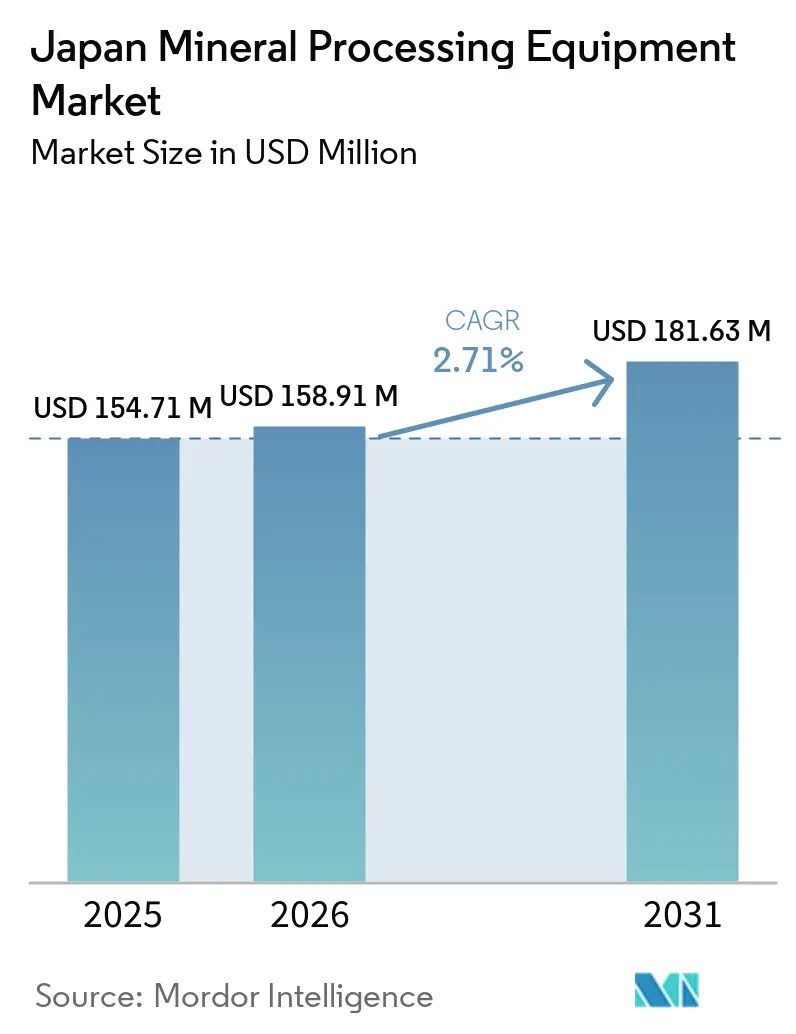
| Base Year Market Size (2025) | USD 154.71 Million |
| Market Size (2026) | USD 158.91 Million |
| Market Size (2031) | USD 181.63 Million |
| Growth Rate (2026 - 2031) | 2.71 % |
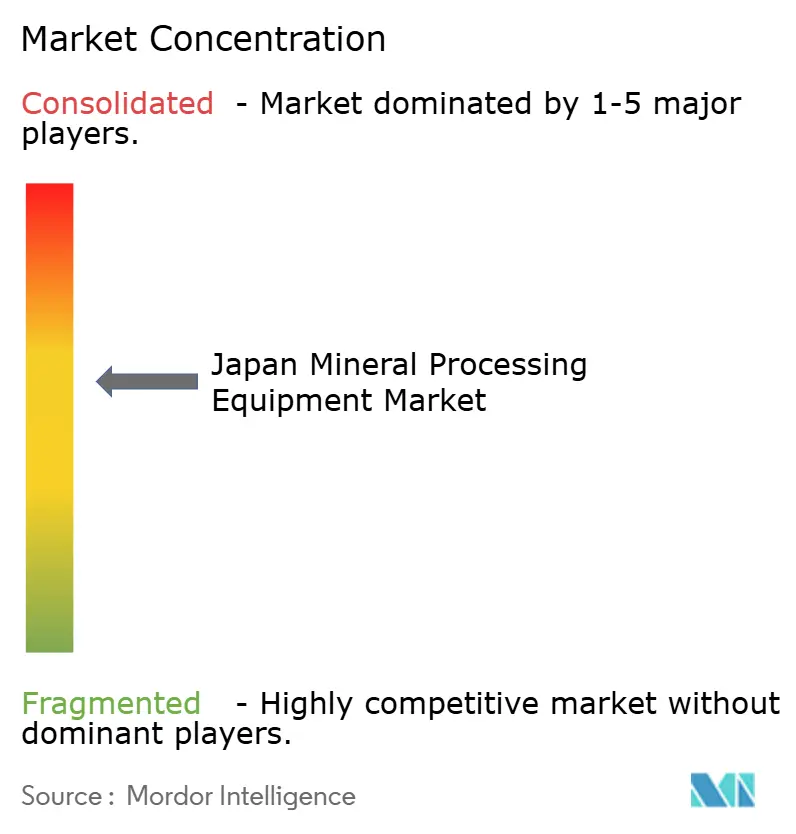
| Market Concentration | Medium |
Major Players *Disclaimer: Major Players sorted in no particular order Image © Mordor Intelligence. Reuse requires attribution under CC BY 4.0. | |
Japan Mineral Processing Equipment Market Analysis by Mordor Intelligence
The Japan mineral processing equipment market size was valued at USD 154.71 million in 2025 and is expected to reach USD 158.91 million in 2026 and is forecast to reach USD 181.63 million by 2031, growing at a CAGR of 2.71% over 2026-2031. Rising demand for battery materials, government stimulus for rare-earth self-sufficiency, and the accelerating replacement of 1980s-1990s era mills and crushers are expanding the Japanese mineral processing equipment market despite flat overall ore output. Seismic design mandates and high electricity tariffs are prompting operators to favor modular, energy-efficient machinery, while the GX Emissions Trading Scheme (GX-ETS) is pushing early adoption of variable-frequency-drive crushers, vertical roller mills, and sensor-based sorters. Deep-sea nodule trials around Minamitorishima and the Okinawa Trough are creating a small but strategic opening for equipment engineered for corrosive saltwater environments. Meanwhile, fully automated haulage and predictive-maintenance platforms are gaining traction among mid-tier miners who cannot staff large maintenance crews yet must avoid unplanned downtime.
Key Report Takeaways
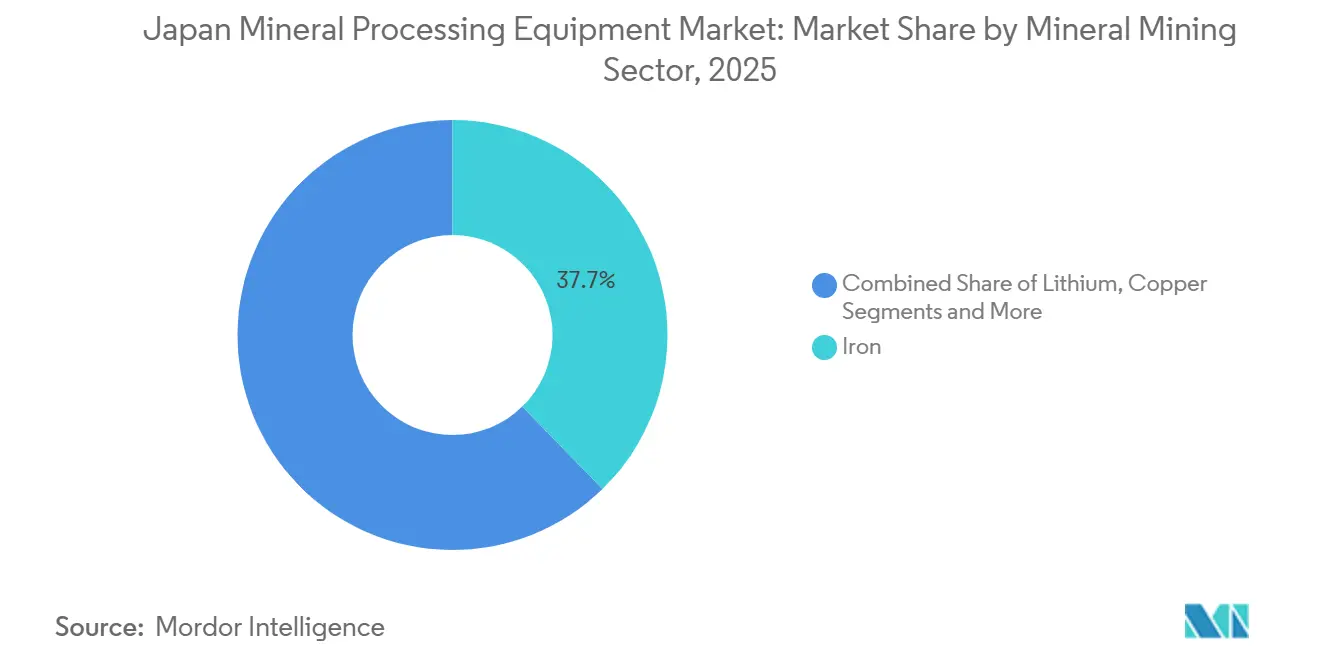
- By mineral mining sector, iron ore processing led with 37.71% of the Japanese mineral processing equipment market share in 2025, while lithium equipment is forecast to expand at a 2.73% CAGR through 2031.
- By equipment type, crushers accounted for 26.17% of 2025 revenue and are projected to grow at a 2.75% CAGR over 2026-2031.
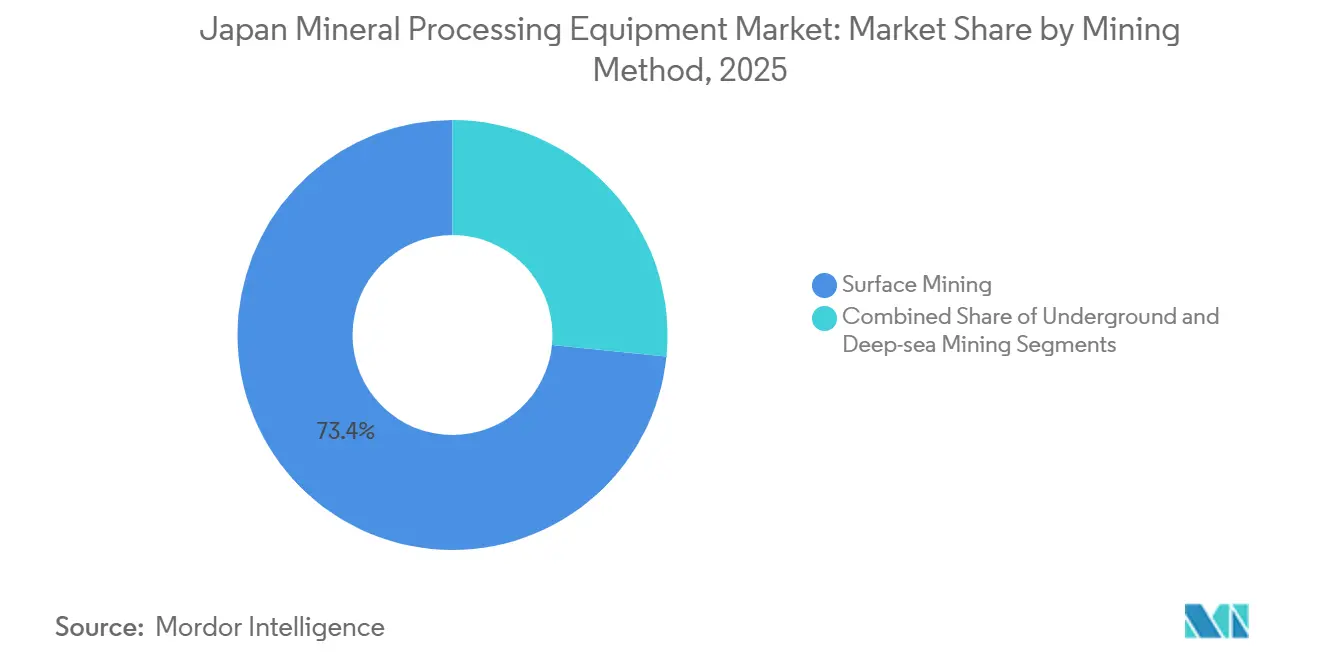
- By mining method, surface operations retained 73.37% share in 2025, but deep-sea methods show the fastest 2.78% CAGR through 2031 as JOGMEC scales polymetallic nodule pilots.
- By automation level, semi-automated systems captured 55.46% of 2025 revenue, whereas fully automated equipment is advancing at a 2.81% CAGR through 2031.
Note: Market size and forecast figures in this report are generated using Mordor Intelligence’s proprietary estimation framework, updated with the latest available data and insights as of January 2026.
Worldwide, activity is shaped by contributions from multiple countries and regions, with Japan representing one among them. The global report on mineral processing equipment market by Mordor Intelligence reflects how these countries and regional layers combine into a single system.
Japan Mineral Processing Equipment Market Trends and Insights
Drivers Impact Analysis*
| Driver | (~) % Impact on CAGR Forecast | Geographic Relevance | Impact Timeline |
|---|---|---|---|
| Domestic Rare-Earth Exploration Push | +0.6% | National, with concentration in Minamitorishima offshore zone and Kirishima onshore sites | Medium term (2-4 years) |
| Resurgence of Copper-Gold Projects | +0.5% | National, early gains in Kagoshima (Yamagano), Hokkaido, and Kyushu regions | Medium term (2-4 years) |
| Government Capex and Tax Incentives for Energy-Efficient Plants | +0.4% | National, with priority for GX-ETS compliant facilities | Short term (≤ 2 years) |
| Accelerating Replacement Cycle of Ageing Mills and Crushers | +0.4% | National, focused on iron ore and bauxite processing plants in coastal prefectures | Short term (≤ 2 years) |
| Data-Driven Predictive-Maintenance Adoption by Mid-Tier Miners | +0.3% | National, early adopters in Hokkaido and Tohoku underground mines | Medium term (2-4 years) |
| Offshore Polymetallic Nodule Trials in Okinawa Trough | +0.3% | Offshore exclusive economic zone, Minamitorishima and Okinawa Trough | Long term (≥ 4 years) |
| Source: Mordor Intelligence | |||
Domestic Rare-Earth Exploration Push
Japan is focusing its rare-earth strategy on deep-sea deposits located at Minamitorishima. In the near term, JOGMEC allocated a significant budget to push forward a pilot project targeting substantial daily output of mud, aiming for completion within a few years. Concurrently, the GX Green Transformation plan is providing subsidies for crushers and flotation cells that meet international energy management standards [1]“FY 2025 Budget Details,” JOGMEC, jogmec.go.jp . While offshore projects sidestep land-use disputes, they necessitate containerized and corrosion-resistant processing units. This specialized niche is currently led by European OEMs, who have started licensing their modules to Japanese shipyards. Highlighting the private sector's alignment with national security objectives, Sumitomo Metal Mining has set its sights on a profit target for the mid-term that includes a new rare-earth refining capacity.
Resurgence of Copper-Gold Projects
High-grade intercepts at the Yamagano prospect, indicating strong gold mineralization over a narrow interval, have revived copper-gold exploration after decades of dormancy. Nippon Steel Mining’s Alceros mine, scheduled to open in the near term, will process a modest annual volume using crushers designed for arsenic-rich sulfide ore, supporting the handling of complex mineralized material. Meanwhile, a remote-operation pilot in Chile’s copper belt is serving as a testbed for autonomous fleets that could be repatriated to Japan, strengthening the country’s capabilities in advanced mine automation and remote asset management.
Government CAPEX and Tax Incentives for Energy-Efficient Plants
The Industrial Competitiveness Enhancement Act extends 10-year tax credits to mineral processors that lower energy use by 15%. GX-ETS carbon allowances tighten 3% annually from FY 2026, driving early replacement of 1990s-era grinders with variable-frequency-drive models that cut power 20-30% [2]“GX-ETS Framework,” Ministry of Economy, Trade and Industry, meti.go.jp . Idemitsu Kosan’s lithium sulfide plant tapped JPY 7.1 billion (USD 47 million) in grants, demonstrating how battery-material lines can layer subsidies and accelerate payback.
Accelerating the Replacement Cycle of Aging Mills and Crushers
Many plants, commissioned decades ago, now find that maintenance costs and GX-ETS penalties surpass the benefits of deferred spending. Komatsu's HM460-6 haul truck demonstrates a significant improvement in fuel efficiency. Meanwhile, in recent years, Metso secured numerous life-cycle service contracts, shifting capital expenditures (capex) to operational expenditures (opex) and ensuring consistent uptime. This replacement drive, primarily motivated by compliance rather than an increase in capacity, underscores Japan's stagnant tonnage perspective.
Restraints Impact Analysis*
| Restraint | (~) % Impact on CAGR Forecast | Geographic Relevance | Impact Timeline |
|---|---|---|---|
| Tightening Carbon-Emission Caps on Mineral Processors | -0.4% | National, with stricter enforcement in Tokyo, Osaka, and Nagoya industrial zones | Short term (≤ 2 years) |
| High Electricity Tariffs Versus Regional Peers | -0.3% | National, most acute in Kyushu and Shikoku prefectures with limited nuclear capacity | Short term (≤ 2 years) |
| Shortage of Skilled Automation Technicians | -0.2% | National, concentrated in rural mining regions with aging populations | Medium term (2-4 years) |
| Seismic-Risk Design Costs for Heavy Fixed Plant | -0.2% | National, highest in Tohoku, Kanto, and Tokai seismic zones | Long term (≥ 4 years) |
| Source: Mordor Intelligence | |||
Tightening Carbon-Emission Caps on Mineral Processors
GX-ETS sets allowances based on recent benchmarks and gradually reduces them each year to encourage sustained emissions reductions. Credits were initially priced at a moderate level and are expected to appreciate over the next several years as compliance requirements become more stringent and market participants adjust to tighter allowance availability. Upgrading a high-capacity bauxite line to electric furnaces requires substantial investment, as the transition involves major changes to energy infrastructure, production processes, and operating practices. However, returns are likely to materialize only when the carbon price reaches a sufficiently high level to offset the upfront capital expenditure and support the long-term economic case for lower-emission production.
High Electricity Tariffs Versus Regional Peers
Industrial power costs in Japan are expected to remain significantly higher than those in Korea, creating stronger cost pressures for quarry operators and increasing the importance of energy efficiency across crushing and haulage operations. Although energy-efficient crushers can help reduce power consumption and improve long-term operating efficiency, their adoption remains limited because they require substantially higher capital expenditure. Komatsu’s Smart Quarry suite, which aims to improve haulage energy efficiency through better operational monitoring and optimization, has gained only limited traction among Japan’s quarries, as many operators continue to prioritize near-term cost control over technology-led efficiency upgrades.
*Our forecasts treat driver/restraint impacts as directional, not additive. The impact forecasts reflect baseline growth, mix effects, and variable interactions.
Segment Analysis
By Mineral Mining Sector: Lithium Drives Equipment Innovation
Iron ore processing generated 37.71% of 2025 revenue, anchoring short-term demand for conveyors and magnetic separators. However, lithium equipment is projected to outpace every other mineral at a 2.73% CAGR, boosting the Japanese mineral processing equipment market by funneling GX subsidies toward battery-material plants. Idemitsu Kosan’s USD 142 million Chiba lithium sulfide line, commissioning June 2027, exemplifies the pivot from bulk ferrous ore to high-margin battery chemicals. The Japan mineral processing equipment market size for lithium is expected to reach USD 21.6 million by 2031, up from USD 18.3 million in 2025.
Rare-earth mud extracted by JOGMEC’s Minamitorishima pilot is steering R&D spending toward saltwater-tolerant separators. Copper equipment demand is backed by Nippon Steel Mining’s 15,000 t/y Alceros project, while gold activity at Irving Resources’ Yamagano prospect draws exploration rigs. Bauxite, limestone, and silica remain volume mainstays yet face flat growth. Battery minerals and critical metals therefore exert outsize influence on new-build specifications, pushing suppliers to prioritize corrosion-proof alloys, modular skids, and high-purity leach circuits that lift the overall Japan mineral processing equipment market.



By Equipment Type: Crushers Lead on Replacement Cycles
Crushers held 26.17% revenue in 2025 and are forecast to expand at 2.75% CAGR, the highest among equipment groups, adding USD 7.2 million to the Japan mineral processing equipment market size by 2031. Replacement of non-VFD jaw and cone units installed pre-2000 is mandatory for GX-ETS compliance, and Komatsu’s new mobile plant paired with its HM460-6 haul truck reduces haulage fuel by 20-30%.
Grinding mills are the second-largest bucket. Metso-Loesche vertical-roller technology cuts power 25%, positioning mills as a decarbonization lever for cement and limestone processors. Conveyors, feeders, screens, and drills together account for under 40% share but incorporate sensor-based ore sorting and condition monitoring. Epiroc’s autonomous Pit Viper 275 E order points to electrification spilling into drilling, a trend likely to reshape the Japanese mineral processing equipment industry over the next cycle.
By Mining Method: Deep-Sea Trials Reshape Long-Term Outlook
Surface mining delivered 73.37% of 2025 revenue, anchored in open-pit limestone and silica quarries. Yet deep-sea methods, though contributing minimally, are projected to grow at 2.78% CAGR through 2031, the fastest within the Japan mineral processing equipment market. JOGMEC’s 1,200 m Minamitorishima pilot needs subsea cutters, riser pipes, and onboard crushers, creating a fresh category for OEMs to tap.
Underground mines—Hishikari gold and the new Alceros copper—form the balance. Sumitomo Heavy Industries’ autonomous underground LHD trials showed 17% cycle-time improvement, yet commercial rollout hinges on resilient wireless networks. Surface mining remains dominant but informs future deep-sea designs that must resist saltwater corrosion and shipboard vibration.
By Automation Level: Fully Automated Systems Gain Despite Talent Gaps
Semi-automated gear earned 55.46% of 2025 revenue. Fully automated systems, however, are poised to post a 2.81% CAGR, elevating their Japan mineral processing equipment market share from 28% in 2025 to 32% by 2031. Hitachi Construction Machinery’s ConSite Mine provided 72-hour failure forecasts for 15 underground sites, cutting downtime costs by up to USD 100,000 per event.
Manual setups linger in small quarries producing under 10,000 t/y but face labor shortages and aging workforces. OEMs are therefore integrating AI diagnostics to widen usage without adding technicians, bridging the skill gap that restrains Japan's mineral processing equipment industry adoption.
Geography Analysis
Japan's exclusive economic zone, spanning a vast area, carves out a distinct maritime mineral landscape. In the northern regions of Hokkaido and Tohoku, gold and limestone mines are swiftly adopting automated haulage. This shift is largely due to the area's extreme weather, which benefits from round-the-clock remote operations. As Sumitomo's trials underscore productivity boosts, the Japan mining equipment market in these prefectures is expected to experience steady growth.
In central Honshu, the corridors of Tokyo, Nagoya, and Osaka are home to aging iron ore agglomeration plants. These plants are retrofitting to VFD crushers, a move spurred by stringent local emissions regulations. Investments are heavily funneled into this region, capitalizing on tariff relief and carbon trading for optimal returns. Meanwhile, demand for deep-sea equipment is concentrated in Okinawa and the distant Minamitorishima atoll, with support vessels launching from Yokohama and Sasebo shipyards.
While Kyushu and Shikoku grapple with soaring electricity costs, curbing investments in non-essential automation, Kyushu's resurgence in copper and gold is drawing exploration rigs and lab-scale processing to Kagoshima, hinting at modest growth. The geographical distribution of activities aligns with resource types: coastal quarries lead in tonnage, frontier island sites attract policy attention, and northern underground hubs are at the forefront of digital advancements.
Mordor Intelligence provides coverage of the mineral processing equipment market across other key regional markets. Detailed country-level analysis extends to China, South Korea, Oman, Egypt, Morocco, South Africa, Italy, Brazil, and Saudi Arabia incorporating local coverage and market participation, as required.
Competitive Landscape
In the Japanese mineral processing equipment market, moderate concentration prevails. Komatsu and Hitachi Construction Machinery, leveraging nationwide service depots and seismic-certified design packages, jointly command a significant share. While their domestic operations benefit from parts logistics and a deep understanding of regulations, European competitors like Metso, Sandvik, FLSmidth, and Weir carve out lucrative niches, particularly in energy-efficient grinding and deep-sea riser systems. Notably, Metso's strategy of numerous life-cycle contracts transforms traditional equipment sales into a steady annuity-style revenue stream.
Komatsu's substantial order from Reko Diq positions it to refine autonomous fleets for future deployment in Japan. Meanwhile, Hitachi's EH4000AC-5 dump truck, boasting regenerative braking techniques honed in Australian iron ore pits, now sets its sights on domestic silica quarries. Furthermore, software giants Hexagon and Trimble are introducing OEM-agnostic fleet-management solutions, diminishing the traditional lock-in of equipment suppliers and compelling Japanese OEMs to adopt open APIs.
Opportunities abound in subsea dredging, lithium-grade flotation, and hydrogen-driven haulage. With neither Komatsu nor Hitachi offering subsea cutters, FLSmidth and Weir are proactively partnering with Japanese shipyards, aiming to localize production ahead of the Minamitorishima demonstration. As the replacement wave approaches, bringing with it heightened carbon penalties, battery-electric loaders from Sandvik and Epiroc are poised to challenge the longstanding dominance of diesel.
Japan Mineral Processing Equipment Industry Leaders
Komatsu Ltd.
Hitachi Construction Machinery Co. Ltd.
Metso
Sandvik AB
FLSmidth
- *Disclaimer: Major Players sorted in no particular order

Recent Industry Developments
- February 2026: The Japan Agency for Marine-Earth Science and Technology (JAMSTEC) successfully executed a landmark subsea exploration project, retrieving massive rare-earth mud samples from a depth of 5,700 meters near Minamitori Island using the drilling vessel Chikyu.
- June 2025: Japan Gold Corp. launched its second 2025 drill program under the Barrick Alliance at the Ebino Project in Kyushu, targeting concealed epithermal vein systems near the high-grade Hishikari Mine with three drill holes totaling approximately 1,300 meters.


Japan Mineral Processing Equipment Market Report Scope
The scope of the report includes the mineral mining sector (Bauxite, Iron, Lithium, Copper, Rare-earth Metals, and Others), equipment type (Crushers, Grinding Mills, Conveyors, Drills and Breakers, Screens and Separators, Feeders, and Others), mining method (Surface Mining, Underground Mining, and Deep-sea Mining), and automation level (Manual, Semi-Automated, and Fully Automated). The Market Forecasts are Provided in Terms of Value (USD) and Volume (Units).
| Bauxite |
| Iron |
| Lithium |
| Copper |
| Rare-earth Metals |
| Others |
| Crushers |
| Grinding Mills |
| Conveyors |
| Drills and Breakers |
| Screens and Separators |
| Feeders |
| Others |
| Surface Mining |
| Underground Mining |
| Deep-sea Mining |
| Manual |
| Semi-Automated |
| Fully Automated |
| By Mineral Mining Sector | Bauxite |
| Iron | |
| Lithium | |
| Copper | |
| Rare-earth Metals | |
| Others | |
| By Equipment Type | Crushers |
| Grinding Mills | |
| Conveyors | |
| Drills and Breakers | |
| Screens and Separators | |
| Feeders | |
| Others | |
| By Mining Method | Surface Mining |
| Underground Mining | |
| Deep-sea Mining | |
| By Automation Level | Manual |
| Semi-Automated | |
| Fully Automated |


Key Questions Answered in the Report
How fast is equipment demand linked to lithium plants expected to grow in Japan?
Lithium equipment demand is projected to rise at a 2.73% CAGR through 2031 as battery-material capacity expands in Chiba and other coastal prefectures.
Which equipment category is replacing the fastest?
Crushers lead with a 2.75% CAGR because older jaw and cone units must be swapped out to meet GX-ETS efficiency rules beginning FY 2026.
What share do semi-automated systems currently hold?
Semi-automated machines captured 55.46% of 2025 revenue, but the fully automated slice is gaining rapidly.
Where are deep-sea mining pilots located?
Trials center on the Minamitorishima seabed and the Okinawa Trough within Japan’s exclusive economic zone.
How strict are Japan’s seismic rules for fixed plant?
Seismic isolation, redundant bracing, and mandatory 72-hour post-quake inspections add 15-25% to crusher and mill installation costs in high-risk zones.
Page last updated on:


 Your data is secure and never sold or shared.


