
France Mineral Processing Equipment Market Size and Share
Market Overview
| Study Period | 2019 - 2031 |
|---|---|
| Forecast Data Period | 2026 - 2031 |
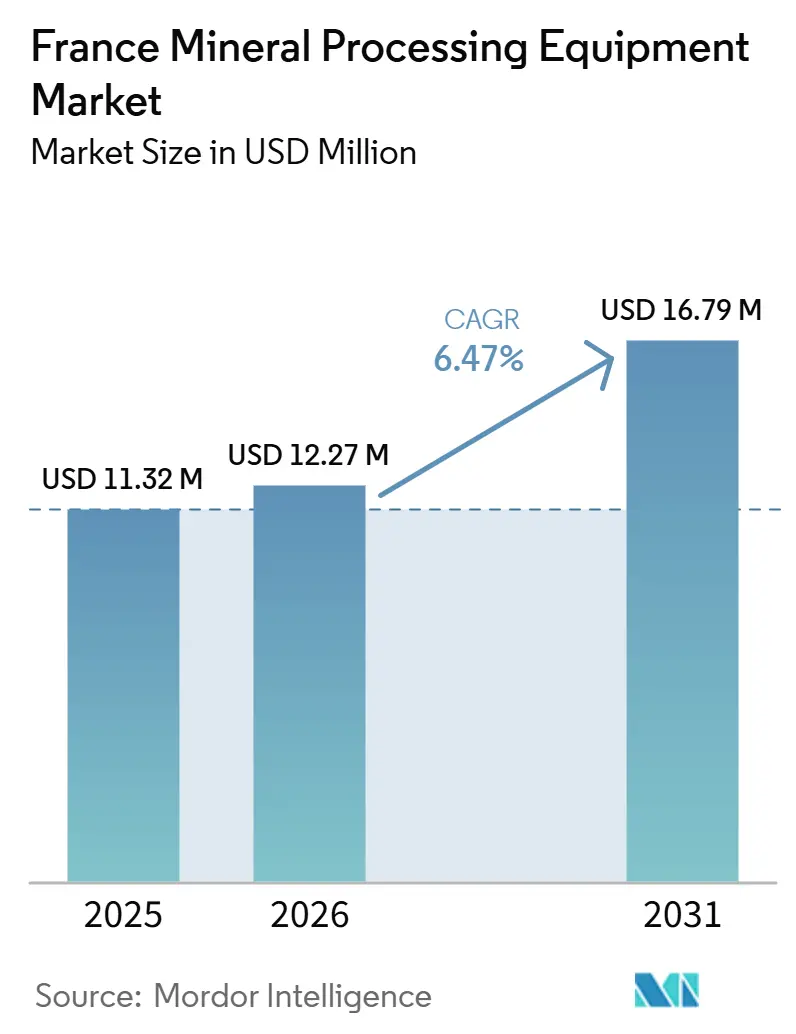
| Base Year Market Size (2025) | USD 11.32 Million |
| Market Size (2026) | USD 12.27 Million |
| Market Size (2031) | USD 16.79 Million |
| Growth Rate (2026 - 2031) | 6.47 % |
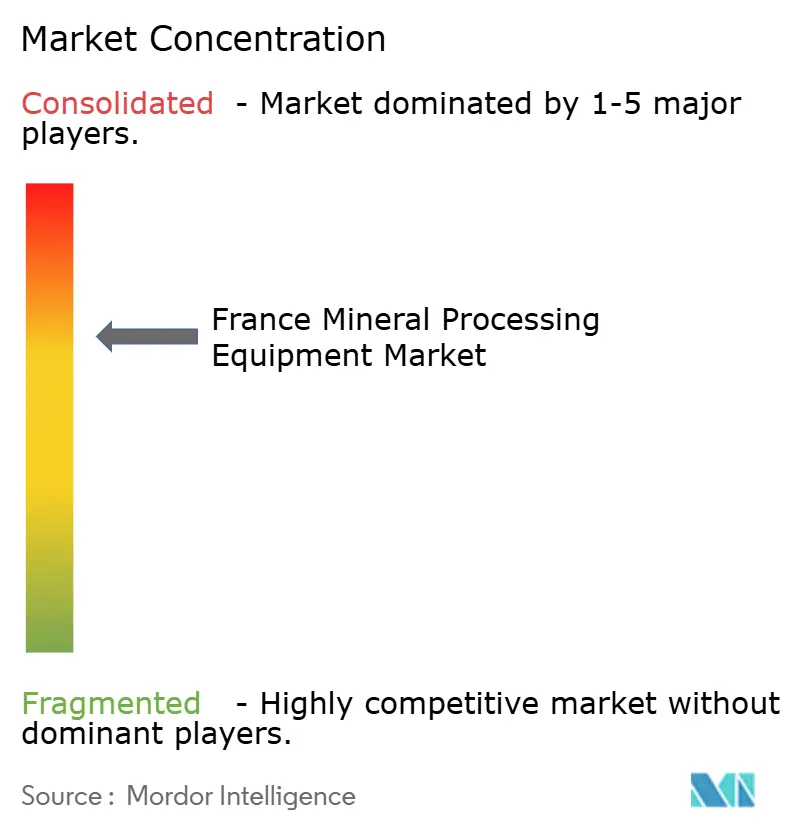
| Market Concentration | Medium |
Major Players *Disclaimer: Major Players sorted in no particular order Image © Mordor Intelligence. Reuse requires attribution under CC BY 4.0. | |
France Mineral Processing Equipment Market Analysis by Mordor Intelligence
The French mineral processing equipment market size was valued at USD 11.32 million in 2025 and is estimated to grow from USD 12.27 million in 2026 to reach USD 16.79 million by 2031, at a CAGR of 6.47% over 2026-2031. Demand is shifting from volume-driven extraction toward equipment that supports battery-mineral processing, automation-led productivity, and low-carbon compliance as active metallic mines have virtually disappeared nationwide. New lithium projects, rare-earth tailings initiatives, and the modernization of France’s sole underground operation at Varangéville salt mine are the primary engines of growth. Government incentives under the France 2030 program and the EU Critical Raw Materials Act compress permitting timelines, creating an early spike in equipment orders through 2027 [1]“France 2030 Industrial Transformation Plan,” Gouvernement de la France, gouvernement.fr. At the same time, the EU Carbon Border Adjustment Mechanism (CBAM) is driving upgrades to energy-efficient crushers, conveyors, and emissions-monitoring hardware as processors race to avoid future carbon tariffs. Persistent industrial labor shortages and aging legacy fleets are further tilting procurement toward semi- and fully automated, low-maintenance designs that embed digital twins and remote diagnostics.
Key Report Takeaways
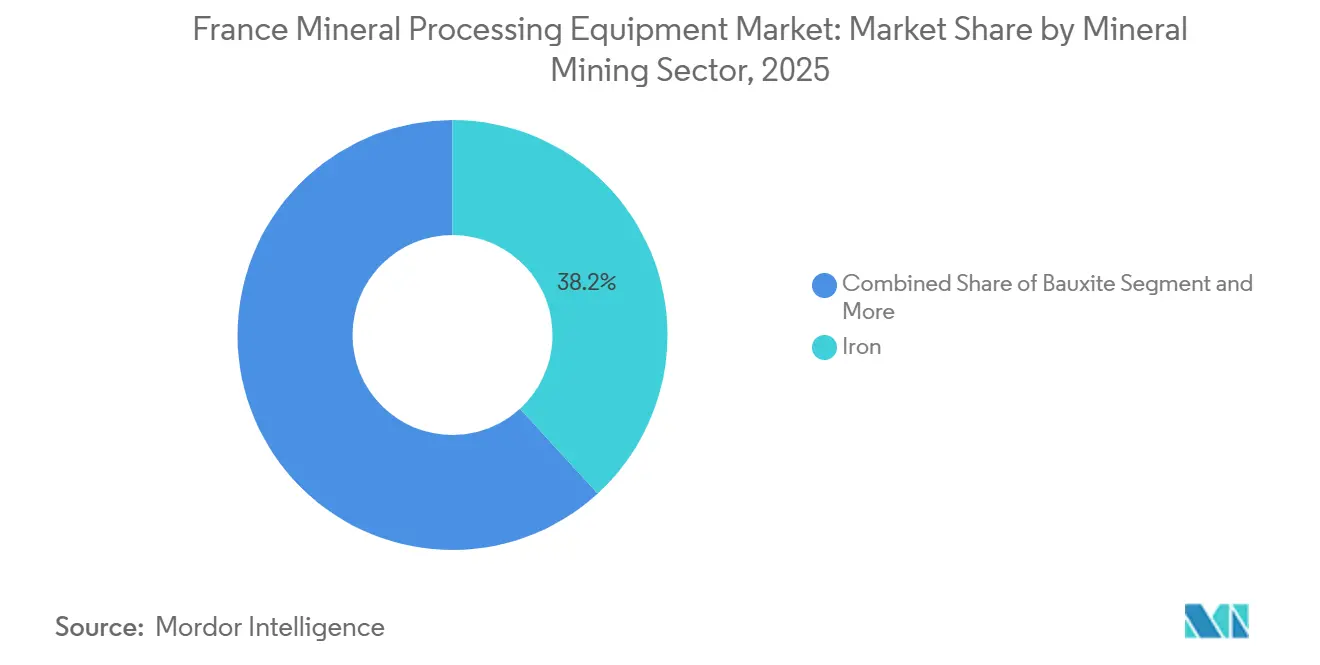
- By mineral mining sector, iron-based processing led with 38.15% of France's mineral processing equipment market share in 2025, while lithium processing is advancing at a 6.96% CAGR through 2031.
- By equipment type, crushers accounted for 34.21% share of the French mineral processing equipment market size in 2025, whereas conveyors are projected to expand at a 7.85% CAGR during 2026-2031.
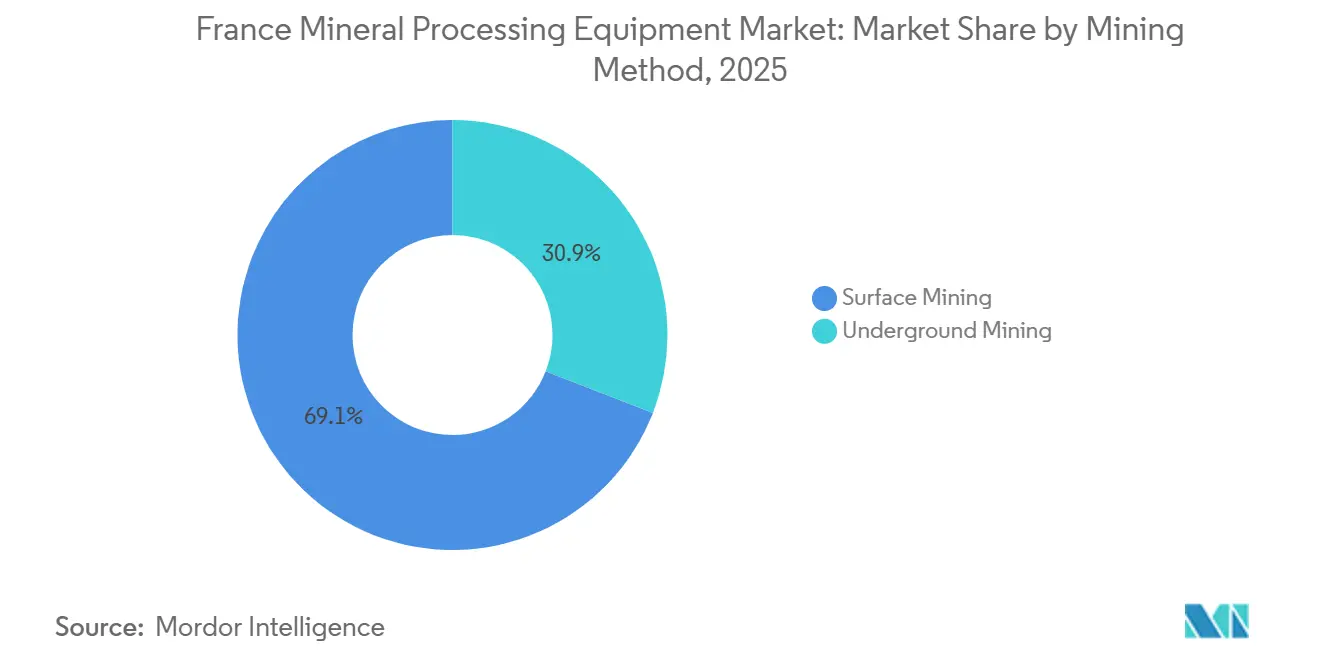
- By mining method, surface mining held 69.12% share of the French mineral processing equipment market size in 2025, but underground mining is forecast to grow at a 7.36% CAGR between 2026 and 2031.
- By automation level, semi-automated equipment captured a 49.33% share of the French mineral processing equipment market in 2025; fully automated systems are set to record an 8.45% CAGR through 2031.
Note: Market size and forecast figures in this report are generated using Mordor Intelligence’s proprietary estimation framework, updated with the latest available data and insights as of January 2026.
Understanding the full system requires moving beyond France boundaries into a wider international view. Mordor Intelligence captures the global mineral processing equipment market scope in its worldwide coverage.
France Mineral Processing Equipment Market Trends and Insights
Drivers Impact Analysis*
| Driver | (~) % Impact on CAGR Forecast | Geographic Relevance | Impact Timeline |
|---|---|---|---|
| Demand for Critical Battery Minerals | +1.2% | Allier, Alsace, Brittany | Medium term (2-4 years) |
| Incentives for Sustainable Mining | +1.1% | National, EU CRMA Strategic Projects | Short term (≤ 2 years) |
| Adoption of Automation and Digitalization | +0.9% | National, early gains in Brittany and Fos-sur-Mer | Long term (≥ 4 years) |
| EU CBAM Compliance Push | +0.8% | National, spillover to cross-border steel processors | Short term (≤ 2 years) |
| Maintenance and Replacement of Aging Fleets | +0.7% | Lorraine, Nord-Pas-de-Calais | Medium term (2-4 years) |
| Repurposing of Abandoned Mine Sites | +0.5% | Massif Central, Vosges | Long term (≥ 4 years) |
| Source: Mordor Intelligence | |||
Accelerating Demand for Critical Battery Minerals
By 2030, France's flagship lithium projects—Imerys EMILI in Allier, Eramet's Alsace venture, and Lithium de France—are set to supply a significant portion of the nation's battery-grade lithium needs. EMILI, for instance, is expected to support the production of lithium hydroxide for electric vehicles, utilizing advanced flotation cells, thickeners, and calcination kilns. Under the EU Critical Raw Materials Act, processing-permit reviews are limited to a specific timeframe. This regulation encourages procurement teams to adopt modular skids, which come pre-commissioned with embedded emissions sensors for CBAM reporting. However, with lithium prices stabilizing since 2024, many marginal deposits face challenges. As a result, the immediate demand for equipment is closely tied to these flagship projects. Vendors offering swift lead times and turnkey installations are securing a larger share of contracts in France's mineral processing equipment market.
Government Incentives for Sustainable Mining Modernization
France 2030 has set aside a substantial EUR 54 billion (approximately USD 59 billion) for the nation's industrial transformation. A significant portion of this is dedicated to decarbonation initiatives, which highlight investments in low-carbon crushers, energy-efficient mills, and iron furnaces primed for hydrogen use. Tax credits have supported low-emission processing lines, featuring equipment with embedded monitoring hardware, enhancing their appeal to grant committees evaluating proposals. In a bid to bolster the industry, regional agencies from Auvergne-Rhône-Alpes and Grand Est are jointly funding feasibility studies. These studies aim to mitigate risks associated with pilot rare-earth separators, thereby expediting early-stage orders. Projects like hydrogen-based direct-reduction facilities underscore the industry's trajectory. Such projects necessitate electric-arc furnaces, pelletizers, and sophisticated gas-handling systems, solidifying demand well into the next decade. While subsidy envelopes are set to taper off post-2028, the outlook for the French mineral processing equipment market suggests a shift. Instead of the previous volatility, the market is poised for a steadier, albeit higher, replacement demand.
Rapid Adoption of Automation and Digitalization
Between 2017 and 2022, industrial vacancies increased significantly, with many hiring initiatives deemed "hard to fill." This trend has nudged operators towards embracing autonomous process trains. Metso's CMGO plant in Brittany, which began operations in 2024, showcases the evolution: a lone operator can now oversee multiple crushing and grinding lines, thanks to Foresight control rooms and Metrics dashboards. Sandvik's AutoMine Core suite enhances productivity by 20% through driverless load-haul-dump cycles [2]“AutoMine Core Productivity Metrics,” Sandvik, sandvik.com. Meanwhile, Sandvik's iDrill platform streamlines operations with automated rod handling and real-time bit analytics, improving efficiency. Komatsu's smart-mining framework, adept at integrating autonomous haulage, drilling, and cross-OEM interoperability, proves particularly advantageous for tight underground lithium headings. Supporting this shift, OECD research highlights the potential for a significant portion of mining roles to be automated by 2030, underscoring the growing push for fully automated solutions in France's mineral processing equipment sector.
EU CBAM Compliance Push Driving Low-Carbon Processing Upgrades
CBAM began its definitive phase in January 2026, with iron and steel representing a major share of covered goods by weight; full tariff enforcement starts in 2027 [3]“Regulation (EU) 2024/… CBAM Transitional Phase,” European Commission, europa.eu. In response, processors are now retrofitting continuous-emissions-monitoring systems (CEMS) and are increasingly opting for high-pressure grinding rolls, which offer significant energy savings over traditional jaw-cone circuits. Weir’s ENDURON crushers, having secured third-party validation for substantial CO₂ reduction, are scoring high in CBAM audits. This endorsement is significantly boosting their order pipeline in France's mineral processing equipment market tenders. Once operational, GravitHy's hydrogen-fueled DRI/HBI plant is expected to produce low-carbon iron feedstock, granting French exporters a tariff edge. This advantage is simultaneously spurring demand for hydrogen-compatible refractory linings and pelletizing equipment. CBAM's influence is already steering alumina refining and rare-earth separation back to Europe, thereby expanding the local market for advanced filtration, calcination, and solvent-extraction systems.
Restraints Impact Analysis*
| Restraint | (~) % Impact on CAGR Forecast | Geographic Relevance | Impact Timeline |
|---|---|---|---|
| Limited Labor for Advanced Technologies | -0.7% | Rural mining regions, aging workforce | Long term (≥ 4 years) |
| Environmental Permitting and Emission Standards | -0.6% | National, Natura 2000 zones | Medium term (2-4 years) |
| Capital Expenditure and Operating Costs | -0.5% | National, linked to global price swings | Short term (≤ 2 years) |
| Fragility for Electrification Components | -0.4% | Global, acute for magnets and batteries | Medium term (2-4 years) |
| Source: Mordor Intelligence | |||
Limited Skilled Labor for Advanced Processing Technologies
In recent years, France's industrial vacancies have significantly increased, with a substantial portion of these positions deemed hard to fill. By 2030, vocational programs are expected to meet only a fraction of the demand for welders, boilermakers, and maintenance technicians essential for servicing automated systems. Consequently, operators are investing heavily in cross-sector retraining. Geographic immobility exacerbates the talent shortage, as most candidates are unwilling to relocate beyond a limited distance. This leaves rural lithium projects in regions like Allier and Alsace reliant on fly-in crews, which not only increases labor costs but also complicates safety planning. With industrial retirements expected to rise sharply by 2030, the aging workforce is outpacing replacement efforts. This trend is nudging processors towards adopting sensor-equipped, remotely supervised equipment, thereby reducing on-site personnel. Studies suggest that a significant portion of mining jobs could be automated by 2030. As a result, vendors providing turnkey digital-twin and autonomous-control solutions are poised to outpace competitors, even amidst labor constraints.
Stringent Environmental Permitting and Emissions Standards
In France, obtaining an Exclusive Research Permit (Permis Exclusif de Recherches, PER) takes significantly longer compared to Germany. Additionally, mine restarts in France can face extensive delays due to a series of legal appeals. The integrated autorisation environnementale decree of 2023 folds water, air, and biodiversity approvals into a single process but increases documentation loads and expert-review fees [4]“Decree 2023-13 Environmental Authorization,” Légifrance, legifrance.gouv.fr. Although EU Strategic Projects benefit from expedited statutory limits, the processing time for permits still lags behind the faster cycles seen in other regions. This delay has led operators to postpone significant equipment orders until they secure the necessary paperwork. At Varangéville, France's only active underground site, a considerable portion of the operating budget is allocated to compliance. This percentage is expected to rise for lithium and rare-earth circuits, which are now subject to REACH and CBAM reporting. Furthermore, the 2024 update to the Industrial Emissions Directive mandates real-time particulate monitoring. As a result, processors are compelled to invest in sensor-equipped baghouses and scrubbers, increasing their installed costs and extending their payback periods.
*Our forecasts treat driver/restraint impacts as directional, not additive. The impact forecasts reflect baseline growth, mix effects, and variable interactions.
Segment Analysis
By Mineral Mining Sector: Battery Lithium Surges Past Legacy Iron Dominance
Iron processing commanded 38.15% of France's mineral processing equipment market share in 2025, anchored by the anchored by established steel processors and forward procurement for the GravitHy DRI/HBI plant targeted for start-up later this decade. Lithium, however, is expanding at a 6.96% CAGR to 2031 on the back of Imerys EMILI and Eramet Alsace, which together aim to cover a significant share of national battery-grade demand and are already securing bespoke flotation cells, thickeners, and calcination kilns. The French mineral processing equipment market size for lithium circuits is forecast to widen further once pilot geothermal-brine extraction in the Rhine Graben proves commercially viable.
In France, the growth of the mineral processing equipment market, particularly in the "others" category—which includes rare earths, cobalt, and specialty minerals—hinges on tailings reprocessing activities in the Massif Central and Vosges regions. The BRGM reports significant recovery rates for neodymium and dysprosium, achieved at a lower capital expenditure (capex) compared to new mines. However, Heraeus' magnet-recycling facility is operating at minimal capacity due to a limited feedstock supply. This indicates that the demand for equipment in this niche will only see significant growth with enhancements in reverse logistics. On the other hand, the iron market remains robust. The Carbon Border Adjustment Mechanism (CBAM) is penalizing high-carbon imports, prompting European steelmakers to pivot towards low-carbon billets sourced from France. This shift is bolstering orders for hydrogen-ready pelletizers, filters, and furnace linings.



By Equipment Type: Conveyors Rise on Modular, Quick-Install Platforms
Crushers held 34.21% of the French mineral processing equipment market in 2025, led by ENDURON jaw and cone models that deliver 40% energy savings and doc-ready CO₂ data for CBAM audits. Conveyors are set to grow at a 7.85% CAGR through 2031 as Metso’s FIT and Foresight packages cut delivery by 25% and on-site setup by 15%, critical within the EU’s compressed Strategic-Project timelines.
France's mineral processing equipment market size for “other” units, such as thickeners, flotation cells, and vertical tower mills, is swelling because lithium hydroxide production needs multi-stage hydromet circuits, while rare-earth separation relies on magnetic concentrators validated by BRGM. Drill and breaker categories are being electrified; Sandvik’s DR416iE electric rotary drill eliminates diesel particulates, although 18-month battery-pack lead times cap fleet roll-outs. Over the forecast period, high-pressure grinding rolls will nibble at traditional crusher demand as operators pursue energy efficiency to satisfy CBAM cost curves.
By Mining Method: Underground Electrification Accelerates
Surface operations still accounted for 69.12% of France's mineral processing equipment market size in 2025, reflecting decades of open-pit iron and coal legacy sites. Underground equipment is forecast to expand at 7.36% CAGR to 2031 as selective lithium pegmatites in Allier and Alsace require low-impact subsurface mining with battery-electric loaders like Komatsu’s WX04B and Sandvik’s DD422iE.
CBAM’s future carbon costs are likely to erode the economic gap between surface haul trucks and grid-powered underground fleets, especially given France’s significant nuclear electricity mix. Even so, battery supply-chain fragility and limited domestic underground-mining expertise mean that most short-term orders remain for surface crushers, screens, and hybrid conveyors retrofitted with variable-frequency drives to trim emissions.
By Automation Level: Full Autonomy Gains Momentum
Semi-automated equipment held 49.33% share of France mineral processing equipment market size in 2025 as operators balanced human oversight with digital instrumentation. Fully automated systems are growing at 8.45% CAGR through 2031, propelled by several open industrial vacancies and a high training “evaporation” rate. Metso’s CMGO reference site shows that one technician can now manage multiple lines remotely, a design that appeals to rural lithium projects facing labor scarcity.
OECD data indicates that by 2030, many mining roles could be at risk of automation, suggesting a continued contraction for manual equipment, which already occupies a minority share. Weir's shift towards aftermarket digital retrofits with significant orders from the Minerals division by 2025 signals a move within the French mineral processing equipment industry. This shift emphasizes the importance of real-time health monitoring for the installed base, a crucial step towards achieving full autonomy.
Geography Analysis
Four key hubs are emerging as focal points for equipment demand. The Allier-Alsace-Brittany lithium corridor, home to EMILI, Eramet Rhine Graben, and Metso’s CMGO automated plant, is expected to dominate France's mineral processing equipment market orders over the next decade. Meanwhile, Fos-sur-Mer on the Mediterranean is positioning itself as a low-carbon iron hub, with GravitHy’s hydrogen-based direct-reduction facility anchoring a broader ecosystem that includes pelletizing, slag-conditioning, and scrap-recycling units. In Lorraine and Nord-Pas-de-Calais, older crushers and conveyors are being replaced with digital twins as the region prepares for significant industrial retirements by 2030.
Massif Central and Vosges, rich in tailings, form the fourth hub. However, rare-earth recycling remains in its early stages, as Heraeus’ European magnet facility operates at minimal capacity. Significant equipment orders are expected only when collection networks become more developed. While France's growth in this sector lags behind lithium-rich nations due to legacy mine closures and a significant reduction in active concession areas over the decades, there are signs of progress. Accelerated Strategic-Project permitting under the EU CRMA is driving procurement activity into the mid-2020s, ahead of anticipated subsidy reductions.
Additionally, geographic labor immobility is influencing equipment choices, with workers showing reluctance to travel beyond short distances. This trend is driving a shift toward fully remote-operated equipment, particularly in rural lithium districts. Such advancements are expected to play a crucial role in addressing the challenges posed by workforce limitations and the evolving demands of the mineral processing industry.
Mordor Intelligence examines the mineral processing equipment market across diverse other regional markets as well, offering granular country-level perspectives for Turkey, Italy, Argentina, Japan, Mexico, Oman, Egypt, Morocco, and South Africa and more.
Competitive Landscape
In 2025, Weir's minerals sector turnover saw a significant portion coming from parts and retrofits, ensuring multi-year cash flows. The French mineral processing equipment market showcases a moderate concentration profile, with Metso, Sandvik, FLSmidth, and Weir dominating the supply of crushers, mills, and conveyors. Meanwhile, Chinese competitors, offering significantly lower capital costs, exerted pressure that led to a decline in FLSmidth’s mining-product revenue in 2024.
Metso’s FIT/Foresight conveyors, boasting reduced installation time, offer a competitive edge for projects racing against tight permit timelines. Weir’s ENDURON crushers not only promise substantial CO₂ reduction but also feature a hydraulic push-button CSS adjustment, enhancing both sustainability and safety for French quarries. Battery-electric pioneers like Komatsu and Sandvik are making strides in underground sectors, pairing autonomous fleet management with zero-diesel loaders. However, with extended battery lead times, their volumes remain limited.
Under the EU Foreign Subsidies Regulation, non-EU equipment orders exceeding a certain threshold are now under scrutiny, a move that increases compliance burdens for Chinese OEMs while subtly benefiting European suppliers. Potential growth areas include rare-earth tailings circuits—validated by BRGM for significant neodymium recoveries at lower capital costs—and turnkey automation solutions to address France’s persistent skilled-labor shortage. With robust service networks and technologies aligned with CBAM standards, industry incumbents are strategically positioned to maintain their foothold in the French mineral processing equipment landscape.
France Mineral Processing Equipment Industry Leaders
Metso Corporation
Sandvik AB
FLSmidth A/S
The Weir Group PLC
Komatsu Ltd.
- *Disclaimer: Major Players sorted in no particular order

Recent Industry Developments
- January 2026: BIA Group acquired long-time Metso distributor BPM Construction, strengthening Metso’s French service network and enhancing aftermarket responsiveness.
- January 2026: USA Rare Earth announced a 3,750 tpa rare-earth metal and alloy plant in Lacq, co-located with Carester’s 1,600 tpa oxide unit. French government support covers 45% of eligible equipment, boosting demand for solvent-extraction and preparation machinery.
- September 2025: Weir launched a redesigned ENDURON jaw and cone crusher line featuring a hydraulic power unit that enables true push-button CSS adjustment, improving safety and maintenance efficiency.


France Mineral Processing Equipment Market Report Scope
The scope includes segmentation by mineral mining sector (bauxite, iron, lithium, and others), equipment type (crushers, feeders, conveyors, drills and breakers, and others), mining method (surface mining and underground mining), and automation level (manual, semi-automated, and fully automated). Market size and growth forecasts are presented by value in USD and by volume in units.
| Bauxite |
| Iron |
| Lithium |
| Others |
| Crushers |
| Feeders |
| Conveyors |
| Drills and Breakers |
| Others |
| Surface Mining |
| Underground Mining |
| Manual |
| Semi-Automated |
| Fully Automated |
| By Mineral Mining Sector | Bauxite |
| Iron | |
| Lithium | |
| Others | |
| By Equipment Type | Crushers |
| Feeders | |
| Conveyors | |
| Drills and Breakers | |
| Others | |
| By Mining Method | Surface Mining |
| Underground Mining | |
| By Automation Level | Manual |
| Semi-Automated | |
| Fully Automated |


Key Questions Answered in the Report
What is the projected CAGR for mineral-processing equipment demand in France through 2031?
The market is forecast to grow at 6.47% CAGR from 2026 to 2031.
Which mineral segment is expanding fastest in France?
Lithium processing leads with a 6.96% CAGR thanks to projects such as Imerys EMILI and Eramet Alsace.
How does the EU CBAM influence equipment selection?
Processors prioritize energy-efficient crushers, conveyors, and emissions-monitoring systems to reduce future carbon-border tariffs.
How do automation levels mitigate France’s labor shortage?
Fully automated plants let one operator oversee multiple lines remotely, easing dependence on scarce welders and technicians.
Page last updated on:


 Your data is secure and never sold or shared.


