
Mexico Animal Feed Organic Trace Minerals Market Size and Share
Market Overview
| Study Period | 2021 - 2031 |
|---|---|
| Forecast Data Period | 2026 - 2031 |
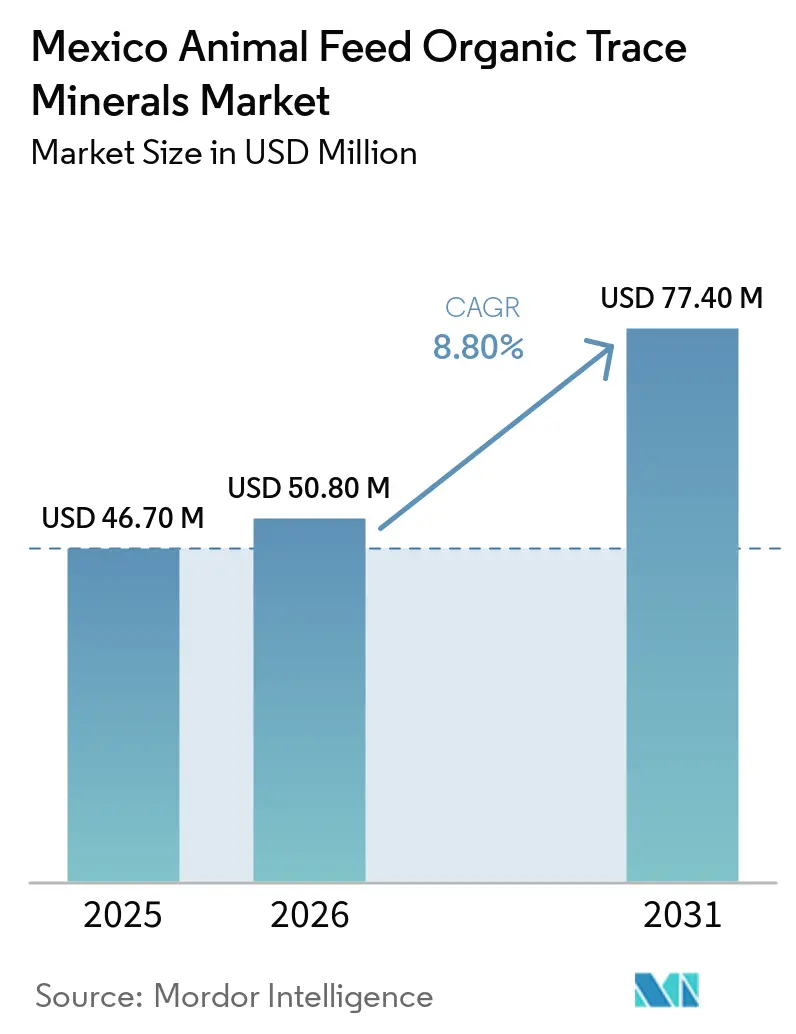
| Base Year Market Size (2025) | USD 46.70 Million |
| Market Size (2026) | USD 50.80 Million |
| Market Size (2031) | USD 77.40 Million |
| Growth Rate (2026 - 2031) | 8.80 % |
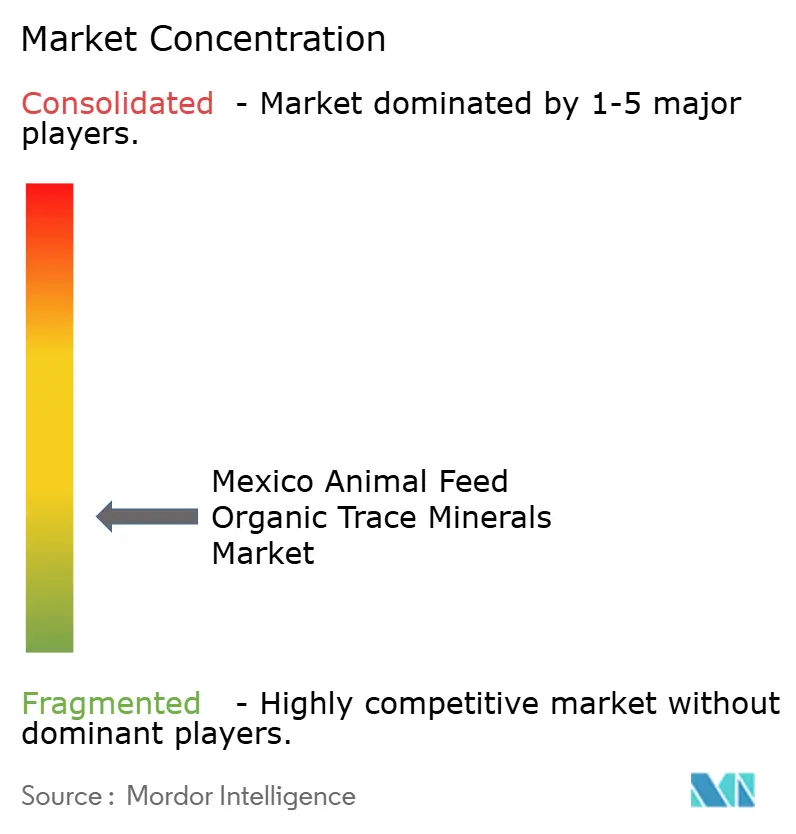
| Market Concentration | Low |
Major Players *Disclaimer: Major Players sorted in no particular order Image © Mordor Intelligence. Reuse requires attribution under CC BY 4.0. | |
Mexico Animal Feed Organic Trace Minerals Market Analysis by Mordor Intelligence
The Mexico animal feed organic trace minerals market size is projected to expand from USD 46.70 million in 2025 and USD 50.80 million in 2026 to USD 77.40 million by 2031, registering a CAGR of 8.80% between 2026 to 2031. The Mexico animal feed organic trace minerals market is witnessing steady growth, primarily due to the increasing demand for high-quality meat, dairy, and poultry products, growing awareness of animal nutrition, and the shift toward sustainable livestock production practices. According to Organization for Economic Co-operation and Development (OECD) statistics, poultry meat consumption in Mexico increased from 5,075.2 thousand metric tons in 2024 to 5,128.0 thousand metric tons in 2024. As organic trace minerals, including zinc, copper, iron, and selenium, are gaining preference over inorganic options due to their higher bioavailability, better animal health outcomes, improved feed efficiency, and reduced environmental impact through lower mineral excretion. Procurement decisions are also shifting because integrated operators increasingly view mineral form as a performance lever tied to immunity, carcass quality, feed efficiency, and environmental control rather than as a basic inclusion item. The Mexico organic trace minerals market for animal feed is also benefiting from export-linked protein chains that favor traceable micronutrition programs, while price pressure at smaller mills continues to slow conversion from inorganic to organic forms.
Key Report Takeaways
- By trace mineral type, zinc held the largest type, 35.0% of the Mexico animal feed organic trace minerals market share in 2025, while selenium is the fastest-growing type, forecast to expand at a 7.7% CAGR through 2026 to 2031.
- By livestock, poultry accounted for the largest livestock, 35.0% of the Mexico animal feed organic trace minerals market size in 2025, while aquaculture is the fastest-growing animal type, projected to record the highest CAGR at 12.0% through 2026 to 2031.
- By chelation type, amino acid chelates led the market share with 40.0% in 2025, while hydroxy trace minerals are the fastest-growing segment, projected to grow at an 9.7% CAGR through 2026 to 2031.
- By form, the dry product segment holds the largest share, capturing 65.0% of the Mexico animal feed organic trace minerals market in 2025, while the liquid form is the fastest-growing segment, forecast to advance at a 8.7% CAGR through 2026 to 2031.
Note: Market size and forecast figures in this report are generated using Mordor Intelligence’s proprietary estimation framework, updated with the latest available data and insights as of January 2026.
Mexico Animal Feed Organic Trace Minerals Market Trends and Insights
Drivers Impact Analysis*
| Driver | (~) % Impact on CAGR Forecast | Geographic Relevance | Impact Timeline |
|---|---|---|---|
| Expansion of Poultry and Swine Feed Production | +2.2% | Mexico nationwide, with stronger activity in Jalisco, Sonora, Yucatán, and Puebla | Short term (≤ 2 years) |
| Shift Toward Higher Bioavailability Mineral Programs | +2.0% | National, especially among integrated commercial operators | Medium term (2-4 years) |
| Pressure to Improve Feed Conversion and Carcass Quality | +1.5% | National, concentrated in large commercial integrators | Medium term (2-4 years) |
| Tighter Feed Safety and Residue Expectations | +1.0% | National, with stronger compliance pressure in export linked chains | Short term (≤ 2 years) |
| Heat Stress Mitigation in High Density Livestock Belts | +0.8% | Sonora, Sinaloa, and Jalisco high temperature zones | Medium term (2-4 years) |
| Export-Oriented Protein Chains Demanding Traceable Micronutrition | +0.6% | Key export linked integrators in Veracruz, Sonora, and Jalisco | Long term (≥ 4 years) |
| Source: Mordor Intelligence | |||
Expansion of Poultry and Swine Feed Production
The growth of poultry and swine feed production is a key driver for the Mexico organic trace minerals market for animal feed. Increasing meat consumption, higher poultry production, and the modernization of livestock farming practices are prompting feed manufacturers to use enhanced nutritional additives, including organic trace minerals such as zinc, copper, selenium, and iron. Poultry remains the dominant application segment, as Mexico ranks among the largest global producers and consumers of poultry. According to the United States Department of Agriculture (USDA), in 2024 Mexico’s poultry sector produced 3.99 million metric tons of chicken meat, increased by 4.15 million metric tons by 2025, sustaining the rising demand for feed across large integrated systems[1]Source: Gustavo Lara, “Poultry and Products Annual,” USDA Foreign Agricultural Service, apps.fas.usda.gov. Swine feed production also plays a significant role, as pork producers aim to improve nutrient absorption and ensure healthier livestock by supplementing with bioavailable minerals.
Shift Toward Higher Bioavailability Mineral Programs
The Mexico animal feed organic trace minerals market is gaining support from clear performance evidence showing that organic forms can deliver more usable mineral uptake at lower inclusion rates. A lower dose and higher efficacy profile are attractive to integrated producers seeking better biological response and lower mineral loss in manure. Hydroxy trace minerals are also drawing interest because their crystalline structure reduces antagonist interactions in the upper gut and helps preserve delivery to the absorption surface, which gives the Mexico animal feed organic trace minerals market another pathway for premiumization beyond traditional chelates. The Mexico animal feed organic trace minerals market is gaining from increasing efforts to minimize the environmental impact of livestock production. Organic trace minerals are absorbed more efficiently compared to conventional inorganic sources, allowing for lower inclusion levels to meet animal nutritional needs. This leads to reduced mineral excretion in manure, aiding producers in addressing issues such as soil accumulation and water contamination.
Pressure to Improve Feed Conversion and Carcass Quality
The Mexico animal feed organic trace minerals market is also being supported by the constant need to improve feed efficiency and physical output quality in intensive protein systems. According to the United States Department of Agriculture (USDA), Mexico’s broiler sector operates at a feed conversion ratio near 1.8 kilograms of feed per kilogram of live weight, while producers continue working toward the 1.7 benchmark seen in stronger global operations. Organic zinc, manganese, and copper are increasingly used where producers want better bone strength, foot pad condition, connective tissue integrity, and lower downgrade rates at slaughter. These kinds of measured outcomes support commercial discussions because technical teams can connect mineral form to litter quality, shell strength, tissue quality, and live performance in a way that fits how large Mexica integrators now evaluate ingredient value.
Export Oriented Protein Chains Demanding Traceable Micronutrition
Export-linked poultry and swine chains are changing how ingredient quality is judged in Mexico. According to United States Department of Agriculture, Mexico's chicken meat exports totaled 9,000 metric tons in 2025, representing a 29% increase from the previous year 2024, increasing pressure on integrators to align with stricter buyer expectations for consistency and production control. In that setting, traceable micronutrient programs carry more weight than generic mineral inputs because they better align with audit needs and repeatable operating standards. The Mexico organic trace minerals market for animal feed benefits from this shift because suppliers can position organic forms as part of a documented nutrition system rather than as a standalone additive. This is especially relevant in integrated operations that already manage feed, breeding, grow-out, and processing within a single chain. Over time, export exposure is likely to reinforce demand for suppliers that can combine technical service, compliance support, and consistent batch quality.
Restraints Impact Analysis*
| Restraint | (~) % Impact on CAGR Forecast | Geographic Relevance | Impact Timeline |
|---|---|---|---|
| Organic Mineral Price Premium Over Inorganic Salts | -1.8% | National, most acute in self-consumption mills and independent operators | Short term (≤ 2 years) |
| Limited Adoption Among Smaller Independent Feed Mills | -1.0% | Nationwide, concentrated in small commercial plants and self-consumption operators | Medium term (2-4 years) |
| Mexico Specific Lot Testing and Labeling Compliance Burden | -0.7% | National, shaped by SENASICA oversight and NOM-012-SAG/ZOO-2020 requirements | Short term (≤ 2 years) |
| Budget Crowd Out from Mycotoxin Control and Core Nutrition Inputs | -0.9% | National, strongest during corn and soybean meal cost spikes | Short term (≤ 2 years) |
| Source: Mordor Intelligence | |||
Organic Mineral Price Premium Over Inorganic Salts
The biggest restraint on broader conversion remains the price gap between organic forms and inorganic salts. Amino acid chelates and hydroxy minerals carry higher per-kilogram costs than zinc sulfate, copper sulfate, and sodium selenite, which makes least-cost formulators cautious when raw material markets are already volatile. According to the United States Department of Agriculture (USDA), in 2024, Mexico imported 17.3 million metric tons of corn from the United States, with approximately 75% allocated for livestock feed and the rest used in food production, including tortillas and snack products. Smaller commercial mills and self-consumption plants are the most reluctant adopters because they need a fast and visible return before accepting higher additive costs. The Mexica organic animal feed trace mineral market therefore advances faster, as suppliers can demonstrate lower-dose use, reduced excretion, or performance gains that offset the premium within one production cycle.
Mexico Specific Lot Testing And Labeling Compliance Burden
Regulatory compliance adds time, cost, and administrative work for suppliers trying to scale specialty mineral sales in Mexico. SENASICA’s authorization guide, released in 2024, requires chemical characterization, stability data, bioavailability evidence, and documentation of the absence of heavy metals for animal feed products and additives. When those rules are combined with NOM-012-SAG/ZOO-2020, batch-level documentation and labeling become part of the daily operating discipline rather than a one-time filing task[2]Source: “NORMA Oficial Mexicana NOM-012-SAG/ZOO-2020, Especificaciones Para La Regulación De Productos Para Uso O Consumo Animal,” Diario Oficial de la Federación, dof.gob.mx . This favors established suppliers, but it also slows product launches and raises the cost of serving smaller accounts that need localized support. The burden is more visible in the Mexico animal feed organic trace minerals market because premium products compete partly on claims of consistency and traceability, which means paperwork and analytical control cannot be treated as secondary issues.
*Our forecasts treat driver/restraint impacts as directional, not additive. The impact forecasts reflect baseline growth, mix effects, and variable interactions.
Segment Analysis
By Mineral Type: Zinc Anchors Revenue While Selenium Accelerates
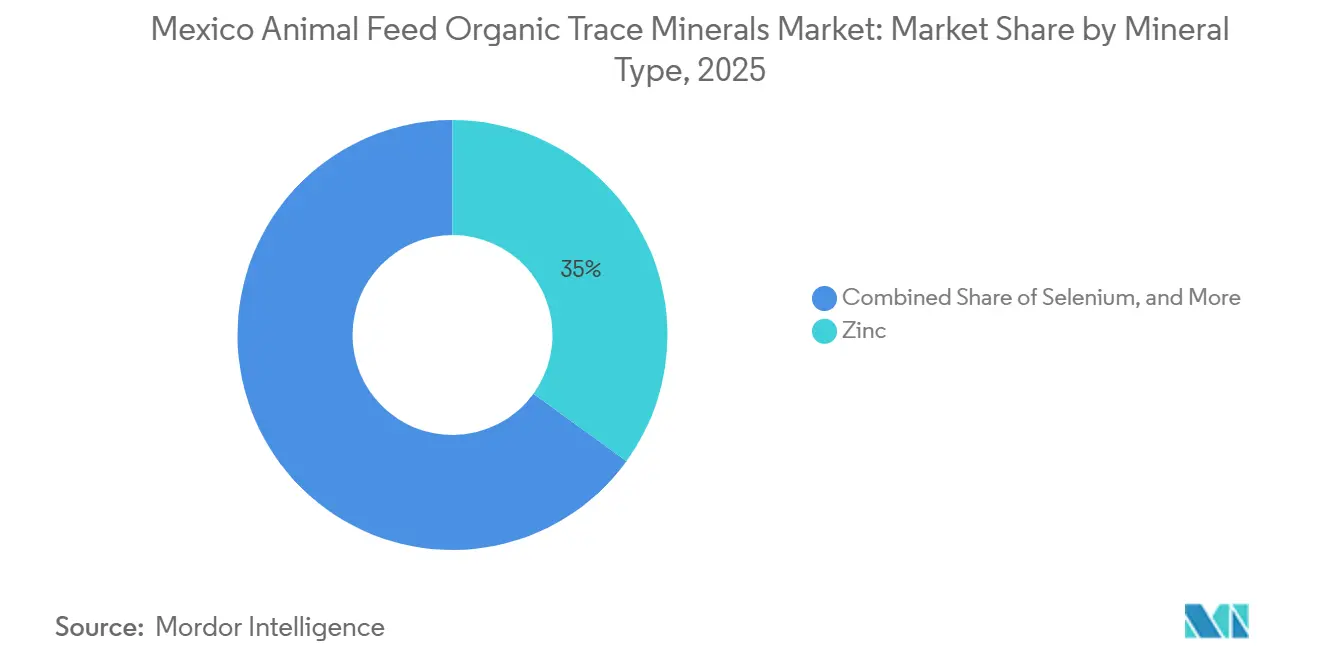
Zinc held 35.0% of the Mexico animal feed organic trace minerals market share in 2025, which kept it at the top of the mineral type segment. That lead reflects its broad use across poultry, swine, dairy, and other livestock systems where immunity, hoof condition, reproduction, and tissue quality all matter. In Mexico’s corn and soybean-based feeding programs, the low effective availability of zinc from standard inorganic sources continues to support the commercial case for chelated and other organic forms. Suppliers have used that argument effectively in poultry-heavy regions where performance differences are easier to track over short production cycles. The Mexica organic trace minerals market for animal feed, therefore, continues to treat zinc as the main gateway product for wider adoption of premium mineral programs.
Selenium is the fastest-growing mineral, projected to expand at a 7.7% CAGR through 2026 to 2031. Its demand is rising because producers increasingly connect selenium with antioxidant protection, immune support, and reproductive performance in high-intensity systems. A 2024 broiler trial found that zinc L-selenomethionine under cyclic heat stress reduced the incidence of wooden breast, which is directly relevant to chicken processors managing quality losses. Copper and manganese follow zinc in revenue contribution, with manganese especially important in layer programs that focus on shell quality and bone development.



By Livestock: Poultry Anchors Demand While Aquaculture Emerges As A High Growth Application
Poultry represented 35.0% of consumption by the livestock category in 2025, making it the largest application in the Mexico animal feed organic trace minerals market size. The segment’s scale reflects the intensity of broiler and layer production, where mineral programs are tied to immune resilience, foot pad condition, shell quality, and tissue integrity. Mexico’s broiler flock approached 413 million birds in 2024, providing suppliers with a very large, technically managed customer base for premium trace mineral offerings[3]Source: Gustavo Lara, “Poultry and Products Annual,” USDA Foreign Agricultural Service, apps.fas.usda.gov. Producers are also more willing to pay for targeted mineral use when health challenges and reproduction goals make each performance gain more valuable.
Aquaculture is the fastest-growing livestock application, with projected growth of 12.0% through 2026 to 2031. Feed demand in this segment is being driven by more intensive shrimp and tilapia systems in Sinaloa, Sonora, and Chiapas. Zinpro’s aquaculture work has also helped define the commercial case, with more than 13 studies across 9 aquatic species showing that chromium methionine can improve carbohydrate utilization efficiency by at least 5% and support shrimp survival during rearing Dairy cattle, beef cattle, and equine demand remain smaller, but those species continue to generate stable purchases where reproductive efficiency, hoof strength, and somatic cell management remain important.
By Chelation Type: Amino Acid Chelates Lead While Hydroxy Minerals Gain Ground Fast
Amino acid chelates accounted for 40.0% of chelation type revenue in 2025 and remained the most established format in the Mexico animal feed organic trace minerals market. Their position is supported by long-standing scientific evidence and a commercial message built around stable intestinal uptake even in the presence of phytate, fiber, and competing ions. That matters in Mexico feed formulas dominated by corn, sorghum, and soybean meal, where antagonistic interactions can limit the effective value of simpler mineral sources.
Hydroxy trace minerals are the fastest-growing chelation type and are projected to rise at a 9.7% CAGR through 2026 to 2031. The growth of hydroxy minerals is attributed to their unique crystalline structure, which reduces water solubility in the upper digestive tract and minimizes undesirable interactions with other feed components prior to absorption. In the Mexico animal feed organic trace minerals market, the adoption of hydroxy minerals is increasing due to the demand for stable and efficient mineral sources that enhance nutrient utilization, improve animal performance, and provide flexibility in feed formulation. Additionally, their ability to preserve mineral integrity during feed processing and storage makes them highly appealing to commercial feed manufacturers and integrated livestock producers aiming for consistent production outcomes.
By Form: Dry Form Dominates But Liquid Gains Traction In High Throughput Operations
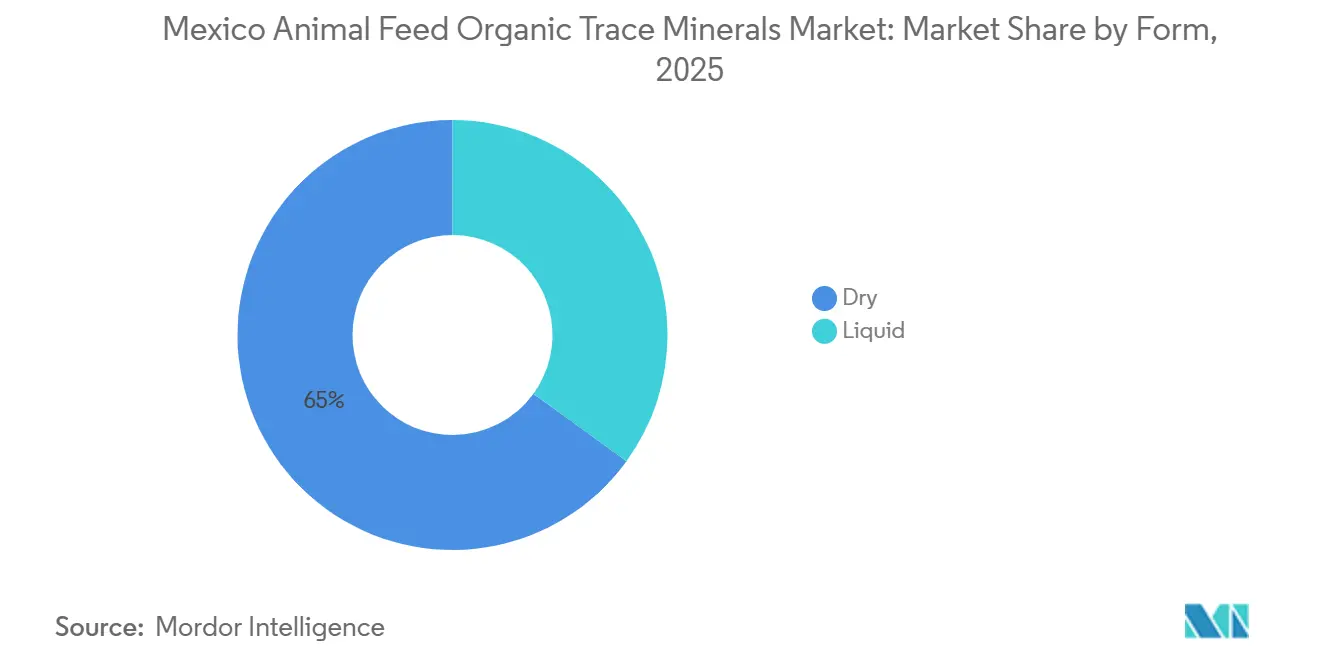
Dry products accounted for 65.0% of the Mexico animal feed organic trace minerals market size in 2025, reflecting the practical fit between dry mineral formats and the country’s existing premix infrastructure. Most feed mills are set up to handle powders and granules through established mixing, conveying, and bagging systems, which lowers operational friction for dry products. Dry organic minerals also offer a shelf life and freight profile that suits centralized premix production and broad distribution. They are easier to sample and test on site, which matters in a market where documentation and lot traceability have become more important under stricter regulations.
Liquid forms are the fastest-growing segment and are projected to grow at an 8.7% CAGR through 2026 to 2031. Their appeal is strongest in large broiler and swine systems where liquid delivery can reduce dust, improve mixing homogeneity, and allow rapid adjustment during changes in flock age, season, or health status. This format also fits operations that want more precise response tools without changing the whole premix structure at once.
Geography Analysis
The Mexico organic trace minerals market share for animal feed, therefore, reflects demand patterns within the country’s main livestock and feed corridors rather than across multiple national markets. The broad center of demand remains tied to the heaviest poultry, swine, and dairy production zones, where integrated operators are most likely to adopt premium mineral programs. Jalisco continues to stand out as one of the most feed-intensive and livestock-dense areas in the country, making it a core destination for premix sales and technical support. Puebla, Veracruz, Sonora, and Yucatán also matter because they combine large animal inventories with established commercial feed activity.
Northern and Pacific corridor demand has a different profile because climate and export orientation both influence mineral use. Sonora and Sinaloa experience repeated thermal stress in livestock systems, which has raised interest in organic zinc, selenium, and chromium for antioxidant and metabolic support. These states also strongly connect with shrimp and aquaculture activities, giving them added importance as the fastest-growing livestock application in the Mexico organic trace minerals market for animal feed. The demand mix in these regions, therefore, differs from that in the center of the country, as aquatic feed and heat management considerations carry greater weight. Chiapas adds further support to this pattern through its role in aquaculture output and its relevance to southern distribution.
Querétaro is gaining strategic importance because it has become a logistics and manufacturing point for multinational nutrition suppliers serving north, center, and south Mexico. Trouw Nutrition’s February 2025 investment in Colón, Querétaro, expanded local production capacity and strengthened supply chain responsiveness for monogastric and ruminant customers. Novus also expanded its local expert team in Querétaro in August 2025, which shows that suppliers now see field presence and technical proximity as a competitive tool rather than as an optional support layer.
Competitive Landscape
The Mexico animal feed organic trace minerals market is moderately fragmented, with the top five companies, such as Zinpro Corporation, Nutreco N.V., Alltech, Inc., Novus International, Inc., and Grupo Nutec, holding a smaller share of 2025 revenue. Multinational suppliers lead the premium tier because they combine proprietary mineral chemistry, technical service teams, and product performance data that support premium pricing. Zinpro Corporation held the highest share in 2025 and remained a visible leader through its Performance Minerals platform and BlueBox diagnostic tool.
Competitive strategy in the Mexico organic trace minerals market for animal feed is less focused on broad advertising and more on proof of performance across specific species and operating conditions. Zinpro has competed by positioning on-farm outcomes, linking mineral use to shell quality, tissue integrity, and litter condition in customer-facing case material. These moves show that suppliers are trying to tie product value to measurable output rather than just lab specifications.
Domestic premix companies and specialist distributors still have room to grow because the market is not concentrated enough to shut out local challengers. Grupo Nutec, Nutrix, and Adiprem are better placed in cost-sensitive accounts where local service reach and customized premix bundles matter more than global branding. That opening is strongest in the large pool of self-consumption and independent mills that do not always fit the high service model used by multinationals. At the same time, SENASICA compliance requirements and product authorization rules raise the bar for opportunistic entrants and offer some protection to established suppliers with registered and documented portfolios. The Mexico animal feed organic trace minerals market therefore remains open enough for share shifts, but not loose enough for unverified suppliers to scale easily.
Mexico Animal Feed Organic Trace Minerals Industry Leaders
Zinpro Corporation
Alltech, Inc.
Novus International, Inc.
Grupo Nutec
Nutreco N.V.
- *Disclaimer: Major Players sorted in no particular order

Recent Industry Developments
- August 2025: Novus International assembled a dedicated multidisciplinary local expert team in Querétaro, Mexico, to deploy its MINTREX bis-chelated organic trace mineral programs and intelligent nutrition solutions for poultry, swine, and dairy producers.
- March 2025: Trouw Nutrition México inaugurated "Project Águila," a new premix and young animal feed plant in Colón, Querétaro, representing a MXN 1 billion (USD 48.8 million) investment, the company's largest in Mexico in its 43-year history. The fully automated facility adds 100,000 metric tons per year of annual capacity across three production lines serving monogastrics, ruminants, and pelleted products, with digital traceability, solar panels, and energy efficiency systems
- March 2024: Zinpro Corporation released its Sustainability Report globally, including in Mexico, showcasing its advancements in sustainable animal nutrition. The report highlights improvements in feed efficiency and reductions in environmental impact achieved through the use of advanced organic trace mineral solutions for poultry, swine, and dairy production.


Mexico Animal Feed Organic Trace Minerals Market Report Scope
Organic trace minerals are vital minerals chemically bonded to organic molecules, such as amino acids, peptides, or proteins. They are incorporated into animal feed to enhance nutrition, support growth, boost immunity, and promote overall animal health. The Mexico Animal Feed Organic Trace Minerals Market Report is Segmented by Trace Mineral Type (Zinc, Iron, Copper, Manganese, Selenium, and Chromium), by Chelation Type (Amino-Acid Chelates, Proteinates, and More), by Form (Dry and Liquid), and by Livestock (Poultry, and More). The Market Forecasts are Provided in Terms of Value (USD).
| Zinc |
| Selenium |
| Copper |
| Manganese |
| Iron |
| Chromium |
| Amino Acid Chelates |
| Proteinates |
| Polysaccharide Complexes |
| Hydroxy Trace Minerals |
| Organic Selenium Yeast |
| Poultry |
| Swine |
| Dairy Cattle |
| Beef Cattle |
| Aquaculture |
| Equine |
| Dry |
| Liquid |
| By Mineral Type | Zinc |
| Selenium | |
| Copper | |
| Manganese | |
| Iron | |
| Chromium | |
| By Chelation Type | Amino Acid Chelates |
| Proteinates | |
| Polysaccharide Complexes | |
| Hydroxy Trace Minerals | |
| Organic Selenium Yeast | |
| By Livestock | Poultry |
| Swine | |
| Dairy Cattle | |
| Beef Cattle | |
| Aquaculture | |
| Equine | |
| By Form | Dry |
| Liquid |


Key Questions Answered in the Report
What is the projected value of organic trace minerals for animal feed in Mexico by 2031?
The sector is projected to reach USD 77.40 million by 2031, up from USD 50.80 million in 2026, with a 8.80% CAGR over 2026 to 2031.
Which livestock category drives the greatest demand in Mexico?
Poultry is the largest application, accounting for 35.0% of consumption in 2025 because broiler and layer systems require tightly managed mineral nutrition.
Which mineral type leads revenue in Mexico?
Zinc led the mineral type segment with 35.0% of revenue in 2025, supported by its broad role across immunity, tissue quality, reproduction, and hoof integrity.
Which product type is growing fastest in chelation technologies?
Hydroxy trace minerals are projected to grow the fastest, with a 9.7% CAGR through 2026 to 2031, driven by greater stability and reduced interactions with digestive tract antagonists.
Page last updated on:


 Your data is secure and never sold or shared.


