
Market Overview
| Study Period | 2021 - 2031 |
|---|---|
| Forecast Data Period | 2026 - 2031 |
| Base Year Market Size (2025) | USD 1.5 Billion |
| Market Size (2026) | USD 1.59 Billion |
| Market Size (2031) | USD 2.11 Billion |
| Growth Rate (2026 - 2031) | 5.83 % |
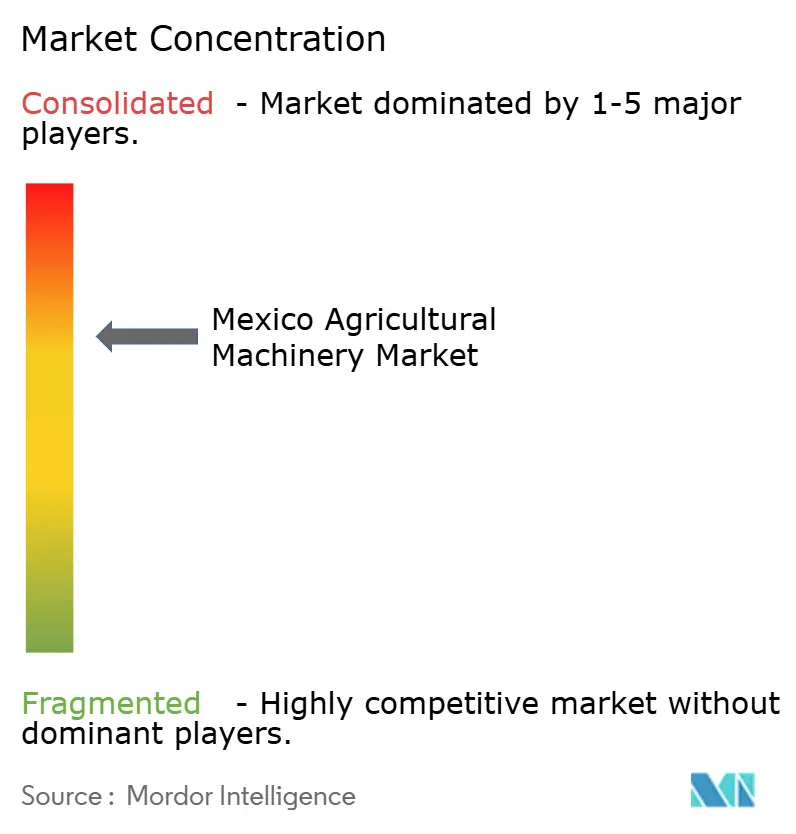
| Market Concentration | Medium |
Major Players *Disclaimer: Major Players sorted in no particular order Image © Mordor Intelligence. Reuse requires attribution under CC BY 4.0. | |
Mexico Agricultural Machinery Market Analysis by Mordor Intelligence
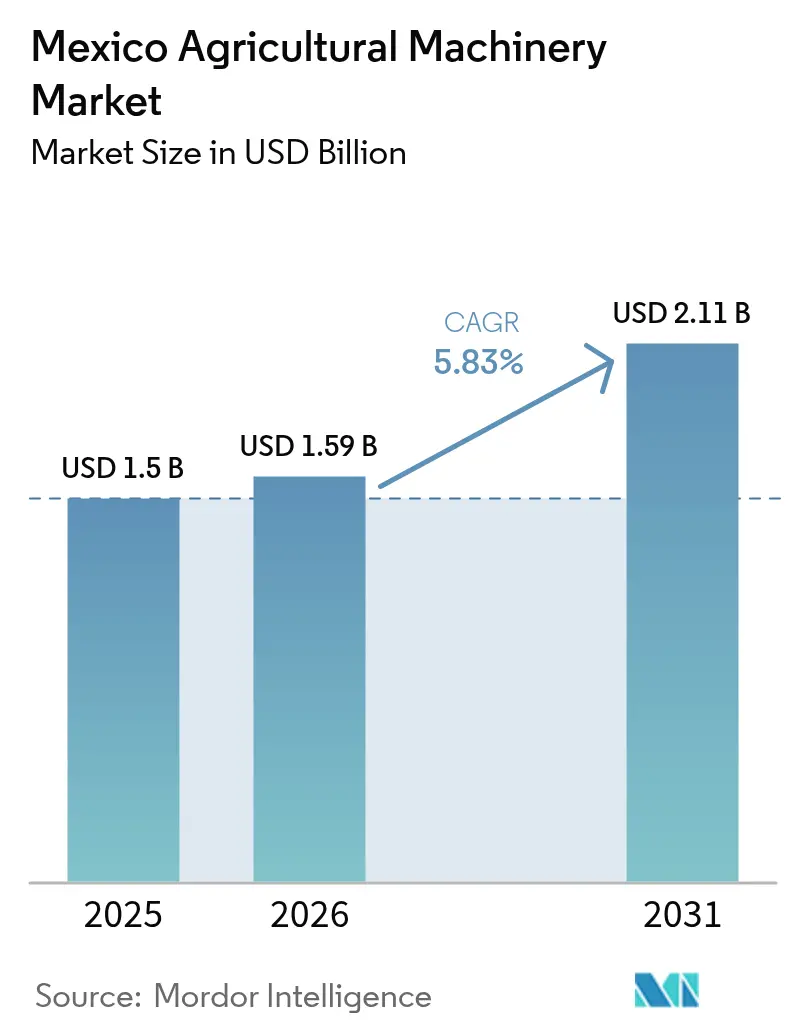
The Mexico agricultural machinery market size is expected to grow from USD 1.5 billion in 2025 to USD 1.59 billion in 2026 and is forecast to reach USD 2.11 billion by 2031 at 5.83% CAGR over 2026-2031. Farm consolidation, consistent public budget allocation, zero-tariff machinery imports, and increased adoption of precision irrigation systems drive the market growth. According to the United States Department of Agriculture, Mexico's domestic corn consumption increased from 44,000 metric tons to 45,700 metric tons from 2022 to 2023. This increase in consumption indicates rising food demand, which necessitates improved crop productivity through agricultural advancements, including agricultural machinery. The Mexican government increased its agricultural budget by 5% in 2024, demonstrating its support for sector modernization[1]. Agricultural trade grew by 700% in 2024, creating significant demand for efficiency-enhancing equipment. Government financing programs focus primarily on medium-sized farms (5-20 hectares), while the growth in protected agriculture increases demand for water-efficient technologies. Global manufacturers are expanding their market presence through local manufacturing facilities and smart-leasing programs, improving equipment access for small-scale farmers.
Key Report Takeaways
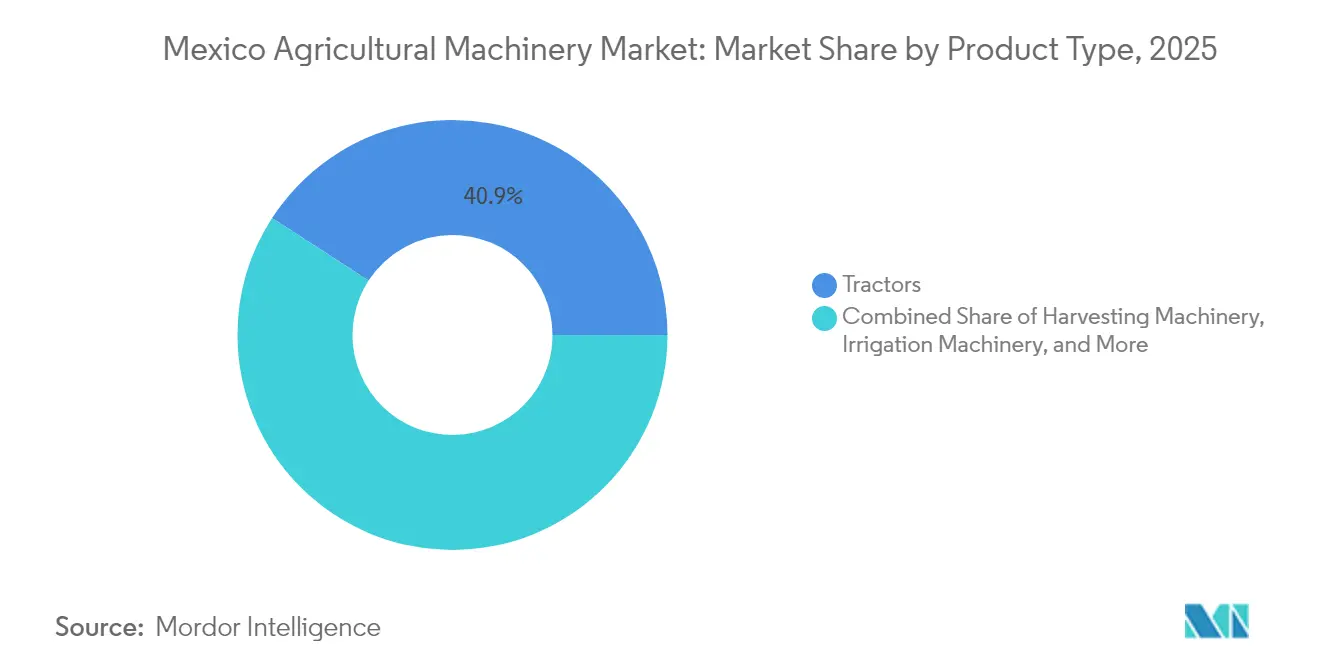
- By product type, tractors led the Mexico agricultural machinery market with a 40.85% share in 2025, while irrigation machinery is projected to grow at a 9.92% CAGR through 2031.
- By farm size, the medium (5–20 hectare) farm held 46.95% Mexico agricultural machinery market share in 2025, while small farms (less than 5 hectares) are projected to expand at a 7.08% CAGR to 2031.
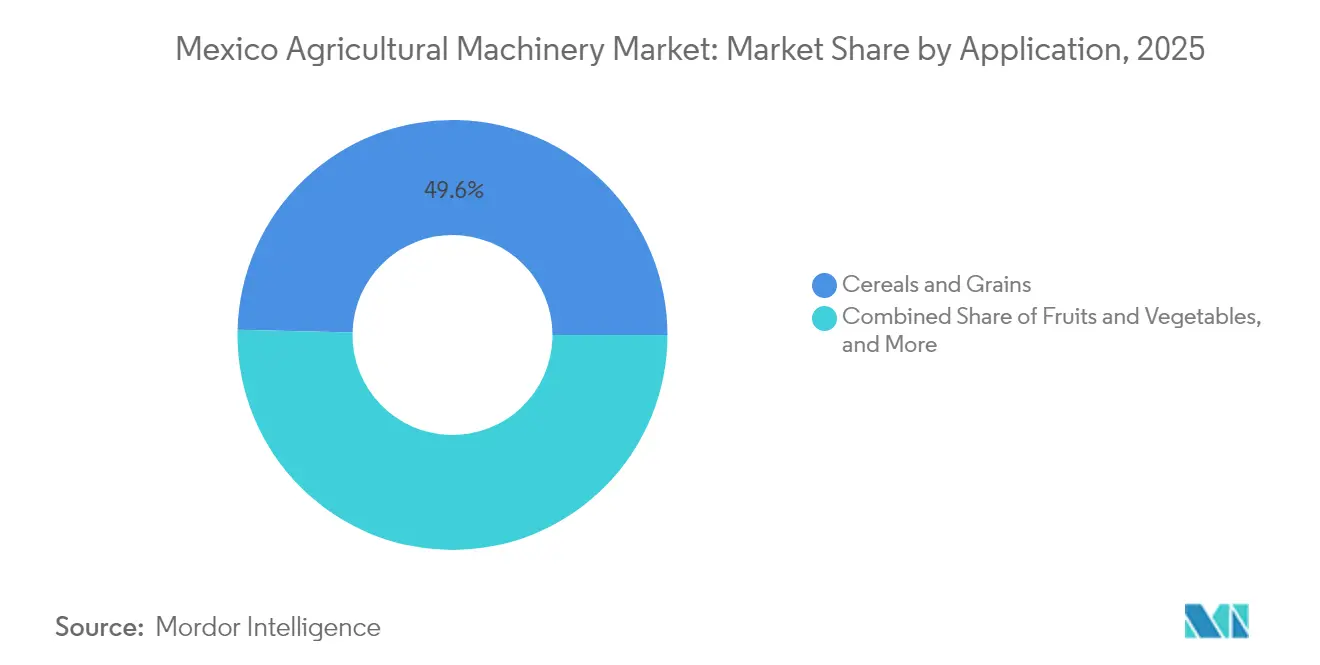
- By application, cereals and grains accounted for a 49.62% share of the Mexico agricultural machinery market size in 2025, while fruits and vegetables are projected to advance at a 9.42% CAGR through 2031.
- Deere & Company, CNH Industrial N.V., AGCO Corporation, Kubota Corporation, and Mahindra & Mahindra Ltd. generated significant revenue in 2024, supported by ongoing capacity additions and captive financing arms.
Note: Market size and forecast figures in this report are generated using Mordor Intelligence’s proprietary estimation framework, updated with the latest available data and insights as of 2026.
Market Trends and Insights
Drivers Impact Analysis of Mexico Agricultural Machinery Market*
| Driver | (~) % Impact on CAGR Forecast | Geographic Relevance | Impact Timeline |
|---|---|---|---|
| Sub-hectare farm consolidation accelerates mechanization | +1.2% | National, concentrated in Sinaloa, Sonora, and Jalisco | Medium term (2-4 years) |
| Federal subsidies for agricultural machines | +1.0% | National, stronger in central and northern states | Short term (≤ 2 years) |
| Tariff-free machinery imports lowering acquisition cost | +0.7% | National, border states benefit most | Short term (≤ 2 years) |
| Rebound in protected-agriculture acreage | +1.1% | Northwest Mexico with Sinaloa leading | Medium term (2-4 years) |
| Dealer-financed credit expansion by Original Equipment Manufacturer (OEM) captive lenders | +0.6% | National, urban-adjacent farming regions | Medium term (2-4 years) |
| Emergence of smart-leasing platforms for seasonal equipment | +0.5% | National, technology-forward producers | Long term (≥ 4 years) |
| Source: Mordor Intelligence | |||
Sub-Hectare Farm Consolidation Accelerates Mechanization
Land policy reforms in Mexico enable farmers to consolidate small parcels for joint operations, leading to equipment-sharing arrangements. In Sinaloa and Sonora states, agricultural cooperatives reduce per-hectare operational costs through shared tractors and harvesters. A study in the Toluca Valley reveals a tractor-to-land ratio of 12.8 hectares per tractor, compared to the Food and Agriculture Organization's (FAO) recommended 50 hectares per tractor, indicating significant equipment underutilization. The consolidation of farmland addresses this inefficiency through shared ownership models. This arrangement facilitates the adoption of precision agriculture technologies, as advanced equipment can now service multiple adjacent plots[2]. Communities with established cooperative practices demonstrate higher rates of participation in machinery sharing programs.
Federal Subsidies for Agricultural Machines
The Special Concurrent Program allocated USD 24.4 billion in January 2025 for irrigation and precision-agriculture equipment purchases. Foreign Inward Remittance Advice (FIRA) offices provide long-term credit, reducing acquisition barriers for mid-sized farms in the Mexico agricultural machinery market. The subsidy structure encourages locally assembled units, leading manufacturers to expand domestic production. Program adoption exceeds 70% in northern grain regions where established dealer networks facilitate enrollment. Dealers use federal incentives to offer integrated financing and after-sales service packages, driving increased demand[3].
Tariff-Free Machinery Imports Lowering Acquisition Cost
The Presidential Anti-Inflation Decree maintains zero import duties on agricultural machinery through 2025. Dealers provide 10-15% discounts on precision planters and specialty harvesters not manufactured domestically, based on reduced landed costs. Border states experience expedited price reductions due to their proximity to import locations. Uncertainty regarding post-2025 tariffs has accelerated equipment purchases in the current cycle. The policy reduces greenhouse construction costs, facilitating investments in protected agriculture that require drip irrigation and climate-control systems.
Emergence of Smart-Leasing Platforms for Seasonal Equipment
Digital marketplaces now offer GPS-tracked equipment leasing pools for agricultural machinery, including planters, harvesters, and sprayers, which farmers utilize seasonally. Farmers who have implemented these platforms report cost reductions of 20-30% per hectare by paying for actual machine usage hours. The platforms establish consolidated maintenance agreements to maintain equipment uptime above 95% and utilize aggregated usage data to optimize lease rates. The initial implementation focused on regions with robust broadband coverage, with usage gradually expanding as rural mobile connectivity improves.
Restraints Impact Analysis of Mexico Agricultural Machinery Market*
| Restraint | (~) % Impact on CAGR Forecast | Geographic Relevance | Impact Timeline |
|---|---|---|---|
| Persistently high interest-rate environment | -1.4% | National, rural areas most affected | Short term (≤ 2 years) |
| Aging rural workforce reluctant to adopt new tech | -0.9% | National, concentrated in traditional farming regions | Long term (≥ 4 years) |
| Environmental and Regulatory Concerns | -0.6% | National, stricter enforcement in export-oriented regions | Medium term (2-4 years) |
| Security concerns in modern farming machinery | -0.5% | National, technology-intensive operations | Medium term (2-4 years) |
| Source: Mordor Intelligence | |||
Persistently High Interest-Rate Environment
Rural loan interest rates are anticipated to remain 3-5% points higher than urban rates in 2025, even after anticipated rate reductions of 25-50 basis points. These elevated rates extend repayment periods for major equipment purchases. Mid-sized agricultural operations that do not qualify for government subsidies find precision farming equipment costs prohibitive compared to manual labor options. Financial institutions typically maintain higher risk premiums on rural loans due to the volatility of agricultural commodity prices and limited collateral options. Consequently, many farmers have switched from purchasing to leasing tractors or postponed equipment acquisitions, which has slowed market growth.
Security Concerns in Modern Farming Machinery
Agricultural producers express concerns about cloud-based telematics systems potentially exposing their operational data to competitors and regulatory bodies. GPS spoofing incidents and ransomware attacks on connected equipment in related agricultural sectors have increased these security concerns. As a result, some farmers disable data connectivity features, which affects the predictive maintenance capabilities essential to equipment manufacturers' service operations. This lack of trust impedes the adoption of autonomous tractors and remote software updates, particularly in high-value fruit and vegetable farming operations where equipment downtime can significantly impact production.
*Our forecasts treat driver/restraint impacts as directional, not additive. The impact forecasts reflect baseline growth, mix effects, and variable interactions.
Mexico Agricultural Machinery Market Segment Analysis
By Product Type:
Tractors Lead While Irrigation Gains PaceTractors account for 40.85% of Mexico's agricultural machinery market share in 2025, driven by their versatility in corn, wheat, and sorghum cultivation. Strategic manufacturing investments, such as John Deere's USD 55 million facility in Nuevo León in 2024, enhance after-sales support and customer retention. Harvesters maintain significance in sugarcane and cotton production regions but experience fluctuating demand based on commodity market conditions. Tillage equipment maintains a consistent market presence due to Mexico's extensive agricultural land area of 145 million hectares, requiring regular soil preparation.
The irrigation machinery segment grows at a 9.92% CAGR, addressing the agricultural sector's consumption of 76% of national water resources, despite 40% efficiency losses. Drip irrigation systems are prevalent in greenhouse operations, while center pivot systems expand in maize-growing regions with limited surface water access. Government initiatives promoting water efficiency provide subsidies for precision sprinkler systems, with dealers incorporating micro-nutrient injection systems for increased profitability. Manufacturers develop scalable pump systems to accommodate the expansion of protected cultivation areas.

By Farm Size:
Medium Units Anchor Demand but Small Farms AccelerateMedium farms spanning 5-20 hectares represented 46.95% of Mexico's agricultural machinery market share in 2025. These farms maintain the optimal balance between operational scale and management efficiency, positioning them as key beneficiaries of Foreign Inward Remittance Advice's (FIRA) agricultural credit programs. Through local equipment-sharing networks, these farms achieve over 1,000 annual operating hours for their primary tractors.
Small farms under 5 hectares are projected to grow at a 7.08% CAGR through 2031, supported by equipment rental services and digital leasing platforms. These farms predominantly utilize compact tractors below 70 HP due to field size constraints. While large farms require advanced equipment like high-capacity combines and GPS-enabled planters, their expansion remains restricted by land ownership regulations, limiting their overall machinery purchases.
By Application:
Cereals Dominate, Fruits AccelerateCereal and grain operations account for 49.62% of Mexico's agricultural machinery market share in 2025. According to the Food and Agriculture Organization, maize cultivation, covering 64.3 million hectares in 2023, drives consistent demand for tractors, planters, and harvesters. Government price-support programs maintain equipment demand despite commodity price fluctuations.
The fruits and vegetables segment records a 9.42% CAGR, driven by expanding greenhouse operations in Sinaloa and Sonora for export production. Equipment requirements extend beyond traditional tillage machinery to include automated conveyors, climate-control fans, and high-pressure foggers. Protected agriculture facilities for tomatoes, peppers, and berries require specialized equipment for climate control, precision irrigation, and automated harvesting systems. Commercial crops, including cotton and sugarcane, remain significant in regional markets, particularly in northern states where large-scale operations support investments in advanced harvesting equipment. The application segmentation aligns with Mexico's agricultural export strategy, prioritizing mechanization investments and technology adoption for high-value crops.
Geography Analysis
The northern states of Mexico demonstrate advanced mechanization, particularly in Sinaloa, where protected-agriculture clusters utilize sophisticated irrigation systems and greenhouse tractors. The region's proximity to the United States' ports facilitates rapid freight transport and efficient spare parts delivery. The high concentration of equipment dealers in Culiacán and Hermosillo enables competitive financing options, driving increased mechanization in the Mexican agricultural machinery market.
In the central highland regions, including Mexico State and Puebla, mechanization adoption shows varied patterns. The Toluca Valley reports a tractor-to-land ratio of 12.81 hectares per tractor, indicating equipment underutilization. To address this, cooperative sharing initiatives maximize machine usage without requiring additional purchases. The government tests smart-leasing programs in these regions before implementing them nationwide.
Mechanization faces challenges in southern states such as Chiapas and Oaxaca due to land fragmentation and mountainous terrain. The agricultural sector adapts through the use of compact articulated tractors and walk-behind tillers, particularly in pineapple and coffee cultivation areas. Federal initiatives support mechanization by offering 50% subsidies on small-scale irrigation pumps, gradually increasing adoption despite geographical constraints.
Regulatory Landscape
Mexico's agricultural machinery market is shaped by trade facilitation measures and mandatory workplace safety standards. The Secretaria de Economia administers tariff mechanisms such as the Sectoral Promotion Program (PROSEC) for the Agricultural Machinery Industry (updated via the PROSEC decree published in August 2024) and the Rule 8 pathway for case-by-case tariff relief on eligible machinery and inputs. These mechanisms can lower duties for authorized users and affect sourcing decisions for imported equipment and components.
On the operations side, compliance is increasingly tied to Official Mexican Standards (NOMs) overseen by the Secretaria del Trabajo y Prevision Social (STPS). NOM-003-STPS-2023, covering safety and health conditions in agricultural activities including the operation and maintenance of agricultural machinery, became mandatory on January 25, 2025. That change raises the value of documented procedures, training, and machine-safety practices for farms, contractors, and dealer service networks.
Competitive Landscape
The Mexico agricultural machinery market exhibits moderate concentration, with the top five companies, Deere & Company, CNH Industrial N.V., AGCO Corporation, Kubota Corporation, and Mahindra & Mahindra Ltd., holding the majority of market share in 2024. Deere & Company maintains market leadership through captive financing options, including 0% introductory rates for initial seasons. CNH Industrial N.V. ranks second, utilizing Case IH's Aguascalientes assembly facility to customize equipment for Mexican agricultural requirements. AGCO Corporation aims to double its precision technology revenue contribution to agricultural sales by 2030.
The industry competition now centers on data-driven services, with manufacturers integrating connectivity systems during production. These systems include fleet management platforms that enable fault detection and maintenance scheduling. New market entrants, particularly electric combine manufacturers, are promoting environmental sustainability, prompting established companies to develop alternative fuel technologies. Partnerships with agricultural financial technology platforms are expanding traditional leasing periods, increasing market accessibility.
After-sales service capabilities moderate price competition in the market. Companies with extensive rural service networks can maintain higher equipment prices due to farmers' need to minimize operational disruptions during critical harvest periods. Companies implementing local parts supply strategies reduce delivery times, strengthening customer relationships and expanding their market presence.
Mexico Agricultural Machinery Industry Leaders
-
Deere & Company
-
CNH Industrial N.V.
-
AGCO Corporation
-
Kubota Corporation
-
Mahindra & Mahindra Ltd.
- *Disclaimer: Major Players sorted in no particular order
Mexico Agricultural Machinery Market Companies Covered in this Report
- Deere & Company
- AGCO Corporation
- CNH Industrial N.V.
- Kubota Corporation
- Lindsay Corporation
- Valmont Industries, Inc. (Valmont Monterrey S. de R.L. de C.V.)
- Mahindra & Mahindra Ltd.
- Kuhn S.A. (Bucher Industries AG)
- Argo Tractors S.p.A.
- SDF S.p.A.
- The Toro Company
- Grupo Jumil S.A. de C.V.
- Jain Irrigation Systems Ltd. (Rivulis Irrigation Ltd.)
- Netafim Limited (Orbia Advance Corporation, S.A.B. de C.V.)
- Rain Bird Corporation
Market Opportunities and Future Outlook
Mechanization programs and on-farm digitalization initiatives create demand beyond conventional tractor replacement cycles, especially among small and medium producers. In April 2026, Veracruz's Secretariat of Agricultural Development, Rural and Fisheries (SEDARPA) implemented a mechanization program that pairs access to specialized equipment with technical advisory services. This structure supports demand for right-sized tractors, implements, and service packages that fit fragmented farm structures.
Opportunities are also clustering around precision irrigation, remote monitoring, and advisory tools where adoption gaps remain material. In May 2026, IICA advanced TeleGAN field testing in Tabasco for satellite-based georeferencing and biomass monitoring. April 2026 also included Bayer inaugurating its first Forward Farm in Mexico in Queretaro, with digital tools (FieldView and CARLOTA) integrated into regenerative practices. Separately, Projecto Moctezuma (reported by Kilimo in July 2026) cited converting 100 hectares in Queretaro and Hidalgo to precision irrigation by the end of Q1 2026, pointing to an addressable base for drip systems, pumping, filtration, fertigation add-ons, and dealer-supported installation and maintenance services.
Recent Industry Developments in Mexico Agricultural Machinery Market
- June 2026: AGCO strengthened its Mexico aftersales footprint by opening a new parts warehouse in Queretaro and rolling out a new ERP platform for service operations. The change is aimed at faster parts availability and higher equipment uptime, supporting lifecycle revenue from service and maintenance for installed fleets across tractors and harvesting equipment.
- June 2025: Kubota North America partnered with Agtonomy to implement autonomous operations for spraying and mowing on Kubota diesel tractors. The collaboration expands the autonomy software available for specialty crop operations, aligning with rising demand for labor-saving features and precision application across Mexico-linked North American supply chains.
- June 2024: AGCO Mexico invested USD 45 million to expand its agricultural equipment manufacturing facilities in Corregidora, Queretaro. The expansion reinforces Mexico's role as a production hub for equipment supply into domestic and regional channels, supporting shorter lead times and more localized configuration for Mexican farming conditions.
Mexico Agricultural Machinery Market Report Scope and Research Methodology
Market Definition and Coverage
This market includes the value of agricultural machinery sold and used in Mexico for core farm operations, covering field preparation, planting, crop care, harvesting, and related mechanization. The sizing is built around equipment demand from farms and the supply flow through authorized and common sales channels.
Scope exclusions: We exclude forestry and construction machinery, and we also exclude purely manual hand tools that are not typically sold as machinery units.
Segments Covered in This Report
- By Product Type
- Tractors
- Engine Power
- Less than 40 HP
- 41 to 60 HP
- 61 to 100 HP
- 101 to 150 HP
- More than 150 HP
- Engine Power
- Harvesting Machinery
- Combine Harvesters
- Forage Harvesters
- Other Harvesting Machinery (Sugarcane, Cotton, and Fruit and Vegetable Harvesters)
- Irrigation Machinery
- Drip Irrigation
- Sprinkler Irrigation
- Other Irrigation Machinery (Boom Irrigation Machinery and Pivot Irrigation)
- Haying and Forage Machinery
- Mowers and Conditioners
- Balers
- Other Haying and Forage Machinery (Windrowers and Tedders)
- Tillage and Seed-bed Machinery
- Plows
- Harrows
- Rotovators and Cultivators
- Other Equipment (Ridgers, Bed Shapers, etc.)
- Tractors
- By Farm Size
- Small (Less Than 5 ha)
- Medium (5-20 ha)
- Large (More Than 20 ha)
- By Application
- Cereals and Grains
- Fruits and Vegetables
- Oilseeds and Pulses
- Commercial Crops
Data Sources, Market Sizing, and Validation
Desk Research
Desk research was used to set the basic structure of the model and to anchor hard-to-move inputs like crop area, production trends, mechanization programs, and import intensity. We primarily reviewed public sources such as SIAP crop statistics, INEGI economic and manufacturing series, SAT customs and trade releases, and related documents from the Secretariat of Agriculture.
To connect demand with supply, we also checked association publications and technical notes (for example, machinery and irrigation bodies), university and peer-reviewed agronomy papers that discuss equipment use patterns, plus company filings and investor presentations that indicate Mexico exposure and product mix. Where financial split details were limited, we referenced paid company financials and a separate patent database to confirm product focus and timing of model inputs. The desk sources listed here are not exhaustive, and additional public sources were also used for data collection, validation, and clarification.
Primary Interviews and Surveys
Primary work focused on validating what actually drives purchases in Mexico, including replacement cycles, financing and leasing behavior, channel margins, and typical price movement by machinery category. We spoke with a mix of OEM and distributor side respondents, dealers and service networks, and large farm operators, then balanced the feedback across the main producing regions and irrigated belts to close gaps left by desk signals.
Distribution of primary research fieldwork respondents
| Company type | Respondent position |
|---|---|
| Top tier: 37% | CXOs: 15% |
| Mid tier: 41% | Functional/Unit leaders: 33% |
| Smaller Players: 22% | Managers: 52% |
Market-Sizing & Forecasting
The core sizing starts with a top-down build where Mexico equipment demand is reconstructed from crop mix and cultivated area, farm-size distribution, and typical machinery intensity by activity. We then align those totals with visible trade and production signals. Those totals were cross-checked with selective bottom-up approximations, such as sampled unit volumes through major dealer corridors and average selling price ranges by equipment class, to correct for over-counting and timing mismatches.
A few practical fingerprints were used as inputs, including harvested area shifts for grains versus high-value crops, irrigated acreage expansion and pump-related equipment pull, credit availability and subsidy timing, tractor and implement replacement cycles, and import share changes reflected in customs categories. For forecasting, we relied on scenario analysis with a short set of drivers (cropped area, irrigation adoption pace, financing cost, and price inflation), then adjusted scenario weights based on what primary respondents expected by farm segment. When bottom-up checks could not cover smaller channels, the gap was handled through penetration assumptions consistent with regional farm structure, then re-tested during validation.
Data Validation & Update Cycle
Outputs were validated through triangulation across independent signals like machinery trade direction, reported equipment utilization, and farm investment sentiment, and then outliers were investigated before final sign-off. If the model showed a sudden share jump for a category without a matching demand indicator, we rechecked assumptions and, when needed, re-contacted primary respondents to confirm what changed.
The study is refreshed on an annual cycle, and interim updates are made when there are material policy, trade, or financing shifts that can move near-term demand. Before delivery, one more pass is completed so clients receive the most current numbers and assumptions available at that time.
Mordor Intelligence's Mexico Agricultural Machinery Market Size Compared Against Other Published Estimates
Published values for Mexico agricultural machinery can look far apart because each publisher draws the line around products and sales flows differently, and updates price and demand assumptions at different times. In this market, the spread is usually driven by whether adjacent equipment gets counted as farm machinery, how used and parallel imports are treated, and whether values are captured at factory-gate, distributor, or retail levels.
Construction-grade loaders and earthmoving equipment sit outside Mordor Intelligence's scope, yet some published totals appear to fold them into broad "equipment" baskets, which can lift the headline number. Differences also come from how prices are carried forward (fixed prices versus inflation-linked ASP steps), and whether forecasts assume an aggressive credit rebound versus a steadier replacement-led cycle that primary interviews supported.
Benchmark comparison
| Source | Market Size | Gaps in Research Methodology |
|---|---|---|
| Mordor Intelligence | USD 1.50 B (2025) | |
| Global Consultancy A | USD 2.88 B (2024) | Uses an agriculture equipment umbrella that can include broader processing and auxiliary equipment, and it anchors on a 2024 revenue base with a longer horizon that may apply smoother pricing changes across categories. |
| Regional Consultancy B | USD 3.25 B (2024) | Appears to group wider machinery and implement sets into a single total and may apply higher penetration assumptions for equipment beyond core field operations, which can overstate demand in smaller farm cohorts. |
Taken together, the comparison mainly shows that scope and pricing carry-forward rules drive most of the gap, not a disagreement that Mexico is mechanizing steadily. By tying the model to farm activity indicators and then rechecking with channel-level reality checks, the final number stays traceable to simple inputs that can be reviewed and repeated.
Key Questions Answered in the Report
What is the 2026 value of the Mexico agricultural machinery market?
The market stands at USD 1.59 billion in 2026.
How fast is the Mexico agricultural machinery market projected to grow through 2031?
It is projected to register a 5.83% CAGR, reaching USD 2.11 billion by 2031.
Which product category leads sales?
Tractors held 40.85% revenue share in 2025.
Why is irrigation machinery the fastest-growing segment?
Water scarcity and the expansion of protected agriculture push demand for precision irrigation, lifting the segment at a 9.92% CAGR.
Which farm-size bracket buys the most machinery?
Farms spanning 5–20 hectares captured 46.95% of purchases in 2025 because they balance scale and financing eligibility.