
United States Animal Feed Organic Trace Minerals Market Size and Share
Market Overview
| Study Period | 2021 - 2031 |
|---|---|
| Forecast Data Period | 2026 - 2031 |
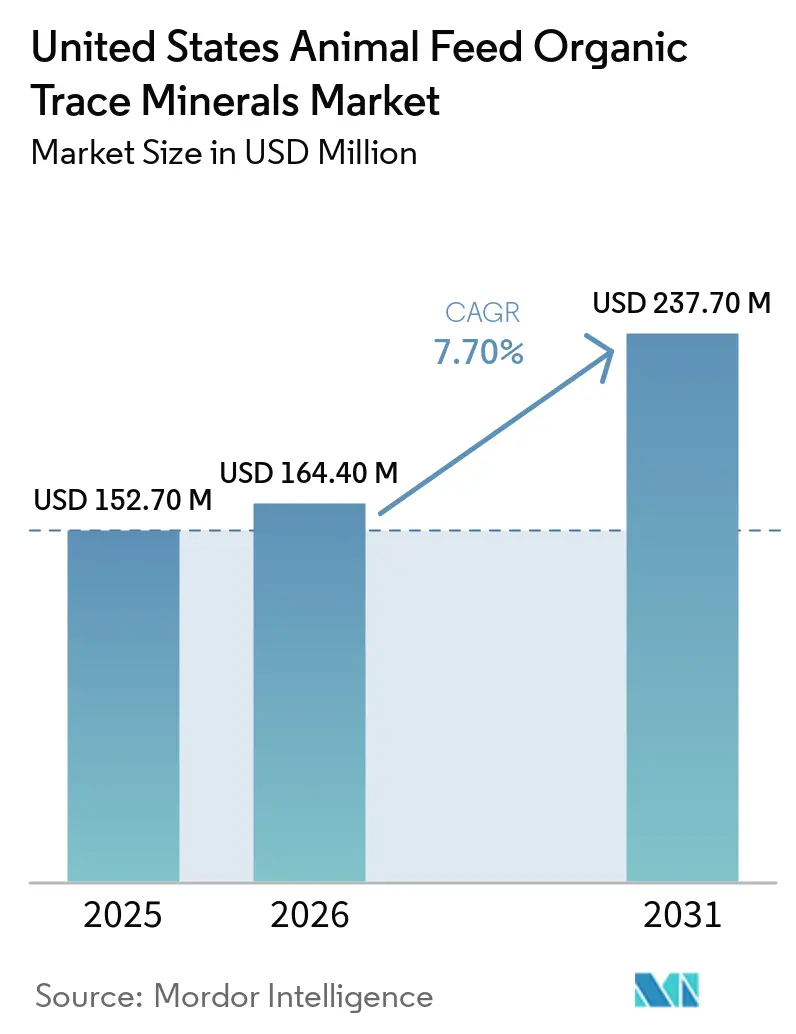
| Base Year Market Size (2025) | USD 152.70 Million |
| Market Size (2026) | USD 164.40 Million |
| Market Size (2031) | USD 237.70 Million |
| Growth Rate (2026 - 2031) | 7.70 % |
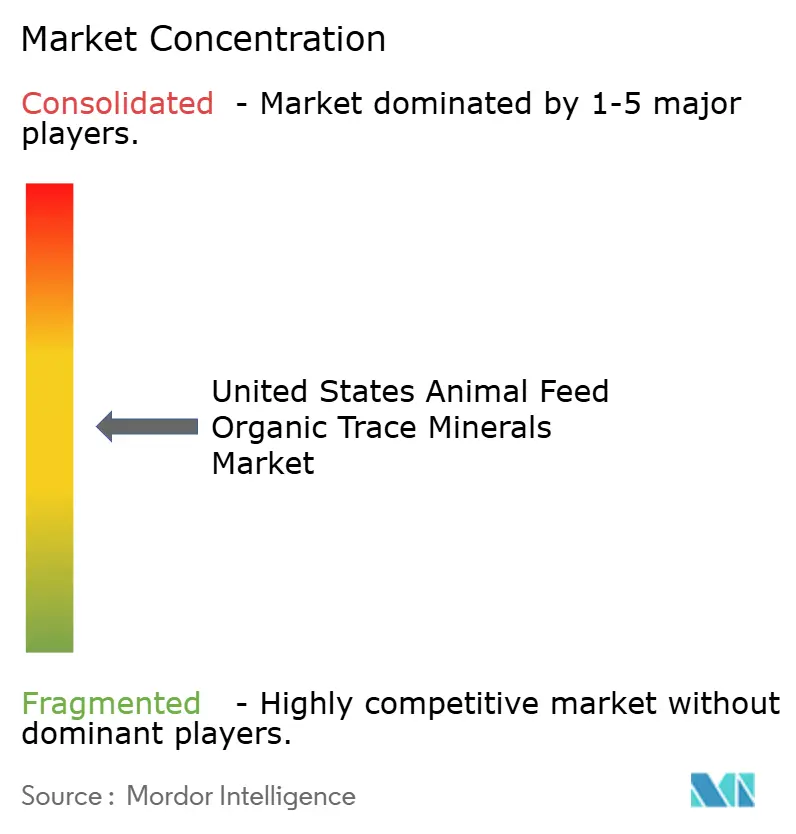
| Market Concentration | Medium |
Major Players *Disclaimer: Major Players sorted in no particular order Image © Mordor Intelligence. Reuse requires attribution under CC BY 4.0. | |
United States Animal Feed Organic Trace Minerals Market Analysis by Mordor Intelligence
The United States animal feed organic trace minerals market size was valued at USD 152.70 million in 2025 and estimated to grow from USD 164.40 million in 2026 to reach USD 237.70 million by 2031, at a CAGR of 7.70% during the forecast period (2026-2031). The United States organic animal feed trace minerals market is supported by a regulatory framework that limits certified-organic livestock feed to approved inputs and excludes antibiotics, ionophores, and synthetic growth promoters, thereby keeping compliant trace mineral forms central to herd nutrition programs. The United States animal feed organic trace minerals market is also entering a phase where supplier reach and channel control matter more, as distribution scale, premix integration, and product compliance are becoming as important as performance claims alone
Key Report Takeaways
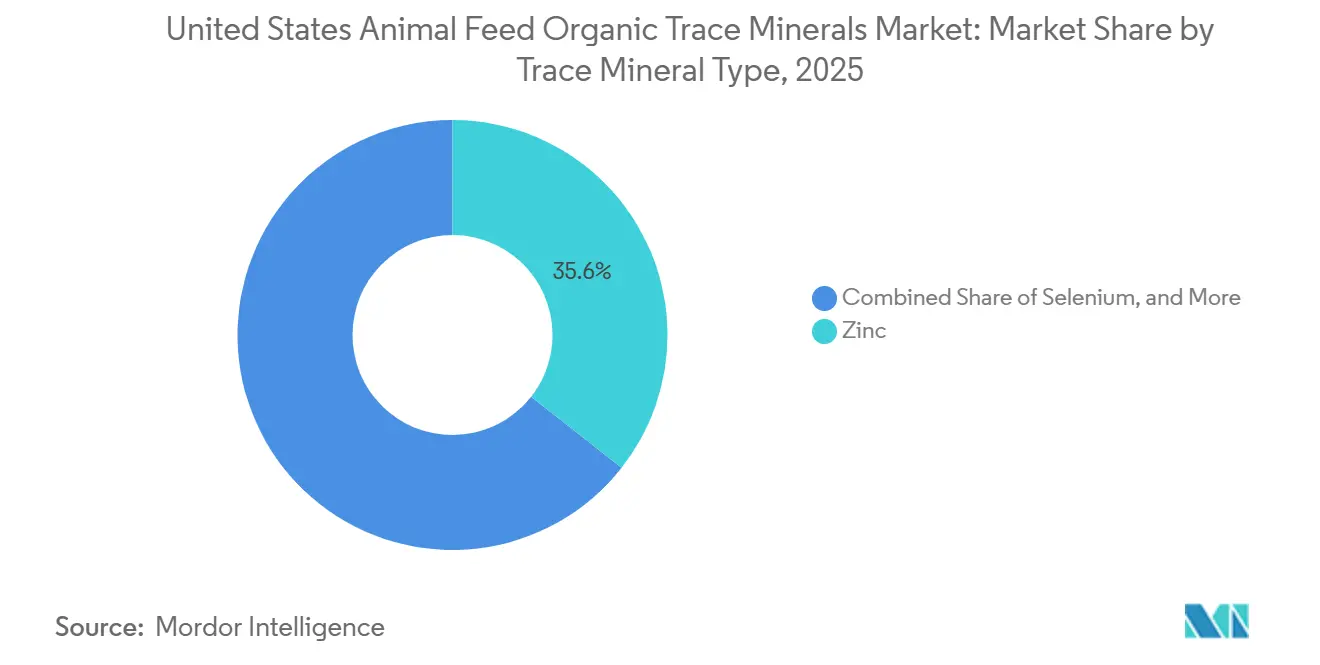
- By trace mineral type, zinc held the largest type, 35.6% of the United States animal feed organic trace minerals market share in 2025, while selenium is the fastest-growing type, forecast to expand at a 7.7% CAGR through 2026 to 2031.
- By animal type, poultry accounted for the largest animal type, 32.5% of the United States animal feed organic trace minerals market size in 2025, while aquaculture is the fastest-growing animal type, projected to record the highest CAGR at 8.9% through 2026 to 2031.
- By chelation type, amino acid chelates led the United States animal feed organic trace minerals market share with 39.7% in 2025, while proteinates are the fastest-growing segment, projected to grow at an 8.1% CAGR through 2026 to 2031.
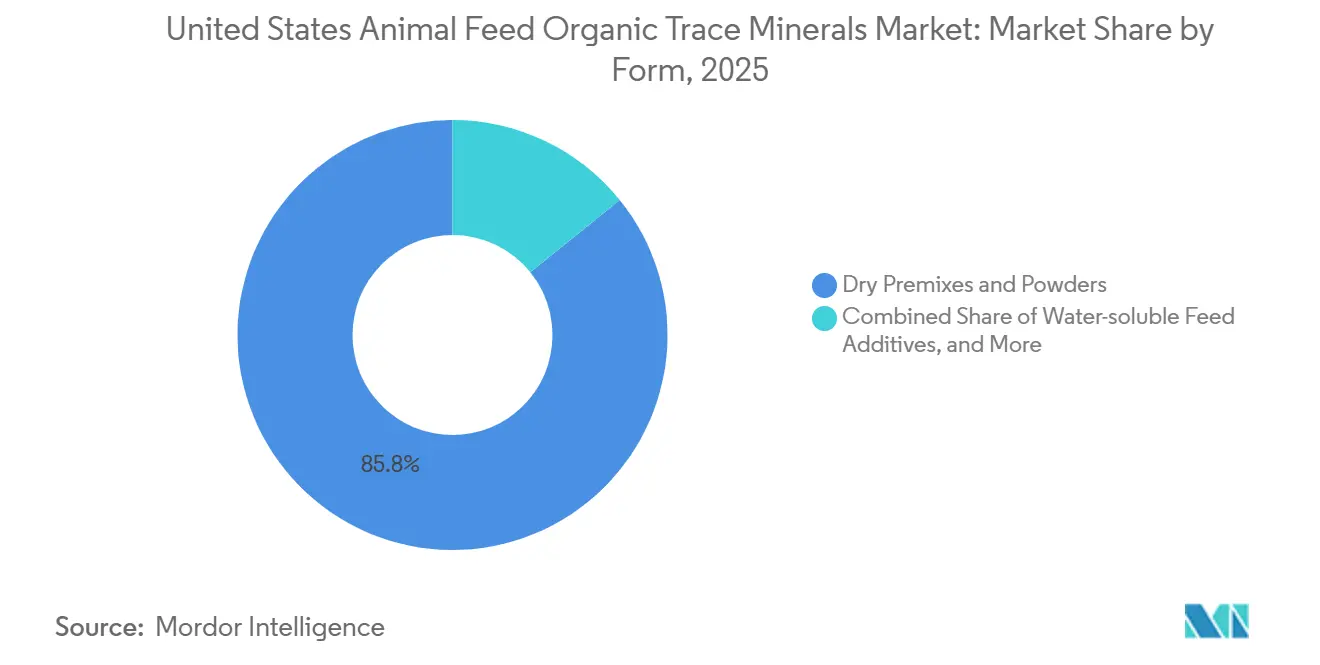
- By form, dry premixes and powders hold the largest segment, captured 85.8% of the United States animal feed organic trace minerals market size in 2025, while water-soluble feed additives are the fastest-growing segment, forecast to advance at a 7.1% CAGR through 2026 to 2031.
Note: Market size and forecast figures in this report are generated using Mordor Intelligence’s proprietary estimation framework, updated with the latest available data and insights as of January 2026.
United States Animal Feed Organic Trace Minerals Market Trends and Insights
Drivers Impact Analysis*
| Driver | (~) % Impact on CAGR Forecast | Geographic Relevance | Impact Timeline |
|---|---|---|---|
| Rising Organic Meat, Milk, and Egg Demand | +1.8% | National, with concentration in dairy belts of Wisconsin, Vermont, and New York and poultry corridors of Arkansas and Georgia | Medium term (2-4 years) |
| Higher Mineral Uptake and Lower Excretion | +1.3% | National, with early gains in states with manure discharge compliance requirements such as Iowa, North Carolina, and Indiana | Medium term (2-4 years) |
| Antibiotic-Free Herd Management Needs | +1.6% | National, strongest pull in USDA (United States Department of Agriculture)-regulated certified operations across the Midwest and Pacific Northwest | Short term (≤ 2 years) |
| Precision Nutrition Adoption in Feed Mills | +1.0% | National, with early uptake at large commercial integrator corridors in the Midwest and Southeast | Medium term (2-4 years) |
| Pasture Antagonism in Organic Ruminant Diets | +0.8% | United States-specific ruminant belt including the Pacific Northwest, Great Plains, and Appalachian forage regions | Medium term (2-4 years) |
| Premix Vitamin Stability Benefits | +0.6% | National, with early uptake at large commercial premix facilities in Iowa, Indiana, and North Carolina | Short term (≤ 2 years) |
| Source: Mordor Intelligence | |||
Rising Organic Meat, Milk, and Egg Demand
The United States organic trace minerals market for animal feed continues to benefit from stronger demand for certified organic animal products. The Agricultural Marketing Service (AMS) reported estimated fluid product sales for March 2026. Total organic milk product sales in the United States reached 272 million pounds, a 5.6% increase from the previous year[1]. Because certified-organic feed must comply with approved input lists and organic sourcing rules, rising consumer demand translates into a more captive feed additive market than in conventional systems. The United States organic trace minerals market for animal feed therefore gains not only from larger output volumes but also from a tighter link between compliance, animal productivity, and feed formulation discipline.
Higher Mineral Uptake and Lower Excretion
The United States organic trace minerals market for animal feed is also supported by evidence that organic forms can improve mineral use efficiency. The absorption gains matter for feed buyers because they improve the case for lower inclusion rates without sacrificing animal response. Lower excretion also matters in operations managing manure nutrients under tighter environmental scrutiny, especially where zinc and copper loading must be watched closely. The United States animal feed organic trace minerals market benefits from this dynamic because better digestibility supports both cost justification and compliance messaging in a single value proposition.
Antibiotic-Free Herd Management Needs
The United States organic animal feed trace mineral market is closely tied to antibiotic-free herd management, as the United States Department of Agriculture organic rules prohibit the use of antibiotics and ionophores in feed for certified-organic livestock. That restriction shifts more of the health management burden toward nutrition, especially for zinc, copper, selenium, and manganese, which support immune response, oxidative defense, and reproductive performance. In that setting, the United States organic trace mineral market for animal feed is part of the basic operating toolkit rather than a discretionary upgrade. Antibiotic-free herd management is a significant driver of the United States animal feed organic trace minerals market, as it promotes natural growth, enhances immunity, and improves metabolic health in livestock without antibiotics.
Precision Nutrition Adoption in Feed Mills
The United States organic trace minerals market for animal feed is benefiting from the broader shift toward precision feeding and more controlled premix formulation. When feed mills adjust nutrient inclusion at the batch level, they place more value on mineral forms with stable absorption profiles across species and production conditions. Kemin’s January 2024 Food and Drug Administration (FDA), approval for KemTRACE Chromium Propionate in growing turkey diets completed broader species coverage in the United States, demonstrating how regulatory clearances can expand the usable range of organic trace mineral products in precision programs. The United States organic trace minerals market for animal feed stands to benefit as commercial mills favor ingredients that align with both software-driven formulation systems and documented regulatory acceptance.
Restraints Impact Analysis*
| Restraint | (~) % Impact on CAGR Forecast | Geographic Relevance | Impact Timeline |
|---|---|---|---|
| High Cost Versus Inorganic Salts | -1.5% | National, most acute in price-sensitive commodity livestock regions of the Midwest and Great Plains | Long term (≥ 4 years) |
| Small Certified-Organic Demand Base | -1.0% | National, structurally tied to the pace of United States Department of Agriculture – National Organic Program (USDA-NOP) certification expansion | Long term (≥ 4 years) |
| Organic Carrier and Certifier Complexity | -0.7% | National, most acute for smaller premix producers and new product entrants navigating Guidance 5030 | Medium term (2-4 years) |
| Narrow Mineral Safety and Inclusion Limits | -0.5% | National, most acute for selenium, copper, and chromium supplementation programs under Food and Drug Administration limits | Short term (≤ 2 years) |
| Source: Mordor Intelligence | |||
High Cost Versus Inorganic Salts
The United States organic trace mineral market for animal feed still faces a cost barrier when buyers compare organic forms with conventional inorganic salts. That gap is easier to defend in certified-organic systems where feed programs support premium milk, egg, and meat pricing, but it remains difficult in operations focused on tight short-cycle returns. The challenge becomes sharper when amino acid or chelating input costs move unpredictably through the feed ingredient chain. Larger operations can often justify the premium through measured performance and compliance logic, while smaller farms may struggle to document the same payback with the same precision. This cost tension keeps the United States organic trace minerals market for animal feed attractive but still selective.
Small Certified-Organic Demand Base
The United States organic trace mineral market for animal feed is constrained by the size of the certified-organic livestock base. The United States Department of Agriculture (USDA) indicates that while policy support for organic transition persists, the conversion from conventional production remains time-intensive, resulting in a gradual expansion of the addressable feed input base[2]. Even when consumer demand improves, producers cannot move into certified status immediately because they must meet feed, land, and management requirements under the United States Department of Agriculture (USDA) organic rules. This means supply-side certification, not just consumer demand, decides how quickly input volumes can rise. As a result, the United States organic trace mineral market for animal feed expands from a controlled base rather than from a broad livestock pool.
*Our forecasts treat driver/restraint impacts as directional, not additive. The impact forecasts reflect baseline growth, mix effects, and variable interactions.
Segment Analysis
By Trace Mineral Type: Zinc Anchors Revenue While Functional Gaps Drive Selenium Adoption
Trace mineral type zinc accounted for the largest share, 35.6%, of the United States animal feed organic trace minerals market in 2025, which made it the largest trace mineral category in the report. Its lead position reflects routine demand across dairy, beef, swine, and poultry programs where hoof integrity, skin condition, immune support, and reproductive performance all matter in day-to-day herd management. The user-supplied review also shows that zinc remains commercially favored because pasture-based organic systems do not consistently cover these needs through forage alone.
Selenium is the fastest-growing type, forecast to expand at a 7.7% CAGR through 2026 to 2031, supported by organic selenium forms that improve tissue retention relative to inorganic alternatives while remaining within Food and Drug Administration (FDA) limits. Chromium, cobalt, and iodine remained smaller categories, although chromium gained visibility after Kemin completed broader Food and Drug Administration (FDA) species approvals for chromium propionate use cases in the United States. Within the United States animal feed organic trace minerals industry, this segment remains shaped by everyday nutritional need on one end and regulatory precision on the other.

By Animal Type: Aquaculture Outpaces Legacy Segments on Feed Traceability Shift
Poultry accounted for the largest share of the United States animal organic trace minerals market for animal feed in 2025, at 32.5%. Poultry remained the largest animal type because commercial feed demand is broad, ration control is high, and mineral supplementation can be standardized across large feed mill networks. The segment also benefits from the wider need for zinc and manganese in bird health, shell quality, and production consistency across layer and broiler systems. The United States organic animal feed trace minerals industry, therefore, shows a split between large, established users, such as poultry, and faster-growing applications where traceability and feed efficiency are gaining ground.
Aquaculture is the fastest-growing animal type, projected to record the highest CAGR at 8.9% through 2026 to 2031. Aquaculture has grown rapidly because buyers are placing greater value on traceable mineral inputs and lower-waste feeding strategies. That trend aligns well with organic mineral forms that support cleaner nutrient delivery at lower dosages. A 2025 study published in Biology found that an organic trace mineral premix at 50% of the standard inorganic dose improved mineral bioaccumulation, antioxidant capacity, and gut microbiota in white shrimp, reinforcing the dose-efficiency case for aquafeed formulators[3].
By Chelation Type: Chelate Structure Determines Bioavailability Premium
Amino acid chelates led the United States animal feed organic trace minerals market share with 39.7% in 2025, which gave them the leading position in organic form and chelation chemistry. Their advantage comes from a combination of stronger identity standards, predictable structure, and repeatable absorption performance across multiple animal systems. The United States organic trace minerals market for animal feed remains highly dependent on this chemistry layer because commercial value is closely tied to structure, regulatory definitions, and documented usability within approved feed systems.
Proteinates are the fastest-growing segment, projected to grow at an 8.1% CAGR through 2026 to 2031, reflecting demand for cost-competitive, compliant products in poultry and dairy premixes. Propionates, led by chromium propionate, also gained attention as species approvals widened and precision nutrition programs became more targeted. Polysaccharide complexes maintained a strong presence in aquaculture and companion animal use, where palatability and wet-feed stability matter. Selenium yeast remained a distinct niche because it is the primary non-chelated organic selenium route for incorporating selenomethionine into yeast biomass.
By Form: Dry Premixes Dominate While Water-Soluble Delivery Addresses Stress Events
Dry premixes and powders hold the largest share, capturing 85.8% of the United States animal feed organic trace minerals market in 2025, making them the dominant delivery format in the market mix. That position reflects the long-established dry blending infrastructure used by commercial feed mills and the broad compatibility of powder-based organic minerals with pelleting, conditioning, and mixing systems. Dry formats also benefit from the formulation logic described in the draft, which allows organic mineral sources to reduce unwanted interactions within vitamin-mineral blends.
Water-soluble feed additives are the fastest-growing segment, forecast to grow at a 7.1% CAGR through 2026 to 2031, as targeted delivery becomes increasingly important during stress periods and short-term intake disruptions. Zinpro’s ProFusion range shows how suppliers are extending beyond dry premix programs into water-based and rapid-response formats for poultry, swine, and cattle. Free-choice minerals and blocks continue to matter in grazing systems where total mixed ration delivery is not practical. Across the United States organic animal feed trace mineral market, form selection now reflects not only feed mill habits but also how quickly producers want to restore mineral status during production stress.
Geography Analysis
The upper Midwest dairy belt, including Wisconsin, Minnesota, Vermont, New York, and Pennsylvania, remains the main center for chelated zinc, copper, and selenium demand in dairy premix programs. The United States organic trace minerals market for animal feed, therefore, remains closely tied to dairy-heavy states where certified production is concentrated, and nutrition programs are more formalized.
The Southeast poultry corridor, spanning Arkansas, Georgia, Alabama, and North Carolina, is the primary regional driver of organic zinc and manganese demand in broiler and layer programs. Large feed mill networks in this corridor create concentrated purchasing points for standardized mineral premixes that can be rolled out across broad contract grower systems. This region also favors suppliers that can align product performance with consistent documentation across multiple facilities. As a result, geographic demand in the United States organic trace minerals market for animal feed is influenced as much by feed mill structure as by livestock numbers.
The Great Plains and Pacific Northwest exhibit distinct demand patterns centered on pasture-based beef and dairy systems, where mineral antagonism is more pronounced. University of Nebraska Extension highlights the practical importance of copper and zinc management in forage-driven cattle systems, which supports demand for better-absorbed organic forms. The Pacific Northwest and Mountain West also add an aquaculture layer as traceability requirements tighten in aquafeed supply chains, even though that base remains smaller than dairy or poultry in value terms. Taken together, these regional patterns show that the US organic trace mineral market for animal feed is national in coverage but distinctly clustered in dairy, poultry, grazing, and emerging aquafeed corridors.
Competitive Landscape
The market demonstrates moderate concentration, with five major players, including Zinpro Corporation, Alltech, Inc., ADM, Kemin Industries, Inc., and Cargill, Incorporated, accounting for a significant portion of annual revenue in 2025. Zinpro Corporation led the market, supported by its specialist focus and branded lines, including Availa, ProPath, and Eco Organic.
These companies maintain strong market positions by consistently investing in research and development, utilizing advanced mineral chelation technologies, and offering precision nutrition solutions designed to enhance livestock performance. Their product portfolios are extensively incorporated into feed formulations for poultry, swine, dairy, and aquaculture, addressing key industry priorities such as improved feed efficiency, immunity, and reproductive performance. Strategic partnerships with feed manufacturers and integrators further bolster their distribution networks across the United States.
The increasing demand for antibiotic-free animal production and sustainable livestock farming practices has heightened competition among these key players. Companies are placing greater emphasis on expanding their organic trace mineral offerings to meet regulatory standards, including Food and Drug Administration (FDA) guidelines and United States Department of Agriculture – National Organic Program (USDA-NOP) requirements. This competitive environment is driving innovation in bioavailable mineral complexes, enabling firms to differentiate through improved product efficacy, environmental sustainability, and cost efficiency.
United States Animal Feed Organic Trace Minerals Industry Leaders
-
Zinpro Corporation
-
Alltech, Inc.
-
ADM
-
Kemin Industries, Inc.
-
Cargill, Incorporated
- *Disclaimer: Major Players sorted in no particular order
Recent Industry Developments
- November 2025: Biochem, entered into a binding agreement with BASF SE to acquire BASF's global glycinate business. This acquisition strengthens Biochem's position in organic trace minerals (OTMs) and expands its global market presence, including the United States. Biochem gains improved market access and an established distribution network from BASF SE, ensuring a smooth transition for United States customers.
- November 2024: Biochem introduced a new line of organic trace minerals named BetaTrace, aimed at enhancing trace mineral bioavailability across all animal species. The patent-pending formula integrates organic zinc, copper, manganese, and iron with betaine, a compound that improves absorption and supports animal performance.
- May 2024: Alltech announced that it would become the primary importer and distributor of Agolin products in the United States. Agolin's essential oil blends are scientifically validated to optimize feed intake and performance, including improving milk and meat production for both ruminant and non-ruminant animals.
United States Animal Feed Organic Trace Minerals Market Report Scope
Organic trace minerals are vital minerals chemically bonded to organic molecules, such as amino acids, peptides, or proteins. They are incorporated into animal feed to enhance nutrition, support growth, boost immunity, and promote overall animal health. The United States animal feed organic trace minerals market report is segmented by trace mineral type (zinc, iron, copper, manganese, selenium, chromium, cobalt, and iodine), by animal type (dairy cattle, beef cattle, poultry, swine, aquaculture, equine and companion animals), by organic form and chelation chemistry (amino-acid chelates, amino acid complexes, proteinates, polysaccharide complexes, selenium yeast, and propionates), and by form (dry premixes and powders, liquid supplements, free-choice minerals and blocks, and water-soluble feed additives). The market forecasts are provided in terms of Value (USD).
| Zinc |
| Copper |
| Manganese |
| Iron |
| Selenium |
| Chromium |
| Cobalt |
| Iodine |
| Poultry |
| Dairy Cattle |
| Beef Cattle |
| Swine |
| Aquaculture |
| Equine |
| Companion Animals |
| Amino Acid Chelates |
| Amino Acid Complexes |
| Proteinates |
| Polysaccharide Complexes |
| Selenium Yeast |
| Propionates |
| Dry Premixes and Powders |
| Liquid Supplements |
| Free-choice Minerals and Blocks |
| Water-soluble Feed Additives |
| By Trace Mineral Type | Zinc |
| Copper | |
| Manganese | |
| Iron | |
| Selenium | |
| Chromium | |
| Cobalt | |
| Iodine | |
| By Animal Type | Poultry |
| Dairy Cattle | |
| Beef Cattle | |
| Swine | |
| Aquaculture | |
| Equine | |
| Companion Animals | |
| By Chelation Type | Amino Acid Chelates |
| Amino Acid Complexes | |
| Proteinates | |
| Polysaccharide Complexes | |
| Selenium Yeast | |
| Propionates | |
| By Form | Dry Premixes and Powders |
| Liquid Supplements | |
| Free-choice Minerals and Blocks | |
| Water-soluble Feed Additives |
Key Questions Answered in the Report
What is the 2031 value forecast for US animal feed organic trace minerals?
The report projects the market to reach USD 237.70 million by 2031, up from USD 164.4 million in 2026, at a 7.70% CAGR through 2026 to 2031.
Which trace mineral category leads revenue in this space?
Zinc led with a 35.6% revenue share in 2025 because it supports immune function, hoof integrity, skin health, and reproductive performance across major livestock species.
Which animal type is growing the fastest through 2031?
Aquaculture is the fastest-growing animal type with an 8.9% CAGR through 2031, supported by stronger traceability and dose-efficiency requirements in aquafeed.
Why are organic trace minerals important in certified-organic livestock feed?
United States Department of Agriculture (USDA)organic rules prohibit antibiotics, ionophores, and synthetic growth promoters in feed, so approved trace mineral forms play a larger role in maintaining herd and flock resilience.