
Managed Green IT Services Market Size and Share
Market Overview
| Study Period | 2020 - 2031 |
|---|---|
| Market Size (2026) | USD 12.07 Billion |
| Market Size (2031) | USD 28.76 Billion |
| Growth Rate (2026 - 2031) | 18.96 % |
| Fastest Growing Market | Asia-Pacific |
| Largest Market | Europe |
| Market Concentration | Medium |
Major Players *Disclaimer: Major Players sorted in no particular order Image © Mordor Intelligence. Reuse requires attribution under CC BY 4.0. | |
Managed Green IT Services Market Analysis by Mordor Intelligence
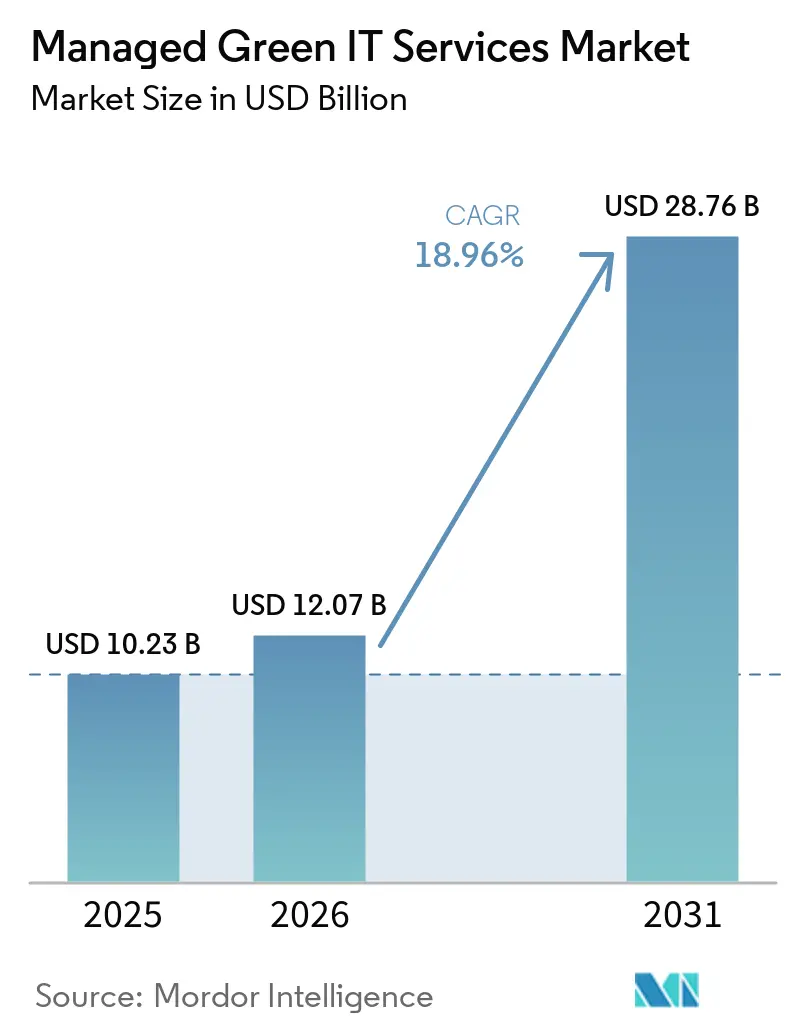
The managed green IT services market size is projected to expand from USD 10.23 billion in 2025 and USD 12.07 billion in 2026 to USD 28.76 billion by 2031, registering a CAGR of 18.96% between 2026 and 2031. The managed green IT services market is moving beyond a compliance-led spend category and is becoming part of core IT operations planning. Corporate decarbonization goals, heavier power use from data centers, and stricter sustainability reporting requirements across large enterprises are supporting growth. The same pattern is making outsourced support more relevant because many companies need outside help to measure emissions, improve energy use, and manage reporting across cloud and on-premises environments. Demand is also shifting toward providers that can combine strategy, implementation, and managed operations under a single contract, thereby raising the value of broad platform capabilities. This is creating space for vendors to connect energy efficiency, carbon tracking, and hybrid infrastructure management without adding significant operational friction.
Key Report Takeaways
- By deployment model, cloud held 63.14% of the managed green IT services market share in 2025, while hybrid is projected to expand at a 19.12% CAGR through 2031.
- By enterprise size, large enterprises accounted for 68.17% of revenue in 2025, while SMEs are expected to record the highest CAGR at 19.23% through 2031.
- By service area, data center and cloud sustainability management accounted for 27.19% of the managed green IT services market in 2025, while consulting, integration, and transformation services are projected to grow at a 19.41% CAGR through 2031.
- By end-use industry, IT and telecom captured 28.12% revenue share in 2025, while retail and e-commerce are projected to expand at a 19.27% CAGR through 2031.
- By geography, Europe held 34.18% share in 2025, while Asia-Pacific is projected to grow at a 19.53% CAGR through 2031.
Note: Market size and forecast figures in this report are generated using Mordor Intelligence’s proprietary estimation framework, updated with the latest available data and insights as of January 2026.
Global Managed Green IT Services Market Trends and Insights
Drivers Impact Analysis*
| Driver | (~) % Impact on CAGR Forecast | Geographic Relevance | Impact Timeline |
|---|---|---|---|
| Growing Corporate Net-Zero Commitments | +4.5% | Global | Long term (≥ 4 years) |
| Rapid Growth of Hyperscale Data Centers Using Renewable Power | +3.2% | Global, concentrated in North America and Asia-Pacific | Medium term (2-4 years) |
| Strengthening Regulations on IT Emissions and Reporting | +3.0% | Europe, with spill-over to North America and Asia-Pacific | Medium term (2-4 years) |
| Rising Energy Costs Improving ROI on Green IT | +2.5% | North America and Europe | Medium term (2-4 years) |
| AI-Driven Real-Time IT Optimization | +2.0% | Global | Medium term (2-4 years) |
| EU Digital Product Passport Spillover Into IT Asset Traceability | +1.2% | Europe and export-facing Asia-Pacific manufacturers | Long term (≥ 4 years) |
| Source: Mordor Intelligence | |||
Growing Corporate Net-Zero Commitments
Corporate net-zero commitments now influence supplier screening, contract renewal, and IT sourcing choices across many large organizations. In its 2025 Environmental Sustainability Report, Microsoft stated that it had deployed closed-loop liquid cooling across all owned data centers and expanded its renewable energy sourcing program, which shows how sustainability goals are now tied to infrastructure design and operation.[1]Microsoft, “2025 Environmental Sustainability Report,” Microsoft Blogs, microsoft.com The managed green IT services market benefits because target-setting alone is not enough; buyers also need auditable operational data, carbon accounting, and ongoing optimization across devices, workloads, and facilities. That requirement is pushing companies toward service partners that can connect day-to-day IT management with emissions reporting and governance in one operating model. It is also widening demand beyond early adopters because supplier disclosure expectations are moving down the value chain and reaching firms that were not previously active in formal sustainability programs.
Rapid Growth of Hyperscale Data Centers Using Renewable Power
The rapid buildout of hyperscale infrastructure is raising the operating importance of energy efficiency, cooling, and renewable integration across the broader managed green IT services market. In 2025, the International Energy Agency stated that electricity demand from AI-accelerated servers is projected to grow by 30% a year in its base scenario, keeping energy planning at the center of IT decisions.[2]International Energy Agency, “Energy Demand From AI,” International Energy Agency, iea.org Microsoft’s 2025 report showed how large operators are redesigning data center systems around liquid cooling and renewable energy procurement, setting a higher operating benchmark for enterprise buyers that rely on cloud ecosystems. As those expectations spread, customers need managed support to track power use, link workloads with emissions, and balance performance with sustainability targets across mixed estates. This is one reason the managed green IT services market is seeing stronger demand for providers that can support real-time monitoring and optimization rather than relying solely on periodic reporting.
Strengthening Regulations on IT Emissions and Reporting
Regulation is turning IT sustainability from a voluntary program into a formal reporting and assurance requirement for an increasing share of the corporate base. The Corporate Sustainability Reporting Directive requires in-scope EU companies to report sustainability information using the ESRS framework, which has pushed organizations to treat IT emissions data with more discipline.[3]European Union, “Directive (EU) 2025/794,” EUR-Lex, eur-lex.europa.eu The 2025 Stop-the-Clock directive delayed some later reporting waves, but it maintained the core structure of the first wave, including the broader direction of disclosure and assurance. The managed green IT services market is benefiting from this shift because many enterprises lack the internal tools or staff to collect granular data across cloud services, hardware fleets, and digital workplaces. As a result, reporting pressure is translating into longer service scopes that include measurement, dashboarding, control design, and operational support rather than one-time advisory work.
Rising Energy Costs Improving ROI on Green IT
Higher power costs and heavier computing loads are making energy efficiency programs easier to defend within normal IT budgeting cycles. The International Energy Agency’s outlook for AI server electricity demand underscores why companies are placing greater emphasis on consumption control and system-level optimization. A 2026 scientific paper on carbon-aware orchestration reported a 34.68% reduction in energy use compared with a standard autoscaling setup in a production-grade environment, supporting the case for managed optimization in complex estates.[4]arXiv Authors, “NeuroScaler, AI-Native, Energy-Efficient, and Carbon-Aware Orchestrator for Green Cloud,” arXiv, arxiv.org The managed green IT services market is therefore benefiting from a clearer link between sustainability measures and direct operating savings. That link matters because companies are more willing to fund monitoring, orchestration, and reporting tools when those services address both energy costs and compliance demands simultaneously.
Restraints Impact Analysis*
| Restraint | (~) % Impact on CAGR Forecast | Geographic Relevance | Impact Timeline |
|---|---|---|---|
| High Up-Front Capex for Green IT Infrastructure | -3.2% | Global, most acute in South America and Middle East and Africa | Medium term (2-4 years) |
| Lack of Skilled Workforce for Sustainable IT Operations | -2.1% | Global | Medium term (2-4 years) |
| Embedded-Carbon Accounting Complexity in Multi-Cloud Environments | -1.8% | North America and Europe | Medium term (2-4 years) |
| Intermittent Renewable Supply Versus IT Load Variability | -1.0% | Asia-Pacific and Europe, high solar and wind markets | Long term (≥ 4 years) |
| Source: Mordor Intelligence | |||
High Up-Front Capex for Green IT Infrastructure
The move toward greener IT operations still carries a meaningful upfront cost burden, especially when projects include cooling retrofits, smart metering, software tools, and renewable integration. This issue is more visible in mid-market accounts and in emerging regions where funding remains tighter, and sustainability projects compete with other core infrastructure needs. The managed green IT services market is affected because some buyers delay adoption until savings, compliance pressure, or customer requirements become harder to ignore. Larger enterprises are still better placed to move early because they can spread project costs across bigger estates and align them with formal reporting programs. That creates a two-speed demand pattern, with early revenue concentrated in organizations with stronger capital access and more mature sustainability teams.
Lack Of Skilled Workforce for Sustainable IT Operations
A shortage of staff who understand both IT operations and sustainability reporting is slowing execution in parts of the market. In 2025, the OECD noted that SMEs often face gaps in climate literacy, ESG capabilities, and data-collection capacity, which limit their ability to translate policy statements into operational delivery. The managed green IT services market continues to benefit from this shortage, as companies turn to external providers when internal teams cannot handle carbon accounting, asset tracing, and reporting workflows. At the same time, service providers also need specialized talent, which can stretch delivery timelines and keep implementation costs elevated. Firms that build internal training programs and practical reporting skills are therefore in a stronger position to scale with demand.
*Our forecasts treat driver/restraint impacts as directional, not additive. The impact forecasts reflect baseline growth, mix effects, and variable interactions.
Segment Analysis
By Deployment Model: Hybrid Adoption Narrows Cloud Dominance
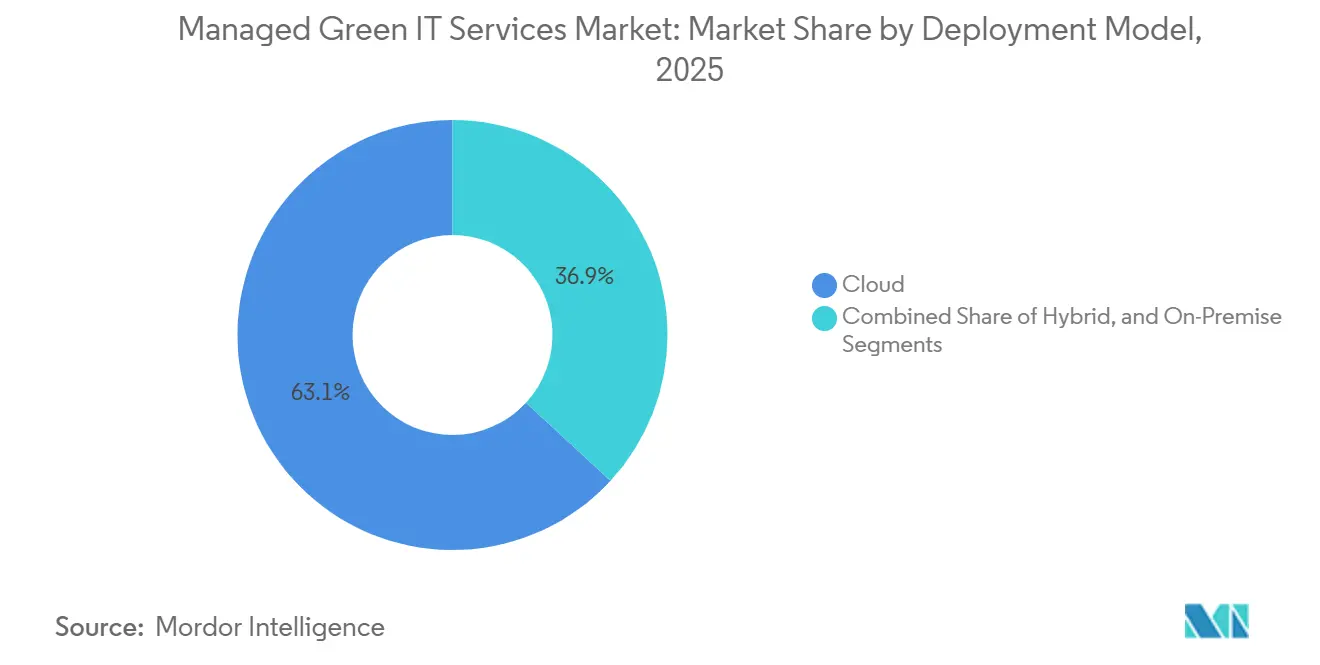
Cloud accounted for 63.14% of revenue in 2025, making it the largest deployment model in the managed green IT services market. Its lead came from the easier adoption of cloud-based tools for emissions reporting, monitoring, and workload visibility. Many enterprises preferred the cloud because it enabled faster rollouts without major upfront infrastructure changes. It also suited companies that wanted managed sustainability support without taking on heavy capital commitments at the start.
Hybrid is projected to grow at a 19.12% CAGR from 2026 to 2031, making it the fastest-growing deployment model. Growth is being driven by organizations that run part of their workloads in the cloud while keeping sensitive or performance-heavy systems on-premises. This mixed setup makes carbon attribution and energy optimization across multiple environments more difficult. As a result, providers that can deliver unified reporting and cross-environment management are well placed to gain share in this part of the market.



By Enterprise Size: SMEs Close the Gap as Supply Chains Tighten Standards
Large enterprises accounted for 68.17% of revenue in 2025, making them the largest customer segment in the managed green IT services market. Their lead was supported by better access to capital, dedicated sustainability teams, and earlier exposure to disclosure requirements. These companies often purchased broader service packages covering data centers, workplace sustainability, asset management, and carbon reporting. Their larger and more complex IT estates also increased the need for recurring managed support.
SMEs are projected to grow at a 19.23% CAGR from 2026 to 2031, making them the fastest-growing segment of enterprises. Demand is rising because smaller suppliers are under growing pressure to provide sustainability data to larger enterprise customers. Many of these firms need practical and lower-cost support rather than large transformation programs. This is creating space for providers to offer modular reporting, monitoring, and optimization services across simpler service tiers.
By Service Area: Consulting Growth Reflects Program Complexity
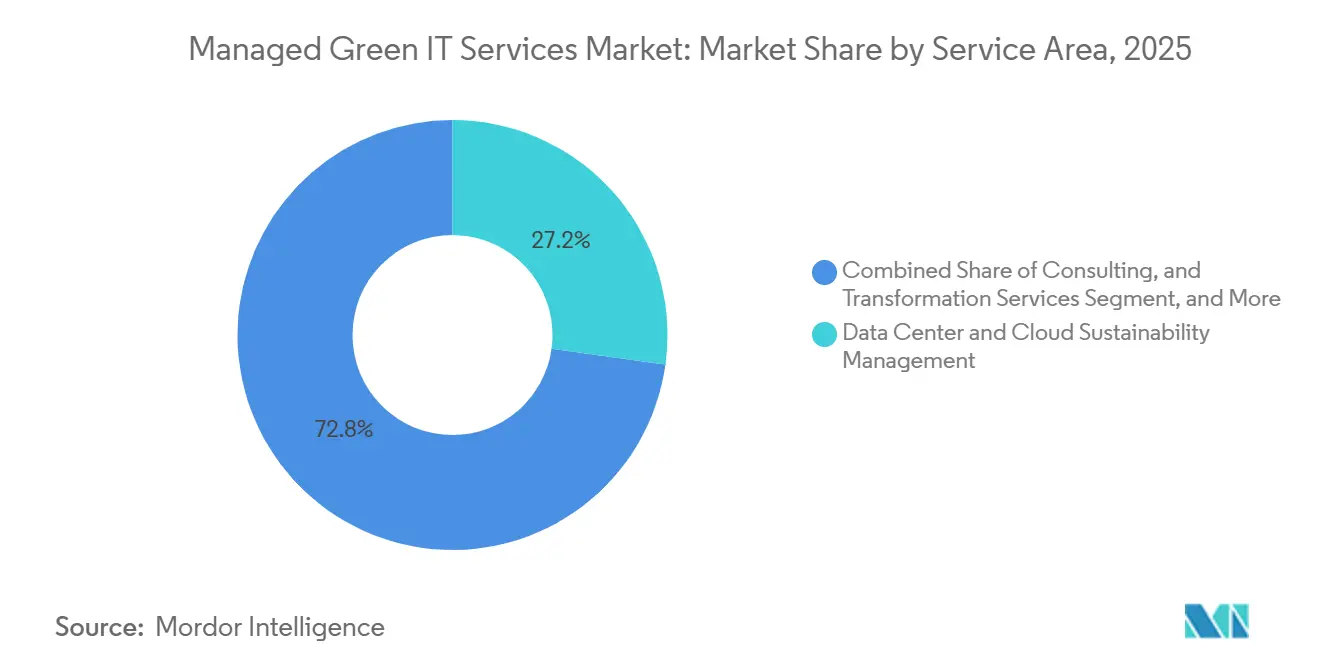
Data center and cloud sustainability management held 27.19% of revenue in 2025, making it the largest service area in the managed green IT services market. This position reflects the high energy intensity of compute infrastructure compared with other IT functions. Many enterprises begin their green IT efforts with data centers and cloud environments because the savings case is clearer and the reporting need is more immediate. From there, programs often expand into devices, workplace operations, and asset lifecycle management.
Consulting, integration, and transformation services are projected to grow at a 19.41% CAGR from 2026 to 2031, making them the fastest-growing service area. Growth is being supported by rising demand for upfront planning, governance design, and integration of sustainability data into business systems. Companies entering green IT programs for the first time often need strategic support before managed execution can scale. This is increasing the role of providers that can connect sustainability goals with IT architecture, reporting workflows, and operational delivery.
By End-Use Industry: Retail and E-Commerce Emerges as a Fast-Moving Buyer Group
IT and telecom held 28.12% of revenue in 2025, making it the largest end-use segment in the managed green IT services market. The sector remains a leading buyer because it operates large digital estates that consume significant power across networks, edge infrastructure, and data centers. This creates continuous demand for energy optimization, emissions tracking, and infrastructure efficiency services. Other established verticals, such as BFSI, manufacturing, and energy and utilities, also remain important because they already work within structured compliance and governance environments.
Retail and e-commerce are projected to grow at a 19.27% CAGR from 2026 to 2031, making them the fastest-growing end-use segment. Growth is being driven by rising scrutiny of environmental claims, packaging data, and logistics emissions across online retail operations. Retailers increasingly need connected IT systems that can support both reporting and real-time operational visibility. This is strengthening demand for service providers that can integrate sustainability data across commerce platforms, fulfillment systems, and delivery networks.
Geography Analysis
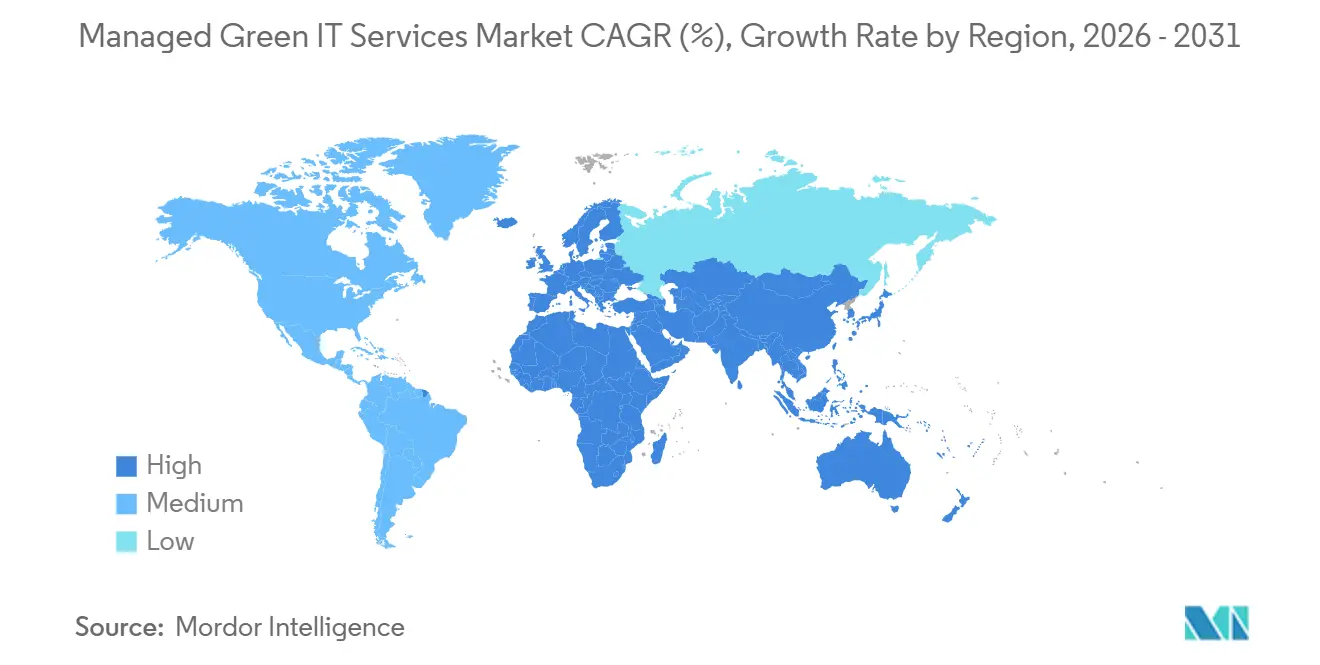
Europe accounted for 34.18% of revenue in 2025, making it the leading regional market for managed green IT services. The managed green IT services market share in Europe stayed ahead because the region has the strongest direct reporting pressure on large enterprises. The Corporate Sustainability Reporting Directive moved sustainability disclosure into a more formal compliance structure, which has increased demand for auditable IT emissions data and recurring operating support. The 2025 directive that delayed later reporting waves did not remove the broader compliance direction for companies already within scope. France adds another layer through the government-backed RGESN standard, which extends green digital expectations to software and service design rather than just hardware. This combination keeps Europe at the forefront because buyers often need external support for data collection, reporting structures, and day-to-day operational controls.
North America remained the second-largest region in the managed green IT services market, combining a large hyperscale base with strong enterprise IT spending. The region also has a large pool of companies that are already pursuing internal sustainability targets and need practical operating tools to support them. Microsoft’s 2025 sustainability report showed continued investment in liquid cooling and renewable sourcing, underscoring how major operators in the region are shaping expectations for lower-emission infrastructure design. South America is still emerging, with adoption more closely linked to enterprise modernization, digital infrastructure buildout, and imported supplier standards than to a single, uniform reporting regime. That leaves demand real but less evenly distributed across countries than in Europe or North America.
Asia-Pacific is projected to grow at a 19.53% CAGR from 2026 to 2031, making it the fastest-growing regional market in the managed green IT services market. Growth is being supported by industrial decarbonization goals, expanding cloud infrastructure, and a wider policy push for cleaner digital systems across major economies. China’s direction toward carbon neutrality, India’s renewable energy push, and Japan’s GX support for low-carbon computing are all driving demand for better-managed infrastructure and reporting practices. The managed green IT services market size in Asia-Pacific is also being lifted by organizations that need help managing large hybrid estates as digital adoption deepens across sectors. The Middle East and Africa remain early-stage markets, but smart-city programs and sovereign-backed digital infrastructure projects are beginning to lay a stronger foundation for green IT services. Over time, regional growth will depend on how quickly buyers move from isolated efficiency projects to formal managed operating models with measurable reporting outputs.

Competitive Landscape
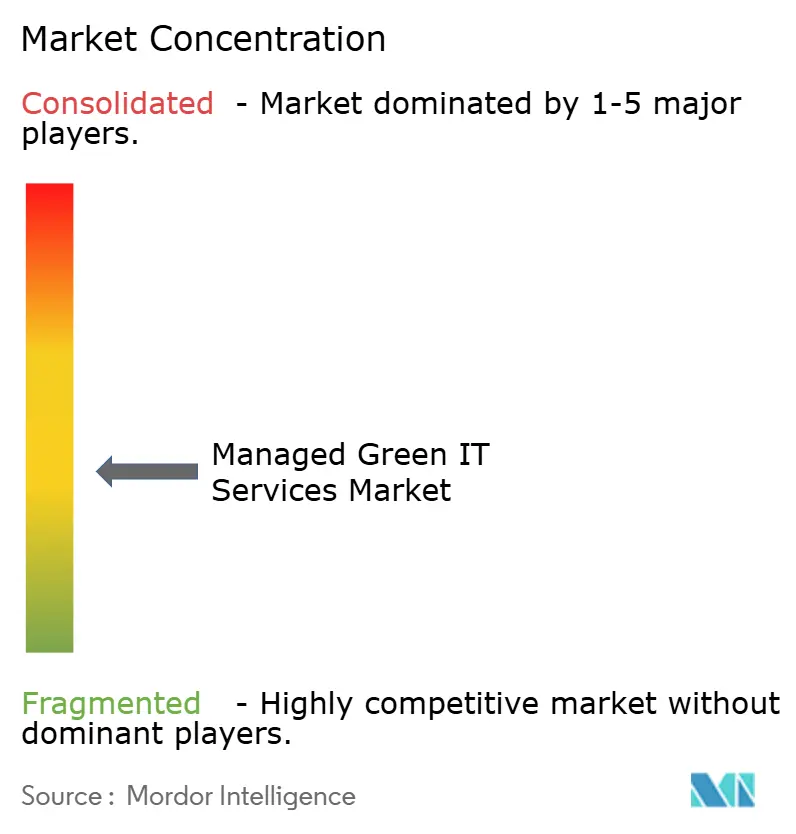
The managed green IT services market in 2026 is moderately fragmented at the upper end, with a small group of global integrators operating across advisory, implementation, and managed delivery. Accenture, Capgemini, HCLTech, IBM, NTT DATA, and TCS remain among the most visible large-scale participants, while firms such as Infosys, Kyndryl, and LTIMindtree continue to build depth around platform-led delivery and hybrid operations. Competition is increasingly focused on who can connect sustainability reporting with infrastructure management rather than on selling stand-alone reporting tools. This matters because clients want fewer handoffs between strategy, system integration, and daily service execution, making the breadth of delivery almost as important as technical specialization.
Strategic moves in 2025 and 2026 show that providers are broadening their role beyond traditional IT outsourcing. NTT DATA said in April 2026 that it had become the first Japan-based IT services company to procure high-quality carbon dioxide removal credits from Climeworks, signaling a broader push into carbon management and a client-facing sustainability positioning. Accenture’s 2025 CDP report highlighted its co-founding membership in the Green Software Foundation, giving it influence over software-related sustainability standards and strengthening its position with buyers seeking recognized frameworks. NTT DATA Business Solutions also announced in 2026 that it had won the SAP Sustainability Partner Award, showing how application-layer sustainability work is becoming a competitive differentiator rather than a side capability. These moves highlight how vendors are competing on platform depth, process integration, and standards alignment simultaneously.
Product and infrastructure partnerships are also widening the competitive field. Infosys announced in February 2026 that it had expanded its work with ExxonMobil on immersion cooling for AI and high-performance computing, signaling a closer link between software services and energy-efficient physical infrastructure. TCS said in April 2026 that it had signed two MoUs with Siemens Energy entities to deepen collaboration across digital systems, industrial AI, data centers, and sustainable operations. These examples suggest that the market is not only about reporting expertise but also depends on who can tie IT operations to power, cooling, and process redesign. As a result, the industry is moving toward a model in which technology integration and sustainability outcomes are evaluated together, keeping the field competitive even though a limited top tier still has a scale advantage.
Managed Green IT Services Industry Leaders
IBM Corporation
Accenture PLC
Wipro Limited
Capgemini SE
Tata Consultancy Services Limited L
- *Disclaimer: Major Players sorted in no particular order

Recent Industry Developments
- June 2026: Schneider Electric and Hon Hai Technology Group (Foxconn) announced a strategic collaboration to co-develop next-generation AI data center reference architectures, incorporating closed-loop energy optimization, modular power and cooling skids, and standardized design frameworks. Production is planned to commence later in 2026, targeting hyperscale AI factory buildouts globally.
- June 2026: SAP announced at SAP Sapphire that new sustainability AI agents will be generally available by the end of 2026, automating multi-step workflows including sustainability reporting preparation, carbon footprint simulation, and packaging compliance assessments, to serve enterprise finance and procurement teams facing CSRD and Scope 3 obligations.
- May 2026: Digital Realty published its 2025 Impact Report confirming 93% global renewable energy coverage, an 18% increase from 2024, and carbon-neutral certification for its European portfolio in Denmark, France, Netherlands, and Sweden, reinforcing the anchor-client demand from data center operators for managed green IT services.
- April 2026: TCS signed two MoUs with Siemens Energy AG and Siemens Energy India Limited, deepening collaboration across IT services, digital and industrial AI, data centers, and sustainable operations growth, strengthening the convergence of energy technology and managed IT services.


Global Managed Green IT Services Market Report Scope
The Managed Green IT Services market refers to outsourced solutions and services that help enterprises embed sustainability principles into IT operations, infrastructure, and asset management. These services encompass data center and cloud sustainability optimization, workplace and end-user computing efficiency, IT asset lifecycle management, green infrastructure monitoring, carbon management, and ESG reporting. Additionally, consulting and integration services enable organizations to transform IT ecosystems toward low-carbon, resource-efficient, and compliant operations. Serving both large enterprises and SMEs across diverse industries, the market’s primary objective is to reduce environmental impact, enhance operational efficiency, ensure regulatory compliance, and support the transition toward sustainable digital infrastructure through managed service delivery.
The Managed Green IT Services market report is segmented by Deployment Model (Cloud, On-Premises, and Hybrid), Enterprise Size (Large Enterprises, and Small and Medium Enterprises), Service Area (Data Center and Cloud Sustainability Management, End-User Computing and Workplace Sustainability Services, IT Asset Lifecycle Management, Green Infrastructure Monitoring and Optimization, Sustainability Reporting and Carbon Management, and Consulting, Integration and Transformation Services), End-Use Industry (IT and Telecom, BFSI, Manufacturing, Energy and Utilities, Retail and E-Commerce, Construction and Infrastructure, Government and Public Sector, and Other End-User Industries), and Geography (North America, South America, Europe, Asia-Pacific, Middle East, and Africa). The Market Forecasts are Provided in Terms of Value (USD).
| Cloud |
| On-Premises |
| Hybrid |
| Large Enterprises |
| Small and Medium Enterprises |
| Data Center and Cloud Sustainability Management |
| End-User Computing and Workplace Sustainability Services |
| IT Asset Lifecycle Management |
| Green Infrastructure Monitoring and Optimization |
| Sustainability Reporting and Carbon Management |
| Consulting, Integration and Transformation Services |
| IT and Telecom |
| BFSI |
| Manufacturing |
| Energy and Utilities |
| Retail and E-Commerce |
| Construction and Infrastructure |
| Government and Public Sector |
| Other End-User Industries |
| North America | United States | |
| Canada | ||
| Mexico | ||
| South America | Brazil | |
| Argentina | ||
| Rest of South America | ||
| Europe | Germany | |
| United Kingdom | ||
| France | ||
| Italy | ||
| Spain | ||
| Russia | ||
| Rest of Europe | ||
| Asia-Pacific | China | |
| India | ||
| Japan | ||
| South Korea | ||
| Australia | ||
| Rest of Asia-Pacific | ||
| Middle East and Africa | Middle East | Saudi Arabia |
| United Arab Emirates | ||
| Rest of Middle East | ||
| Africa | South Africa | |
| Nigeria | ||
| Rest of Africa | ||
| By Deployment Model | Cloud | ||
| On-Premises | |||
| Hybrid | |||
| By Enterprise Size | Large Enterprises | ||
| Small and Medium Enterprises | |||
| By Service Area | Data Center and Cloud Sustainability Management | ||
| End-User Computing and Workplace Sustainability Services | |||
| IT Asset Lifecycle Management | |||
| Green Infrastructure Monitoring and Optimization | |||
| Sustainability Reporting and Carbon Management | |||
| Consulting, Integration and Transformation Services | |||
| By End-Use Industry | IT and Telecom | ||
| BFSI | |||
| Manufacturing | |||
| Energy and Utilities | |||
| Retail and E-Commerce | |||
| Construction and Infrastructure | |||
| Government and Public Sector | |||
| Other End-User Industries | |||
| By Geography | North America | United States | |
| Canada | |||
| Mexico | |||
| South America | Brazil | ||
| Argentina | |||
| Rest of South America | |||
| Europe | Germany | ||
| United Kingdom | |||
| France | |||
| Italy | |||
| Spain | |||
| Russia | |||
| Rest of Europe | |||
| Asia-Pacific | China | ||
| India | |||
| Japan | |||
| South Korea | |||
| Australia | |||
| Rest of Asia-Pacific | |||
| Middle East and Africa | Middle East | Saudi Arabia | |
| United Arab Emirates | |||
| Rest of Middle East | |||
| Africa | South Africa | ||
| Nigeria | |||
| Rest of Africa | |||


Key Questions Answered in the Report
What is the managed green IT services market size in 2026 and where is it expected to reach by 2031?
The managed green IT services market stood at USD 12.07 billion in 2026 and is projected to reach USD 28.76 billion by 2031, growing at an 18.96% CAGR.
Which deployment model currently leads managed green IT services adoption?
Cloud led with 63.14% share in 2025 because it offers a faster and lighter path to reporting, monitoring, and sustainability tool deployment.
Which customer group is expanding fastest in managed green IT services?
SMEs are projected to grow at a 19.23% CAGR through 2031, mainly because supply chain standards are pushing smaller firms to provide better sustainability data.
Why does Europe hold the largest regional share?
Europe led with 34.18% in 2025 because CSRD-led reporting rules and related governance requirements are creating stronger demand for auditable IT emissions management.
Why is Asia-Pacific growing faster than other regions?
Asia-Pacific is projected to grow at a 19.53% CAGR because cloud buildout, industrial decarbonization goals, and cleaner digital infrastructure programs are all moving forward at the same time.
Which service area and end-use vertical look strongest over the forecast period?
Consulting, integration and transformation services are projected to grow at a 19.41% CAGR, while retail and e-commerce is expected to expand at a 19.27% CAGR as reporting, logistics, and digital operations become more connected.
Page last updated on:


 Your data is secure and never sold or shared.


