
Magnesium Nitrate Hexahydrate Market Size and Share
Market Overview
| Study Period | 2021 - 2031 |
|---|---|
| Market Size (2026) | USD 0.88 Billion |
| Market Size (2031) | USD 1.08 Billion |
| Growth Rate (2026 - 2031) | 4.27 % |
| Fastest Growing Market | Asia Pacific |
| Largest Market | Asia Pacific |
| Market Concentration | Medium |
Major Players *Disclaimer: Major Players sorted in no particular order Image © Mordor Intelligence. Reuse requires attribution under CC BY 4.0. | |
Magnesium Nitrate Hexahydrate Market Analysis by Mordor Intelligence
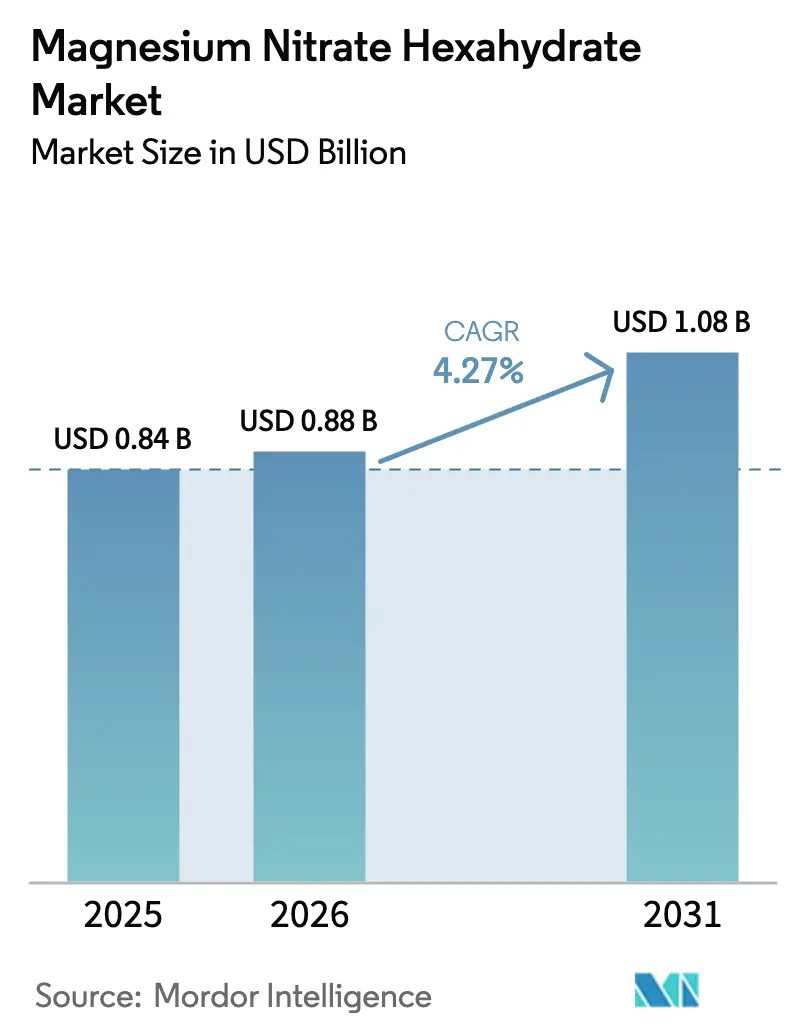
The Magnesium Nitrate Hexahydrate Market size is expected to increase from USD 0.84 billion in 2025 to USD 0.88 billion in 2026 and reach USD 1.08 billion by 2031, growing at a CAGR of 4.27% over 2026-2031. Demand growth pivots on two reinforcing factors. First, greenhouse and drip-irrigated farms are replacing calcium-ammonium nitrate with water-soluble magnesium nitrate to correct simultaneous nitrogen and magnesium deficiencies without raising soil pH, a shift that directly lifts fertilizer-grade volumes. Second, industrial users value the compound’s hygroscopicity in nitric-acid concentration, its oxidizing balance in mining explosives, and its latent-heat profile in phase-change thermal storage, which together create a recurring, diversified pull that moderates cyclical swings in the agriculture cycle. Competitive intensity remains moderate because quality specifications differ sharply between fertilizer, industrial, and reagent grades, creating natural customer lock-in and room for specialty producers to price for purity. Upstream magnesium price volatility injects margin risk, yet the supply chain is slowly regionalizing as projects in Arkansas and Brazil move closer to first metal, a development that should smooth raw-material shocks for downstream formulators by the late forecast period.
Key Report Takeaways
- By grade, fertilizers grade captured 51.28% of the magnesium nitrate hexahydrate market share in 2025, and the segment is projected to advance at a 5.03% CAGR during the forecast period (2026-2031).
- By primary function, dehydrating Agent commanded 35.22% of the 2025 revenue pool; dehydrating agent functions display the fastest trajectory at 4.78% CAGR during the forecast period (2026-2031).
- By application, fertilizers and foliar sprays accounted for 40.78% of the market in 2025, and are also expected to grow at the fastest CAGR of 4.98% during the forecast period (20261-2031).
- By end-user industry, the agriculture end-use pocket led with 41.92% allocation in 2025, while water and wastewater treatment is slated to rise at 4.88% CAGRd uring the forecast period (2026-2031).
- By region, Asia-Pacific held 25.12% of global consumption in 2025, and the region is forecast to clock a robust 4.96% CAGR to 2031 on the strength of Chinese fertilizer and chemical demand.
Note: Market size and forecast figures in this report are generated using Mordor Intelligence’s proprietary estimation framework, updated with the latest available data and insights as of January 2026.
Market Trends and Insights
Drivers Impact Analysis of Magnesium Nitrate Hexahydrate Market*
| Driver | (~) % Impact on CAGR Forecast | Geographic Relevance | Impact Timeline |
|---|---|---|---|
| Rising demand for specialty and water-soluble fertilizers | +1.2% | Global, strongest in Asia-Pacific and South America | Medium term (2-4 years) |
| Growing adoption as catalytic feedstock in fine chemicals | +0.8% | North America, Europe, East Asia | Long term (≥ 4 years) |
| Increasing use in mining explosives and detonators | +0.6% | China, India, Chile, Peru, Australia | Medium term (2-4 years) |
| Emerging use in thermal-energy-storage phase-change materials | +0.5% | Europe and North America | Long term (≥ 4 years) |
| Deployment in 3-D-printed concrete admixtures | +0.3% | North America, Europe, select Asian economies | Long term (≥ 4 years) |
| Source: Mordor Intelligence | |||
Rising Demand for Specialty and Water-Soluble Fertilizers
Precision fertigation systems allow growers to meter nutrients in line with evapotranspiration, and magnesium nitrate delivers 16% nitrogen with 9.4% magnesium in a form that stays neutral in solution. Field trials in 2026 found that 0.5% seed priming lifted maize germination by 12% under drought stress, underscoring its resilience benefit[1]Crop Science Society, “Seed Priming With Magnesium Nitrate Improves Drought Tolerance,” cropscience.org. A 6,000-ton plant opened in Brazil in 2025, enabling regional distributors to supply soluble grades with a two-week lead time instead of six, removing a historic logistics hurdle for coffee and citrus growers. Foliar studies in 2025 showed that 2% sprays boosted sweet-corn ear weight by 9% and cut blossom-end rot by 22%, proving the compound’s role in protecting marketable yield. Demand lifts in a stepwise fashion as farms install drip systems, meaning the driver’s full effect lands over a medium horizon.
Growing Adoption as Catalytic Feedstock in Fine Chemicals
Magnesium nitrate converts to high-surface-area magnesium oxide on calcination, an attribute prized for Lewis-acid catalysis. A 2025 study achieved 94% ketone-to-alcohol conversion at 120°C using oxide derived from the salt, beating palladium on cost per mole converted. Petrochemical licensors specify 2N-5N grades as supports in reforming and cracking catalysts because decomposition releases no sulfur that would poison active metals. Dehydrating qualities make it an alternative to sulfuric acid for pushing nitric acid to 95 wt%, a purity demanded in explosives and certain active pharmaceutical ingredients. Validation cycles in pharmaceuticals run four to six years, placing growth in the long-term bucket.
Increasing Use in Mining Explosives and Detonators
Security restrictions on pure ammonium nitrate have spurred interest in magnesium-nitrate-sensitized emulsions. Lab trials in 2025 recorded 8-12% higher detonation temperatures and pressures, translating into cleaner rock fragmentation and lower downstream milling energy[2]PatSnap Eureka, “Performance Comparison of Magnesium and Ammonium Nitrate Explosives,” patsnap.com. The compound is listed as a regulated precursor in the European Union, which raises paperwork but simultaneously legitimizes its performance credentials. Adoption in mines takes two to three years because field-scale shots must clear safety, dust, and overbreak metrics, so the impact falls in the medium term.
Emerging Use in Thermal-Energy-Storage Phase-Change Materials
With a melting window near 90°C and latent heat up to 162 J/g, magnesium nitrate suits industrial waste-heat capture and building hydronic loops. A 2026 composite that blended the salt with expanded graphite reached 6.86 W/mK thermal conductivity, quadruple that of the neat salt, while retaining 200 stable cycles. A pilot 140 kWh module logged 88% round-trip efficiency, proving bankable performance for district heating. Commercial roll-out waits on installer training and fire-safety codes, situating the impact in the long term.
Restraints Impact Analysis of Magnesium Nitrate Hexahydrate Market*
| Restraint | (~) % Impact on CAGR Forecast | Geographic Relevance | Impact Timeline |
|---|---|---|---|
| Health and environmental scrutiny of nitrate discharge | -0.90% | Global, with heightened enforcement in EU (Nitrates Directive 91/676/EEC) and North America (EPA MCL 10 mg/L); acute pressure in nitrate-vulnerable zones (Iowa, Brittany, Chesapeake Bay watershed) | Short term (≤2 years) |
| Volatile magnesium ore and brine supply chain pricing | -0.70% | Global, with acute exposure in North America (Great Salt Lake water-level constraints) and China (energy curtailments in Pidgeon-process smelters); secondary impact in Dead Sea brine operations | Short term (≤2 years) |
| Substitution by calcium-/ammonium-nitrate blends in fertigation | -0.50% | Europe (Spain, Netherlands greenhouse clusters), North America (California, Arizona), Middle East (Israel drip-irrigation systems); limited impact in Asia-Pacific where magnesium deficiency is more prevalent | Medium term (2-4 years) |
| Source: Mordor Intelligence | |||
Health and Environmental Scrutiny of Nitrate Discharge
The United States caps nitrate-nitrogen in drinking water at 10 mg/L, and the European Union limits groundwater nitrate to 50 mg/L, rules that force growers in vulnerable zones to trim soluble nitrate inputs or add cover crops. Municipal plants considering magnesium-nitrate coagulants must show that residual nitrate stays inside discharge permits that now often include dual phosphorus and nitrate ceilings, complicating business cases. An Environmental Protection Agency (EPA) paper in 2024 linked farm runoff to the Gulf of Mexico hypoxic zone, fast-tracking state mandates for controlled-release fertilizers that depress immediate demand. Because regulators already enforce these limits, the restraint bites in the short term.
Volatile Magnesium Ore and Brine Supply Pricing
China supplies 85% of global primary magnesium from energy-intensive Pidgeon smelters; power rationing in Shaanxi during Q3 2024 spiked metal to USD 4,000/ton, a price that raised nitrate conversion costs by up to 18%. Great Salt Lake evaporation ponds hit record lows, forcing the main US producer to invest USD 15 million in new ponds, a move that only partially offsets lower brine grade. Feedstock swings flow straight into the magnesium nitrate price stack, where raw materials represent nearly half the cost base, and contract clauses pass through jumps within six months, placing the hit squarely in the short term.
*Our forecasts treat driver/restraint impacts as directional, not additive. The impact forecasts reflect baseline growth, mix effects, and variable interactions.
Magnesium Nitrate Hexahydrate Market Segment Analysis
By Grade:
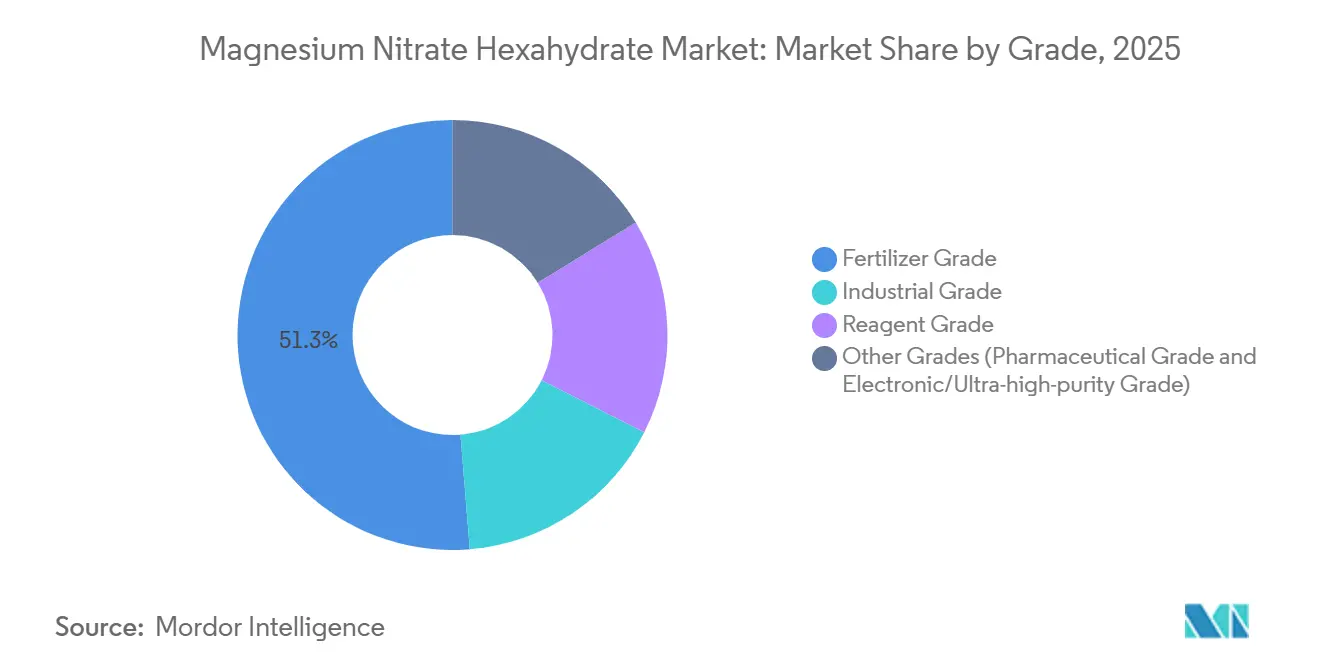
Fertilizer Grade Anchors Volume, Reagent Grade Captures Premium MarginsFertilizer Grade captured 51.28% of the magnesium nitrate hexahydrate market share in 2025 and is projected to expand at a 5.03% CAGR as protected-agriculture acreage grows and soluble blends displace bulk dolomitic lime. Industrial Grade posted slower growth because demand in nitric-acid concentration, detonators, and petrochemical catalysts is mature, yet its multi-year contracts buffer revenue during fertilizer downturns. Reagent Grade, manufactured at 98-99.5% purity, serves analytical laboratories and pharmaceutical synthesis niches where batch traceability commands premiums of 50-80% over commodity grades.
The magnesium nitrate hexahydrate market size for Reagent Grade is forecast to grow substantially as pharmaceutical validation cycles clear and demand for water-quality testing kits expands. Fertilizer Grade pricing remains tethered to global nitrogen benchmarks, but freight savings from the new Brazilian plant could widen delivered-cost spreads by 8-10%, defending margins despite volatile upstream magnesium prices. Suppliers that can swing output between grades stand to arbitrage transient price spikes, yet most facilities are purpose-built, reinforcing moderate market concentration.



By Primary Function:
Dehydrating Applications Lead, Oxidizing Demand Tied to Explosives R&DDehydrating-agent use held 35.22% of revenue in 2025 and will grow at 4.78% CAGR because pharmaceutical and explosives producers rely on up-to-95% nitric acid that the salt delivers without sulfate contamination. Oxidizing-agent volumes track mining explosives research programs, many of which sit in advanced pilots, so near-term growth is slower but could inflect if regulatory shifts keep tightening pure ammonium nitrate.
The magnesium nitrate hexahydrate market size for Solubilizing Agent roles in fertigation is set to touch a higher value, mirroring drip-irrigation acreage expansion. Catalytic-promoter demand, though under 10% of volume, is projected to post the highest margin growth as oxide nanoclusters emerge as low-cost supports in transfer-hydrogenation routes for fine chemicals. Function splits underscore a classic dual-engine profile: large agricultural tonnage plus small, high-value chemical niches.
By Application:
Fertigation Dominates, Water Treatment Emerges as High-Growth NicheFertilizers and foliar sprays delivered 40.78% of 2025 revenue, and volumes are projected to climb at 4.98% CAGR, pulled by greenhouse vegetables and tree crops that suffer acute magnesium deficiencies. Water and wastewater treatment, the smallest bucket today, is on track for a higher share in the future as utilities pilot magnesium-nitrate coagulation that slashes sludge production versus aluminum sulfate.
Explosives and propellants, despite regulatory red tape, represent a significant revenue upside scenario if field trials in copper and iron ore mining validate superior fragmentation economics. Application diversification limits downside because a demand dip in any one bucket seldom aligns with the others, insulating aggregate revenues.
By End-user Industry:
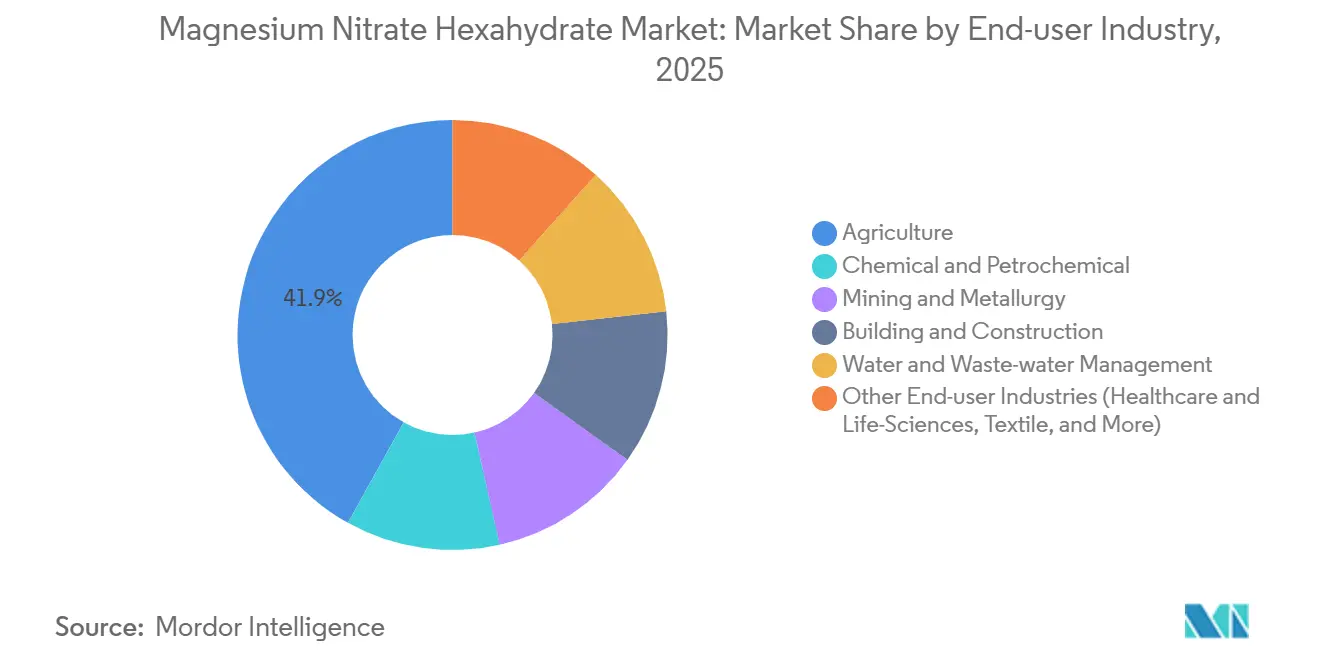
Agriculture Leads, Chemical Sector Offers Margin StabilityAgriculture consumed 41.92% of tonnage in 2025, yet price sensitivity in farming means operating margins sit 200-300 basis points below chemical and pharmaceutical sales. Chemical and petrochemical customers sign three- to five-year contracts indexed to magnesium chloride or nitric-acid benchmarks, sheltering producers from spot volatility.
The magnesium nitrate hexahydrate market size tied to water and wastewater management is projected to grow with a CAGR of 4.88% during the forecast period (2026-2031), encouraged by EU and US phosphorus mandates. Mining and metallurgy end users represent a small demand but offer strategic lift when metal prices spike. The overall portfolio blend leaves suppliers less exposed to single-sector cycles than many commodity chemical markets.
Geography Analysis
APAC Magnesium Nitrate Hexahydrate Market
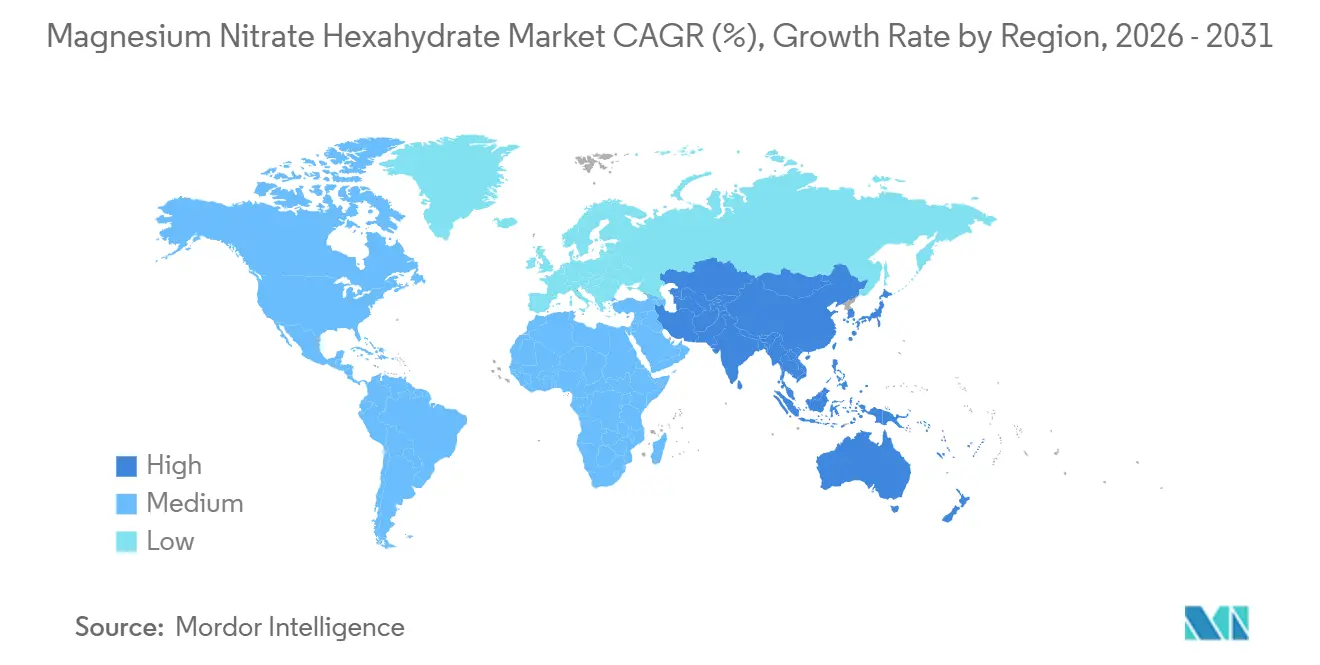
Asia-Pacific led the magnesium nitrate hexahydrate market in 2025 with 25.12% revenue and is positioned for the fastest 4.96% CAGR through 2031. China’s upstream dominance in primary magnesium secures captive feedstock for domestic nitrate producers, keeping ex-works prices 12-18% lower than imports in most months. India’s government subsidies for micro-irrigation under the Pradhan Mantri Krishi Sinchayee Yojana are catalyzing fertigation adoption among tomato and capsicum growers, accelerating soluble-grade demand. Japan and South Korea, while small in tonnage, buy high-purity reagent grades, supporting premium unit margins.
North America Magnesium Nitrate Hexahydrate Market
North America ranks second in revenue, split between the United States’ industrial and laboratory consumption and Mexico’s protected-agriculture boom. The December 2025 Defense Production Act award to build a brine-to-metal plant in Arkansas could shave 5-7% off regional nitrate production costs once operational, improving supply resilience against Chinese power curtailments. Canada’s role remains niche, focused on explosives predispersions for hard-rock mines and reagent sales to pharmaceutical plants in Ontario and Quebec.
EMEA and South America Magnesium Nitrate Hexahydrate Market
Europe posts moderate tonnage but commands high value because buyers seek reagent and coagulant grades certified to EN and REACH (Registration, Evaluation, Authorisation and Restriction of Chemicals) standards. Stricter nitrate and phosphorus directives are rotating demand from agriculture into municipal water treatment, cushioning revenue even as fertilizer tonnage flattens. South America is the fastest-expanding export destination for Israeli and Norwegian producers, following the Brazilian specialty-fertilizer plant that cut delivery lead times by a month. The Middle East and Africa lag in volume yet show upside in petrochemicals and acid-mine-drainage remediation in South African gold and coal fields.

Competitive Landscape
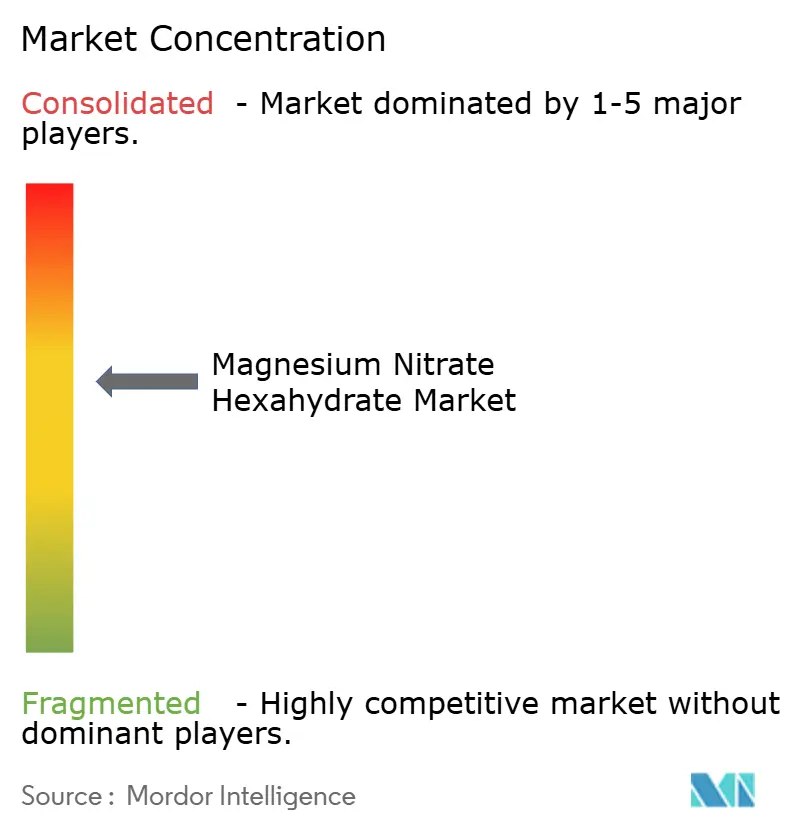
The Magnesium Nitrate Hexahydrate market is moderately concentrated. Niche players such as GFS Chemicals and Noah Chemicals remain relevant by offering lot-specific certificates of analysis for pharmaceutical and semiconductor users unwilling to qualify large-batch commodity suppliers. Patent activity has risen, with inventions covering high-surface-area magnesium agents for boron and fluoride removal, signaling that intellectual property, not just scale, will shape competitive advantages in emerging applications.
Magnesium Nitrate Hexahydrate Industry Leaders
Avantor Inc.
GFS Chemicals Inc.
Haifa Negev technologies LTD
Yara
Merck KGaA
- *Disclaimer: Major Players sorted in no particular order
Magnesium Nitrate Hexahydrate Market Companies Covered in this Report
- American Elements
- Avantor Inc.
- GFS Chemicals Inc.
- Haifa Negev Technologies LTD
- Merck KGaA
- Noah Chemicals
- Sure Chemical Co., Ltd. Shijiazhuang
- Spectrum Chemical
- Thermo Fisher Scientific Inc.
- Valudor Products, LLC
- Yara

Recent Industry Developments in Magnesium Nitrate Hexahydrate Market
- March 2026: West High Yield Resources Ltd. sealed an agreement with Galaxy Trade and Technology, LLC. This deal centers on the purchase and sale of magnesium-rich serpentine ore, sourced from West High Yield's Record Ridge Industrial Minerals Mine project in Canada. The extracted magnesium from this ore can be used for the production of Magnesium Nitrate Hexahydrate.
- June 2024: Researchers successfully synthesized magnesium borate/magnesium oxide nanostructures using magnesium nitrate hexahydrate as a precursor. These nanostructures exhibited an exceptional adsorption capacity of 505.05 mg/g, showcasing their potential for efficient water treatment applications.


Global Magnesium Nitrate Hexahydrate Market Report Scope
Magnesium nitrate hexahydrate is a highly water-soluble, white crystalline inorganic salt, primarily used as a magnesium/nitrogen fertilizer, catalyst, and laboratory reagent.
The Magnesium Nitrate Hexahydrate market is segmented by grade, primary function, application, end-user industry, and geography. By grade, the market is segmented into fertilizer grade, industrial grade, reagent grade, and other grades (pharmaceutical grade and electronic/ultra-high-purity grade). By primary function, the market is segmented into solubilizing agent, dehydrating agent, oxidizing agent, and catalyzing/promoter agent. By application, the market is segmented into fertilizers and foliar sprays, chemical synthesis and catalysts, explosives and propellants, water and waste-water treatment, concrete and construction additives, and other applications (thermal energy storage (TES), pharmaceuticals and nutraceuticals, and more). By end-user industry, the market is segmented into agriculture, chemical and petrochemical, mining and metallurgy, building and construction, water and waste-water management, and other end-user industries (healthcare and life-sciences, textile, and more). The report also covers the market size and forecasts for magnesium nitrate hexahydrate in 17 countries across major regions. The market sizes and forecasts are provided in terms of value (USD).
| Fertilizer Grade |
| Industrial Grade |
| Reagent Grade |
| Other Grades (Pharmaceutical Grade, Electronic/Ultra-high-purity Grade) |
| Solubilizing Agent |
| Dehydrating Agent |
| Oxidizing Agent |
| Catalyzing/Promoter Agent |
| Fertilizers and Foliar Sprays |
| Chemical Synthesis and Catalysts |
| Explosives and Propellants |
| Water and Waste-water Treatment |
| Concrete and Construction Additives |
| Other Applications (Thermal Energy Storage (TES), Pharmaceuticals and Nutraceuticals, etc.) |
| Agriculture |
| Chemical and Petrochemical |
| Mining and Metallurgy |
| Building and Construction |
| Water and Waste-water Management |
| Other End-user Industries (Healthcare and Life-Sciences, Textile, etc.) |
| Asia-Pacific | China |
| Japan | |
| India | |
| South Korea | |
| ASEAN Countries | |
| Rest of Asia-Pacific | |
| North America | United States |
| Canada | |
| Mexico | |
| Europe | Germany |
| United Kingdom | |
| France | |
| Italy | |
| Spain | |
| Russia | |
| NORDIC Countries | |
| Rest of Europe | |
| South America | Brazil |
| Argentina | |
| Rest of South America | |
| Middle-East and Africa | Saudi Arabia |
| South Africa | |
| Rest of Middle-East and Africa |
| By Grade | Fertilizer Grade | |
| Industrial Grade | ||
| Reagent Grade | ||
| Other Grades (Pharmaceutical Grade, Electronic/Ultra-high-purity Grade) | ||
| By Primary Function | Solubilizing Agent | |
| Dehydrating Agent | ||
| Oxidizing Agent | ||
| Catalyzing/Promoter Agent | ||
| By Application | Fertilizers and Foliar Sprays | |
| Chemical Synthesis and Catalysts | ||
| Explosives and Propellants | ||
| Water and Waste-water Treatment | ||
| Concrete and Construction Additives | ||
| Other Applications (Thermal Energy Storage (TES), Pharmaceuticals and Nutraceuticals, etc.) | ||
| By End-user Industry | Agriculture | |
| Chemical and Petrochemical | ||
| Mining and Metallurgy | ||
| Building and Construction | ||
| Water and Waste-water Management | ||
| Other End-user Industries (Healthcare and Life-Sciences, Textile, etc.) | ||
| By Geography | Asia-Pacific | China |
| Japan | ||
| India | ||
| South Korea | ||
| ASEAN Countries | ||
| Rest of Asia-Pacific | ||
| North America | United States | |
| Canada | ||
| Mexico | ||
| Europe | Germany | |
| United Kingdom | ||
| France | ||
| Italy | ||
| Spain | ||
| Russia | ||
| NORDIC Countries | ||
| Rest of Europe | ||
| South America | Brazil | |
| Argentina | ||
| Rest of South America | ||
| Middle-East and Africa | Saudi Arabia | |
| South Africa | ||
| Rest of Middle-East and Africa | ||


Key Questions Answered in the Report
How large will the magnesium nitrate hexahydrate market be by 2031?
Magnesium Nitrate Hexahydrate market is projected to reach USD 1.08 billion by 2031, climbing at a 4.27% CAGR from 2026.
Which grade captures the highest share today?
Fertilizer Grade leads with 51.28% of revenue and is also the fastest-growing grade through 2031.
What is the fastest-growing application area?
Water and wastewater treatment is advancing at a 4.88% CAGR as utilities trial magnesium-based coagulants for phosphorus removal.
Which region is set to expand the quickest?
Asia-Pacific is forecast to post the highest 4.96% regional CAGR, powered by Chinese upstream supply and Indian greenhouse expansion.
Page last updated on:


 Your data is secure and never sold or shared.


