
Hexamethylenediamine Market Size and Share
Market Overview
| Study Period | 2020 - 2031 |
|---|---|
| Market Volume (2026) | 1.52 Million tons |
| Market Volume (2031) | 1.83 Million tons |
| Growth Rate (2026 - 2031) | 3.81 % |
| Fastest Growing Market | Asia Pacific |
| Largest Market | Asia Pacific |
| Market Concentration | High |
Major Players *Disclaimer: Major Players sorted in no particular order Image © Mordor Intelligence. Reuse requires attribution under CC BY 4.0. | |
Hexamethylenediamine Market Analysis by Mordor Intelligence
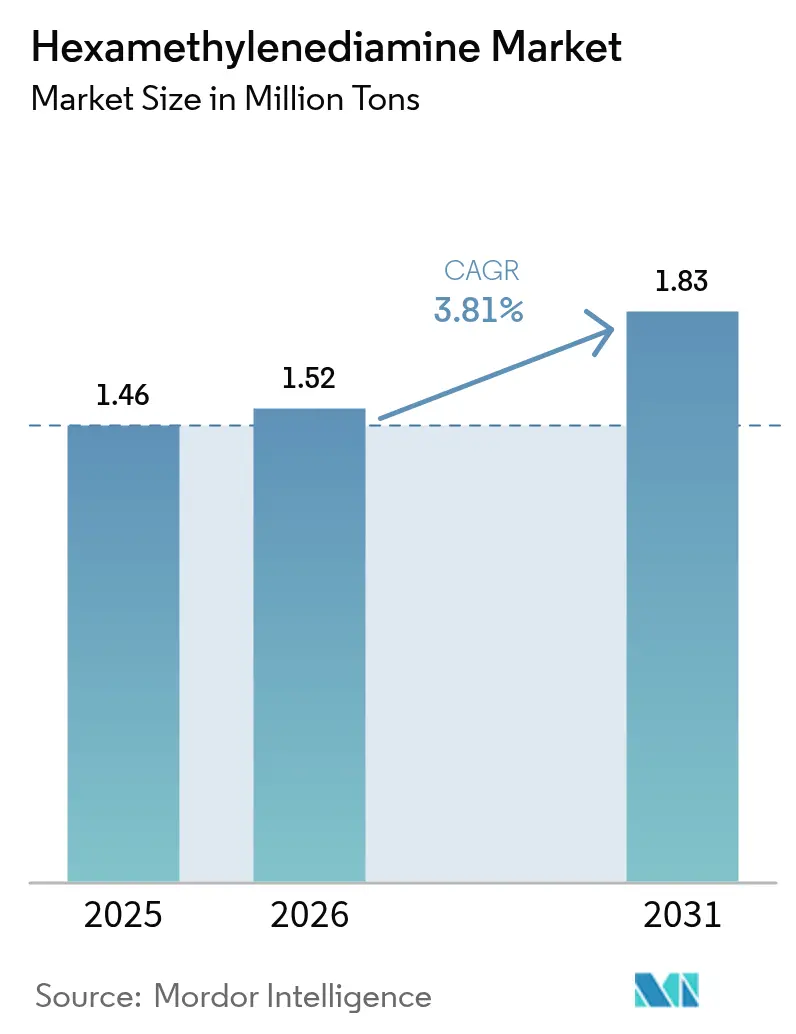
The Hexamethylenediamine market size is expected to grow from 1.46 million tons in 2025 to 1.52 million tons in 2026 and is forecast to reach 1.83 million tons by 2031 at 3.81% CAGR over 2026-2031. Demand strength is rooted in nylon 6,6 production, while capacity constraints in the adiponitrile-to-hexamethylenediamine chain are triggering fresh investment across Asia-Pacific, North America and Europe. Strategic focus on lightweight vehicle parts, the post-pandemic revival of technical textiles and the steady uptake of specialty applications such as epoxy curing agents underpin volume expansion. Producers have responded to recent supply shocks by accelerating vertical integration and by piloting bio-based feedstocks that promise lower cost and reduced emissions. At the same time, crude-linked feedstock volatility, REACH-driven amine-emission limits and scale-up risk for bio routes temper the outlook.
Key Report Takeaways
- By application, nylon production led with 77.65% of hexamethylenediamine market share in 2025; other applications are projected to grow at a 4.92% CAGR to 2031.
- By grade, standard industrial grade commanded 70.95% share of the hexamethylenediamine market size in 2025; bio-based grade is forecast to post the fastest 5.47% CAGR between 2026-2031.
- By end-use industry, the automotive segment held 45.15% of the hexamethylenediamine market size in 2025, while other end-user industries are expected to expand at 5.33% CAGR through 2031.
- By geography, Asia-Pacific accounted for 51.74% of the hexamethylenediamine market share in 2025; the region is set to register a 4.82% CAGR over 2026-2031.
Note: Market size and forecast figures in this report are generated using Mordor Intelligence’s proprietary estimation framework, updated with the latest available data and insights as of 2026.
Market Trends and Insights
Drivers Impact Analysis of Hexamethylenediamine Market*
| Driver | (~) % Impact on CAGR Forecast | Geographic Relevance | Impact Timeline |
|---|---|---|---|
| Increasing consumption of Nylon 6,6 in lightweight vehicle parts | +1.2% | Global, with concentration in Asia-Pacific and North America | Medium term (2-4 years) |
| Rapid capacity additions for adiponitrile-to-HMDA | +0.8% | Asia-Pacific core, spill-over to North America | Short term (≤ 2 years) |
| Shift towards bio-based adiponitrile feedstocks | +0.6% | Europe and North America leading, Asia-Pacific following | Long term (≥ 4 years) |
| Emergence of hexamethyldiaamine-based epoxy curing agents | +0.4% | Global, with early adoption in specialty applications | Medium term (2-4 years) |
| Growing demand for hexamethyldiaamine from textile industry | +0.7% | Asia-Pacific dominant, emerging in South America | Short term (≤ 2 years) |
| Source: Mordor Intelligence | |||
Increasing Consumption of Nylon 6,6 in Lightweight Vehicle Parts
Automotive light-weighting targets are accelerating nylon 6,6 adoption, and the downstream pull-through is boosting the hexamethylenediamine market. Vehicle makers value polyamide’s strength-to-weight ratio, heat resistance and recyclability, particularly for battery-electric models where mass directly affects range. Asia-Pacific OEMs are ramping nylon intake manifold and structural-member usage alongside regional polyamide capacity additions, tightening regional balances and rewarding integrated suppliers. In North America, Tier-1 suppliers are redesigning engine-bay components around nylon 6,6 to cope with turbo-charging heat loads. The material substitution trend is therefore driving a structural, rather than merely cyclical, uplift in hexamethylenediamine demand.
Rapid Capacity Additions for Adiponitrile-to-HMD
Supply shocks in 2024 exposed reliance on a handful of adiponitrile units. Producers reacted by green-lighting de-bottlenecks and grass-roots lines that push integrated adiponitrile-hexamethylenediamine capacities higher in China, the Gulf Coast and Western Europe. INVISTA’s Maitland restart and Ascend’s 90 kt/y Alabama build-out epitomize the trend. While the wave will ease feedstock tightness, it also risks short-term oversupply and sharper regional price swings. Still, most operators deem the capex justified to safeguard downstream nylon economics and capture proximity advantages in Asia-centric end-use clusters.
Shift Toward Bio-Based Adiponitrile Feedstocks
Policy pressure on Scope-3 emissions is turning bio-routes from pilot curiosity into mainstream investment priority. Covestro-Genomatica’s milestone run of bio-HMD demonstrates cost parity potential against petro routes when renewable carbon credits are priced in. Europe’s decarbonization incentives shorten payback periods, prompting early-stage feasibility work in North America and, increasingly, China. Life-cycle assessments show 50-70% lower greenhouse-gas footprints, an advantage that appeals to automotive and apparel brands targeting net-zero supply chains. The competitiveness hinge remains fermentation scale-up and feedstock logistics, yet the directional shift is clear: bio-based platforms will re-shape long-term cost curves and market positioning.
Emergence of HMD-Based Epoxy Curing Agents
Beyond nylon, specialty demand is surfacing in advanced adhesives, composite resins and antimicrobial coatings. Evonik’s thermo-latent systems illustrate how HMD contributes flexibility without sacrificing glass-transition temperature, enabling crash-resistant structural bonding[1]. Marine-sector coatings exploit the diamine’s chain structure to deliver long-lasting biofouling resistance, a feature attracting shipyards seeking reduced maintenance costs. Specialty volumes remain modest compared with nylon, but margin uplift exceeds 25% versus commodity grades, making this diversification a strategic hedge for producers facing nylon price cyclicality.
Restraints Impact Analysis of Hexamethylenediamine Market*
| Restraint | (~) % Impact on CAGR Forecast | Geographic Relevance | Impact Timeline |
|---|---|---|---|
| Volatility in crude-derived adiponitrile prices | -0.9% | Global, with acute impact in import-dependent regions | Short term (≤ 2 years) |
| Scale-up risk for bio-based hexamethyldiaamine technologies | -0.5% | Europe and North America leading adoption | Medium term (2-4 years) |
| Stringent REACH restrictions on amine emissions | -0.3% | Europe primary, with spillover to other regions | Long term (≥ 4 years) |
| Source: Mordor Intelligence | |||
Volatility in Crude-Derived Adiponitrile Prices
Because adiponitrile tracks crude-naphtha spreads, upstream price shifts transmit quickly to hexamethylenediamine contract settlements, squeezing unintegrated players. The 2015 China plant accident underscored concentration risk, and subsequent refinery outages kept spot premiums wide. Import-heavy Europe feels swings most acutely, amplifying margin pressure on captive nylon spinners. Currency movement adds another layer: a weak euro inflates dollar-indexed feedstocks, further eroding competitiveness. These factors spur back-integration projects and intensify interest in bio-routes that decouple cost from oil volatility.
Scale-Up Risk for Bio-Based HMD Technologies
Fermentation yields above 99% in lab settings rarely translate seamlessly to 100 kt/y reactors. Contamination control, oxygen transfer and feedstock pre-treatment each introduce costly engineering work-arounds. Financing remains complicated by longer validation cycles and uncertain offtake commitments, slowing final investment decisions despite favorable ESG narratives. Regulatory approvals for novel enzymes add time and expense, especially in regions without harmonized biotech codes. Consequently, bio-HMD could capture single-digit share by 2030, but timelines may slip if pilot-to-commercial hurdles prove steeper than anticipated.
*Our forecasts treat driver/restraint impacts as directional, not additive. The impact forecasts reflect baseline growth, mix effects, and variable interactions.
Hexamethylenediamine Market Segment Analysis
By Application:
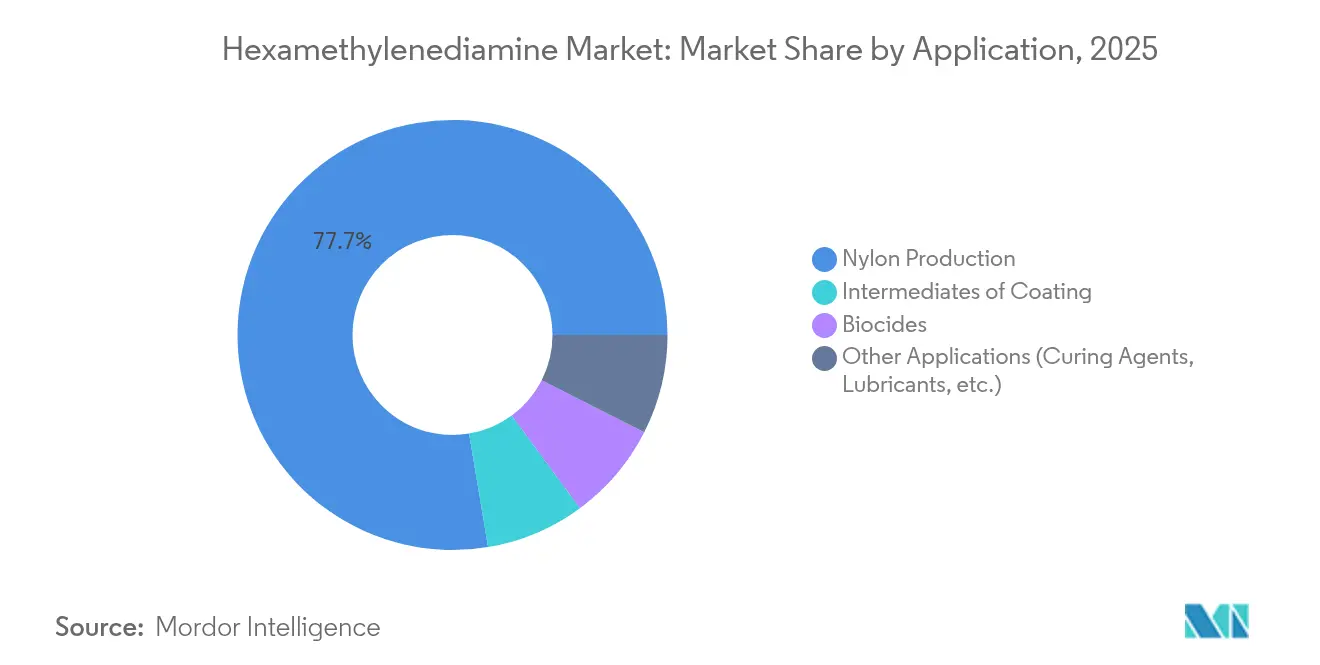
Nylon Dominance with Emerging Specialty MomentumNylon production retained a commanding 77.65% slice of the hexamethylenediamine market in 2025. The segment’s volume translates to 1.13 million tons, supported by automotive under-the-hood parts and carpet fibers. This pool underpins the largest absolute demand increment over the forecast horizon, but its CAGR trails at 3.54%. In contrast, specialty uses such as epoxy curing agents and biocide intermediates are expanding at a 4.92% pace, lifting their share of the hexamethylenediamine market size from 0.34 million tons in 2026 toward 0.43 million tons in 2031.
Diversification into higher-margin niches mitigates revenue exposure to nylon price cycles. Producers supply formulation-ready grades that shorten customer qualification time, reinforcing switching costs. The approach also leverages existing purification trains, so incremental capex stays low relative to returns. As a result, specialty penetration is expected to continue outpacing base-polymer growth across all regions.

By Grade:
Standard Volume, Bio-Based UpsideStandard industrial grade remains the workhorse with 70.95% of 2025 demand, translating to about 1.04 million tons. Producers optimize this stream for balanced purity and cost, fitting nylon salt specifications. High-purity grade, at 17.72%, serves electronics and pharmaceutical uses that tolerate no trace metals. Meanwhile, bio-based grade, still niche at 11.33%, is scaling at a 5.47% CAGR on the back of brand owner sustainability goals.
The hexamethylenediamine market share shift toward bio variants accelerates once 50 kt/y fermentation lines reach nameplate throughput, a milestone anticipated in 2027. Early adopters can charge 10-15% premiums, offsetting higher initial unit costs. Long term, process learning curves and renewable-credit monetization could position bio-HMD at the low end of the global cost curve.
By End-Use Industry:
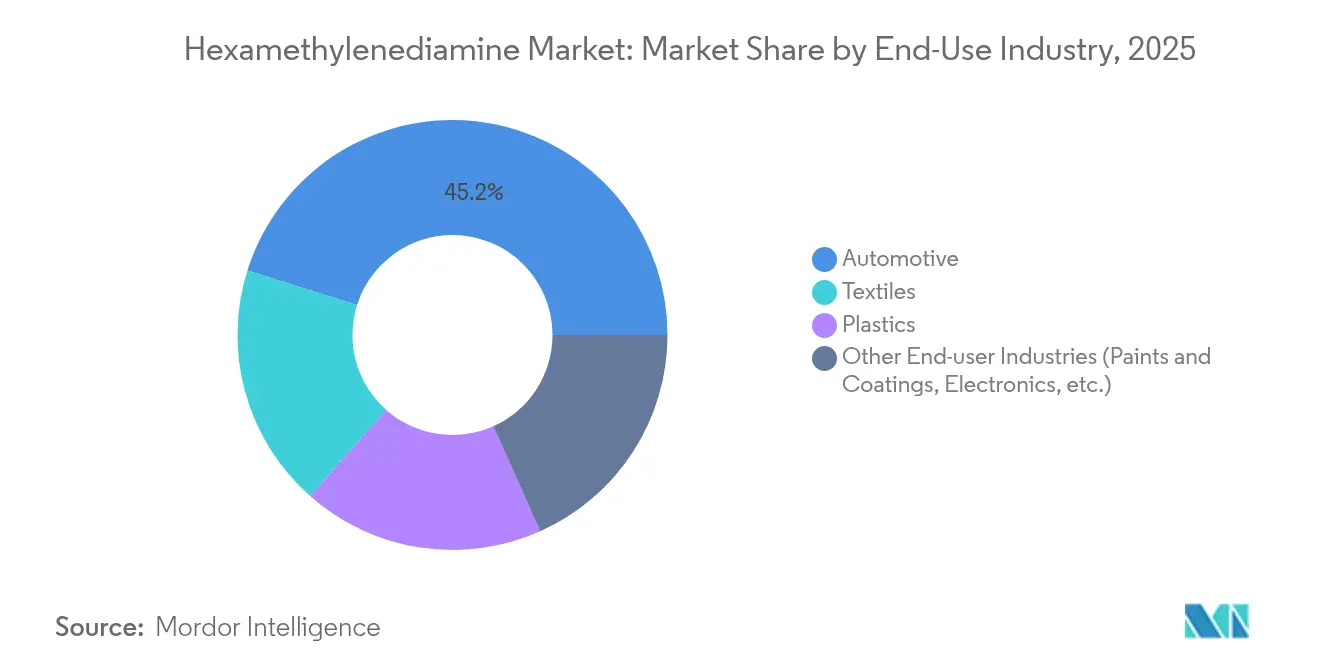
Automotive Leadership, Broader Sector UptakeAutomotive accounted for 45.15% of the hexamethylenediamine market size, or roughly 0.66 million tons in 2025, anchored by nylon 6,6 structural components. Electrification reinforces this pull as every 10 kg removed from a battery-electric car can add up to 0.7% driving range. Yet, other end-user industries—encompassing electronics, healthcare and marine—are on track for a 5.33% CAGR. Their aggregate share rises from 0.28 million tons in 2026 to 0.36 million tons by 2031.
Textiles, the historic second pillar, experiences mid-single-digit growth on the back of high-tenacity industrial yarns and technical fabrics, while engineered plastics cover consumer-goods housings and small appliances. These broader avenues cushion producers from cyclical auto build rates and diversify regional revenue mixes.
Geography Analysis
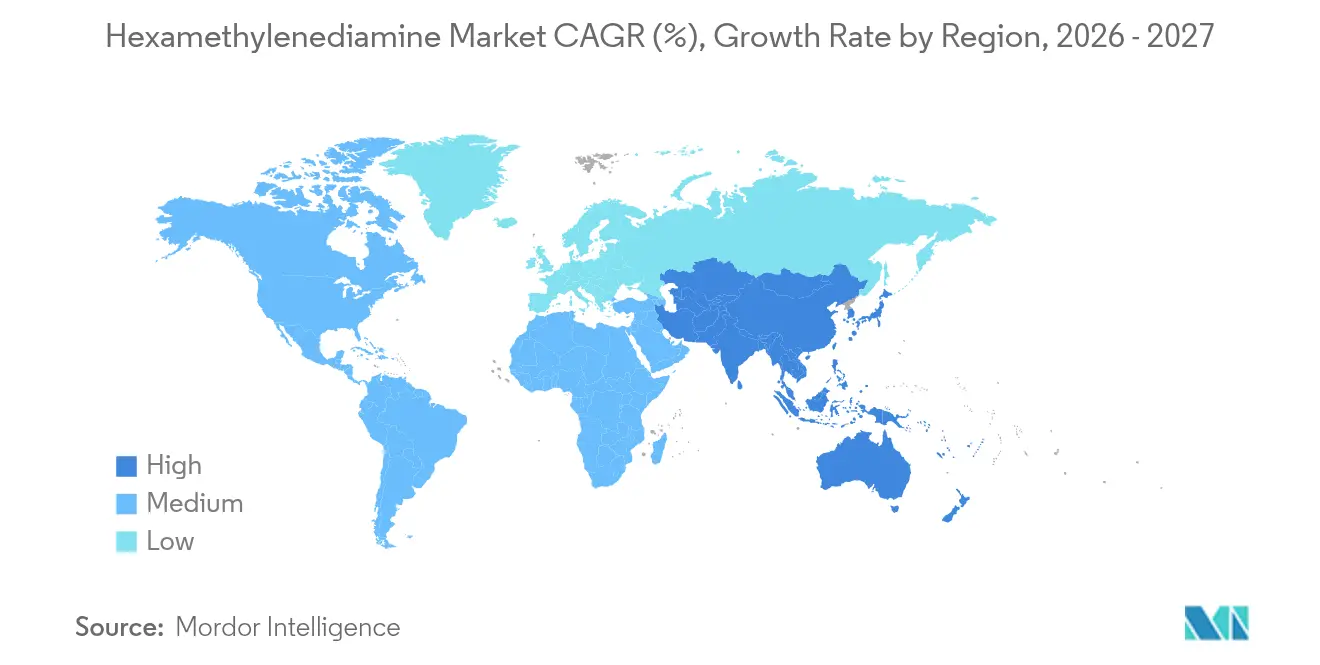
APAC Hexamethylenediamine Market
Asia-Pacific’s 51.74% stake in the hexamethylenediamine market reflects China’s integrated refinery-to-nylon ecosystem and the region’s outsized automotive and textile sectors. Regional demand rises at a 4.82% CAGR, lifting volume from 0.79 million tons in 2026 to nearly 0.99 million tons by 2031. Governments promote advanced materials clusters, and proximity to adipic-acid feedstock shortens supply lines. Investments such as INVISTA’s RMB 1.75 billion capacity doubling in Shanghai anchor the local supply chain and strengthen competitiveness.
North America Hexamethylenediamine Market
North America’s share is underpinned by shale-advantaged feedstocks and captive automotive resin demand. Yet, cost competition from imports and recent bankruptcy proceedings at a major producer underscore vulnerability to price cycles. Producers emphasize high-purity and bio-based grades to defend margins and secure offtake from electronics and medical OEMs.
Europe Hexamethylenediamine Market
Europe is focusing on sustainability and specialty niches. BASF’s new 260 kt/y French plant integrates advanced purification and energy-efficient reactors that align with tightening decarbonization directives. REACH restrictions on amine emissions are stricter than other regions, raising compliance costs yet providing a non-price competitive moat for local output.
MEA and South America Hexamethylenediamine Market
South America plus the Middle East and Africa both regions leverage competitive gas economics and expanding downstream plastics demand. Brazil’s automotive-production rebound and Saudi Arabia’s chemicals diversification initiatives open windows for regional HMD units, albeit from a small base. Political and logistical risk keeps growth moderate compared with Asia-Pacific, but cross-border joint ventures are positioning to tap these frontier volumes.
Regulatory Landscape
Hexamethylenediamine (CAS 124-09-4) is regulated as an industrial chemical in major consuming regions, with compliance tied to chemical-inventory status and hazard communication. In the European Union, hexamethylenediamine is a registered substance under REACH (EC No 1907/2006), which drives ongoing obligations on data maintenance and safe-use conditions across the supply chain.
In the United States, hexamethylenediamine appears on EPA systems that support chemical identity and inventory status, including TSCA inventory screening. State-level air permitting can add practical constraints for producers and downstream processors handling volatile or corrosive amines, and the Texas Commission on Environmental Quality (TCEQ) publishes health-based toxicity factors used in permitting and monitoring reviews. EPA reporting requirements under TSCA also evolve over time, and in May 2026 EPA extended the reporting deadline to May 21, 2027 for 16 chemicals subject to TSCA Section 8(d) health and safety data reporting.
Value Chain Analysis
The upstream value chain is built around adiponitrile (ADN) feedstocks that produce HMDA via catalytic hydrogenation, with ADN typically derived from butadiene-based hydrocyanation or routes linked to acrylonitrile chemistry. HMDA production relies on high-pressure hydrogenation with metal catalysts and ammonia to control selectivity. This process intensity, along with tight impurity control needs for nylon salt and high-purity grades, tends to concentrate supply in large, integrated complexes rather than merchant tolling.
Midstream dynamics are influenced by vertical integration and logistics. Leading producers commonly pair ADN and HMDA with downstream nylon 6,6 or polyurethane intermediates to reduce exposure to crude-linked feedstock volatility and to secure offtake, aligning with the report context that highlights investment and integration moves after recent supply shocks in the ADN-to-HMDA chain. Downstream, nylon 6,6 is the largest pull-through (the dominant application in the report), while specialty streams such as epoxy curing agents and other intermediates require consistent quality and documentation. Distribution is typically a mix of long-term contracts for polymer-grade volumes and spot sales for merchant HMDA, where regional balances and plant outages can shift pricing and availability quickly.
Competitive Landscape
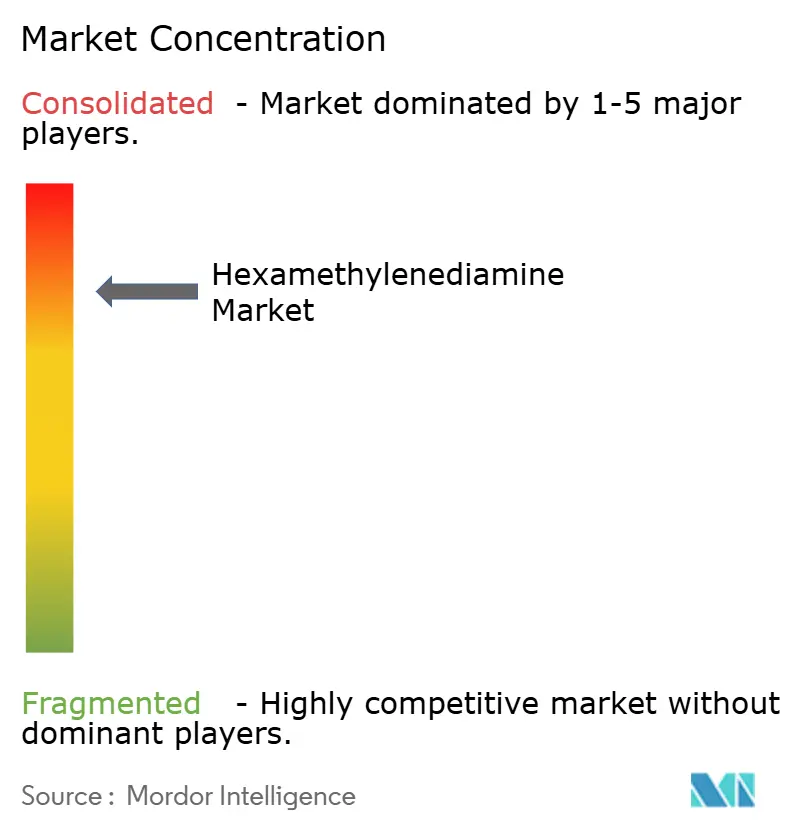
Global supply is consolidated around six integrated groups controlling roughly 65% of capacity. Scale economies in high-pressure nitrile hydrogenation, plus the need for captive adiponitrile, create natural entry barriers. Recent deals reinforce this structure: BASF bought Solvay’s polyamide assets then secured DOMO’s Alsachimie stake to lock in upstream intermediates, while INVISTA divested selected downstream nylon lines to focus on feedstock integration. Chinese state-backed entrants are adding capacity aggressively, intensifying margin pressure on legacy Western plants.
Competitive strategy is tilting toward process innovation and green chemistry. Patents covering low-energy hydrogenation catalysts, continuous purification and solvent recycling are climbing, offering cost and ESG advantages. Partnerships such as Covestro-Genomatica aim to commercialize bio-routes at world-scale, potentially resetting cost curves by late decade. On the specialty front, Evonik and Mitsubishi Gas Chemical tailor high-purity and latent-curing grades that fetch 25-40% price premiums over bulk material. In this evolving arena, diversified portfolios and access to bio-feedstock technology will determine long-term winners.
Hexamethylenediamine Industry Leaders
-
Ascend Performance Materials
-
INVISTA (Koch)
-
Henan Shenma Nylon Chemical
-
BASF SE
-
Radici Group
- *Disclaimer: Major Players sorted in no particular order
Hexamethylenediamine Market Companies Covered in this Report
- Ascend Performance Materials
- BASF
- Cathay Biotech Inc.
- Dow
- DOMO Chemicals
- Evonik Industries AG
- Genomatica Inc.
- INVISTA
- Radici Partecipazioni SpA
- Solvay
- Shenma Industrial Co. Ltd
- Spectrum Chemical
- Thermo Fisher Scientific Inc.
Market Opportunities and Future Outlook
Capacity additions and route innovations have expanded supply options across the ADN-to-HMDA chain. BASF started up a 260,000 metric tons per year HMDA plant at Chalampe, France in June 2025, strengthening European supply options while operating under tighter REACH compliance requirements. In China, Wanhua Chemical commissioned a 180,000 tons per year HMDA project in April 2024, supporting its downstream HDI and related chains and reinforcing continued demand for integrated precursor capacity tied to coatings and engineered materials.
A second track involves alternative production routes that bypass the conventional ADN step, potentially reducing dependency on constrained intermediates and changing cost positioning for both new entrants and incumbents that license or develop proprietary processes. In 2026, multiple Chinese producers disclosed progress on caprolactam-to-hexamethylenediamine pathways, including commissioning activity by China Xuyang Group (50,000 tons per year unit) and full-line connectivity achieved by Yongrong Technology (30,000 tons per year project). Alongside route innovation, specialty-grade pull from epoxy curing agents and higher-purity end uses creates a margin-led diversification lane for producers investing in purification and application support, complementing the dominant nylon 6,6 demand base emphasized in the report.
Recent Industry Developments in Hexamethylenediamine Market
- May 2026: Wanhua Chemical and Henan Pingmei Shenma established Huashen New Materials (Henan) Co., Ltd. to deepen integration across the nylon industrial chain. The entity was registered May 26, 2026 and links upstream intermediates to downstream polymer applications under a coordinated structure, supporting feedstock security and faster scale-up of new nylon-precursor capacity in China.
- June 2025: Ascend Performance Materials commenced an orderly wind-down of its HMD production facility in Lianyungang, China. The wind-down reduces regional merchant supply and redirects sourcing toward other integrated producers.
- July 2024: INVISTA announced a USD 23 million investment at its Maitland site, supporting reliability and capability upgrades tied to its nylon 6,6 intermediates chain. The investment strengthens operating resilience for an integrated producer and helps buffer downstream customers from disruption risk in the ADN-to-HMD supply corridor.
Hexamethylenediamine Market Report Scope and Research Methodology
Market Definition and Coverage
For this study, the market is defined as the total demand for hexamethylenediamine (HMDA) across major consuming industries, tracked in volume terms and aggregated across regions into a global total.
Scope exclusions: We exclude downstream nylon and coatings product revenues, and we count only HMDA itself (not adjacent diamines or isocyanates).
Segments Covered in This Report
- By Application
- Nylon Production
- Intermediates of Coating
- Biocides
- Other Applications (Curing Agents, Lubricants, etc.)
- By Grade
- Standard Industrial Grade
- High-Purity Grade
- Bio-based Grade
- By End-use Industry
- Automotive
- Textiles
- Plastics
- Other End-user Industries (Paints and Coatings, Electronics, etc.)
- By Geography
- Asia-Pacific
- China
- India
- Japan
- South Korea
- Thailand
- Indonesia
- Vietnam
- Malaysia
- Philippines
- Rest of Asia-Pacific
- North America
- United States
- Canada
- Mexico
- Europe
- Germany
- United Kingdom
- France
- Italy
- Spain
- Russia
- NORDIC Countries
- Turkey
- Rest of Europe
- South America
- Brazil
- Argentina
- Colombia
- Rest of South America
- Middle-East and Africa
- Saudi Arabia
- United Arab Emirates
- Qatar
- South Africa
- Nigeria
- Egypt
- Rest of Middle-East and Africa
- Asia-Pacific
Data Sources, Market Sizing, and Validation
Desk Research
Desk work focused on building the supply and demand context that can be checked against a volume-based market. We referenced public materials such as USGS and national statistics offices for chemical production signals, UN Comtrade for trade flows that help sense-check regional availability, and customs and port releases where available for short-term disruptions.
We also used sources such as safety and regulatory registries (for example, EPA and ECHA listings), peer-reviewed polymer and chemical engineering journals for process and yield context, and trade association publications linked to polyamides and chemicals. Company annual reports, investor presentations, and plant announcements helped map capacity changes, turnarounds, and integration shifts. Where needed, a paid subscription for company financials and a patent database were used to clarify ownership structures and technology direction. These examples are not exhaustive, and many other public sources were also reviewed for data collection, validation, and clarification.
Primary Interviews and Surveys
Primary inputs came from interviews and structured surveys with participants across the HMDA value chain, including producers, distributors, and downstream users in nylon and coatings intermediates. Since this is a global market, outreach was balanced across APAC, EMEA, and the Americas so assumptions on operating rates, import dependence, and demand swings could be compared against local views.
We used respondent input to refine how producers describe utilization, how traders map HMDA shipments by region, and how end users distinguish HMDA from adjacent intermediates when reporting consumption.
Distribution of primary research fieldwork respondents
| Company type | Respondent position | Region |
|---|---|---|
| Top tier: 27% | CXOs: 15% | APAC: 47% |
| Mid tier: 57% | Functional/Unit leaders: 27% | EMEA: 31% |
| Smaller Players: 16% | Managers: 58% | Americas: 22% |
Market-Sizing & Forecasting
Sizing was built using a top-down approach where global and regional HMDA volumes are reconstructed from demand pools tied to nylon 6,6 chain consumption and other HMDA-consuming applications, and then validated against trade visibility and supply-side constraints. To keep the totals realistic, we also ran selective bottom-up checks using sampled capacity by site, typical operating rates, and indicative shipment splits by region, which helped adjust for gaps where direct reporting is thin.
Key inputs used in the model included nylon 6,6 related production trends, announced capacity additions and shutdowns in the adiponitrile to HMDA chain, regional import share signals from customs statistics, typical conversion yields for major processes, and end-use demand indicators from automotive and industrial activity. Forecasting relied mainly on scenario analysis supported by expert consensus on capacity timing, utilization normalization, and downstream substitution risk, and then the scenarios were translated into year-by-year volumes. When a segment or country datapoint could not be confirmed, it was imputed using nearby markets with similar end-use mix and then rechecked during primary follow-ups.
Data Validation & Update Cycle
Outputs were cross-checked against independent signals such as capacity announcements, trade balances, and downstream nylon activity so the final series did not drift away from what the market can physically supply and absorb. Variances that exceeded expected bands were reviewed, assumptions were revisited, and respondents were re-contacted when a change looked structural rather than temporary.
A multi-step internal review is completed before sign-off, and the report is refreshed annually, with interim updates added when material events occur (for example, a major plant outage or a confirmed new line start-up). Before delivery, we do a final pass to ensure the latest public updates and validated inputs are reflected in the numbers.
Mordor Intelligence's Hexamethylenediamine Market Size Compared Against Other Published Estimates
Published market sizes for HMDA can look far apart because some sources report revenue and others report volume, and the boundary between HMDA and downstream nylon value is not always kept clean. Differences also show up when base years are not aligned and when currency conversion timing or inflation assumptions are applied differently.
Capacity additions and the nylon 6,6 demand signals are the checks that keep Mordor Intelligence tied to a volume-defined HMDA total of 1.52 million tons (2026), instead of drifting into downstream polymer revenues. In addition, some publishers appear to use aggressive pricing ramps or mix in related intermediates, which can lift the headline USD figure even if physical volumes are similar.
Benchmark comparison
| Source | Market Size | Gaps in Research Methodology |
|---|---|---|
| Mordor Intelligence | USD 1.52 M (2026) | |
| Global Research Publisher A | USD 8.32 B (2024) | Reported in revenue terms and appears to reflect a broader value pool that can be influenced by price swings, mix shifts, and possible inclusion of downstream polymer value, which makes it hard to reconcile to a pure HMDA volume series. |
| Industry Analyst Group B | USD 6.62 B (2025) | Uses a different base year and a USD-denominated framing that is sensitive to assumed average pricing and exchange-rate timing, and the disclosed scope does not clearly separate HMDA from downstream applications. |
The spread in published values is mostly explained by unit choice and boundary control, not by a sudden change in end-market reality. By keeping the estimate traceable to demand indicators and supply feasibility, the final number stays reproducible and easier to update when new capacity or trade data is confirmed.
Key Questions Answered in the Report
What is the current size of the hexamethylenediamine market
The hexamethylenediamine market stands at 1.52 million tons in 2026 and is projected to reach 1.83 million tons by 2031.
Which application dominates demand?
Nylon production accounts for 77.65% of global demand, making it the primary volume outlet for hexamethylenediamine.
Which region holds the largest share?
Asia-Pacific leads with 51.74% of global volume thanks to China’s integrated nylon supply chain and expanding automotive production.
How fast is bio-based hexamethylenediamine growing?
Bio-based grade is forecast to post a 5.47% CAGR between 2026-2031 as sustainability regulations and brand commitments drive adoption.
What are the main restraints on market growth?
Crude-linked adiponitrile price volatility and the technical scale-up risk of bio-based technologies are the two most significant headwinds.