
Liquid Nitrogen Market Size and Share
Market Overview
| Study Period | 2020 - 2031 |
|---|---|
| Market Volume (2026) | 309.79 Million tons |
| Market Volume (2031) | 371.62 Million tons |
| Growth Rate (2026 - 2031) | 3.71 % |
| Fastest Growing Market | Asia Pacific |
| Largest Market | Asia Pacific |
| Market Concentration | Medium |
Major Players *Disclaimer: Major Players sorted in no particular order Image © Mordor Intelligence. Reuse requires attribution under CC BY 4.0. | |
Liquid Nitrogen Market Analysis by Mordor Intelligence
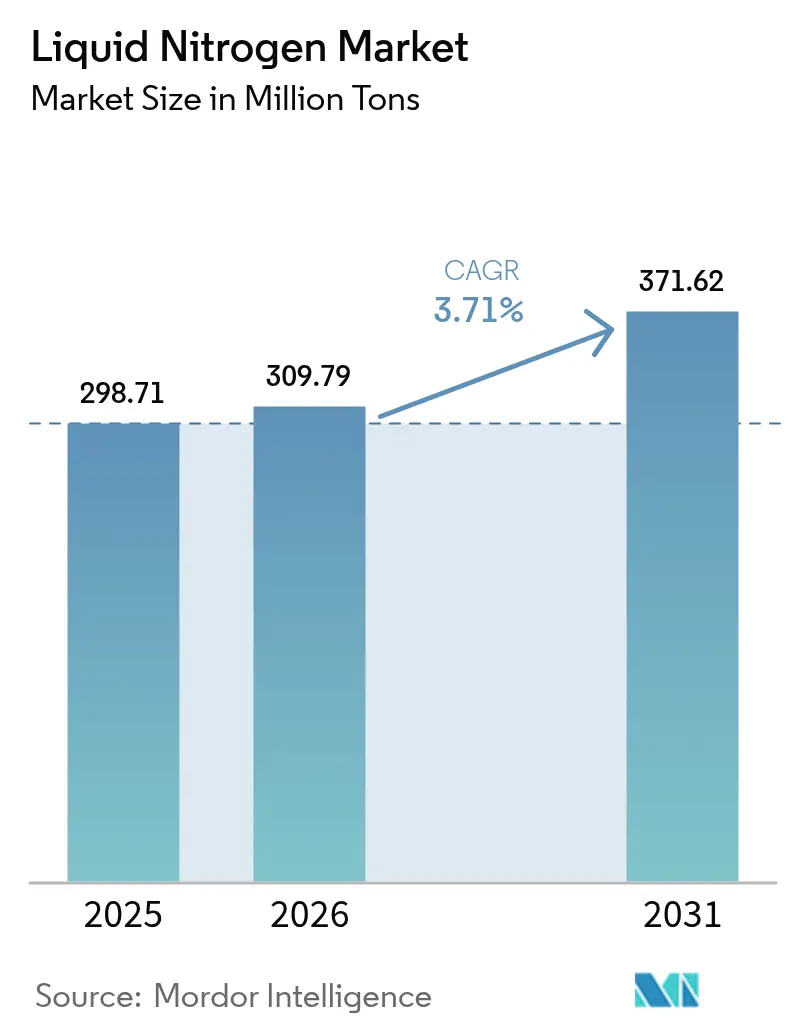
The Liquid Nitrogen Market size in 2026 is estimated at 309.79 Million tons, growing from 2025 value of 298.71 Million tons with 2031 projections showing 371.62 Million tons, growing at 3.71% CAGR over 2026-2031. This healthy expansion underscores the liquid nitrogen market’s evolution from a bulk refrigerant business toward high-value, application-engineered solutions in pharmaceuticals, electronics, and superconducting infrastructure where technical substitutes remain limited[1]Air Liquide, “2024 Universal Registration Document,” airliquide.com. Structural demand is further anchored by long-term supply contracts between air-separation unit operators and anchor customers that view ultra-low-temperature reliability as mission-critical. Asia-Pacific sets the pace, supported by China’s semiconductor build-out and India’s biologics capacity, while North America and Europe preserve demand through biologics cold-chain investments and outpatient oncology adoption. On the supply side, vertically integrated majors deploy digital logistics platforms and energy-efficient plants that compress delivered cost and improve service certainty. Mid-sized regional firms carve out pockets of growth in specialty food processing and laboratory services, illustrating that a balanced ecosystem sustains competitive intensity without suppressing innovation.
Key Report Takeaways
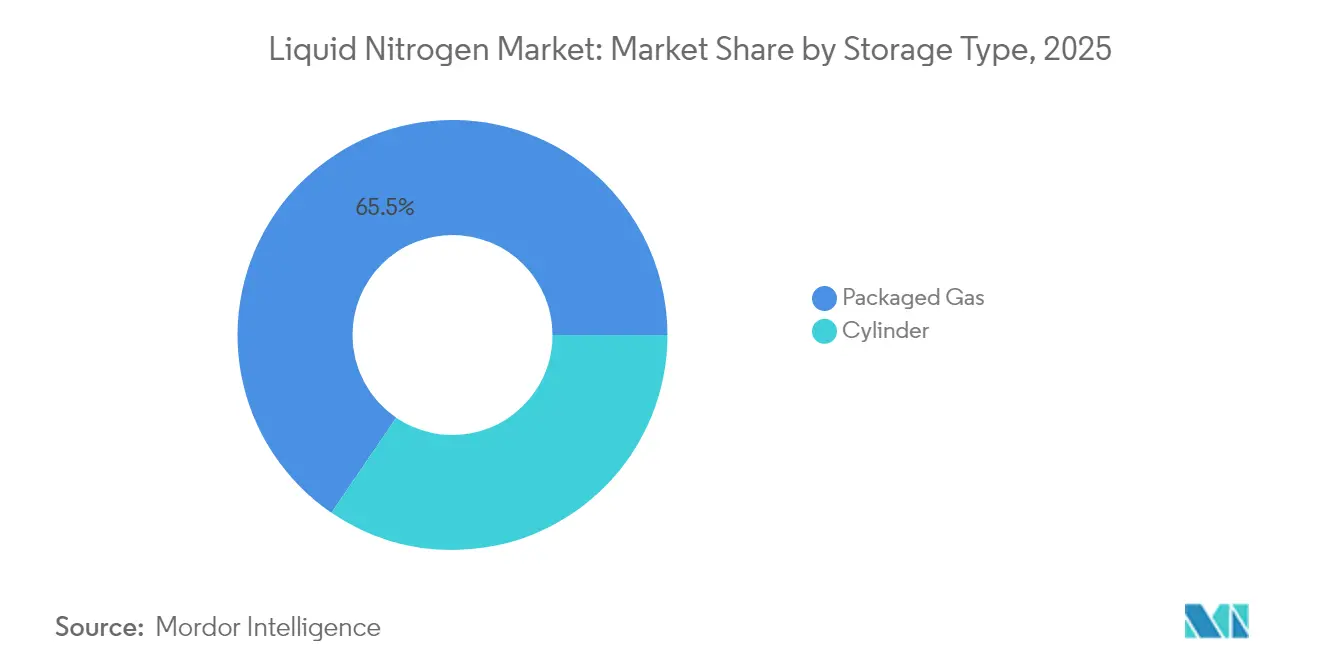
- By storage type, packaged gas held 65.48% of the Liquid Nitrogen market share in 2025, whereas cylinder storage is projected to expand at a 4.15% CAGR through 2031.
- By function, coolant applications commanded 57.72% share of the Liquid Nitrogen market size in 2025, while refrigerant use is advancing at a 4.63% CAGR to 2031.
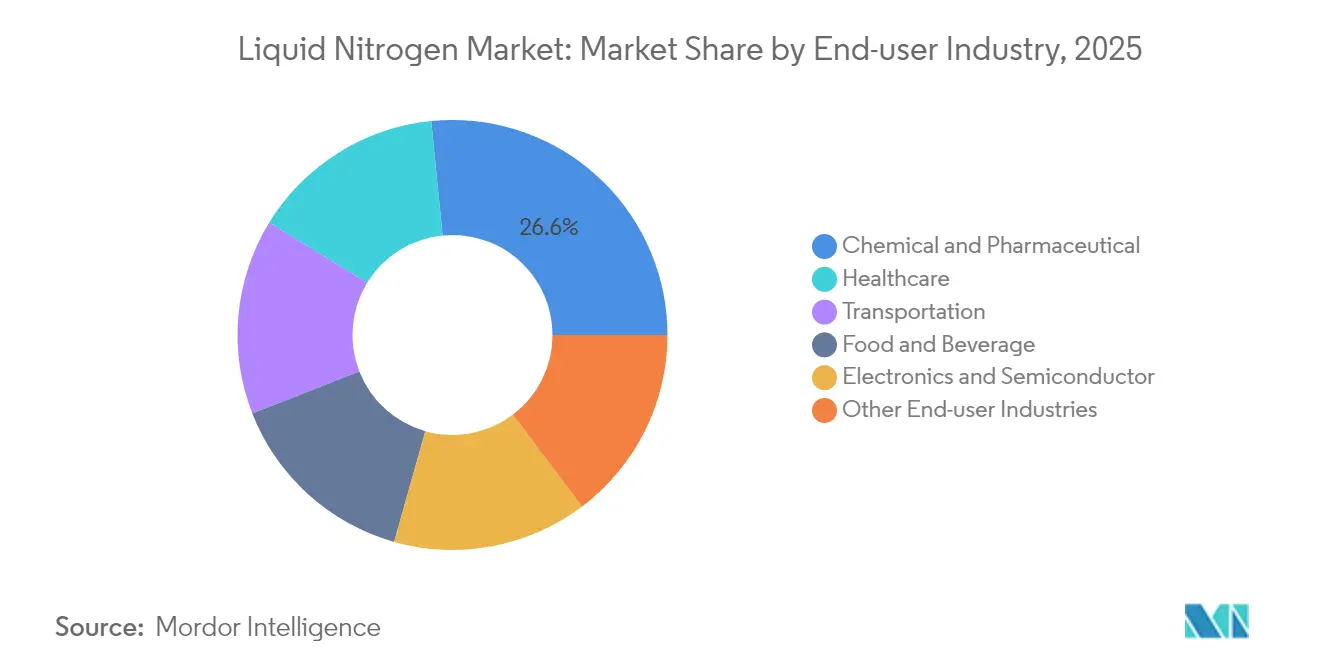
- By end-user industry, the chemical and pharmaceutical segment accounted for 26.58% of the Liquid Nitrogen market size in 2025, and the food and beverage segment is growing fastest at a 4.82% CAGR through 2031.
- By geography, Asia-Pacific led with 46.10% revenue share in 2025 and is forecast to grow at a 4.36% CAGR to 2031.
Note: Market size and forecast figures in this report are generated using Mordor Intelligence’s proprietary estimation framework, updated with the latest available data and insights as of 2026.
Market Trends and Insights
Drivers Impact Analysis of Liquid Nitrogen Market*
| Driver | (~) % Impact on CAGR Forecast | Geographic Relevance | Impact Timeline |
|---|---|---|---|
| Increasing demand from chemical and pharmaceutical industry | +0.8% | Global, with concentration in North America & APAC | Medium term (2-4 years) |
| Cryogenic logistics expansion for biologics cold-chains | +0.6% | North America & EU core, expanding to APAC | Long term (≥ 4 years) |
| Rapid uptake of LN2 cryo-ablation devices in outpatient oncology | +0.5% | North America & EU, early adoption in urban APAC | Medium term (2-4 years) |
| Sub-cooled LN2 systems for superconducting grid projects | +0.4% | Global, with early deployment in China & EU | Long term (≥ 4 years) |
| On-site ASU co-product strategies boosting captive supply | +0.3% | Industrial clusters globally, concentrated in APAC | Short term (≤ 2 years) |
| Source: Mordor Intelligence | |||
Increasing Demand from Chemical and Pharmaceutical Industry
Liquid nitrogen underpins inert atmospheres, rapid crystallization, and moisture-free handling that define modern active pharmaceutical ingredient quality. Continuous manufacturing lines require instantaneous temperature shifts that only liquid nitrogen can provide without chemical contamination. Regulatory encouragement for continuous processes accelerates adoption as companies de-risk scale-up timelines. Demand density in pharmaceutical hubs justifies dedicated pipelines, lowering delivered cost and cementing supplier–customer partnerships. The segment also benefits from burgeoning specialty chemical output in the Asia-Pacific that views cryogenic inerting as a productivity multiplier. A virtuous cycle emerges in which stringent purity norms, higher biologics complexity, and proximity logistics jointly lift off-take volumes for leading gas producers.
Cryogenic Logistics Expansion for Biologics Cold-Chains
Personalized medicine drives unprecedented cold-chain complexity. Cell and gene therapies need -80 °C to -196 °C transport conditions, and liquid nitrogen enables this temperature window with reliable phase behavior[2]Haier Biomedical, “Cryogenic Chain Connected Solutions,” haierbiomedical.com. Equipment makers add IoT telemetry that alerts handlers if excursion risk occurs, raising confidence among regulators and insurers. Pharmaceutical sponsors are building distributed manufacturing nodes; each node demands liquid nitrogen tanks, vaporizers, and fail-safe alarms. The high value of shipped biologics means logistics providers accept premium nitrogen pricing because loss events are costlier than gas expenditure. North America dominates volumes, yet European and Asian sites are scaling as approval pipelines widen.
Rapid Uptake of LN2 Cryo-Ablation Devices in Outpatient Oncology
Outpatient clinics increasingly treat dermatologic and small solid tumors via liquid-nitrogen-driven cryo-ablation that avoids operating-room scheduling and general anesthesia. Compact devices create precisely controlled ice fronts, destroying tissue while sparing margins, and achieve outcomes similar to surgical excision with lower cost. Favorable reimbursement and patient preference for same-day procedures spur recurring nitrogen consumption. Device suppliers now design modular dewars and quick-connect valves that minimize waste and simplify staff training. Growth is strongest in dermatology chains in the United States and Germany, with urban Asia-Pacific practitioners beginning to adopt.
Sub-Cooled LN2 Systems for Superconducting Grid Projects
Utilities seek transmission efficiency and grid stability. High-temperature superconducting cables cooled with sub-cooled liquid nitrogen eliminate resistive losses and enable compact rights-of-way. China’s State Grid and European operators have completed demonstration lines that run at -196 °C using closed-loop nitrogen baths. Each kilometer of cable embeds dedicated refrigerator stations and backup dewars, locking in multi-decade gas demand. Government decarbonization targets align with the technology, and supplier consortia offer turnkey cooling stacks paired with long-term gas contracts. As pilot projects validate economics, the addressable load for liquid nitrogen suppliers broadens beyond electronics into energy infrastructure.
Restraints Impact Analysis of Liquid Nitrogen Market*
| Restraint | (~) % Impact on CAGR Forecast | Geographic Relevance | Impact Timeline |
|---|---|---|---|
| Safety and regulatory compliance costs for LN2 plants | -0.70% | Global, with stricter enforcement in North America & EU | Short term (≤ 2 years) |
| High energy intensity/carbon footprint of cryogenic distillation | -0.40% | Global, with higher impact in regions with carbon pricing (EU, California) | Medium term (2-4 years) |
| High-efficiency mechanical freezers eroding LN2 demand | -0.50% | Industrial markets globally, concentrated in food processing | Medium term (2-4 years) |
| Source: Mordor Intelligence | |||
Safety and Regulatory Compliance Costs for LN2 Plants
Authorities tightened oversight after several cryogenic incidents, mandating improved ventilation, oxygen-deficiency monitoring, and operator certification. OSHA inspections grew more frequent, raising compliance budgets for gas producers and distributors. Smaller operators struggle to fund upgrades and higher insurance premiums, prompting an uptick in plant divestitures to majors that can amortize costs over larger sales books. While these measures improve workplace safety, they elevate entry barriers and can delay new capacity rollouts, marginally tempering overall liquid nitrogen market growth.
High-Efficiency Mechanical Freezers Eroding LN2 Demand
Advances in cascade and pulse-tube refrigeration deliver -80 °C chambers with lower electricity draw, challenging liquid nitrogen in certain food and biostorage niches. Manufacturers value simplified logistics when they can avoid tank deliveries and venting protocols. Electrical capital outlay is declining as heat-recovery integration offsets utility bills, making mechanical systems appealing in energy-price-sensitive regions. Although mechanical units cannot reach -196 °C, they satisfy many frozen food specifications, trimming incremental nitrogen tonnage, especially in mature markets where retrofit cycles favor new efficiency standards.
*Our forecasts treat driver/restraint impacts as directional, not additive. The impact forecasts reflect baseline growth, mix effects, and variable interactions.
Liquid Nitrogen Market Segment Analysis
By Storage Type – Packaged Gas Remains Dominant While Cylinder Usage Accelerates
Packaged gas led the liquid nitrogen market with a 65.48% liquid nitrogen market share in 2025, owing to cost-effective tanker deliveries that match the high-volume, steady-state consumption profiles of petrochemical, metallurgy, and electronics customers. Bulk storage tanks accept daily top-ups, minimizing handling and vapor loss. Logistics hubs near industrial corridors capitalize on rail sidings and dedicated truck fleets, keeping per-ton transport expense low. Customer retention is strong because site piping and control systems are optimized for bulk flow.
Though smaller today, Cylinder storage is the liquid nitrogen market’s fastest riser at a 4.15% CAGR through 2031 as laboratories, medical practices, and contract manufacturing facilities prefer portability and simplified permitting. Cylinder-based micro-bulk solutions give users modular scalability without installing permanent tanks. Suppliers leverage telemetry caps that transmit fill levels, scheduling dynamic routing, and minimizing stockouts. The growth bifurcation implies that firms able to harmonize bulk tanker infrastructure with agile cylinder services will capture the widest segment spread.



By Function – Coolant Volumes Anchor the Base While Refrigerant Use Gains Momentum
Coolant applications accounted for 57.72% of the Liquid Nitrogen market size in 2025, evident in furnace inerting, semiconductor wafer cooling, and metal quenching lines that cannot risk oxidation. These legacy sectors favor stable contractual volumes and drive network planning for producers. Continuous flow further enables nitrogen recycling loops that lower unit cost and curb vent emissions. Suppliers deploy dedicated pipelines within megaplants, reducing trucking dependency and tightening supplier–client ties.
Refrigerant applications grow at a 4.63% CAGR, outpacing coolants as manufacturers of plant-based proteins, premium ice cream, and ready-to-drink coffee adopt liquid nitrogen for instantaneous freezing and nitrogen infusion. Due to ultracold vaccine logistics, the liquid nitrogen market size attributed to pharmaceuticals also swells within the refrigerant bucket. Although starting from a smaller base, refrigerant buyers value purity grade and temperature control, allowing suppliers to charge premium spreads. Strategic positioning toward these high-margin niches safeguards producers from commoditization pressure prevalent in the traditional coolant domain.
By End-User Industry – Chemical Leadership Persists While Food Becomes the Growth Engine
Chemical and pharmaceutical users claimed 26.58% of Liquid Nitrogen market share in 2025, leveraging nitrogen to protect moisture-sensitive reactions and boost crystallization yields. Continuous-flow reactors in drug manufacture benefit from nitrogen’s instant cooling that stabilizes polymorph forms and preserves potency, with regulators accelerating approvals for continuous plants, nitrogen volumes per kilogram of output inch upward. Geographic clustering of pharma hubs in North America, Western Europe, and India concentrates demand, enabling pipeline distribution and lowering logistics costs.
Food and beverage is the fastest-expanding customer base at a 4.82% CAGR, powered by plant-based meat texturization, nitrogen dosing in cold brew coffee, and micro-bubble formation in craft beer. Consumer preference for clean-label processing favors cryogenic freezing over brine methods, as nitrogen leaves no residue. Small-batch producers select cylinder packages that integrate with compact spiral freezers, boosting service frequency for distributors. This juxtaposition of steady chemical volumes and dynamic food innovation underscores balanced portfolio opportunities for suppliers seeking resilience across economic cycles.
Geography Analysis
APAC Liquid Nitrogen Market
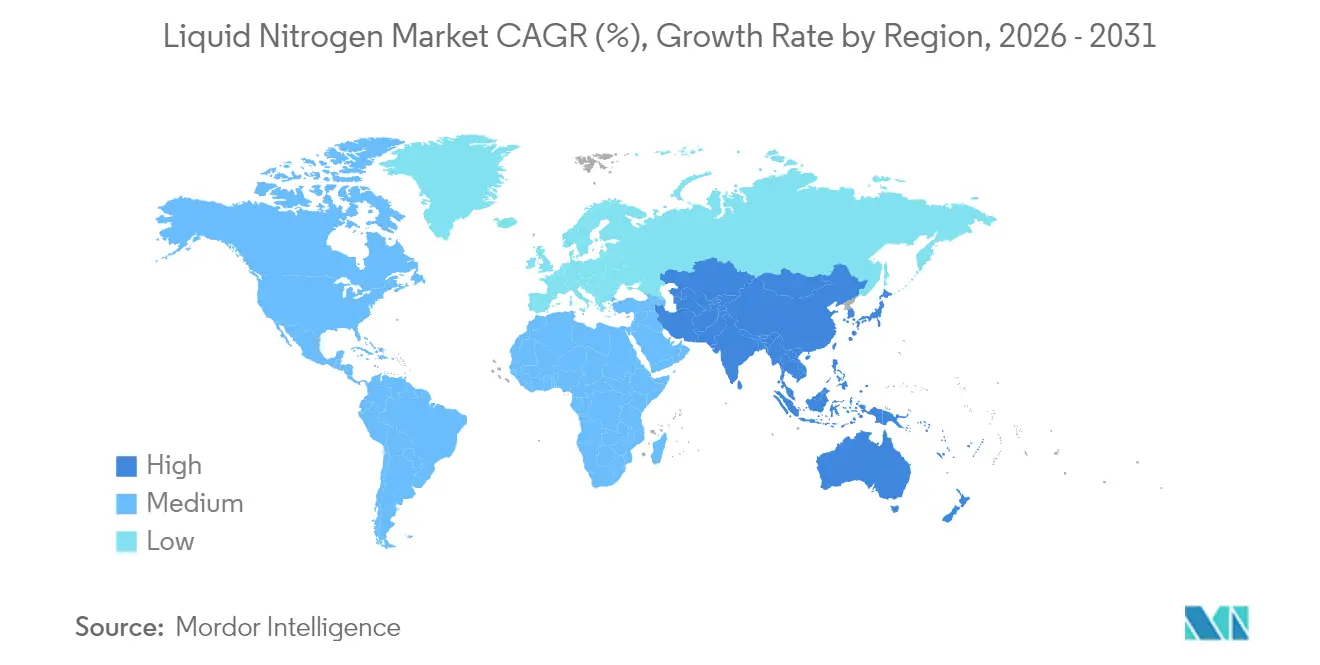
Asia-Pacific commanded 46.10% of the Liquid Nitrogen market share in 2025 and is projected to expand at a 4.36% CAGR through 2031, reinforcing its dual status as the largest and fastest-growing region. China leads wafer fabrication investments exceeding USD 50 billion, each fab demanding nitrogen purities under 1 ppm oxygen for etching and testing. India’s biologics surge compounds demand, with new vaccine lines installing bulk nitrogen tanks alongside automated vapor phase storage. Local governments subsidize pipeline corridors in industrial parks, fostering captive demand clusters.
North America Liquid Nitrogen Market
North America maintains mature yet robust consumption anchored by petrochemicals on the Gulf Coast, expansive food processing in the Midwest, and biopharmaceutical hubs in Massachusetts and North Carolina. Long-term contracts between medical centers and gas majors ensure stable bulk dispatches, while outpatient oncology drives incremental cylinder usage. Plant expansions employ energy-recovery turbines and advanced adsorption cycles, trimming electricity intensity by 15%, sustaining competitiveness amid rising power tariffs.
EMEA and South America Liquid Nitrogen Market
Europe balances stability with innovation, pivoting toward superconducting grid pilots and advanced therapy supply chains. Strict safety codes heighten operating costs, yet high disposable income supports premium nitrogen applications in gastronomy and craft beverages. South America and Middle East & Africa trail in volume but show accelerating installations of packaged gas depots serving food exports and petrochemical complexes. Brazil’s nitrogen-freeze shrimp exports and Saudi Arabia’s polymer projects represent early anchor loads that can scale distribution density. This geographic mosaic demonstrates that global suppliers must navigate differing regulatory, infrastructure, and application maturity levels to maximize portfolio yield.

Regulatory Landscape
Liquid nitrogen is regulated primarily through occupational safety and transport-safe containment requirements rather than substance-specific restrictions. Across major markets, it is typically classified as a refrigerated liquefied gas (commonly carrying the H281 hazard statement for cryogenic injury), which drives controls such as oxygen-deficiency hazard mitigation, ventilation, and worker training under workplace safety regimes including OSHA guidance in the United States.
Industry standards shape compliance and equipment selection, especially Compressed Gas Association (CGA) standards for pressure relief devices (CGA S-1.1 through S-1.3) and insulated cargo tanks (CGA-341), along with regional safe-handling guidance such as Asia Industrial Gases Association (AIGA) Guideline 129/25 for cryogenic and refrigerated liquids. In the EU, nitrogen is generally treated as low regulatory burden because it is exempt from REACH registration (Annex IV/V), while cross-border trade and customs classification commonly uses HTS code 2804.30.00.00, affecting landed-cost variability more than substance-level permitting.
Value Chain Analysis
The liquid nitrogen value chain starts with power-intensive production at cryogenic air separation units (ASUs), operated by integrated industrial gas majors and regional producers. Supply is often structured around anchor offtakers through on-site ASUs and pipelines for high and steady demand (petrochemicals, metals, electronics), while merchant output is directed to bulk liquid distribution where logistics reliability and boil-off management influence delivered cost and service levels.
Downstream, distribution splits into bulk cryogenic tanker routes, micro-bulk and cylinder/dewar networks for labs, clinics, and specialty food producers, plus managed services that add telemetry, inventory planning, and refilling to reduce losses. Channel partners and distributors (for example, retail industrial gas networks such as Airgas, alongside majors like Linde, Air Products, and Messer) support last-mile coverage, while niche suppliers differentiate through monitoring and refill models, exemplified by Nitrex Specialty Gases offering weight-based liquid nitrogen monitoring and refill services in Southern California to limit evaporation losses versus traditional tank swapping.
Competitive Landscape
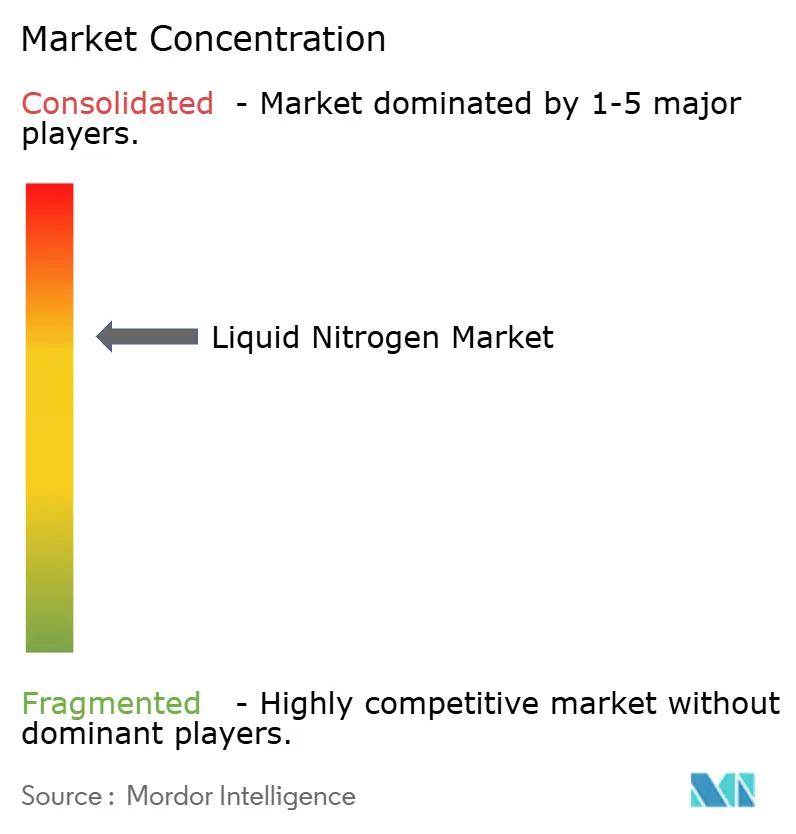
The Liquid Nitrogen market is moderately concentrated. Vertically integrated operations grant these firms control from oxygen sales to turnkey cryogenic freezers, embedding them deeply within customer process design. Recent capital programs favor modular, energy-efficient ASUs, yielding lower specific power draw and enhancing sustainability credentials in carbon-conscious sectors. The largest companies are acquiring distributors to secure last-mile access, as illustrated by Linde’s Southeast Asia deal that added twelve depots in 2024. The upshot is a landscape where scale and specialization coexist, yet the bargaining power tilts toward providers that combine both attributes.
Liquid Nitrogen Industry Leaders
Air Liquide
Linde PLC
TAIYO NIPPON SANSO CORPORATION
Air Products and Chemicals, Inc.
Messer
- *Disclaimer: Major Players sorted in no particular order
Liquid Nitrogen Market Companies Covered in this Report
- Air Liquide
- Air Products and Chemicals, Inc.
- Asia Industrial Gases Pte., Ltd.
- Gruppo Siad
- Gulf Cryo
- Haier Biomedical
- Iwatani Corporation
- Linde PLC
- Messer
- NEXAIR
- Southern Industrial Gas Sdn Bhd
- TAIYO NIPPON SANSO CORPORATION
- Tokyo Gas Chemicals Co., Ltd.

Market Opportunities and Future Outlook
Near-term opportunity is concentrated in contract-tied, high-purity capacity buildouts that relocate production closer to semiconductor and advanced industrial customers, improving supply assurance and increasing the share of engineered, specification-driven liquid nitrogen. This direction is supported by Air Liquide investments across multiple geographies, including a EUR 70 million project in Singapore to supply ultra-pure nitrogen for VisionPower Semiconductor Manufacturing Company (VSMC) with operations beginning in 2026, and a USD 350 million ASU investment in St. James Parish, Louisiana to supply HYUNDAI-POSCO Louisiana LLC, which ties liquid nitrogen demand to large integrated industrial sites.
A second whitespace appears in emerging and under-served industrial hubs where nitrogen infrastructure is being built alongside new complexes and long-term offtake agreements. Air Liquide signed a long-term agreement with Silleno LLP to build two high-purity nitrogen production units in Kazakhstan (Atyrau region), and it also started building a new ASU in Huizhou, Guangdong (China), reflecting ongoing supply localization into growth corridors. Together, these projects support opportunities for suppliers and logistics providers in bulk delivery, micro-bulk, and cylinder services for distributed biotech and outpatient care settings, as well as digital fleet and telemetry capabilities aimed at reducing boil-off and improving compliance performance.
Recent Industry Developments in Liquid Nitrogen Market
- July 2026: Air Liquide announced a USD 170 million investment in Indiana, United States, to build two new production units to supply ultra-pure nitrogen and other gases to SK hynix for an AI memory chip packaging facility. The planned commissioning by end-2028 reinforces dedicated, customer-tied gas infrastructure for advanced electronics, where nitrogen purity and uptime are non-negotiable.
- July 2025: Linde announced an investment in Brownsville, Texas, to build an air separation unit supplying nitrogen, oxygen, and argon to support commercial space-sector operations, with operations slated to start in Q1 2026. The project highlights how reliability-driven end markets are pulling liquid nitrogen capacity toward specialized industrial clusters.
- July 2024: Air Liquide inaugurated a new air separation unit in Kosi, Uttar Pradesh, India, expanding its healthcare and industrial merchant footprint. With daily capacity including about 45 tonnes of liquid nitrogen, the facility strengthens regional availability for cylinders and bulk deliveries supporting India’s growing medical and industrial demand base.


Liquid Nitrogen Market Report Scope and Research Methodology
Market Definition and Coverage
This market covers liquid nitrogen that is produced, distributed, and used as a cryogenic coolant or refrigerant by industrial and commercial end users. Our sizing tracks demand that is actually consumed in applications, aligned to liquid form delivery and usage rather than gaseous nitrogen.
Scope exclusions: We exclude on-site nitrogen generated and consumed as gas without liquefaction, and we do not treat equipment sales such as tanks, vaporizers, or cold boxes as market revenue.
Segments Covered in This Report
- By Storage Type
- Cylinder
- Packaged Gas
- By Function
- Coolant
- Refrigerant
- End-User Industry
- Chemical and Pharmaceutical
- Healthcare
- Transportation
- Food and Beverage
- Electronics and Semiconductor
- Other End-user Industries
- By Geography
- Asia-Pacific
- China
- India
- Japan
- South Korea
- Rest of Asia-Pacific
- North America
- United States
- Canada
- Mexico
- Europe
- Germany
- United Kingdom
- Italy
- France
- Russia
- Rest of Europe
- South America
- Brazil
- Argentina
- Rest of South America
- Middle East and Africa
- Saudi Arabia
- South Africa
- Rest of Middle East and Africa
- Asia-Pacific
Data Sources, Market Sizing, and Validation
Desk Research
Desk work starts with building a clear demand map for liquid nitrogen across healthcare, food processing, chemicals, transport cooling, and electronics use cases. We use public sources such as US Energy Information Administration (for energy cost context), US Geological Survey and national industrial statistics offices (for industrial output signals), UN Comtrade and customs portals (for trade and movement patterns of industrial gases), and sources such as the US FDA and CDC (for life sciences activity indicators that link to cold chain needs).
To make the inputs usable for a market model, we also review company annual reports, investor presentations, plant expansion announcements, association publications, and reputable business press. Where needed, we complement public information with paid subscriptions for company financials and intelligence, patent databases, and shipment-level import and export data to sanity check directionally visible flows. These desk research sources are not exhaustive, and other references were also used for data collection, validation, and clarification during analysis.
Primary Interviews and Surveys
Primary discussions are used to pressure-test the desk assumptions and to fill gaps that are not visible in public data, especially around merchant supply behavior and application mix. We spoke with participants across production, distribution, and high-use end users, and inputs were balanced across APAC, EMEA, and the Americas so regional pricing, utilization, and supply constraints could be compared on a like-for-like basis.
Distribution of primary research fieldwork respondents
| Company type | Respondent position | Region |
|---|---|---|
| Top tier: 27% | CXOs: 12% | APAC: 44% |
| Mid tier: 55% | Functional/Unit leaders: 28% | EMEA: 30% |
| Smaller Players: 18% | Managers: 60% | Americas: 26% |
Market-Sizing & Forecasting
The core sizing is built using a top-down approach where end-use demand pools are reconstructed from observable activity and throughput indicators, then translated into liquid nitrogen consumption. For example, we link cold chain intensity, industrial production trends, and electronics output to estimated liquid nitrogen usage rates, and then reconcile that to regional supply availability.
To keep the model grounded, totals are corroborated with selective bottom-up approximations, such as sampled volume by application multiplied by typical delivered pricing ranges, and channel checks on bulk versus packaged distribution mix. Key inputs used as practical fingerprints include reported industrial output indices, healthcare and laboratory activity signals, cold storage and frozen food throughput trends, electronics manufacturing expansion cues, and energy price movements that affect production economics and delivered costs. When direct data is missing for a country, gaps are handled by using peer-market proxies, adjusted for industrial structure and import reliance, and then rechecked with interview feedback.
For forecasting, scenario analysis is used so we can reflect different paths for industrial activity, healthcare cold chain buildout, and electronics capacity additions, which are then translated into volume growth and price progression assumptions. The final trajectory is cross-checked with expert views on utilization, supply additions, and expected normalization of logistics and energy inputs over the forecast period.
Data Validation & Update Cycle
Before sign-off, model outputs are checked against independent signals such as trade direction, industrial production momentum, and known capacity or expansion announcements, and variances are investigated rather than averaged away. Where numbers look unusual, we re-contact interviewees for clarification, and the assumptions are rewritten in simpler terms so another analyst can reproduce the logic without hidden steps.
A multi-step internal review is followed, where calculations, unit consistency (volume versus value), and currency timing are rechecked, and segment totals are reconciled back to the overall market. Reports are refreshed annually, and interim updates are made when material events occur such as major capacity additions, policy changes affecting industry output, or sharp energy cost shifts. Before delivery, a final analyst pass is completed so clients receive the most current view available at that time.
Mordor Intelligence's Liquid Nitrogen Market Sizing Compared With Other Published Estimates
Published market sizes for liquid nitrogen often diverge because the scope and the unit of measurement are not kept consistent across studies, and this changes what gets counted. Differences also come from how pricing is treated, how regional totals are converted to USD, and how frequently assumptions are refreshed after energy or capacity shocks.
Some external publications primarily report a value-based total in USD, and they may blend merchant liquid, on-site supply arrangements, and related cryogenic services into a single number. In Mordor Intelligence, the sizing on this page is presented in volume terms and stays centered on liquid nitrogen consumption across defined functions and end-user industries, which reduces distortion from short-term price swings and mixed service bundles.
Benchmark comparison
| Source | Market Size | Gaps in Research Methodology |
|---|---|---|
| Mordor Intelligence | USD 309.79 M (2026) | |
| Industry Research Publisher A | USD 23.86 B (2025) | This estimate is reported as market value, not volume, and it can embed delivered price assumptions and service components that move with energy and logistics costs. The year basis also differs, so comparing without normalizing unit and timing can overstate the spread. |
| Global Insights Publisher B | USD 19.50 B (2024) | The published figure is value-based and is built with a broader segmentation set that can include adjacent supply modes beyond pure liquid consumption. Currency conversion timing and assumed ASP progression are not always transparent, which can shift the headline value materially. |
The table shows that most of the gap is explained by unit choice and by whether pricing and bundled supply services are mixed into the headline number. By keeping the model tied to application-linked consumption signals first, and then translating to comparable totals, we keep the steps traceable and easier to validate across regions and years.


Key Questions Answered in the Report
How large is the liquid nitrogen market in 2026?
The liquid nitrogen market size is 309.79 million tons in 2026 and is forecast to reach 371.62 million tons by 2031.
Which region leads demand for liquid nitrogen?
Asia-Pacific holds 46.10% of global volume, driven by semiconductor fabs in China and pharmaceutical growth in India.
What is the fastest-growing end-user segment?
Food and beverage applications are expanding at a 4.82% CAGR due to plant-based protein processing and nitrogen-infused beverages.
Why are cylinder deliveries gaining popularity?
Smaller labs and outpatient clinics prefer cylinder packages for portability and lower upfront infrastructure cost.
What main restraint could slow growth?
Rising compliance expenses for safety upgrades and competition from high-efficiency mechanical freezers may temper adoption rates.
Page last updated on:


 Your data is secure and never sold or shared.


