
Sodium Metasilicate Pentahydrate Market Size and Share
Market Overview
| Study Period | 2021 - 2031 |
|---|---|
| Market Size (2026) | USD 0.9 Billion |
| Market Size (2031) | USD 1.14 Billion |
| Growth Rate (2026 - 2031) | 4.84 % |
| Fastest Growing Market | Asia-Pacific |
| Largest Market | Asia-Pacific |
| Market Concentration | Medium |
Major Players *Disclaimer: Major Players sorted in no particular order Image © Mordor Intelligence. Reuse requires attribution under CC BY 4.0. | |
Sodium Metasilicate Pentahydrate Market Analysis by Mordor Intelligence
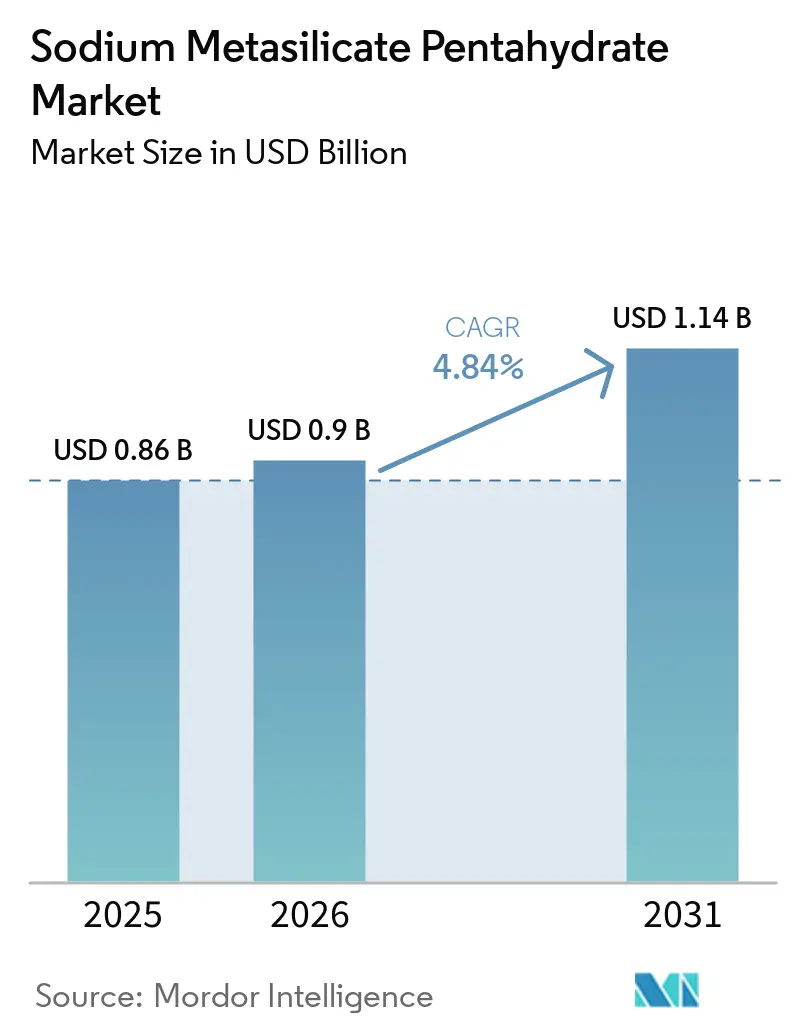
The Sodium Metasilicate Pentahydrate Market size is projected to grow from USD 0.86 billion in 2025 to USD 0.9 billion in 2026, and reach USD 1.14 billion by 2031, growing at a CAGR of 4.84% from 2026 to 2031. The upward trajectory reflects continued substitution of phosphates in industrial cleaners, the push for digital product passports under the EU Detergents Regulation (EU) 2026/405, and a cost-conscious shift toward captive soda-ash sourcing as Chinese energy and freight bills trend higher. Asia-Pacific demand is reinforced by large municipal water-treatment projects and construction programs in China, India, and ASEAN economies. In North America, natural trona deposits keep feedstock costs low, allowing producers to invest in high-efficiency furnaces that compress energy intensity by double-digit rates. The competitive landscape is tilting toward vertically integrated players that can balance raw-material volatility with process-decarbonization initiatives to satisfy emerging federal procurement rules in the United States.
Key Report Takeaways
- By purity, industrial-grade material captured 58.10% of the sodium metasilicate pentahydrate market share in 2025, while low-alkali specialty blends are forecast to advance at a 5.46% CAGR through 2031.
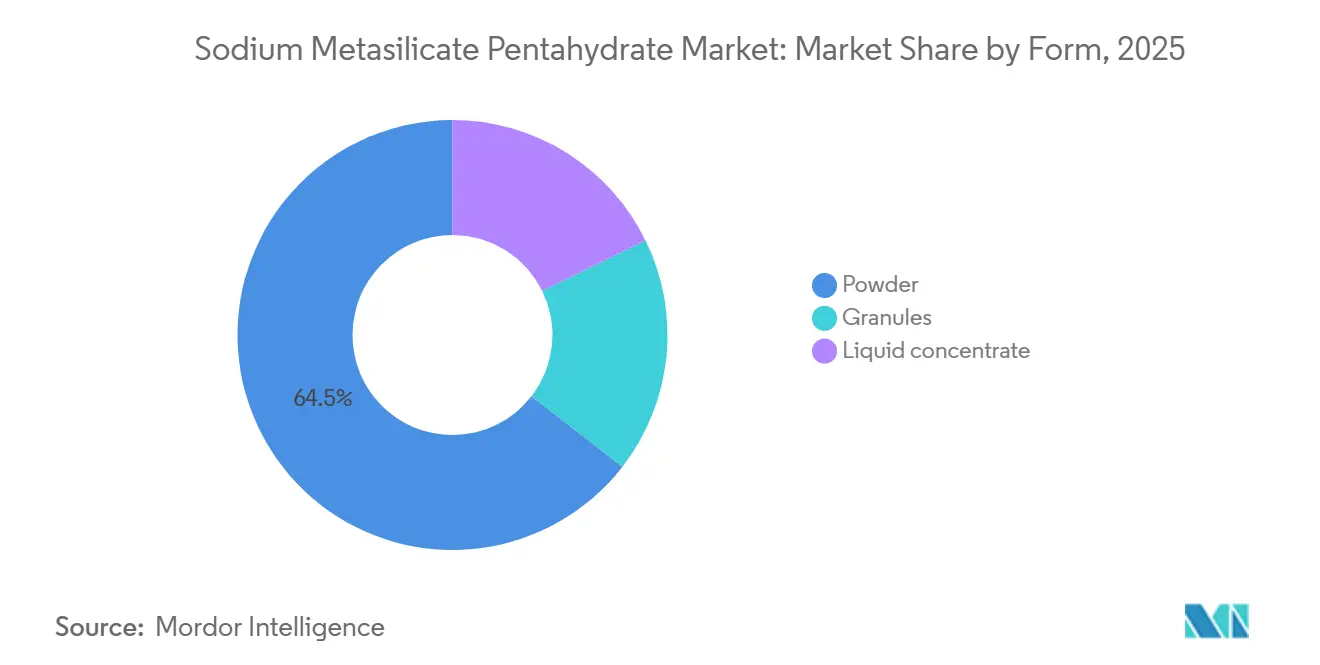
- By form, powder held 64.50% share of the sodium metasilicate pentahydrate market size in 2025, and liquid concentrate is projected to expand at a 5.54% CAGR between 2026 and 2031.
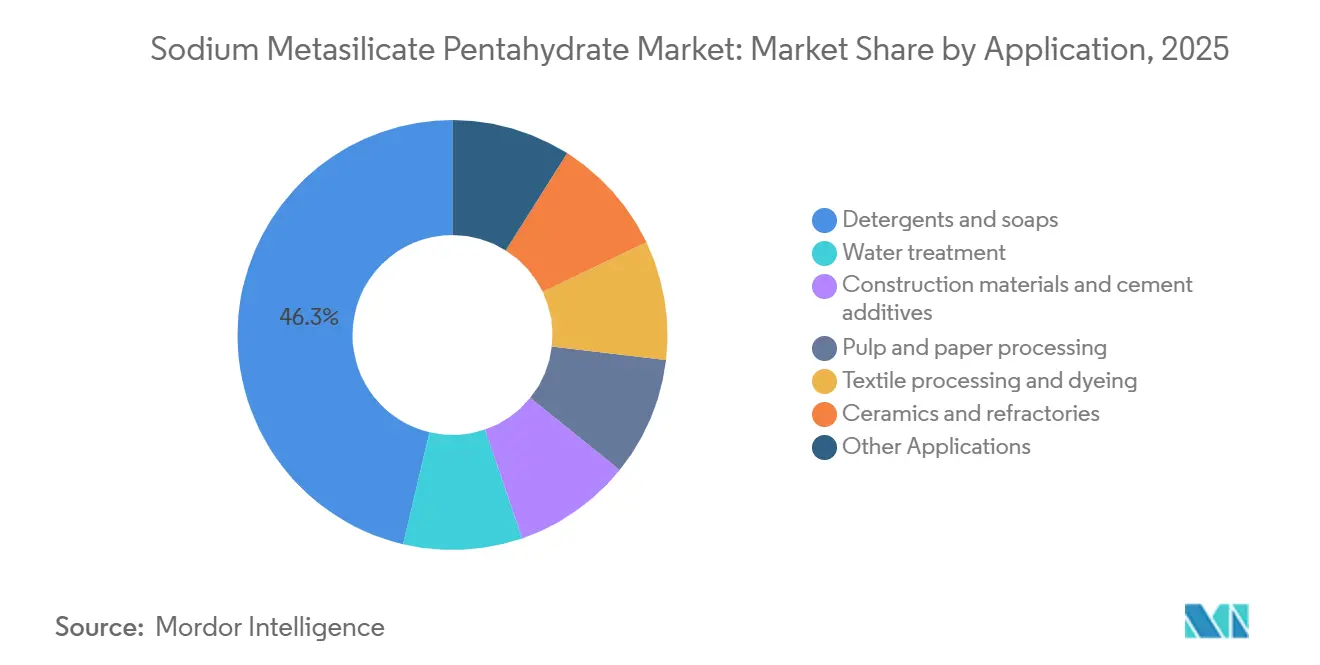
- By application, detergents and soaps led with 46.30% revenue share in 2025; water treatment is expected to register the fastest 5.71% CAGR to 2031.
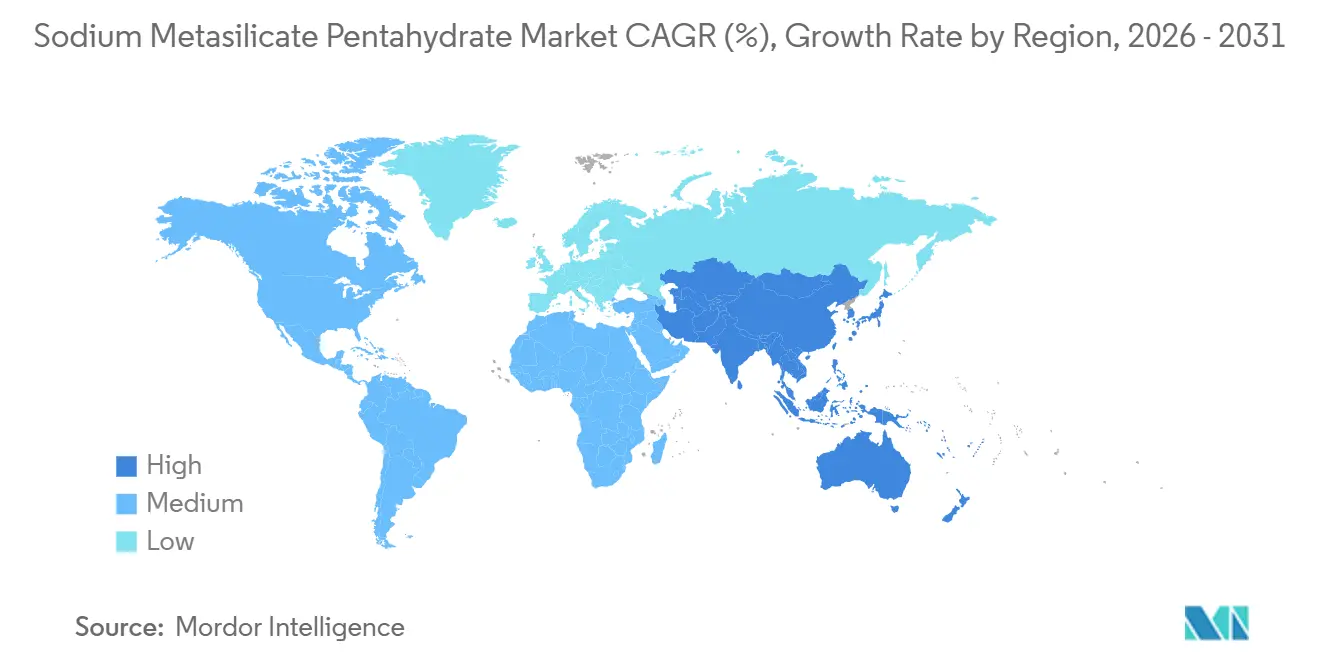
- By geography, Asia-Pacific accounted for 47.80% of the sodium metasilicate pentahydrate market in 2025, whereas the same region is forecast to grow at a 5.67% CAGR over 2026-2031.
Note: Market size and forecast figures in this report are generated using Mordor Intelligence’s proprietary estimation framework, updated with the latest available data and insights as of January 2026.
Market Trends and Insights
Drivers Impact Analysis of Sodium Metasilicate Pentahydrate Market*
| Drivers | (~) % Impact on CAGR Forecast | Geographic Relevance | Impact Timeline |
|---|---|---|---|
| Rising demand in detergents and cleaning agents | +1.2% | Global, with a concentration in Asia-Pacific and North America | Medium term (2-4 years) |
| Expanding applications in construction and cement additives | +0.9% | Asia-Pacific core, spill-over to the Middle East and Latin America | Long term (≥ 4 years) |
| Increasing use in water treatment and industrial cleaning | +1.4% | Global, led by China, India, and the U.S., municipal upgrades | Medium term (2-4 years) |
| Growth in the pulp and paper processing industry | +0.6% | North America, Europe, and Southeast Asia | Long term (≥ 4 years) |
| Shift toward phosphate-free industrial dishwashing formulations | +0.8% | Europe and North America, early adoption in Japan and South Korea | Short term (≤ 2 years) |
| Source: Mordor Intelligence | |||
Rising Demand in Detergents and Cleaning Agents
Stringent phosphate caps in the EU, United States, and Canada are directing formulators to replace sodium tripolyphosphate with sodium metasilicate pentahydrate in automatic dishwasher powders and institutional cleaners. The compound supplies alkalinity, sequesters hard-water ions, and deposits a protective silicate film on glass and steel that most zeolites cannot replicate. Typical inclusion levels hover between 1.5% and 3.0 wt %, balancing pH with the thermal stability needed to co-grind with sodium percarbonate bleaches. Digital ingredient passports demanded by ECHA now force manufacturers to document purity profiles and heavy-metal limits, a compliance cost many small blenders absorb via tolling partnerships. Asian exporters chasing EU shelf space are therefore shifting to high-purity supplies that match REACH Annex XVII thresholds, buttressing near-term volume growth for the sodium metasilicate pentahydrate market.
Expanding Applications in Construction and Cement Additives
Sodium metasilicate pentahydrate densifies concrete by precipitating calcium silicate hydrate phases that lift compressive strength and lower permeability, making it attractive under low-carbon procurement rules in the United States and EU. The U.S. Buy Clean Initiative earmarks USD 4.5 billion for low-embodied-carbon materials, while Germany’s EUR 500 million grant for bio-based building products elevates demand for water-resistant silicate sealants. China’s Zero Carbon Building Standard has similar pull-through effects as local governments mandate recycled and alternative binders in public works, deepening regional uptake. Sodium metasilicate also activates fly-ash and slag-rich cement mixes, suppressing clinker content and aligning producers with Paris-aligned decarbonization roadmaps. These structural incentives extend the growth runway for the sodium metasilicate pentahydrate market beyond its historic detergent base.
Increasing Use in Water Treatment and Industrial Cleaning
Municipal operators phasing out phosphorus-based inhibitors have embraced sodium metasilicate pentahydrate for hardness sequestration and corrosion control, achieving up to 40% lower corrosion rates compared with carbonate systems[1]Allan Chemical, “Technical Data Sheet—Sodium Metasilicate Pentahydrate,” allanchemical.com. India’s Jal Jeevan Mission and China’s rural water-supply upgrades widen the municipal addressable pool, though bid awards remain price sensitive. In oil refineries and petrochemical plants, high-pH silicate cleaners strip heat-exchanger fouling without flash rust, trimming downtime and chemical inventory costs. U.S. Gulf Coast operators employ automated dosing that favors liquid concentrates, translating regulatory pressure into steady volume gains for the sodium metasilicate pentahydrate market.
Growth in Pulp and Paper Processing Industry
Kraft mills deploy sodium metasilicate to buffer pH in lignin dissolution and peroxide bleaching, maintaining sodium-sulfur balance during black-liquor recovery[2]Separation and Purification Technology Journal, “Silicate-Assisted Closed-Loop Bleaching in Kraft Mills,” sciencedirect.com. New techno-economic models show that silicate-assisted closed-loop bleaching can trim external chemical spend by USD 28 per ton of recovered lignin, making it attractive for integrated biorefinery concepts in North America and Scandinavia. Southeast Asian mills scaling packaging grades add incremental pickup, yet rising LNG tariffs in Indonesia and Vietnam shift the sourcing preference toward suppliers with captive soda-ash assets. These dynamics underline another durable end-use pillar for the sodium metasilicate pentahydrate market.
Restraints Impact Analysis of Sodium Metasilicate Pentahydrate Market*
| Restraints | (~) % Impact on CAGR Forecast | Geographic Relevance | Impact Timeline |
|---|---|---|---|
| Environmental concerns and handling regulations | -0.6% | Europe and North America, with spillover to Asia-Pacific | Medium term (2-4 years) |
| Competition from low-alkali enzymatic cleaning chemistries | -0.8% | North America and Europe, early adoption in Japan | Short term (≤ 2 years) |
| Price volatility of soda-ash and silica-sand feedstocks | -0.7% | Global, with acute impact in synthetic-soda-ash regions (China, Europe) | Short term (≤ 2 years) |
| Source: Mordor Intelligence | |||
Environmental Concerns and Handling Regulations
Sodium metasilicate pentahydrate solutions exhibit pH levels of 12-13 at 1% concentration, qualifying as skin and eye irritants under GHS, which raises the cost of compliance with OSHA and EU CLP labeling mandates. Alkaline effluents must be neutralized before discharge, adding CAPEX for wastewater treatment at user sites that lack dedicated neutralization tanks. Solvay booked EUR 432 million in environmental provisions for legacy limestone storage and groundwater monitoring linked to synthetic soda-ash production, showing how liabilities can stack up at scale. EU ETS carbon prices elevate the cost of gas-fired furnaces by double-digit percentages, lowering European competitiveness against U.S. trona-based supply. Uneven regulatory intensity across jurisdictions amplifies supply-chain complexity for multinationals in the sodium metasilicate pentahydrate market.
Competition from Low-Alkali Enzymatic Cleaning Chemistries
Protease and lipase enzymes active at near-neutral pH are winning share in institutional kitchens because they reduce worker exposure to harsh alkalinity and perform well in cold water. North American foundries reveal that 40% of new core-making installations now adopt phenolic-urethane binders, eroding demand for sodium-silicate-CO₂ systems. Enzyme-rich cleaners cost 20%-30% more per dose yet close the gap on cost-per-wash through lower temperature and shorter cycles. Sodium metasilicate suppliers are countering with hybrid builders that mix specialty blends below 95% purity with enzyme stabilizers, but head-to-head economics remain challenging in premium service niches. These substitution trends shave almost one percentage point off the medium-term growth potential of the sodium metasilicate pentahydrate market.
*Our forecasts treat driver/restraint impacts as directional, not additive. The impact forecasts reflect baseline growth, mix effects, and variable interactions.
Sodium Metasilicate Pentahydrate Market Segment Analysis
By Purity:
Industrial-Grade Dominance Amid Specialty-Blend AccelerationIndustrial-grade material controlled 58.10% of the 2025 sodium metasilicate pentahydrate market share, reflecting its role in heavy-duty detergents, boiler-water treatment, and refractory binders. Technical-grade products at 95-98% purity remain cost-efficient choices for textiles, ceramics, and construction sealants. The sodium metasilicate pentahydrate market size linked to low-alkali specialty blends is projected to climb at 5.46% CAGR through 2031 as enzyme-compatible formulations proliferate.
Specialty grades below 95% purity still deliver silicate film formation on glass yet temper alkalinity to protect aluminum ware and sensitive skin. PQ Corporation’s Indonesia micronizer brings premium silica performance to Asian customers that target green-label cleaning and low-VOC coatings, an indicator that product differentiation is shifting to particle engineering and impurity control. EU digital passports now record heavy-metal levels, nudging suppliers to invest in online analyzers that keep lead, arsenic, and chromium below REACH Annex XVII limits. This regulatory loop further entrenches industrial-grade demand while supporting rapid growth in specialty-blend niches inside the sodium metasilicate pentahydrate market.
By Form:
Powder Prevalence Versus Liquid-Concentrate Efficiency GainsPowder remained the dominant form with 64.50% share in 2025 as detergent manufacturers favor dry blending and long shelf life. Granular variants cut dusting and improve flowability, meeting stricter workplace exposure limits. Liquid concentrates, although smaller in volume, are rising at 5.54% CAGR through 2031 on the back of automated dosing in water treatment and on-site dilution that trims packaging mass and freight cost, enhancing sustainability scores for corporate buyers.
Liquid silicates at 40%-50% solids streamline batch preparation in textile dyeing and detergent compounding, eliminating dissolution steps and slashing mixing time by up to 30%. Asia-Pacific municipalities prefer tanker deliveries that drop concentrates into central tanks feeding automated corrosion-control loops, a practice that supports steady uptake for the sodium metasilicate pentahydrate market. Freeze-thaw instability still curtails liquid expansion in colder climates without heated storage, leaving powders entrenched in parts of Europe, North America, and high-altitude South America. Technology improvements in trace-inhibitor packages that prevent crystallization below 5 °C may unlock new winter-grade liquids and rebalance the form mix over the forecast horizon.



By Application:
Detergent Leadership and Water-Treatment SurgeDetergents and soaps held 46.30% of overall demand in 2025, underscoring the compound’s entrenched position as an alkaline builder and corrosion inhibitor in automatic dishwasher and institutional cleaning powders. Water treatment emerges as the fastest-growing line at 5.71% CAGR through 2031, reinforced by phosphorus discharge limits and replacement of zinc-phosphate corrosion systems in closed-loop cooling towers.
The sodium metasilicate pentahydrate market size aligned to construction is buoyed by densifier and cement-activator roles, while pulp and paper retains a stable base load in kraft processing and deinking. Textile processors in India, Bangladesh, and Vietnam rely on silicate buffering to stabilize vat and reactive dyes, supporting regional increments even as global apparel trade ebbs. Ceramics and refractories applications benefit from CO₂-cured sodium-silicate binders that shorten mold cycles and reduce organic binder emissions. Across these verticals, the sodium metasilicate pentahydrate market share continues to pivot toward water-treatment and specialty material applications that offer higher margins and resilience against detergent substrate substitution.
Geography Analysis
APAC Sodium Metasilicate Pentahydrate Market
Asia-Pacific commanded 47.80% of 2025 revenue and is projected to grow at a 5.67% CAGR through 2031 as China’s Zero Carbon Building Standard, India’s Jal Jeevan Mission, and ASEAN construction booms accelerate procurement of corrosion inhibitors, cement densifiers, and enzyme-compatible detergent blends. Local suppliers leverage proximity to burgeoning pulp and paper and textile complexes, while multinationals deepen stakes through capacity additions and joint ventures.
North America Sodium Metasilicate Pentahydrate Market
North America capitalizes on abundant Wyoming trona reserves that underpin low-cost natural soda ash, fostering expansions like PQ Corporation’s high-efficiency furnace in Augusta, Georgia, commissioned in 2025. The U.S. Buy Clean Initiative channels USD 4.5 billion toward low-carbon cement additives, sustaining demand for silicate hardeners. Foundry substitution toward phenolic-urethane binders constrains volume slightly, yet water-treatment implementations at municipal utilities in the Midwest and Sun Belt shore up growth for the sodium metasilicate pentahydrate market.
EMEA and South America Sodium Metasilicate Pentahydrate Market
Europe wrestles with synthetic-soda-ash energy costs and carbon fees, yet the digital passport clause in Regulation (EU) 2026/405 harmonizes market access and underpins premium pricing for high-purity supply. Germany’s EUR 500 million green-building grant and France’s tax credits sustain construction uptake, partially offsetting lagging detergent exports linked to a strong euro. South America and the Middle East and Africa remain smaller but rising, with Saudi desalination plants and Brazilian pulp mills furnishing anchor offtake that collectively enlarge the global sodium metasilicate pentahydrate market footprint.

Competitive Landscape
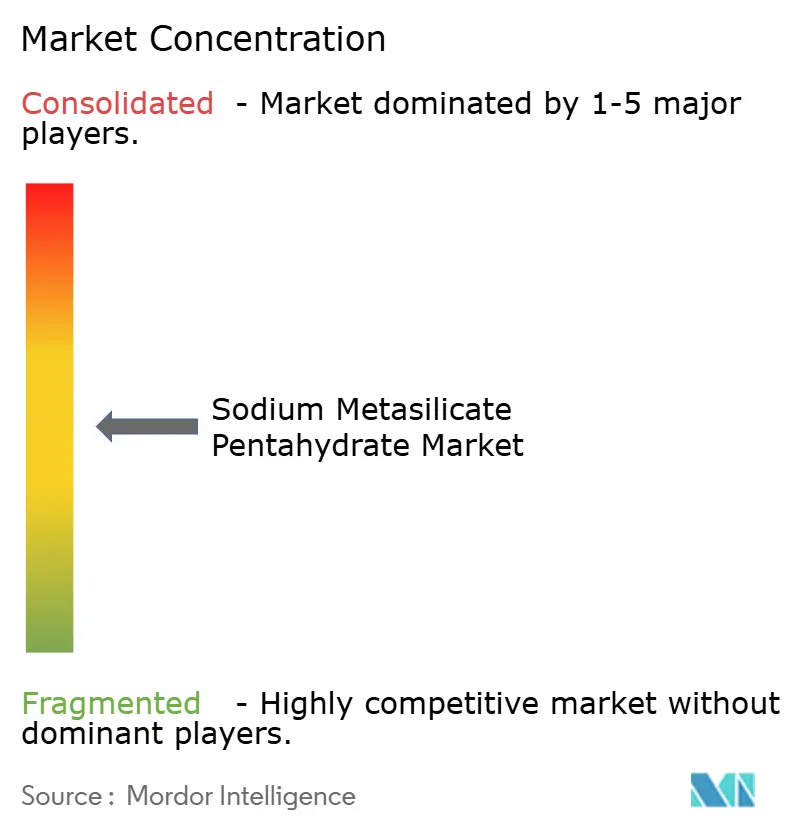
The sodium metasilicate pentahydrate market is moderately consolidated. PQ Corporation’s parallel build-outs in Georgia and Indonesia illustrate a dual-track strategy that marries low-cost trona feedstock with downstream specialty silica micronization to capture premium coating and personal-care margins. Solvay doubled down on Green River natural soda-ash reserves, adding 600,000 tons/year by end-2024 to hedge synthetic-route volatility and channel excess soda ash into captive silicate units across Europe.
Tokuyama, OxyChem, and a slate of Indian and Chinese specialists deploy regional proximity to detergents, textiles, and foundry hubs, but energy-price escalation and tighter ESG audits drive many to explore joint procurement of renewable power and carbon-capture pilots. Process decarbonization, including oxy-fuel burners and waste-heat recovery, is emerging as a differentiator in tender specifications issued by multinational consumer-goods firms. Producers that document cradle-to-gate emissions through verified Environmental Product Declarations gain a pricing premium that can reach mid-single-digit percentages, reinforcing the value of integrated data reporting in the sodium metasilicate pentahydrate market.
White-space opportunities are surfacing in lithium-ion battery recycling, where silicate leach solutions reportedly recover up to 95% of cobalt, nickel, and lithium, and in additive-manufacturing binder jetting, a segment forecast to crest USD 35.6 billion by 2027. Smaller Asian producers may lack the research and development budgets to pivot, accentuating a possible wave of mergers or strategic alliances aimed at pooling technology and building digital-compliance platforms able to satisfy both EU passport and U.S. federal procurement screens.
Sodium Metasilicate Pentahydrate Industry Leaders
PQ Corporation
Simalco
Tokuyama Corporation
QEMETICA
Solvay
- *Disclaimer: Major Players sorted in no particular order
Sodium Metasilicate Pentahydrate Market Companies Covered in this Report
- American Elements
- Ankit Silicate
- Changyi Longgang Inorganic Silicon
- Gujarat Multi Gas Base Chemicals
- IQE Group
- J. R. Simplot Company
- Kiran Global Chem
- Nippon Chemical Industrial
- Occidental Petroleum (OxyChem)
- Penta Manufacturing Company
- PQ Corporation
- QEMETICA
- Shandong Laizhou Hongda Chemical
- Shandong Tiantai Silicate
- Shenzhen Feiming Sci-Tech
- Silmaco
- Solvay
- Tokuyama Corporation
- W. R. Grace & Co.
- Yogi Mag Chem

Recent Industry Developments in Sodium Metasilicate Pentahydrate Market
- March 2026: The EU Detergents Regulation (EU) 2026/405 entered into force, mandating digital product passports, phosphorus caps, and extended biodegradability requirements for formulations containing ≥10% organic ingredients.
- May 2025: Germany unveiled a EUR 500 million grant program supporting bio-based building materials that include sodium metasilicate-enhanced sealants aligned with LEED v5 criteria.


Global Sodium Metasilicate Pentahydrate Market Report Scope
Sodium Metasilicate Pentahydrate, a white crystalline inorganic compound, is valued for its high alkalinity and water solubility. It is widely used as a cleaner, grease cutter, and anticorrosion agent in detergents, industrial cleaning, paper deinking, water treatment, and concrete manufacturing.
The sodium metasilicate pentahydrate market is segmented by purity, form, applications, and geography. By purity type, the market is segmented into industrial-grade (≥99%), technical-grade (95-98%), and low-alkali specialty blends (Less than 95%). By form factor, the market is segmented into powder, granules, and liquid concentrate. By application, the market is segmented into detergents and soaps, water treatment, construction materials and cement additives, pulp and paper processing, textile processing and dyeing, ceramics and refractories, and other applications. The report also covers the market size and forecasts for the sodium metasilicate pentahydrate market in 17 countries across major regions. For each segment, the market sizing and forecasts have been done based on revenue (USD).
| Industrial-grade (≥99%) |
| Technical-grade (95-98%) |
| Low-alkali specialty blends (Less than 95%) |
| Powder |
| Granules |
| Liquid concentrate |
| Detergents and soaps |
| Water treatment |
| Construction materials and cement additives |
| Pulp and paper processing |
| Textile processing and dyeing |
| Ceramics and refractories |
| Other Applications |
| Asia-Pacific | China |
| Japan | |
| India | |
| South Korea | |
| ASEAN Countries | |
| Rest of Asia-Pacific | |
| North America | United States |
| Canada | |
| Mexico | |
| Europe | Germany |
| United Kingdom | |
| France | |
| Italy | |
| Spain | |
| Russia | |
| NORDIC Countries | |
| Rest of Europe | |
| South America | Brazil |
| Argentina | |
| Rest of South America | |
| Middle-East and Africa | Saudi Arabia |
| South Africa | |
| Rest of Middle-East and Africa |
| By Purity | Industrial-grade (≥99%) | |
| Technical-grade (95-98%) | ||
| Low-alkali specialty blends (Less than 95%) | ||
| By Form | Powder | |
| Granules | ||
| Liquid concentrate | ||
| By Application | Detergents and soaps | |
| Water treatment | ||
| Construction materials and cement additives | ||
| Pulp and paper processing | ||
| Textile processing and dyeing | ||
| Ceramics and refractories | ||
| Other Applications | ||
| By Geography | Asia-Pacific | China |
| Japan | ||
| India | ||
| South Korea | ||
| ASEAN Countries | ||
| Rest of Asia-Pacific | ||
| North America | United States | |
| Canada | ||
| Mexico | ||
| Europe | Germany | |
| United Kingdom | ||
| France | ||
| Italy | ||
| Spain | ||
| Russia | ||
| NORDIC Countries | ||
| Rest of Europe | ||
| South America | Brazil | |
| Argentina | ||
| Rest of South America | ||
| Middle-East and Africa | Saudi Arabia | |
| South Africa | ||
| Rest of Middle-East and Africa | ||


Key Questions Answered in the Report
How large will global demand for sodium metasilicate pentahydrate be by 2031?
It is forecast to reach USD 1.14 billion, expanding at a 4.84% CAGR over 2026-2031.
Which region contributes the highest growth through 2031?
Asia-Pacific leads, holding 47.80% of 2025 demand and advancing at 5.67% CAGR during 2026-2031 owing to construction and water-treatment investments.
What purity segment grows the quickest?
Low-alkali specialty blends below 95% purity post the fastest 5.46% CAGR through 2031 due to compatibility with enzyme-rich cleaners.
Why are liquid concentrates gaining share?
They reduce packaging waste, cut freight cost per active unit, and integrate easily with automated dosing in large industrial sites.
What is the main raw-material risk?
The combined 60%-70% cost exposure to soda ash and silica sand prices, which remain volatile, especially for synthetic-route producers.
How are regulations influencing product design?
EU digital passports and U.S. Buy Clean rules push suppliers to document emissions and metal impurities, favoring high-purity, low-carbon silicate grades.
Page last updated on:


 Your data is secure and never sold or shared.


