
Magnesium Stearate Market Size and Share
Market Overview
| Study Period | 2020 - 2031 |
|---|---|
| Market Size (2026) | USD 636.72 Million |
| Market Size (2031) | USD 840.73 Million |
| Growth Rate (2026 - 2031) | 5.72 % |
| Fastest Growing Market | Asia Pacific |
| Largest Market | Asia Pacific |
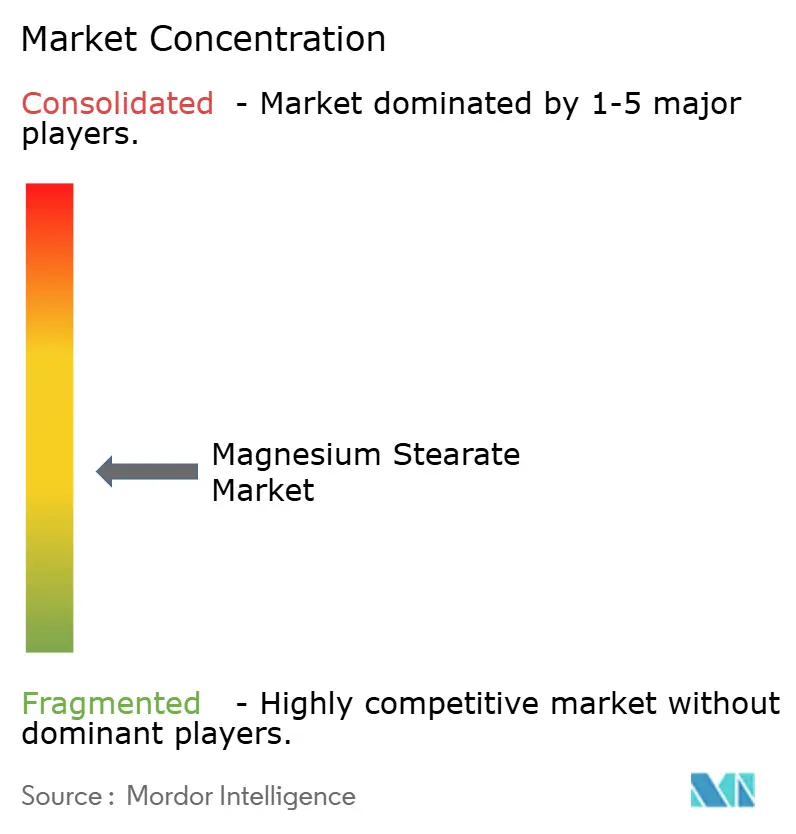
| Market Concentration | Medium |
Major Players *Disclaimer: Major Players sorted in no particular order Image © Mordor Intelligence. Reuse requires attribution under CC BY 4.0. | |
Magnesium Stearate Market Analysis by Mordor Intelligence
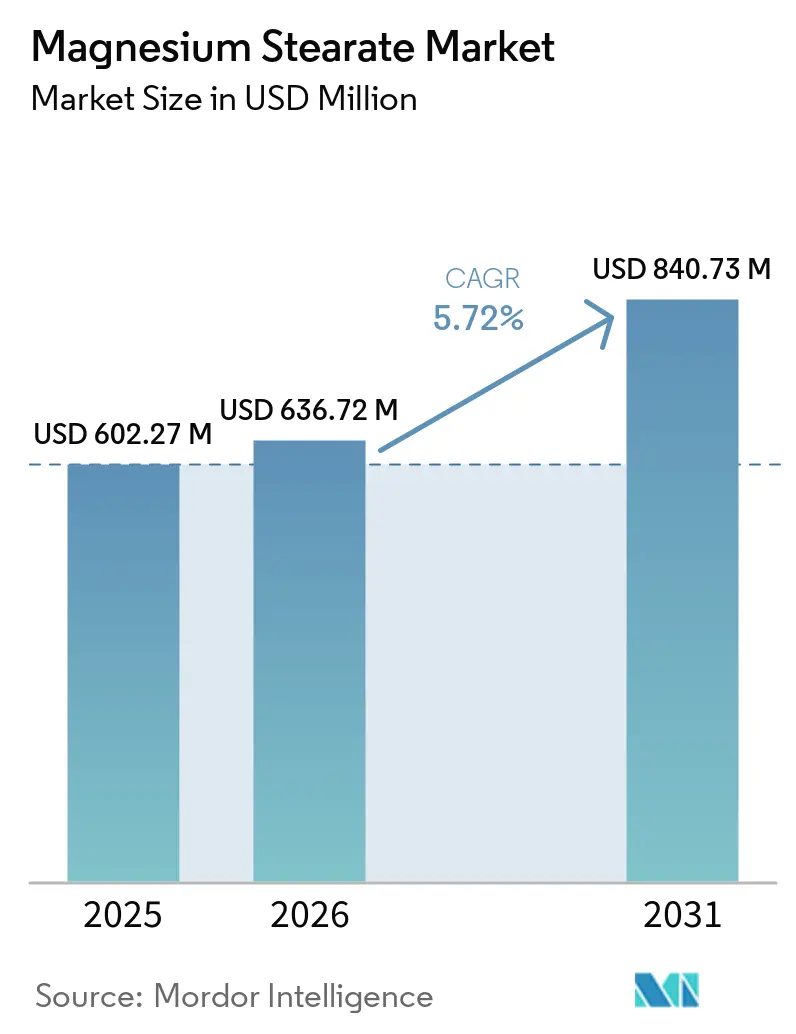
The Magnesium Stearate market size is expected to grow from USD 602.27 million in 2025 to USD 636.72 million in 2026 and is forecast to reach USD 840.73 million by 2031 at 5.72% CAGR over 2026-2031. Current growth momentum mirrors the compound’s entrenched role in pharmaceutical compression, personal care binding, anti-caking food systems, and polymer heat stabilization. Heightened investment in continuous oral-solid-dose manufacturing, especially across North America and Europe, keeps demand buoyant as equipment makers specify excipients that sustain lubrication under high-throughput conditions. Clean-label imperatives have simultaneously pushed suppliers to introduce plant-based or palm-free grades, adding premium-priced alternatives without displacing core volumes. Asia-Pacific’s expanding generic production and rising per-capita medicine intake anchor bulk consumption, while the advent of electric-vehicle wire harnesses opens a small yet strategically significant outlet for stearate-stabilized PVC. Competitive intensity revolves around analytical consistency, fatty-acid-chain verification, and traceability programs that reassure quality-focused buyers.
Key Report Takeaways
- By end-user industry, the pharmaceutical segment held 43.62% of the Magnesium Stearate market share in 2025, whereas personal care is forecast to advance at a 6.12% CAGR to 2031.
- By geography, Asia-Pacific dominated with 41.12% revenue share in 2025 and is set to post the fastest 6.01% CAGR through 2031.
Note: Market size and forecast figures in this report are generated using Mordor Intelligence’s proprietary estimation framework, updated with the latest available data and insights as of 2026.
Market Trends and Insights
Drivers Impact Analysis of Magnesium Stearate Market*
| Driver | (~) % Impact on CAGR Forecast | Geographic Relevance | Impact Timeline |
|---|---|---|---|
| Accelerated Shift to Continuous-manufacturing Lines in Solid-dose Pharma | +1.2% | Global, with concentration in North America & EU | Medium term (2-4 years) |
| Emergence of Vegan/palm-free Grades Targeting Clean-label Nutraceuticals | +0.8% | North America & EU core, spill-over to APAC | Long term (≥ 4 years) |
| Rising Intake of Oral Solid Dosage Forms in Low-income Economies | +1.5% | APAC core, with secondary impact in MEA | Short term (≤ 2 years) |
| Polyvinyl Chloride (PVC) Heat-stabilization Demand in Electric-vehicle Wire Harnesses | +0.7% | Global, with early gains in China, Germany, United States | Medium term (2-4 years) |
| Rapid Expansion of Cosmetic Pressed-powder Lines | +0.9% | Global, with concentration in North America & APAC | Short term (≤ 2 years) |
| Source: Mordor Intelligence | |||
Accelerated Shift to Continuous-manufacturing Lines in Solid-dose Pharma
Large producers such as Pfizer and Eli Lilly now run commercial continuous-manufacturing assets that blend, compress, and coat tablets in integrated skids, eliminating stoppages that once masked excipient variability. Magnesium stearate market participants able to guarantee narrow particle-size distributions and stable fatty-acid ratios secure preferred-supplier status because any deviation escalates the risk of lubrication overshoot that damages tensile strength. Regulators back the switch by shortening approval review times for continuous plants, further entrenching high-specification excipient demand. Continuous processing magnifies every input’s contribution to critical-quality attributes, encouraging tier-one buyers to pare their vendor lists to firms with robust in-line analytical tools.
Emergence of Vegan / Palm-free Grades Targeting Clean-label Nutraceuticals
Consumers scrutinize excipient origins as closely as active ingredients, prompting nutraceutical formulators to abandon animal-derived or palm-based stearates where feasible. Suppliers such as Biogrund commercialized CompactCel LUB, a vegetable-sourced grade that matches traditional lubrication yet aligns with vegan labeling and Roundtable on Sustainable Palm Oil commitments [1]Product Team, “CompactCel LUB Technical Data Sheet,” biogrund.com. While functional equivalence lowers reformulation hurdles, manufacturers still validate flow, compressibility, and dissolution in pilot runs, sustaining testing revenues for analytical houses. Retailers amplify momentum by mandating excipient transparency for store-brand supplements, nudging even cost-sensitive private-labelers toward certified vegan inputs.
Rising Intake of Oral-Solid-Dosage Forms in Low-income Economies
Expanded public insurance and generic substitution across India, Indonesia, Nigeria, and Vietnam has lifted annual tablet volumes and, by extension, lubricant consumption. Local producers favor well-characterized materials that regulators readily accept, keeping the magnesium stearate market entrenched in price-sensitive bids. Government procurement often awards to facilities meeting WHO pre-qualification, a standard that implicitly rewards suppliers with global pharmacopeia conformity. Demand spikes, however, can reveal quality-variance risks among micro-scale stearate mills, compelling multinational buyers to dual-source from audited, higher-cost vendors to ensure uninterrupted supply.
Rapid Expansion of Cosmetic Pressed-powder Lines
Korean beauty (K-beauty), Japanese beauty (J-beauty), and premium United States makeup brands have multiplied pressed-powder launches that rely on magnesium stearate for silky feel, sebum absorption, and pan integrity. Laboratories optimize stearate concentration to balance adhesion with brush pickup, making surface area and crystal morphology decisive purchase criteria. Growth in this niche benefits distributors capable of stocking cosmetic-grade certifications and offering micro-pulverized variants suitable for air-cushion compacts. Higher value per kilogram than pharmaceutical grades offsets volume limitations and raises margins for specialists serving color-cosmetics houses.
Restraints Impact Analysis of Magnesium Stearate Market*
| Restraint | (~) % Impact on CAGR Forecast | Geographic Relevance | Impact Timeline |
|---|---|---|---|
| Stringent Palm-oil Traceability Regulations Increasing Input Costs | -0.9% | Global, with concentration in EU & North America | Medium term (2-4 years) |
| Adoption of Sodium Stearyl Fumarate as a High-performance Clean-label Alternative | -1.1% | North America & EU core, expanding to APAC | Long term (≥ 4 years) |
| Quality-variance Risk From Micro-scale Suppliers | -0.6% | APAC core, with secondary impact in MEA | Short term (≤ 2 years) |
| Source: Mordor Intelligence | |||
Stringent Palm-oil Traceability Regulations Increasing Input Costs
The European Union’s deforestation regulation and parallel the United States Customs audits oblige stearate producers to document every tonne of palm-derived stearic acid. Compliance entails satellite monitoring, isotopic fingerprinting, and blockchain recordkeeping, driving procurement overheads that smaller mills struggle to absorb. Analytical mandates from bodies like the Malaysian Palm Oil Board have raised testing frequency, adding laboratory capital expense and elongating lead times [2]J. Tan et al., “Palm-oil Traceability Using Isotopic Techniques,” mdpi.com . Larger multinationals, however, recoup costs by marketing certified-sustainable excipients at premiums to personal-care brands prioritizing ethical sourcing.
Adoption of Sodium Stearyl Fumarate as a High-performance Clean-label Alternative
In moisture-sensitive modified-release tablets, formulators pivot to sodium stearyl fumarate to avoid prolonged disintegration that magnesium stearate may cause at higher shear energies. Peer-reviewed trials show fumarate lubricants retain mechanical strength while cutting disintegration time by up to 30%. The additive’s hydrophilic nature also simplifies wet-granulation processing. Yet its higher cost and limited availability constrain adoption to value-added therapies or markets where quick dissolution is critical, tempering overall displacement of existing stearate demand.
*Our forecasts treat driver/restraint impacts as directional, not additive. The impact forecasts reflect baseline growth, mix effects, and variable interactions.
Magnesium Stearate Market Segment Analysis
By End-User Industry:
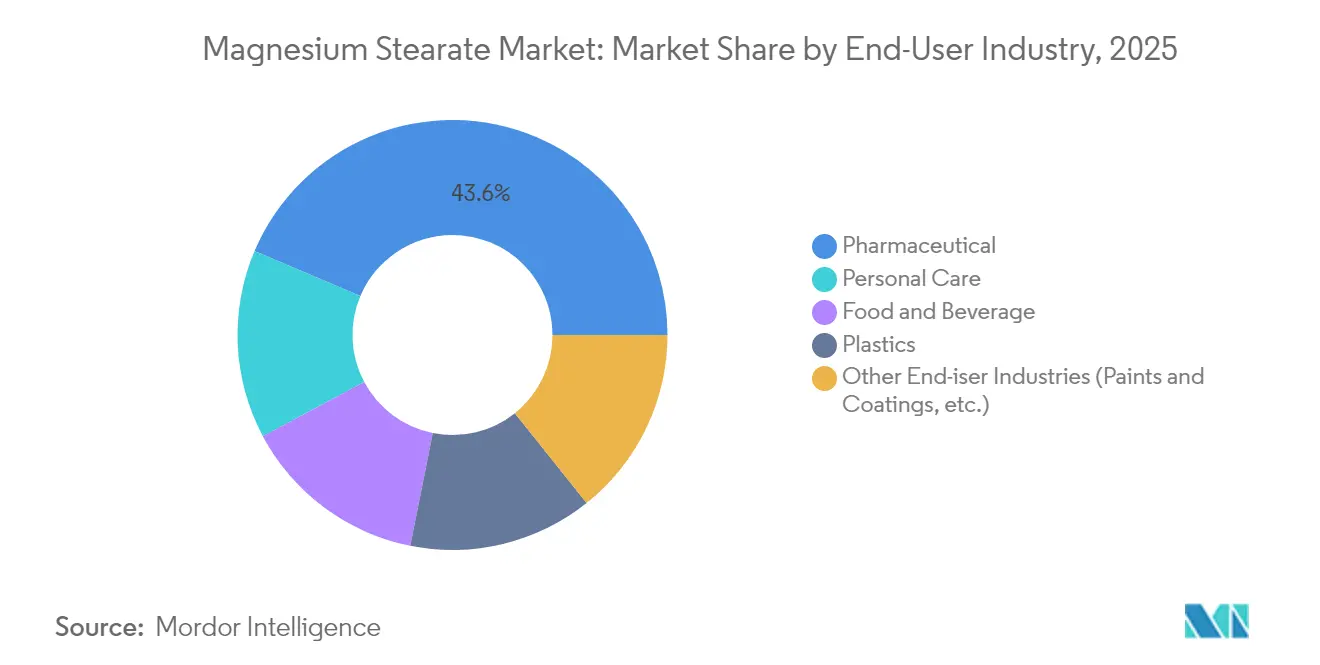
Pharmaceutical Dominance Drives Market StabilityIn 2025, pharmaceutical applications accounted for 43.62% of the Magnesium Stearate market revenue, underscoring decades of regulatory acceptance and cost-efficient performance. Tablets, capsules, and granules integrate the excipient at concentrations usually below 2%, yet cumulative volumes remain high due to sheer output of oral-solid doses. Because reformulating legacy products demands new bioequivalence dossiers, brand and generic manufacturers retain existing stearate grades, insulating this segment from short-term substitution risk. Meanwhile, the personal care business, anchored by pressed-powder and dry shampoo launches, shows the fastest trajectory at a 6.12% CAGR. This growth adds premium-priced, cosmetic-grade volumes, albeit from a smaller base.
Food and beverage formulators employ the powder as an anti-caking and flow agent in icing sugar, baking mixes, and powdered drink bases. Even at low inclusion rates, dependable moisture control renders magnesium stearate indispensable where conveyor throughput and consumer pour-ability intersect. Plastics processors have carved a niche in heat-stabilized Polyvinyl Chloride (PVC), particularly for electric-vehicle wiring that experiences higher under-hood temperatures. Although representing a modest slice, this outlet diversifies revenue streams and lowers reliance on pharmaceutical cycles. Collectively, these patterns safeguard the broader magnesium stearate market against demand shocks in any single vertical.



Geography Analysis
APAC Magnesium Stearate Market
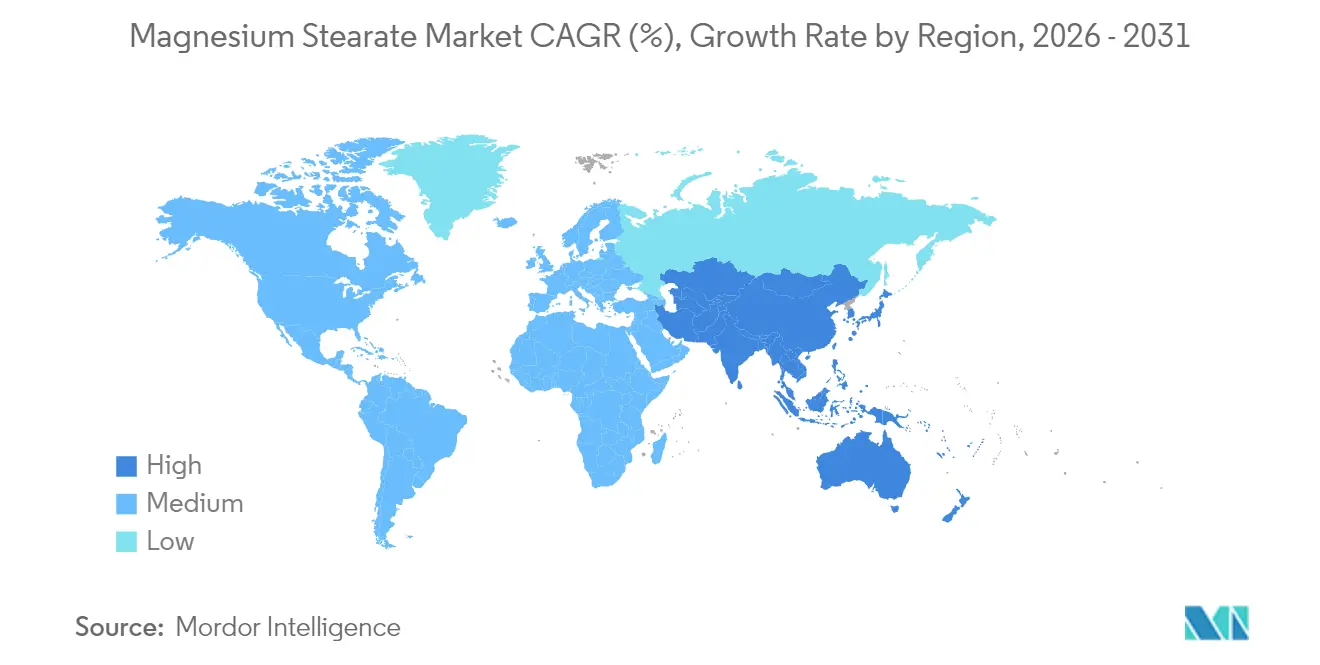
Asia-Pacific led with 41.12% revenue in 2025 and is on track for a 6.01% CAGR through 2031, making it the linchpin of the magnesium stearate market. China’s magnesium-metal capacity surged 24.5% in 2024, surpassing 1.02 Million tonnes and cushioning regional raw-material supply. Concurrently, India’s contract-development and manufacturing organizations ramped tablet output for exports to Africa and Latin America, further lifting lubricant demand. Southeast Asian nations benefit as both consumption and secondary processing hubs, with Vietnam and Indonesia offering cost-advantaged blending services that feed neighboring Association of Southeast Asian Nations (ASEAN) markets.
North America and Europe Magnesium Stearate Market
North America remains a technology pacesetter, hosting several Food and Drug Administration (FDA)-approved continuous-manufacturing plants that set stringent excipient specification benchmarks. Buyers insist on full United States Pharmacopeia (USP), European Pharmacopoeia (EP), and Japanese Pharmacopoeia (JP) monograph compliance, compelling vendors to maintain harmonized documentation packs. Clean-label advocacy is more pronounced in the United States, where natural-product retailers blacklist animal-derived stearates, nudging suppliers toward certified vegan lines. Europe mirrors these quality demands and intensifies sustainability scrutiny, compelling palm-supply chain audits and life-cycle assessments before purchasing decisions.
MEA and South America Magnesium Stearate Market
South America, the Middle East, and Africa collectively contribute a smaller but rising parcel of global uptake. Brazil’s Agência Nacional de Vigilância Sanitária (ANVISA) fast-track for generic approvals fuels tablet output, while Saudi Arabian and South African public tenders prioritize local sourcing where feasible. However, fragmented local production capacity often lacks advanced analytical instruments, creating opportunity for multinational suppliers offering turnkey quality services. Despite lower volume, these geographies offer risk diversification and long-run upside as healthcare spend per capita climbs.

Regulatory Landscape
Magnesium stearate is covered under long-established food additive and pharmaceutical excipient frameworks. In the United States, it is affirmed as GRAS under 21 CFR 184.1440 for specified food uses (including as a lubricant and release agent), while globally it is listed under JECFA as INS 470(iii) with an ADI noted as "not specified," which supports broad acceptance when purity specifications are met.
On standards, the Codex Alimentarius list of specifications for food additives was revised in 2025 (CXA 6-2025) and maintains specifications for magnesium stearate, reinforcing harmonized food-grade requirements across many importing markets. For pharmaceutical applications, buyers commonly align to PDG harmonized expectations across USP, EP, and JP, so suppliers emphasize multi-compendial documentation and tight controls on fatty-acid profiles and metallic impurities to support global interchangeability across regulated drug supply chains.
Value Chain Analysis
The magnesium stearate value chain starts with upstream feedstocks, including fatty acids (primarily stearic and palmitic acids) sourced from vegetable oils and fats (often palm and other oleochemicals), and magnesium sources such as magnesium oxide or magnesium salts. Production is typically carried out via direct neutralization of fatty acids with magnesium oxide, or through indirect precipitation routes, with economics tied to oleochemical availability, energy costs for magnesium inputs, and the ability to meet tight impurity limits for regulated end uses.
Traceability programs for palm-derived inputs increasingly shape procurement, including RSPO-certified palm oil and oleochemical streams, with buyers asking for chain-of-custody documentation alongside pharmacopeial compliance packs. Midstream producers convert and refine metal soaps, then complete downstream finishing steps such as purification, controlled milling, and micronization to match application-specific particle size and performance needs for pharmaceuticals and personal care. Distribution is split between direct supply agreements to large pharmaceutical and personal care manufacturers and specialty chemical distributors for smaller formulators, with qualification cycles and auditing concentrated among quality-critical customers.
Competitive Landscape
The Magnesium Stearate Market is moderately fragmented, with the top five producers, such as Baerlocher GmbH, Merck KGaA, Valtris Specialty Chemicals, Peter Greven GmbH & Co. KG, and FACI Corporate S.p.A. accounting for a significant global revenue. Baerlocher GmbH leverages vertical integration in metal soaps to deliver consistent fatty-acid profiles. Merck KGaA maintains premium standing via stringent Current Good Manufacturing Practice (cGMP) stewardship and multi-compendial dossiers updated across International Council for Harmonization (ICH) regions. Tier-two competitors differentiate through regional proximity and bespoke particle-size tailoring, appealing to cosmetic formulators seeking unique sensory attributes. Strategic partnerships intensify as customers demand co-development support. Excipient makers invest in application labs to simulate continuous-mixing shear, enabling predictive lubrication modeling.
Magnesium Stearate Industry Leaders
Baerlocher GmbH
Valtris Specialty Chemicals
Merck KGaA
Peter Greven GmbH & Co. KG
FACI Corporate S.p.A
- *Disclaimer: Major Players sorted in no particular order
Magnesium Stearate Market Companies Covered in this Report
- Baerlocher GmbH
- FACI Corporate S.p.A.
- Huzhou City Linghu Xinwang Chemical Co., Ltd
- IRRH Specialty Chemicals
- James M. Brown Ltd.
- Kemipex
- Kirsch Pharma GmbH
- Merck KGaA
- MLA Group of Industries
- NB Entrepreneurs
- Nimbasia
- Peter Greven GmbH & Co. KG
- Roquette Frères
- Struktol Company of America, LLC
- Thermo Fisher Scientific Inc.
- Valtris Specialty Chemicals

Market Opportunities and Future Outlook
Opportunities are most visible in higher-specification and differentiated grades that reduce qualification friction for regulated customers. PDG-linked alignment across USP, EP, and JP creates room for suppliers that can maintain harmonized, audit-ready documentation and consistently meet compendial limits on impurities and fatty-acid composition, which is especially relevant as global drug manufacturers consolidate supplier lists for continuous solid-dose manufacturing.
Sourcing transparency is a second lever where suppliers can capture premium demand. Regulatory and buyer scrutiny of upstream oleochemicals, alongside food additive positioning (for example, US GRAS status under 21 CFR 184.1440 and Codex listing under INS 470(iii)), supports product lines that pair multi-compendial compliance with traceability and origin claims, including vegan or palm-free positioning referenced by market participants. Given the long validation windows often required to qualify new sites and grades for pharmaceutical use, localized finishing, testing, and technical support near major pharma hubs in North America and Europe remains a practical whitespace for suppliers looking to shorten change-control timelines and strengthen customer integration.
Recent Industry Developments in Magnesium Stearate Market
- April 2026: Baerlocher GmbH highlighted PFAS-free and circular-economy additive technologies at Plastics Recycling Show Europe (PRSE) in Amsterdam, emphasizing solutions relevant to polymer additives portfolios that include metallic soaps. The positioning aligns magnesium stearate suppliers serving plastics customers with recyclate performance requirements and tightening material compliance expectations in Europe.
- April 2026: Valtris Specialty Chemicals participated in ChinaPlas 2026 in Shanghai (April 21-24), promoting its sustainable solutions strategy across polymer additives and specialty chemicals. The activity underscored competitive emphasis on sustainability-led differentiation in additives supply chains that intersect with metallic stearates used in plastics processing.
- April 2024: Evonik Industries AG expanded capacity at its Darmstadt site using solvent-free micronization for producing RESOMER polymer powders, strengthening access to fine-powder processing capabilities. The added micronization capacity is relevant for customers that require ultra-fine, tightly controlled powder properties, reinforcing downstream processing as a differentiator in specialty excipient and additive applications.


Magnesium Stearate Market Report Scope and Research Methodology
Market Definition and Coverage
For this methodology, the market is the revenue generated from magnesium stearate sold as a functional additive and processing aid across major end-use industries, measured at the point of sale and consolidated across key producing and consuming countries.
Scope exclusions: The sizing excludes in-house captive consumption that is not monetized, and it also excludes adjacent metallic stearates and mixed additive blends where magnesium stearate is not separately priced.
Segments Covered in This Report
- By End-User Industry
- Pharmaceutical
- Food & Beverage
- Personal Care
- Plastics
- Other End-iser Industries (Paints & Coatings, etc.)
- By Geography
- Asia-Pacific
- China
- Japan
- India
- South Korea
- ASEAN Countries
- Rest of Asia-Pacific
- North America
- United States
- Canada
- Mexico
- Europe
- Germany
- United Kingdom
- France
- Italy
- Spain
- Russia
- NORDIC Countries
- Rest of Europe
- South America
- Brazil
- Argentina
- Rest of South America
- Middle East and Africa
- Saudi Arabia
- South Africa
- Rest of Middle East and Africa
- Asia-Pacific
Data Sources, Market Sizing, and Validation
Desk Research
Desk work started with anchoring demand drivers that are visible in public data, and then mapping them to where magnesium stearate is typically used. Sources consulted include official trade and tariff statistics (such as UN Comtrade and national customs portals), industrial production and chemical output series (such as the US Federal Reserve and Eurostat), and macro indicators from bodies such as the World Bank.
We also reviewed technical and safety references that help confirm use cases and constraints, such as USP and FDA ingredient references, EFSA opinions, and peer reviewed formulation and excipient papers. Company annual reports, investor decks, and credible industry press were used to track capacity additions, regional expansions, and raw material context (fatty acid and magnesium salt availability). For cross-checking financials, patents, shipment patterns, and tender visibility, paid subscriptions for company intelligence, patent coverage, and shipment-level import export data were used where relevant. This desk list is not exhaustive, and many other sources were referred to for data collection, validation, and research clarification.
Primary Interviews and Surveys
Primary inputs were gathered through expert interviews and structured surveys with manufacturers, distributors, and large end users who buy excipients and additives for tablets, capsules, foods, personal care, and plastics. To keep assumptions realistic, we tested typical dosage and loading rates, procurement patterns, and regional pricing logic, and then reconciled those views against the desk indicators across APAC, EMEA, and the Americas.
Distribution of primary research fieldwork respondents
| Company type | Respondent position | Region |
|---|---|---|
| Top tier: 30% | CXOs: 14% | APAC: 51% |
| Mid tier: 55% | Functional/Unit leaders: 29% | EMEA: 31% |
| Smaller Players: 15% | Managers: 57% | Americas: 18% |
Market-Sizing & Forecasting
Sizing was built using a top-down demand pool, where end-use output indicators are converted into magnesium stearate consumption with penetration and inclusion-rate assumptions, and then translated into value using region-specific average selling prices. The key inputs include oral solid dose production trends (as a proxy for lubricant demand), growth in nutraceutical formats, processed food output where anti-caking aids are relevant, personal care manufacturing indices, and plastics processing activity linked to internal lubricants.
Once these totals were formed, they were corroborated with selective bottom-up approximations such as sampled supplier revenue signals, distributor channel checks, and simple volume times ASP calculations for a few high-visibility countries. When bottom-up signals were incomplete, gaps were handled by using comparable-country intensity factors and then re-tested during follow-up calls so outliers were not carried into the final totals.
For forecasting, scenario analysis was used around a core trend line, with expert consensus on how quickly pharmaceutical volumes, clean-label preferences (including palm-free sourcing), and regional pricing move over time. The output was then stress-tested against macro production indicators so the growth path stayed plausible in each region.
Data Validation & Update Cycle
Model outputs are checked against independent signals like trade flows, industrial production movement, and observed pricing ranges, and then variances are reviewed before sign-off. If a region shows a sharp shift that is not supported by these signals, we re-check the drivers, revisit assumptions, and re-contact selected interviewees to clarify what changed.
Each estimate goes through multi-step analyst review, including arithmetic checks, unit consistency checks, and reasonableness tests by end-use demand logic. Reports are refreshed annually, and interim updates are made when material events occur, such as new capacity announcements, major regulatory changes, or unusually large price swings. Before delivery, a final pass is completed so clients receive the most current view available at that time.
Mordor Intelligence's Magnesium Stearate Market Size Versus Other Published Estimates
Published market values for magnesium stearate do not always match because each publisher draws the line on what to count and which year to anchor, and they also differ in how they translate volumes into value. Differences show up quickly when grades, end uses, and country coverage are not treated in the same way.
The largest gaps usually come from whether the scope is limited to sold material only versus including captive use, how pricing is averaged across pharma-grade and industrial-grade material, and whether the near-term year is a base estimate or a forward year. Currency timing also matters because chemical inputs move, and a model that keeps older exchange rates or does not re-check ASPs can drift away from what buyers see in contracts.
Benchmark comparison
| Source | Market Size | Gaps in Research Methodology |
|---|---|---|
| Mordor Intelligence | USD 636.72 M (2026) | |
| Global Consultancy A | USD 650.87 M (2025) | Uses a different base year and may apply broader application and form coverage with higher blended pricing, which can lift the value even if volumes are similar. |
| Industry Publisher B | USD 621.60 M (2025) | Anchors the model to an earlier base and can lean more on stated revenue growth paths, with less explicit separation of pharma-grade versus industrial-grade ASPs by region. |
The table shows that small choices in anchor year, grade-level pricing, and how regional demand pools are built can create noticeable spreads. By keeping the value tied to end-use output signals and re-validating the price blend for pharma and industrial demand before finalizing the totals, the sizing stays traceable to repeatable steps, which is the approach applied here by Mordor Intelligence.


Key Questions Answered in the Report
What is the current value of the magnesium stearate market?
The market is valued at USD 636.72 Million in 2026 and is forecast to reach USD 840.73 Million by 2031.
Which end-user industry dominates demand?
Pharmaceutical manufacturing leads with a 43.62% revenue share in 2025, driven by the excipient’s role in tablet lubrication.
Which region is growing the fastest?
Asia-Pacific posts the highest 6.01% CAGR to 2031 due to expanding generic drug production and abundant magnesium supply.
Why are clean-label grades gaining traction?
Vegan and palm-free formulations meet consumer transparency expectations and help brands comply with evolving sustainability standards.
What alternative lubricant threatens market share?
Sodium stearyl fumarate offers faster disintegration and cleaner labeling for certain modified-release tablets, posing niche competition.
Page last updated on:


 Your data is secure and never sold or shared.


