
South America Professional Liquid Soap Market Size and Share
Market Overview
| Study Period | 2021 - 2031 |
|---|---|
| Forecast Data Period | 2026 - 2031 |
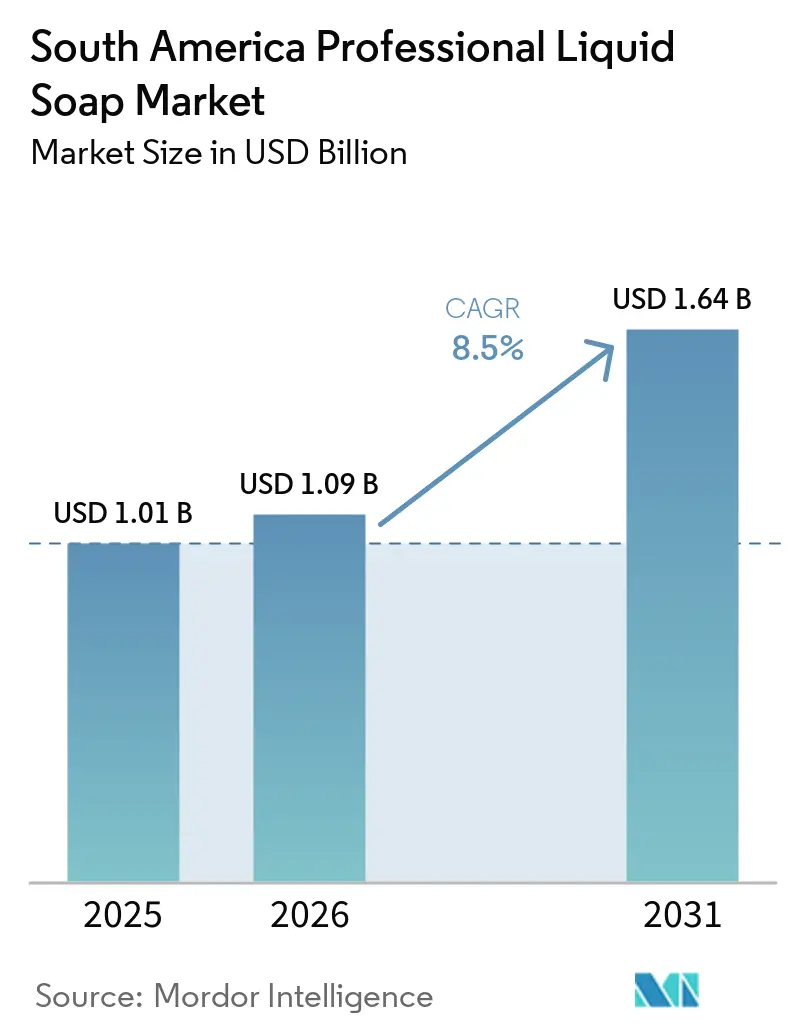
| Base Year Market Size (2025) | USD 1.01 Billion |
| Market Size (2026) | USD 1.09 Billion |
| Market Size (2031) | USD 1.64 Billion |
| Growth Rate (2026 - 2031) | 8.50 % |
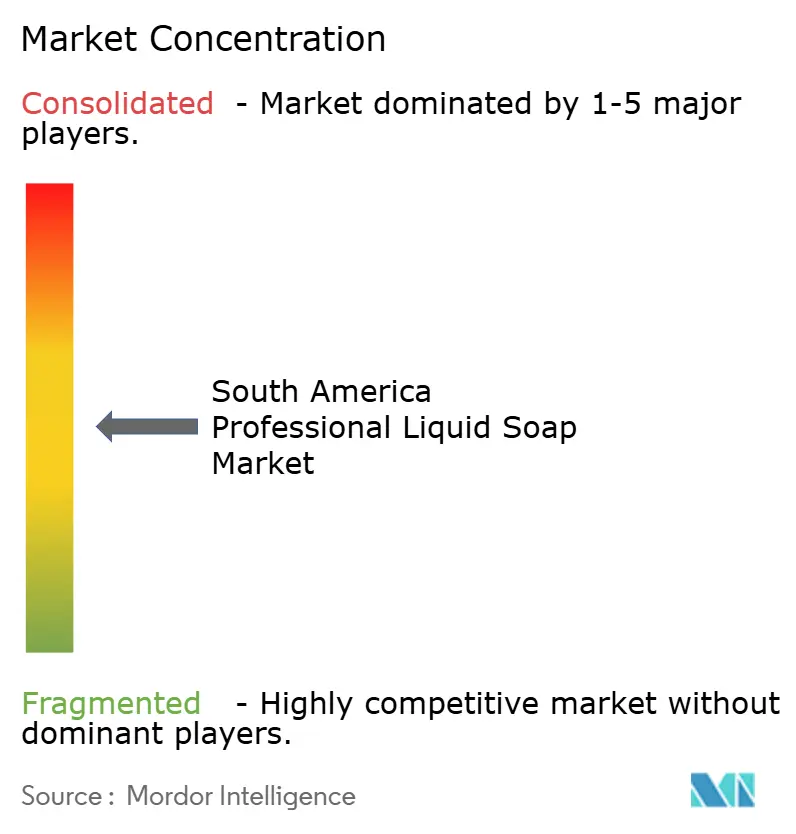
| Market Concentration | Medium |
Major Players
*Disclaimer: Major Players sorted in no particular order Image © Mordor Intelligence. Reuse requires attribution under CC BY 4.0. |
|
South America Professional Liquid Soap Market Analysis by Mordor Intelligence
The South America professional liquid hand soap market size was valued at USD 1.01 billion in 2025 and is estimated to grow from USD 1.09 billion in 2026 to reach USD 1.64 billion by 2031, at a CAGR of 8.50% during the forecast period (2026-2031). Healthcare, hospitality, manufacturing, and public facilities provide the region’s most durable sources of institutional demand. Regulatory requirements increasingly make registered liquid formulations a routine procurement item rather than a discretionary purchase. New health facilities and higher hospitality activity create new washroom locations that need recurring supplies. Suppliers are responding with refill formats, certified antimicrobial products, dispensing systems, and broader distribution coverage. These conditions support continued expansion of the South America professional liquid hand soap market despite pressure on institutional budgets.
Key Report Takeaways
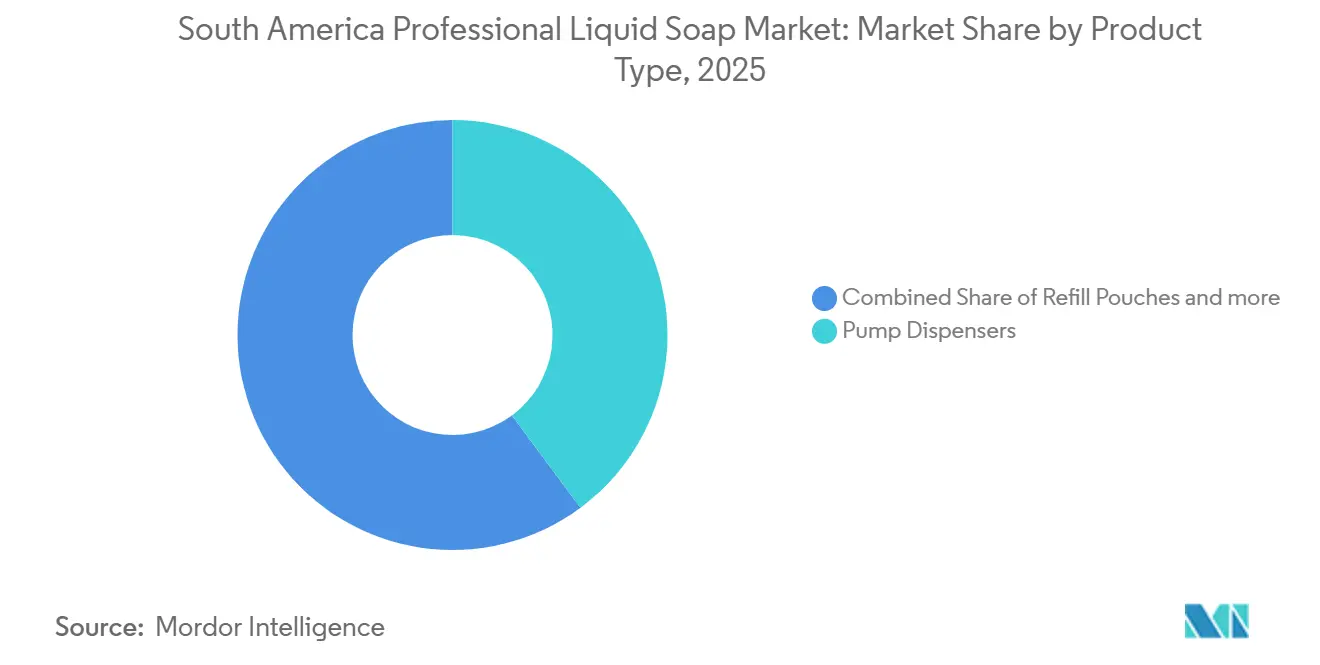
- By product type, pump dispensers held 39.86% of the South America professional liquid hand soap market share in 2025, while refill pouches recorded the highest projected CAGR at 8.79% through 2031.
- By price range, the mass tier accounted for 65.39% of the South America professional liquid hand soap market size in 2025, while premium formulations are forecast to grow at an 8.82% CAGR through 2031.
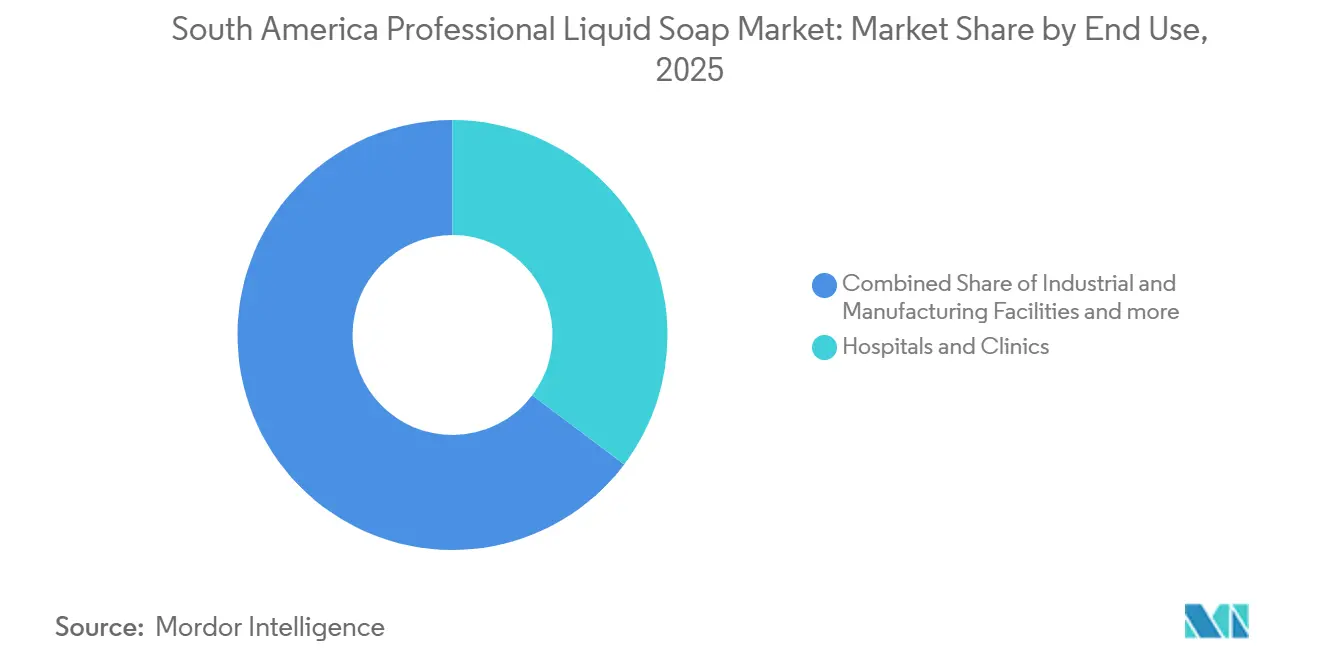
- By end use, hospitals and clinics held 35.28% revenue share in 2025, while industrial and manufacturing facilities are expected to expand at a 9.12% CAGR through 2031.
- By country, Brazil accounted for 41.58% revenue share in 2025, while Argentina is forecast to record the highest CAGR at 9.05% through 2031.
Note: Market size and forecast figures in this report are generated using Mordor Intelligence’s proprietary estimation framework, updated with the latest available data and insights as of January 2026.
South America Professional Liquid Soap Market Trends and Insights
Drivers Impact Analysis*
| Driver | (~) % Impact on CAGR Forecast | Geographic Relevance | Impact Timeline |
|---|---|---|---|
| Increasing institutional focus on hand hygiene and infection prevention | +2.0% | South America, concentrated in Brazil and Argentina | Short term (≤ 2 years) |
| Expansion of healthcare and hospitality infrastructure | +1.8% | Brazil and Colombia, with spillover to Chile and Peru | Medium term (2-4 years) |
| Growing demand for specialized and antimicrobial formulations | +1.3% | Brazil and Argentina, expanding to Colombia | Medium term (2-4 years) |
| Expansion of institutional and workplace hygiene standards | +1.2% | MERCOSUL, with early gains in São Paulo, Buenos Aires, and Bogotá | Long term (≥ 4 years) |
| Rising adoption of touchless and automated dispensing systems | +0.8% | Brazil and Chile, expanding to Argentina | Medium term (2-4 years) |
| Increasing premiumization of professional hygiene products | +0.7% | Brazil and Chile, with early adoption in Colombia and Peru | Long term (≥ 4 years) |
| Source: Mordor Intelligence | |||
Increasing institutional focus on hand hygiene and infection prevention
Healthcare-associated infections remain a major concern in hospitals, keeping infection prevention and hand hygiene central to healthcare procurement. Brazil’s hand-hygiene protocols follow the WHO’s five key moments, reinforcing the need for accessible hand-hygiene products at points of care. Brazil Ministry of Health – Hand Hygiene Protocol PAHO also promotes infection-prevention programs across the Americas, including the availability of appropriate hand-hygiene supplies in healthcare facilities. PAHO – Infection Prevention and Control Programs Standardized protocols therefore support consistent demand for liquid soap and other professional hand-hygiene products. Hospitals increasingly favor formulations that combine effective cleansing with skin-care properties, particularly for frequent-use settings. Dispenser compatibility and refill efficiency also influence procurement decisions because they help facilities maintain hygiene standards while controlling operating costs.
Expansion of healthcare and hospitality infrastructure
Brazil allocated BRL 31 billion (USD 5.7 billion) through 2026 for the construction and renovation of 2,762 public healthcare facilities under the Novo PAC Saúde program, creating recurring opportunities for institutional washroom and hygiene-supply procurement. [1]Source: Ministry of Health Brazil, "PAC Health FAQ", gov.br/saude/ Colombia’s expanding hotel sector is similarly increasing the number of commercial facilities requiring professionally supplied hygiene products, supported by continued investment from international hotel chains. Together, healthcare infrastructure development in Brazil and hospitality expansion in Colombia are creating new-account opportunities for professional liquid hand soap suppliers across South America. New facilities also require standardized dispensers, refill systems, and routine hygiene replenishment, creating opportunities beyond the initial product sale. Procurement frameworks favor suppliers capable of maintaining consistent supply, regulatory compliance, and service coverage across multiple locations.
Growing demand for specialized and antimicrobial formulations
Antimicrobial liquid soaps are essential in critical-care units, food-processing facilities, and cleanroom environments where enhanced pathogen control is required. Formulations containing active ingredients such as chlorhexidine gluconate and benzalkonium chloride are suited to applications requiring stronger antimicrobial performance than conventional cleansing products. Regulatory scrutiny of high-risk hygiene products in Brazil is also increasing the importance of documented formulations and compliant suppliers. This creates opportunities for established manufacturers with registered antimicrobial products to secure recurring institutional contracts. Ecolab’s broader hygiene solutions combine specialized chemistry, monitoring, and service support for protein-processing facilities, reinforcing the shift toward integrated hygiene programs rather than standalone products. Such integrated offerings can improve operational consistency, strengthen customer retention, and support premium pricing in demanding institutional applications.
Expansion of institutional and workplace hygiene standards
Export-oriented manufacturers and institutional buyers in Brazil, Chile, and Colombia are placing greater emphasis on workplace hygiene and safety standards, strengthening demand for professional hand-hygiene systems. Brazil’s NR-32 and Chile’s Law 16,744, alongside Colombia’s occupational safety requirements, support formal hygiene practices in institutional and industrial settings. Argentina’s regulatory simplification for certain hygiene and personal-care products can lower entry barriers for compliant regional suppliers, while Brazil’s stronger enforcement encourages institutional buyers to verify product registration and labeling. Formal procurement practices, including tenders for liquid soap and dispensers, are also supporting the shift toward standardized professional products. These developments expand opportunities for suppliers offering compliant formulations, dispenser-compatible formats, and documented quality standards.
Restraints Impact Analysis*
| Restraint | (~) % Impact on CAGR Forecast | Geographic Relevance | Impact Timeline |
|---|---|---|---|
| Availability of lower-cost bar soaps and alternative hand-hygiene products | -0.6% | Peru and informal sectors across MERCOSUL | Short term (≤ 2 years) |
| Price sensitivity and institutional procurement constraints | -0.8% | Argentina, Brazil, and Colombia | Medium term (2-4 years) |
| Regulatory and certification complexity across countries | -0.4% | Colombia, Chile, and Peru | Long term (≥ 4 years) |
| Packaging waste and sustainability compliance costs | -0.3% | Chile, Brazil, and Colombia | Medium term (2-4 years) |
| Source: Mordor Intelligence | |||
Availability of lower-cost bar soaps and alternative hand-hygiene products
Bar soap remains widely used in price-sensitive schools, municipal offices, and smaller food-service businesses, where buyers typically prioritize the lowest compliant unit cost. This pressure is particularly evident in Peru and informal Brazilian channels, encouraging substitution toward more affordable registered cleaning products. Alcohol-based hand rubs also compete for dispenser space in healthcare facilities, creating additional pressure on liquid soap demand. Limited procurement budgets and high usage frequency further reinforce demand for economical hand-hygiene solutions. Suppliers offering bulk packs and cost-efficient formulations can therefore gain an advantage in high-volume institutional accounts. As a result, the mass tier maintains a strong value position, while differentiated and premium formats continue to gain traction.
Regulatory and certification complexity across countries
Compliance requirements vary across South American markets, particularly outside the MERCOSUR core, requiring suppliers to manage country-specific registrations, labeling, documentation, and distribution arrangements. Brazil’s 2025 sanitizer regulations incorporated MERCOSUR-related requirements, improving regulatory alignment for compliant suppliers operating across the bloc. [2]Source: Ministry of Health Brazil, "National Health Surveillance Agency - ANVISA", gov.br/anvisa/However, Colombia, Chile, and Peru continue to require close attention to local regulatory procedures, creating additional administrative and market-entry costs. These differences can lengthen product approval timelines and increase the need for local regulatory expertise. Established suppliers therefore benefit from stronger compliance capabilities, established documentation systems, and regional distribution networks.
*Our forecasts treat driver/restraint impacts as directional, not additive. The impact forecasts reflect baseline growth, mix effects, and variable interactions.
Segment Analysis
By Product Type: Refill Formats Reshape Institutional Procurement Logic
Pump dispensers held 39.86% of the South America professional liquid hand soap market share in 2025. Their leading position reflects use in regulated settings that need controlled single-dose dispensing. Hospitals, large hotels, and corporate complexes have an established base of dispenser equipment. This installed base supports recurring purchases of compatible liquid soap. Suppliers often bundle the dispenser and consumable product in service agreements lasting several years. These arrangements reduce reliance on spot purchasing and can stabilize account relationships. Refill bottles remain relevant for mid-size food-service operators and educational facilities. Other product types serve narrower use cases within professional washrooms.
Refill pouches are the fastest-growing format, with an 8.79% CAGR forecast through 2031 in the South America professional liquid hand soap market. Their lower material intensity can reduce transport weight and packaging use. Chilean, Brazilian, and Colombian packaging policies support greater attention to material-efficient formats. Chile’s Law 20.920 (REP) establishes collection and recovery obligations for packaging [3]Source: Global Product Compliance, "Chile Regulations for Various Sectors", gpcgateway.com, while Brazil’s solid-waste framework promotes reverse logistics, and Colombia’s Resolution 1407/2018 regulates the environmental management of packaging waste. Pouches can improve delivery efficiency for distributors handling large volumes, while their adoption is increasingly influenced by regulatory compliance beyond cost considerations. Suppliers offering compliant pouch formats are better positioned to serve customers with packaging obligations.



By Price Range: Premium Gains Structural Momentum Among Regulated Buyers
The mass tier accounted for 65.39% of market value in 2025, driven largely by public hospitals, municipal facilities, and schools. Their tender rules focus on registered products that meet the required specification at the lowest cost. Domestic suppliers with recognized generic formulations can address this need. The mass tier remains driven by cost-sensitive institutional procurement, with public-sector tenders prioritizing standardized, compliant hygiene products at competitive prices, supporting steady demand for affordable liquid hand soaps. This pattern showed limited pricing power as customers moved within lower-cost registered product ranges. The mass tier will remain essential because institutional budgets remain constrained. It also provides the entry-level volume base for domestic professional suppliers.
Premium formulations are projected to grow at an 8.82% CAGR through 2031. Private hospitals, higher-tier hospitality operators, and multinational campuses are the main buyers. These buyers prioritize products with specialized formulations, regulatory documentation, and dependable service support. Professional soaps may incorporate chlorhexidine, other antimicrobial agents, and skin-conditioning ingredients to meet surgical scrub, critical-care, and frequent-use applications. Higher active-ingredient costs and certification requirements create barriers to generic competition, supporting premium demand as institutional hygiene standards become more stringent.
By End Use: Industrial Facilities Drive Growth Beyond Healthcare
Hospitals and clinics represented 35.28% of the South America professional liquid hand soap market in 2025, supported by mandatory hand-hygiene practices across patient-care areas. Brazil’s national hygiene protocols and PAHO’s infection-prevention initiatives further sustain demand, making procurement essential even under constrained healthcare budgets. Hotels and restaurants constitute another significant demand segment, while offices, schools, universities, and other institutions contribute recurring consumption. Different regulatory and hygiene requirements across these settings create a diversified demand base and reduce dependence on a single end-use sector.
Industrial and manufacturing facilities are forecast to grow at a 9.12% CAGR through 2031, supported by rising workplace hygiene and safety requirements. Export-oriented manufacturers are increasingly adopting structured hygiene frameworks, strengthening demand for managed washroom solutions. Food processing and protein facilities have particularly stringent contamination-control requirements, supporting demand for specialized hygiene programs. Ecolab provides worker-hygiene products, hand cleaners, dispensers, and food-safety solutions for processing facilities in Brazil. Manufacturers also value dispensing and monitoring technologies that improve hygiene compliance and supply management, making industrial facilities an important growth channel beyond healthcare.
Geography Analysis
Brazil accounted for 41.58% of regional market value in 2025, representing South America’s largest national share. Its institutional procurement base is supported by extensive healthcare infrastructure, with Novo PAC Saúde allocating BRL 31 billion (USD 5.7 billion) through 2026. New facilities require hand-hygiene products compliant with ANVISA standards, while Brazil’s 2025 sanitizer regulations aligned with MERCOSUR frameworks, reducing cross-border compliance barriers.
Argentina is the fastest-growing country, with a forecast CAGR of 9.05% through 2031. The removal of the PAIS tax in December 2024 eased cost pressures for import-dependent suppliers, while digital sworn declarations introduced in 2025 simplified certain manufacturer registration processes. ANMAT also took action against unregistered liquid soap brands in November 2025, encouraging institutional buyers to favor compliant products. Softys Professional continues to expand its institutional customer network in Argentina.
Colombia is emerging as a source of incremental demand, supported by growth in hospitality and tourism and rising hygiene standards. Boyacá’s 2025 hotel hygiene pilot further highlighted the importance of safe tourism facilities. Chile offers opportunities for refill suppliers as packaging policies encourage material-efficient formats, while Peru contributes healthcare-related demand. The wider South American market favors suppliers with agile regional distribution and the ability to adapt products, pricing, and compliance strategies to local conditions.
Competitive Landscape
The South America professional liquid hand soap market is moderately concentrated, with global suppliers operating alongside regional manufacturers, country specialists, and local distributors. Ecolab and Unilever have scale in formulation, service, and logistics, while Oleak, Softys Professional, Mercoquímica, and Paboni de Colombia compete through local relationships and procurement responsiveness. Players like Unilever supports professional hygiene offerings through dedicated formulations and logistics investment in Brazil, making service capability as important as product availability.
Technology and certified antimicrobial formulations are key competitive areas. Oleak’s digital monitoring solutions enable healthcare facilities to track hygiene product usage and streamline replenishment processes. Such technology-driven services strengthen supplier relationships by integrating product supply with ongoing operational support. Ecolab launched ReadyDose concentrated cleaning tablets in Brazil in 2025, reducing packaging mass and supporting institutional sustainability requirements.
Regulatory harmonization can affect established suppliers and new entrants. Brazil’s RDC 989/2025 and IN 394/2025 raised certification standards for sanitizer products, making it harder for undocumented suppliers to serve formal institutions while potentially simplifying expansion for compliant suppliers across markets. Regional incumbents retain advantages through subnational distributor networks and local tender expertise, while multinationals benefit from broader portfolios and logistics investment. Price pressure remains significant in public procurement, limiting margin expansion. The market therefore remains moderately concentrated rather than controlled by a small group of suppliers.
South America Professional Liquid Soap Industry Leaders
-
Ecolab, Inc.
-
Oleak Industria E Comercio LTDA
-
Softys Argentina SA
-
Unilever PLC
-
Berhlan Institutional
- *Disclaimer: Major Players sorted in no particular order

Recent Industry Developments
- July 2026: Suzano and Kimberly-Clark finalized the creation of Arbex, combining Kimberly-Clark's International Family Care and Professional business (outside the United States) with Suzano's tissue assets. The joint venture consolidates capabilities relevant to away-from-home and professional channels, reshaping how product, pricing, and supply are managed across international markets that include Latin America.
- December 2025: Unilever inaugurated its first distribution center in Serra, Espírito Santo, Brazil. The BRL 145 million investment, or USD 24.7 million, expanded the company’s logistics network. The site has 14,000 pallet positions and increased Brazilian storage capacity by 40%.
- May 2025: Kimberly-Clark agreed to sell 51% of its International Family Care and Professional business to Suzano in a deal that valued the new joint venture at USD 3.4 billion. The transaction scope (including 22 plants in 14 countries) supports manufacturing scale and portfolio focus, which can influence professional washroom product availability and route-to-market priorities in Latin America.


South America Professional Liquid Soap Market Report Scope
| Pump Dispensers |
| Refill Bottles |
| Refill Pouches |
| Other Product Types |
| Mass |
| Premium |
| Hospitals and Clinics |
| Hotels and Restaurants |
| Commercial Offices and Corporate Buildings |
| Schools and Universities |
| Industrial and Manufacturing Facilities |
| Other End Uses |
| Brazil |
| Argentina |
| Colombia |
| Chile |
| Peru |
| Rest of South America |
| By Product Type | Pump Dispensers |
| Refill Bottles | |
| Refill Pouches | |
| Other Product Types | |
| By Price Range | Mass |
| Premium | |
| By End Use | Hospitals and Clinics |
| Hotels and Restaurants | |
| Commercial Offices and Corporate Buildings | |
| Schools and Universities | |
| Industrial and Manufacturing Facilities | |
| Other End Uses | |
| By Country | Brazil |
| Argentina | |
| Colombia | |
| Chile | |
| Peru | |
| Rest of South America |


Key Questions Answered in the Report
What is the forecast growth rate for professional liquid hand soap in South America?
The sector is forecast to grow at an 8.50% CAGR from 2026 to 2031, reaching USD 1.64 billion by 2031.
Which product format is growing fastest in South America?
Refill pouches are forecast to grow at an 8.79% CAGR through 2031 because institutional buyers are placing more weight on packaging efficiency.
Which end-use segment leads professional liquid hand soap demand?
Hospitals and clinics led with 35.28% of revenue in 2025, supported by clinical hand-hygiene requirements.
Which country has the largest professional liquid hand soap demand in the region?
Brazil held 41.58% of regional value in 2025 because of its healthcare infrastructure, industrial base, and regulatory system.
Page last updated on:





