
North America Liquid Hand Soap Market Size and Share
Market Overview
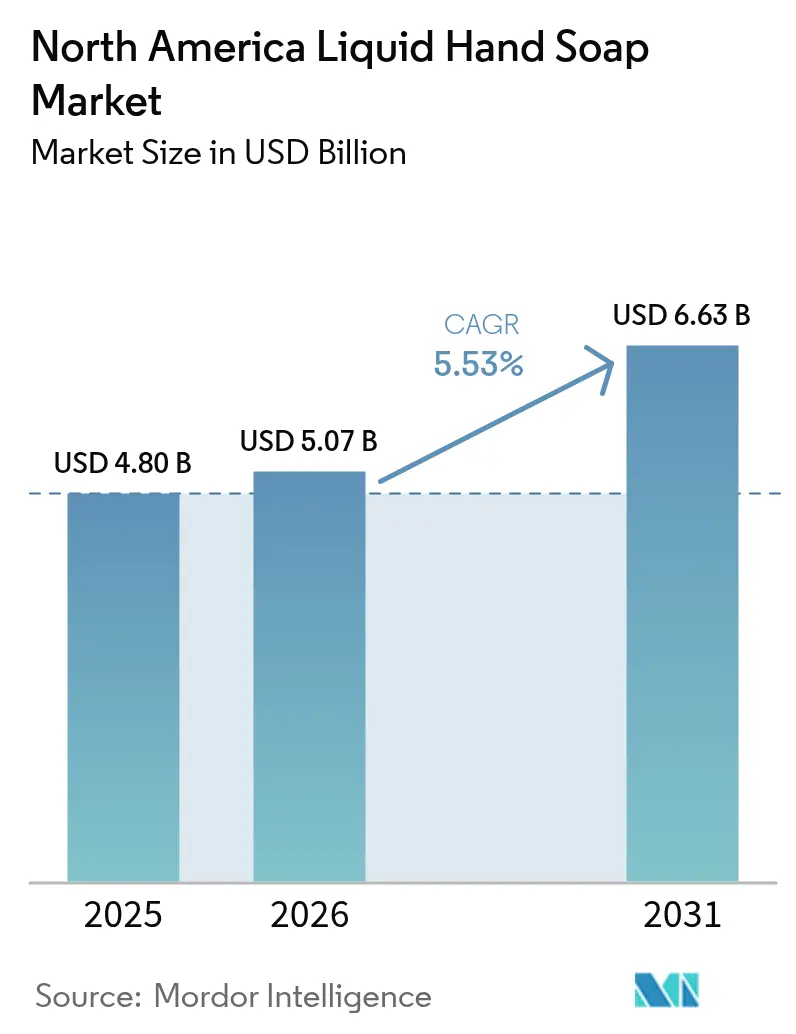
| Study Period | 2021 - 2031 |
|---|---|
| Forecast Data Period | 2026 - 2031 |
| Base Year Market Size (2025) | USD 4.8 Billion |
| Market Size (2026) | USD 5.07 Billion |
| Market Size (2031) | USD 6.63 Billion |
| Growth Rate (2026 - 2031) | 5.53 % |
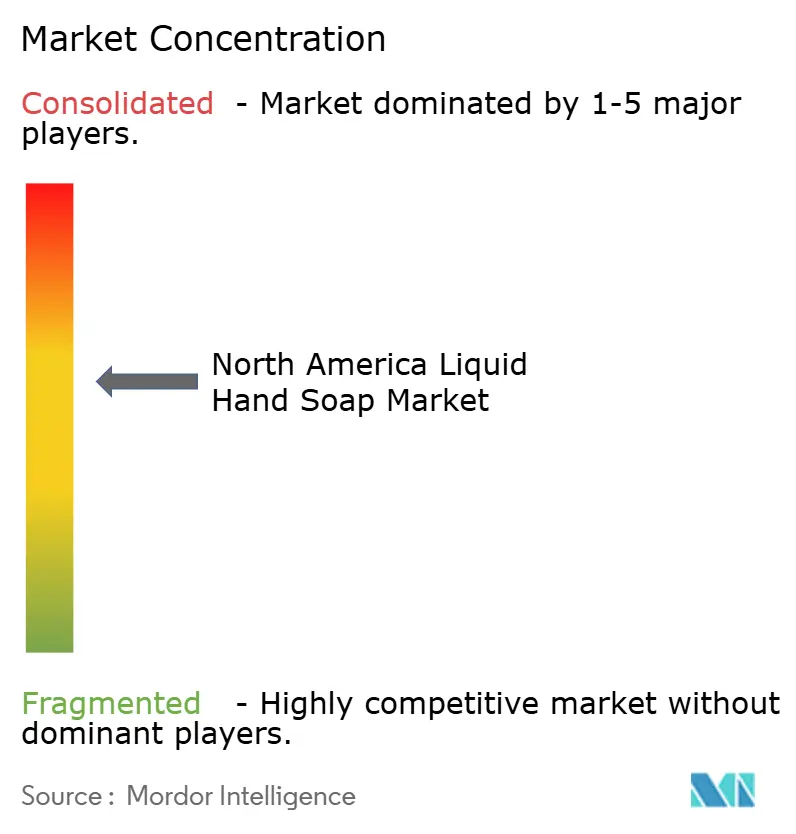
| Market Concentration | Medium |
Major Players *Disclaimer: Major Players sorted in no particular order Image © Mordor Intelligence. Reuse requires attribution under CC BY 4.0. | |
North America Liquid Hand Soap Market Analysis by Mordor Intelligence
The North America liquid hand soap market size is expected to grow from USD 4.8 billion in 2025 to USD 5.07 billion in 2026 and is forecast to reach USD 6.63 billion by 2031 at 5.53% CAGR over 2026-2031. This growth is propelled by premium formulation launches, federal “Buy-American” purchasing rules, and brand investments in refillable packs that lower plastic use. Demand is also supported by touchless dispensing technology adopted in hospitals and foodservice operations, while shrinkflation scrutiny pressures brand pricing strategies[1]The White House, “Biden-Harris Administration Finalizes Rule to Maximize Federal Purchases of American-Made Sustainable Products,” whitehouse.gov. Rising biosurfactant adoption, combined with hypoallergenic positioning, further broadens consumer reach across income tiers. Together, these dynamics reinforce the long-term resilience of the North America liquid hand soap market.
Key Report Takeaways
By packaging type, pump dispensers captured 39.27% of the North America liquid hand soap market share in 2024, while pouches are expanding at a 5.23% CAGR through 2030.
By end-user, residential consumption accounted for 53.64% of the North America liquid hand soap market size in 2024; commercial usage is advancing at a 5.92% CAGR to 2030.
By category, regular formulations held 82.38% of the North America liquid hand soap market size in 2024, yet herbal/organic variants are projected to grow at a 6.21% CAGR over the same horizon.
By product type, gel-based offerings led with 84.42% of the North America liquid hand soap market share in 2024, whereas foaming solutions are on track for a 4.96% CAGR through 2030.
Note: Market size and forecast figures in this report are generated using Mordor Intelligence’s proprietary estimation framework, updated with the latest available data and insights as of 2026.
Market Trends and Insights
Drivers Impact Analysis of North America Liquid Hand Soap Market*
| Driver | % Impact on CAGR Forecast | Geographic Relevance | Impact Timeline |
|---|---|---|---|
| Sustainability-led shift to refill and recyclable packs | +1.2% | North America & Global | Medium term (2-4 years) |
| SKU premiumisation through skin-care and fragrance cross-over | +0.8% | United States & Canada | Short term (≤ 2 years) |
| Touchless dispenser adoption in commercial spaces | +1.0% | North America core, spill-over to Mexico | Short term (≤ 2 years) |
| Biosurfactant and hypoallergenic formulations uptake | +0.7% | United States & Canada | Medium term (2-4 years) |
| Federal “Buy-American” hygiene procurement clauses | +0.9% | United States | Long term (≥ 4 years) |
| Technology advancements in manufacturing | +0.6% | North America | Long term (≥ 4 years) |
| Source: Mordor Intelligence | |||


Sustainability-Led Shift to Refill and Recyclable Packs
California’s SB 54 mandates that all packaging be recyclable or compostable by 2032, driving manufacturers toward mono-material pouches and closed-loop cartridges that cut plastic tonnage and freight costs[2]Packaging School, “Exploring California’s SB 54,” packagingschool.com. Henkel’s Dial brand now employs 100% post-consumer recycled bottles, earning third-party GreenCircle certification while maintaining high production volumes at its Pennsylvania facility. Federal buyers accelerate this momentum through the GSA’s listing program for single-use plastic-free packaging, granting visibility to compliant suppliers. Together, regulatory pressure and procurement incentives add roughly 1.2% to the market CAGR as converters re-tool lines for pouch laminates and refill systems.
SKU Premiumisation Through Skin-Care and Fragrance Cross-Over
Premium positioning through skin-care and fragrance integration transforms liquid hand soap from a commodity to an experiential product category, capturing higher margins and consumer loyalty. This premiumization strategy leverages the beauty industry's expertise in sensory formulation and ingredient storytelling. Ulta Beauty's Conscious Beauty program, encompassing over 300 participating brands with criteria including clean ingredients, sustainable packaging, and cruelty-free formulations, demonstrates retailer support for premium positioning. L'Oréal's commitment to 95% biobased ingredients and 100% recyclable plastic packaging by 2030 exemplifies how beauty conglomerates apply premium innovation capabilities to adjacent categories. The crossover strategy succeeds by addressing consumers' desire for multifunctional products that deliver cleansing efficacy alongside skin conditioning benefits. GOJO's PURELL HEALTHY SOAP incorporates natural moisturizers, skin conditioners, and spa-inspired formulations while maintaining hypoallergenic properties and excluding phthalates, parabens, and triclosan[3]GOJO Industries, “PURELL HEALTHY SOAP Fresh Scent Foam,” gojo.com.
Touchless Dispenser Adoption in Commercial Spaces
Post-pandemic hygiene protocols permanently altered commercial facility management, driving sustained demand for touchless dispensing solutions that minimize cross-contamination risks. The CDC's emphasis on accessible handwashing facilities with soap and adequate drying provisions reinforces institutional adoption of automated systems. Healthcare facilities particularly benefit from touchless technology, as CDC guidelines recommend alcohol-based hand rubs for routine decontamination when hands are not visibly soiled, creating complementary demand for soap-based systems when washing is required. Diversey's IntelliCare touchless dispensers deliver up to 350 doses per cartridge with high dose efficiency, addressing both hygiene and operational cost concerns. The FDA Food Code 2022 mandates handwashing sinks with soap in foodservice operations, creating regulatory demand for reliable dispensing systems that support 20-second handwashing protocols. Commercial adoption accelerates as facility managers recognize touchless systems' dual benefits of infection control and labor efficiency, contributing 1.0% to market CAGR with immediate implementation timelines.
Biosurfactant and Hypoallergenic Formulations Uptake
The integration of biosurfactants and hypoallergenic ingredients addresses growing consumer awareness of chemical sensitivities while meeting sustainability objectives through biodegradable formulations. FDA regulation of hand soap ingredients under 21 CFR guidelines ensures safety standards while permitting innovation in surfactant chemistry. Biosurfactants derived from microbial fermentation offer superior biodegradability compared to petroleum-based alternatives, aligning with environmental regulations like the EPA's Significant New Use Rule for bisalkylated fatty alkyl amine oxide, which requires reporting for water releases above 80 ppb concentration. Diversey's SURE plant-based range achieves Cradle to Cradle GOLD certification with 100% biodegradability and approximately 16% lower carbon footprint versus petroleum-based equivalents. The formulation trend responds to institutional buyers' sustainability mandates while addressing consumer preferences for gentler ingredients that reduce skin irritation risks. This biosurfactant adoption contributes 0.7% to market CAGR with medium-term impact as manufacturers reformulate existing products and develop new offerings that meet both performance and sustainability criteria.
Restraints Impact Analysis of North America Liquid Hand Soap Market*
| Restraint | % Impact on CAGR Forecast | Geographic Relevance | Impact Timeline |
|---|---|---|---|
| Regulatory and retailer pressure on single-use plastics | -0.8% | North America & Global | Short term (≤ 2 years) |
| Price war versus bar-soap & tablet concentrates | -0.6% | United States & Canada | Medium term (2-4 years) |
| Contamination risk in bulk-refill dispensers | -0.4% | North America | Short term (≤ 2 years) |
| Shrinkflation scrutiny limiting pack-size tactics | -0.3% | United States | Short term (≤ 2 years) |
| Source: Mordor Intelligence | |||
Regulatory and Retailer Pressure on Single-use Plastics
Escalating regulatory restrictions on single-use plastics create compliance costs and operational complexity that constrain market growth, particularly affecting traditional packaging formats. The Retail Industry Leaders Association documents heightened regulatory attention driven by ocean plastics concerns and recycling disruptions, with state regulations expanding beyond plastic bags to include containers, straws, and expanded polystyrene foodservice ware. California's SB 54 imposes civil penalties up to USD 50,000 per day per violation for non-compliance with recyclability and plastic reduction targets, creating significant financial exposure for manufacturers. The EU's Regulation 2025/40 on Packaging and Packaging Waste, effective August 2026, sets binding reduction targets of 5% by 2030, 10% by 2035, and 15% by 2040, influencing global suppliers who serve multiple markets, such as SGS. Compliance requires substantial investment in alternative packaging materials, redesigned dispensing systems, and supply chain modifications. The regulatory pressure reduces market CAGR by 0.8% as manufacturers absorb transition costs and navigate complex compliance requirements across multiple jurisdictions.
Contamination Risk in Bulk-refill Dispensers
Microbial contamination in bulk-refillable dispensers poses significant health risks that limit adoption in hygiene-sensitive environments, creating a preference for sealed refill systems despite cost considerations. A comprehensive study published in Applied and Environmental Microbiology documented that all 14 bulk refillable dispensers in an elementary school were heavily contaminated with 6.0-7.0 log10 CFU/ml of Gram-negative opportunistic species, including Citrobacter, Providencia, Pseudomonas, and Serratia. The research demonstrated that washing with contaminated bulk soap produced a 26-fold increase in Gram-negative bacteria on hands post-wash, with 97% of hands testing positive for harmful bacteria versus 52% before washing. In contrast, sealed-refill dispensers eliminated contamination entirely, with no detectable contamination 12 months post-installation and actual bacterial reduction during handwashing. The CDC's facility cleaning guidance emphasizes that cleaning with soap-containing commercial cleaners reduces germs on surfaces, but contaminated soap negates these benefits. Healthcare facilities particularly avoid bulk systems due to infection control requirements, limiting market penetration in high-value institutional segments.
*Our forecasts treat driver/restraint impacts as directional, not additive. The impact forecasts reflect baseline growth, mix effects, and variable interactions.
North America Liquid Hand Soap Market Segment Analysis
By Packaging Type:
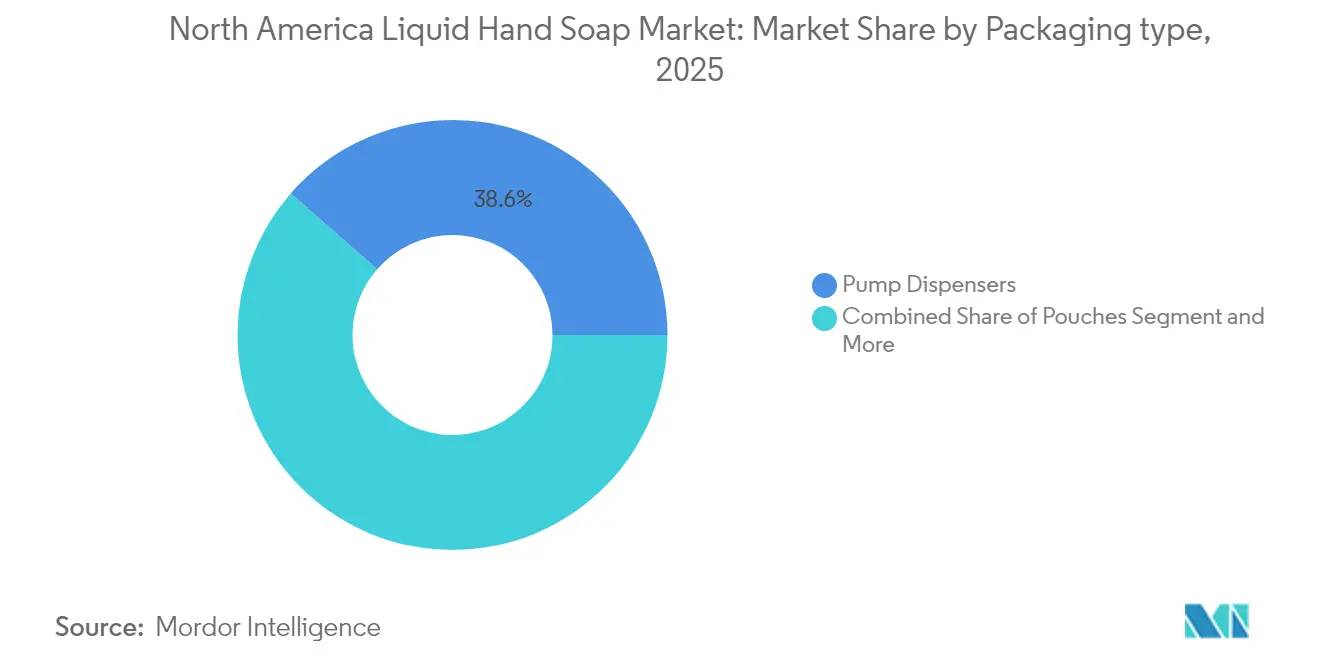
Pouches Drive Sustainable InnovationPump dispensers retained 38.56% of the North America liquid hand soap market in 2025, supported by entrenched household habits and widespread fixture compatibility. Yet pouches are adding 5.17% CAGR, capturing buyers focused on reduced plastic and lower logistics costs. Brands such as Diversey supply monolayer polyethylene pouches that refill multiple trigger bottles, cutting virgin resin weight per use. This momentum positions pouches as the headline growth story within the North America liquid hand soap market.
Wall-mount cartridges and bulk gallon jugs continue serving institutional environments, but contamination concerns reinforce sealed formats. Bottles designed for in-store refill stations bridge the transition, appealing to eco-minded shoppers without demanding fixture changes. Regulatory clauses in 21 CFR 117.37 on sanitary facilities encourage operators to invest in proven dispensing integrity, indirectly benefiting high-grade packaging suppliers.


By End-user:
Commercial Growth AcceleratesResidential buyers accounted for 53.12% of the North America liquid hand soap market size in 2025, reflecting daily household hygiene routines. However, commercial demand is scaling faster at 5.86% CAGR, led by hospitals, restaurants, and schools compelled to sustain stringent wash standards. CDC guidance elevates soap-and-water efficacy over sanitizers when hands are visibly soiled, reinforcing unit volume growth in large venues.
Federal agencies prioritize domestically made options under Buy American provisions, funneling volumes toward U.S. manufacturers able to demonstrate local content. Corporate campuses and travel hubs also deploy sensor-activated dispensers that favor higher-margin proprietary refill cartridges, sharpening commercial segment profitability across the North America liquid hand soap market.
By Category:
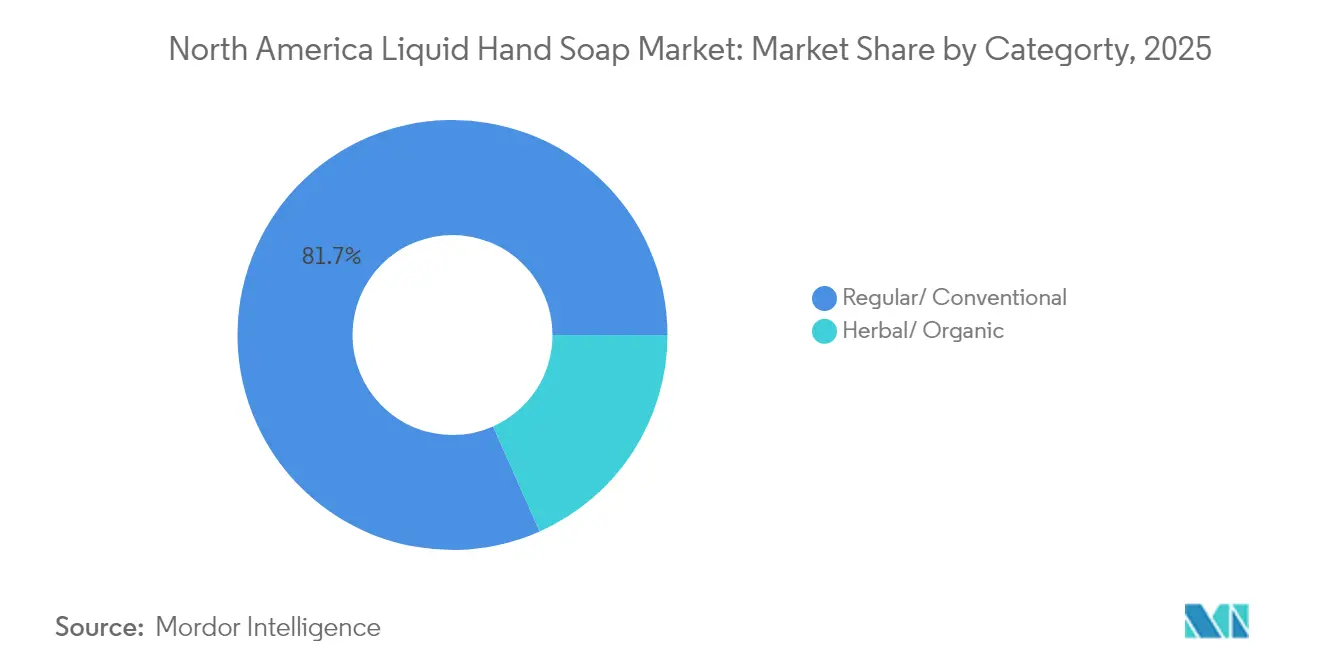
Organic Variants Capture Premium PositioningRegular formulas delivered 81.65% of 2025 revenues, underpinned by value pricing and proven antibacterial performance. Still, herbal/organic SKUs are rising at a 6.11% CAGR as clean-beauty narratives expand. Retail banners use “free-from” merchandising to justify double-digit price gaps, emboldening suppliers to invest in 95% biobased inputs consistent with L’Oréal’s 2030 roadmap.
The Consumer Product Safety Commission clarifies labeling rules that separate true soaps from OTC drug claims, enabling organic makers to tout plant oils without navigating drug monographs. As shoppers seek gentler cleansers, premium organic lines deepen channel penetration and elevate average selling prices inside the North America liquid hand soap market.
By Product Type:
Gel-Based Leadership Faces Foaming InnovationGel variants controlled 83.74% of 2025 sales, benefiting from viscosity that dispenses cleanly through legacy pumps. Foaming systems, however, are gaining a 4.92% CAGR due to lower soap usage per wash and user perception of rich lather. GOJO’s PURELL Fresh Scent Foam saves roughly 6 gallons of water per refill and holds ECOLOGO approval, exemplifying dual sustainability and performance credentials.
As more facilities retrofit touchless foam pumps, suppliers scale surfactant blends optimized for quick-rinse performance, reducing dwell time at sinks. Specialty antimicrobial foams containing benzalkonium chloride target healthcare niches and require FDA OTC compliance filings. This interplay of convenience and regulatory rigor guides future product-type share shifts within the North America liquid hand soap market.
Geography Analysis
United States Liquid Hand Soap Market
The United States generated 77.85% of 2025 revenue, anchored by an extensive retail grid and disciplined federal purchasing that rewards sustainable U.S. production. Walgreens Boots Alliance alone operates 8,560 stores, creating enormous shelf bandwidth for national brands. Local manufacturing, such as Henkel’s West Hazleton plant, meets Buy American thresholds, ensuring continued capture of federal facility contracts.
Mexico and Canada Liquid Hand Soap Market
Mexico is forecast to outpace peers at 5.68% CAGR, propelled by a natural-personal-care segment that already equals 10% of national beauty spend. Soap manufacturing shows deep domestic roots with MX$156.7 billion output and efficient clusters in Guanajuato and Estado de México, positioning local suppliers to embrace refill pouches rapidly. International entrants often partner with upscale retailers in Mexico City and Monterrey while optimizing last-mile e-commerce logistics to reach affluent consumers. Canada remains a steady mid-single-digit contributor, underscored by active trademark filings from multinational leaders like Unilever, signaling ongoing product-cycle investment. Harmonized ingredient disclosure laws foster consumer trust, while strong pharmacy channels mirror U.S. planogram strategies, sustaining category visibility in the North America liquid hand soap market.
Regulatory Landscape
In the United States, liquid hand soap compliance hinges on product claims and classification. Cosmetic hand soaps fall under FDA cosmetics oversight, including facility registration and product listing under the Modernization of Cosmetics Regulation Act of 2022 (MoCRA), with FDA continuing to update its Cosmetics Direct portal and guidance during 2026 to support mandatory registration maintenance. Products marketed with antibacterial or therapeutic claims follow the FDA OTC drug pathway for topical antiseptics, where the FDA has taken action to remove certain actives (such as triclosan) from consumer antibacterial soap uses. Public health antimicrobial claims can also trigger US EPA requirements under FIFRA when products are positioned as pesticides or disinfectants.
In Canada, Health Canada regulates cosmetic hand soaps under the Cosmetic Regulations and related labeling requirements, including INCI ingredient nomenclature and bilingual labeling conventions. Cosmetic products generally require submission of a Cosmetic Notification Form (CNF) within 10 days of first sale, while products represented with therapeutic antimicrobial claims can be classified as drugs or natural health products, adding pre-market and labeling obligations. Packaging sustainability regulation is also a practical compliance driver across North America, with California SB 54 setting recyclability and compostability targets by 2032 and civil-penalty exposure for non-compliance that influences pack-format decisions across national brands.
Value Chain Analysis
The North America liquid hand soap value chain begins with chemical inputs (surfactants, preservatives, chelators, fragrances, colorants, and skin-conditioning agents) and packaging materials (pump components, bottles, cartridges, and refill pouches). Formulation and compounding typically involve heating and controlled handling of viscous surfactants, followed by blending, filling, and labeling. For institutional formats, output is often matched to proprietary dispenser systems and sealed refills that reduce contamination risk relative to bulk refill models. Ingredient pathways can also bifurcate when products make antibacterial claims, pulling in OTC-drug-compliant actives and additional quality requirements.
Upstream sourcing has been shaped by logistics volatility and a push for domestic supply resilience, illustrated by Fuller Industries initiating a partnership with Brenntag in May 2025 to source domestic surfactants for liquid hand soap production. Downstream, consumer products move through mass retail, drugstores, club stores, and e-commerce, while commercial demand is served via JanSan distributors, facility-service providers, and healthcare procurement networks. Device-linked arrangements, including touchless dispensers tied to refill cartridges, increase switching costs and reinforce long-term supply relationships for institutional buyers.
Competitive Landscape
Market concentration measures 6 / 10, indicating moderate consolidation. Procter & Gamble, Colgate-Palmolive, Henkel, and Unilever harness vertically integrated supply chains, broad ad budgets, and robust R&D. Henkel’s Dial exemplifies scale advantage through renewable-energy procurement and full PCR bottle conversion, shielding margins as resin prices fluctuate. Emerging challengers thrive in premium natural niches. Unilever’s 2025 purchase of Dr. Squatch accelerates its entry into male-grooming-oriented soaps, highlighting acquisition as a shortcut to credibility.. Device innovators, including GOJO and Diversey, defend institutional share through patented touchless dispensers linked to proprietary refills, creating high switching costs.
Distributor consolidation adds another layer: the BradyIFS–Envoy merger forms a USD 5 billion JanSan giant, compressing supplier lists and demanding favorable rebate structures. Simultaneously, Walgreens Boots Alliance’s take-private deal by Sycamore Partners introduces potential private-label expansion across 12,500 outlets, affecting shelf allocation for branded soaps.
North America Liquid Hand Soap Industry Leaders
Colgate-Palmolive Company
GOJO Industries
Henkel
Reckitt Benckiser
Procter & Gamble
- *Disclaimer: Major Players sorted in no particular order
North America Liquid Hand Soap Market Companies Covered in this Report
- Colgate-Palmolive Company (Softsoap)
- GOJO Industries Inc.
- Henkel AG & Co. KGaA (Dial)
- Reckitt Benckiser Group PLC (Dettol)
- Unilever PLC (Seventh Generation)
- Procter & Gamble Co. (Safeguard)
- S. C. Johnson & Son Inc.
- Kao Corporation
- Vi-Jon LLC
- 3M Company
- Ecolab Inc.
- The Hain Celestial Group Inc.
- The J. R. Watkins Co.
- Dr. Bronner's Magic Soaps
- Honest Company Inc.
- Church & Dwight Co. Inc.
- Kimberly-Clark Corporation
- Blyth Inc. (Method)
- Seventh Generation Inc.
- L'Occitane en Provence

Market Opportunities and Future Outlook
Manufacturing upgrades and capacity additions create a clear opportunity for brands and private label suppliers to localize supply and shorten replenishment cycles while meeting buyer requirements tied to domestic content and sustainability. Recent investments show where scale is being built: Henkel has disclosed a USD 23 million investment across its Geneva, New York and West Hazleton, Pennsylvania sites to increase capacity for Dial liquid hand soap and related hygiene products, and Colgate-Palmolive has upgraded its Cambridge, Ohio personal care facility for liquid hand soap production. These moves expand the feasibility of co-manufacturing, packaging conversion, and ingredient supply for high-throughput lines, higher PCR content, and refill formats.
Packaging redesign and compliant claims management are also active areas for product development. Regulatory pressure on single-use plastics, including California SB 54 packaging requirements by 2032, supports broader rollout of mono-material pouches, sealed refill cartridges, and refill-compatible bottles, particularly for retailers and institutional buyers that track plastic reduction. On the claims side, MoCRA registration and listing obligations in the United States, along with Canada-specific CNF and labeling requirements, raise the value of strong ingredient documentation and quality systems. Suppliers that can scale hypoallergenic and plant-based formulations gain advantage because they can meet hygiene needs without unintentionally triggering drug or pesticide regulatory pathways unless they choose to pursue those claims.
Recent Industry Developments in North America Liquid Hand Soap Market
- April 2026: Henkel’s Dial rolled out limited-edition seasonal liquid hand soap scents (including Tropic Spritz and Citrus Sorbet) at major retailers, pairing new fragrance variants with antibacterial positioning and aloe vera moisturization. The launch highlights how large brands use rapid scent cycles to defend shelf space while keeping efficacy and skin-conditioning claims central to differentiation.
- November 2025: GOJO Industries introduced the PURELL CX10 hand hygiene technology platform for commercial environments, emphasizing dispenser-and-refill integration and operational efficiency features. This strengthens device-linked ecosystems in institutional channels, where installed dispensers drive recurring proprietary refill demand.
- January 2024: Reckitt expanded its Dettol liquid hand wash lineup for commercial bathrooms with the Dettol Pro Cleanse positioning and an advanced formula narrative focused on hygiene performance in high-traffic settings. The update reflects continued segmentation between consumer and professional end-users, with commercial formats competing on both compliance readiness and ease of use for facility operators.


North America Liquid Hand Soap Market Report Scope and Research Methodology
Market Definition and Coverage
This market covers liquid hand soap sold in North America for hand cleansing, across household and commercial use, and counted as manufacturer level revenue in USD for the study period.
Scope exclusions: We exclude bar soaps, hand sanitizers, hand lotions, dishwashing liquids, and other personal wash products not positioned as liquid hand soap for hands.
Segments Covered in This Report
- By Packaging Type
- Pump Dispensers
- Bottles/Containers (Refill)
- Pouches (Refill)
- Wall-Mount Cartridges
- Bulk Gallon Jugs
- Others
- By End-user
- Residential
- Commercial
- By Category
- Regular/ Conventional
- Natural/ Organic
- By Product Type
- Foaming
- Gel-based
- Others
- Geography
- United States
- Canada
- Mexico
- Rest of North America
Data Sources, Market Sizing, and Validation
Desk Research
Desk research helped us set the factual base, especially for demand signals, trade flow context, and regulatory boundaries that affect what is sold as hand soap. We used public sources such as US Census Bureau retail and manufacturing releases, USITC trade statistics, and Statistics Canada tables, and we also referred to agency updates tied to the US FDA (including ingredient and claim guidance).
To keep assumptions realistic, we reviewed company annual reports, investor presentations, and earnings call notes to understand category exposure and pricing commentary. We also used paid subscriptions for company financials and intelligence, news and financials, and an import-export shipment level database to spot shifts in inbound finished goods and packaging materials that can affect supply and availability. The desk source list is not exhaustive, and we relied on additional public and paid references to collect data, validate totals, and clarify open questions.
Primary Interviews and Surveys
Primary work was used to confirm how liquid hand soap is counted at shelf, how pricing moved by channel, and how refill packs and dispenser formats are being recognized in revenue. We spoke with a mix of brand and private label stakeholders, distributors, and commercial buyers across the United States, Canada, and Mexico, so gaps from desk research could be closed and the final assumptions checked for realism.
Distribution of primary research fieldwork respondents
| Company type | Respondent position |
|---|---|
| Top tier: 31% | CXOs: 14% |
| Mid tier: 49% | Functional/Unit leaders: 32% |
| Smaller Players: 20% | Managers: 54% |
Market-Sizing & Forecasting
Sizing starts with a top-down build, reconstructing consumer and institutional hand hygiene demand through category level sales signals, channel mix shifts, and pricing movement in local currency, then translating into manufacturer revenue. We corroborate outputs with selective bottom-up approximations, such as sampled ASP times volume checks across key packaging formats, and we use supplier and distributor feedback as a sanity check before totals are finalized.
In the model, a few practical inputs tend to matter most, including liquid soap price per unit movement, the split between residential and commercial consumption, refill pack penetration (pouches and bottles/containers) versus pump dispensers, the adoption rate of wall-mount cartridge systems in facilities, and product mix between foaming and gel-based soaps. Forecasting is run using scenario analysis supported by simple time series smoothing, with assumptions agreed through primary inputs on pricing, promotion intensity, and normalization of commercial demand. Where data is thin for smaller channels or sub-geographies, we bridge gaps by applying observed ratios from comparable channels and then rechecking implied volumes using interview feedback.
Data Validation & Update Cycle
Validation is done in several steps, where model outputs are compared against independent signals such as category growth commentary, trade directionality, and observable price bands, and then explained variances are documented before sign-off. If a region or channel shows an unusual jump, we recheck the underlying drivers, reconfirm key assumptions with selected respondents, and revise only what can be defended through evidence.
Reports refresh annually, and interim updates are triggered when material events occur, such as major price resets, regulatory changes affecting product claims, or sudden shifts in commercial demand. Before delivery, an analyst performs a fresh pass on key inputs so clients receive the most current view available at the time of publication.
Mordor Intelligence's North America Liquid Hand Soap Market Sizing Compared With Other Published Estimates
Published market values for liquid hand soap in North America often differ because each publisher draws the boundary in a slightly different way, then uses its own pricing and currency timing choices. Differences also come from how commercial demand is treated, since institutional packs and dispenser systems can be counted as soap revenue in one model and as dispensers or hygiene systems in another.
In our work, the biggest spread usually traces back to refresh cadence and the timing of average selling price updates, since inflation, pack size changes, and private label mix can shift realized pricing within a year. A second gap driver is validation depth, where trade flows, channel checks, and commercial buyer feedback either get used to challenge initial totals or are left as assumptions. This is where the refresh led checks and USD conversion timing applied by Mordor Intelligence can change the final number.
Benchmark comparison
| Source | Market Size | Gaps in Research Methodology |
|---|---|---|
| Mordor Intelligence | USD 4.80 B (2025) | |
| Regional Consultancy A | USD 9.96 B (2025) | This figure appears to use a broader definition that can pull in adjacent hand wash and antibacterial hygiene categories beyond liquid hand soap, and it can also reflect a different revenue point such as retail sales value rather than manufacturer revenue. |
| Industry Source B | USD 3.20 B (2024) | The lower value can occur when the scope is limited to hand wash sales tracked in a narrower channel set, with less explicit coverage of refill formats and institutional supply, and with pricing held to a prior-year average before later inflation effects are reflected. |
The table shows that the widest gaps are not about math, they are mostly about what is included and how prices are updated through time. By tying the model to clear product boundaries, practical channel level checks, and current year pricing in local markets before converting to USD, the final estimate stays traceable and repeatable for decision making.


Key Questions Answered in the Report
How large is the North America liquid hand soap market in 2026 and how fast will it grow?
The market is valued at USD 5.07 billion in 2026 and is projected to advance at a 5.53% CAGR to reach USD 6.63 billion by 2031.
Which packaging format is growing fastest in North America?
Refillable pouches lead with a 5.17% CAGR thanks to lower plastic weight and retailer sustainability mandates.
Why is commercial demand rising faster than residential demand?
Hospitals, foodservice sites, and schools must maintain strict hygiene protocols, boosting commercial usage at a 5.86% CAGR through 2031.
Which product category commands premium pricing?
Herbal / organic liquid hand soaps carry higher price points and are expanding at a 6.11% CAGR as consumers trade up for clean-label formulations.
Page last updated on:


 Your data is secure and never sold or shared.


