
Jet Lag Therapy Market Size and Share
| Study Period | 2019 - 2030 |
| Market Size (2025) | USD 462.30 Million |
| Market Size (2030) | USD 558.67 Million |
| CAGR (2025 - 2030) | 3.86% |
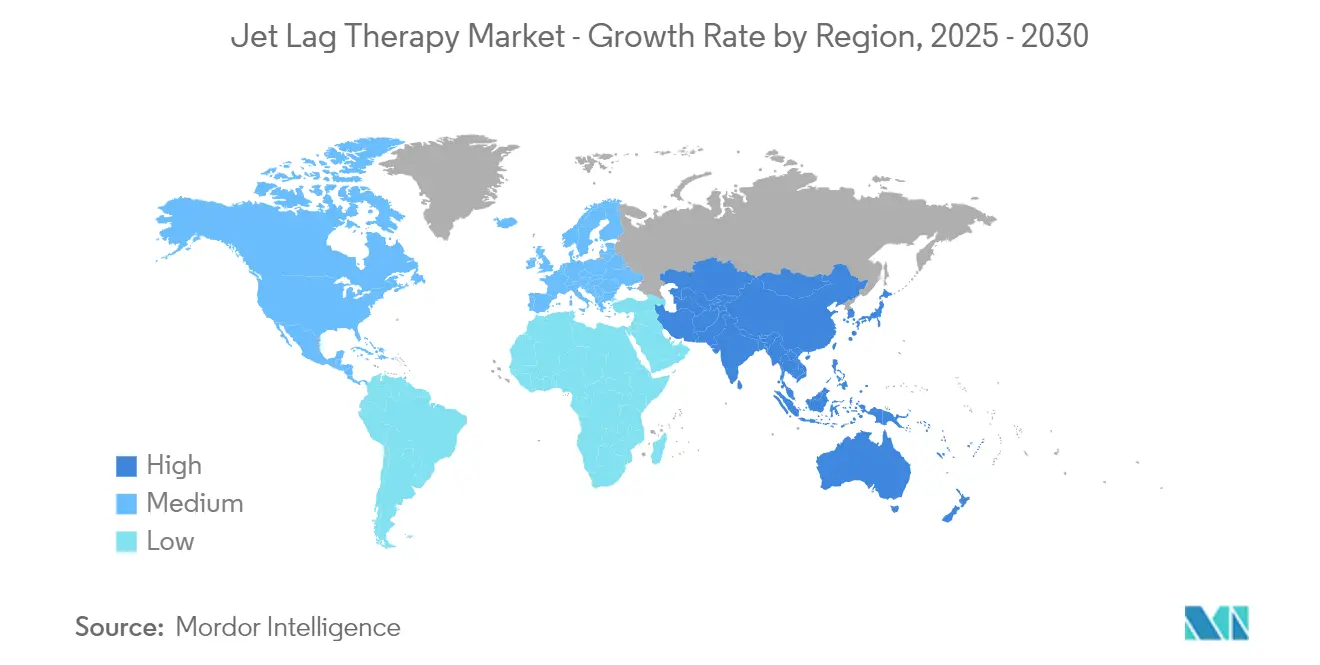
| Fastest Growing Market | Asia Pacific |
| Largest Market | North America |
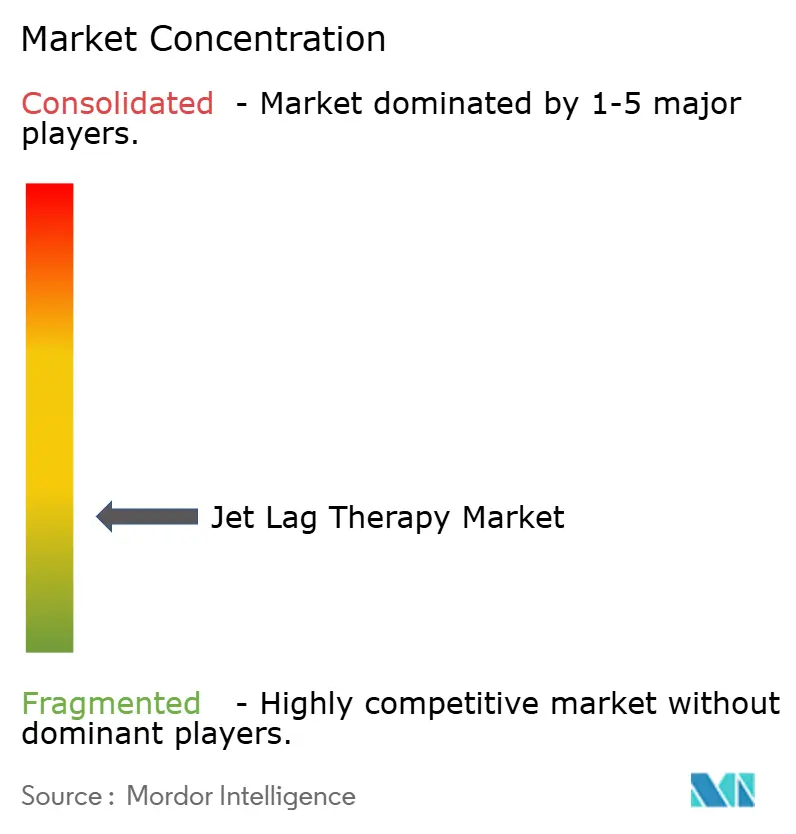
| Market Concentration | Low |
Major Players *Disclaimer: Major Players sorted in no particular order |
Jet Lag Therapy Market Analysis by Mordor Intelligence
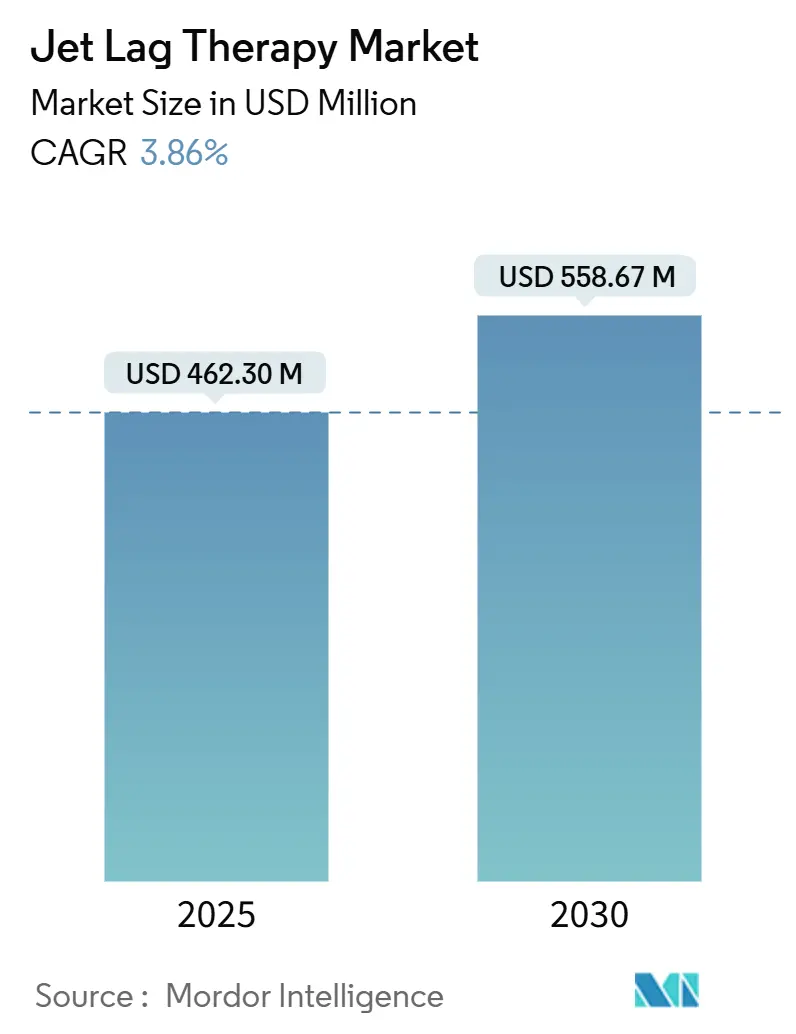
The Jet Lag Therapy Market size is estimated at USD 462.30 million in 2025, and is expected to reach USD 558.67 million by 2030, at a CAGR of 3.86% during the forecast period (2025-2030).
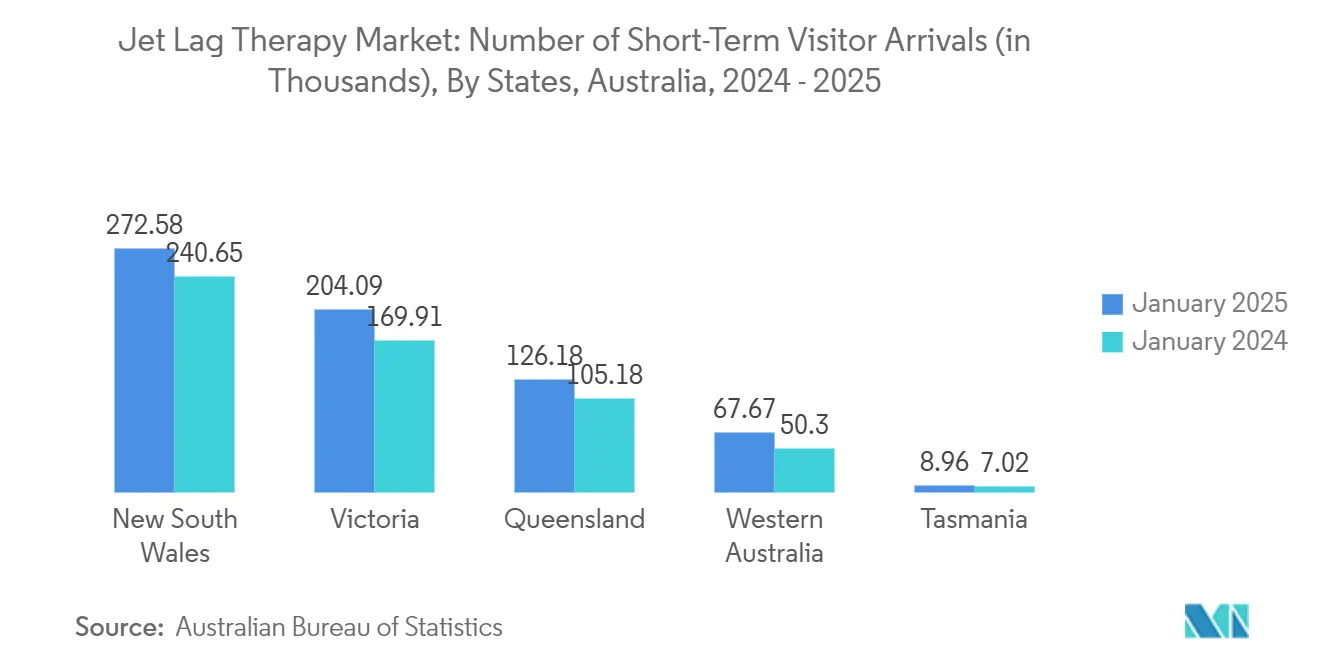
Jet lag is a common condition that arises when individuals travel across different time zones, disrupting the body's circadian rhythm. The increasing volume of air passenger travel over the years has significantly contributed to the rise in individuals experiencing jet lag. As reported by the Bureau of Infrastructure and Transport Research Economics, Australian domestic commercial aviation, including charter operations, carried 5.46 million passengers in January 2025. This represents a 5.8 percent increase compared to 5.16 million passengers recorded in January 2024. This surge in air travel has resulted in a larger population experiencing circadian rhythm disruptions, creating a heightened need for solutions that help travelers adapt to time zone changes, further bolstering the market growth.
Moreover, the jet lag therapy market is witnessing robust growth, driven by innovative drug launches and regulatory approvals. In April 2024, EQL Pharma AB launched Mellozzan, a melatonin-based drug, in Austria and Germany, followed by marketing approval in Switzerland in July 2024. EQL Pharma, a leader in developing generics, has positioned Mellozzan for treating jet lag in adults and addressing sleep and ADHD-related issues in children. Through a global licensing agreement with Adalvo, Mellozzan is now set to reach approximately 100 countries. This strategic expansion underscores the growing demand for effective jet lag management solutions, further accelerating market growth.
Furthermore, the increasing awareness of the negative health impacts of disrupted circadian rhythms has led to a growing focus on effective treatment solutions. In October 2023, ALTURiX introduced CEYESTO, a melatonin-based solution for jet lag treatment, in the United Kingdom. CEYESTO, which is 80% more affordable than other melatonin products, serves as a cost-effective alternative to the National Health Service (NHS). Additionally, it is designed to address various sleep-wake phase disorders and insomnia, including those linked to Attention Deficit Hyperactivity Disorder (ADHD), in both children and adults. The development of such accessible and effective solutions is driving the expansion of the jet lag therapy market.
In conclusion, the jet lag therapy market is expanding rapidly, driven by rising air travel and innovative, accessible treatment solutions. This growth reflects the increasing demand for effective management of circadian rhythm disruptions. However, the market faces challenges such as the potential side effects of jet lag medications, high research and development costs, and stringent regulatory requirements, which act as restraints to growth.
Global Jet Lag Therapy Market Trends and Insights
The Wearable Devices Segment is Expected to Witness Significant Growth Over the Forecast Period
Wearable devices are playing a pivotal role in jet lag therapy by integrating advanced features to address sleep and circadian rhythm disruptions. These devices monitor sleep patterns, provide personalized recommendations for sleep and light exposure, and employ light therapy to regulate the body’s internal clock. Additionally, they collect biometric data, such as heart rate variability and skin temperature, offering comprehensive insights into sleep quality and circadian health. The rising prevalence of jet lag among frequent travelers is driving demand for these innovative solutions, fueling advancements in light therapy wearables and positioning this segment for significant growth.
Moreover, the wearable devices segment in the jet lag therapy market is witnessing rapid growth, driven by advancements like the Retimer 3 light therapy wearable. Launched by Re-Time Pty Ltd in August 2024 via a Kickstarter campaign, the Retimer 3 is engineered to alleviate stress, enhance sleep quality, and improve productivity by regulating the circadian rhythm. It emits blue-green light to activate retinal cells and support natural sleep cycles. Integrated with Apple Health and Android Health Connect, it enables users to monitor health through a smartphone app. By addressing consumer demand for innovative and tech-driven solutions, this launch is expanding the adoption of wearable devices and accelerating the growth of the jet lag therapy market.
Technological advancements and strategic collaborations are driving the jet lag therapy market's growth by enhancing solutions for luxury travelers. In February 2024, Timeshifter, Inc., a leader in circadian technology, partnered with InterContinental Hotels & Resorts to introduce its jet lag app to the hotel’s guests. The app delivers personalized plans based on individual preferences, sleep patterns, and chronotypes, enabling effective management of jet lag symptoms. This collaboration highlights the rising demand for tailored circadian wearable technology among premium travelers. By addressing this demand, the launch is significantly contributing to the expansion of the jet lag therapy market, positioning it for sustained growth.
In conclusion, the medical devices segment is witnessing significant growth, driven by advancements in light therapy wearables and strategic collaborations.
North America is Expected to Hold a Significant Share in the Jet Lag Therapy Market
North America is projected to drive the jet lag therapy market, subjected to the combination of factors such as increasing international and business travel, rising disposable incomes, growing awareness of jet lag, and the introduction of new airlines in the region. For instance, according to the Global Business Travel Association (GBTA), Canadian business travel spending in 2024 reached USD 25.9 billion, reflecting a strong annual growth rate of 13.5%. This growth surpassed the global average of 11.8% and the United States' growth rate of 9.2% for the fiscal year. Additionally, approximately 65% of Canadian travel buyers reported an increase in business trips for their companies in 2024 compared to the previous year. This rise in business travel underscores the growing demand for jet lag therapy solutions as more individuals are exposed to the challenges of frequent travel across time zones.
Tourism trends in Canada further support the market's expansion. Statistics Canada reported that Ontario was the most visited province in 2023, with 40.4% of visitors being Canadian and 40.2% being non-Canadian. Additionally, the Bureau of Transport Statistics stated that the United States airlines carried approximately 83.3 million passengers (domestic and international) in December 2024, representing a 5.9% increase from December 2023. Of these, 72.1 million were domestic passengers, and 11.2 million were international passengers. This rise in air travel has led to a higher number of individuals experiencing jet lag, thereby boosting the demand for jet lag therapy and supporting the overall market growth.
Furthermore, rising disposable income across the region also plays a crucial role in driving the market. For instance, according to the United States Bureau of Economic Analysis, the personal disposable income in the United States increased to USD 22,015.6 billion in December 2024, up from USD 20,996.4 billion in December 2023. This increase in disposable income has encouraged higher spending on long-haul travel, further driving the demand for jet lag management solutions.
Additionally, market growth is being further fueled by developments in the airline sector, as the expansion of airline networks enhances global connectivity and increases passenger traffic. In 2024, Toronto Pearson Airport welcomed eight new airlines, including Sun Country, ITA Airways, Swiss International Air Lines, BermudAir, Qatar Airways, Alaska Airlines, Hainan Airlines, and Royal Air Maroc. This development solidified its position as North America's best-connected airport for global destinations. Additionally, California-based airline Air Cahana was launched in late 2024. The introduction of new airlines and the expansion of intercontinental and international routes have led to a rise in passengers traveling across time zones, thereby driving the demand for jet lag therapy solutions.
In conclusion, the jet lag therapy market in North America is expected to grow significantly, driven by increasing travel trends, rising disposable incomes, and the expansion of airline networks. These factors collectively position the region as a key contributor to the market's overall growth.
Competitive Landscape
The jet lag therapy market is fragmented in nature due to the presence of several companies operating globally as well as regionally. The competitive landscape includes an analysis of a few international as well as local companies that hold significant market share and are well known. The companies include Novalogy, Inc., Clinigen Limited, Nature Bright, Nestlé Health Science U.S., and Re-Time Pty Ltd, among others.
Jet Lag Therapy Industry Leaders
-
Novalogy, Inc.
-
Clinigen Limited
-
Nature Bright
-
Nestlé Health Science U.S.
-
Re-Time Pty Ltd
- *Disclaimer: Major Players sorted in no particular order
Recent Industry Developments
- October 2024: In October 2024, researchers from Duke-NUS Medical School and the University of California, Santa Cruz, identified a critical regulator of the circadian rhythm at the tail end of Casein Kinase 1 delta (CK1δ). Published in PNAS journal, the study highlights that CK1δ’s unique tail sequences control its protein-tagging mechanism, directly influencing the regulation of the body’s internal clock. This breakthrough could drive advancements in the jet lag therapy by enabling the development of targeted treatments for circadian rhythm disorders caused by disruptions like jet lag.
- July 2024: In July 2024, Ultrahuman, a UK-based wearable device firm, unveiled PowerPlugs, a platform offering individual apps and plugins for health tracking. This marks the debut of the world's first smart ring, prominently featuring AFib detection. Among its various plugins are options for pregnancy monitoring, jet lag management, Vitamin D intake oversight, and caffeine consumption tracking.
Global Jet Lag Therapy Market Report Scope
As per the scope of the report, jet lag is the medical condition which occurs when the circadian rhythm of the human body takes time to adjust to the new sleep and wake cycle at the destination. The common symptoms include headaches, fatigue, stomach discomfort, insomnia, difficulty concentrating, and others.
The jet lag market is segmented into product type, end-user, and geography. By product type, market is segmented into melatonin, herbal and natural products, prescription drugs, and medical devices. By end-user, the market is segmented into cabin crew, business travelers, athletes, seasonal travelers, and other end users. By geography, the market is segmented into North America, Europe, Asia-Pacific, and Rest of the World. For each segment, the market sizing and forecasts have been done on the basis of revenue (USD).
| Melatonin | |
| Herbal and Natural Products | |
| Prescription Drugs | Nonbenzodiazepines |
| Benzodiazepines | |
| Medical Devices | Wearable Devices |
| Light Box |
| Cabin Crew |
| Business Travelers |
| Athletes |
| Seasonal Travelers |
| Others |
| North America | United States |
| Canada | |
| Mexico | |
| Europe | Germany |
| United Kingdom | |
| France | |
| Italy | |
| Spain | |
| Rest of Europe | |
| Asia-Pacific | China |
| Japan | |
| India | |
| Australia | |
| South Korea | |
| Rest of Asia-Pacific | |
| Rest of the World |
| By Product | Melatonin | |
| Herbal and Natural Products | ||
| Prescription Drugs | Nonbenzodiazepines | |
| Benzodiazepines | ||
| Medical Devices | Wearable Devices | |
| Light Box | ||
| By End User | Cabin Crew | |
| Business Travelers | ||
| Athletes | ||
| Seasonal Travelers | ||
| Others | ||
| Geography | North America | United States |
| Canada | ||
| Mexico | ||
| Europe | Germany | |
| United Kingdom | ||
| France | ||
| Italy | ||
| Spain | ||
| Rest of Europe | ||
| Asia-Pacific | China | |
| Japan | ||
| India | ||
| Australia | ||
| South Korea | ||
| Rest of Asia-Pacific | ||
| Rest of the World | ||
Key Questions Answered in the Report
How big is the Jet Lag Therapy Market?
The Jet Lag Therapy Market size is expected to reach USD 462.30 million in 2025 and grow at a CAGR of 3.86% to reach USD 558.67 million by 2030.
What is the current Jet Lag Therapy Market size?
In 2025, the Jet Lag Therapy Market size is expected to reach USD 462.30 million.
Who are the key players in Jet Lag Therapy Market?
Novalogy, Inc., Clinigen Limited, Nature Bright, Nestlé Health Science U.S. and Re-Time Pty Ltd are the major companies operating in the Jet Lag Therapy Market.
Which is the fastest growing region in Jet Lag Therapy Market?
Asia Pacific is estimated to grow at the highest CAGR over the forecast period (2025-2030).
Which region has the biggest share in Jet Lag Therapy Market?
In 2025, the North America accounts for the largest market share in Jet Lag Therapy Market.
What years does this Jet Lag Therapy Market cover, and what was the market size in 2024?
In 2024, the Jet Lag Therapy Market size was estimated at USD 444.46 million. The report covers the Jet Lag Therapy Market historical market size for years: 2019, 2020, 2021, 2022, 2023 and 2024. The report also forecasts the Jet Lag Therapy Market size for years: 2025, 2026, 2027, 2028, 2029 and 2030.
Jet Lag Therapy Market Report
Statistics for the 2025 Jet Lag Therapy market share, size and revenue growth rate, created by Mordor Intelligence™ Industry Reports. Jet Lag Therapy analysis includes a market forecast outlook for 2025 to 2030 and historical overview. Get a sample of this industry analysis as a free report PDF download.