
Cybersecurity Workforce Training and Simulation Platforms Market Size and Share
Market Overview
| Study Period | 2020 - 2031 |
|---|---|
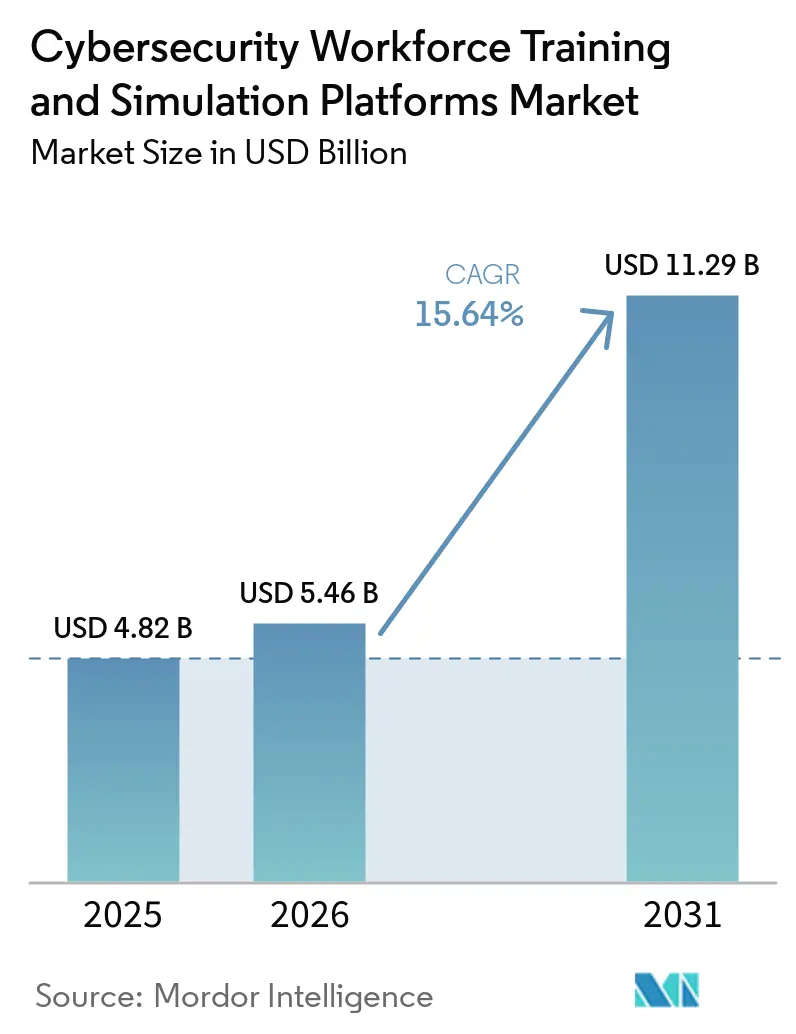
| Market Size (2026) | USD 5.46 Billion |
| Market Size (2031) | USD 11.29 Billion |
| Growth Rate (2026 - 2031) | 15.64 % |
| Fastest Growing Market | Asia-Pacific |
| Largest Market | North America |
| Market Concentration | Medium |
Major Players *Disclaimer: Major Players sorted in no particular order Image © Mordor Intelligence. Reuse requires attribution under CC BY 4.0. | |
Cybersecurity Workforce Training and Simulation Platforms Market Analysis by Mordor Intelligence
The cybersecurity workforce training and simulation platforms market size is projected to be USD 4.82 billion in 2025, USD 5.46 billion in 2026, and reach USD 11.29 billion by 2031, growing at a CAGR of 15.64% from 2026 to 2031. Demand is rising because organizations now treat workforce readiness as a live security control instead of a periodic compliance task. The threat mix has changed quickly, with AI-generated phishing, impersonation attempts, and channel-spanning social engineering making older training models less effective. Budget decisions are also moving closer to risk, audit, and compliance teams because buyers increasingly need role-based evidence, measurable reporting, and stronger documentation for internal reviews and external obligations. Competitive positioning is shifting toward vendors that can deliver adaptive simulations, managed program support, and behavioral measurement instead of only large content libraries. The strongest growth opportunities sit around hybrid deployment, SME adoption, healthcare expansion, and technical simulation environments that link awareness training with incident response and analyst readiness.
Key Report Takeaways
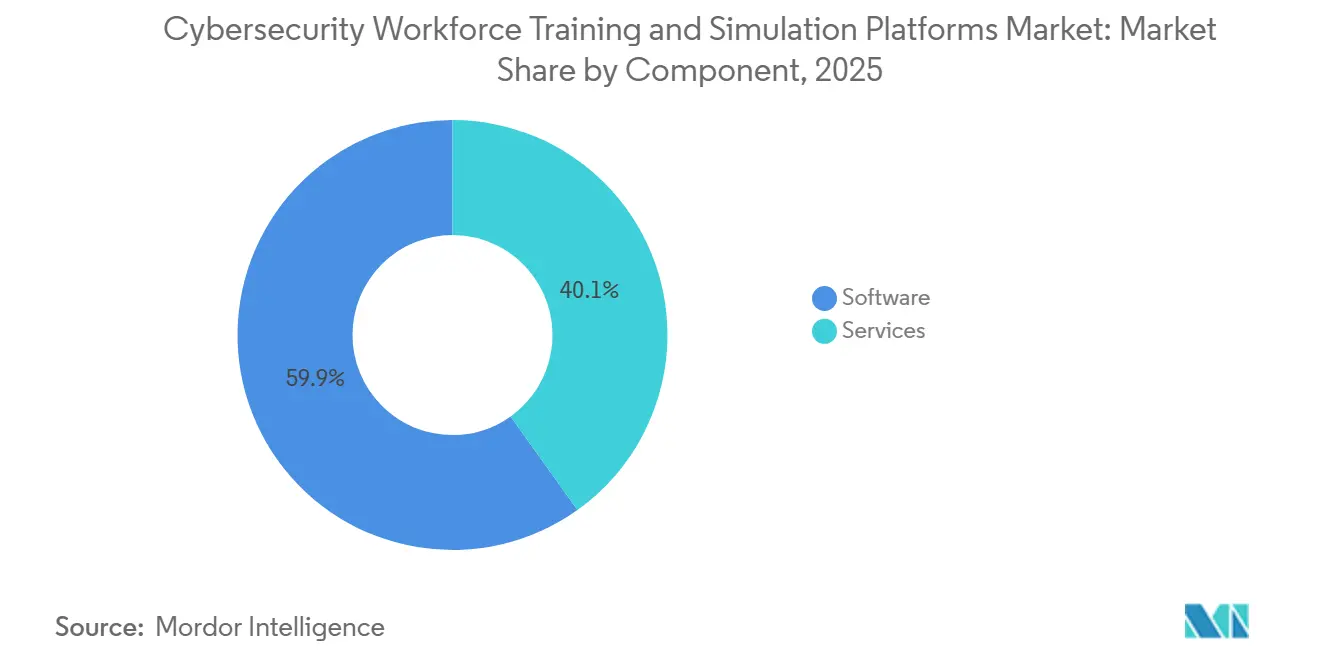
- By component, software led with a 59.87% share in 2025, while services are projected to grow at a 16.72% CAGR through 2031.
- By deployment, cloud accounted for 52.91% share of the cybersecurity workforce training and simulation platforms market in 2025, while hybrid is expected to expand at a 16.83% CAGR through 2031.
- By enterprise size, large enterprises held 58.09% share of the cybersecurity workforce training and simulation platforms market in 2025, while SMEs are projected to grow at a 16.94% CAGR through 2031.
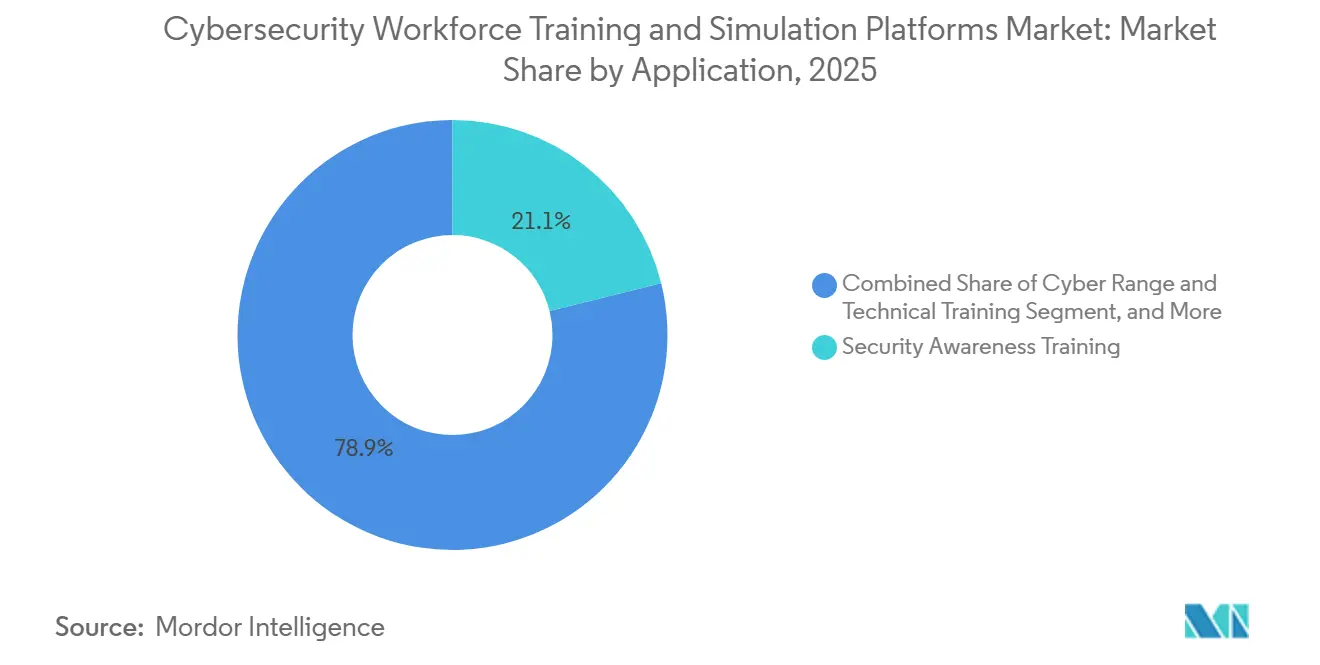
- By application, security awareness training accounted for 21.14% of revenue in 2025, while cyber range and hands-on technical training are projected to expand at a 17.05% CAGR through 2031.
- By end-user industry, BFSI held a 16.08% share of the cybersecurity workforce training and simulation platforms market in 2025, while healthcare and life sciences is expected to grow at a 17.16% CAGR through 2031.
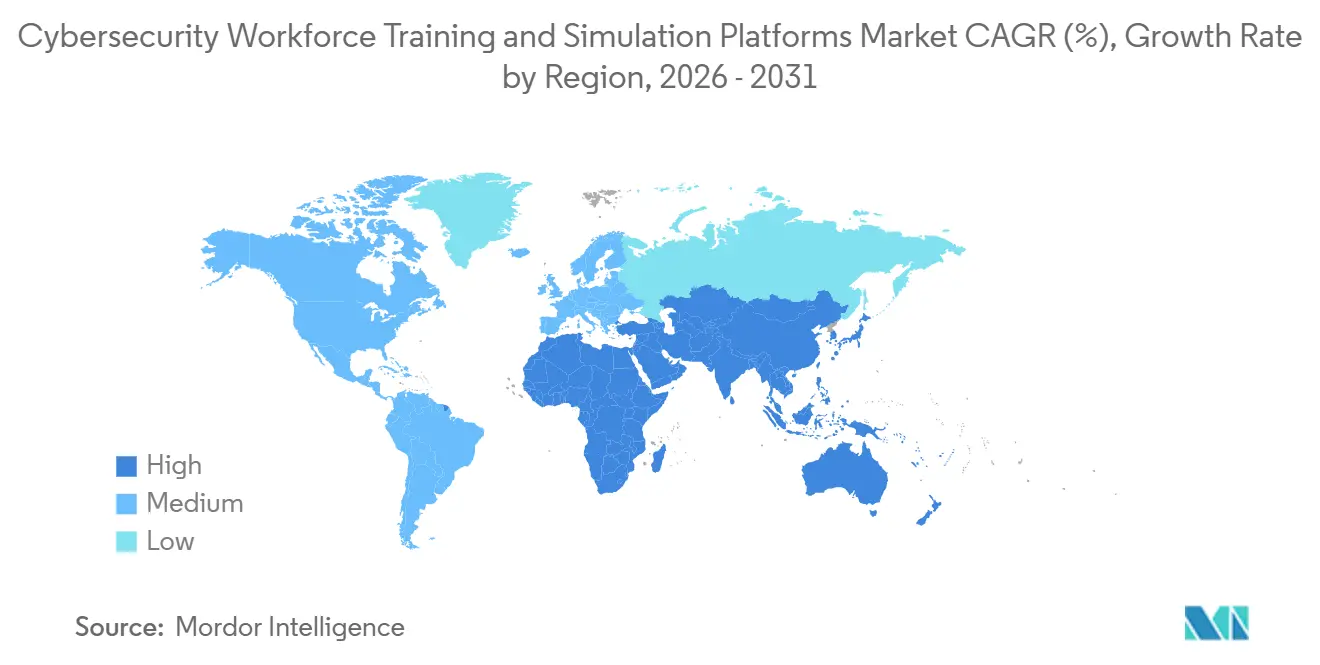
- By geography, North America held 31.12% share of the cybersecurity workforce training and simulation platforms market in 2025, while Asia-Pacific is projected to expand at a 17.27% CAGR through 2031.
Note: Market size and forecast figures in this report are generated using Mordor Intelligence’s proprietary estimation framework, updated with the latest available data and insights as of January 2026.
Market Trends and Insights
Drivers Impact Analysis of Cybersecurity Workforce Training and Simulation Platforms Market*
| Driver | (~) % Impact on CAGR Forecast | Geographic Relevance | Impact Timeline |
|---|---|---|---|
| Rising Phishing Proficiency Gaps Driven by AI-Generated Attacks | +3.2% | Global | Short term (≤ 2 years) |
| Cyber Insurance and Audit Requirements for Measurable Human-Risk Controls | +2.5% | North America and EU | Medium term (2-4 years) |
| Shift from Awareness Content to Continuous Simulation-Based Skill Validation | +2.1% | Global | Medium term (2-4 years) |
| Expanding Demand for Role-Based Training Across Security Operations and Incident Response Teams | +1.6% | North America, EU, Asia-Pacific | Medium term (2-4 years) |
| Growing Adoption of Cloud-Native, API-Ready Training Platforms in Mid-Market Enterprises | +1.2% | Asia-Pacific, North America, EU | Short term (≤ 2 years) |
| Expansion of Public Sector Cyber Workforce Upskilling Programs | +0.9% | North America, EU, Asia-Pacific | Long term (≥ 4 years) |
| Source: Mordor Intelligence | |||
Rising Phishing Proficiency Gaps Driven by AI-Generated Attacks
AI-generated attacks have weakened the old assumption that workers can spot phishing based solely on grammar mistakes, generic greetings, or visual inconsistencies. Hoxhunt reported a 14-fold increase in AI-generated phishing attacks in 2026, demonstrating how quickly attack quality has improved across employee-facing channels. The Cloud Security Alliance noted that AI-enabled tools can produce up to 100 personalized spear-phishing variants per hour, enabling a much wider share of the workforce to be targeted with tailored messages.[1] In the cybersecurity workforce training and simulation platforms market, this changes the product requirement from occasional awareness refreshers to faster content updates and more adaptive simulation design. KnowBe4 also tracked a 41% increase in attacks via Microsoft Teams and a 49% increase in calendar invite phishing, indicating that vendors now need broader simulation coverage than email alone. Buyers in the cybersecurity workforce training and simulation platforms market are therefore favoring platforms that turn new threat patterns into active exercises within days instead of quarters.
Cyber Insurance and Audit Requirements for Measurable Human-Risk Controls
The cybersecurity workforce training and simulation platforms market is also gaining support from insurance and audit processes that increasingly focus on measurable workforce behavior rather than policy existence alone. Buyers now place greater value on platforms that can show phishing simulation outcomes, role-based completion, and reporting behavior in a format that risk and compliance teams can reuse. This matters because training programs are being reviewed alongside broader control frameworks such as HIPAA, PCI-DSS, SOC 2, and CMMC, underscoring the need for documented evidence rather than generic attendance records. The proposed HIPAA Security Rule updates underscore stronger expectations for protecting electronic protected health information, which supports a more formal approach to workforce cybersecurity controls in healthcare settings.[2] In practice, this pushes the cybersecurity workforce training and simulation platforms market toward platforms that export audit-ready data and keep evidence trails that are easier to defend during reviews. The result is that purchasing decisions are moving away from HR-led content selection toward risk-led platform selection with deeper reporting.
Shift From Awareness Content to Continuous Simulation-Based Skill Validation
The cybersecurity workforce training and simulation platforms market is moving from annual awareness campaigns to continuous simulation programs that measure behavior more frequently and adjust content more quickly. NIST Cybersecurity Framework 2.0 placed explicit emphasis on governance, protection, and continuous improvement, supporting ongoing reinforcement rather than point-in-time testing.[3] KnowBe4’s AIDA Orchestration launch showed how autonomous systems can create, schedule, and adapt phishing tests and assignments at the user level, reducing the manual burden on administrators. SANS reported that 61% of cybersecurity teams experienced higher stress levels in 2026, while unclear career progression became a much larger retention issue than a year earlier, tying training design more closely to workforce stability. That combination makes the cybersecurity workforce training and simulation platforms market more attractive to buyers who want stronger security outcomes and clearer career progression for analysts and general staff. It also helps explain why vendors are adding personalized paths, automated orchestration, and outcome dashboards rather than relying solely on content volume.
Expanding Demand for Role-Based Training Across Security Operations and Incident Response Teams
Role-based training demand is widening because organizations no longer see security operations teams and general employee awareness as separate capability tracks. The 2026 SANS SOC Survey found that 79% of SOCs used AI tools, but only 36% had integrated them into defined workflows, indicating a clear training gap within operational teams.[4] ISC2 reported that 70% of enterprises now customize training by job role, which makes role-specific design a baseline buying condition rather than a premium feature. In the cybersecurity workforce training and simulation platforms market, this supports stronger demand for labs, SOC simulations, blue-team drills, and incident response practice that mirror real operating conditions. Hack The Box expanded its platform in June 2026 with SOC Range, Crisis Control, and role-based blue-team tracks, reflecting the broader move toward workflow-based technical training. The cybersecurity workforce training and simulation platforms market is therefore broadening from workforce awareness into enterprise-wide readiness, which expands account value and increases product depth expectations.
Restraints Impact Analysis of Cybersecurity Workforce Training and Simulation Platforms Market*
| Restraint | (~) % Impact on CAGR Forecast | Geographic Relevance | Impact Timeline |
|---|---|---|---|
| Limited Ability to Prove Direct ROI on Reduced Breach Frequency | -1.8% | Global | Medium term (2-4 years) |
| Content Localization and Scenario Maintenance Costs for Multi-Region Rollouts | -1.3% | Middle East and Africa, Asia-Pacific, South America | Long term (≥ 4 years) |
| Integration Friction With LMS, SIEM, IAM, and GRC Stacks | -0.9% | Global | Short term (≤ 2 years) |
| Simulation Fatigue and Declining Employee Engagement Over Time | -0.6% | North America and EU | Medium term (2-4 years) |
| Source: Mordor Intelligence | |||
Limited Ability To Prove Direct ROI on Reduced Breach Frequency
The hardest budget question in the cybersecurity workforce training and simulation platforms market remains whether better training can be tied directly to fewer successful breaches. This is difficult because prevented incidents are not directly observable, so finance teams often struggle to connect simulation activity with avoided loss. SANS found that 27% of organizations experienced breaches tied to capability gaps, which supports the need for training, but it still does not solve the reverse proof problem that boards often want. Vendors are responding by combining phishing-prone trends, reporting rates, and risk scores into unified dashboards that make progress easier to discuss. Even so, the cybersecurity workforce training and simulation platforms market still faces friction when buyers compare training spend with tools that have more direct incident or infrastructure metrics. This issue is likely to keep favoring vendors that can translate behavior change into language that audit, insurance, and finance teams can use without extra interpretation.
Content Localization And Scenario Maintenance Costs for Multi-Region Rollouts
Multi-region deployments create a real cost burden in the cybersecurity workforce training and simulation platforms market, as simulation content must remain culturally relevant, language-specific, and aligned with local regulatory expectations. A scenario built around one country’s payment practices or communication norms often loses realism when used without adaptation in another market. KnowBe4 addressed part of this need in 2026 with a Content Creation Agent that supported 30 languages through its Synthesia partnership, which showed how central localization has become in training design. The maintenance burden remains because regulations, attack styles, and local references continue to change after the initial rollout. That cost pressure is especially evident among mid-market buyers in faster-growing regions, where budgets are smaller but the need for relevant training is growing rapidly. For the cybersecurity workforce training and simulation platforms market, this means multilingual scale alone is not enough, and vendors must keep refreshing local scenarios if they want adoption to hold.
*Our forecasts treat driver/restraint impacts as directional, not additive. The impact forecasts reflect baseline growth, mix effects, and variable interactions.
Cybersecurity Workforce Training and Simulation Platforms Market Segment Analysis
By Component:
Software Dominates As Services Accelerate In Managed DeliverySoftware accounted for 59.87% of the cybersecurity workforce training and simulation platforms market in 2025, underscoring the shift toward centralized platforms. The software base remained larger because buyers preferred scalable content libraries, easier user administration, and broader integration options across distributed workforces. In the cybersecurity workforce training and simulation platforms market, cloud-delivered software also makes it easier to launch adaptive simulations at a large scale without corresponding increases in operational effort. That advantage has kept software at the center of buyer evaluations even as service intensity rises.
Services are projected to grow at a 16.72% CAGR through 2031, which signals that a different part of the value chain is strengthening. Many mid-market and resource-constrained buyers now want program management, campaign design, analytics interpretation, and reporting support instead of a stand-alone license. ISC2 reported that 77% of enterprises used a mix of in-house and third-party providers for training delivery, which supports the wider move toward managed support models. Across the cybersecurity workforce training and simulation platforms industry, this makes services more than an add-on because managed delivery helps buyers convert platform usage into measurable operational routines. It also increases renewal stickiness because behavioral data, campaign history, and reporting logic are embedded in the vendor relationship rather than confined solely to the software layer.
By Deployment:
Cloud Leads While Hybrid Emerges As Compliance ArchitectureCloud accounted for 52.91% of the cybersecurity workforce training and simulation platforms market in 2025, reflecting the ease of global rollout and continuous content maintenance. Buyers favored cloud models because they simplified updates, shortened deployment times, and connected well with identity, HR, and collaboration systems already used across the enterprise. The cybersecurity workforce training and simulation platforms market benefited from this model because new content, simulation templates, and administrative changes could be pushed without local infrastructure work. Cloud was especially well aligned with firms that had already standardized large parts of their security and productivity stack around SaaS.
Hybrid is projected to grow at a 16.83% CAGR through 2031, suggesting a more compliance-driven architecture choice. Regulated sectors increasingly want cloud-based content management and AI simulation benefits while keeping behavioral evidence, employee profiles, and other sensitive records in controlled, local environments. SoSafe’s positioning around EU-only data residency highlighted how sovereignty and privacy requirements are shaping deployment selection in Europe. On-premises models still retain importance in defense and critical infrastructure settings where air-gapped or tightly isolated environments remain necessary. In the cybersecurity workforce training and simulation platforms market, hybrid growth suggests that the future choice will be less about cloud versus on-premises and more about where specific data elements are allowed to live.
By Enterprise Size:
Large Enterprises Lead While SMEs Drive Future GrowthBy Enterprise Size: Large Enterprises Lead While SMEs Drive Future GrowthLarge enterprises held 58.09% of the cybersecurity workforce training and simulation platforms market share in 2025, which reflected their larger attack surfaces, broader regulatory exposure, and stronger training budgets. These organizations were early adopters because they needed structured programs across many departments, user groups, and geographies. The cybersecurity workforce training and simulation platforms market has remained anchored in this customer set because large buyers also require stronger reporting, attestation support, and broader integration. Their procurement cycles are longer, but their deployments are deeper and often span awareness, simulation, and technical readiness together.
SMEs are projected to grow at a 16.94% CAGR through 2031, underscoring how platform economics are widening the addressable market. Annual seat pricing, pre-built compliance templates, and faster onboarding have reduced the barrier that once kept advanced simulation tools concentrated in large companies. SANS reported that regulatory compliance influenced hiring and training decisions for 95% of surveyed organizations in 2026, up sharply from 2025, which helps explain why smaller firms are moving faster. Across the cybersecurity workforce training and simulation platforms industry, cyber insurance expectations are also making structured training harder for SMEs to delay. The segment’s growth shows that simplicity, managed support, and faster time to value are becoming as important as feature depth in the next phase of expansion.
By Application:
Security Awareness Training Anchors Revenue While Cyber Range Claims The Growth PremiumSecurity awareness training accounted for 21.14% of the cybersecurity workforce training and simulation platforms market in 2025, making it the largest application base. Its lead came from breadth rather than depth, because nearly every organization needs baseline employee training even if technical simulation budgets remain narrower. In the cybersecurity workforce training and simulation platforms market, this application continues to anchor account entry and supports upsell into phishing simulation, insider threat awareness, and compliance-linked modules. It remains the most widely adopted layer because it covers the entire employee population rather than just specialist teams.
Cyber range and hands-on technical training are projected to grow at a 17.05% CAGR through 2031, reflecting stronger demand for realistic analyst practice and live response exercises. Buyers increasingly want environments where security teams can rehearse incident handling, detection logic, and coordination under pressure, rather than relying solely on theoretical instruction. Cyberbit’s September 2025 acquisition of RangeForce showed that vendors are already positioning for greater scale in this part of the cybersecurity workforce training and simulation platforms market. The application mix also shows that the cybersecurity workforce training and simulation platforms industry is widening beyond awareness into technical readiness, crisis management, and secure development. That broader scope lifts revenue potential per customer because one platform can support both general workforce behavior change and specialist team capability building.

By End-User Industry:
BFSI Leads As Healthcare Escalates InvestmentBFSI captured 16.08% of the cybersecurity workforce training and simulation platforms market share in 2025, reflecting its long-standing exposure to fraud, regulation, and supervisory oversight. Financial institutions adopted earlier because training evidence increasingly supports operational risk management, internal control reviews, and multi-jurisdiction audit processes. In the cybersecurity workforce training and simulation platforms market, BFSI buyers also value behavioral logs and attestation features, as regulators and auditors expect more than just completion records. That made the segment a natural fit for platforms that combine awareness campaigns with measurable outcome tracking.
Healthcare and life sciences are projected to grow at a 17.16% CAGR through 2031, driven by broader digital adoption and increased pressure on workforce safeguards. The expansion of electronic health records, the growth of telemedicine, and the rise in third-party connectivity have increased the number of human and process touchpoints that training programs need to cover. The proposed HIPAA Security Rule updates reinforced the importance of stronger cybersecurity protections around health information, which supports more structured workforce programs in this segment. Government and public-sector demand is also rising under workforce upskilling mandates, while operational technology security requirements are driving industrial manufacturing. The cybersecurity workforce training and simulation platforms market is therefore becoming more vertically specialized, with healthcare advancing rapidly because basic awareness is no longer sufficient in high-risk clinical and operational environments.
Geography Analysis
North America Cybersecurity Workforce Training and Simulation Platforms Market
North America accounted for 31.12% of the cybersecurity workforce training and simulation platforms market in 2025, making it the largest regional market. The region benefited from mature enterprise procurement, stronger security spending discipline, and a clearer link between training, insurance, and audit expectations. U.S. demand is reinforced by layered obligations such as CMMC, SEC cybersecurity disclosure requirements, and HIPAA-linked workforce expectations, which make documented training evidence more valuable across industries. The U.S. Department of War Office of the CIO launched the Cyber Registered Apprenticeship Program in April 2026, signaling sustained public investment in simulation-based cyber skills development. NIST also awarded more than USD 3 million across 13 states in 2025 to support cybersecurity workforce development, helping strengthen the regional talent and training ecosystem for cybersecurity workforce training and simulation platforms.
Europe Cybersecurity Workforce Training and Simulation Platforms Market
Europe remained the second-largest region in the cybersecurity workforce training and simulation platforms market in 2025, with demand shaped strongly by regulation. NIS2 expanded the number of organizations subject to cybersecurity obligations, and DORA added further pressure on financial entities to maintain stronger operational resilience and workforce preparedness. Germany’s IT security market rose 10.1% in 2025 to EUR 11.1 billion (USD 11.99 billion) and is projected to grow 9.9% in 2026 to EUR 12.2 billion (USD 13.3 billion), which shows a healthy spending backdrop for training and security software adoption. SoSafe has benefited from this setting by building on GDPR-aligned data handling, EU-focused hosting, and multilingual content that aligns with local compliance and sovereignty expectations.
APAC, MEA and South America Cybersecurity Workforce Training and Simulation Platforms Market
Asia-Pacific is projected to grow at a 17.27% CAGR through 2031, which makes it the fastest-expanding region in the cybersecurity workforce training and simulation platforms market. The region’s biggest growth driver is the severe talent shortfall, which reached 3.4 million professionals in 2025, according to the supplied material. India is seeing stronger healthcare and enterprise demand as digital obligations tighten, while Japan’s NICT launched a new cycle of practical cyber simulation training in April 2026 for registered security professionals. Malaysia’s projected need for 28,068 cybersecurity professionals by 2026 against an existing base of 16,765 shows how wide the regional training gap remains. South America is advancing on the back of Brazil’s LGPD enforcement maturity and the wider financial sector's digitalization, while the Middle East and Africa remain the smallest but still active, as outcome-based training becomes more important in regulated financial settings. The cybersecurity workforce training and simulation platforms market is therefore expanding fastest where threat exposure and workforce shortages are rising together, even if regional budgets remain less mature than in North America.
Competitive Landscape
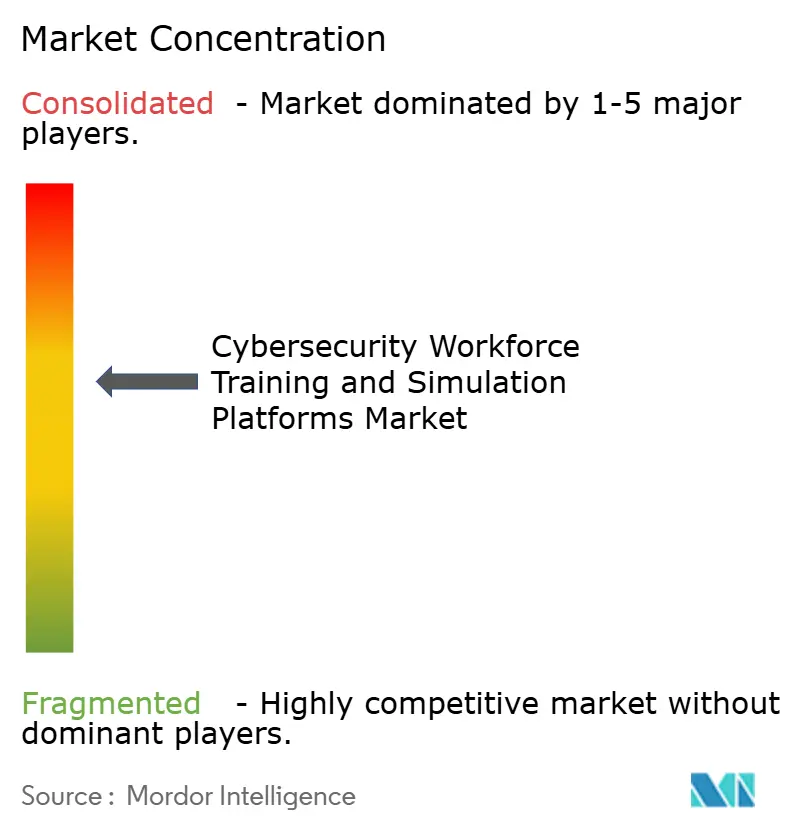
The cybersecurity workforce training and simulation platforms market remains moderately consolidated, with security awareness vendors, human risk platforms, and cyber range specialists competing across overlapping parts of the enterprise demand. The main point of differentiation is no longer the size of a content library alone, because buyers now want stronger behavioral evidence, role-level risk scoring, and reporting that supports audits and internal governance. KnowBe4’s February 2026 launch of AIDA Orchestration showed how platform leaders are using autonomous workflow design to shorten the gap between threat intelligence and training execution. Cofense’s May 2026 launch of AI-driven campaign detection and an AI Assistant reflected a different but related strategy that more tightly linked phishing detection and training customization within a single platform flow. In the cybersecurity workforce training and simulation platforms market, these moves show that automation, same-day content refresh, and multilingual adaptation are becoming central competitive requirements.
A second competitive lane is opening where vendors try to serve both general employee awareness and technical team readiness within the same customer relationship. Cyberbit’s acquisition of RangeForce in September 2025 highlighted consolidation inside the cyber range segment as suppliers prepare for stronger demand in hands-on simulation. Hack The Box moved in the same direction with its June 2026 platform expansion, which added SOC Range and role-based defensive tracks for operational teams. These moves matter because the cybersecurity workforce training and simulation platforms market is expanding from awareness-only buying to broader security-readiness buying across departments and skill levels.
European vendors are also reshaping competition by emphasizing behavioral science and data sovereignty from the start, rather than retrofitting them later. SoSafe’s product positioning in Europe showed how native support for EU data residency and multilingual deployment can create a meaningful advantage in highly regulated environments. Hoxhunt’s 2026 research found that continuous training was associated with significantly lower malicious click rates, strengthening the case for outcome-focused human risk management rather than static program delivery. The cybersecurity workforce training and simulation platforms market is, therefore, rewarding vendors that can combine adaptive content, technical realism, localized deployment, and clear behavioral evidence within a single operating model. That balance keeps competition active because no single vendor currently controls all of the market’s fastest-growing use cases across awareness, simulation, analyst training, and compliance reporting.
Cybersecurity Workforce Training and Simulation Platforms Industry Leaders
-
KnowBe4, Inc.
-
Proofpoint, Inc.
-
Cofense, Inc.
-
Mimecast Limited
-
Hoxhunt Oy
- *Disclaimer: Major Players sorted in no particular order
Cybersecurity Workforce Training and Simulation Platforms Market Companies Covered in this Report
- KnowBe4, Inc.
- Proofpoint, Inc.
- Cofense, Inc.
- Hoxhunt Oy
- Mimecast Limited
- Barracuda Networks, Inc.
- CybeReady Ltd.
- Terranova Security Inc.
- Infosec Institute, Inc.
- SANS Institute
- NINJIO, Inc.
- Curricula, Inc.
- Fishbone Inc.
- Hook Security LLC
- AwareGO ehf.
- Phished.io B.V.
- SoSafe GmbH
- Blackbird.AI, Inc.
- Wizer Security, Inc.
- Cyberbit Ltd.
Recent Industry Developments in Cybersecurity Workforce Training and Simulation Platforms Market
- June 2026: Hoxhunt released its 2026 Human Risk Management research reports documenting a 14-fold increase in AI-generated phishing attacks through 2026 and contributing data to the Verizon 2026 Data Breach Investigations Report for the second consecutive year.
- May 2026: KnowBe4 launched AI-native Security Awareness Training in 2 tiers, SAT Foundation and SAT Advanced, alongside a 12th AI agent, the Content Creation Agent, which converts internal policies into bespoke training modules and quizzes in 30 languages via a Synthesia integration for AI-localized video content. SAT Advanced includes the full AIDA suite with the Deepfake Training Content Agent for leadership-impersonation simulation.
- May 2026: Cofense launched AI-driven campaign detection and an AI Assistant for its Unified Phishing Defense Platform, cutting simulation campaign creation from hours to minutes using natural language prompts. The Customization Portal enables auto-translation of training content into multiple languages, and new phishing detection capabilities target campaign-level threat patterns rather than individual email-by-email responses.
- May 2026: SoSafe launched a Policy-to-Lesson feature enabling organizations to convert any policy document into a structured, trackable E-learning experience in under 10 minutes, alongside fully mobile-responsive next-generation E-learning lessons for distributed workforces and a redesigned Phishing Report Button for Google Mail.
Global Cybersecurity Workforce Training and Simulation Platforms Market Report Scope
The Cybersecurity Workforce Training and Simulation Platforms market focuses on solutions and services that strengthen employee and professional preparedness against cyber threats through interactive training, simulations, and hands-on exercises. These platforms deliver security awareness programs, phishing simulations, cyber ranges, red/blue/purple team exercises, incident response drills, secure coding and DevSecOps training, compliance modules, and insider threat awareness. Driven by the rising frequency of cyberattacks, the shortage of skilled cybersecurity professionals, and regulatory compliance needs, industries such as BFSI, healthcare, IT, manufacturing, retail, and government are adopting these platforms to reduce human error, improve response capabilities, and build a resilient security culture. The core objective is to create a skilled, vigilant, and adaptive workforce capable of effectively preventing, detecting, and responding to cyber threats, thereby safeguarding critical digital assets and enhancing organizational resilience.
The Cybersecurity Workforce Training and Simulation Platforms market report is segmented by Component (Software and Services), Deployment (Cloud, On-Premises, and Hybrid), Enterprise Size (Large Enterprises, and Small and Medium Enterprises), Application (Security Awareness Training, Phishing and Social Engineering Simulation, Cyber Range and Hands-on Technical Training, Red Team/Blue Team/Purple Team Exercises, Incident Response and Crisis Management Drills, Secure Coding and DevSecOps Training, Compliance Training, Insider Threat Awareness), End-user Industry (BFSI, Healthcare and Life Sciences, Information Technology and Telecom, Retail and E-commerce, Industrial Manufacturing, Government and Public Sector, and Other End-user Industries), and Geography (North America, South America, Europe, Asia-Pacific, Middle East, and Africa). The Market Forecasts are Provided in Terms of Value (USD).
Segmentation Overview
| Software |
| Services |
| Cloud |
| On-Premises |
| Hybrid |
| Large Enterprises |
| Small and Medium Enterprises |
| Security Awareness Training |
| Phishing and Social Engineering Simulation |
| Cyber Range and Hands-on Technical Training |
| Red Team / Blue Team / Purple Team Exercises |
| Incident Response and Crisis Management Drills |
| Secure Coding and DevSecOps Training |
| Compliance Training |
| Insider Threat Awareness |
| BFSI |
| Healthcare and Life Sciences |
| Information Technology and Telecom |
| Retail and E-commerce |
| Industrial Manufacturing |
| Government and Public Sector |
| Other End-user Industries |
| North America | United States | |
| Canada | ||
| Mexico | ||
| South America | Brazil | |
| Argentina | ||
| Rest of South America | ||
| Europe | Germany | |
| United Kingdom | ||
| France | ||
| Italy | ||
| Spain | ||
| Russia | ||
| Rest of Europe | ||
| Asia-Pacific | China | |
| India | ||
| Japan | ||
| South Korea | ||
| Australia | ||
| Rest of Asia-Pacific | ||
| Middle East and Africa | Middle East | Saudi Arabia |
| United Arab Emirates | ||
| Rest of Middle East | ||
| Africa | South Africa | |
| Nigeria | ||
| Rest of Africa | ||
| By Component | Software | ||
| Services | |||
| By Deployment | Cloud | ||
| On-Premises | |||
| Hybrid | |||
| By Enterprise Size | Large Enterprises | ||
| Small and Medium Enterprises | |||
| By Application | Security Awareness Training | ||
| Phishing and Social Engineering Simulation | |||
| Cyber Range and Hands-on Technical Training | |||
| Red Team / Blue Team / Purple Team Exercises | |||
| Incident Response and Crisis Management Drills | |||
| Secure Coding and DevSecOps Training | |||
| Compliance Training | |||
| Insider Threat Awareness | |||
| By End-user Industry | BFSI | ||
| Healthcare and Life Sciences | |||
| Information Technology and Telecom | |||
| Retail and E-commerce | |||
| Industrial Manufacturing | |||
| Government and Public Sector | |||
| Other End-user Industries | |||
| By Geography | North America | United States | |
| Canada | |||
| Mexico | |||
| South America | Brazil | ||
| Argentina | |||
| Rest of South America | |||
| Europe | Germany | ||
| United Kingdom | |||
| France | |||
| Italy | |||
| Spain | |||
| Russia | |||
| Rest of Europe | |||
| Asia-Pacific | China | ||
| India | |||
| Japan | |||
| South Korea | |||
| Australia | |||
| Rest of Asia-Pacific | |||
| Middle East and Africa | Middle East | Saudi Arabia | |
| United Arab Emirates | |||
| Rest of Middle East | |||
| Africa | South Africa | ||
| Nigeria | |||
| Rest of Africa | |||
Key Questions Answered in the Report
What is the size outlook for the cybersecurity workforce training and simulation platforms space?
It is projected at USD 4.82 billion in 2025, USD 5.46 billion in 2026, and USD 11.29 billion by 2031, with a 15.64% CAGR over 2026-2031.
Which region leads revenue and which one is growing fastest?
North America led with 31.12% share in 2025, while Asia-Pacific is projected to post the fastest growth at a 17.27% CAGR through 2031.
Which application area currently brings in the most revenue?
Security awareness training led applications with a 21.14% share in 2025 because it covers the broadest employee base and often acts as the first purchase layer.
Why are SMEs becoming a faster-growing customer group?
SMEs are benefiting from cloud delivery, seat-based pricing, pre-built compliance templates, and stronger insurance and regulatory pressure, which supports a 16.94% CAGR through 2031.
Which end-user vertical is expanding the fastest?
Healthcare and life sciences is projected to grow at a 17.16% CAGR through 2031 as digital exposure rises across records, telemedicine, and connected vendor environments.
What are buyers looking for from vendors in 2026?
Buyers increasingly want adaptive simulations, role-based learning, multilingual content, hybrid deployment options, and behavioral evidence that supports audits, compliance reviews, and program reporting.