
Inflation Devices Market Size and Share
Market Overview
| Study Period | 2020 - 2031 |
|---|---|
| Forecast Data Period | 2026 - 2031 |
| Market Size (2026) | USD 677.52 Million |
| Market Size (2031) | USD 876.53 Million |
| Growth Rate (2026 - 2031) | 5.29 % |
| Fastest Growing Market | Asia-Pacific |
| Largest Market | North America |
Major Players *Disclaimer: Major Players sorted in no particular order Image © Mordor Intelligence. Reuse requires attribution under CC BY 4.0. | |
Inflation Devices Market Analysis by Mordor Intelligence
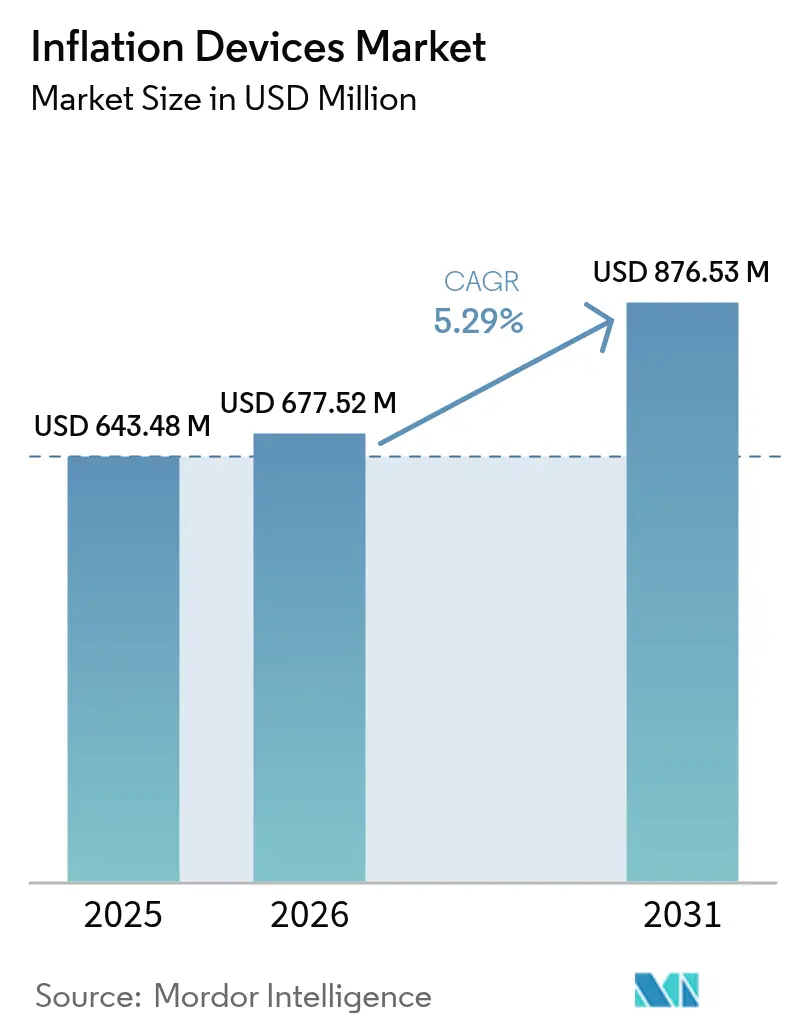
The Inflation devices market size is expected to grow from USD 643.48 million in 2025 to USD 677.52 million in 2026 and is forecast to reach USD 876.53 million by 2031 at 5.29% CAGR over 2026-2031. This outlook demonstrates the ability of the Inflation devices market to adapt to aging-population pressures, a heavier cardiovascular disease burden, and the rapid shift of catheter procedures into outpatient settings. Persistently high shipping, labor, and raw-material expenses—exacerbated by geopolitical tensions—compel manufacturers to re-engineer logistics footprints and invest 3–5% of revenue in supply-chain services. At the same time, digital pressure-sensing consoles are moving from optional add-ons to mandatory procurement criteria as providers chase data for quality metrics, while ambulatory surgical centers (ASCs) expand procedure volumes on the back of Medicare's USD 6.8 billion spend in 2023, representing an 11.5% increase from the previous year's USD 6.1 billion Medicare Payment Advisory Commission.
Key Report Takeaways
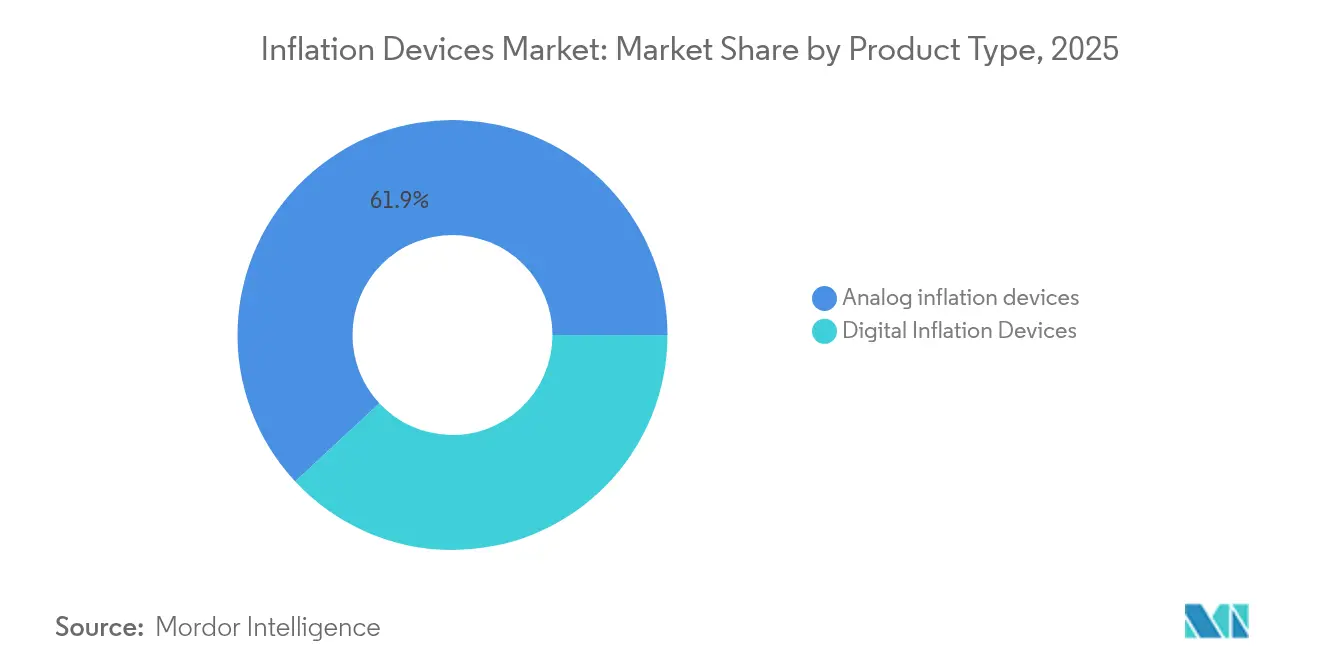
- By product type, analog inflation devices held 61.94% of Inflation devices market share in 2025; digital inflation devices are advancing at a 6.15% CAGR through 2031.
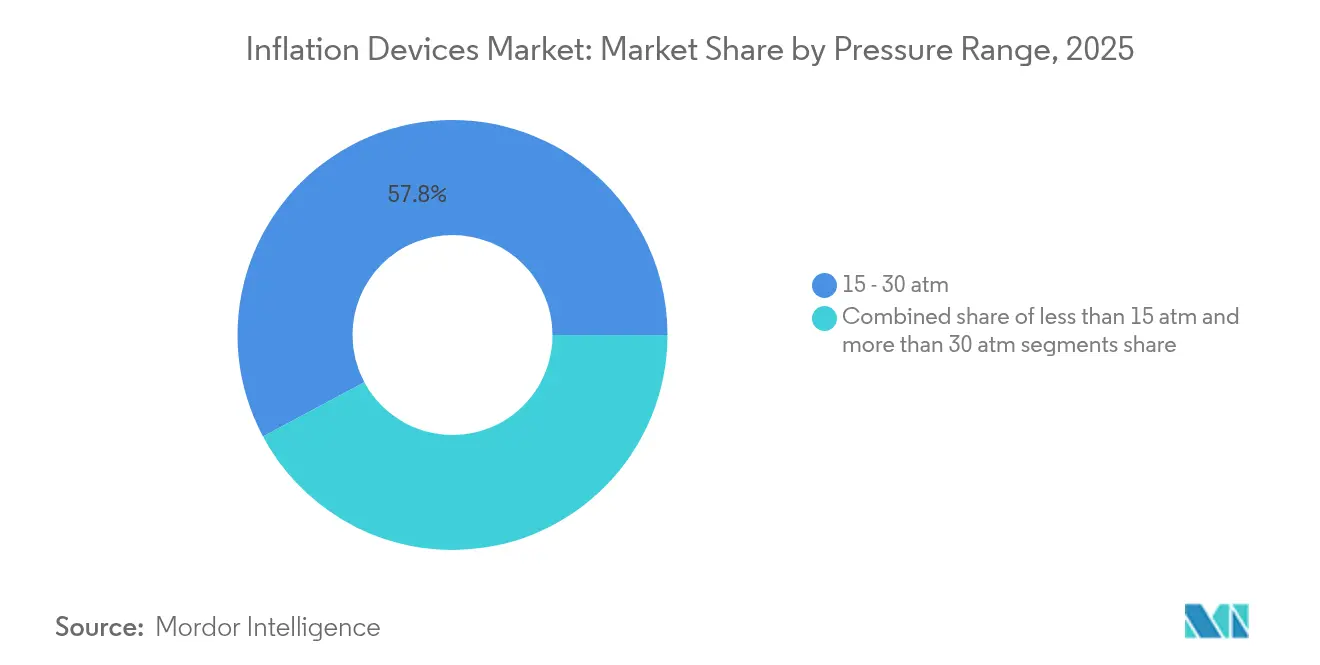
- By pressure range, the 15–30 atm segment accounted for 57.82% of Inflation devices market size in 2025 and is projected to expand at 7.54% CAGR to 2031.
- By application, coronary angioplasty generated 43.92% of Inflation devices market size in 2025, while neurovascular procedures post the quickest 6.38% CAGR through 2031.
- By end user, hospitals captured 53.15% of Inflation devices market share in 2025; ASCs deliver the fastest 6.83% CAGR through 2031.
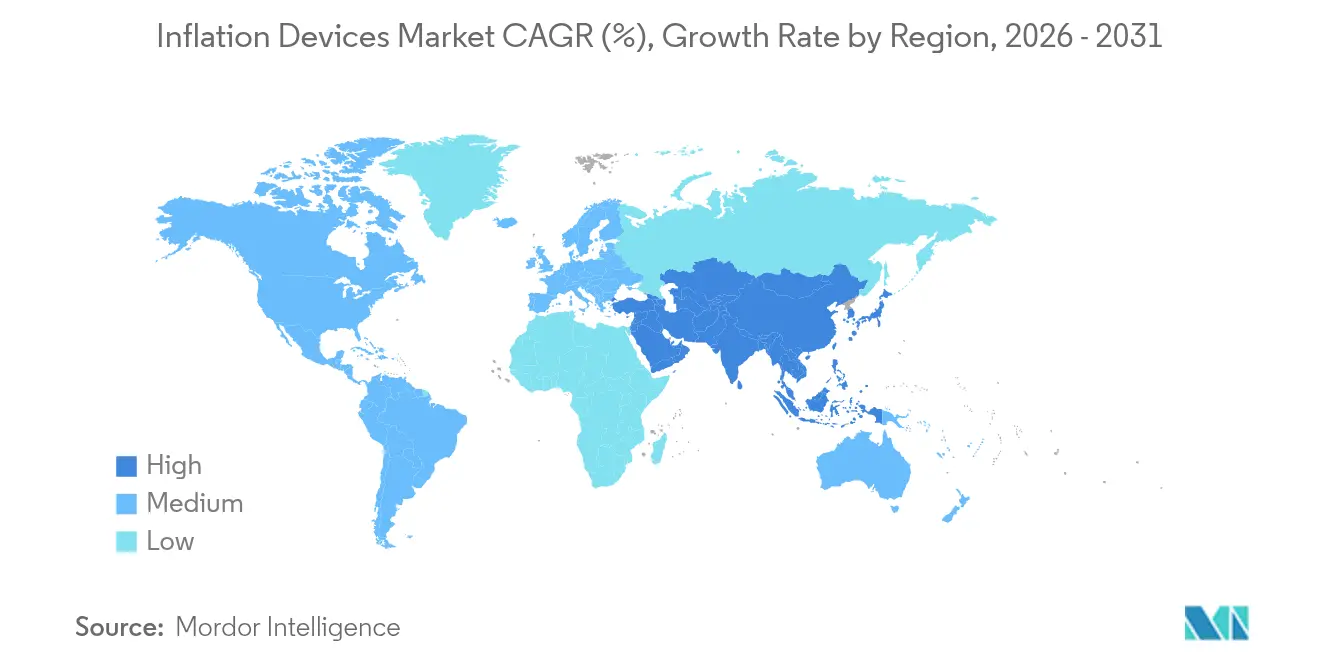
- North America remained the largest geography at 41.95% of the Inflation devices market in 2025, whereas Asia-Pacific records a 7.06% CAGR outlook to 2031.
Note: Market size and forecast figures in this report are generated using Mordor Intelligence’s proprietary estimation framework, updated with the latest available data and insights as of 2026.
Market Trends and Insights
Drivers Impact Analysis of Inflation Devices Market*
| Driver | (~) % Impact on CAGR Forecast | Geographic Relevance | Impact Timeline |
|---|---|---|---|
| Rising prevalence of cardiovascular & peripheral arterial diseases | +1.2% | Global, with higher impact in North America & Europe | Long term (≥ 4 years) |
| Growth in minimally-invasive angioplasty procedures | +0.9% | Global, led by North America & Asia-Pacific | Medium term (2-4 years) |
| Favourable reimbursement reforms for catheter-based interventions | +0.7% | North America & Europe, expanding to Asia-Pacific | Medium term (2-4 years) |
| Integration of digital pressure-sensing & data logging in inflation devices | +0.6% | North America & Europe, with spillover to Asia-Pacific | Short term (≤ 2 years) |
| Adoption in neurovascular & structural-heart interventions | +0.5% | Global, with early adoption in developed markets | Long term (≥ 4 years) |
| Shift toward single-use sterile inflation devices for infection control | +0.4% | Global, accelerated in post-pandemic healthcare settings | Short term (≤ 2 years) |
| Source: Mordor Intelligence | |||
Rising prevalence of cardiovascular & peripheral arterial diseases
Ischemic-heart-disease patients in the United States are projected to top 29 million by 2060. This demographic surge underpins recurrent demand in the Inflation devices market, particularly for units rated 15–30 atm that now satisfy 58.27% of global requirement. Hospitals are scaling cath-lab capacity and choosing pumps that offer granular pressure control and temperature-stable gauges, positioning suppliers with robust, intuitive designs to win high-value contracts in aging economies.
Growth in minimally-invasive angioplasty procedures
FDA clearance of the AGENT Paclitaxel-Coated Balloon Catheter, which cut major adverse events 11.1% at 12 months, illustrates innovation’s role in expanding case volumes. ASCs, buoyed by double-digit Medicare spending growth, prioritize rapid device setup and digital monitoring. In response, manufacturers of the Inflation devices market roll out consoles with auto-inflation algorithms to streamline same-day discharge protocols.
Favourable reimbursement reforms for catheter-based interventions
CMS lifted the Physician Fee Schedule Conversion Factor 2.93% for 2024. New HCPCS codes covering dynamic balloons clarify billing, easing premium-device adoption. Parallel liberalization in India aligns local standards with EU MDR requirements. Collectively these shifts improve cash-flow visibility, encouraging providers to upgrade within the Inflation devices market to data-rich, digitally logged platforms.
Integration of digital pressure-sensing & data logging
Next-generation Wheatstone-bridge sensors achieve 460.1 kPa-1 sensitivity while bypassing temperature calibration. Wireless modules export real-time readings to electronic records, aligning with FDA change-control guidance and aiding post-market surveillance. As a result, procurement committees increasingly mandate digital readiness, driving the Inflation devices market toward sensor-centric value propositions.
Restraints Impact Analysis of Inflation Devices Market*
| Restraint | (~) % Impact on CAGR Forecast | Geographic Relevance | Impact Timeline |
|---|---|---|---|
| High average selling price of digital inflation devices | -0.8% | Global, with higher impact in price-sensitive markets | Medium term (2-4 years) |
| Stringent Class III regulatory pathway in key markets | -0.6% | North America & Europe, expanding globally | Long term (≥ 4 years) |
| Supply-chain vulnerability for precision pressure gauges & syringes | -0.5% | Global, with concentration in Asia-Pacific manufacturing | Short term (≤ 2 years) |
| Growing catheter designs that eliminate separate inflation devices | -0.4% | North America & Europe, with spillover to developed markets | Long term (≥ 4 years) |
| Source: Mordor Intelligence | |||
High average selling price of digital inflation devices
Digital consoles list 30–40% higher than analog pumps, limiting uptake where hospital margins remain thin. Cost-of-ownership assessments—which include calibration, software, and training—may widen that gap. Analogue pumps therefore persist in emergency carts, tempering growth in the premium tier of the Inflation devices market.
Stringent Class III regulatory pathway in key markets
Premarket approval demands extensive data and rising user fees; FY 2025 FDA rates increased again. Smaller innovators find global launches in the Inflation devices market financially daunting, slowing disruptive entries and preserving incumbent dominance.
*Our forecasts treat driver/restraint impacts as directional, not additive. The impact forecasts reflect baseline growth, mix effects, and variable interactions.
Inflation Devices Market Segment Analysis
By Product Type:
digital integration drives premium segment growthAnalog pumps generated 61.94% of the Inflation devices market in 2025, favored for reliability and low unit cost. High-volume hospitals continue to buy analog because technicians already master the workflow. Still, digital devices are projected to add USD 131.6 million by 2031 on a 6.15% CAGR as centers seek audit-ready data capture. Wireless consoles that log every inflation-deflation cycle satisfy accreditation mandates, raising switching incentives inside the Inflation devices market.
Digital systems integrate pressure graphs, auto-adjust algorithms, and remote diagnostics, slashing biomedical engineer call-outs. Trade-in credits and leasing plans dilute sticker shock, enabling independent ASCs to leapfrog older technology. Although analog remains entrenched, the strategic direction inside the Inflation devices market points to data-centric platforms becoming the reference standard.



By Application:
neurovascular momentum accelerates adoptionCoronary angioplasty still dominates volume, but neurovascular interventions register the fastest CAGR at 6.38%. Micro-profile pumps capable of fractional-atmosphere increments are in high demand among neuro-interventionalists, highlighting the expanding technical sophistication of the Inflation devices market.
Peripheral angioplasty enjoys steady patient inflow as awareness of critical-limb ischemia spreads. Gastroenterologists report an 88.9% success rate using drug-coated balloons for benign esophageal strictures, encouraging GI units to stock dedicated inflation kits. Urologists engaged in prostate-artery embolization likewise recruit ultra-high-resolution imaging that benefits from pressure-stable devices. Combined, these applications enlarge the procedurally diverse base of the Inflation devices market.
By Pressure Range:
mid-range versatility sustains demandUnits rated 15–30 atm account for 57.82% of the Inflation devices market thanks to multi-lesion versatility. These pumps handle drug-coated balloon inflation, calcified stenosis, and peripheral disease without switching tools, simplifying inventory. Growth at 7.54% CAGR underscores provider confidence that one SKU can span most anatomical challenges.
Low-pressure (<15 atm) devices survive in pediatrics and delicate visceral work, while >30 atm systems remain niche for chronic total occlusions. R&D budgets therefore center on mid-range refinements—leak-proof connectors, faster deflation—and not on pressure extremes. Fiber-optic gauge integration is the next frontier as vendors race to raise measurement accuracy within the core range of the Inflation devices market.
By End User:
ASC growth transforms channel economicsHospitals held 53.15% of value in 2025, yet ASCs will contribute the bulk of incremental gains through 2031. Outpatient centers demand compact pumps with intuitive UIs; suppliers have responded with fast-prime syringes to cut room turnover times. Specialty clinics and dedicated cath-labs reinforce mid-tier demand, procuring premium pumps for niche cases while standardizing consumables to curb costs. This user cascade diversifies revenue streams and enhances resilience for companies active in the Inflation devices market.
Geography Analysis
North America Inflation Devices Market
North America generated 41.95% of global revenue in 2025, underpinned by high procedural density and supportive reimbursement. CMS’s 2.93% fee-schedule uplift secures predictable returns for providers, fueling capital expenditure on next-generation consoles. Canadian labs, benefiting from device reciprocity with FDA approvals, follow U.S. buying patterns, while Mexico upgrades cardiac infrastructure through public–private funding.
Europe Inflation Devices Market
Europe maintains second position through comprehensive insurance coverage and stringent MDR oversight, which elevates demand for pumps with exportable log files. Germany, France, and the United Kingdom together perform more than 600,000 PCI and peripheral procedures per year, guaranteeing baseline throughput for the Inflation devices market. Southern Europe, seeking cost balance, often opts for hybrid analog-digital configurations that meet compliance at lower capital cost.
APAC Inflation Devices Market
Asia-Pacific is forecast to expand 7.06% annually, the sharpest pace in the Inflation devices market. China approved 12,213 medical devices in 2023, over half in Class III, reflecting regulator willingness to fast-track innovation. India’s domestic manufacturing push is narrowing import gaps, opening sub-USD 2,000 analog segments. Japan and South Korea, both aging rapidly, sustain complex neurovascular case growth, creating premium device pockets. Southeast Asian governments co-finance cath-lab rollouts, enabling first-time purchases and widening regional demand for the Inflation devices market.

Regulatory Landscape
Inflation devices and closely related balloon catheter accessory systems are regulated under risk-based frameworks that shape design controls, verification, and post-market obligations. In the United States, many balloon inflation devices fall under FDA medical device rules that commonly route to 510(k) clearance pathways, while manufacturing and quality-system compliance, including FDA quality system expectations, governs supplier changes and process validations. A key technical anchor is the FDA recognition of ISO 10555-4:2023 for balloon dilatation catheters, with a stated transition deadline of July 5, 2026 to move away from reliance on the prior edition. This increases the importance of demonstrated burst-pressure performance, deflation time, and leak integrity in submissions and change control.
In Europe, EU MDR 2017/745 continues to require risk-based classification and conformity assessment, with greater scrutiny on clinical evaluation, post-market surveillance, and traceability. Recent recall activity highlights regulator focus on component integrity and sterile barrier performance in inflation-related devices, including a November 2024 Class 2 recall initiated by Abbott Vascular for certain INDEFLATOR inflation devices due to potential leaks and an August 2024 Class 2 recall affecting MONARCH Inflation Devices tied to sterile barrier integrity concerns. These actions reinforce compliance premium requirements around connector robustness, packaging validation, and field-corrective-action readiness for suppliers selling globally.
Value Chain Analysis
The inflation devices value chain begins with specialized materials and components, including medical-grade polymers for syringes and housings, high-pressure tubing, and precision mechanical elements such as piston controls and luer-lock connectors, along with pressure measurement subsystems (analog gauges or digital sensing modules). Device manufacturing integrates molding, machining, assembly, calibration, and packaging, with performance verification centered on pressure accuracy and leak-proof connections aligned to applicable standards and quality-system requirements such as ISO 13485 and FDA manufacturing controls. Sterilization, frequently Ethylene Oxide (EtO) for sterile kits and packs, is a constrained node where capacity, environmental oversight, and validation timelines can affect lead times.
Downstream, distribution runs through direct hospital/IDN contracting and distributor networks serving hospitals, ambulatory surgical centers, and specialty cath labs, with growing pull from procedure packs that bundle inflation devices with other disposables. The highest-friction points are supplier qualification and material substitutions, since changes to polymers, tubing, or gauge suppliers often trigger re-validation and regulatory documentation updates. Manufacturers therefore emphasize dual sourcing for critical parts, deeper supplier quality agreements, and tighter incoming inspection for precision gauges and connectors to reduce the risk of recalls and shipment holds.
Competitive Landscape
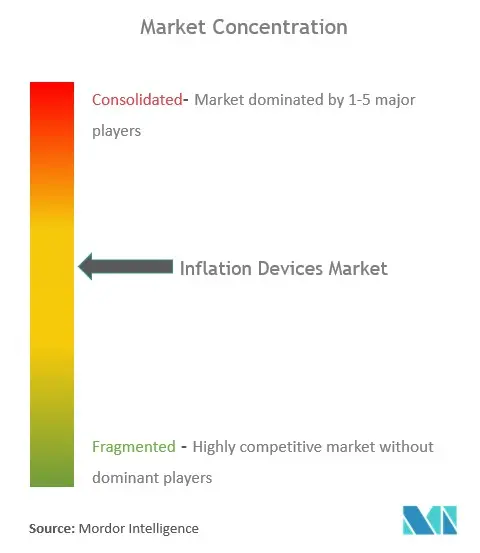
The top five players control roughly half of the Inflation devices market, constituting moderate consolidation. Medtronic logged USD 8.4 billion Q2 FY25 revenue, up 5.3%, riding TAVR and structural-heart momentum. Boston Scientific reported 26.2% cardiovascular sales growth in Q1 2025 after acquiring Bolt Medical.
Quality-control scrutiny shapes competitive fortunes; FDA warning letters to Chinese syringe makers spotlight supply risk and open doors for compliant suppliers. Established firms hedge with vertically integrated service packages—training, software analytics, and guaranteed turn-times. Niche entrants specialize in neurovascular micro-pressure devices, vying for high-margin sub-segments of the Inflation devices market. AI-enabled dashboards that benchmark inflation cycles represent the next competitive differentiator as hospitals link procurement to measurable outcome improvements.
Inflation Devices Industry Leaders
Teleflex Incorporated
Merit Medical Systems
Johnson & Johnson Services, Inc
ARGON MEDICAL
B. Braun SE
- *Disclaimer: Major Players sorted in no particular order
Inflation Devices Market Companies Covered in this Report
- Merit Medical Systems
- Cook Group
- B. Braun
- Terumo
- Boston Scientific
- Medtronic
- Abbott Laboratories
- Teleflex
- Atrion Corporation
- Argon Medical Devices
- Cardinal Health
- Penumbra
- Nipro
- Olympus
- Smiths Group
- Shenzhen SCW Medicath Ltd.
- Lepu Medical
- Integra LifeSciences
- Acandis

Market Opportunities and Future Outlook
Opportunity is building around specialized use cases that require tighter control of pressure profiles and better workflow integration, rather than generic manual pumps. Structural heart and complex interventions provide visible whitespace for higher-pressure, more controlled inflation solutions, highlighted by Corvention receiving FDA 510(k) clearance in May 2026 for its KardiaPSI Balloon Catheter for balloon aortic valvuloplasty (24 atm) and following with the first U.S. clinical case in June 2026 at WashU Medicine in St. Louis as part of a limited launch. These milestones support adjacent accessory pathways, including inflation devices and pressure-management workflows that emphasize repeatability, documentation, and rapid setup in high-acuity cases.
A second opportunity track is the shift from standalone devices to data-producing subsystems aligned with cath-lab digitization and robotics. Product direction in 2026 points to inflation solutions that can connect to broader procedural platforms, exemplified by Sentante unveiling the Inflante digital balloon inflation device in July 2026 with real-time capture of pressure profiles and timing, and Philips launching the Bridge Plus Occlusion Balloon in April 2026 for superior vena cava tear management during transvenous lead extraction. Together, these launches reinforce room for digital logging, connectivity, and procedure-specific kits that address safety events, audit trails, and training needs across hospitals and expanding outpatient settings.
Recent Industry Developments in Inflation Devices Market
- April 2026: Argon Medical Devices, Inc. opened a new international facility in Singapore to serve as an operational hub across 20 Asia-Pacific countries. The facility supports regional logistics, training, and customer support for interventional portfolios that depend on consistent accessory and disposable availability. A larger in-region footprint also helps reduce lead-time variability for hospitals and outpatient sites that standardize on specific inflation and catheter workflows.
- April 2025: Teleflex Incorporated received FDA 510(k) clearance for the AC3 Range Intra-Aortic Balloon Pump (IABP) designed for patient transport. While the product sits within balloon-based hemodynamic support, it reinforces the trend toward integrated, transport-ready systems that elevate expectations for device reliability, usability, and supporting accessories across cardiac care pathways. The clearance also broadens Teleflex positioning in interventional and critical-care accounts that purchase multiple balloon-related device categories.
- July 2024: Teleflex Incorporated received FDA 510(k) clearance for the Ringer Perfusion Balloon Catheter, a rapid-exchange catheter intended to allow continuous coronary blood flow during prolonged inflations. The clearance supports wider adoption of longer-duration inflation techniques in specific coronary use cases, which can increase demand for compatible inflation devices and pressure-management consistency. It also adds momentum to procedure-kit strategies where catheter and inflation workflows are optimized together for efficiency.


Inflation Devices Market Report Scope and Research Methodology
Market Definition and Coverage
This market covers medical inflation devices used to inflate and deflate balloon catheters during minimally invasive procedures. All values are captured as the selling price of the device supplied to hospitals, ASCs, and similar care settings across major regions.
Scope exclusions: We exclude standalone balloon catheters, guidewires, stents, and procedure service revenue. We also exclude general-purpose syringes that are not positioned as inflation devices.
Segments Covered in This Report
- By Product Type (Value)
- Analog Inflation Devices
- Digital Inflation Devices
- By Pressure Range (Value)
- less than 15 atm
- 15 – 30 atm
- more than 30 atm
- By Application (Value)
- Coronary Angioplasty
- Peripheral Angioplasty
- Neurovascular Procedures
- Gastroenterology & ERCP
- Urology & Others
- By End User (Value)
- Hospitals
- Ambulatory Surgical Centers
- Specialty Clinics & Cath Labs
- By Geography (Value)
- North America
- United States
- Canada
- Mexico
- Europe
- Germany
- United Kingdom
- France
- Italy
- Spain
- Rest of Europe
- Asia-Pacific
- China
- India
- Japan
- South Korea
- Australia
- Rest of Asia-Pacific
- South America
- Brazil
- Argentina
- Rest of South America
- Middle East and Africa
- GCC
- South Africa
- Rest of Middle East and Africa
- North America
Data Sources, Market Sizing, and Validation
Desk Research
Desk work starts by mapping how many procedures are being done that typically need inflation devices, and how those volumes change by region and care setting. We relied on public health statistics and procedure reporting where available, then used clinical evidence to interpret how often inflation devices are used across different interventions.
For triangulation, we referenced sources such as the World Health Organization health statistics, CDC healthcare data products, OECD health indicators, U.S. FDA device databases and recalls, and peer-reviewed clinical journals covering interventional cardiology and radiology outcomes. We also reviewed company annual reports, investor presentations, reputable press, and association websites to confirm product positioning and how adoption is evolving. In a few steps, a paid subscription database was used for company financials, and an import and export shipment-level view was used to sanity-check supplier exposure. These examples are not exhaustive, and many other public sources were used to collect data, validate inputs, and clarify open questions.
Primary Interviews and Surveys
To tighten assumptions that are not clearly visible in public sources, we spoke with a mix of clinicians, cath lab and ASC procurement staff, and product and sales leaders from device suppliers and distributors. These discussions were spread across the main healthcare markets, so regional practice differences, pressure-range preferences, and the analog versus digital shift could be reflected in our model inputs.
Distribution of primary research fieldwork respondents
| Company type | Respondent position | Region |
|---|---|---|
| Top tier: 25% | CXOs: 12% | APAC: 45% |
| Mid tier: 57% | Functional/Unit leaders: 42% | EMEA: 37% |
| Smaller Players: 18% | Managers: 46% | Americas: 18% |
Market-Sizing & Forecasting
Sizing is built using a top-down approach where procedure volumes are reconstructed by therapy area, then filtered by the share of cases that use balloon catheters and the typical inflation device utilization per case. The result is converted into value using region-specific average selling price ranges. After that, totals are reviewed against selective bottom-up checks from supplier revenue exposure, distributor channel discussions, and sampled ASP times volume math.
Key inputs we tracked include interventional cardiology and peripheral vascular procedure volumes, growth in ambulatory surgical centers versus hospitals, the split between analog and digital devices, demand for higher pressure ranges for tougher lesions, and replacement or reprocessing tendencies that influence unit turns. For the forecast, we use scenario analysis where procedure growth, site-of-care shift, and ASP movement are varied within ranges agreed during interviews, then consolidated into a base case. When supplier-side detail is missing in smaller countries, gaps are handled by using procedure proxies and regional price ladders, and then the totals are rechecked for reasonableness.
Data Validation & Update Cycle
Validation is done in steps, starting with unit and value logic checks at the country and regional level, then running variance checks against independent signals such as procedure growth, reimbursement direction, and reported device-category trends. When outputs fall outside expected ranges, we revisit assumptions and trigger targeted re-contacts to confirm whether the issue is pricing, utilization, or scope.
Before sign-off, the model and write-up go through a separate analyst review, so formulas, conversions, and year alignment errors are caught early. Reports are refreshed on an annual cycle, and interim adjustments are made when material events occur such as major recalls, regulatory shifts, or step-changes in procedure volumes. Right before delivery, we do a fresh pass to ensure the latest public updates are reflected.
Mordor Intelligence's Inflation Devices Market Size Versus Other Published Estimates
Published inflation devices market values often differ because the scope and the anchor year are not the same across sources, even when the device name sounds identical. Differences also show up when one study ties demand to procedure counts and site-of-care mix, while another leans more on manufacturer revenue narratives or older base-year structures.
The main spread usually comes from what is counted as an inflation device. That includes how procedures are assumed to use one device per case, and how pricing is moved forward year to year with the analog-to-digital mix. In our work, the 2026 value is tied to procedure-led demand pools and pressure-range adoption checks, then converted using region-level price ladders that are refreshed during the update cycle, which is a modeling choice applied by Mordor Intelligence.
Benchmark comparison
| Source | Market Size | Gaps in Research Methodology |
|---|---|---|
| Mordor Intelligence | USD 677.52 M (2026) | |
| Global Consultancy A | USD 638.13 M (2025) | Uses a different base year and may apply a broader device interpretation tied to balloon catheter workflow, which can shift counts across analog and digital and change the year-on-year price progression. |
| Research Publisher B | USD 517.00 M (2018) | Anchored to an older base year and earlier adoption curve, so the later shift toward higher-pressure use cases and digital displays can be underrepresented when extrapolated forward. |
Overall, the gap across estimates is mainly explained by year selection and how tightly device demand is connected to procedure volumes and usage per case. By keeping assumptions explicit, aligning units to clinical use, and rechecking totals against multiple independent signals, our estimate stays traceable and repeatable for planning.


Key Questions Answered in the Report
What is the current size of the Inflation Devices market?
The Inflation Devices market size is USD 677.52 million in 2026 and is projected to reach USD 876.53 million by 2031.
Which region holds the largest share in the Inflation Devices market?
North America leads with 41.95% share, supported by high procedural volumes and favorable reimbursement.
Which segment is growing fastest within the Inflation Devices market?
Digital inflation devices exhibit the highest segment CAGR at 6.15% through 2031 due to demand for data-rich workflows.
How is regulation affecting new product introductions?
Class III approval pathways require extensive clinical data and higher user fees, extending time-to-market for advanced devices.
Page last updated on:


 Your data is secure and never sold or shared.


