
Industrial Electrical Component Market Size and Share
Market Overview
| Study Period | 2021 - 2032 |
|---|---|
| Market Size (2027) | USD 11.27 Billion |
| Market Size (2032) | USD 20.65 Billion |
| Growth Rate (2027 - 2032) | 12.86 % |
| Fastest Growing Market | Asia Pacific |
| Largest Market | Asia-Pacific |
| Market Concentration | Medium |
Major Players *Disclaimer: Major Players sorted in no particular order Image © Mordor Intelligence. Reuse requires attribution under CC BY 4.0. | |
Industrial Electrical Component Market Analysis by Mordor Intelligence
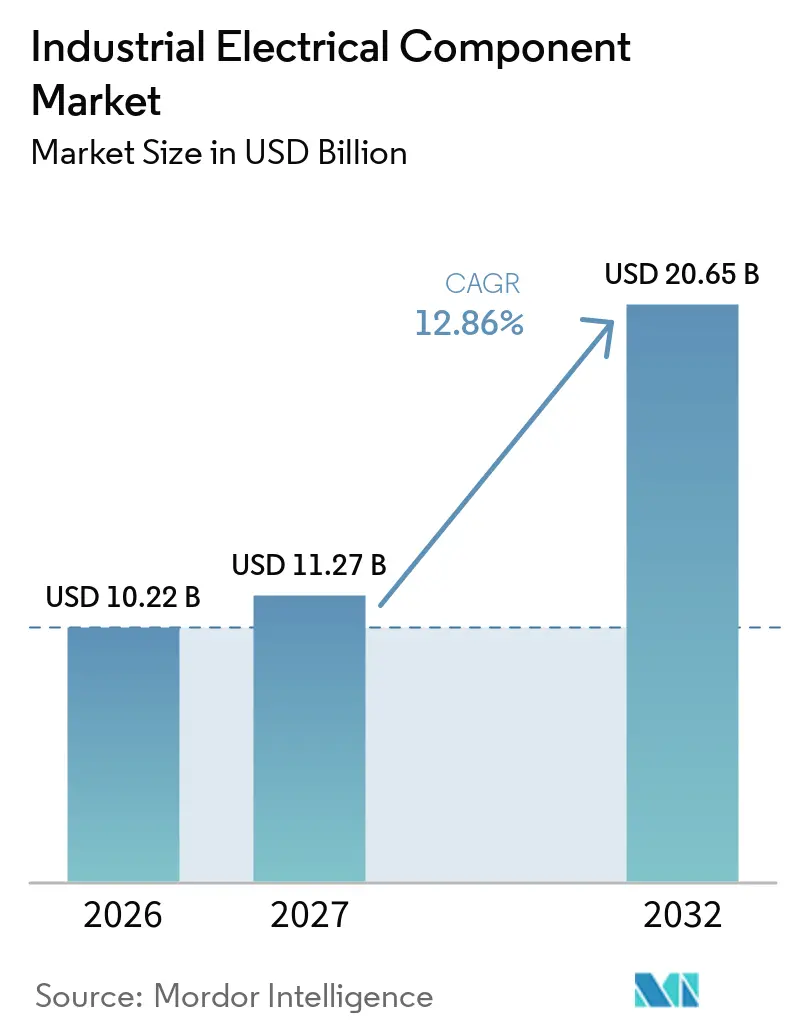
The Industrial Electrical Component Market size is projected to be USD 10.22 billion in 2026, USD 11.27 billion in 2027, and reach USD 20.65 billion by 2032, at a CAGR of 12.86% from 2027 to 2032. Demand is being supported by higher power needs in data centers, factory automation programs, grid upgrades, and the wider use of renewable power systems across manufacturing, utility, commercial, and critical-infrastructure projects. Electrical components are becoming more intelligent because operators need better monitoring, faster fault detection, and remote control in industrial facilities. This changes competition from a focus on basic products toward certified systems that combine protection, connectivity, and power management. Vendors with broad portfolios can serve large infrastructure projects, while focused suppliers can still address needs in smart surge protection and modular equipment. Input costs, compliance requirements, and long delivery times for grid equipment remain important limits on the industrial electrical components market.
Key Report Takeaways
- By product, switches held 26.4% of global revenue in 2026, while surge protection devices are forecast to grow at a 13.3% CAGR through 2032.
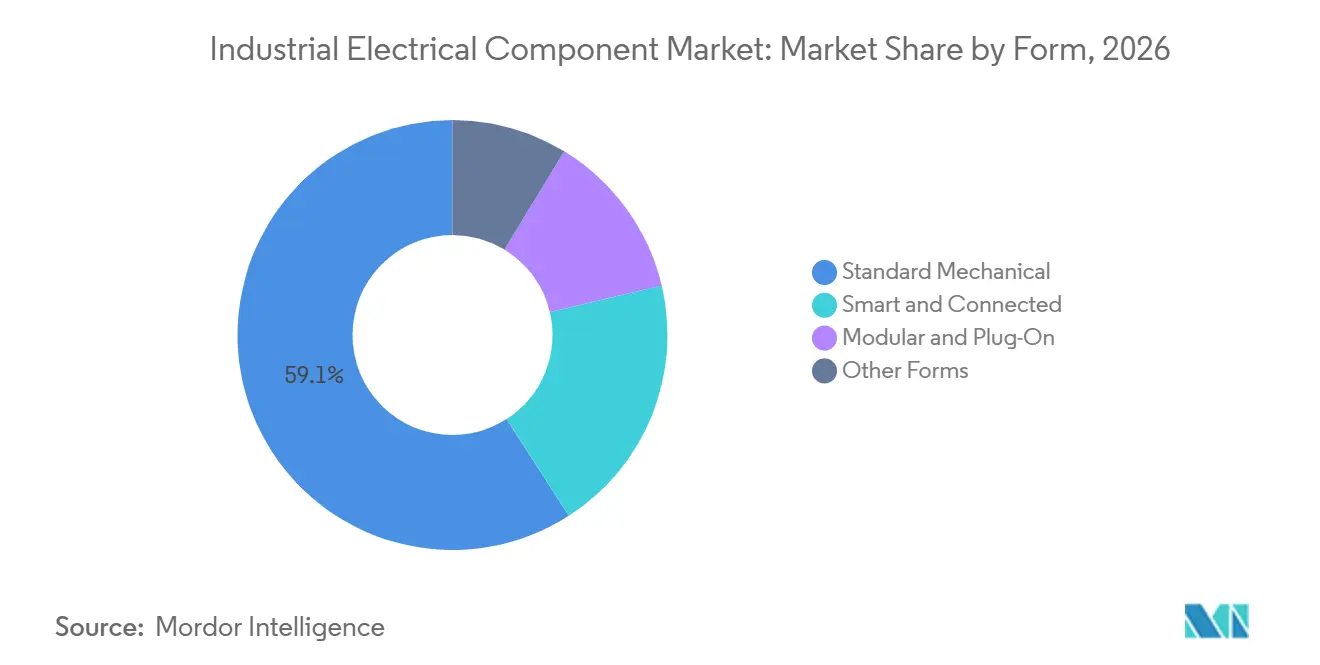
- By form, standard mechanical products held 59.1% of global revenue in 2026, while smart and connected products are forecast to grow at a 15.4% CAGR through 2032.
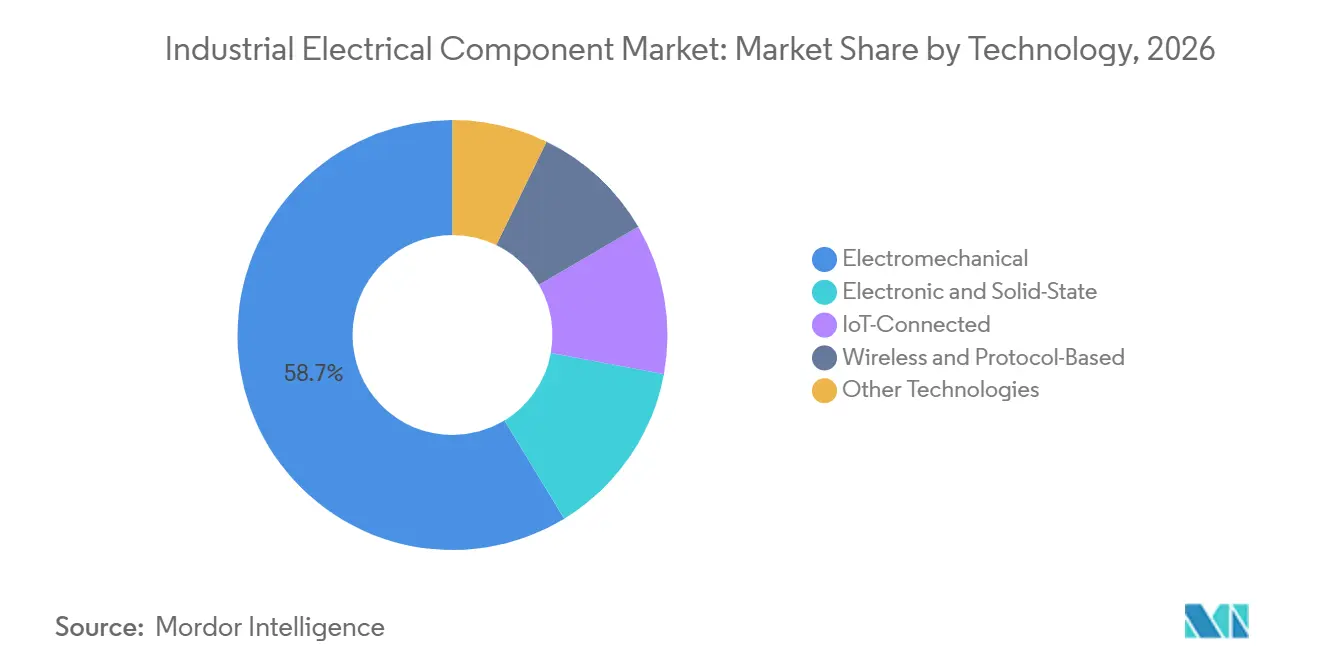
- By technology, electromechanical products held 58.7% of global revenue in 2026, while IoT-connected technology is forecast to grow at a 14.2% CAGR through 2032.
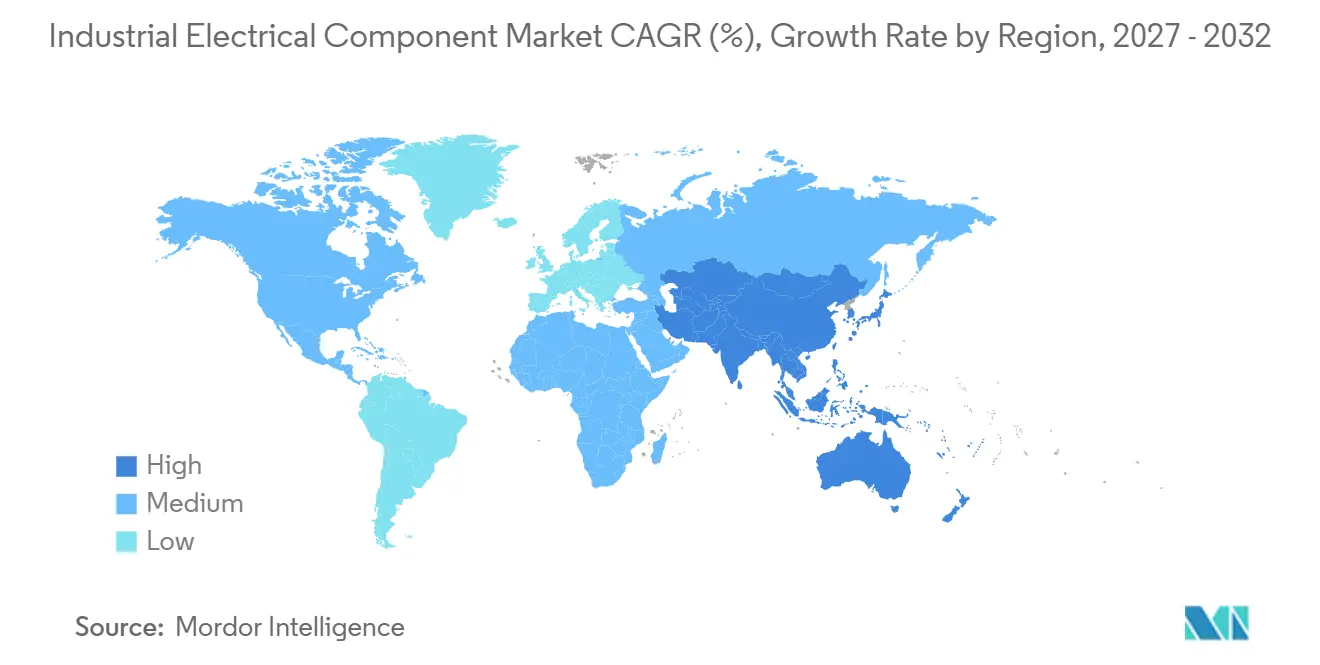
- By geography, Asia-Pacific held 42.3% of global revenue in 2026 and is forecast to grow at a 13.7% CAGR through 2032.
Note: Market numbers in this report are based on Mordor Intelligence's proprietary estimation framework, which combines nine months of actuals with Q4 projections for base year 2026.
Market Trends and Insights
Drivers Impact Analysis of Industrial Electrical Component Market*
| Driver | (~) % Impact on CAGR Forecast | Geographic Relevance | Impact Timeline |
|---|---|---|---|
| Industrial Automation and Smart Factory Investment | +3.10% | Global; core in China, Japan, South Korea, and North America | Medium term (2-4 years) |
| Grid Modernization and Renewable-Energy Integration | +2.70% | Europe and North America; spill-over to APAC and MEA | Long term (≥4 years) |
| Data-Center and AI Power-Density Expansion | +2.30% | North America and APAC core; fast-spreading to Europe and MEA | Short term (≤2 years) |
| Industrial Electrification and Energy-Efficiency Mandates | +2.00% | Europe core; early gains in India, Japan, and Latin America | Long term (≥4 years) |
| DC Distribution for Storage, EV Charging and Solar | +1.50% | APAC core (China, South Korea); North America and Europe | Medium term (2-4 years) |
| Modular Prefabricated Power Infrastructure | +1.20% | North America and Europe; expanding to APAC data-center markets | Short term (≤2 years) |
| Source: Mordor Intelligence | |||
Industrial Automation and Smart Factory Investment
Factory automation supports the industrial electrical components market because every automated production line requires switching, sensing, control, and protection equipment. A 2025 survey of 600 manufacturing executives found that 80% planned to direct at least 20% of improvement budgets toward smart manufacturing in 2026. The Japan Electrical Manufacturers' Association projected a 6.1% rise in programmable controller output for FY2026 after output increased 12.1% in FY2025. Autonomous robotics increases demand for reliable protection on 24V DC power buses because production equipment requires consistent operation. China’s programs for AI and intelligent factories also support a sustained base of equipment demand. These programs favor suppliers that can offer standardized products with dependable local support.
Grid Modernization and Renewable-Energy Integration
Grid investment is expanding the industrial electrical components market because new networks need more monitoring and protection at the component level. The European Council backed the European Grids Package in June 2026 to support modernized energy networks for decarbonization[1]. Hitachi Energy and Grid United advanced the North Plains Connector, a 3,000 MW, ±525 kV high-voltage direct-current project extending approximately 420 miles. IEC SRD 63317:2025 provides guidance for low-voltage direct-current industrial applications that link solar generation, battery storage, and motor drives. Equipment replacement will support demand for conventional switchgear, while renewable power management will require more advanced switching systems. This gives full-range suppliers an advantage in projects that include both standard and intelligent equipment.
Data-Center and AI Power-Density Expansion
The industrial electrical components market benefits from AI data centers because higher rack power requires stronger distribution, protection, and switching equipment. NVIDIA specified a 120 kW to 130 kW load per GB200 NVL72 rack, compared with less than 20 kW for earlier generations, which increases the duty required from supporting electrical equipment. ABB’s direct-current portfolio is designed for 800 VDC distribution in large AI facilities and states that this approach can improve energy efficiency by more than 5%. Long transformer lead times make factory-built and pre-certified modular switchgear more relevant to project schedules. This demand strengthens the industrial electrical components market for vendors that can provide tested, resilient equipment and supply reliability. Suppliers that can shorten installation work without reducing compliance requirements are likely to receive more attention from developers.
Industrial Electrification and Energy-Efficiency Mandates
Electrification policy creates replacement demand in the industrial electrical components market because older systems cannot always meet modern efficiency and monitoring needs. The European Commission stated that 60% of current industrial fossil-fuel energy demand could be electrified with commercially available technologies[2]. The European Commission also proposed the Industrial Accelerator Act in March 2026, including local-content and low-carbon considerations for public procurement. The Energy Performance of Buildings Directive supports renovation pathways that can increase the use of smart panels and related electrical equipment. Policy requirements add demand beyond normal maintenance spending and make certification an important part of purchasing decisions. Similar industrial programs in India and South Korea broaden the geographic base for electrically efficient equipment.
Restraints Impact Analysis of Industrial Electrical Component Market*
| Restraint | (~) % Impact on CAGR Forecast | Geographic Relevance | Impact Timeline |
|---|---|---|---|
| Copper, Aluminum, Semiconductor and Rare-Earth Cost Volatility | -1.90% | Global; most acute in North America and Europe due to import dependence | Short term (≤2 years) |
| Complex Qualification and Compliance Requirements | -1.30% | Europe (IEC/CE/EN) and North America (UL/CSA) most intensive | Medium term (2-4 years) |
| Critical Grid-Component Lead-Time Exposure | -0.90% | North America and Europe; transformer lead times exceed 36 months | Short term (≤2 years) |
| Legacy-Component Obsolescence and Dual-Sourcing Costs | -0.70% | Global; highest cost exposure in mature markets (US, Germany, Japan) | Long term (≥4 years) |
| Source: Mordor Intelligence | |||
Copper, Aluminum, Semiconductor and Rare-Earth Cost Volatility
Material costs limit the industrial electrical components market because copper, aluminum, semiconductors, and rare-earth inputs are used across protection and connection products. J.P. Morgan forecast copper at USD 10,500 per metric ton for 2026 and aluminum at USD 3,800 per metric ton in Q3 2026[3]. Manufacturers with fixed-price contracts face pressure when several input costs rise at the same time. Price increases can be passed through only where contracts allow them, creating different outcomes across customer groups. The industrial electrical components market, therefore, remains exposed when contract terms do not match volatile input costs.
Complex Qualification and Compliance Requirements
Qualification requirements slow the industrial electrical components market when suppliers need to meet several technical rules before products can be approved. IEC 61643 requires testing for surge protection devices, while IEC SRD 63317:2025 adds low-voltage direct-current system considerations. Restrictions on SF₆ in medium-voltage switchgear also require product redesign and new certification activities in Europe. ABB stated that its HiPerGuard product received UL 9540 certification for its class, showing the value of approved equipment in battery-linked systems[4]. Networked devices can also require cybersecurity alignment under IEC 62443 alongside power-system requirements. The resulting time and expense favor larger suppliers that can maintain certifications across several regions.
*Our forecasts treat driver/restraint impacts as directional, not additive. The impact forecasts reflect baseline growth, mix effects, and variable interactions.
Industrial Electrical Component Market Segment Analysis
By Product:
Surge Protection Leads Growth, Switches Anchor the BaseIn the industrial electrical components market, switches held 26.4% of the global share in 2026, reflecting their use across distribution boards, control panels, and automation systems. This broad installed base links switch demand to most industrial infrastructure investments. Wiring and cable accessories, connectors and terminals, and related products provide important secondary demand because electrical systems need reliable connections as well as control devices. Siemens expanded its SENTRON ECPD portfolio with residual current monitoring that supports continuous leakage-current detection. Such products show how circuit protection is moving toward continuous diagnostics in applications such as data centers and pharmaceutical facilities. Basic equipment still accounts for much of the volume, but diagnostic functions can raise value per installation.
Within the industrial electrical components market, surge protection devices are forecast to grow at a 13.3% CAGR through 2032, the fastest rate among product categories. Solar, battery storage, and electric vehicle charging systems introduce transient voltage conditions that older alternating-current protection systems were not designed to manage. Semtech launched the TDS2621LP SurgeSwitch for 24V DC power buses in collaborative robots and automated manufacturing, with IEC 61000-4-5 surge compliance in a 1.6 mm² footprint. Distribution boards can also benefit from commercial building renovations under the Energy Performance of Buildings Directive. Junction boxes and enclosures remain important in modular data centers, where standardized IP-rated units can reduce installation time. Product suppliers therefore need both established components and solutions suited to direct-current and digitally managed systems.
By Form:
Smart and Connected Disrupts, Standard Mechanical EnduresIn the industrial electrical components market, standard mechanical products held 59.1% of global revenue in 2026 because industrial sites have a large installed base of mechanical assemblies. Many of these assets remain in service for 15 years to 25 years, which creates steady replacement demand. Brownfield modernization supports continued volume because users often replace like-for-like equipment first. Schneider Electric expanded its prefabricated power modules for AI-ready infrastructure, with standardized modules delivering up to 2.5 MW per container. Modular and plug-on equipment is especially relevant when data centers and substations must be installed quickly. Siemens also introduced a refurbished SIRIUS soft starter with up to 50% lower CO₂ emissions than a new device, which shows how suppliers can extend product life while addressing sustainability needs.
Smart and connected products are forecast to grow at a 15.4% CAGR through 2032, making them the fastest-growing form segment. Remote diagnostics, energy monitoring, and demand response require equipment that can exchange usable operating data. The industrial electrical components market increasingly rewards products that act as both switching devices and data sources. Networked procurement requirements also raise the importance of IEC 62443 and IEC 61850 alignment for suppliers serving critical infrastructure. Smart products do not replace mechanical equipment immediately because many facilities retain long replacement cycles. Instead, each modernization project creates an opportunity to add connectivity where it offers a clear maintenance or energy-management benefit.


By Technology:
IoT-Connected Gains Ground on the Electromechanical BaseIn the industrial electrical components market, electromechanical technology held 58.7% of global revenue in 2026, supported by its extensive installed base in industrial and infrastructure settings. This base sustains recurring replacement demand as systems reach the end of life. Electronic and solid-state products serve applications that require higher switching speed, lower mechanical wear, or more frequent duty cycles. Wireless and protocol-based technology is useful in building management and microgrids, where new control cabling can be costly. IEC SRD 63317:2025 supports vendor-independent design considerations for low-voltage direct-current industrial systems. The technology mix will therefore change gradually because existing equipment remains serviceable while new facilities favor greater digital control.
In the industrial electrical components market, IoT-connected technology is forecast to grow at a 14.2% CAGR through 2032 as predictive maintenance and energy management become more common. These systems allow components to supply condition data as well as perform switching or protection functions. ABB’s Infinitus direct-current portfolio is supported by more than 700 patents and extends its NVIDIA collaboration for 800 VDC power architecture. This approach places connectivity and direct-current protection within a broader data-center power system. IoT-enabled designs can create useful differentiation, but they also increase cybersecurity and certification requirements. Suppliers with proven interoperability are better placed to address facilities that need reliable monitoring across many devices.

Geography Analysis
APAC Industrial Electrical Component Market
Asia-Pacific held 42.3% of the industrial electrical components market share in 2026 and is forecast to expand at a 13.7% CAGR through 2032. The regional industrial electrical components market combines manufacturing investment, electricity infrastructure spending, renewable deployment, and expanding data-center capacity. Japan Electrical Manufacturers' Association forecast FY2026 switching control equipment and switchgear production of JPY 1.8 trillion, which was USD 12.0 billion using the rate supplied in the draft, and 6.8% annual growth. Semiconductor fabrication and data-center investment are important demand sources in Japan. India, Vietnam, Indonesia, and Thailand also benefit from manufacturing relocation and new industrial capacity. ABB announced a USD 75 million investment in India to expand manufacturing and research and development for electrification and automation technologies.
North America and Europe Industrial Electrical Component Market
North America is supported by large data-center construction programs that require switchgear, distribution boards, and surge protection equipment. The industrial electrical components market in Europe is reinforced by the European Grids Package and industrial electrification measures. Germany, France, and the United Kingdom remain core sources of spending, while Poland benefits from data-center investment and industrial automation upgrades. The Energy Performance of Buildings Directive creates a separate renovation path for smart distribution boards and wiring accessories. North American buyers place particular weight on delivery certainty because critical power equipment can affect construction schedules. European buyers also need equipment that can meet new efficiency, environmental, and digitalization requirements.
MEA and South America Industrial Electrical Component Market
South America and Middle East and Africa are smaller contributors but remain structurally important to the industrial electrical components market. Brazil is supported by power-sector investment and energy-transition programs. Saudi Arabia and the United Arab Emirates generate demand through smart-city activity, industrial-zone electrification, and renewable-power integration. These projects require suppliers to meet IEC and local compliance requirements. Morocco is becoming a near-shore manufacturing location for European exports. Egypt and South Africa support longer-cycle replacement demand for grid distribution infrastructure. These regions can offer growth opportunities for vendors that balance certified products with accessible pricing and local service.
Mordor Intelligence provides coverage of the industrial electrical component market across other key regional markets. Detailed country-level analysis extends to Saudi Arabia incorporating local coverage and market participation, as required.
Competitive Landscape
Market Concentration
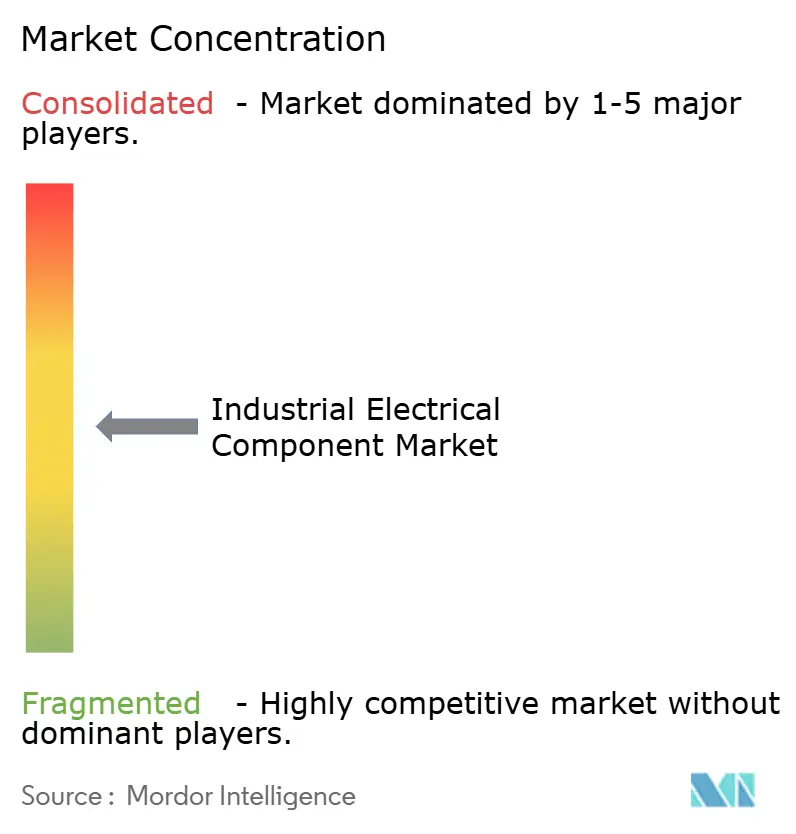
The premium tier of the industrial electrical components market is moderately concentrated around ABB, Schneider Electric, Siemens, Eaton, and Legrand. These companies have broad portfolios in switchgear, circuit protection, and data-center power systems, as well as established distribution channels. Their scale helps them serve complex projects that require coordinated components and documented compliance. Hubbell completed its USD 3 billion acquisition of NSI Industries in June 2026, adding more than 15,000 branded electrical fittings, connectors, and wire-management products. The move extends Hubbell’s presence in data-center and electrification applications. Legrand acquired Kratos Industries in February 2026 and invested in Accelsius to add medium-voltage and thermal-management capabilities for critical-power customers.
Technology differentiation is becoming more significant in the industrial electrical components market as customers seek faster delivery, direct-current capability, and greater system visibility. Schneider Electric unveiled software-defined medium-voltage switchgear in September 2026 and stated that it can enable up to 3× faster ordering and 2× faster commissioning than custom-built systems. The technology was piloted at an Equinix colocation facility. ABB uses its Infinitus platform and NVIDIA collaboration to position itself in direct-current architecture for AI data centers. Siemens introduced direct-current protection and switching products for data centers, battery storage, renewable integration, and AI factories. These actions show that component suppliers are responding to wider power-system needs rather than selling standalone devices alone.
Price-sensitive markets provide room in the industrial electrical components market for Chinese and Indian suppliers, including CHINT and IoT-focused manufacturers, especially in Asia-Pacific and Middle East and Africa. Their lower-cost offerings can pressure established European suppliers that have higher structural costs. At the same time, compliance with IEC 62443 can become a barrier in critical infrastructure procurement because buyers need cybersecurity assurance for networked devices. Legrand’s acquisition of Avtron Power Solutions in October 2025 added load-bank and power-quality capabilities for data centers. Focused specialists retain opportunities in IoT-native surge protection and modular edge switchgear. Rockwell Automation remains a borderline company for this scope because its core offering is centered on industrial automation software, programmable controllers, interfaces, and drives rather than the defined electrical component categories. Socomec and Mersen are closer replacements because their portfolios include critical-power switching, circuit protection, fuses, and surge protection.
Industrial Electrical Component Industry Leaders
-
Schneider Electric SE
-
Legrand S.A.
-
Siemens AG
-
ABB Ltd
-
Eaton Corporation plc
- *Disclaimer: Major Players sorted in no particular order
Industrial Electrical Component Market Companies Covered in this Report
- ABB Ltd
- ALBRECHT JUNG GMBH & CO. KG
- Amphenol Corporation
- Belden Inc.
- CHINT Group Co., Ltd.
- Eaton Corporation plc
- GE Vernova Inc.
- GEWISS S.p.A.
- Hager SE
- Havells India Limited
- Honeywell International Inc.
- Hubbell Incorporated
- Larsen & Toubro Limited
- Legrand S.A.
- Leviton Manufacturing Co., Inc.
- Mitsubishi Electric Corporation
- OMRON Corporation
- Phoenix Contact GmbH & Co. KG
- Rockwell Automation, Inc.
- Schneider Electric SE
- Siemens AG
- TE Connectivity plc
- Vimar S.p.A.
- WAGO GmbH & Co. KG
Recent Industry Developments in Industrial Electrical Component Market
- September 2026: Schneider Electric unveiled the world's first fully Software-Defined Medium Voltage switchgear at YOTTA 2026 in Las Vegas, delivering up to 3× faster ordering and 2× faster commissioning versus custom-built systems, already piloted with Equinix at a live colocation facility. Broader commercial availability is planned for 2028.
- August 2026: Semtech Corporation launched the TDS2621LP SurgeSwitch for 24V DC power buses in collaborative robots and automated manufacturing, delivering IEC 61000-4-5 surge compliance in a 1.6 mm² footprint.
- June 2026: Hubbell Incorporated completed its USD 3 billion acquisition of NSI Industries, adding more than 15,000 branded electrical fittings, connectors, and wire-management products.
- April 2026: ABB introduced HiPerGuard 34.5kV for AI data centers, enabling direct grid connection at distribution voltage without step-down conversion.
Global Industrial Electrical Component Market Report Scope
Industrial Electrical Components refer to cables, wires, switchgear, light bulbs, circuit breakers, enclosures, panels, power distribution units, remote power panels, switchboards, and medium & low-voltage transformers, among others, which altogether play a crucial part in facilitating and controlling the power flow to various industrial units.
The Industrial Electrical Components Market is segmented by product, form, technology, and geography. By product, the market is segmented into switches, sockets, circuit protection, distribution boards, wiring, connectors, junction boxes, surge protection, and other products. By form, the market is segmented into standard mechanical, smart and connected, modular, and other forms. By technology, the market is segmented into electromechanical, electronic, IoT-connected, wireless, and other technologies. The report also covers the market size and forecasts for the global industrial electrical components market across 26 countries in key regions. For each segment, the market sizing and forecasts have been provided on the basis of value (USD).
Segmentation Overview
| Switches |
| Sockets and Receptacles |
| Circuit Protection Devices |
| Distribution Boards and Consumer Units |
| Wiring and Cable Accessories |
| Connectors and Terminals |
| Junction Boxes and Enclosures |
| Surge Protection Devices |
| Other Products |
| Standard Mechanical |
| Smart and Connected |
| Modular and Plug-On |
| Other Forms |
| Electromechanical |
| Electronic and Solid-State |
| IoT-Connected |
| Wireless and Protocol-Based |
| Other Technologies |
| North America | United States |
| Canada | |
| Mexico | |
| Europe | Germany |
| France | |
| Italy | |
| Spain | |
| United Kingdom | |
| Poland | |
| Russia | |
| Rest of Europe | |
| Asia-Pacific | China |
| India | |
| Japan | |
| South Korea | |
| Australia | |
| Indonesia | |
| Vietnam | |
| Thailand | |
| Rest of Asia-Pacific | |
| South America | Brazil |
| Argentina | |
| Chile | |
| Rest of South America | |
| Middle East and Africa | Saudi Arabia |
| United Arab Emirates | |
| Egypt | |
| South Africa | |
| Morocco | |
| Rest of Middle East and Africa |
| By Product | Switches | |
| Sockets and Receptacles | ||
| Circuit Protection Devices | ||
| Distribution Boards and Consumer Units | ||
| Wiring and Cable Accessories | ||
| Connectors and Terminals | ||
| Junction Boxes and Enclosures | ||
| Surge Protection Devices | ||
| Other Products | ||
| By Form | Standard Mechanical | |
| Smart and Connected | ||
| Modular and Plug-On | ||
| Other Forms | ||
| By Technology | Electromechanical | |
| Electronic and Solid-State | ||
| IoT-Connected | ||
| Wireless and Protocol-Based | ||
| Other Technologies | ||
| By Geography | North America | United States |
| Canada | ||
| Mexico | ||
| Europe | Germany | |
| France | ||
| Italy | ||
| Spain | ||
| United Kingdom | ||
| Poland | ||
| Russia | ||
| Rest of Europe | ||
| Asia-Pacific | China | |
| India | ||
| Japan | ||
| South Korea | ||
| Australia | ||
| Indonesia | ||
| Vietnam | ||
| Thailand | ||
| Rest of Asia-Pacific | ||
| South America | Brazil | |
| Argentina | ||
| Chile | ||
| Rest of South America | ||
| Middle East and Africa | Saudi Arabia | |
| United Arab Emirates | ||
| Egypt | ||
| South Africa | ||
| Morocco | ||
| Rest of Middle East and Africa | ||
Key Questions Answered in the Report
What is the projected growth rate for industrial electrical components?
The industrial electrical components market is forecast to grow at a 12.86% CAGR from 2027 to 2032, reaching USD 20.65 billion.
Which product category is growing the fastest?
Surge protection devices are forecast to expand at a 13.3% CAGR through 2032, supported by solar, battery storage, and electric vehicle charging applications.
Why are smart electrical components growing faster than standard equipment?
Smart and connected products are forecast to grow at a 15.4% CAGR as facilities require remote diagnostics, energy monitoring, and demand response.
Which region leads demand for industrial electrical components?
Asia-Pacific held 42.3% share in 2026 and is forecast to grow at a 13.7% CAGR through 2032.
How are AI data centers affecting demand for electrical equipment?
Higher rack power increases demand for distribution boards, switchgear, circuit protection, surge protection, and direct-current power systems.
What is the main challenge facing equipment suppliers?
Rising copper, aluminum, semiconductor, and compliance costs can pressure margins and lengthen product qualification cycles.