
Industrial Couplings Market Size and Share
Market Overview
| Study Period | 2020 - 2031 |
|---|---|
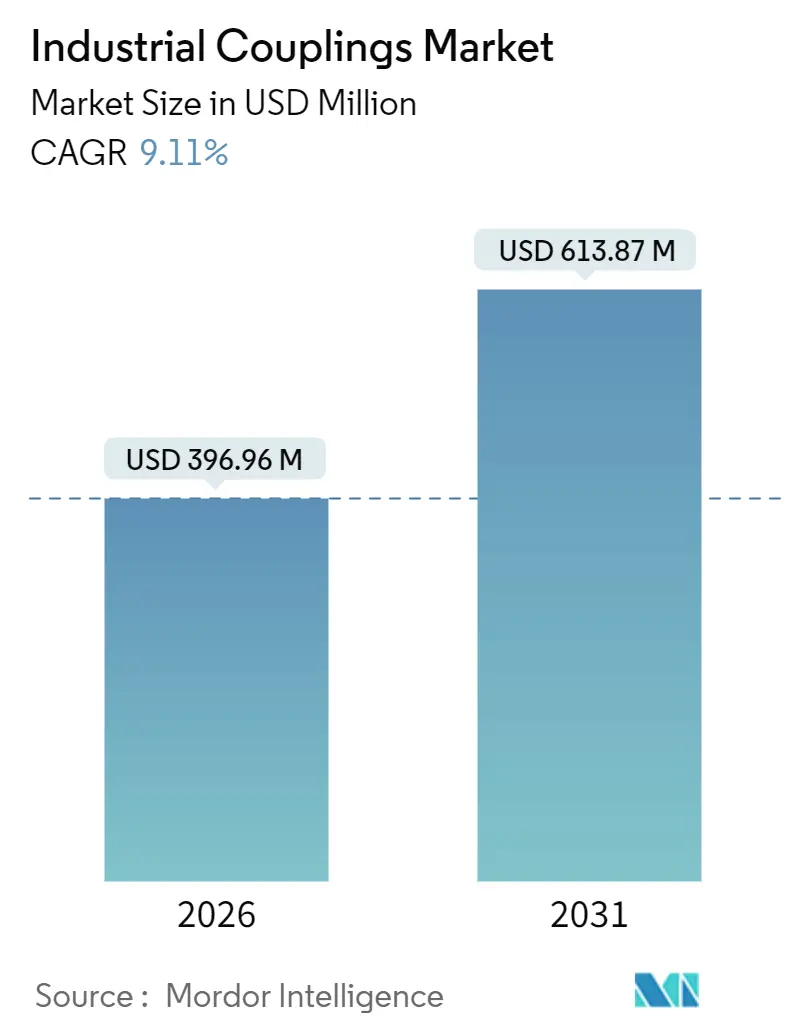
| Market Size (2026) | USD 396.96 Million |
| Market Size (2031) | USD 613.87 Million |
| Growth Rate (2026 - 2031) | 9.11 % |
| Fastest Growing Market | Middle East |
| Largest Market | Asia Pacific |
| Market Concentration | Medium |
Major Players *Disclaimer: Major Players sorted in no particular order Image © Mordor Intelligence. Reuse requires attribution under CC BY 4.0. | |
Industrial Couplings Market Analysis by Mordor Intelligence
The industrial couplings market size stood at USD 396.96 million in 2026 and, with a 9.11% CAGR, is projected to reach USD 613.87 million by 2031. The electrification of vehicles, hydrogen electrolyzer rollouts, and the miniaturization of precision motion-control assemblies are pressuring OEMs to specify lighter, cleaner, and higher-speed torque-transfer solutions. Flexible designs presently account for roughly half of demand, yet magnetic variants are gaining momentum as pharmaceutical and semiconductor fabs eliminate any pathways for lubricant ingress. Composite hubs drove double-digit growth in aerospace and medical-device platforms by trimming rotating mass by more than 40%, while Asia-Pacific manufacturers continue to localize production under supportive state subsidies. Competitive intensity has risen as leading brands embed sensors inside hubs to stream real-time torque data, a step that enables predictive maintenance offerings and lifts aftermarket pull-through. Direct-drive motor architectures remain an overhang, but their adoption is confined to low-torque, low-shock niches where couplings add limited functional value.
Key Report Takeaways
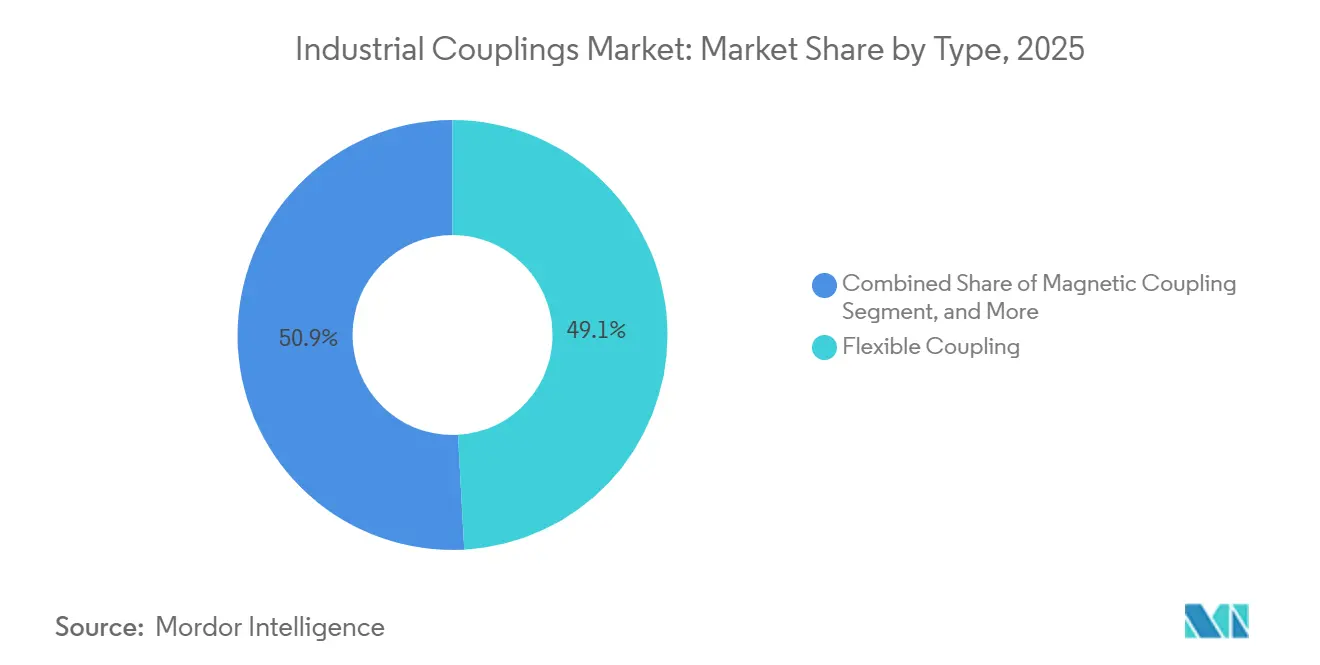
- By type, flexible couplings held 49.13% revenue share in 2025, and magnetic couplings are advancing at a 10.22% CAGR to 2031.
- By material, carbon steel dominated with 37.28% of the industrial couplings market share in 2025, while composite materials are expanding at a 10.29% CAGR through 2031.
- By torque range, Medium (500-5,000 Nm) dominated with a 45.67% share in 2025, while High (Above 5,000 Nm) is expanding at a 9.79% CAGR through 2031.
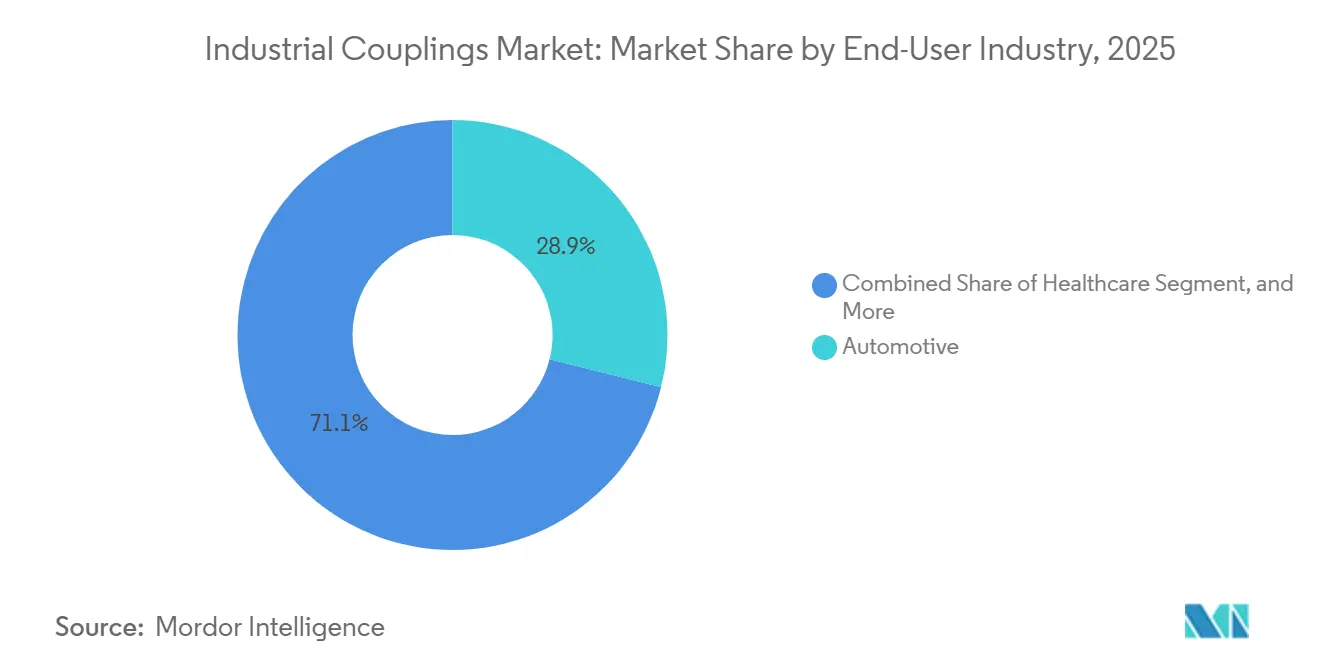
- By end-user industry, automotive accounted for 28.91% of demand in 2025, and healthcare is forecast to post a 10.88% CAGR to 2031.
- By distribution channel, OEM sales accounted for 62.33% of turnover in 2025, and aftermarket transactions are growing at a 9.54% CAGR through 2031.
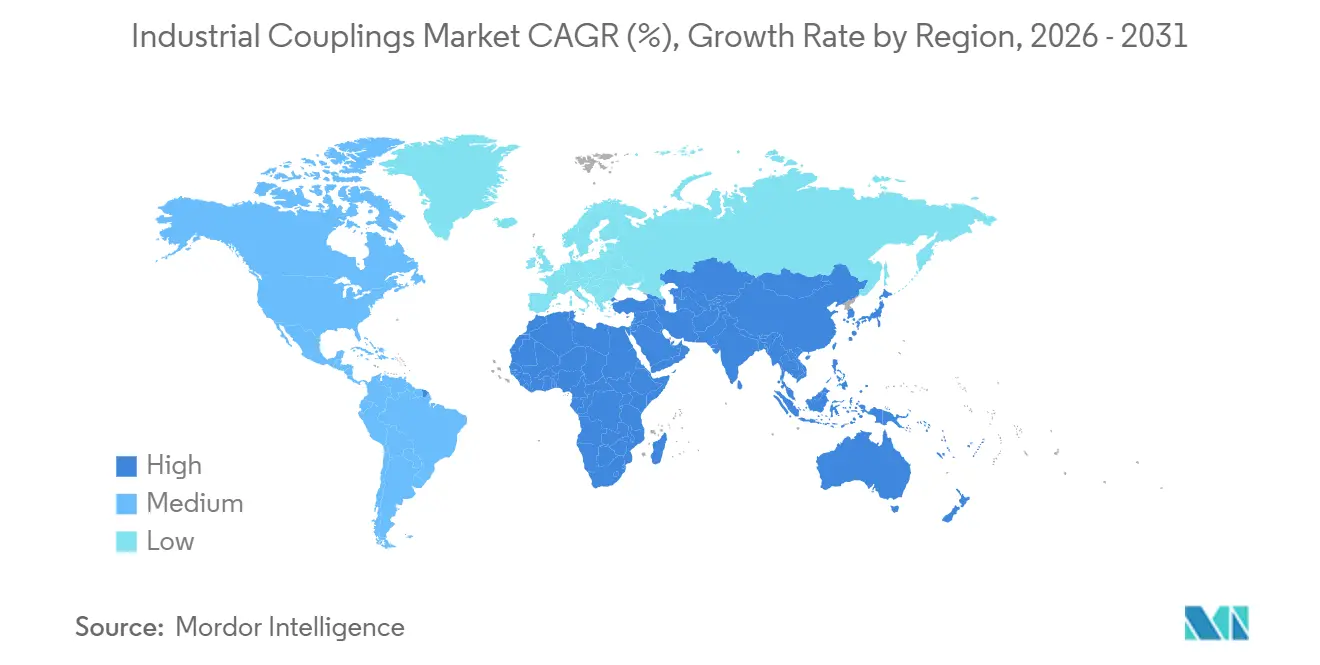
- By geography, Asia-Pacific captured a 42.76% share in 2025, whereas the Middle East is growing at a 10.17% CAGR over the same horizon.
Note: Market size and forecast figures in this report are generated using Mordor Intelligence’s proprietary estimation framework, updated with the latest available data and insights as of January 2026.
Market Trends and Insights
Drivers Impact Analysis of Industrial Couplings Market*
| Driver | (~) % Impact on CAGR Forecast | Geographic Relevance | Impact Timeline |
|---|---|---|---|
| Expanding use in precision motion-control systems | +1.8% | Global, with concentration in Germany, Japan, South Korea | Medium term (2-4 years) |
| Growing adoption in high-speed electric powertrains | +2.1% | North America, Europe, China | Short term (≤ 2 years) |
| Rising demand from green hydrogen electrolyzers | +1.5% | Europe, Middle East, Australia | Long term (≥ 4 years) |
| Increased investments in automated intralogistics equipment | +1.3% | Asia-Pacific core, spill-over to North America | Medium term (2-4 years) |
| Emergence of AI-enabled predictive maintenance platforms | +1.0% | Global, early adoption in North America and Western Europe | Medium term (2-4 years) |
| Government incentives for domestic manufacturing hubs | +1.4% | United States, European Union, India, Saudi Arabia | Long term (≥ 4 years) |
| Source: Mordor Intelligence | |||
Expanding Use in Precision Motion-Control Systems
Semiconductor lithography, robotic surgery, and coordinate measuring machines demand couplings that maintain angular misalignment below 0.5° while withstanding torque spikes above 1,000 Nm. Bellows and disc formats are now the default because they absorb axial and radial displacement without introducing backlash, preserving micron-level positioning accuracy. Extreme-ultraviolet tools, for instance, rely on multi-stage assemblies that decouple wafer-stage vibration from the reticle carriage, sustaining throughput above 170 wafers per hour.[1] Collaborative robots used in electronics assembly further favor zero-maintenance couplings that reduce total ownership cost by a quarter over five years. As ISO 9409 flanges converge globally, suppliers can stock a single SKU for multiple verticals, cutting inventory and accelerating custom releases.
Growing Adoption in High-Speed Electric Powertrains
Battery-electric drivetrains operate at 12,000-20,000 rpm, twice the ceiling of legacy combustion units, compelling coupling vendors to tighten balance grades to G2.5 or finer. Shock loads can exceed nominal torque by a factor of 3, prompting elastomeric insert innovations that stiffen progressively under load. Dual-input couplings in hybrid trucks moderate torque blending between diesel and electric sources while compensating for multi-millimeter thermal expansion across long shafts. Efficiency gains of 1.2 percentage points, documented by the United States Department of Energy, translate into 4-6 km of extra range per charge cycle.[2] Regulatory momentum, such as Euro 7 tailpipe limits, also nudges adoption, channeling drivetrain redesign budgets toward higher-speed coupling solutions.
Rising Demand from Green Hydrogen Electrolyzers
Electrolyzers producing hydrogen above 30 bar cannot tolerate mechanical seal failures, which is why magnetic couplings have become mandatory in new builds. Installed capacity under construction surpassed 92 GW in 2025, with 60% located in Europe and the Middle East.[3] Hermetically sealed torque transfer cuts maintenance downtime by 40% and saves USD 15,000-20,000 per megawatt over the asset life. Platforms such as Siemens Energy’s Silyzer 300 specify magnetic drives rated for 85 °C continuous duty, a threshold aligned with ATEX Zone 1 certification. Certification cycles lasting up to 18 months represent both a barrier to entry and a moat for qualified incumbents.
Increased Investments in Automated Intralogistics Equipment
E-commerce fulfillment centers deploy autonomous mobile robots and high-speed conveyors that tolerate up to 5° of misalignment while maintaining positions within 2 mm over 10,000 duty cycles. Flexible jaw or Oldham couplings cushion deceleration shocks as floor robots stop within 0.3 s from 1.5 m/s, extending drivetrain life and trimming downtime. Global intralogistics capex is projected to exceed USD 180 billion by 2027, with more than one-third earmarked for motion-control equipment. Micro-fulfillment footprints now impose 50 mm envelope constraints, pushing designers toward ultra-compact couplings capable of 200 Nm torque ratings.
Restraints Impact Analysis of Industrial Couplings Market*
| Restraint | (~) % Impact on CAGR Forecast | Geographic Relevance | Impact Timeline |
|---|---|---|---|
| Volatility in forged steel and specialty alloy prices | -1.2% | Global, acute in Europe and North America | Short term (≤ 2 years) |
| Competitive threat from direct-drive motor architectures | -1.5% | Global, concentrated in pump and conveyor applications | Medium term (2-4 years) |
| Long replacement cycles in process industries | -0.8% | Mature markets in North America, Europe, Japan | Long term (≥ 4 years) |
| Lack of skilled installers in emerging economies | -0.6% | Southeast Asia, Africa, Latin America | Medium term (2-4 years) |
| Source: Mordor Intelligence | |||
Volatility in Forged Steel and Specialty Alloy Prices
Forged-steel billet values spiked 18% early in 2025 due to iron-ore supply constraints, then fell 12% by mid-year as Chinese mills lifted output. Nickel-alloy surcharges fluctuated between USD 4.20 and USD 6.80 per kilogram, squeezing suppliers' margins for those without hedging programs. Smaller manufacturers with revenue below USD 50 million face steep pricing power deficits at service centers and must adopt quarterly pass-through clauses, a practice that elongates purchase cycles and strains client relationships. Vacuum-arc-remelted alloys, required for couplings above 5,000 Nm, add USD 8-12 per kilogram to base steel cost, intensifying the pressure on specialty product lines.
Competitive Threat from Direct-Drive Motor Architectures
Direct-drive systems mount the payload directly on the motor shaft, cutting parts count by 15% and lifting efficiency by up to 3 percentage points in conveyors and pumps. ABB’s permanent-magnet motors, for example, reach 96% efficiency at partial loads. Although capital outlay is 30-40% higher, payback periods shrink below two years in operations running over 6,000 hours annually. Couplings remain indispensable in shock-prone environments such as crushers or presses, where they safeguard bearings. In low-torque, steady-state applications, however, the elimination trend is real and will likely cap addressable volumes over the medium term.
*Our forecasts treat driver/restraint impacts as directional, not additive. The impact forecasts reflect baseline growth, mix effects, and variable interactions.
Industrial Couplings Market Segment Analysis
By Type:
Precision Magnetic Variants Accelerate in Hermetic DutiesFlexible couplings retained 49.13% of revenue in 2025, underscoring their versatility across compressors, HVAC blowers, and automotive assembly lines. Magnetic units, however, are surging ahead at a 10.22% CAGR because pharmaceutical and semiconductor plants cannot afford seal leakage. The industrial couplings market size for magnetic designs is projected to widen substantially as hydrogen electrolyzers and wet-etch tools roll out worldwide. Rigid formats persist in grinding machines where shafts stay aligned within 0.02 mm, while fluid couplings dominate mining haul trucks that crave torque multiplication during startup. Universal-joint styles are used in agricultural and construction equipment that must accommodate more than 10° of angular misalignment. Bellows couplings occupy premium healthcare niches such as MRI gantries, where zero backlash sustains sub-micron accuracy, and elastomeric inserts damp torsional vibration in variable-frequency HVAC drives.
Lightweight disc couplings with carbon-fiber hubs, which cut inertia by 35%, help robots achieve faster acceleration and shorten pick-and-place cycle times. Hybrid designs combining elastomeric dampers with metallic packs now appear in wind-turbine pitch drives that face emergency torque loads above 50,000 Nm. Compliance pressure from the European Union’s Machinery Regulation 2023/1230 obliges suppliers to integrate fail-safe mechanical fuses on collaborative-robot couplings, a requirement that may swell certification spending but shields incumbents from price-led entrants. Taken together, type diversification supports more resilient revenue streams as the industrial couplings market navigates end-user volatility.

By Material:
Composites Challenge Steel on Weight and StiffnessCarbon steel accounted for 37.28% of volume in 2025 because it met cost targets below USD 2.50 per kilogram in the 500-5,000 Nm segment. Stainless steel meets stringent hygienic codes in food and pharma, yet polishing and passivation add USD 12-18 per unit, leaving room for substitution wherever corrosion risks are acceptable. Composite hubs, climbing at a 10.29% CAGR, resonate with aerospace actuators and surgical robots that shave grams to extend mission life or minimize surgeon fatigue. The industrial couplings market share for carbon steel may erode gradually as carbon-fiber-reinforced PEEK and titanium alloys demonstrate comparable stiffness at dramatic weight reductions. Aluminum retains a role in textile looms and labelers that run below 1,000 Nm because its low inertia fosters high acceleration.
Additive manufacturing unlocks latticed geometries that optimize stiffness-to-weight ratios while embedding sensor cavities at no tooling cost. The trade-off remains price: composite units retail at USD 150-300, compared with USD 30-60 for steel, limiting adoption to applications where performance trumps capex. As high-speed electric drives proliferate, however, inertia reduction delivers measurable energy savings, closing the economic gap faster than steel producers can discount raw stock.
By Torque Range:
High-Torque Use-Cases Fuel Above-Average GrowthMedium-torque couplings in the 500-5,000 Nm range accounted for 45.67% of shipments in 2025, serving the broad mid-market of pumps, blowers, and conveyors. The high-torque class above 5,000 Nm is forecast to advance at 9.79% CAGR, mirroring capital investment in crushers, cement kilns, and wind-turbine main shafts. The industrial couplings market size for high-torque models benefits from escalating drivetrain ratings in renewable energy and mining. Low-torque devices under 500 Nm remain essential for servo motors that value responsiveness and zero backlash, but price competition is stiffer because of generic alternatives.
Vendors that can certify products to API 671 or ISO 14691 gain preferred-supplier status on petrochemical and LNG projects, a niche where a single purchase order can eclipse annual shipment volumes in low-torque catalog lines. Conversely, direct-drive motors threaten only the sub-500 Nm bracket, leaving the high-torque tier largely insulated for the forecast period, especially when couplings also serve as torsional dampers, preserving gearboxes and bearings.
By End-User Industry:
Healthcare Emerges as the Fastest-Growing VerticalAutomotive plants absorbed 28.91% of demand in 2025 across engine test benches, battery-pack assembly, and transmission lines. Healthcare, growing at a 10.88% CAGR, reflects the deployment of MRI and CT scanners, as well as robotic surgery suites that cannot tolerate positional drift. The industrial couplings market for medical use will accelerate as global imaging scanner stock expands and surgical robot adoption widens beyond affluent hospitals. Oil and gas projects continue to procure metallic-disc or diaphragm couplings that handle sour gas and temperature extremes, while metals and mining use elastomeric dampers to tame shock loads in crushers.
Food and beverage processors remain captive to stainless-steel or polymeric designs that meet 3-A Sanitary Standards, while aerospace integrators pursue ever-lighter hubs to extend drone endurance and slash aircraft fuel burn. Regulatory oversight, notably the United States FDA’s 21 CFR Part 820, raises quality-system costs but also entrenches qualified suppliers by making audits and documentation part of the product value proposition.
By Distribution Channel:
Aftermarket Momentum Builds with Digital ProcurementOEM assemblies captured 62.33% of 2025 sales because new equipment embeds couplings from day one. Aftermarket revenue, however, is climbing 9.54% annually as installed fleets age and as AI-driven condition-monitoring solutions flag impending failures weeks in advance. Distributors have responded with augmented online catalogs, 3D CAD downloads, and torque calculators, compressing quote-to-order cycles from 6 weeks to 2 days for standardized SKUs. Low-torque items migrate swiftly to e-commerce carts, whereas high-torque or custom builds still necessitate site surveys, finite-element validations, and field commissioning support.
Margin differentials favor replacements: aftermarket gross profit hovers around 45% compared with roughly 27% on first-fit sales. Consequently, leading vendors align inventory and technical resources toward retrofit opportunities, particularly in sectors like pulp-and-paper or cement that run assets on multidecade cycles. As predictive analytics matures, the industrial couplings market will likely tilt further toward proactive upgrades rather than emergency swaps, smoothing quarterly demand patterns and aiding capacity planning.
Geography Analysis
APAC and Oceania Industrial Couplings Market
Asia-Pacific supplied 42.76% of global revenue in 2025, buoyed by China’s 30-million-unit vehicle output and India’s USD 26 billion incentive packages for electronics, pharmaceuticals, and advanced materials. Japan maintains premium demand for semiconductor lithography couplings that run beyond 1,000 Nm with sub-micron concentricity, while South Korean shipyards order heavy-duty marine couplings rated above 50,000 Nm. Australia’s mining output, including 900 million t of iron ore in 2025, supports continuous orders for high-torque dampers in haul trucks and conveyors. Government-backed infrastructure spending above USD 1.5 trillion per year stimulates pipelines of metro rails, desalination plants, and petrochemical hubs, each requiring diverse coupling families.
MEA Industrial Couplings Market
The Middle East, forecast to grow at a 10.17% CAGR, benefits from Saudi Arabia’s USD 500 billion NEOM industrial zone and the United Arab Emirates’ downstream petrochemical expansion, which added 4 million t of polyethylene capacity in 2025. Qatar’s North Field LNG expansion specifies API 610 pump couplings for cryogenic service, while Egypt’s Suez Canal Economic Zone draws textile and food processors that standardize on flexible or elastomeric units. Harmonizing local regulations with ISO standards shortens approval timelines and lowers localization costs for multinational suppliers.
The Americas, Europe and Africa Industrial Couplings Market
North America and Europe together represented roughly 45% of 2025 turnover, mainly replacement purchases in older factories and energy-efficiency retrofits. The United States CHIPS and Science Act unlocks semiconductor fabs in Arizona, Texas, and Ohio, each of which consumes precision couplings for wafer handling and gas-delivery modules. Germany’s Energiewende is accelerating wind-turbine installations that require pitch-drive dampers certified for 20-year life. Canada’s hydro projects and Norway’s offshore wind clusters further expand the high-torque addressable base. South America registers mid-single-digit growth, concentrated in Brazil’s sugarcane mills and Argentina’s shale rigs, while Africa remains an early-stage play confined to South African mining and Egyptian industrial corridors due to infrastructure gaps and currency volatility.
Regulatory Landscape
Industrial couplings sold into machinery and process-duty applications face tightening safety, trade, and product-compliance regimes that increasingly shape approved-vendor lists. In Europe, the Machinery Regulation (EU) 2023/1230 is a key anchor for coupling designs used on machines with higher safety obligations, pushing more documentation and conformity activities into the component supply chain. For hermetic and hazardous-area duties, certification and traceability requirements intersect with ATEX Zone classifications commonly specified on magnetic-drive packages for electrolyzers and similar sealed services, extending qualification cycles and reinforcing incumbent advantages.
Trade and cross-border compliance also influence sourcing decisions and landed costs for coupling-adjacent hardware. In the United States, the Department of Commerce advanced trade remedy actions on freight rail couplers, including a countervailing duty proceeding with a preliminary determination published on March 3, 2026 and related antidumping investigations with preliminary affirmative determinations dated May 1, 2026, illustrating the level of scrutiny placed on coupling-type imports. At the same time, broader supply-chain compliance expectations, including REACH/RoHS documentation and emerging carbon reporting obligations such as CBAM in the EU, add supplier-data requirements that larger coupling vendors and their tier-one distributors are better positioned to operationalize.
Value Chain Analysis
The industrial couplings value chain begins with raw materials and semi-finished inputs (carbon steel, stainless steel, aluminum, specialty alloys for high torque ranges, and composites). It then moves through machining, heat treatment, surface finishing, balancing, and final assembly with elastomeric elements, disc packs, bellows, or magnet assemblies. Qualification and test capability, including API 671 and ISO 14691-aligned validation in oil and gas and rotating equipment, sits upstream of commercialization and can require dedicated rigs and metrology. This structure shapes make-versus-buy decisions and tends to favor suppliers with in-house test labs.
Downstream, OEM channels dominate first-fit integration on motors, pumps, compressors, robotics, and other automation equipment, while replacements drive a significant share of unit flow in mature installed bases. Digitalization is also changing the chain, as Siemens and ABB integrate sensing elements (torque, vibration, thermal) into coupling and drivetrain ecosystems to support condition monitoring. That pull-through effect shifts demand toward branded aftermarket kits and service contracts. Compliance data exchange has become a practical node as well, with suppliers increasingly asked to provide REACH SVHC and RoHS 3 declarations and carbon reporting artifacts for cross-border shipments. Interoperability bodies such as ODVA and FieldComm Group further support OT/IT integration paths used to operationalize device-level monitoring in industrial environments.
Competitive Landscape
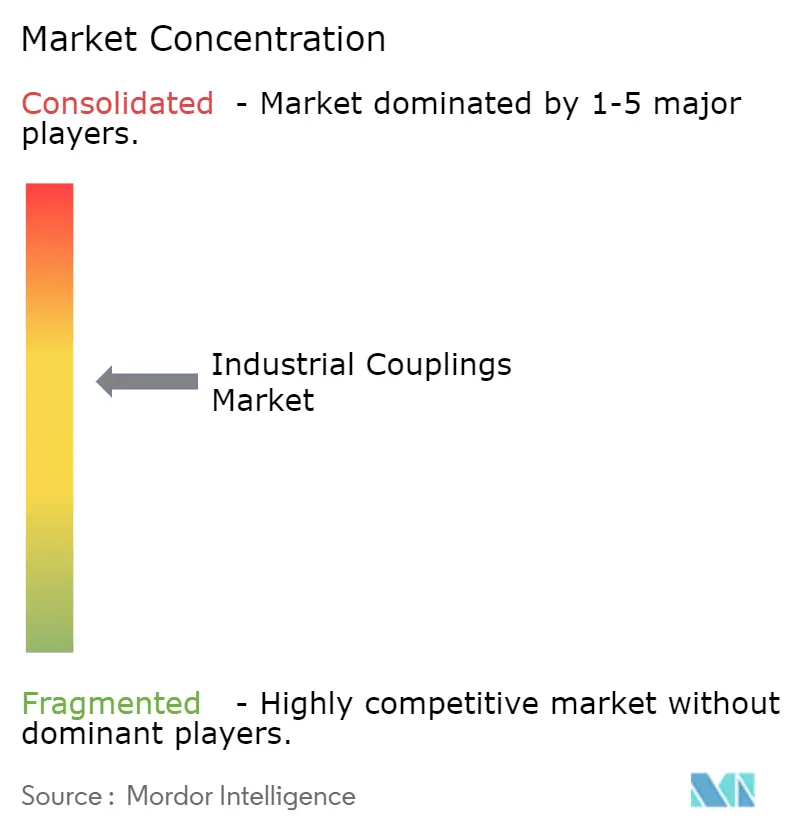
The industrial couplings market is moderately fragmented: the top five vendors, Altra Industrial Motion, Regal Rexnord, Siemens, ABB, and SKF, account for an estimated 35-40% of revenue. Tier-1 brands differentiate through embedded sensors and analytics platforms that convert hub telemetry into high-margin subscription services. Siemens secured patent EP3985276A1 covering a strain-gauge-infused coupling with wireless data streaming, illustrating the pivot toward “hardware plus software” business models. Mid-size firms such as Ringfeder or Ruland Manufacturing defend their share by delivering rapid customizations in under two weeks via additive manufacturing, undercutting larger competitors’ six-week cycles.
White-space opportunities lie in ultra-high-speed couplings tuned for 25,000 rpm electric-vehicle traction motors or aerospace actuators, both of which require G1.0 balance grades and torsional stiffness above 100,000 Nm per radian. Direct-drive solutions clip volume growth in low-torque commodity pumps and conveyors, driving incumbents to realign portfolios toward precision-demanding sectors like medical imaging and green hydrogen. Barriers to entry remain formidable: ISO 14691 and API 671 compliance testing can cost more than USD 2 million in capital equipment and extend certification timelines to 18 months, discouraging thin-capitalized challengers.
Supply-chain resilience programs also shape competition. Regal Rexnord’s USD 45 million capacity expansion in Wisconsin adds automated machining cells and inline machine-vision defect detection, reducing scrap by 15% and safeguarding lead times against raw-material shocks. Siemens and SKF integrate torque sensors and thermal arrays to forecast wear six to eight weeks in advance, cutting customer downtime by up to 35%. Partnerships such as ABB-Voith on offshore wind couplings pool motor and elastomeric expertise, accelerating time-to-market in high-megawatt turbines. Mergers, notably Altra’s purchase of Coupling Corporation of America, aim to secure high-torque intellectual property and broaden service footprints.
Industrial Couplings Industry Leaders
-
Altra Industrial Motion Corp.
-
Baker Hughes Company
-
Emerson Electric Co.
-
Siemens AG
-
ABB Ltd
- *Disclaimer: Major Players sorted in no particular order
Industrial Couplings Market Companies Covered in this Report
- Altra Industrial Motion Corp.
- Regal Rexnord Corporation
- KTR Systems GmbH
- Siemens AG
- ABB Ltd
- Emerson Electric Co.
- Baker Hughes Company
- SKF AB
- Lovejoy Inc.
- John Crane Ltd.
- Voith GmbH and Co. KGaA
- Renold PLC
- Ruland Manufacturing Co.
- Coupling Corporation of America
- Dodge Industrial Inc.
- Tsubakimoto Chain Co.
- VULKAN Group
- Lord Corporation
- Ringfeder Power Transmission
- Industrial Clutch Parts Ltd.
- Rexnord Kette GmbH
- Hauri Couplings
Market Opportunities and Future Outlook
A primary whitespace is in certified, application-specific couplings where compliance and qualification constrain the supplier set. Enforcement-phase shifts tied to the EU Machinery Regulation (EU) 2023/1230, along with broader use of ATEX-aligned specifications in hazardous and sealed services, increases the value of pre-certified product families, documented safety functions, and auditable quality systems. This shows up most clearly in collaborative automation cells and process-industry skids. Procurement behavior is also moving from spec-based purchasing toward certification-aligned sourcing, which reduces the pool of eligible mid-tier automation component suppliers. It creates space for vendors that can package documentation, test evidence, and traceability as part of the deliverable.
A second opportunity is the convergence of couplings with connected-maintenance stacks, where telemetry-ready designs can be treated as standard interfaces rather than custom retrofits. ODVA and FieldComm Group are advancing interoperable industrial communication standards that support device-level data integration, benefiting coupling vendors that embed sensing and expose usable health indicators to plant platforms. At the same time, supply-chain visibility mandates, including CBAM-linked carbon reporting, reward suppliers that can provide product-level emissions and material traceability. That differentiation can be meaningful in export-heavy regions and within multinational OEM qualification frameworks where compliance workflows are already part of supplier onboarding.
Recent Industry Developments in Industrial Couplings Market
- January 2026: ABB Q4 2025 results press release: record quarterly orders exceeding $10 billion for the first time. The surge points to strong demand for electrical and automation subsystems, highlighting opportunities for coupling products in robotics and motion control ecosystems. The momentum supports ABBs strategic emphasis on electrification and intelligent manufacturing, which may extend downstream use of industrial couplings.
- October 2025: Siemens AG launched SIRIUS 3RQ4 coupling relay series with 70% bio based plastic housing. The product upgrade improves sustainability credentials in coupling relays used for high-speed motion control. The update aligns with eco-friendly trends and strengthens Siemenss position in material-efficient electrical components.
- August 2025: Regal Rexnord Corp. and ABB Ltd collaboration to integrate Thomson Movotrak 7th Axis Cobot Transfer Units with ABB GoFa cobots. The alliance expands end-to-end automation offerings and increases the role of couplings in integrated robotics systems. The partnership also enhances service ecosystems and accelerates deployment of automated solutions across manufacturing lines.
Industrial Couplings Market Report Scope and Research Methodology
Market Definition and Coverage
This market covers industrial couplings used to connect rotating shafts and transmit torque in industrial equipment, including flexible and rigid designs used across general manufacturing, energy, and process industries. Values are measured as revenue generated from coupling product sales within the defined scope.
Scope exclusions: It excludes purely automotive driveline couplings, clutches and brakes sold as separate products, and standalone gearboxes or bearings that are not sold as couplings.
Segments Covered in This Report
- By Type
- Flexible Coupling
- Rigid Coupling
- Fluid Coupling
- Magnetic Coupling
- Universal Joint Coupling
- By Material
- Carbon Steel
- Stainless Steel
- Aluminum
- Composite Materials
- Other Materials
- By Torque Range
- Low (Below 500 Nm)
- Medium (500-5,000 Nm)
- High (Above 5,000 Nm)
- By End-user Industry
- Automotive
- Aerospace and Defence
- Oil and Gas
- Healthcare
- Metal and Mining
- Power Generation
- Food and Beverage
- Other End-user Industries
- By Distribution Channel
- OEM
- Aftermarket
- By Geography
- North America
- United States
- Canada
- Mexico
- Europe
- Germany
- United Kingdom
- France
- Russia
- Rest of Europe
- Asia-Pacific
- China
- Japan
- India
- South Korea
- Australia
- Rest of Asia-Pacific
- Middle East and Africa
- Middle East
- Saudi Arabia
- United Arab Emirates
- Rest of Middle East
- Africa
- South Africa
- Egypt
- Rest of Africa
- Middle East
- South America
- Brazil
- Argentina
- Rest of South America
- North America
Data Sources, Market Sizing, and Validation
Desk Research
Desk research starts with building a demand map for rotating equipment that uses couplings, then linking that demand to production, trade, and installation activity by region. We typically rely on public manufacturing and industrial production series (for example, national statistics offices and the World Bank), energy and power project indicators (such as EIA and IEA releases), and trade statistics (such as UN Comtrade) to see where equipment builds and replacements are concentrating.
To tighten assumptions, product and application references are taken from standards and engineering bodies (such as ISO and ASME publications), along with patent databases and peer reviewed mechanical engineering journals that indicate design shifts and material preferences. We also review company filings, investor presentations, and credible press coverage to capture channel structure and pricing commentary, then use paid subscriptions for company financials and news screening, plus shipment level import-export data where available to confirm directionality. These desk sources are illustrative, and we consulted many other references to collect data, validate it, and clarify open questions.
Primary Interviews and Surveys
Primary work is used to translate broader machinery activity into coupling-specific demand and to check what is actually shipped and replaced in the field. We speak with product managers, distributors, maintenance leaders, and engineering teams across major industrial regions so the model reflects replacement cycles, customer specification trends, and typical price bands by coupling type and torque range. Where secondary data is thin, these discussions help set realistic adoption rates by end use and reduce the risk of counting adjacent power transmission parts.
Distribution of primary research fieldwork respondents
| Company type | Respondent position | Region |
|---|---|---|
| Top tier: 38% | CXOs: 14% | APAC: 48% |
| Mid tier: 45% | Functional/Unit leaders: 32% | EMEA: 32% |
| Smaller Players: 17% | Managers: 54% | Americas: 20% |
Market-Sizing & Forecasting
Sizing is built using a top-down and bottom-up model logic, where industrial equipment build, installed base, and maintenance activity are translated into coupling demand pools by end use, then valued using typical price ranges. After shaping the demand pool, we run selective bottom-up checks using supplier revenue splits, distributor mix indicators, and sampled ASP to volume approximations so the totals stay grounded.
Key inputs used in the model include industrial production trends, capital spending signals in heavy industry, installed base growth for pumps, compressors, conveyors, and turbines, typical replacement intervals linked to downtime and vibration exposure, and design substitution signals (such as shifts between elastomer, metallic, and composite options). Because pricing can vary across torque range and application criticality, we apply region-specific pricing progression, then run channel checks to confirm that the direction of ASP movement is consistent.
For forecasting, we use scenario analysis supported by short time-series smoothing for cyclical end markets, then adjust assumptions using expert views on plant utilization, energy project pipelines, and maintenance budgeting behavior. When bottom-up checks show gaps (for example, limited visibility into smaller regional distributors), the model uses conservative proxy ratios based on comparable regions, and we retest them during primary follow-ups.
Data Validation & Update Cycle
Validation is done in steps so unusual outcomes are identified early and corrected with evidence. We compare modeled totals against independent signals like machinery output, trade movements for power transmission components, and reported revenue direction for relevant product lines, then investigate any variance that falls outside expected ranges.
Before sign-off, assumptions are reviewed by another analyst and the model logic is rechecked for double counting between OEM and aftermarket routes. If a key input shifts materially, such as a swing in industrial production, energy project timing, or major pricing changes, respondents are re-contacted and the model is rerun. Reports are refreshed annually, with interim updates for material events, and an analyst performs a final pre-delivery pass so clients receive the latest view.
Mordor Intelligence's Industrial Couplings Market Estimate Compared With Other Published Estimates
Published market sizes for industrial couplings can look far apart because the scope line is not drawn the same way across studies, and because pricing and replacement assumptions are handled differently. Differences also come from whether a study sizes only coupling products, or folds in adjacent power transmission parts, and whether the time window is an industrial rebound year or a softer cycle.
Import-export direction checks and installed base linked replacement signals are the evidence used to keep Mordor Intelligence's 2026 value tied to coupling-only revenue, which avoids pulling in bearings, gearboxes, and broader driveline content. The spread in other figures usually reflects broader definitions, faster ASP escalation in forecasts, and less frequent refresh cycles that may miss recent changes in industrial capex and maintenance spending.
Benchmark comparison
| Source | Market Size | Gaps in Research Methodology |
|---|---|---|
| Mordor Intelligence | USD 0.40 B (2026) | |
| Global Data Publisher A | USD 4.20 B (2024) | This figure appears to use a wider product boundary that can bundle industrial couplings with general power transmission components, and it also uses an earlier base year that can shift the total due to cycle timing. |
| Global Catalog Publisher B | USD 21.19 B (2024) | This estimate likely reflects a broad sales classification for "industrial coupling" that may include multiple coupling-like categories and related driveline products, and it may not remove channel overlap between OEM and aftermarket routes. |
Taken together, the table suggests the main driver of disagreement is market definition control and how adjacent components are treated in the total. By keeping inputs linked to observable equipment activity, realistic replacement behavior, and practical price bands, the resulting market value stays traceable to repeatable steps year after year.
Key Questions Answered in the Report
What is the projected value of the industrial couplings market by 2031?
The market is forecast to reach USD 613.87 million by 2031 on the back of a 9.11% CAGR.
Which coupling type is growing the fastest through 2031?
Magnetic couplings are advancing at a 10.22% CAGR due to their hermetic, zero-leakage operation.
Why are composites gaining traction in coupling construction?
Composite hubs reduce rotating weight by about 40%, improving acceleration and energy efficiency in aerospace, robotics, and medical equipment.
How is predictive maintenance changing aftermarket dynamics?
Sensor-enabled hubs stream torque and vibration data, allowing AI platforms to schedule replacements ahead of failure, which is boosting aftermarket revenue at a 9.54% CAGR.
Which region offers the highest growth potential for suppliers?
The Middle East, led by mega-projects like NEOM and large LNG expansions, is expected to grow at roughly 10.17% CAGR through 2031.
What competitive strategy are leading vendors adopting to differentiate?
Top players embed IoT sensors in couplings and monetize data analytics subscriptions, securing higher margins than hardware sales alone.