
Market Overview
| Study Period | 2020 - 2031 |
|---|---|
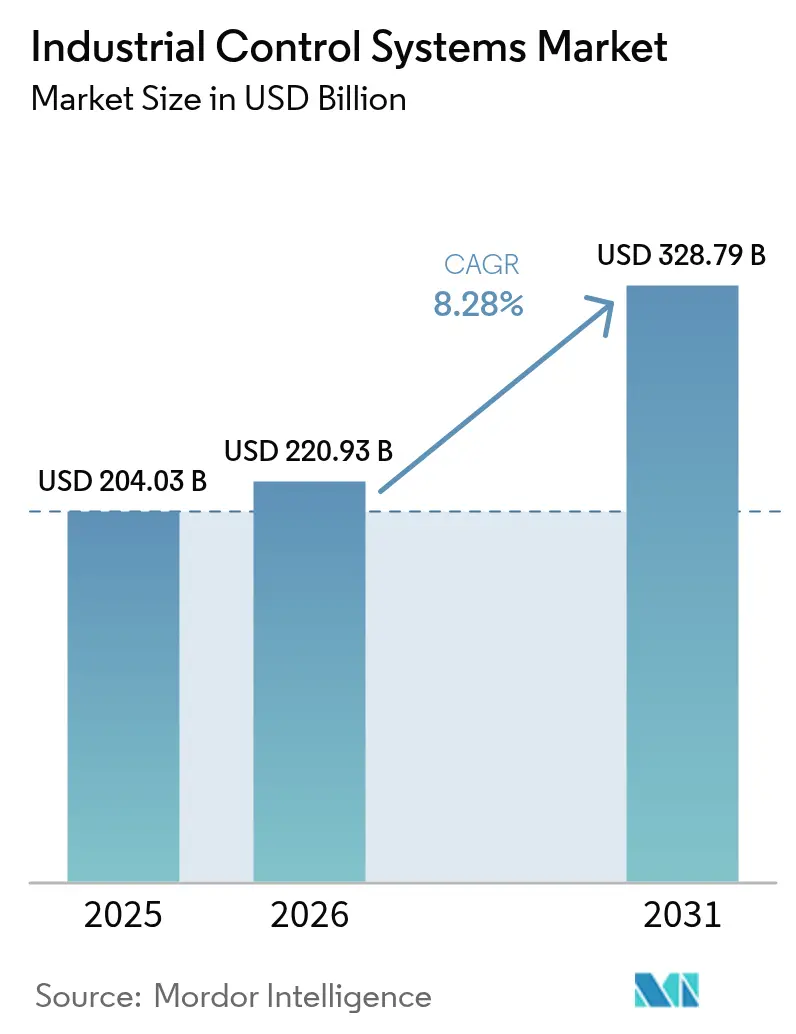
| Market Size (2026) | USD 220.93 Billion |
| Market Size (2031) | USD 328.79 Billion |
| Growth Rate (2026 - 2031) | 8.28 % |
| Fastest Growing Market | Asia Pacific |
| Largest Market | Europe |
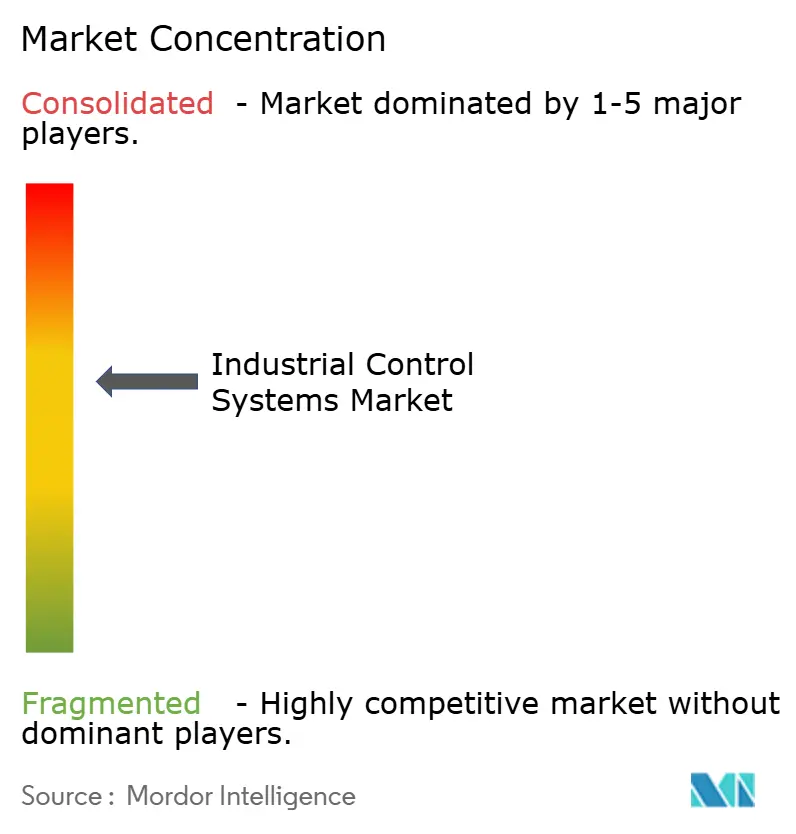
| Market Concentration | Medium |
Major Players *Disclaimer: Major Players sorted in no particular order Image © Mordor Intelligence. Reuse requires attribution under CC BY 4.0. | |
Industrial Control Systems Market Analysis by Mordor Intelligence
industrial control systems market size in 2026 is estimated at USD 220.93 billion, growing from 2025 value of USD 204.03 billion with 2031 projections showing USD 328.79 billion, growing at 8.28% CAGR over 2026-2031. Accelerated digitalization under Industry 4.0, mounting cybersecurity obligations, and the growing appeal of open, vendor-neutral architectures are reinforcing automation as an operational cornerstone rather than an efficiency add-on. Heightened supply-chain risk during the 2024 semiconductor squeeze underscored the value of software-defined control platforms that detach functionality from dedicated hardware, while government incentives in Europe and North America widened the capital pool for retrofit projects. Cloud, edge, and on-premise deployments now coexist as manufacturers seek analytics at scale without surrendering low-latency process control. Competitive positioning increasingly favors vendors that combine interoperable hardware with AI-enabled software and integrated security, especially in high-precision sectors such as electronics and life sciences.
Key Report Takeaways
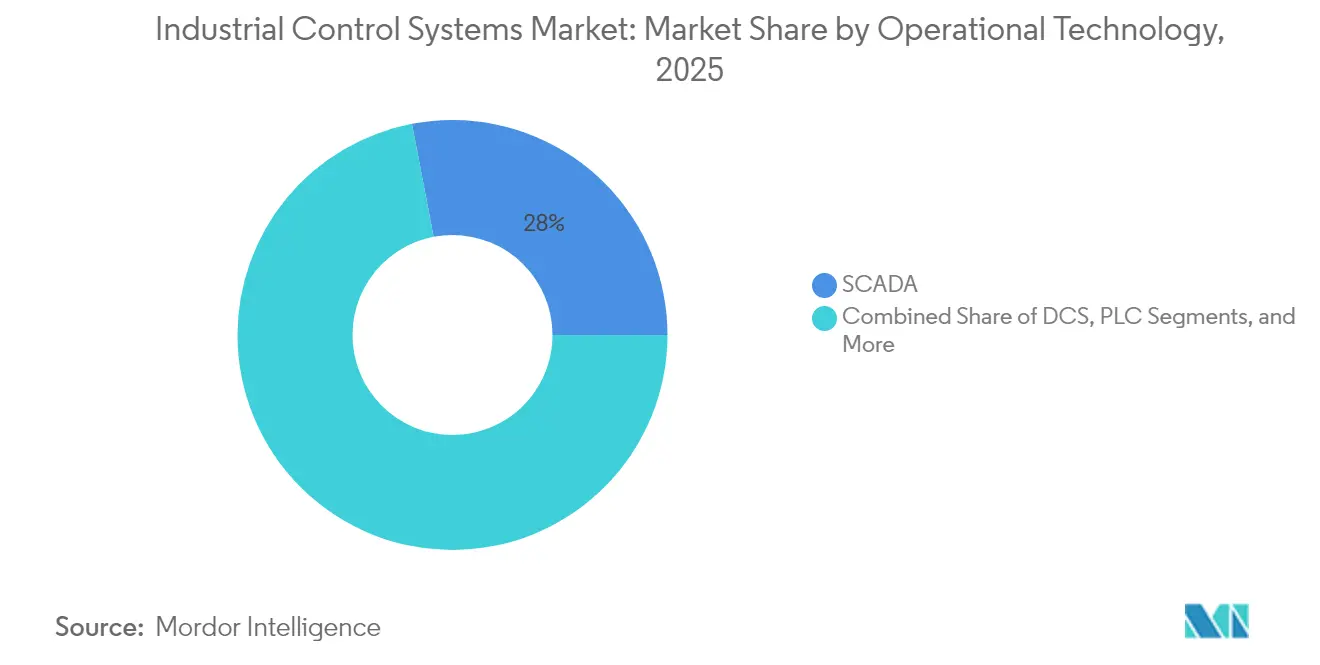
- By operational technology, SCADA held 28.02% of industrial control systems market share in 2025, while edge-enabled PLCs are forecast to expand at 11.24% CAGR through 2031.
- By software, Asset Performance Management led with 23.18% revenue share in 2025; industrial cybersecurity platforms record the highest projected CAGR at 12.55% to 2031.
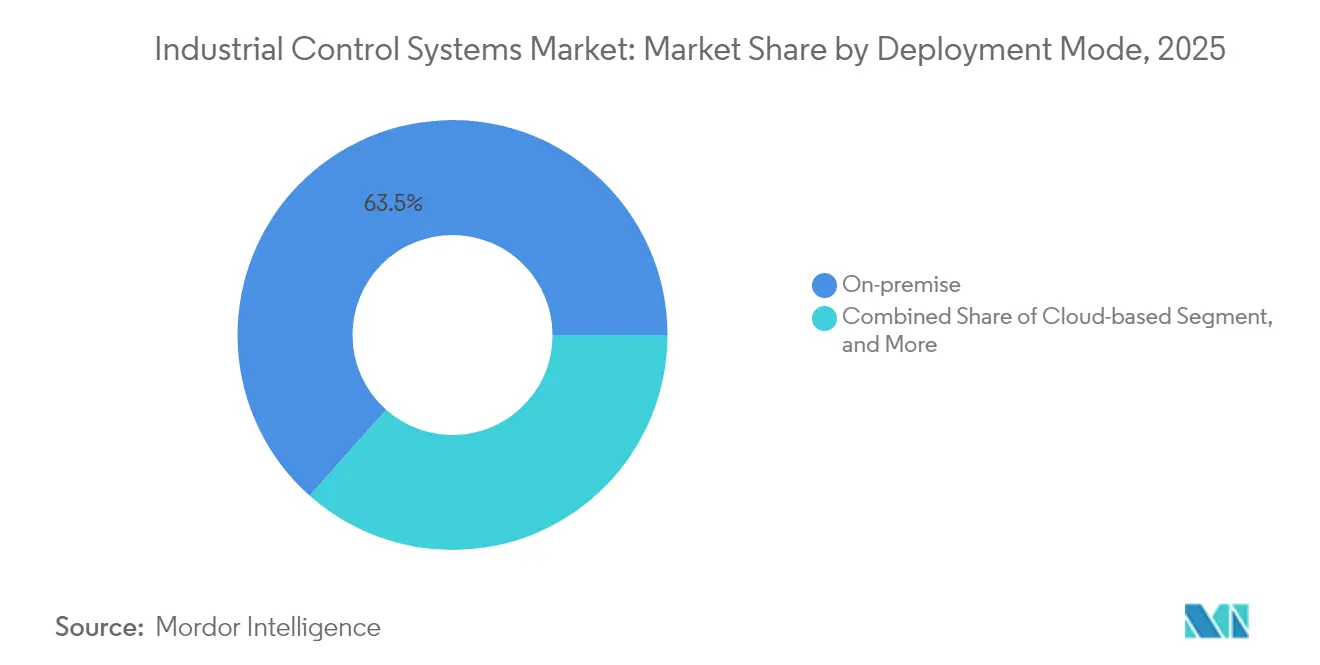
- By deployment mode, on-premise systems accounted for 63.45% of revenue in 2025, whereas cloud-based deployments are set to rise at 13.09% CAGR.
- By end-user industry, oil & gas commanded 25.05% share in 2025; electronics & semiconductor manufacturing is advancing at 12.47% CAGR to 2031.
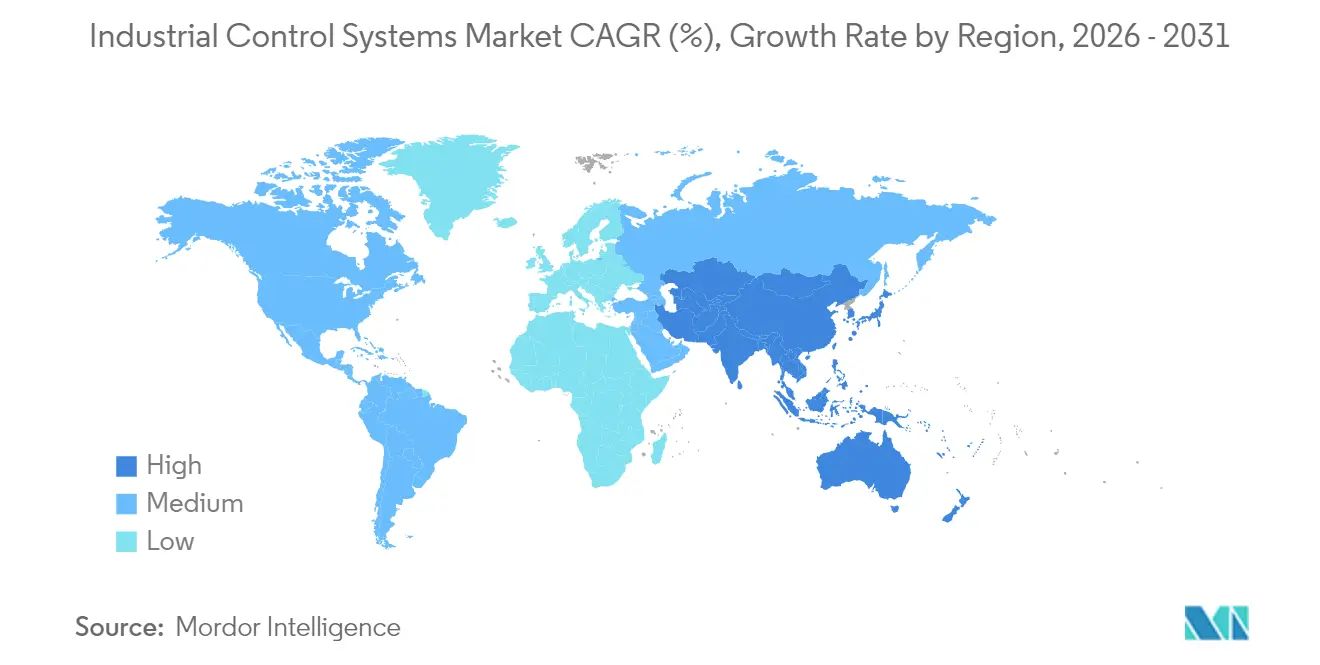
- By geography, Europe led with 28.12% share in 2025, while Asia-Pacific is the fastest-growing region at 10.12% CAGR through 2031.
Note: Market size and forecast figures in this report are generated using Mordor Intelligence’s proprietary estimation framework, updated with the latest available data and insights as of 2026.
Market Trends and Insights
Drivers Impact Analysis of Industrial Control Systems Market*
| Driver | (~) % Impact on CAGR Forecast | Geographic Relevance | Impact Timeline |
|---|---|---|---|
| Industry 4.0 roll-outs accelerating plant-wide automation | +2.1% | Global, with concentrated gains in Germany, US, China | Medium term (2-4 years) |
| Growing emphasis on industrial safety and functional-safety compliance | +1.8% | Europe & North America core, spill-over to APAC | Long term (≥ 4 years) |
| Surge in demand for real-time data-driven mass-customisation | +1.5% | Global, with early gains in automotive and electronics hubs | Short term (≤ 2 years) |
| Government incentives for smart-factory retrofits | +1.2% | Europe, North America, selective APAC markets | Medium term (2-4 years) |
| Open Process Automation (O-PAS) architecture gaining traction | +0.8% | Global, with early adoption in oil & gas and chemicals | Long term (≥ 4 years) |
| Shift to "OT-as-a-Service" edge platforms | +0.7% | North America & Europe core, expanding to APAC | Medium term (2-4 years) |
| Source: Mordor Intelligence | |||
Industry 4.0 Roll-outs Accelerating Plant-wide Automation
Manufacturers are extending automation from isolated lines to enterprise-wide networks that merge operational, engineering, and business data. AI-ready edge nodes such as Siemens SINUMERIK ONE now execute predictive maintenance and adaptive feed-rate control directly on the machine floor, shrinking decision latency.[1] Broader connectivity generates compound value, which explains why average OT budgets grew 30% in 2025 despite macro headwinds. As a result, interoperable offerings are edging out proprietary point products, reshaping competitive dynamics across the industrial control systems market.
Growing Emphasis on Industrial Safety and Functional-Safety Compliance
Industrial regulations are converging around dual mandates of safety integrity (IEC 61508/61511) and cybersecurity resilience (IEC 62443). Tools such as Siemens SIBERprotect isolate compromised assets within milliseconds while keeping safety loops intact, making certified safety PLCs and secure communication protocols indispensable. With CISA releasing 24 advisories on OT vulnerabilities in 2024, buyers now factor cyber-safety credentials into capital planning, nudging the industrial control systems market toward vendors that offer natively integrated capabilities.
Surge in Demand for Real-time Data-driven Mass-customisation
As high-mix, low-volume production becomes the norm, plants require modular cells that can swap product variants via software. Virtual commissioning using Rockwell Automation’s Emulate3D tied to NVIDIA Omniverse allows engineers to stress-test automation before hardware arrives, slashing changeover time.[2] The capability to reconfigure lines overnight is emerging as a purchase trigger, driving incremental spend across the industrial control systems market.
Government Incentives for Smart-factory Retrofits
Public funding now targets specific digital stack components. Germany’s Manufacturing-X scheme channels EUR 150 million (USD 161 million) into shared data-spaces that favor open standards over proprietary ecosystems.[3] Similarly, the US CHIPS Manufacturing USA Institute commits USD 200 million to semiconductor digital twins. Such programs de-risk adoption and allow suppliers to frame ROI beyond traditional cost-savings narratives.
Restraints Impact Analysis of Industrial Control Systems Market*
| Restraint | (~) % Impact on CAGR Forecast | Geographic Relevance | Impact Timeline |
|---|---|---|---|
| Shortage of skilled OT/ICS engineers | -1.4% | Global, with acute impact in North America and Europe | Long term (≥ 4 years) |
| High capex and long pay-back periods | -0.9% | Global, with concentrated impact on SMEs | Medium term (2-4 years) |
| Semiconductor lead-time volatility disrupting controller supply | -0.6% | Global, with severe impact on Asia-Pacific manufacturing | Short term (≤ 2 years) |
| Legacy-system integration complexity | -0.5% | Global, with concentrated impact on mature industrial regions | Medium term (2-4 years) |
| Source: Mordor Intelligence | |||
Shortage of Skilled OT/ICS Engineers
Deloitte estimates 1.9 million US manufacturing roles may go unfilled by 2033, many requiring hybrid IT-OT skills. Scarcity inflates labor costs and prolongs commissioning cycles, prompting vendors to bundle managed services and low-code configuration to soften onboarding friction.
High Capex and Long Pay-back Periods
Full-stack automation retrofits often demand dual operations during cut-over, doubling equipment exposure and stretching ROI horizons. Semiconductor shortages in 2024 pushed controller lead-times past 50 weeks, elevating working capital requirements. Vendors that can stage deployments or price via consumption models gain an edge with capital-constrained buyers.
*Our forecasts treat driver/restraint impacts as directional, not additive. The impact forecasts reflect baseline growth, mix effects, and variable interactions.
Industrial Control Systems Market Segment Analysis
By Operational Technology:
Edge Intelligence Reshapes HierarchiesSCADA platforms retained a 28.02% slice of the industrial control systems market in 2025, yet their centralized approach is being contested by edge-enabled PLCs that are posting 11.24% CAGR through 2031. The influx of micro-AI chips allows PLCs to process condition-monitoring and quality-inspection workloads locally, reducing data backhaul and network congestion. In oil & gas and chemicals, Distributed Control Systems still govern continuous processes, but customers are layering predictive algorithms over legacy DCS to extend asset life. Human-Machine Interfaces have evolved into decision-support consoles incorporating AR overlays for on-the-spot troubleshooting. Intelligent Electronic Devices are gaining traction in utilities as grid operators pursue faster fault isolation. Across these use cases, the industrial control systems market rewards suppliers that embed open APIs, enabling plant managers to mix best-of-breed components without vendor lock-in.
With SCADA still contributing USD 57.18 billion to industrial control systems market size in 2025, upgrade cycles center on container-based micro-services that keep supervisory layers intact while injecting analytics. Meanwhile, pilot programs in discrete manufacturing show edge PLC clusters trimming unplanned downtime by up to 20%, accelerating payback. Vendors able to harmonize lifecycle services for both centralized and distributed architectures are expected to capture disproportionate share.

By Software:
Cybersecurity Gains Momentum beside APM DominanceAsset Performance Management generated 23.18% of 2025 revenue as plants chase overall equipment effectiveness and schedule-free maintenance. Looking ahead, cybersecurity suites are set to outpace all other categories at 12.55% CAGR, a reaction to increased ransomware targeting OT assets. Integrated offerings that fuse vulnerability scanning, zero-trust segmentation, and safety-PLC hardening resonate with risk-averse sectors such as pharmaceuticals. Manufacturing Execution Systems now bundle quality analytics and electronic batch records, while Product Lifecycle Management tools couple with digital twins to bridge design and production. ERP vendors are exposing OT data models via REST APIs, feeding demand-driven planning algorithms. The industrial control systems market is therefore tilting toward platforms that orchestrate cross-domain data rather than discrete modules.
Industrial cyber platforms, forecast to exceed USD 15.26 billion in industrial control systems market size by 2031, are attracting venture funding and prompting established vendors to buy niche specialists. Suppliers competent in synchronizing APM, MES, and cyber layers position themselves as single-throat-to-choke partners for digital transformation roadmaps.
By Deployment Mode:
Hybrid Architectures Take Center StageOn-premise installations still generate 63.45% of segment revenue because many operators prioritize deterministic latency and IP control. However, cloud services are rising at 13.09% CAGR as firms offload data-lake management and model training to hyperscalers. Edge nodes mediate the two realms, executing sub-20 millisecond control loops locally while passing aggregated insights to the cloud. Private 5G networks amplify this design by offering predictable bandwidth, enabling mobile robots and wearable HMIs. For brownfield sites, vendors now market micro-data-centers that retrofit into existing control rooms, providing a stepping-stone to hybrid rollouts. As cybersecurity postures mature, segment leaders will monetize subscription analytics layered atop perpetual on-premise licences, driving recurring revenue within the industrial control systems market.
Cloud-hosted analytics tied to USD 30 billion of industrial control systems market size could eclipse on-premise growth by 2028 if data-residency concerns ease, highlighting the strategic importance of sovereign-cloud partnerships.
By End-user Industry:
Electronics Fab Leads Automation IntensityOil & gas retained 25.05% revenue leadership due to continuous-process complexity and hazardous conditions that necessitate advanced control. Yet electronics and semiconductor fabs are scaling expenditure at 12.47% CAGR, motivated by nanometer-level tolerances and clean-room yields. Chemical producers remain avid adopters of model-predictive control to squeeze efficiency from thin margins, while utilities digitize substations for distributed energy integration. Automotive plants, grappling with ICE-to-EV transitions, favor modular conveyor cells programmable for mixed-model output. Life sciences manufacturers deploy closed-loop environmental controls to meet regulatory validation. Each vertical values domain templates embedded in vendor libraries, minimizing commissioning overhead. Consequently, vendors are tailoring verticalized reference architectures, a trend that will re-shape account segmentation across the industrial control systems industry.
Electronics fabs alone are on track to contribute USD 44.58 billion to industrial control systems market size by 2031, underscoring why suppliers are opening dedicated semiconductor centers of excellence in Asia and North America.
Geography Analysis
Europe Industrial Control Systems Market
Europe steers 28.12% of 2025 revenue, driven by rigorous functional-safety statutes and sustainability mandates that reward high-efficiency automation. Funding schemes such as Manufacturing-X distribute EUR 150 million (USD 161 million) to projects that emphasize data sovereignty, giving domestic vendors an early-mover edge. Capital projects increasingly bundle carbon-footprint dashboards, aligning with the EU’s Green Deal reporting. Eastern European clusters act as near-shore capacity for Western OEMs, stimulating incremental demand for mid-tier control gear.
APAC Industrial Control Systems Market
Asia-Pacific, advancing at 10.12% CAGR, benefits from large-scale capacity expansions in electronics, EV batteries, and renewable components. China’s demographic headwinds and wage inflation accelerate factory automation, while Southeast Asian nations leverage tax incentives to lure reshoring projects. Domestic PLC and robot suppliers are gaining share, but multinational incumbents retain dominance in high-end safety and motion solutions. Government cyber rules, notably China’s Critical Information Infrastructure law, push buyers toward products with verifiable security lineage, shaping procurement shortlists.
North America Industrial Control Systems Market
North America sustains momentum through reshoring initiatives and the CHIPS Act’s USD 200 million digital-twin program. Energy transition spending in the US Gulf Coast is spawning demand for open-process automation to retrofit LNG, hydrogen, and CCS facilities. Canada’s NGen USD 35 million sustainable manufacturing challenge propels SME adoption of modular control kits. Heightened cyber directives from CISA elevate procurement specifications, giving advantage to suppliers with IEC 62443 certifications. Collectively, these trends keep the industrial control systems market on a diversified regional growth footing.
Regulatory Landscape
Industrial control systems deployments increasingly operate under explicit cyber and supply-chain compliance duties, particularly in critical infrastructure. In the United States, NIST SP 800-82 Revision 3 remains a key reference for securing OT/ICS environments, while the bulk electric system continues to tighten enforceable requirements through NERC CIP updates approved through the Federal Energy Regulatory Commission (FERC). These include CIP-003-11 (approved March 24, 2026) for low-impact BES cyber systems and the updated supply chain risk management standard CIP-013-4 (finalized April 28, 2026). The measures reinforce procurement expectations around asset inventory, access control, monitoring, and vendor risk controls, which then shape PLC, SCADA, and DCS hardening and lifecycle patching practices.
In Europe, the EU Cyber Resilience Act entered into force on December 10, 2024, introducing product-level cybersecurity obligations that extend to ICS components sold as digital products. A near-term compliance milestone is the start of vulnerability reporting obligations from June 2026, which raises expectations for secure-by-design engineering, coordinated vulnerability disclosure, and post-market support processes among control system OEMs and industrial software providers. Across regions, the IEC 62443 series continues to function as the dominant technical framework for IACS cybersecurity, increasingly used to translate policy requirements into concrete security development lifecycle and deployment controls.
Value Chain Analysis
The industrial control systems value chain starts with semiconductor and electronics inputs (processors, memory, connectivity modules) and embedded software and toolchains, which then feed OEM manufacturing of controllers and software platforms (PLCs, DCS, SCADA, HMIs, and industrial software). After certification, distribution, and implementation, system integrators are central to delivery for many projects, bundling design, installation, migration, and lifecycle services across brownfield estates. This integration role is amplified by the OT skills shortage and the need to reconcile safety, cybersecurity, and uptime constraints during cutovers. The 2024 semiconductor lead-time volatility highlighted exposure at the controller and I/O layer, reinforcing buyer interest in architectures that decouple control applications from dedicated hardware and reduce single-component bottlenecks.
Downstream, value increasingly concentrates in software, cybersecurity, and managed lifecycle services layered over installed hardware. Standards-driven compliance, notably IEC 62443-aligned practices, and critical-infrastructure expectations shape buying criteria. Trade and policy actions also affect integration economics, as tariffs and component cost spikes can disrupt fixed-bid controls integration programs and shift sourcing strategies toward regionalized supply chains. Hyperscalers, industrial edge ecosystems, and partner marketplaces influence platform selection, while end users weigh vendor and integrator capabilities in patch management, asset visibility, secure remote access, and supply-chain assurance.
Competitive Landscape
The market shows moderate concentration as the top five suppliers account for roughly 55% of revenue, yet open-standard tailwinds enable niche players to punch above their weight. Incumbents such as Siemens, ABB, Rockwell Automation, Schneider Electric, and Honeywell are pivoting from hardware moats to software ecosystems, investing heavily in AI engines and digital-thread integration. Rockwell’s tie-up with NVIDIA embeds physics-based simulation into controls design, shaving months off factory-acceptance testing. Siemens deepens alliances with DMG MORI and Renishaw to tether machine-tool digital twins to in-process metrology, driving closed-loop quality. ABB’s purchase of Siemens Gamesa’s power-electronics line expands its grid-edge footprint, complementing its forthcoming robotics IPO.
Disruptors leverage open-process automation to insert specialized modules—cyber micro-gateways, real-time middleware, or sustainability optimizers—into brownfield estates. ExxonMobil’s first-of-a-kind O-PAS deployment validates multi-vendor interoperability, prompting conservative sectors such as chemicals to re-evaluate procurement criteria. Venture funding flows to firms offering low-code OT-as-a-Service, compressing deployment cycles for SMEs. Strategic collaborations proliferate; Komatsu partners with ABB to hybridize mining equipment, while Sick and Endress+Hauser pool sensor know-how to accelerate turnkey process skids.
Competitive differentiation increasingly hinges on lifecycle services that mitigate the global OT skills deficit. Vendors extend remote diagnostics, cyber-patch orchestration, and AI model retraining as managed offerings. Those demonstrating quantified sustainability gains—energy cutbacks, waste minimization—win board-level sponsorships. As a result, the industrial control systems market is transitioning from product-centric sales toward outcome-based engagements, pressuring laggards to refresh business models.
Industrial Control Systems Industry Leaders
-
Siemens AG
-
Omron Corporation
-
Honeywell International Inc.
-
Rockwell Automation Inc.
-
ABB Ltd.
- *Disclaimer: Major Players sorted in no particular order
Industrial Control Systems Market Companies Covered in this Report
- Siemens AG
- ABB Ltd.
- Rockwell Automation Inc.
- Schneider Electric SE
- Honeywell International Inc.
- Emerson Electric Co.
- Yokogawa Electric Corporation
- Mitsubishi Electric Corporation
- Omron Corporation
- GE Digital (General Electric Co.)
- Bosch Rexroth AG
- Phoenix Contact GmbH
- Beckhoff Automation GmbH
- Hitachi Ltd.
- Delta Electronics Inc.
- Advantech Co., Ltd.
- Johnson Controls International plc
- Fortinet Inc. (ICS-cybersecurity)
- Palo Alto Networks Inc. (ICS-cybersecurity)
- ICS-Secure LLC
Market Opportunities and Future Outlook
Compliance-driven security modernization is creating near-term whitespace for industrial cybersecurity platforms and services that map directly to the standards and directives used by buyers. The EU Cyber Resilience Act, with vulnerability reporting obligations beginning in June 2026, is raising demand for secure-by-design product engineering, coordinated vulnerability disclosure workflows, and long-term patch support across ICS vendors and industrial software suppliers. In the United States, the continued tightening of bulk electric system requirements through NERC CIP standards, including FERC approval of CIP-003-11 in March 2026 and the finalized CIP-013-4 supply chain standard in April 2026, supports opportunities for certified network segmentation, monitoring, and vendor risk management tooling that can be deployed without destabilizing production.
A second opportunity pocket is the shift toward software-defined and multi-vendor, IT-OT connected architectures that reduce retrofit friction in brownfield sites while enabling scalable analytics. Named market signals include Siemens partnering with Databricks and FFT (July 2026) to connect shop-floor data to enterprise AI via FFT DataBridge, supporting cloud training with edge execution. The release of ANSI/ISA-112.00.01-2025 (published February 2026) to standardize SCADA lifecycle and architectural terminology also supports more repeatable modernization playbooks for owners and integrators. Alongside Open Process Automation momentum in process industries, these developments favor vendors and integrators offering container-friendly control, edge data management, and interoperable connectivity stacks that can shorten commissioning cycles and reduce dependence on proprietary middleware.
Recent Industry Developments in Industrial Control Systems Market
- March 2026: Siemens announced a verified cybersecurity solution for industrial private 5G networks in collaboration with Palo Alto Networks, combining industrial connectivity with next-generation firewall capabilities. The move supports secure OT mobility and segmentation use cases as plants adopt private 5G for latency-sensitive operations and remote access. It also raises the competitive bar for vendors bundling connectivity with security controls aligned to industrial cybersecurity expectations.
- March 2026: Honeywell commercially launched Experion Operations Assistant, an AI-powered control room assistant that combines historical context with real-time operational insights for operators. The release advances human-in-the-loop decision support within DCS and control room workflows, strengthening how analytics connect to operator actions. It also strengthens Honeywell's positioning in autonomy-oriented upgrades that can be deployed as software-led enhancements to installed control systems.
- September 2025: Omron launched the Sysmac-Edge DX1 Data Flow Controller to accelerate factory-floor data collection, analysis, and visualization at the edge. This expands the addressable base for modernization projects that need device-level connectivity and contextualization without a full control system replacement. It also reinforces demand for edge controllers that bridge OT protocols with higher-level applications and analytics stacks.
Industrial Control Systems Market Report Scope and Research Methodology
Market Definition and Coverage
This market is defined as the revenues generated from industrial control systems used to monitor, control, and automate industrial operations across process and discrete industries, including control hardware and related control software sold for industrial use.
Scope exclusions: We exclude general IT office software and non-industrial consumer automation products that are not sold for industrial process or plant control.
Segments Covered in This Report
- By Operational Technology
- Supervisory Control and Data Acquisition (SCADA)
- Distributed Control System (DCS)
- Programmable Logic Controller (PLC)
- Intelligent Electronic Devices (IED)
- Human-Machine Interface (HMI)
- Other Systems
- By Software
- Asset Performance Management (APM)
- Product Lifecycle Management (PLM)
- Manufacturing Execution System (MES)
- Enterprise Resource Planning (ERP)
- Industrial Cyber-security Platforms
- Other Software
- By Deployment Mode
- On-premise
- Cloud-based
- Edge / Hybrid
- By End-user Industry
- Oil and Gas
- Chemical and Petrochemical
- Power and Utilities
- Food and Beverages
- Automotive and Transportation
- Life Sciences
- Water and Wastewater
- Metal and Mining
- Pulp and Paper
- Electronics and Semiconductor
- Other End-user Industries
- By Geography
- North America
- United States
- Canada
- Mexico
- Europe
- Germany
- United Kingdom
- France
- Rest of Europe
- Asia-Pacific
- China
- India
- Japan
- Rest of Asia-Pacific
- South America
- Brazil
- Argentina
- Rest of South America
- Middle East
- United Arab Emirates
- Saudi Arabia
- Rest of Middle East
- Africa
- South Africa
- Nigeria
- Rest of Africa
- North America
Data Sources, Market Sizing, and Validation
Desk Research
Desk research was used to build the basic industry map and to collect measurable signals that can be tracked every year. We typically rely on public sources such as the US Energy Information Administration for power sector indicators, the US Census Bureau for manufacturing data, Eurostat for industrial production series, and the International Energy Agency for energy and industry outlooks. For context on industrial automation standards and terminology, sources such as IEC publications and NIST guidance were also reviewed, along with selected peer-reviewed journals covering control engineering and industrial networks.
To convert these signals into a usable sizing model, we also reviewed company annual reports, investor presentations, and product documentation to understand where revenues sit across OT systems and software layers. In a few places, paid database subscriptions were used for company financials, patent landscaping, and shipment and trade level checks, particularly when public disclosures were uneven across regions. The desk sources listed above are illustrative only, and many additional public sources were used to collect data, validate assumptions, and clarify gaps.
Primary Interviews and Surveys
Primary interviews and surveys were carried out with a mix of control system suppliers, system integrators, industrial software specialists, and end users across process and discrete industries. Discussions focused on typical replacement cycles, deployment choices (on-premise versus cloud or edge-hybrid), and how pricing and bundling behave for core OT systems and adjacent software. Because this is a global market, we balanced input across APAC, EMEA, and the Americas so assumptions were not driven by one region or one industry alone.
Distribution of primary research fieldwork respondents
| Company type | Respondent position | Region |
|---|---|---|
| Top tier: 27% | CXOs: 19% | APAC: 44% |
| Mid tier: 52% | Functional/Unit leaders: 32% | EMEA: 37% |
| Smaller Players: 21% | Managers: 49% | Americas: 19% |
Market-Sizing & Forecasting
Sizing starts with a top-down build where industrial activity by region is reconstructed into an addressable control spend pool, and then split by control system adoption and typical mix across major end-user industries. We then corroborate totals using selective bottom-up checks, such as sampled supplier revenue splits, channel and integrator feedback, and a simple ASP times shipment or deployment volume logic for key OT categories.
Key inputs that were tracked in the model include industrial production and manufacturing output trends, power generation and grid investment signals, brownfield modernization and replacement cycle timing, the share of plants moving to connected architectures (including edge or hybrid deployments), and software attach rates for layers like MES and APM. Where direct disclosure was missing, gaps were handled using peer-group proxies and region-level weighting, followed by rechecking the implied per-site spend with interview feedback so the output stayed realistic.
For forecasting, we leaned on scenario analysis supported by a light regression check using industrial output and capital spending indicators, and then adjusted the path based on expert views on automation investment timing and the pace of software adoption. Assumptions were kept transparent so changes in a few drivers, like faster cloud adoption or slower replacement cycles, could be traced into the market totals.
Data Validation & Update Cycle
Validation was done through repeated triangulation across the model, desk signals, and primary feedback, with variance checks at the region, industry, and system-type level. When an output looked out of line, it was traced back to the driver causing it, and then the underlying assumption was revisited before sign-off.
A multi-step review is followed internally so calculations, unit conversions, and scope logic are checked by another analyst before finalization. Reports are refreshed annually, and interim updates are made when material events shift demand or pricing assumptions. Before delivery, a final pass is completed to ensure the latest public indicators and any new interview insights are reflected.
Mordor Intelligence's Industrial Control Systems Market Market Size Compared With Other Published Estimates
It is common to see different market sizes published for industrial control systems, even when the topic label looks the same. The gaps usually come from how each study draws the line around what counts as an industrial control system, which year is treated as the starting point, and how software layers and services are handled.
By tracking deployment-mode shifts, software attach rates, and end-user investment timing, Mordor Intelligence keeps the value tied to defined OT systems plus specific industrial software layers (rather than folding in broad industrial automation categories), which is a frequent reason the published totals spread.
Benchmark comparison
| Source | Market Size | Gaps in Research Methodology |
|---|---|---|
| Mordor Intelligence | USD 220.93 B (2026) | |
| Global Consultancy A | USD 193.12 B (2024) | Uses an earlier base year and a broader component list, and it appears to mix some adjacent automation hardware with core control systems, which can shift totals depending on what is treated as ICS. |
| Trade Publisher B | USD 154.30 B (2023) | Starts from a different base year and groups the market using solution and service buckets, which can undercount software layers like MES or APM when they are not consistently included inside the control system boundary. |
Overall, the spread is mainly explained by boundary choices and year selection, followed by how software and services are attached to OT platforms. Our approach stays repeatable because the totals are built from visible industrial activity signals, checked with practical pricing and adoption inputs, and then reviewed for outliers before release.
Key Questions Answered in the Report
What is the current value of the industrial control systems market?
The market was valued at USD 220.93 billion in 2026 and is forecast to reach USD 328.79 billion by 2031.
Which operational technology segment is expanding fastest?
Edge-enabled PLCs lead growth at 11.24% CAGR through 2031.
Why is cybersecurity spending rising in industrial automation?
Increased OT-focused ransomware and dual safety-cyber compliance requirements push cybersecurity platforms to 12.55% CAGR.
Which region shows the strongest growth outlook?
Asia-Pacific posts the highest regional CAGR at 10.12% due to electronics capacity build-out and labor-scarcity automation.
How are open-process automation standards affecting vendors?
O-PAS adoption allows end-users to mix components from multiple suppliers, pressuring incumbents to certify open interfaces or risk share erosion.
What is the biggest barrier to wider automation adoption?
A persistent shortage of OT-skilled engineers is subtracting an estimated 1.4 percentage points from forecast CAGR.