
India Small Commercial Vehicle Market Size and Share
Market Overview
| Study Period | 2019 - 2031 |
|---|---|
| Forecast Data Period | 2026 - 2031 |
| Base Year Market Size (2025) | USD 6.89 Billion |
| Market Size (2025) | USD 7.34 Billion |
| Market Size (2030) | USD 9.62 Billion |
| Growth Rate (2026 - 2031) | 5.58 % |
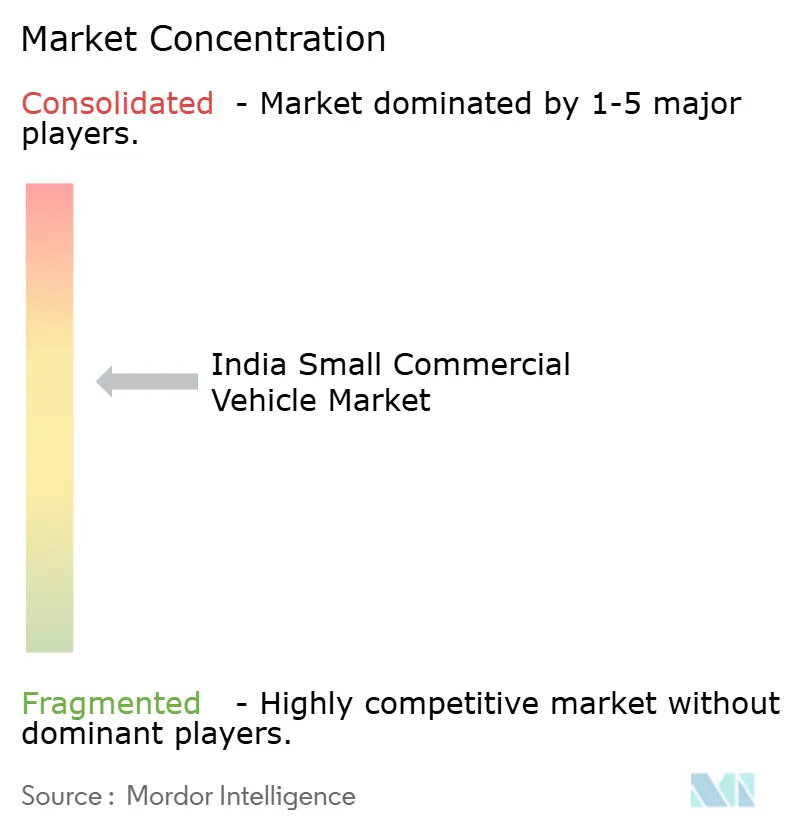
| Market Concentration | Medium |
Major Players
*Disclaimer: Major Players sorted in no particular order Image © Mordor Intelligence. Reuse requires attribution under CC BY 4.0. |
|
India Small Commercial Vehicle Market Analysis by Mordor Intelligence
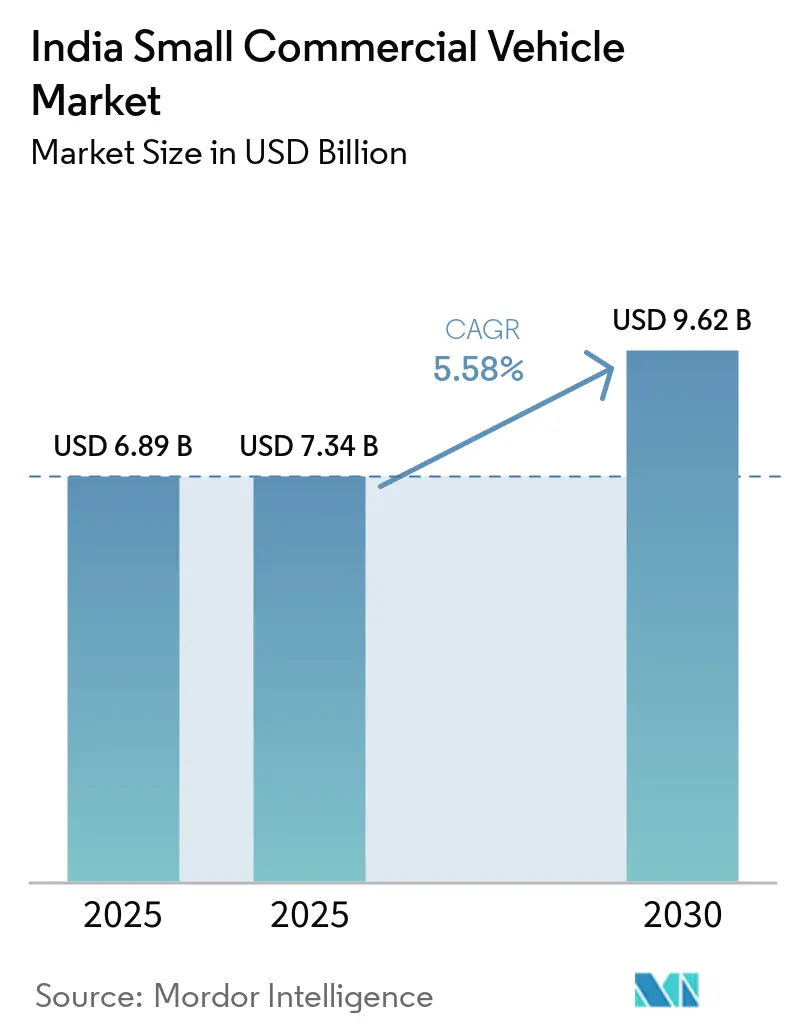
The India small commercial vehicle market size was valued at USD 6.89 billion in 2025 and is estimated to grow from USD 7.27 billion in 2026 to reach USD 9.62 billion by 2031, at a CAGR of 5.58% during the forecast period (2026-2031). Demand is linked to the expansion of organized distribution, shorter delivery cycles, and the need for vehicles that can operate reliably on urban and peri-urban routes. The India small commercial vehicle market also benefits when retailers, logistics providers, and small businesses need regular movement of goods between regional hubs and local delivery points. Electrification is widening the choice of vehicle configurations, although its practical use remains strongest where routes are predictable and charging can be planned. Government support for electric mobility continues to shape fleet purchasing decisions through the PM E-DRIVE scheme[1]“Cabinet Approves PM Electric Drive Revolution in Innovative Vehicle Enhancement Scheme With an Outlay of Rs. 10,900 Crore Over a Period of Two Years,” Prime Minister of India, pmindia.gov.in. Manufacturers are therefore balancing established internal combustion engine offerings with electric, CNG, and bi-fuel models that address different operating needs.
Key Report Takeaways
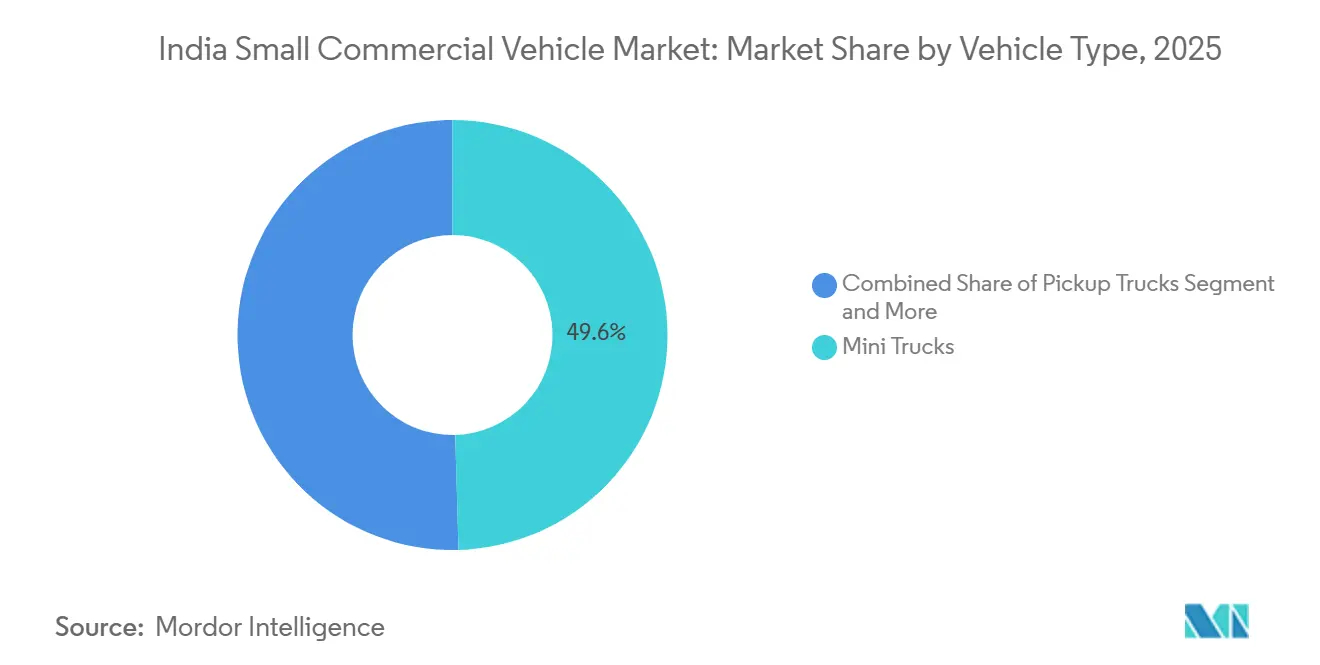
- By vehicle type, mini trucks held 49.56% of the India small commercial vehicle market share in 2025 and are projected to record the highest projected CAGR at 6.71% through 2031.
- By payload capacity, the sub-2.5-tonne segment accounted for 54.37% of the India small commercial vehicle market size in 2025 and is forecast to grow at a 6.28% CAGR through 2031.
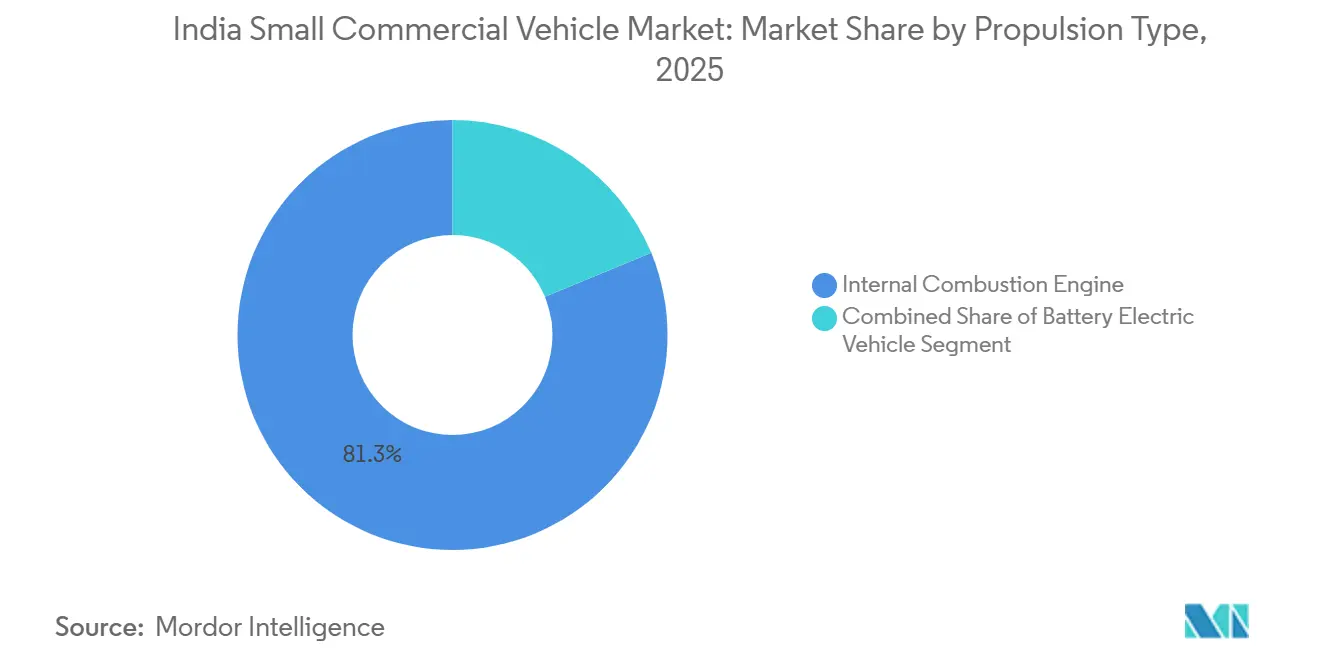
- By propulsion type, internal combustion engine vehicles held 81.25% of the India small commercial vehicle market share in 2025, while battery electric vehicles are forecast to expand at a 10.53% CAGR through 2031.
- By end-use industry, logistics and courier services held 37.63% of the India small commercial vehicle market in 2025, while e-commerce last-mile services are forecast to grow at an 8.58% CAGR through 2031.
Note: Market size and forecast figures in this report are generated using Mordor Intelligence’s proprietary estimation framework, updated with the latest available data and insights as of January 2026.
India Small Commercial Vehicle Market Trends and Insights
Drivers Impact Analysis*
| Driver | (~) % Impact on CAGR Forecast | Geographic Relevance | Impact Timeline |
|---|---|---|---|
| Accelerated E-Commerce Penetration | +1.5% | Asia Pacific core, spill-over to tier-2/3 urban centers | Medium term (2-4 years) |
| Rapid Post-GST Hub-And-Spoke Logistics | +1.2% | National, with early gains in Maharashtra, Gujarat, Karnataka | Medium term (2-4 years) |
| Growth of Organized Retail Platforms | +0.9% | Urban centers, expanding to semi-urban markets | Medium term (2-4 years) |
| Fame-LI and State EV Subsidy Schemes | +0.8% | National, stronger adoption in Delhi NCR, Maharashtra, Karnataka | Short term (≤ 2 years) |
| Digital Freight Platforms | +0.7% | Metro cities expanding to tier-2 markets | Short term (≤ 2 years) |
| Food-Cold-Chain Grants Pushing | +0.4% | National, concentrated in agricultural states | Long term (≥ 4 years) |
| Source: Mordor Intelligence | |||
Accelerated E-Commerce Penetration Into Tier-2/3 Cities
E-commerce is spreading demand beyond the largest metropolitan areas and is creating more regular delivery activity in smaller cities. This change supports the India small commercial vehicle market because delivery networks need vehicles that can make repeated stops on constrained local roads. Jaipur, Indore, Lucknow, and Bhubaneswar illustrate the type of markets where denser multi-drop routes can favor compact cargo vehicles. Better fulfillment quality also makes demand more repeatable for operators, rather than dependent on a short period of online customer acquisition. Local service coverage and financing access can become important differentiators for manufacturers serving these areas. This setting gives fleet operators a reason to add vehicles suited to local delivery patterns instead of relying only on larger regional trucks.
Rapid Post-GST Hub-and-Spoke Logistics Expansion
The goods and services tax framework has supported distribution models that use regional hubs and local spokes. These models require frequent freight movement between warehouses and neighborhood delivery points, which fits the operating role of small commercial vehicles. Bhiwandi, Tauru, Hosur, Nagpur, and Bhubaneswar are examples of locations where regional distribution can connect to dense local routes. The India small commercial vehicle market gains when operators centralize inventory and use smaller vehicles for the final stages of distribution. Shorter feeder trips can improve the usefulness of mini trucks and light pickups where the route pattern is regular. The resulting replacement cycle depends on whether fleet owners see a clear operating advantage from purpose-built local vehicles.
Growth of Organized Retail & Kirana Aggregation Platforms
Kirana aggregation platforms create delivery needs that differ from traditional express freight. Their routes often involve dense, short delivery loops that can limit empty running and support steady vehicle use. The pattern can make electric vehicle use more practical when a fleet returns to a depot with charging access. Organized retailers are also sourcing goods from regional supplier clusters and distributing them to similar markets. This can create both forward delivery and reverse logistics activity on the same network. The India small commercial vehicle industry, therefore, serves routes where predictable daily volume can improve the economics of a dedicated fleet.
Government FAME-II & State EV Subsidy Schemes
The PM E-DRIVE scheme has created a policy framework for electric mobility, including support for vehicle categories relevant to freight operations. National support is complemented by state measures in Delhi, Maharashtra, Karnataka, Gujarat, and Rajasthan. These measures can reduce the initial cost difference for fleet owners considering battery-electric minibusses and cargo three-wheelers. The benefit is most meaningful for urban operators with high daily vehicle use and reliable depot charging. Manufacturers can use this policy window to develop fleet relationships before incentive structures change. The India small commercial vehicle market is consequently seeing greater attention to electric offerings in delivery applications with stable routes.
Restraints Impact Analysis*
| Restraint | (~) % Impact on CAGR Forecast | Geographic Relevance | Impact Timeline |
|---|---|---|---|
| High TCO Gap Between BEV and ICE | -0.6% | National, more pronounced in price-sensitive rural markets | Medium term (2-4 years) |
| Fragmented Financing Ecosystem | -0.4% | Rural and semi-urban markets predominantly | Short term (≤ 2 years) |
| Payload Derating | -0.3% | Urban markets with weight-sensitive applications | Medium term (2-4 years) |
| Slow Rollout Of Hydrogen Refuelling Corridor | -0.2% | Limited to pilot corridors in Gujarat, Haryana | Long term (≥ 4 years) |
| Source: Mordor Intelligence | |||
High TCO Gap Between BEV & ICE in Sub-1-Tonne Range
The ownership case for electric vehicles remains uneven in the sub-2.5-ton cargo category. Electric cargo three-wheelers are better suited to short and predictable urban loops where depot charging is available. Mini trucks often face more variable routes and may need charging options outside the depot, which are not consistently available. This makes route flexibility a central concern for operators comparing electric and internal-combustion-engine vehicles. The India small commercial vehicle market will see faster electric adoption, where daily mileage and charging access allow operators to recover the initial investment. Outside those conditions, conventional powertrains and alternative-fuel models remain important options for small fleet owners.
Fragmented Financing Ecosystem for First-Time Buyers
Many buyers in tier-2 and tier-3 cities are first-time owners operating small businesses or self-employment ventures. These buyers may not have the formal credit records, registered business profiles, or collateral expected in traditional underwriting. Limited access to finance can delay vehicle purchases in locations that otherwise offer strong local demand. Alternative credit assessment through freight platform transaction records could help lenders evaluate operating activity. Financing programs for electric three-wheelers show that targeted products can improve access, though their coverage remains limited. The India small commercial vehicle industry needs broader financing solutions if new owner-operators are to participate more fully in vehicle demand.
*Our forecasts treat driver/restraint impacts as directional, not additive. The impact forecasts reflect baseline growth, mix effects, and variable interactions.
Segment Analysis
By Vehicle Type: Mini Trucks Support Local Freight Activity
Mini trucks held 49.56% of the India small commercial vehicle market in 2025 and are forecast to grow at a 6.71% CAGR through 2031. They connect distribution centers to neighborhood delivery points and support a broad range of goods movement. Their compact size helps operators navigate dense urban and peri-urban roads. They also suit routes that require regular stops and moderate loads. The Tata Ace platform has established a long operating presence among small transport operators. This installed base supports continued demand for service, replacement, and model upgrades.
Pickup trucks serve users who need greater carrying capacity and longer load beds for construction supplies, rural distribution, and cold-chain activities. They give operators a path to handle larger consignments while retaining flexibility on regional and local roads. Vans remain relevant where goods need protection from the weather or where enclosed bodies are required. Pharmaceutical distribution, consumer goods supply, and hospitality logistics are among the applications where this format is useful. Cargo three-wheelers occupy a separate role in dense urban delivery, especially where low operating costs and short routes matter most. Together, these formats allow the India small commercial vehicle market to serve operating needs that differ by cargo type, road conditions, and delivery frequency.



By Payload Capacity: Sub-2.5-Tonne Vehicles Form the Core
The sub-2.5-ton category accounted for 54.37% of the India small commercial vehicle market size in 2025 and is forecast to expand at a 6.28% CAGR through 2031. It covers the compact vehicle formats used on frequent urban and local distribution runs. The category fits operations where vehicle frequency matters more than moving the largest possible load on each trip. It also aligns with delivery routes that return to a hub or depot within the day. Electric configurations can be relevant on these predictable routes when charging is available. The segment consequently serves logistics providers, retailers, and small operators with diverse cargo requirements.
Vehicles in the 2.5- to 3.5-ton range serve users who need a higher payload while maintaining access to local roads. They can support fleet upgrades when operators seek better load utilization on established routes. The 3.5-tonne-and-above category sits near the boundary between small and medium commercial vehicle use. It can be useful when a single higher-capacity vehicle replaces several lower-capacity trips. This choice may limit demand for the smallest formats on some routes, although it can improve transport productivity. The India small commercial vehicle market, therefore, includes a range of payload choices rather than a uniform shift toward larger vehicles.
By Propulsion Type: Electric Models Gain Attention Alongside ICE
Internal combustion engine vehicles held 81.25% of the India small commercial vehicle market in 2025, while battery electric vehicles are projected to grow at a 10.53% CAGR through 2031. Internal combustion engines remain important because they offer familiar operations and route flexibility. Their established service ecosystem also matters to small fleet owners operating outside major cities. CNG and bi-fuel options provide another choice for operators that want to manage fuel costs without fully changing their operating model. Manufacturers are maintaining these choices while developing electrical products. This mixed approach reflects the varied route, charging, and payload needs found across India.
Battery electric vehicles are most relevant for high-frequency delivery routes with dependable return-to-base operations. Cargo three-wheelers have a clear use case in this setting because their routes are often short and predictable. Plug-in hybrid vehicles remain limited because charging access outside larger urban areas is still uneven. Fuel-cell vehicles are also at an early stage because freight corridors do not yet have the required refueling network. PM E-DRIVE provides a continuing policy basis for electric mobility support. The India small commercial vehicle market is thus likely to retain several propulsion options as operators match vehicles to route conditions.
By End-Use Industry: Logistics Remains Central to Demand
Logistics and courier services accounted for 37.63% of the India small commercial vehicle market in 2025, while e-commerce last-mile services are forecast to grow at an 8.58% CAGR through 2031. Logistics fleets require dependable vehicles for moving goods between hubs, stores, and delivery points. Courier networks also need compact vehicles that can complete repeated local stops. E-commerce delivery is expanding this role in smaller cities as fulfillment networks become more organized. The route characteristics can favor mini trucks, pickups, vans, and cargo three-wheelers for different tasks. This broad demand base supports regular replacement and fleet additions.
FMCG and consumer durables distribution provide steady demand across cities and rural trading areas. Agriculture and dairy distribution can create seasonal usage peaks, particularly where producers need timely movement of perishable goods. Cold-chain policy support can strengthen the case for refrigerated transport in food processing and related supply chains. Pharmaceutical and health-care distribution places greater value on enclosed and temperature-controlled vehicles. Construction, retail, hospitality, and municipal services add specialized demand with different route patterns. The India small commercial vehicle industry consequently relies on several end-use categories rather than a single source of demand.
Geography Analysis
Maharashtra and Karnataka account for a substantial share of India small commercial vehicle market activity because of their manufacturing, retail, and logistics networks. Maharashtra combines port-linked freight movement with a broad industrial base and established fulfillment activity. Karnataka benefits from Bengaluru’s technology-enabled delivery ecosystem and quick-commerce operations. Tamil Nadu supports demand through automotive component distribution and its industrial base. Telangana adds last-mile needs through its growing services economy. These states provide an operating environment where regular urban and regional freight activity supports a range of small commercial vehicle formats.
Delhi-NCR, Uttar Pradesh, Rajasthan, and Madhya Pradesh are major demand areas for conventional mini trucks and pickups. Agricultural trade, small and medium-sized businesses, and consumer goods distribution support vehicle use across the region. The Western Dedicated Freight Corridor can strengthen feeder demand by concentrating long-distance freight movement on rail-linked routes[2]"How Dedicated Freight Corridors Could Change India’s Commercial Vehicle Business," Finnovate Financial Services Pvt Ltd., www.finnovate.in. Smaller vehicles can then serve the frequent first-mile and last-mile movements around logistics nodes. E-commerce activity in tier-3 towns is also bringing more operators into organized delivery networks. The India small commercial vehicle market has scope to deepen in this region as local fleets formalize and broaden their service coverage.
West Bengal, Odisha, Jharkhand, Bihar, and the northeastern states remain important for future fleet development. These locations have lower formalization and more second-hand vehicle use than the more mature western and southern markets. Financing limitations can constrain new vehicle purchases, even where freight and delivery needs are rising. Improving roads and broader digital commerce reach can make local routes more viable for organized operators. Cold-chain support has added relevance in the northeast, where agricultural output and infrastructure gaps create a need for refrigerated transport. The India small commercial vehicle market can benefit as these regions gain stronger service, financing, and distribution networks.
Competitive Landscape
The India small commercial vehicle market is led by established manufacturers, while competition below the largest companies remains broad. Tata Motors and Mahindra & Mahindra have strong positions in conventional vehicle categories. Ashok Leyland has an established presence in smaller trucks, while Piaggio Vehicles is active in cargo three-wheelers. Maruti Suzuki serves commercial van applications, and Eicher Motors offers products near the upper end of the small commercial vehicle range. These companies compete through product coverage, dealer networks, financing relationships, and service availability. Their established distribution systems matter especially to operators that depend on quick maintenance support.
Tata Motors has continued to widen the range of products available to small operators. The company launched the Ace Pro in 2025 as an entry-level four-wheel mini truck, reinforcing its focus on first-time buyers and local freight users[3]The Hindu Bureau, "Tata Motors unveils Ace Pro mini truck at ₹ 3.99 lakh," The Hindu, www.thehindu.com. Tata Motors has also added higher-payload and electric pickup options to address changes in route requirements and fleet needs. These launches show how established manufacturers are using their product ranges and propulsion choices to protect their positions. The India small commercial vehicle market remains responsive to manufacturers that can match vehicle specifications to local operating conditions.
Electric-focused companies such as Euler Motors, Greaves Electric Mobility, and Altigreen Propulsion Labs are seeking a greater role in urban freight. Their focus is strongest where fleets have predictable routes and are open to new vehicle technology. Financing, charging access, and after-sales support remain important to their ability to grow beyond early fleet deployments. A fleet financing model that uses transaction history from digital freight platforms could help first-time operators access electric vehicles. Larger manufacturers also have an advantage through their existing retail and service networks. The India small commercial vehicle industry is therefore competitive in both conventional and electric vehicle categories, with different strengths across route types and customer groups.
India Small Commercial Vehicle Industry Leaders
-
Tata Motors Ltd.
-
Mahindra & Mahindra Ltd.
-
Ashok Leyland Ltd.
-
Piaggio Vehicles Pvt Ltd.
-
Maruti Suzuki India Ltd.
- *Disclaimer: Major Players sorted in no particular order

Recent Industry Developments
- August 2026: Mahindra & Mahindra announced plans to introduce four to five products across its light and intermediate commercial vehicle range in FY27, drawing cooperation from its acquisition of SML Isuzu.
- May 2026: Tata Motors marked 21 years of the Tata Ace with the launch of the Ace Gold+ XL, extending the range to improve load capacity and last-mile transport efficiency.
- April 2026: Tata Motors launched the Intra EV Pickup at INR 11.95 lakh (~USD 14,300), featuring CCS2 fast charging that enables a 10–80% charge in around 55 minutes.


India Small Commercial Vehicle Market Report Scope
The India Small Commercial Vehicle market is segmented by vehicle type, payload capacity, propulsion type, and end-use industry. By Vehicle Type, the market is segmented into Mini Trucks, Pickup Trucks, Vans, and Three-Wheelers. By Payload Capacity, the market is segmented into Sub-2.5 Ton, 2.5 Ton to 3.5 Ton, and 3.5 Ton and Above. By Propulsion Type, the market is segmented into Internal Combustion Engine, Battery Electric Vehicles, Plug-in Hybrid Electric Vehicles, and Fuel Cell Electric Vehicles. By End-Use Industry, the market is segmented into Logistics & Courier, E-Commerce Last-Mile, FMCG & Consumer Durables, Agriculture & Dairy, Construction & Infrastructure, Retail, Pharmaceuticals & Healthcare, Hospitality & Catering, and Municipal Services. Market forecasts are provided in terms of Value (USD) and Volume (Units).
| Mini Trucks |
| Pickup Trucks |
| Vans |
| Three-Wheelers |
| Sub-2.5 Ton |
| 2.5 Ton to 3.5 Ton |
| 3.5 Ton and Above |
| Internal Combustion Engine |
| Battery Electric Vehicle |
| Plug-in Hybrid Electric Vehicle |
| Fuel Cell Electric Vehicle |
| Logistics & Courier |
| E-Commerce Last-Mile |
| FMCG & Consumer Durables |
| Agriculture & Dairy |
| Construction & Infrastructure |
| Retail |
| Pharmaceuticals & Healthcare Distribution |
| Hospitality & Catering |
| Municipal Services |
| By Vehicle Type | Mini Trucks |
| Pickup Trucks | |
| Vans | |
| Three-Wheelers | |
| By Payload Capacity | Sub-2.5 Ton |
| 2.5 Ton to 3.5 Ton | |
| 3.5 Ton and Above | |
| By Propulsion Type | Internal Combustion Engine |
| Battery Electric Vehicle | |
| Plug-in Hybrid Electric Vehicle | |
| Fuel Cell Electric Vehicle | |
| By End-Use Industry | Logistics & Courier |
| E-Commerce Last-Mile | |
| FMCG & Consumer Durables | |
| Agriculture & Dairy | |
| Construction & Infrastructure | |
| Retail | |
| Pharmaceuticals & Healthcare Distribution | |
| Hospitality & Catering | |
| Municipal Services |


Key Questions Answered in the Report
What is driving demand for small commercial vehicles in India?
Organized logistics, e-commerce delivery, retail distribution, and local freight routes are supporting demand for compact cargo vehicles. These uses require vehicles that can operate repeatedly between hubs, stores, and delivery points.
Which vehicle type leads India’s small commercial vehicle market?
Mini trucks led with 49.56% share in 2025 and are projected to grow at a 6.71% CAGR through 2031. Their role in local goods movement supports broad use across several customer groups.
Which propulsion type is growing fastest in India’s small commercial vehicle market?
Battery electric vehicles are forecast to grow at a 10.53% CAGR through 2031. Their strongest use case is on high-frequency routes with dependable charging access.
What is the largest payload category for small commercial vehicles in India?
The sub-2.5-tonne category held 54.37% share in 2025 and is projected to expand at a 6.28% CAGR through 2031. It is widely suited to frequent local delivery operations.
Page last updated on:


 Your data is secure and never sold or shared.


