
Market Overview
| Study Period | 2020 - 2031 |
|---|---|
| Forecast Data Period | 2026 - 2031 |
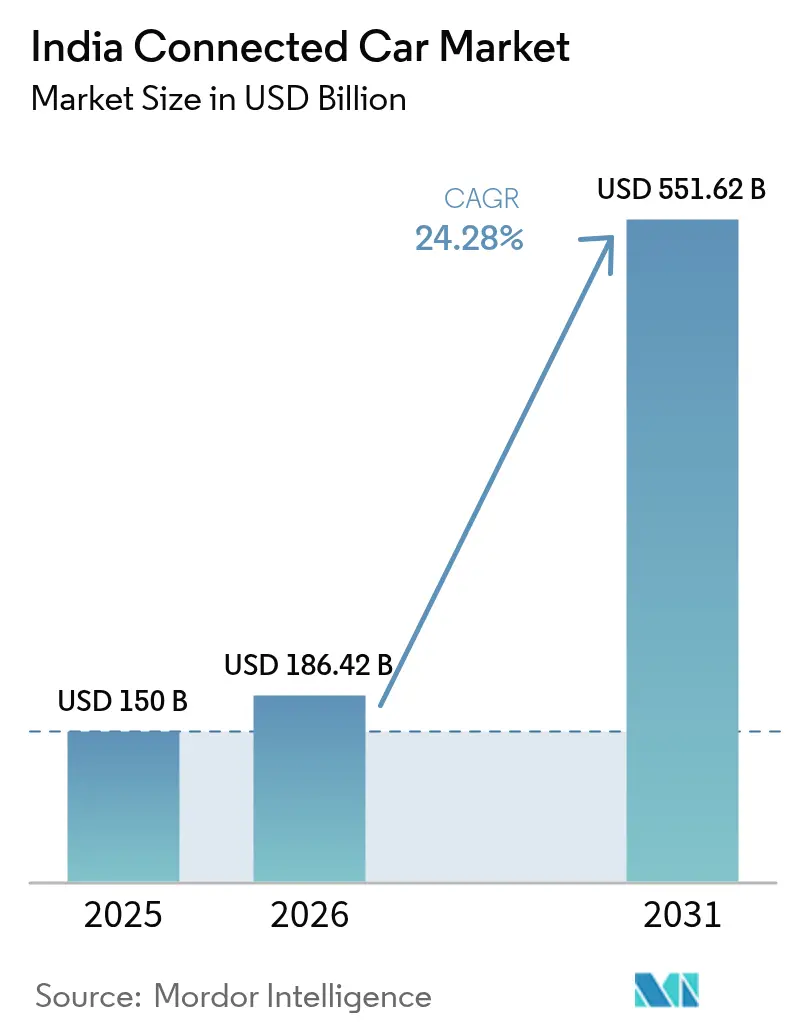
| Base Year Market Size (2025) | USD 150 Billion |
| Market Size (2026) | USD 186.42 Billion |
| Market Size (2031) | USD 551.62 Billion |
| Growth Rate (2026 - 2031) | 24.28 % |
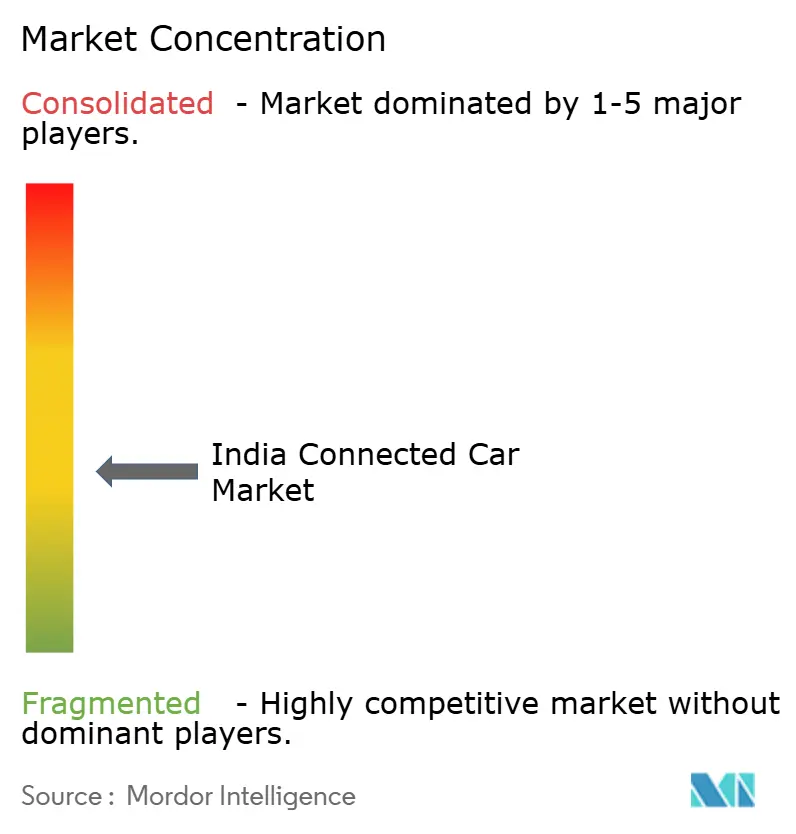
| Market Concentration | Medium |
Major Players *Disclaimer: Major Players sorted in no particular order Image © Mordor Intelligence. Reuse requires attribution under CC BY 4.0. | |
India Connected Car Market Analysis by Mordor Intelligence
The India connected car market size is expected to grow from USD 150 million in 2025 to USD 186.42 million in 2026 and is forecast to reach USD 551.62 million by 2031 at 24.28% CAGR over 2026-2031. Growth springs from mandatory telematics rules, rapid 5G coverage, and consumer appetite for smartphone-like vehicle experiences, positioning the India connected car market as a hotbed for global and domestic suppliers. Regulatory pushes such as AIS-140, NavIC positioning, and Bharat NCAP 2.0 embed connectivity into even entry vehicles, while the India connected car market benefits from the world’s third-largest automotive production base that lets OEMs amortize electronics costs quickly. Telco-OEM revenue sharing lowers subscription hurdles and lets the India connected car market deliver affordable data plans that match rising disposable income. Embedded cyber-security stacks are moving up the buying checklist as data breaches dent trust, yet vendors that prove secure OTA pipelines capture an advantage.
Key Report Takeaways
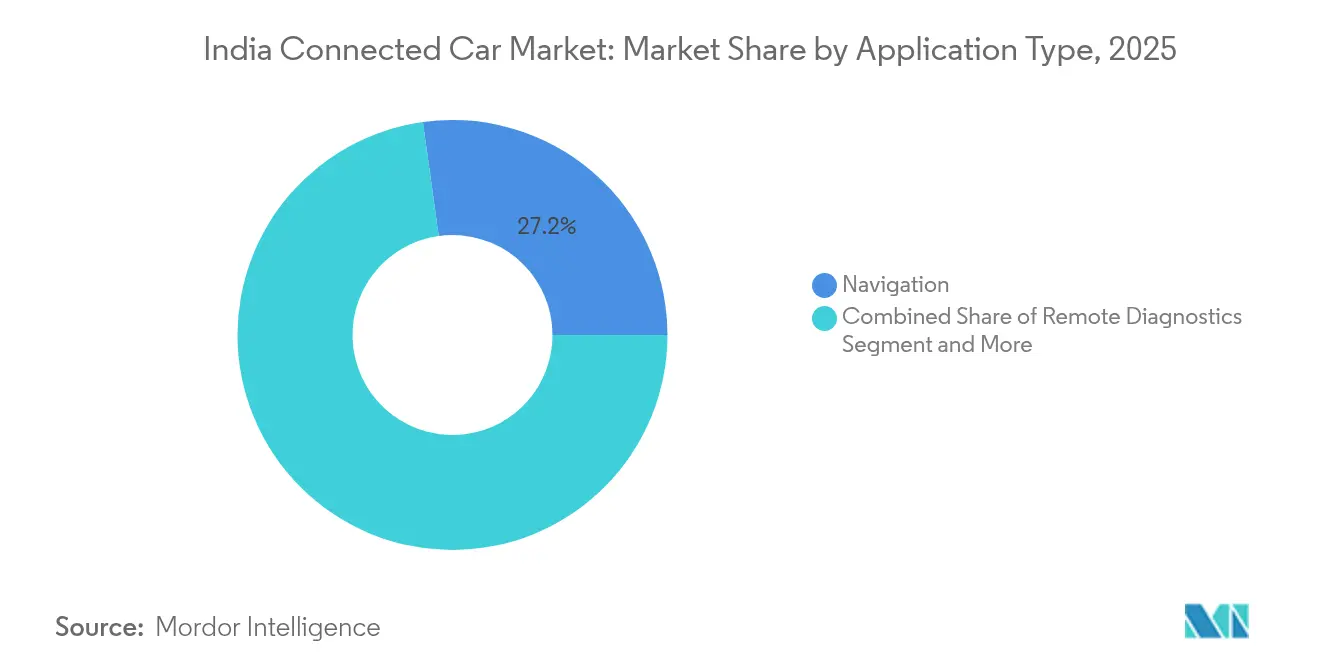
- By application, navigation held 27.20% of the India connected car market share in 2025 while over-the-air updates are projected to soar at a 26.15% CAGR through 2031.
- By connectivity type, embedded solutions accounted for 46.55% of the India connected car market size in 2025; integrated systems are forecast to expand at 25.1% CAGR between 2026 and 2031.
- By communication model, vehicle-to-infrastructure captured 52.45% revenue share in 2025, while vehicle-to-cloud communication leads CAGR growth at 26.05% until 2031.
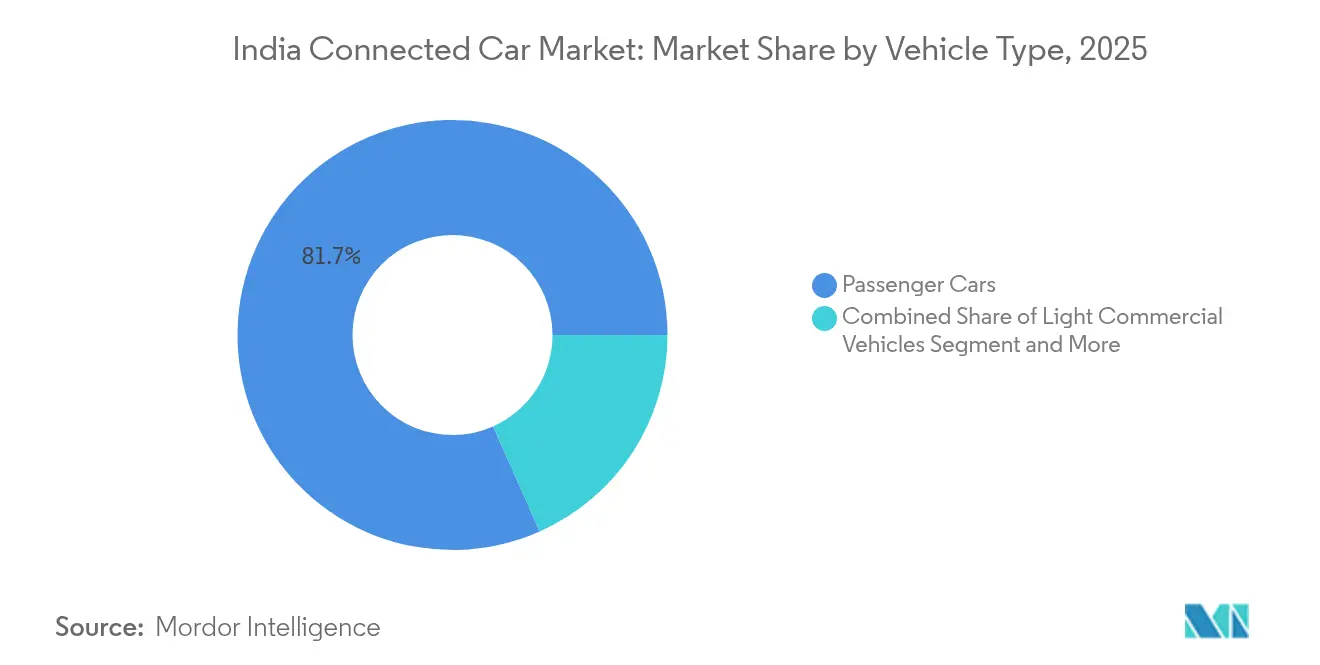
- By vehicle type, passenger cars commanded 81.65% of the India connected car market size in 2025, yet light commercial vehicles will log the fastest 24.95% CAGR to 2031.
- By sales channel, OEM factory fitment dominated with 86.65% share in 2025, although after-market retrofits are advancing at 25.9% CAGR through 2031.
Note: Market size and forecast figures in this report are generated using Mordor Intelligence’s proprietary estimation framework, updated with the latest available data and insights as of 2026.
India Connected Car Market Trends and Insights
Drivers Impact Analysis*
| Driver | (~) % Impact on CAGR Forecast | Geographic Relevance | Impact Timeline |
|---|---|---|---|
| Rapid Smartphone and 4G/5G | +6.2% | National metros and tier-1 cities | Short term (≤ 2 years) |
| Government AIS-140 and AV-NEXT | +5.8% | Nationwide, commercial and emerging passenger | Medium term (2-4 years) |
| OEM-Telco Revenue-Share Models | +4.1% | High-ARPU urban clusters | Medium term (2-4 years) |
| Rising Disposable Income and Spend | +3.7% | Tier-1 and tier-2 cities | Long term (≥ 4 years) |
| On-board NavIC Compliance | +3.2% | National corridors | Short term (≤ 2 years) |
| Pay-Per-Use Insurance Pilots | +2.8% | Dense urban traffic zones | Medium term (2-4 years) |
| Source: Mordor Intelligence | |||
Rapid Smartphone and 4G/5G Penetration
India’s 5G user base touched 365 million as of July 2025, creating a ready canvas for vehicle-smartphone fusion that steers the India connected car market toward mass adoption [1]“BSNL 4G Expansion Note,” Department of Telecommunications, dot.gov.in. Majority of shoppers now cite connected features as pivotal when selecting a new vehicle, and OEMs respond by equipping even compact SUVs with integrated eSIMs and mobile apps. Kia’s 2024 launch of the Syros model bundled an Airtel eSIM, letting owners access live traffic, geo-fencing, and theft alerts. The India connected car market also benefits because cloud transactions ride on existing telco billing rails, keeping subscription costs near mobile-data parity. As consumer expectations migrate from phones to dashboards, infotainment and safety applications move from nice-to-have to deal-breakers, accelerating standard-fit connectivity across model lines.
Government’s AIS-140 and AV-NEXT Mandates
AIS-140 demands tracking and emergency buttons on commercial vehicles, while the AV-NEXT draft roadmap insists on NavIC integration in passenger cars, making compliance the main door-opener to the India connected car market. Bharat NCAP 2.0 scoring further elevates connected safety by awarding additional stars for telematics-enabled e-call and crash notification. The predictable demand curve allows Tier-1 suppliers to scale ECUs locally, which trims unit costs and increases domestic value addition. Over time, mandatory compliance morphs into a competitive differentiator as brands that exceed the bare minimum tout higher safety scores.
OEM–Telco Revenue-Share Models
Kia and Airtel, Honda and Jio, and Maruti Suzuki with MapMyIndia illustrate revenue-share models that distribute data costs over an entire vehicle lifecycle, reducing sticker shock. Telcos gain incremental ARPU, while OEMs turn connected features into subscription bundles ranging from entry-level roadside assist to premium concierge. Such models help the India connected car market escape the low-margin hardware trap by monetizing services like predictive maintenance and location-based coupons. Because billing, SIM management, and cyber-security already reside inside telco networks, automotive partners can plug into mature platforms instead of building from scratch.
Rising Disposable Income and Aspirational Spend
Urban households climbed significantly in 2024, and many allocate savings to in-car tech that mirrors smartphone convenience. Compact SUVs such as Hyundai’s Creta EV bundle connected features as standard, making them aspirational rather than luxury. Younger buyers gravitate to cars they can control through voice assistants, and this preference radiates into tier-2 cities as incomes rise. For fleet owners, telematics reduces fuel and maintenance, offsetting upfront costs. Consequently, the India connected car market sees higher penetration in high-growth body styles like crossovers where tech acts as a lifestyle badge.
Restraints Impact Analysis*
| Restraint | (~) % Impact on CAGR Forecast | Geographic Relevance | Impact Timeline |
|---|---|---|---|
| Data-Breach and Cyber-Attack Concerns | −3.2% | Urban markets | Short term (≤ 2 years) |
| Patchy LTE Coverage on Rural Corridors | −2.8% | Northern and eastern hinterlands | Medium term (2-4 years) |
| Low ARPU on Connected-Service Subscriptions | −2.1% | Tier-2 and tier-3 cities | Long term (≥ 4 years) |
| Legacy Fleet Unable to Retrofit | −1.9% | Logistic hubs with older trucks | Medium term (2-4 years) |
| Source: Mordor Intelligence | |||
Data-breach and Cyber-attack Concerns
Ransomware attacks on global infotainment systems raised red flags among Indian buyers who now hesitate to share driving data. While startups like SecureThings offer anomaly-detection software, uptake stays uneven because no India-specific regulation mirrors the EU WP.29 cyber-security clause. Without mandatory standards, small OEMs treat cyber spend as optional, opening gaps that erode trust. High-profile hacks would slow the India connected car market if consumers begin disabling SIM modules or refuse consent for data collection.
Patchy LTE Coverage on Rural Corridors
National highways linking mineral belts in Jharkhand or tourist routes in the Northeast suffer blind spots, forcing connected trucks to fall back on SMS beaconing. The BSNL 4G expansion, slated to finish in 2026, will plug holes, yet interim downtime dilutes fleet analytics benefits [2]“India Crosses 365 Million 5G Users,” The Economic Times, economictimes.indiatimes.com. OEMs must add dual-profile modems and store-and-forward logic, which raises BOM cost and tempers growth in value-conscious segments.
*Our forecasts treat driver/restraint impacts as directional, not additive. The impact forecasts reflect baseline growth, mix effects, and variable interactions.
Segment Analysis
By Application Type: Navigation Leads While OTA Updates Accelerate
Navigation accounted for 27.20% of the India connected car market share in 2025 as clogged city grids and mixed-quality road signs made live rerouting vital. Local mapping partners like MapMyIndia curate pothole alerts and fuel-station data that resonate with daily commuters. In contrast, over-the-air updates log a 26.15% CAGR to 2031 as OEMs realize a single remote fix avoids thousands of service-bay visits. The India connected car market size for OTA upgrades is projected to rise significantly by 2031, a gain that highlights software’s growing share of vehicle value. Remote diagnostics and multimedia streaming follow, fueled by telco bundling of in-car data plans with family mobiles. Emergency e-call adoption ticks upward under Bharat NCAP 2.0, reinforcing safety as a selling theme.
The second wave of application adoption centers on personalization. Cabin climate presets sync through cloud profiles while voice assistants learn local dialects. Such evolutions will further cement the India connected car market as a software arena in which continuous delivery outranks model-year refresh cycles.



By Connectivity Type: Embedded Solutions Dominate Despite Cost Pressures
Embedded eSIM modules shipped in 46.55% of new connected vehicles during 2025 because OEMs want lifecycle control over diagnostics, firmware, and data routing. Integrated connectivity, which piggybacks on smartphone data, grows quickest at 25.1% CAGR as supply-chain costs lift and consumers push back against rising MSRPs. The hybrid approach often lands in mid-trim variants where buyers bring their own data but the car retains a low-bandwidth fallback eSIM for critical safety traffic.
Tethered systems remain niche in penetration, used mainly by aftermarket dongles. Yet the low hardware bill keeps them alive for fleet retrofits. Over the forecast horizon, the India connected car industry will likely settle on a dual-core strategy: embedded for high-value or regulatory-heavy use cases, integrated for budget lines.
By Communication Model: V2I Infrastructure Drives Current Adoption
Vehicle-to-Infrastructure held 52.45% share in 2025, helped by municipal investments in adaptive traffic lights and toll-plaza digitization. For example, Bengaluru’s command center shares signal phase data with company fleets to minimize idle time. V2I’s share is predicted to slip modestly as Vehicle-to-Cloud usage will climb to 26.05% CAGR by 2031 on the back of cheaper storage and analytics. The India connected car market size tied to V2C services is expected to grow, thus reflecting analytics and content streaming demand.
V2V and V2P remain limited to pilot corridors such as the Delhi-Jaipur expressway. Adoption awaits spectrum allocation clarity around the 5.9 GHz band and roadside unit funding. Nevertheless, once critical mass builds, peer-to-peer alerts for blind-spot hazard and pedestrian proximity could unlock another growth inflection.
By Vehicle Type: Passenger Cars Lead While Commercial Segments Accelerate
Passenger cars contributed 81.65% revenue in 2025, fueled by high sales volumes and intense feature wars among brands. Compact SUVs dominate because tech-savvy buyers equate connected dashboards with non-negotiable value. Light commercial vehicles post the fastest 24.95% CAGR as last-mile operators chase dispatch efficiency. Heavy trucks adopt connectivity for fuel coaching, but the addressable fleet renews slower, tempering volume.
As EV sales rise, both passenger and LCV segments lean more on connectivity to manage battery health and charging route planning. Fleet owners, meanwhile, plan to exploit ADAS-driven insurance rebates, pushing adoption deeper into agrarian and mining haul routes where downtime wreaks high opportunity costs.
By Sales Channel: OEM Integration Dominates Despite After-Market Growth
OEM factory fitment commanded 86.65% of 2025 shipments since warranty assurance and AIS-140 compliance encourage buyers to pick built-in kits. This route captures almost the entire subsidy from production-linked incentive schemes that reward local module sourcing. After-market sales, however, clock a brisk 25.9% CAGR as millions of pre-2020 cars seek retrofit security and navigation. Chipset maker Quectel and integrators like Embitel target this long-tail via plug-and-play boxes. For insurers, retrofits create new data streams without waiting a decade for the fleet to turn over.
The dual-channel ecosystem means the India connected car market balances premium factory systems with affordable add-ons, expanding the total reachable customer base.
Geography Analysis
Metropolitan clusters such as Delhi NCR, Mumbai, Pune, Bengaluru, and Hyderabad account for a notable share of current connected car activations. These zones enjoy near-continuous 5G coverage, dense dealer networks, and consumers comfortable with app payments. Pune, home to multiple OEM R&D centers, doubles as a sandbox for early OTA rollouts. In West India, high per-capita income intersects with bumper-to-bumper traffic, which heightens the perceived utility of navigation and e-call.
Tier-2 cities like Indore, Coimbatore, and Lucknow form the next vanguard. As fiber backhaul extends and average incomes climb, OEMs launch mid-spec connected trims tailored to these buyers. Yet patchy LTE on peri-urban ring roads forces fallback modes and raises support costs. Government Digital India projects earmark rural BTS upgrades, but completion staggered to 2026 leaves a short-term reliability gap.
Long-haul freight corridors from Mumbai to Chennai or Delhi to Kolkata expose another dimension. Fleet managers demand minute-by-minute tracking to comply with e-way bill norms, though coverage black holes on the Odisha plateau or Jharkhand forests dilute value. Pilot satellite-cellular hybrid modems aim to plug these gaps. The India connected car industry thus adapts products to a mosaic of connectivity profiles, from ultradense metro grids to sporadic rural nodes.
Regulatory Landscape
India connected-car regulation is being shaped by transport standards under MoRTH and telecom and spectrum policy under TRAI and DoT. On 30 April 2026, TRAI issued a consultation paper on a regulatory framework for Vehicle-to-Everything (V2X) communication, with the consultation window running through early June 2026, establishing a formal pathway for how vehicles and roadside infrastructure communicate and are authorized in India.
The same TRAI consultation references DoT seeking recommendations via a 1 December 2025 letter and captures in-principle decisions from MoRTH's V2X/ITS standards task force, including alignment toward C-V2X and a spectrum plan around 5.9 GHz (an initial 30 MHz block, with adjacent spectrum identified for future ITS use). In parallel, Automotive Industry Standards (AIS) under MoRTH continue to expand the compliance perimeter for connected functions, including AIS-189, which sets uniform provisions for Cyber Security and Management Systems (CSMS) for applicable vehicle categories, while homologation and compliance testing remains anchored in India's authorized testing ecosystem supported by programs such as NATRiP.
Value Chain Analysis
The value chain for connected cars in India runs from connectivity enablers (telecom networks, eSIM provisioning, and cloud platforms) through hardware and software layers (TCUs, antennas, GNSS, cockpit domain controllers, OTA stacks, and cybersecurity tooling) into OEM integration and downstream distribution via dealers, fleet operators, and insurers. On the hardware side, Tier-1s and electronics manufacturers supply infotainment and telematics control units, and recent capacity moves point to localization around core modules that sit behind embedded connectivity and OTA, including Samsung HARMAN's India operations supplying digital cockpits and TCUs to multiple large OEMs.
Software and systems integration increasingly concentrates in automotive engineering hubs such as Pune, where OEMs and partners build software-defined vehicle capabilities, V2X readiness, and service monetization layers. Upstream dependencies still include imported semiconductors and specialized automotive components, while standards and compliance requirements (for example AIS-140 for commercial telematics and AIS-189 for CSMS) shape component specifications, validation cycles, and test requirements through India's homologation and testing infrastructure (for example ARAI-linked compliance processes and NATRiP-enabled facilities).
Competitive Landscape
The India connected car market hosts a blend of mass OEMs, challenger brands, telcos, Tier-1 electronics suppliers, and over-the-air platform specialists. Maruti Suzuki, Hyundai, and Tata Motors leverage installed bases and dealer reach to preload telematics on fresh models. MG Motor pushes the envelope with AI-voice assistants in every variant, compelling incumbents to match. Telcos Airtel and Jio bring network, billing, and cyber-security expertise; they monetise data plans while embedding SIM life-cycle tools.
Technology startups add agility. Fleetx raised USD 34.2 million to expand AI dispatch analytics that rival OEM dash data. MapMyIndia’s NavIC-first maps became default on several 2025 launches. Cyber-security niche players like SecureThings or Cybellum pitch intrusion detection systems that meet emerging WP.29-style expectations.
M&A heats up as OEMs seek digital depth. Tata Motors revealed plans to acquire a significant stake of Freight Tiger to fold logistic SaaS into its commercial lineup [3]“Acquires Stake in Freight Tiger,” Tata Motors, tatamotors.com. Hyundai partnered with Savari to co-develop V2X stacks entrenched in Indian spectrum rules. Competitive edge now hinges less on metal stamping and more on cloud uptimes, vulnerability response time, and developer ecosystems, underscoring the software-defined car thesis within the India connected car market.
India Connected Car Industry Leaders
Maruti Suzuki India Ltd
Hyundai Motor India Ltd
Tata Motors Ltd
Mahindra & Mahindra Ltd
Kia India Pvt Ltd
- *Disclaimer: Major Players sorted in no particular order

Market Opportunities and Future Outlook
A near-term opportunity is compliance-led security and lifecycle software operations as India formalizes cyber security and V2X governance. The publication of AIS-189 (CSMS scope) and TRAI's April 2026 V2X consultation together push OEMs and suppliers to productize cybersecurity management, secure OTA pipelines, and audit-ready processes that can be offered across passenger and commercial platforms, especially where factory-fit connectivity already dominates new-vehicle installations.
Another opportunity sits in India's fast-expanding local engineering and manufacturing footprint for cockpit and telematics electronics, which supports deeper in-country integration of connected features and OTA-led feature rollouts. Evidence of this shift includes Samsung HARMAN's connected-car manufacturing expansion in Pune and partnerships such as JSW Motors with Tata Elxsi to build a software-defined mobility engineering center in Pune, which expands the ecosystem for OTA, in-vehicle apps, and connected service bundles tailored for Indian use cases (navigation localization, fleet productivity, and vernacular voice experiences).
Recent Industry Developments
- July 2026: Maruti Suzuki onboarded five startups, including Sarvam AI, through its incubation program to strengthen customer interaction using generative AI agents across its connected ecosystem. The move signals OEM focus on software-led engagement layers that sit above basic telematics, supporting differentiation and retention for connected services.
- May 2026: VE Commercial Vehicles (VECV) increased its stake in VE Connected Solutions by acquiring an additional 23%, taking its total holding to 74%. The higher ownership consolidates control over telematics execution and product roadmap for commercial-vehicle connectivity, tightening integration between vehicles, fleet data, and service delivery.
- October 2024: Kia India partnered with Airtel Business on the Kia Connect 2.0 platform, expanding vehicle management, AI voice, remote control, and safety functions on Airtel's network. The tie-up reinforced telco-OEM operating models in India, combining connectivity provisioning and service delivery to scale connected features across mass-market variants.


Research Methodology Framework and Report Scope
Market Definition and Coverage
This market is defined as the value generated in India from connected car features and services that enable in-vehicle connectivity, data exchange, and remote or digital functions across passenger and commercial vehicles.
Scope exclusions: We exclude stand-alone consumer gadgets and accessories that are not installed for vehicle connectivity use, and we also exclude non-automotive IoT spend that is not tied to a car.
Segmentation Overview
- By Application Type
- Navigation
- Remote Diagnostics
- Multimedia Streaming
- Social Media and Other Apps
- OTA Update
- On-Road Assistance
- E-call and SOS Assitance
- Remote Operation
- Auto Parking/Connected Parking
- Autopilot
- Home Integration
- Stolen Vehicle Recovery/Warning
- By Connectivity Type
- Embedded
- Integrated
- Tethered
- By Communication Model
- Vehicle-to-Vehicle (V2V)
- Vehicle-to-Infrastructure (V2I)
- Vehicle-to-Pedestrian (V2P)
- Vehicle-to-Cloud (V2C)
- By Vehicle Type
- Passenger Cars
- Light Commercial Vehicles
- Heavy Commercial Vehicles
- By Sales Channel
- OEM-Factory-Fit
- After-Market Retrofit
Data Sources, Market Sizing, and Validation
Desk Research
Desk research set the factual floor for the model so we could start with real adoption signals, and then work back to value. Public and official sources were used to map India's vehicle parc, new registrations, and policy signals, including Ministry of Road Transport and Highways publications, SIAM releases, Automotive Research Association of India references (including AIS related notices), and Telecom Regulatory Authority of India updates.
To make sure the connectivity layer was not treated as a black box, we also reviewed Department of Telecommunications releases, India customs trade statistics for relevant electronics categories, and peer-reviewed or conference papers that discuss telematics and V2X readiness in India. We complemented this with company filings, annual reports, investor presentations, and reputable press coverage, followed by selective use of paid subscriptions for company financials and news intelligence, and for patent databases to understand feature roadmaps. These source examples are illustrative and not exhaustive, and many other public materials were also used for data collection, validation, and clarification.
Primary Interviews and Surveys
Primary work focused on checking what is actually being fitted, activated, and paid for in India, rather than only what is marketed. We spoke with a mix of OEM-side functions, component and software suppliers, telecom and platform stakeholders, and downstream users such as fleet and mobility operators, with viewpoints balanced across major auto hubs and demand centers in the country.
Distribution of primary research fieldwork respondents
| Company type | Respondent position |
|---|---|
| Top tier: 30% | CXOs: 20% |
| Mid tier: 49% | Functional/Unit leaders: 28% |
| Smaller Players: 21% | Managers: 52% |
Market-Sizing & Forecasting
Sizing starts from a demand-pool build that uses India vehicle sales and parc to reconstruct the addressable installed base, which is then filtered by connectivity fitment and activation rates across key feature buckets. We used top-down and bottom-up logic in one model, where the headline is built from macro indicators and then checked using supplier roll-ups and sampled price-times-volume math.
Inputs that were treated as key drivers include passenger versus commercial mix, embedded versus tethered connectivity penetration, telematics mandate related fitment timing, 4G and 5G coverage readiness, and typical subscription attach and renewal behavior (including multi-year bundles). Where public pricing was inconsistent, price bands were normalized using interview feedback and cross-checked against published feature packages and financing bundles. For forecasting, scenario analysis was used, with assumptions anchored in how quickly new models ship with factory-fitted modules, how regulations evolve, and how data plan economics move. Gaps in the bottom-up checks were handled by using conservative adoption ranges and then re-validating the implied revenue per vehicle with expert feedback.
Data Validation & Update Cycle
Outputs are validated through multiple checks so the totals stay realistic when compared with independent signals such as vehicle shipments, connectivity module availability, and telecom coverage progress. Variances are investigated at the input level, and if a number is being pulled by a single assumption, that assumption is re-tested through follow-up calls and desk re-checks before sign-off.
Each report is refreshed annually, and interim updates are made when a material change is observed, such as a policy shift, a major recall tied to connected features, or a sudden price move in connectivity plans. Before delivery, a fresh review pass is completed so clients receive the latest updated view rather than a dated snapshot.
Mordor Intelligence's India Connected Car Market Sizing Compared With Other Published Estimates
Published market sizes for India connected cars can look far apart even when everyone is describing the same theme, because the counted revenue streams and the timing of adoption are not handled the same way. Differences usually come from what gets treated as connected revenue, the year chosen for the starting point, and how pricing and activation are assumed as vehicles age.
Key gap drivers in this market often include whether the estimate counts only connected features and services, or also counts broader vehicle electronics value, and whether inactive factory-fitted modules are counted as revenue. Another common driver is the handling of subscriptions and bundled plans, since some models assume a fast paid attach rate, and others spread monetization over a longer renewal cycle. Currency conversion timing and refresh cadence also matter, since India auto sales and feature launches can shift within a year.
Benchmark comparison
| Source | Market Size | Gaps in Research Methodology |
|---|---|---|
| Mordor Intelligence | USD 150.00 B (2025) | |
| Industry Publisher A | USD 3.50 B (2024) | This estimate is anchored to a smaller paid-revenue pool and a different base year, and it appears to focus on nearer-term connectivity revenue without fully scaling in-vehicle application value and longer subscription monetization. |
| Industry Publisher B | USD 8.43 B (2024) | The scope and time horizon are presented with mixed figures across the page, which can shift the implied market boundary, and the model assumptions on pricing and activation are not consistently tied to India vehicle parc and launch cadence. |
Vehicle shipments, installed base build, and feature activation checks are the evidence points that keep Mordor Intelligence aligned to a connected-car revenue pool that includes application value across telematics, infotainment, and driver assistance. When the scope is tightened to comparable revenue lines and years, the remaining differences usually come down to subscription attach assumptions and how quickly embedded connectivity becomes standard across new models.


Key Questions Answered in the Report
How big is the India connected car market in 2026?
The India connected car market size is valued at USD 186.42 million in 2026.
What is the projected CAGR for connected vehicles in India to 2031?
The market is forecast to expand at a 24.28% CAGR from 2026 to 2031.
Which application holds the largest share today?
Navigation leads with 27.20% share thanks to real-time traffic and local mapping integration.
Why are over-the-air updates growing fastest?
OTA cuts service-center visits and lets OEMs push features remotely, driving a 26.15% CAGR to 2031.
Page last updated on:


 Your data is secure and never sold or shared.


