
Market Overview
| Study Period | 2017 - 2029 |
|---|---|
| Forecast Data Period | 2025 - 2029 |
| Historical Data Period | 2017 - 2023 |
| Market Size (2025) | USD 0.53 Billion |
| Market Size (2029) | USD 1.28 Billion |
| Growth Rate (2025 - 2029) | 24.81 % |
| Market Concentration | High |
Major Players *Disclaimer: Major Players sorted in no particular order Image © Mordor Intelligence. Reuse requires attribution under CC BY 4.0. | |

India Hybrid Vehicles Market Analysis by Mordor Intelligence
The India Hybrid Vehicles Market size is estimated at 0.53 billion USD in 2025, and is expected to reach 1.28 billion USD by 2029, growing at a CAGR of 24.81% during the forecast period (2025-2029).
The Indian hybrid vehicles market is experiencing a significant transformation driven by technological advancements and evolving consumer preferences. Major automotive manufacturers are strategically positioning themselves in this growing sector, with Toyota maintaining a dominant hybrid vehicle market share, holding 78.22% market share in 2023. This market consolidation reflects the maturity of hybrid technology and the importance of established manufacturing capabilities. The industry is witnessing increased competition as more hybrid car manufacturers in India enter the market with new hybrid models, particularly in the luxury and mid-range segments, leading to greater consumer choice and technological innovation.
Infrastructure development plays a crucial role in supporting the hybrid car market ecosystem, with significant progress made in charging station deployment. The number of public charging stations reached 10,900 units in 2022, marking a substantial increase from previous years. This expansion of charging infrastructure, combined with improvements in hybrid powertrain technology, is addressing range anxiety concerns and making hybrid cars in India more practical for daily use. Manufacturers are also investing in localization of production and development of India-specific hybrid models to better serve market demands.
The market is benefiting from declining battery costs and improving technology efficiency. Battery pack prices have dropped to 171 USD/kWh in 2023, making hybrid cars in India more cost-competitive. This price reduction, coupled with advancements in battery technology and power management systems, is enabling manufacturers to offer more affordable hybrid options while maintaining performance standards. The industry is seeing increased integration of smart technologies and connected features in hybrid vehicles, enhancing their appeal to tech-savvy consumers.
The used car market's robust growth, reaching USD 37.57 billion in 2023, indicates increasing acceptance of alternative powertrains among Indian consumers. This trend is particularly significant as it demonstrates growing consumer confidence in hybrid technology and its resale value. Manufacturers are responding by expanding their hybrid vehicle portfolios and introducing innovative financing solutions to make these vehicles more accessible to a broader customer base. The market is also witnessing increased collaboration between automotive companies and technology providers to develop more efficient and cost-effective hybrid solutions, reflecting key hybrid vehicle market trends.
India Hybrid Vehicles Market Trends and Insights
India's auto interest rates have shown a consistent downward trend, driven by RBI's measures and evolving lending practices
- In recent times, India's auto interest rate stood at approximately 8.567%, marking a decline from the 8.698% observed in 2021. This slight decrement of about 1.5% continues the trend from the prior year, wherein rates reduced from 9.15% in 2019 to 8.698% in 2021. Factors underpinning these dynamics may encompass monetary policy decisions by the Reserve Bank of India (RBI), domestic credit demand, and broader macroeconomic conditions.
- During 2017-2023, India's auto interest rate was observed at 9.508%. Over the subsequent years, the rate experienced minor fluctuations, descending slightly to 9.454% in 2018 and then marginally ascending to 9.466% in 2019. However, a more significant decline was observed from 2019 onwards, culminating at 8.567% in 2022. Reports from the RBI suggest that these shifts could be attributed to a combination of monetary easing measures, evolving lending practices, and attempts to bolster economic growth in the face of challenges such as the global pandemic.
- The recent trend analysis of India's auto interest rates anticipates a continued trend of relatively lower interest rates in the coming years. The current decrease to 8.567% in 2022, building on the decline from 9.15% in 2019, reflects a deliberate effort by the Reserve Bank of India (RBI) to stimulate economic growth. This downward pressure on rates is likely to persist as the RBI continues to employ monetary easing measures and lending practices evolve to support credit demand.


Government initiatives and stringent norms drive rapid growth in the electric vehicle market in India
- India's electric vehicle (EV) market is in a growth phase, with the government actively formulating strategies to combat pollution. The Fame India scheme, launched in 2015, has played a pivotal role in driving vehicle electrification. Building on its success, Fame Phase 2, active till April 2022, further bolstered EV sales, especially in 2021, with the government offering subsidies like INR 10,000 grants for electric cars with battery capacities up to 15 kWh.
- State governments across India are increasingly incorporating electric buses into their fleets, aiming to transition from internal combustion engine (ICE) buses. This move not only cuts operational costs but also curbs carbon emissions and improves air quality. In a notable move, the Delhi government greenlit the procurement of 300 new low-floor electric (AC) buses in March 2021, with 100 of them hitting the roads in January 2022. These initiatives contributed to a significant 62.58% surge in demand for electric commercial vehicles in India in 2022 over 2021.
- The demand for electric cars has surged in recent times, driven by the government's introduction of stringent norms. In August 2021, the Indian government unveiled the Vehicle Scrappage Policy, targeting the phasing out of polluting and unfit vehicles, irrespective of their age. This policy, set to be implemented by 2024, is steering consumers toward electric cars. Additionally, the government has set an ambitious target of having 30% of all cars in India electrified by 2030. These initiatives are poised to propel electric car sales during the 2024-2030 period in India.

OTHER KEY INDUSTRY TRENDS COVERED IN THE REPORT
- India's population, driven by factors like a young demographic and improved healthcare, is projected to reach 1,522.77 million by 2030, reflecting steady growth
- The consumer spending for vehicle purchases in Asia-Pacific, as exemplified by India, shows signs of cautious optimism during 2022-2023, following a period of volatility
- The combined revenue from shared rides in India is expected to rise consistently driven by factors like technological advancements, urbanization, and shifting consumer preferences
- Electric vehicle sales in India increased because of the falling battery prices and government incentives
- The Indian vehicle market shows resilience with a strong recovery in consumer spending and vehicle purchases
- The numerous tax hikes in the country were expected to increase fuel prices in 2023
- India's GDP per capita is expected to sustain growth, reaching USD 4,205.47 by 2030
- India's journey toward lower inflation sets the stage for economic resilience and investor confidence
- India's electric vehicle charging station market surges with 6,800 slow charging and 4,100 fast charging stations in 2022
- Various new entries and new product launches may accelerate the battery pack market in India
- The used car sales market in India presents a landscape teeming with opportunities and growth
- Suzuki and Hyundai lead India's HEV sector, while Toyota and Renault face declining numbers
Segment Analysis: Vehicle Type
Light Commercial Vans Segment in India Hybrid Vehicles Market
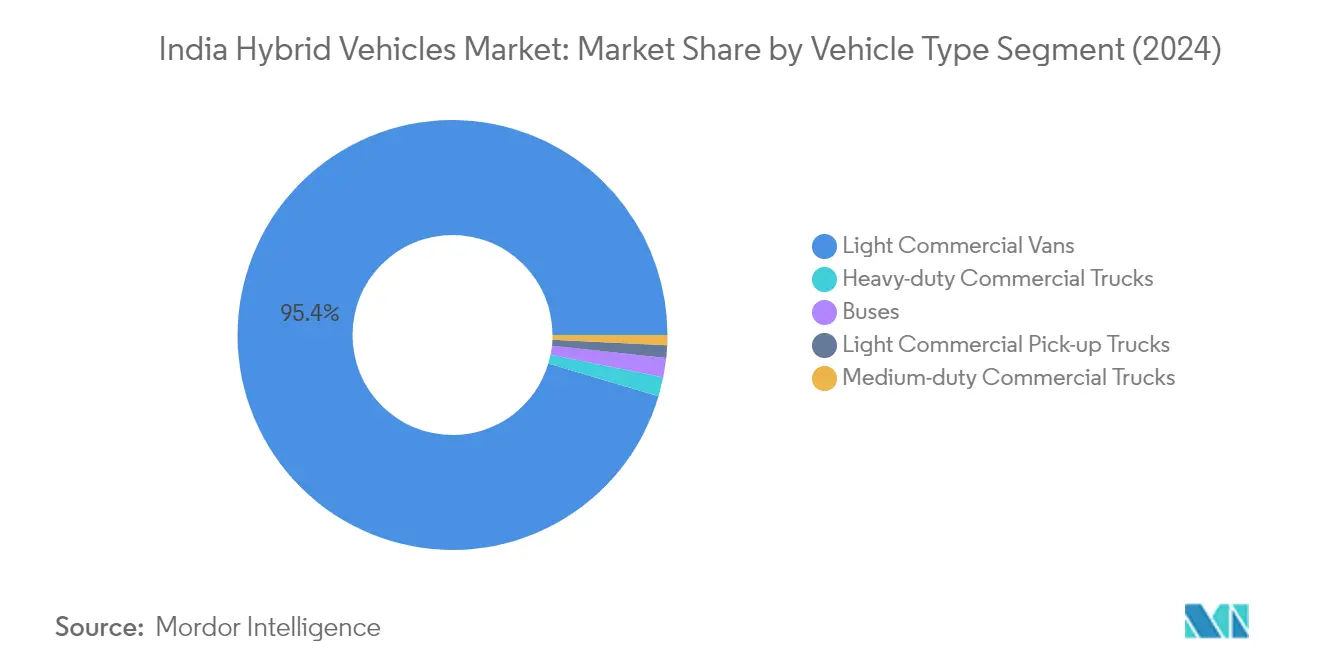
Light Commercial Vans (LCVs) have emerged as the dominant force in India's hybrid vehicle industry, commanding approximately 95% market share in 2024. This overwhelming market leadership can be attributed to several factors, including the segment's versatility in last-mile delivery applications, growing e-commerce activities, and increasing adoption of sustainable transport solutions in urban logistics. The segment's prominence is further reinforced by supportive government policies promoting cleaner commercial transport alternatives and the rising awareness among fleet operators about the long-term cost benefits of hybrid commercial vehicle solutions. Additionally, the availability of various financing options and the expanding charging infrastructure network have made hybrid light commercial vehicles an increasingly attractive option for commercial fleet operators and small businesses alike.

Light Commercial Pick-up Trucks Segment in India Hybrid Vehicles Market
The Light Commercial Pick-up Trucks segment is witnessing remarkable growth in the hybrid commercial vehicle market, demonstrating the strongest growth trajectory among all commercial vehicle segments. This exceptional growth is driven by increasing demand for efficient and environmentally friendly last-mile delivery solutions, particularly in urban and semi-urban areas. The segment's growth is further catalyzed by technological advancements in hybrid drivetrain technologies specifically designed for pick-up trucks, making them more efficient and cost-effective for commercial operations. Additionally, government initiatives promoting cleaner commercial vehicles, coupled with rising fuel costs, are encouraging fleet operators to transition to hybrid pick-up trucks. The segment is also benefiting from expanding charging infrastructure and improving battery technology, which are addressing previous concerns about range and reliability.
Remaining Segments in Vehicle Type
The other segments in India's hybrid system in automotive market, including Heavy-duty Commercial Trucks, Medium-duty Commercial Trucks, and Buses, each play unique roles in the market's development. Heavy-duty Commercial Trucks are gaining traction in long-haul transportation, where hybrid technology offers significant fuel savings. Medium-duty Commercial Trucks are finding applications in regional distribution and construction sectors, benefiting from the balance between payload capacity and operational efficiency offered by hybrid powertrains. The Buses segment is particularly significant in urban public transportation, where hybrid technology helps reduce emissions and operating costs in high-traffic environments. These segments collectively contribute to the market's diversification and demonstrate the versatility of hybrid technology across different commercial vehicle applications.
Competitive Landscape
Top Companies in India Hybrid Vehicles Market
The hybrid car brands in India market is characterized by intense competition among established automotive manufacturers who are rapidly expanding their hybrid offerings. Companies are heavily investing in product innovation, particularly in developing advanced hybrid powertrains and fuel-efficient technologies tailored for Indian driving conditions. Operational agility is demonstrated through flexible manufacturing capabilities, with many players establishing dedicated hybrid vehicle production lines and expanding their existing facilities to accommodate growing demand. Strategic moves include forming technology partnerships for hybrid system development, establishing charging infrastructure, and creating specialized dealer networks for hybrid vehicle sales and service. Market expansion strategies focus on introducing hybrid variants across different vehicle segments, from entry-level to luxury, while simultaneously strengthening after-sales support and maintenance networks across tier-1 and tier-2 cities.
Market Dominated by Global Auto Giants
The Indian hybrid vehicles market exhibits a highly consolidated structure dominated by global automotive conglomerates with a strong local manufacturing presence. These established players leverage their international expertise in hybrid technology while adapting their offerings to meet local market requirements and price sensitivities. The market shows a limited presence of local specialists, as the complex nature of hybrid technology and high development costs create significant entry barriers. Mergers and acquisitions activity primarily revolves around technology acquisitions and strategic partnerships rather than direct company takeovers, with major players focusing on securing critical hybrid powertrain components and battery technology through collaborative ventures.
The competitive dynamics are shaped by the strong presence of Japanese and European manufacturers who have successfully transferred their global hybrid expertise to the Indian market. These companies maintain their market positions through extensive dealer networks, strong brand recognition, and established service infrastructure. Local manufacturing joint ventures have become increasingly important for global players to maintain cost competitiveness and meet local content requirements, while also helping them navigate regulatory frameworks and leverage government incentives for hybrid vehicle production.
Innovation and Localization Drive Future Success
For incumbent players to maintain and expand their market share, focus needs to be placed on developing India-specific hybrid solutions that balance performance with affordability. Success strategies include increasing localization of hybrid components to reduce costs, expanding charging infrastructure networks, and creating comprehensive financing solutions for customers. Companies must also invest in building technical expertise through training programs and establishing research and development centers in India to develop market-specific innovations. Additionally, strengthening relationships with local suppliers and developing a robust supply chain ecosystem will be crucial for long-term success.
Contenders looking to gain ground in the market need to focus on identifying and serving underserved segments while developing innovative business models that address specific market needs. This includes creating hybrid solutions for commercial vehicle segments, developing affordable hybrid options for mass-market segments, and establishing strategic partnerships with established players for technology access. The regulatory environment is expected to become more supportive of hybrid vehicles, with government policies increasingly focusing on reducing emissions and promoting cleaner transportation alternatives. However, companies must remain vigilant about potential changes in subsidy structures and emission norms while also addressing the growing competition from pure electric vehicles in certain segments.
India Hybrid Vehicles Industry Leaders
BMW India Private Limited
Daimler AG (Mercedes-Benz AG)
Honda Cars India Limited
Maruti Suzuki India Limited
Toyota Kirloskar Motor Pvt. Ltd.
- *Disclaimer: Major Players sorted in no particular order


Recent Industry Developments
- October 2023: Maruti Suzuki India Limited (MSIL) announced that its board approved the issue of 12.32 million equity shares of the company to Suzuki Motor Corporation (SMC) for a price of INR 10.4 thousand per share as a consideration for the acquisition of 100% of equity shares of SMG (Suzuki Motor Gujarat). Post allotment of the subscriptions SMC, Japan holding would increase to 58.19% in MSIL.
- August 2023: TVS Motor and BMW Motorrad have been discussing the expansion of their partnership beyond India.
- August 2023: Toyota Kirloskar Motor launched the all-new MPV Vellfire strong hybrid electric vehicle (SHEV) for a starting price of INR 11.99 million to INR 12.99 million.


India Hybrid Vehicles Market Report Scope
Commercial Vehicles are covered as segments by Vehicle Type.Vehicle Type
| Commercial Vehicles | Buses |
| Heavy-duty Commercial Trucks | |
| Light Commercial Pick-up Trucks | |
| Light Commercial Vans | |
| Medium-duty Commercial Trucks |
| Vehicle Type | Commercial Vehicles | Buses |
| Heavy-duty Commercial Trucks | ||
| Light Commercial Pick-up Trucks | ||
| Light Commercial Vans | ||
| Medium-duty Commercial Trucks |


Market Definition
- Vehicle Type - The category includes passenger cars and commercial vehicles.
- Vehicle Body Type - Under Passenger Cars, the category includes Hatchbacks, Sedans, Sports Utility Vehicles, and Multi-purpose Vehicles; for Commercial Vehicles, it covers Light Commercial Pick-up Trucks, Light Commercial Vans, Medium-duty Commercial Trucks, Heavy-duty Commercial Trucks, and Medium and Heavy Duty Buses.
- Fuel Category - The category exclusively covers Hybrid Electric Vehicles (HEV).
| Keyword | Definition |
|---|---|
| Electric Vehicle (EV) | A vehicle which uses one or more electric motors for propulsion. Includes cars, buses, and trucks. This term includes all-electric vehicles or battery electric vehicles and plug-in hybrid electric vehicles. |
| BEV | A BEV relies completely on a battery and a motor for propulsion. The battery in the vehicle must be charged by plugging it into an outlet or public charging station. BEVs do not have an ICE and hence are pollution-free. They have a low cost of operation and reduced engine noise as compared to conventional fuel engines. However, they have a shorter range and higher prices than their equivalent gasoline models. |
| PEV | A plug-in electric vehicle is an electric vehicle that can be externally charged and generally includes all-electric vehicles as well as plug-in hybrids. |
| Plug-in Hybrid EV | A vehicle that can be powered either by an ICE or an electric motor. In contrast to normal hybrid EVs, they can be charged externally. |
| Internal combustion engine | An engine in which the burning of fuels occurs in a confined space called a combustion chamber. Usually run with gasoline/petrol or diesel. |
| Hybrid EV | A vehicle powered by an ICE in combination with one or more electric motors that use energy stored in batteries. These are continually recharged with power from the ICE and regenerative braking. |
| Commercial Vehicles | Commercial vehicles are motorized road vehicles designed for transporting people or goods. The category includes light commercial vehicles (LCVs) and medium and heavy-duty vehicles (M&HCV). |
| Passenger Vehicles | Passenger cars are electric motor– or engine-driven vehicles with at least four wheels. These vehicles are used for the transport of passengers and comprise no more than eight seats in addition to the driver’s seat. |
| Light Commercial Vehicles | Commercial vehicles that weigh less than 6,000 lb (Class 1) and in the range of 6,001–10,000 lb (Class 2) are covered under this category. |
| M&HDT | Commercial vehicles that weigh in the range of 10,001–14,000 lb (Class 3), 14,001–16,000 lb (Class 4), 16,001–19,500 lb (Class 5), 19,501–26,000 lb (Class 6), 26,001–33,000 lb (Class 7) and above 33,001 lb (Class 8) are covered under this category. |
| Bus | A mode of transportation that typically refers to a large vehicle designed to carry passengers over long distances. This includes transit bus, school bus, shuttle bus, and trolleybuses. |
| Diesel | It includes vehicles that use diesel as their primary fuel. A diesel engine vehicle have a compression-ignited injection system rather than the spark-ignited system used by most gasoline vehicles. In such vehicles, fuel is injected into the combustion chamber and ignited by the high temperature achieved when gas is greatly compressed. |
| Gasoline | It includes vehicles that use gas/petrol as their primary fuel. A gasoline car typically uses a spark-ignited internal combustion engine. In such vehicles, fuel is injected into either the intake manifold or the combustion chamber, where it is combined with air, and the air/fuel mixture is ignited by the spark from a spark plug. |
| LPG | It includes vehicles that use LPG as their primary fuel. Both dedicated and bi-fuel LPG vehicles are considered under the scope of the study. |
| CNG | It includes vehicles that use CNG as their primary fuel. These are vehicles that operate like gasoline-powered vehicles with spark-ignited internal combustion engines. |
| HEV | All the electric vehicles that use batteries and an internal combustion engine (ICE) as their primary source for propulsion are considered under this category. HEVs generally use a diesel-electric powertrain and are also known as hybrid diesel-electric vehicles. An HEV converts the vehicle momentum (kinetic energy) into electricity that recharges the battery when the vehicle slows down or stops. The battery of HEV cannot be charged using plug-in devices. |
| PHEV | PHEVs are powered by a battery as well as an ICE. The battery can be charged through either regenerative breaking using the ICE or by plugging into some external charging source. PHEVs have a better range than BEVs but are comparatively less eco-friendly. |
| Hatchback | These are compact-sized cars with a hatch-type door provided at the rear end. |
| Sedan | These are usually two- or four-door passenger cars, with a separate area provided at the rear end for luggage. |
| SUV | Popularly known as SUVs, these cars come with four-wheel drive, and usually have high ground clearance. These cars can also be used as off-road vehicles. |
| MPV | These are multi-purpose vehicles (also called minivans) designed to carry a larger number of passengers. They carry between five and seven people and have room for luggage too. They are usually taller than the average family saloon car, to provide greater headroom and ease of access, and they are usually front-wheel drive. |


Research Methodology
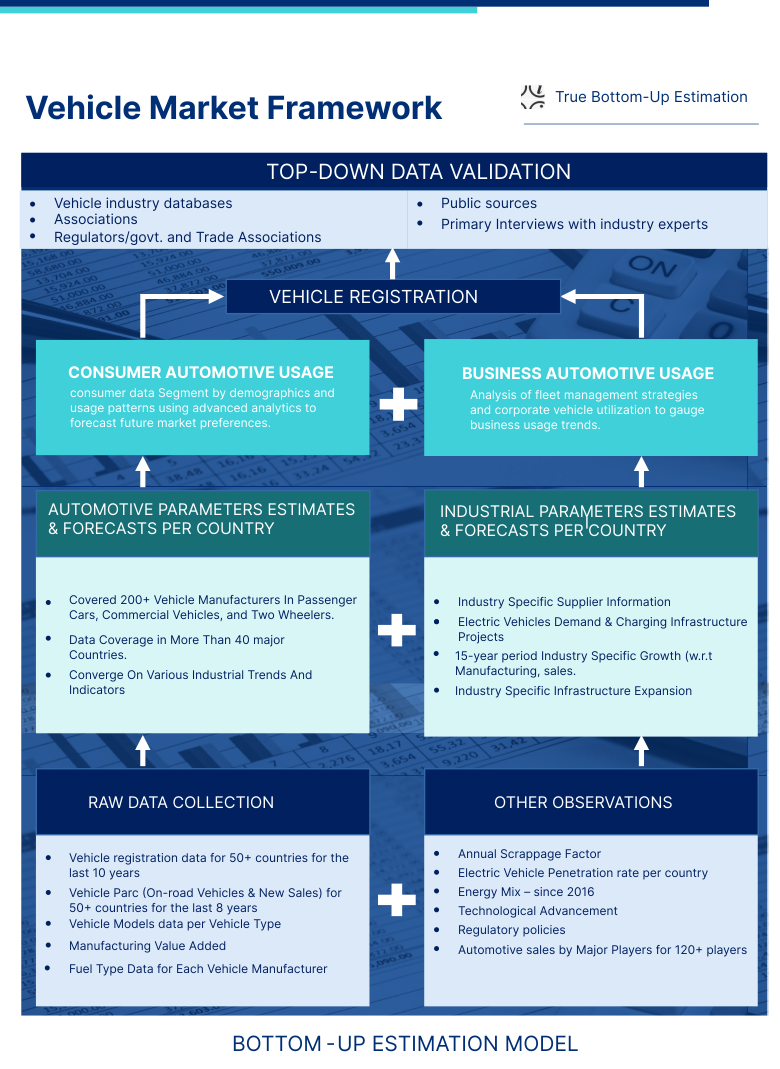
Mordor Intelligence follows a four-step methodology in all its reports.
- Step-1: Identify Key Variables: To build a robust forecasting methodology, the variables and factors identified in Step-1 are tested against available historical market numbers. Through an iterative process, the variables required for market forecast are set and the model is built based on these variables.
- Step-2: Build a Market Model: Market-size estimations for the historical and forecast years have been provided in revenue and volume terms. Market revenue is calculated by multiplying the sales volume with their respective average selling price (ASP). While estimating ASP factors like average inflation, market demand shift, manufacturing cost, technological advancement, and varying consumer preference, among others have been taken into account.
- Step-3: Validate and Finalize: In this important step, all market numbers, variables, and analyst calls are validated through an extensive network of primary research experts from the market studied. The respondents are selected across levels and functions to generate a holistic picture of the market studied.
- Step-4: Research Outputs: Syndicated Reports, Custom Consulting Assignments, Databases & Subscription Platforms.





 Your data is secure and never sold or shared.


