
India Inkjet Printer Market Size and Share
Market Overview
| Study Period | 2020 - 2031 |
|---|---|
| Forecast Data Period | 2026 - 2031 |
| Base Year Market Size (2025) | USD 47.59 Billion |
| Market Size (2026) | USD 49.38 Billion |
| Market Size (2031) | USD 59.39 Billion |
| Growth Rate (2026 - 2031) | 3.76 % |
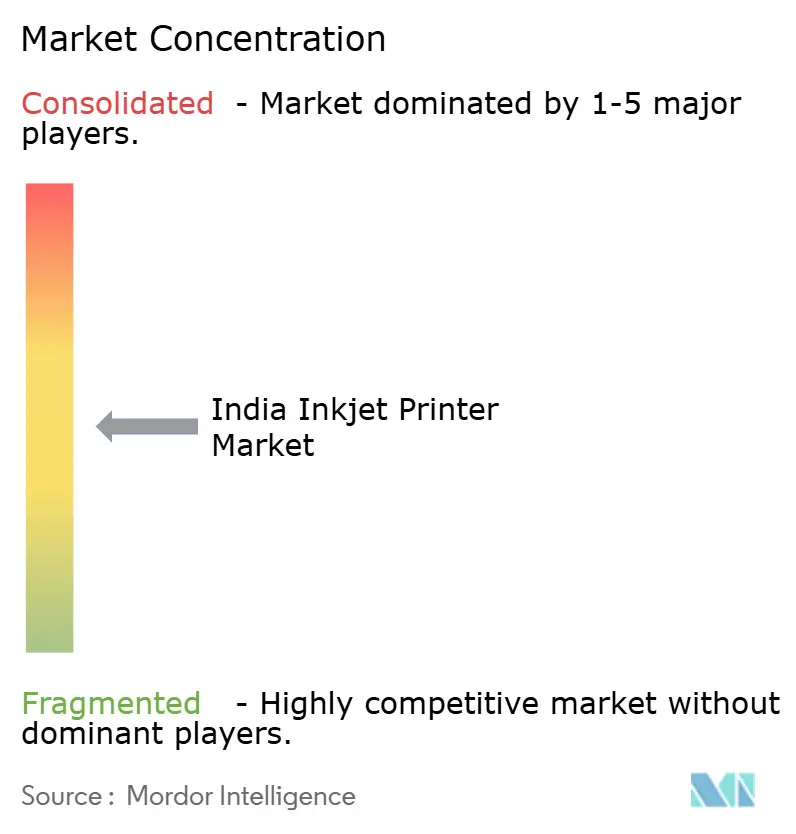
| Market Concentration | Medium |
Major Players *Disclaimer: Major Players sorted in no particular order Image © Mordor Intelligence. Reuse requires attribution under CC BY 4.0. | |
India Inkjet Printer Market Analysis by Mordor Intelligence
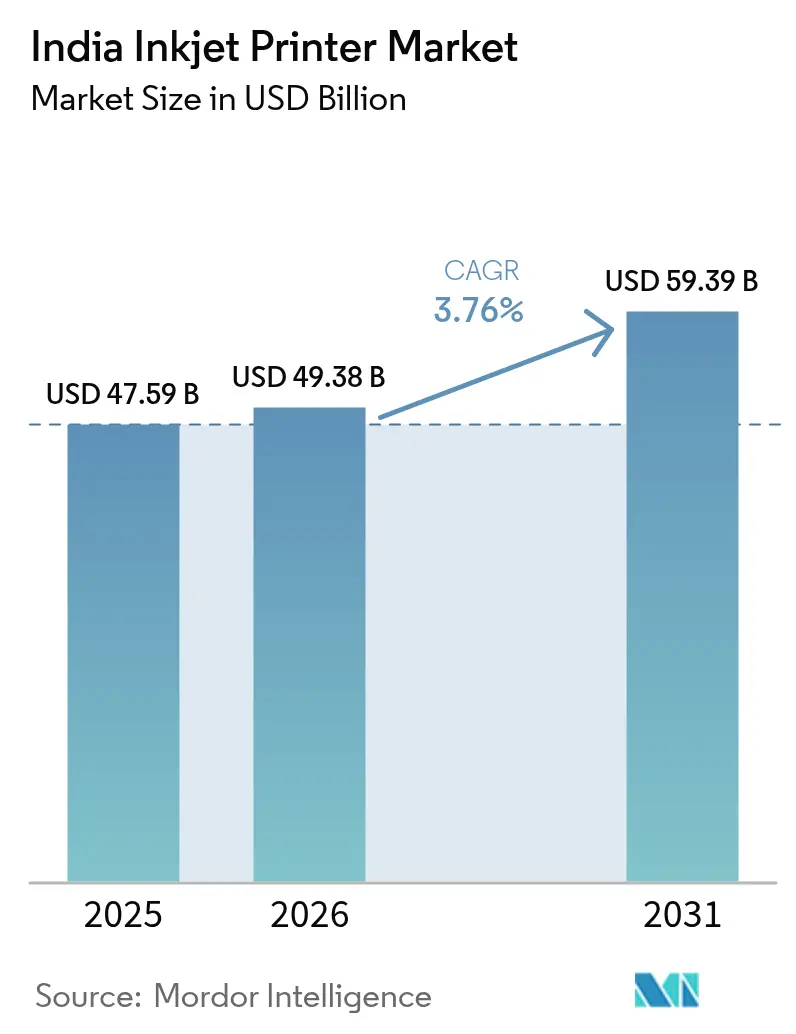
The India inkjet printer market size was valued at USD 47.59 billion in 2025 and estimated to grow from USD 49.38 billion in 2026 to reach USD 59.39 billion by 2031, at a CAGR of 3.76% during the forecast period (2026-2031). Government digitization programs, industrial automation goals, and rising SME demand for low-TCO ink-tank models are strengthening momentum for the India inkjet printer market. Multi-function devices dominate urban offices, while continuous inkjet (CIJ) systems underpin industrial coding lines across pharmaceutical and FMCG plants. Pigment-based inks continue to edge out dye alternatives in commercial settings, yet UV-curable formulations are scaling quickly as manufacturers favor low-VOC chemistries. Global suppliers leverage Make-in-India incentives to localize assembly, but semiconductor sourcing risks and e-waste regulations continue to shape product design across the India inkjet printer market.
Key Report Takeaways
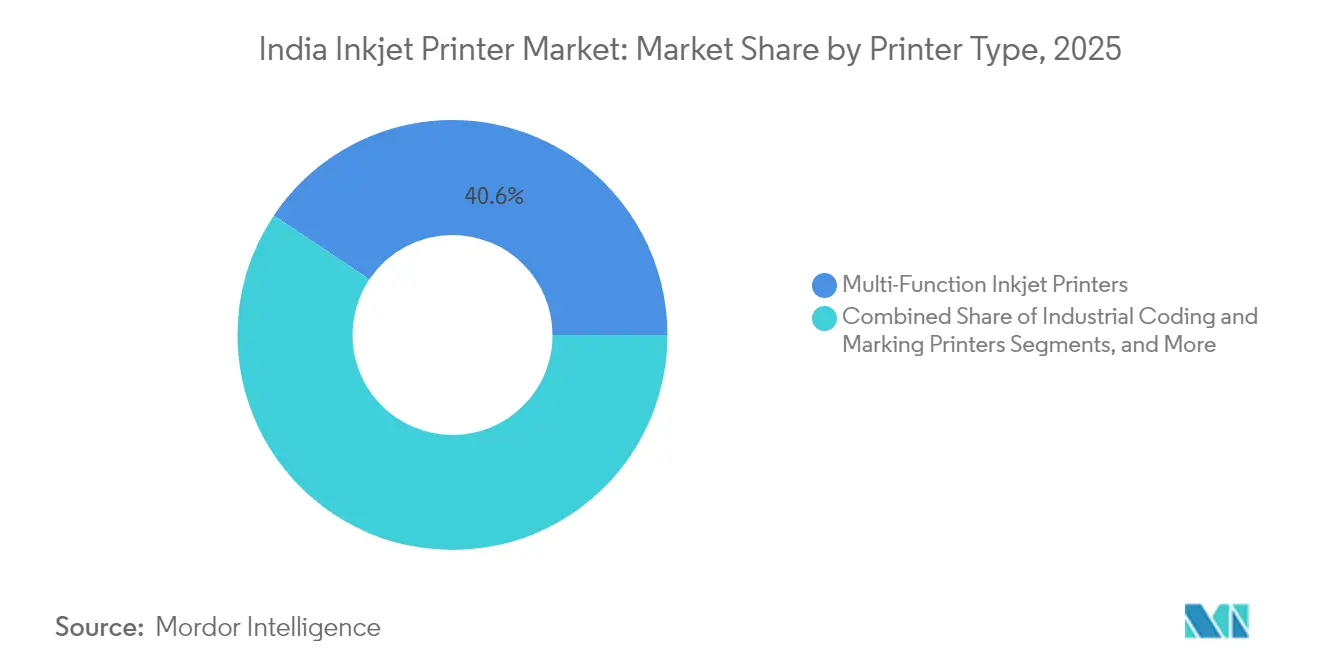
- By printer type, multi-function models led with a 40.61% share of the India inkjet printer market in 2025, while industrial coding and marking equipment is projected to expand at a 5.28% CAGR through 2031, the fastest pace in the segment.
- By end-user industry, packaging held 28.21% of the India inkjet printer market share in 2025, while security printing is set to grow at 5.05% CAGR to 2031.
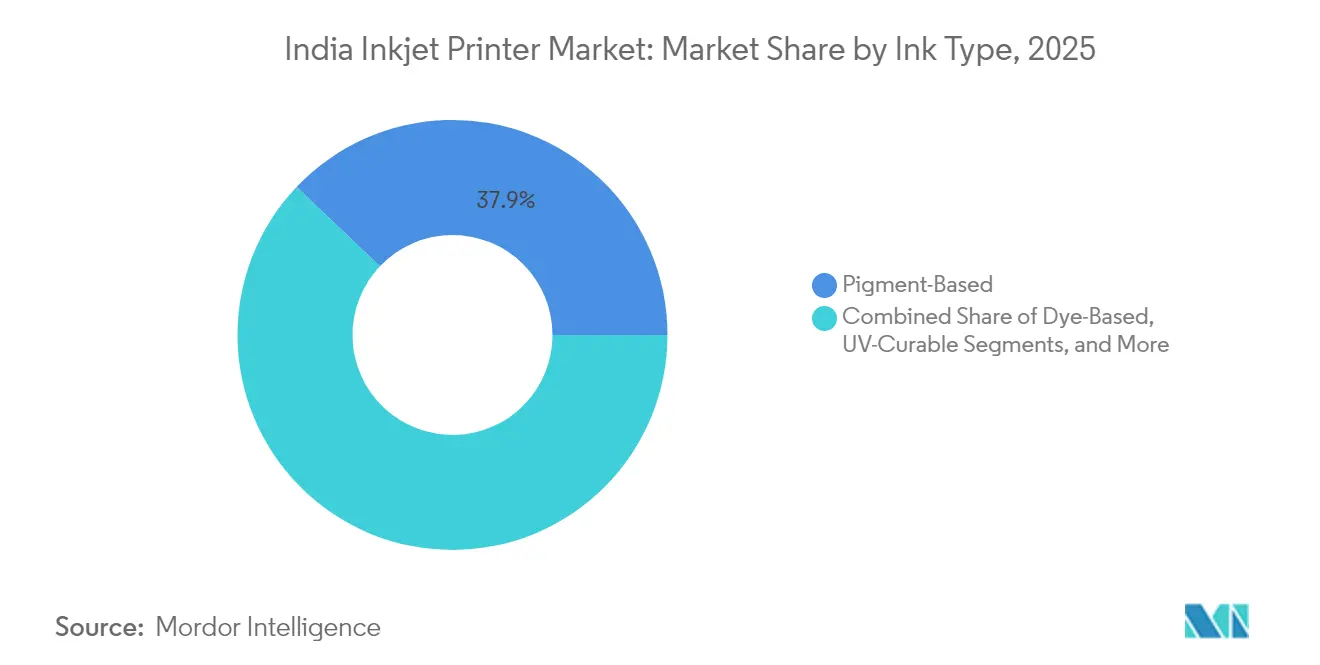
- By ink type, pigment formulations accounted for 37.92% share of the India inkjet printer market size in 2025; UV-curable inks are advancing at a 5.72% CAGR.
- By technology, CIJ systems captured 57.88% of the India inkjet printer market size in 2025, and drop-on-demand platforms are moving ahead at 5.86% CAGR.
Note: Market size and forecast figures in this report are generated using Mordor Intelligence’s proprietary estimation framework, updated with the latest available data and insights as of 2026.
Worldwide, activity is shaped by contributions from multiple countries and regions, with India representing one among them. The global report on inkjet printers market by Mordor Intelligence reflects how these countries and regional layers combine into a single system.
India Inkjet Printer Market Trends and Insights
Drivers Impact Analysis*
| Driver | (~) % Impact on CAGR Forecast | Geographic Relevance | Impact Timeline |
|---|---|---|---|
| Surging SME demand for low-TCO ink-tank models | +1.20% | National, Tier-2 cities | Medium term (2-4 years) |
| Expansion of industrial coding and marking applications | +1.00% | Gujarat, Maharashtra, Tamil Nadu | Short term (≤ 2 years) |
| Government Make-in-India incentives for local assembly | +0.80% | National electronics clusters | Long term (≥ 4 years) |
| Rapid shift to hybrid work driving SOHO printer refresh | +0.70% | Delhi, Mumbai, Bangalore, Hyderabad | Short term (≤ 2 years) |
| Rising penetration of photo-realistic textile printing | +0.5% | Textile clusters: Gujarat, Tamil Nadu, West Bengal | Medium term (2-4 years) |
| Emerging demand from on-demand book publishing | +0.3% | Urban centers with publishing ecosystems | Long term (≥ 4 years) |
| Source: Mordor Intelligence | |||
Surging SME Demand for Low-TCO Ink-Tank Models
SMEs increasingly adopt ink-tank machines that cut per-page costs by up to 90%, propelled by MeitY’s pledge for the digital economy to reach 20% of national income by 2029-30. Epson EcoTank units priced from INR 7,699 to INR 134,999 deliver yields of 7,500 color pages per refill. Government MSME programs amplify uptake as compliance documentation volumes rise. The total cost of ownership edge shifts buying criteria from up-front price to lifecycle value across the India inkjet printer market. Vendors emphasize high-capacity tanks, spill-free bottle designs, and bundled service plans to secure repeat consumable revenue.
Expansion of Industrial Coding and Marking Applications
Pharmaceutical QR-code mandates under Drugs Rules 2022 and FSSAI food-packaging norms push CIJ and thermal inkjet adoption. Videojet and KGK Jet supply serialization lines in Gujarat and Hyderabad, integrating IoT dashboards for real-time quality checks. Nanoparticle security inks using strontium bismuth fluoride strengthen anti-counterfeit defenses, widening the India inkjet printer market opportunity in sensitive document and currency printing. Cross-sector demand now spans dairy, processed foods, and consumer electronics as traceability moves mainstream.
Government Make-in-India Incentives for Local Assembly
Production-linked incentives (PLI) and import-duty offsets drive Canon and HP to ramp Indian output; HP targets 33% local production of PCs and peripherals by 2031 via Dixon and VVDN partnerships. Domestic ink chemistry programs backed by MeitY reduce reliance on imported consumables. Plants in Tamil Nadu, Karnataka, and Uttar Pradesh shorten supply chains and qualify devices for preferential government tenders, reinforcing the India inkjet printer market’s localized competitive edge.
Rapid Shift to Hybrid Work Driving SOHO Printer Refresh
Post-pandemic hybrid policies compress replacement cycles from 5-7 to 3-4 years as firms subsidize home printing allowances. Compact Wi-Fi multifunction devices with duplex output and sub-5-W standby draw lead preferences in metro hubs; Konica Minolta’s bizhub 185en/165en typifies the category. Cloud print management lets IT teams secure dispersed fleets, and energy-efficient specs resonate with environmentally mindful households, sustaining demand across the India inkjet printer market.
Restraints Impact Analysis*
| Restraint | (~) % Impact on CAGR Forecast | Geographic Relevance | Impact Timeline |
|---|---|---|---|
| Intensifying price war with entry-level laser printers | -0.90% | National commercial sites | Short term (≤ 2 years) |
| Counterfeit/refilled ink eroding OEM cartridge revenue | -0.60% | Tier-2 and Tier-3 cities | Medium term (2-4 years) |
| Supply-chain volatility for semiconductors and printheads | -0.50% | Imported component hubs | Short term (≤ 2 years) |
| Growing environmental scrutiny of disposable cartridges | -0.40% | Urban centers with strict e-waste enforcement | Long term (≥ 4 years) |
| Source: Mordor Intelligence | |||
Intensifying Price War with Entry-Level Laser Printers
Brother’s low-cost monochrome laser models rival mid-range ink-tank pricing and deliver higher page yields. Toner cost erosion narrows inkjet TCO benefits in large-volume monochrome scenarios, motivating corporate buyers to reconsider technology mix. Inkjet vendors counter with aggressive pricing, higher-capacity tanks, and value messaging around color versatility and media range to defend India inkjet printer market share.
Counterfeit/Refilled Ink Eroding OEM Cartridge Revenue
Third-party cartridge vendors in Delhi’s Nehru Place and Mumbai’s Lamington Road undercut OEM prices by up to 70%, luring price-sensitive SMEs. Quality inconsistencies risk printhead damage and brand perception, while improper disposal flouts E-Waste Rules 2022, elevating environmental liabilities. OEMs deploy authentication chips, subscription ink delivery, and legal action to safeguard the consumables stream within the India inkjet printer market.
*Our forecasts treat driver/restraint impacts as directional, not additive. The impact forecasts reflect baseline growth, mix effects, and variable interactions.
Segment Analysis
By Printer Type: Multi-Function Dominance Amid Industrial Surge
Multi-function devices held 40.61% of India inkjet printer market share in 2025, reflecting workplace densification and the hybrid model’s need for scan-copy-print versatility . Their compact footprints and wireless connectivity anchor enterprise and SOHO refresh cycles. Industrial coding units, however, are projected to log a 5.28% CAGR, capitalizing on pharmaceutical serialization and FMCG traceability requirements.
Large-format systems gain favor in architecture and textile studios, underpinned by ColorJet’s digital pigment lines that cut water use by 98% . Single-function desktop machines persist in education and small retail niches where acquisition cost remains paramount. Collectively, these dynamics underscore how functional diversity anchors segment resilience across the India inkjet printer market.

By End-User Industry: Packaging Leadership with Security Acceleration
Packaging applications accounted for 28.21% of India inkjet printer market size in 2025, spanning flexible pouches, corrugated cases, and on-pack codes for e-commerce fulfillment. Security printing is slated for a 5.05% CAGR as anti-counterfeit drives lift demand for variable data and covert ink features.
Commercial print shops embrace short-run digital workflows, while textile producers such as Shrinath Cotfab scale direct-to-towel inkjet capability using Zimmer Colaris platforms. On-demand book publishing expands language-specific titles without inventory drag, keeping the India inkjet printer market diversified across end users.
By Ink Type: Pigment Stability Versus UV Innovation
Pigment inks held 37.92% share in 2025, prized for archival durability and outdoor fade resistance. UV-curable sets are poised for 5.72% CAGR as low-VOC mandates and instant-dry features suit packaging and décor substrates.
Eco-solvent blends from ColorJet priced at INR 2,650-2,875 per L offer greener signage options. Dye inks continue in photo kiosks and textile transfers where gamut saturation overrides longevity. Advanced nanoparticle security formulas broaden specialty demand within the India inkjet printer market.
By Technology: CIJ Reliability Meets Drop-on-Demand Precision
CIJ platforms captured 57.88% of India inkjet printer market size in 2025 thanks to non-stop performance on high-speed FMCG lines. Drop-on-demand systems, combining piezo and thermal heads, are advancing at a 5.86% CAGR as printhead reliability rises and variable droplet controls sharpen graphic output.
Patent filings cover nozzle self-seal designs, automated purging, and AI-based droplet sensing that extend uptime. Hybrid architectures pairing CIJ speed with droplet-on-demand resolution emerge for applications needing both code clarity and graphic precision across the India inkjet printer market.
Geography Analysis
Northern and western corridors housing Delhi NCR, Mumbai, and Pune form the largest customer base through corporate HQ clusters and pharma-FMCG plants. HP’s pledge that one in three PCs sold domestically will be Indian-made by 2031 illustrates foreign confidence in local supply chains.Southern states Karnataka, Tamil Nadu, and Andhra Pradesh represent the fastest-growing region, boosted by IT services, textiles, and bulk drugs production. ColorJet’s textile printers resonate in Tirupur and Erode, where digital pigment routes cut water usage and meet international sustainability audits. Eastern states such as West Bengal and Odisha present greenfield opportunities as MSME digitization checklists and industrial corridors expand. Tier-2 and Tier-3 cities across all zones adopt ink-tank models rapidly, supported by strengthened distribution networks and service partners. Region-specific e-waste enforcement shapes product features like cartridge take-back, influencing go-to-market plans within the India inkjet printer market.
Regulatory Landscape
Compliance requirements for inkjet printers in India cut across product safety, environmental stewardship, and packaging or food-contact rules that influence device design and consumables. Printers and plotters sold in India require BIS CRS registration, referenced to IS 13252 (Part 1):2010, with a transition toward the updated IS/IEC 62368-1:2023 that shapes electrical safety documentation, component selection, and import or assembly readiness for OEMs and channel partners.
On sustainability, Extended Producer Responsibility (EPR) authorization from the Central Pollution Control Board (CPCB) applies to printers and cartridges under the E-Waste Management Rules, which pushes OEM take-back programs and traceable recycling partnerships. Packaging-linked regulations also affect ink and labeling choices, including FSSAI requirements for printing inks used on food packaging (IS 15495 under the Food Safety and Standards (Packaging) Regulations, 2018 as amended in 2025). Separately, the Plastic Waste Management (Amendment) Rules, 2026 (notified 31 March 2026) mandate recycled plastic use and marking requirements for packaging, reinforcing demand for durable variable printing and compliant labeling workflows across FMCG and pharma packaging lines.
Value Chain Analysis
The value chain runs from upstream printheads, semiconductors, inks, substrates, and plastics for housings and cartridges to downstream assembly, distribution, and services. Global OEMs (Canon, HP, Epson, Brother) typically combine imported core components, including printheads and electronics, with localized final assembly and channel fulfillment, while industrial coding and marking suppliers such as Videojet and KGK Jet extend the chain through line integration, consumables supply, and uptime-oriented service contracts for FMCG and pharmaceutical plants.
Localization and compliance expectations are increasingly built into midstream activities. Epson's Chennai facility, operational since October 2025, assembles EcoTank printers with local partner RIKUN Manufacturing Pvt. Ltd., shortening lead times and aligning with Make-in-India procurement preferences. Downstream, organized retail and e-commerce channels support volume for consumer and SOHO devices, while managed print services, authorized service centers, and consumables replenishment models help protect OEM economics amid counterfeit or refill pressure and rising EPR obligations under India's e-waste regime.
Competitive Landscape
Global majors Canon, HP, Epson, and Brother lead on distribution breadth, R&D budgets, and brand equity, yet domestic challengers ColorJet India and Control Print gain share through application focus and localized support. Patent intensity remains high; HP alone holds 4,400+ U.S. claims covering fluid-ejection circuits and substrate handling.[1] Sustainability ambitions color rivalry, spurring recyclable cartridges, energy-sipping engines, and closed-loop ink reclamation.
HP’s EMS alliances with Dixon and VVDN add PC and peripheral capacity that can flex into printers, while Canon eyes PLI credits for assembling entry-level models. Supply-chain fluidity, especially in chips and MEMS heads, favors vendors with multi-sourcing footprints. Overall, the India inkjet printer market balances healthy competition with collaborative localization initiatives that lift technology sophistication.
India Inkjet Printer Industry Leaders
-
Seiko Epson Corporation
-
Canon Inc.
-
HP Inc.
-
Brother Industries, Ltd.
-
ColorJet India Limited
- *Disclaimer: Major Players sorted in no particular order
Market Opportunities and Future Outlook
White space is emerging where regulation-driven traceability and sustainability needs intersect with industrial inkjet adoption in packaging. The Plastic Waste Management (Amendment) Rules, 2026 introduce packaging marking and recycled-content requirements, which increases the value of dependable variable-data printing, coding, and label or pack artwork control for converters and brand owners. For food-linked applications, FSSAI packaging rules for inks, with IS 15495 referenced under the Food Safety and Standards (Packaging) Regulations and updated via the 2025 compendium, reinforce demand for compliant ink sets and controlled workflows that support documentation of ink chemistry, migration safety, and process validation.
A second opportunity cluster centers on India-based capability buildout and application enablement. Epson's ink-tank printer manufacturing in Sriperumbudur (Chennai), with an initial capacity cited at 20,000 printers per month and operations commencing in October 2025, provides a concrete platform for faster SKU refreshes and localized configurations for SMEs and government-linked procurement. In industrial and commercial segments, expansion of solution centers and technology centers supports application testing and training, reducing adoption friction for UV inkjet label presses, large-format graphics, and coding systems that integrate IoT dashboards and serialization requirements under pharma and FMCG compliance programs.
Recent Industry Developments
- April 2026: HP Inc. launched the scalable Latex FS70 W printer at Media Expo Mumbai 2026, featuring 6-litre white ink capacity for signage and décor applications. The rollout strengthens HP's penetration in high-volume signage and industrial print segments, expanding throughput and reducing downtime for large format jobs.
- July 2025: Seiko Epson Corporation opened a high-capacity ink tank inkjet printer manufacturing facility in India in collaboration with RIKUN Manufacturing Pvt. Ltd. in Chennai. The plant enlarges local production capabilities, improving supply reliability for enterprise customers in the Indian inkjet segment.
- July 2025: Canon Inc. launched an upgraded imagePRESS V1000 with a vacuum paper feeding deck at Print Expo Chennai 2025. The upgrade enhances print quality and handling efficiency for commercial and in-plant environments, reinforcing Canon's enterprise printing presence.
Research Methodology Framework and Report Scope
Market Definition and Coverage
For this study, the market covers revenue generated in India from inkjet printers and inkjet printing systems sold for home, office, and industrial print needs, counted in value terms and expressed in USD.
Scope exclusions: We exclude laser and impact printers, photocopiers that are not inkjet-based, pure printing services, and paper or media supplies that are not part of printer system revenue.
Segmentation Overview
- By Printer Type
- Single-Function Desktop Inkjet Printers
- Multi-Function Inkjet Printers
- Large-Format Inkjet Printers
- Industrial Coding and Marking Printers
- By End-User Industry
- Books
- Commercial Print
- Advertising Print
- Transactional Print
- Labels
- Packaging
- Security
- Other Print Formats
- By Ink Type
- Dye-Based
- Pigment-Based
- UV-Curable
- Solvent-Based
- Other Ink Types
- By Technology
- Continuous Inkjet (CIJ)
- Drop-on-Demand
- Thermal Inkjet (TIJ)
- Piezoelectric Inkjet (PIJ)
Data Sources, Market Sizing, and Validation
Desk Research
Desk research helped us set the guardrails for the model before speaking to market participants. We referred to public and official sources that clarify India print demand and trade flows, such as the Ministry of Commerce and Industry trade statistics, the Directorate General of Commercial Intelligence and Statistics, the World Bank, the International Telecommunication Union, and the UNESCO Institute for Statistics (for education-linked print indicators). We also reviewed India policy and standards references relevant to electronics products, plus publicly available customs and import trend commentary from reputed press.
On the supply side, we used company annual reports, investor decks, and statutory filings to understand product mix, channel approach, and price positioning. Patent databases were used selectively to understand technology direction in printheads and inks, and an import-export shipment-level database was used to validate the direction of printer shipments and mix at a high level. The sources listed here are illustrative and not exhaustive, and many other references were used for data collection, cross-checks, and clarification during the study.
Primary Interviews and Surveys
Primary work was used to verify what desk research could not fully explain, especially pricing movement, channel margins, and what share of demand comes from home, office, and industrial coding and marking use cases. We spoke with a balanced set of respondents across distributors, resellers, service partners, large buyers, and industry specialists, and inputs were checked across India demand clusters to reduce single-city bias.
Distribution of primary research fieldwork respondents
| Company type | Respondent position |
|---|---|
| Top tier: 38% | CXOs: 14% |
| Mid tier: 47% | Functional/Unit leaders: 31% |
| Smaller Players: 15% | Managers: 55% |
Market-Sizing & Forecasting
We built the India inkjet printer market using a top-down demand reconstruction, where India print demand by format (for example, books, commercial print, advertising print, transactional, labels, packaging, and security) is converted into inkjet adoption and then into system value using realistic price points. To keep the totals grounded, results were then corroborated using selective bottom-up checks, such as sampled average selling price (ASP) x estimated units for key printer classes and channel checks on shipment direction, and then adjusted when gaps appeared.
A few practical inputs were tracked because they move the market in an explainable way. These include import and shipment trend direction, replacement cycles for home and office devices, the installed base shift toward multi-function units, industrial coding and marking line additions, and ASP movement by ink technology (dye, pigment, UV-curable, and solvent-based). Where bottom-up visibility was weak, we used bounded ranges based on interview consensus and public signals, and then picked mid-points that matched independent trade and consumption indicators.
For forecasting, scenario analysis was used so that the outlook reflects plausible ranges for education and office printing, industrial packaging activity, and pricing pressure. Assumptions for each driver were reviewed with primary respondents, and the final forecast was taken only after the driver paths stayed consistent with India macro and trade signals.
Data Validation & Update Cycle
Before sign-off, model outputs are checked against independent signals such as trade direction, replacement behavior cues, and pricing movement observed through channels. If a value looks off, the driver assumptions are revisited, the math is re-run, and follow-up calls are triggered with the most relevant respondent group.
A second analyst reviews the logic, inputs, and calculations to catch mismatches and ensure the scope rules are applied consistently across years. Reports are refreshed annually, and interim updates are made when material events shift pricing, supply availability, or demand conditions. Before delivery, we do a final pass so clients receive the latest updated view.
Mordor Intelligence's India Inkjet Printer Market Size Versus Other Published Estimates
Published market sizes for India inkjet printers can look far apart because the underlying scope is not always the same, and because pricing and shipment assumptions are handled differently. We also see differences when one estimate is built from print-format demand signals, and another is built from device shipment snapshots or a narrower buyer group.
Import shipment direction, print-format demand signals, and ASP checks through channel discussions are the anchors that tie Mordor Intelligence to a system-value view of inkjet across home, office, and industrial applications, rather than only one end-user slice. When these anchors are not used together, totals can drift, especially if labels and packaging inkjet systems are either folded in too broadly or left out entirely.
Benchmark comparison
| Source | Market Size | Gaps in Research Methodology |
|---|---|---|
| Mordor Intelligence | USD 47.59 B (2025) | |
| Industry Portal A | USD 1.55 B (2025) | This figure appears to focus mainly on consumer or device-only revenue and can undercount industrial inkjet systems used in coding, labeling, and packaging lines, which lifts the total value in broader-scope models. |
| Trade Publication B | USD 2.15 B (2025) | This estimate is typically closer to printer unit shipments multiplied by a blended ASP, which can miss higher-value industrial configurations and can also treat multi-function inkjet differently across channels and use cases. |
Looking at the spread, the biggest driver is usually what gets counted as part of inkjet in India, and how industrial coding and packaging-related inkjet value is treated. By keeping scope rules explicit and tying the math to observable demand and pricing signals, we end up with a total that is easier to trace and re-create year after year.
Key Questions Answered in the Report
What is the forecast value of the India inkjet printer market by 2031?
The market is projected to reach USD 59.39 billion by 2031.
Which printer type leads sales in India?
Multi-function inkjet models held 40.61% share in 2025.
Which segment is expected to grow fastest through 2031?
Industrial coding and marking printers are forecast to expand at a 5.28% CAGR.
Why are UV-curable inks gaining traction?
They meet low-VOC regulations and cure instantly, supporting packaging and décor applications.
What regional areas are expanding quickest?
Southern states, notably Karnataka and Tamil Nadu, are the fastest-growing due to IT, textile, and pharma investments.
How are OEMs combating counterfeit ink?
They deploy authentication chips, subscription delivery, and legal enforcement to protect consumables revenue.