
India D2C E-commerce Market Size and Share
Market Overview
| Study Period | 2020 - 2031 |
|---|---|
| Forecast Data Period | 2026 - 2031 |
| Base Year Market Size (2025) | USD 87.5 Billion |
| Market Size (2026) | USD 108.76 Billion |
| Market Size (2031) | USD 322.1 Billion |
| Growth Rate (2026 - 2031) | 24.30 % |
| Market Concentration | Low |
Major Players *Disclaimer: Major Players sorted in no particular order Image © Mordor Intelligence. Reuse requires attribution under CC BY 4.0. | |
India D2C E-commerce Market Analysis by Mordor Intelligence
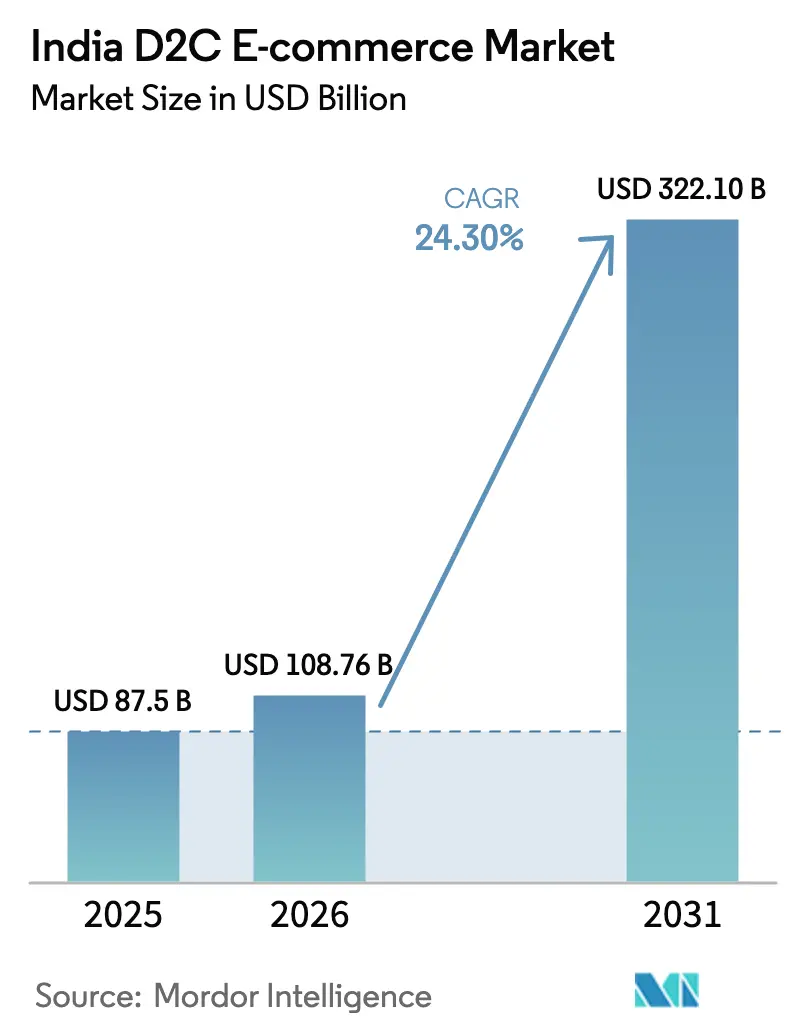
The India D2C E-commerce market size was valued at USD 87.5 billion in 2025 and estimated to grow from USD 108.76 billion in 2026 to reach USD 322.1 billion by 2031, at a CAGR of 24.30% during the forecast period (2026-2031). Intensifying smartphone adoption in tier-2 and tier-3 cities, the nationwide rollout of the Open Network for Digital Commerce (ONDC), and GST-enabled logistics efficiencies are accelerating direct-to-consumer adoption and reducing structural frictions for brands. Delhi NCR retains leadership thanks to high disposable incomes and same-day delivery coverage for 60% of pin codes, yet Hyderabad’s cost advantages and supportive start-up ecosystem position it as the fastest-growing city node. Working-capital stress, driven by 25-30% cash-on-delivery (COD) return rates, has catalyzed revenue-based financing models that extend 15-30% of monthly sales as quick liquidity, sustaining scale-up ambitions for capital-efficient brands. Inflation in digital marketing cost-per-click (CPC) and stricter data-privacy norms compel brands to diversify toward social and community commerce channels, with live-commerce conversion rates six to eight times higher than display advertising
Key Report Takeaways
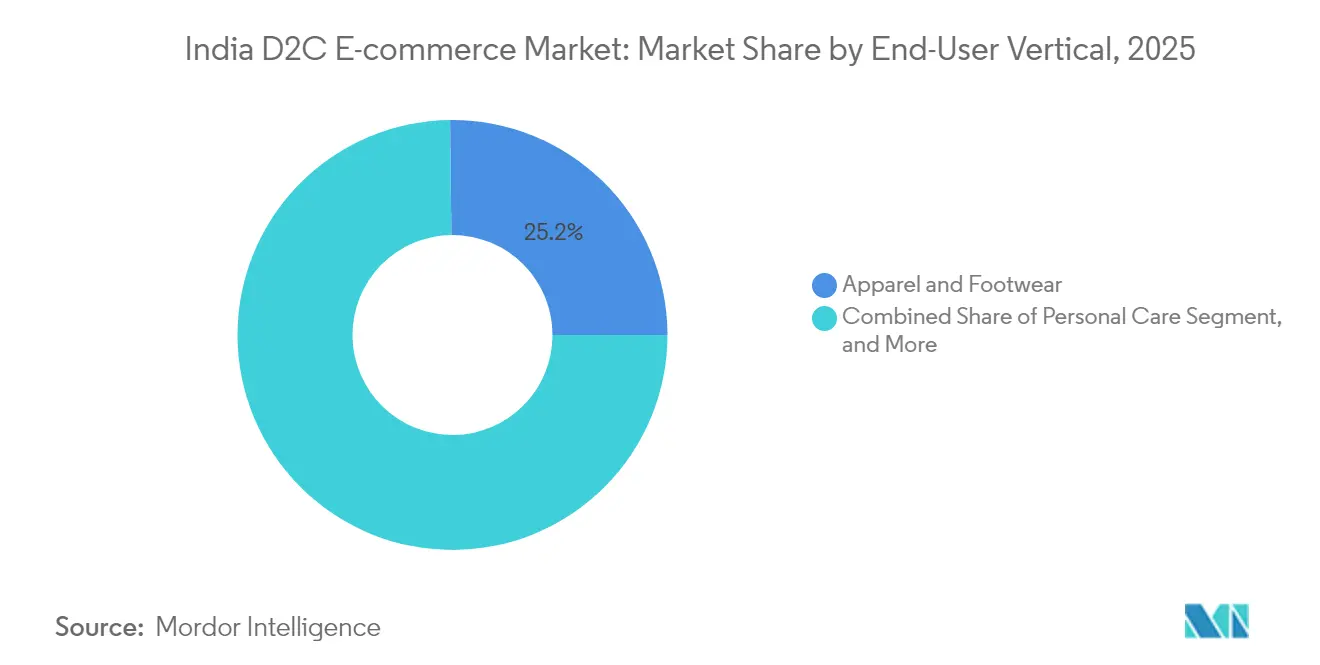
- By end-user vertical, Apparel and Footwear led with 25.18% of India D2C E-commerce market share in 2025, while Personal Care is projected to advance at a 24.92% CAGR to 2031.
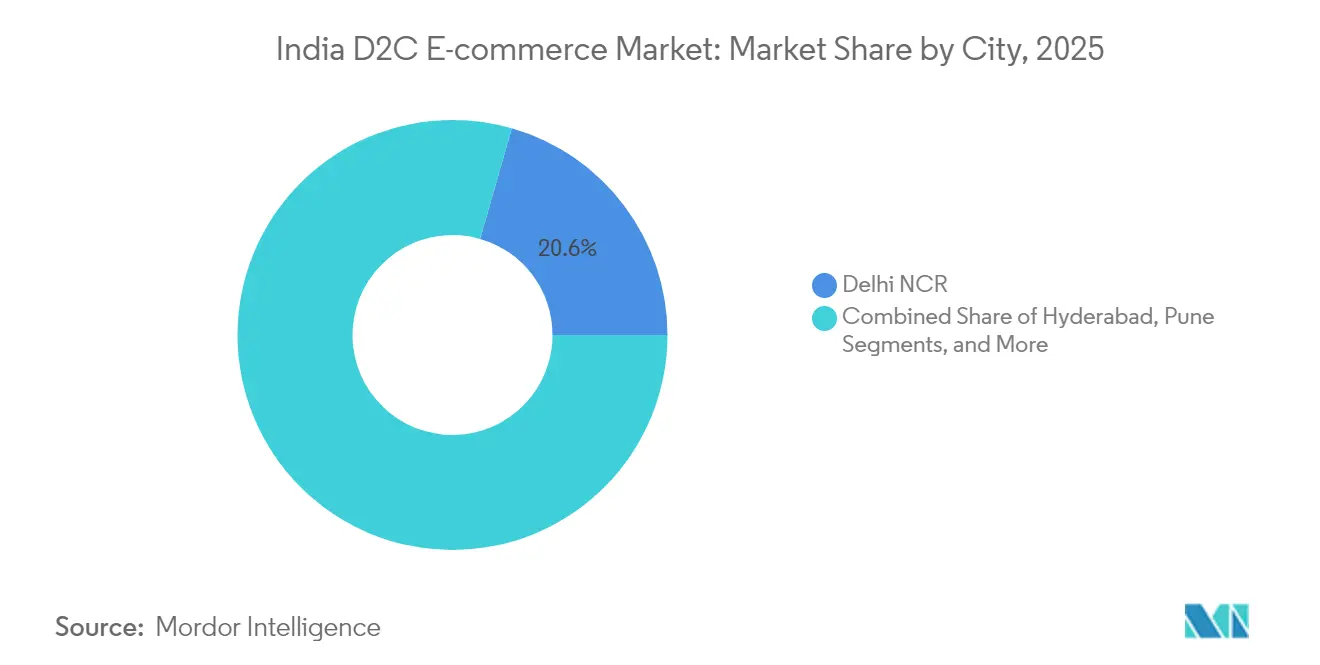
- By city cluster, Delhi NCR held 20.55% share of the India D2C E-commerce market size in 2025, whereas Hyderabad is forecast to expand at a 25.10% CAGR through 2031.
Note: Market size and forecast figures in this report are generated using Mordor Intelligence’s proprietary estimation framework, updated with the latest available data and insights as of 2026.
India D2C E-commerce Market Trends and Insights
Drivers Impact Analysis*
| Driver | (~) % Impact on CAGR Forecast | Geographic Relevance | Impact Timeline |
|---|---|---|---|
| Accelerating VC/PE Funding Into D2C Brands | +4.2% | National, with concentration in Bengaluru, Mumbai, Delhi NCR | Medium term (2-4 years) |
| GST-Enabled Nationwide Logistics Efficiencies | +3.8% | National, with early gains in tier-2/3 cities | Long term (≥ 4 years) |
| Rise of ONDC and Open-API Commerce Infrastructure | +2.5% | National, pilot markets in Bengaluru, Delhi, Bhopal | Short term (≤ 2 years) |
| Tier-2/3 Smartphone Penetration Boosting Online First-Purchases | +2.8% | Tier-2/3 cities across all states | Medium term (2-4 years) |
| Social-Commerce-Led Community Group Buying Momentum | +1.8% | National, stronger in vernacular-speaking regions | Short term (≤ 2 years) |
| Gen-Z Preference for Sustainable, Native Made-in-India Labels | +1.5% | Urban centers, expanding to tier-2 cities | Long term (≥ 4 years) |
| Source: Mordor Intelligence | |||
Accelerating VC/PE funding into D2C brands
Selective capital deployment is favoring enterprises with positive contribution margins, sustained 15-20% monthly revenue growth, and proven retention economics, even though overall funding slipped to USD 757 million in 2024.[1]D2C Funding Declines to USD 757M in 2024 from USD 930M in 2023, VCCEdge, vccedge.com Large rounds now emphasize supply-chain automation, headless commerce platforms, and AI-driven personalization, positioning funded companies such as boAt to target IPOs in 2025 at USD 300-500 million valuations. Revenue-based lenders, led by Recur Club, allocated INR 150 crore (USD 18 million) during 2024 to alleviate COD-related working-capital gaps. Consolidation is accelerating, enabling well-capitalized players to absorb niche labels and widen stock-keeping units (SKUs) without commensurate marketing-spend escalation. Capital discipline thereby converts funding scarcity into a market-share opportunity for operators with efficient cost structures.
GST-enabled nationwide logistics efficiencies
Unified GST has lowered interstate transit dwell time, trimmed logistics costs by 20-25%, and enabled 2-3-day delivery to 19,000+ pin codes through third-party carriers.[2]GST Impact on Logistics Efficiency, Ministry of Finance, finmin.nic.in Centralized fulfillment now suffices for categories like apparel, reducing inventory duplication across hubs and cutting administrative overhead by up to 18%. Small D2C entrants can scale nationally without recreating regional warehousing, while established brands re-optimize network footprints to free working capital. Harmonized e-invoicing also simplifies returns reconciliation, a critical element given COD reversal volumes. Over the long term, lower distribution frictions are expected to widen the India D2C E-commerce market by pulling underserved pin codes into viable service radii.
Rise of ONDC and open-API commerce infrastructure
ONDC enables an interoperable buyer-seller discovery layer with commission ceilings near 3%, compared with 15-25% typical of incumbent marketplaces. More than 700,000 vendors have already joined, while plug-and-play seller apps from players such as Fynd integrate logistics, payments, and customer support. Early adopters report 15-20% lower acquisition costs and faster basket-build rates. The protocol levels discovery for niche labels and catalyzes participation from local manufacturers that lacked the technology stack to sell nationally. As interoperability matures, platform dependency risks recede, rebalancing the negotiating power toward brand owners and expanding consumer choice within the India D2C E-commerce market.
Tier-2/3 smartphone penetration boosting online first-purchases
Smartphone reach in tier-2/3 zones hit 78% in 2024, creating 150 million new digital consumers, 65% of whom complete a first online purchase within six months of device ownership. Orders from small towns now exceed 50% of GMV on platforms such as Meesho, validating vernacular content and price-conscious assortments. COD remains preferred by 70% of these shoppers, necessitating robust returns management and credit-risk analytics. Brands tailoring regional aesthetics, localized sizing, and value packs witness elevated repeat rates. Improved 4G coverage and Unified Payments Interface (UPI) adoption underpin digital wallet usage, gradually shifting COD volumes into prepaid modes that enhance cash-flow cycles.
Restraints Impact Analysis*
| Restraint | (~) % Impact on CAGR Forecast | Geographic Relevance | Impact Timeline |
|---|---|---|---|
| Escalating Digital Marketing CPA Inflation | -2.8% | National, more severe in competitive categories like beauty and fashion | Short term (≤ 2 years) |
| Fragmented Cold-Chain for Grocery and Perishables | -1.5% | Tier-2/3 cities, rural areas with limited infrastructure | Medium term (2-4 years) |
| Low Repeat-Purchase Rates Beyond Top 5 Metros | -1.2% | Tier-2/3 cities, smaller urban centers | Medium term (2-4 years) |
| High Working-Capital Cycle Due to Cash-on-Delivery Returns | -0.8% | National, with higher impact in price-sensitive segments | Short term (≤ 2 years) |
| Source: Mordor Intelligence | |||
Escalating digital-marketing CPA inflation
Google Ads CPC rose between 30% and 100% across categories in 2024, while Facebook CPM climbed 25–40%, lifting acquisition costs to INR 800–1,200 per new customer. Apple’s privacy policy shifts further erode attribution precision, swelling unoptimized spend. Brands with lower average-order values, such as personal care, must extend payback periods or optimize retention loops to preserve contribution margin. Heavier competition in auction-based media favors capital-rich players, compressing visibility for emerging labels. In response, operators allocate larger budgets to owned media, referral incentives, and loyalty tiers, emphasizing lifetime-value realization over top-of-funnel volume.
Fragmented cold-chain for grocery and perishables
Only 4% of fresh produce currently traverses temperature-controlled transit, against 25% benchmarks in developed economies. In tier-2/3 geographies, 15–20% of cold-storage nodes experience power downtime, elevating spoilage and brand-reputation risk. Capital expenditure of INR 15–20 million per regional cold hub is prohibitive for smaller D2C entrants seeking geographic expansion. Last-mile wastage in temperature-sensitive categories averages 8–12% versus 2–3% for ambient products, undermining margin potential. Until integrated cold-chain networks scale, grocery and gourmet D2C offerings will skew toward shelf-stable SKUs or concentrate service in metropolitan zones.
*Our forecasts treat driver/restraint impacts as directional, not additive. The impact forecasts reflect baseline growth, mix effects, and variable interactions.
Segment Analysis
By End-User Vertical: Personal Care Accelerates Past Fashion
Apparel and Footwear accounted for 25.18% of India D2C E-commerce market share in 2025, reflecting early-mover depth in catalog breadth and influencer partnerships. However, Personal Care is poised to compound at a 24.92% CAGR to 2031 as premium beauty GMV expands toward USD 3 billion on the back of AR try-ons, AI diagnostics, and 12–24 micro-collections each year. Skincare alone advances at a 14.6% trajectory, with clean-label formulations and dermat-backed claims converting skeptical first-time buyers. High lifetime value, often exceeding INR 2,000, makes Paid Social breakevens feasible despite rising CPC.
Adjacent segments mirror divergent headwinds and tailwinds. Grocery growth is tethered to cold-chain deficiencies yet feels uplift from quick-commerce models that rotate inventory within 20 minutes, a dynamic elevating demand for revenue-based financing to fund rolling stock. Home Décor benefits from the remote-work paradigm, with furniture subscriptions reducing upfront purchase inertia. Healthcare-adjacent D2C blends prescription fulfillment and teleconsults, driving adherence-based revenue stability. Jewelry leverages virtual try-on engines to bridge tactile gaps inherent in online gold and gems trading, while BIS certification complexity in electronics raises entry barriers that safeguard incumbents.



By City: Hyderabad Outpaces Delhi NCR Growth
Delhi NCR captured 20.55% of India D2C E-commerce market size in 2025, underpinned by INR 8.5 lakh average household income and 85% digital shopping penetration. Same-day coverage on six of ten pin codes undergirds premium-segment fulfilment, but heightened advertising competition inflates CAC up to 50% above other metros. Hyderabad, by contrast, enjoys 25.10% annual growth, aided by lower warehouse rents, proximity to the South’s manufacturing belt, and strategic governmental incentives. Bengaluru’s tech ecosystem maintains leadership in AI-driven personalization, though real-estate burdens compress margin for inventory-heavy segments.
Second-tier urban clusters, Pune, Chandigarh, Coimbatore, and Indore, benefit from tier-2 smartphone momentum and ONDC’s low-cost rails. COD remains dominant at 70%, necessitating advanced returns forecasting and fraud-mitigation algorithms. Brands customizing regional catalogues and vernacular support observe elevated repeat ratios. The geographic spread underscores the imperative for elastic fulfillment models capable of scaling nationwide without inflating fixed cost bases, reinforcing the long-run appeal of the India D2C E-commerce market.
Geography Analysis
Delhi NCR’s same-day promise covers 60% of addresses and underpins luxury consumption patterns, translating to ticket sizes 22% higher than the national average. Nonetheless, retention economics rely on precision segmentation that nudges one-month reorder windows rather than acquisition revolutions. Mumbai’s affluent catchment fuels discretionary outlays in jewelry and high-end Personal Care, where authenticity badges and limited editions justify gross margins north of 60%. Bengaluru, housing India’s densest tech talent pool, exhibits the highest penetration of AI-powered shopping journeys, though SKU proliferation strains warehousing footprints.
Hyderabad’s composite of industrial policy, maturing IT workforce, and lower overheads delivers the fastest compounded growth, making it a launch pad for South-bound expansion. Chennai and Kolkata, while smaller in overall GMV, illustrate cultural resonance with regional language merchandising and festival-linked micro-collections. Significantly, tier-2/3 conurbations, collectively termed “Other Cities”, represent the next big frontier: 150 million newly banked mobile users, 70% COD reliance, and elevated time spent on short-video platforms create fertile terrain for live commerce and community buying. ONDC’s zero-gatekeeper model further unlocks logistics reach for indigenous labels, compressing go-to-market durations.
Regulatory Landscape
India D2C e-commerce operates under a layered compliance framework anchored by the Consumer Protection (E-Commerce) Rules, 2020, which require clear disclosures, grievance redressal, and fair marketplace practices. Data handling has tightened under the Digital Personal Data Protection (DPDP) Act, 2023, raising the compliance bar for consent, security controls, and breach readiness, with penalties that can reach INR 250 crore for repeated non-compliance.
Product and listing compliance is also becoming more operationally explicit for online selling. The Legal Metrology (Packaged Commodities) Amendment Rules, 2026 introduce additional e-commerce-facing disclosure requirements, including a searchable country-of-origin filter effective from July 1, 2026, which increases the importance of accurate catalog governance for D2C brands. BIS guidance on e-commerce self-governance, alongside GST requirements for inter-state e-commerce suppliers (including registration triggers under CGST provisions), shapes how brands handle invoices, warehousing registrations, and returns workflows at scale.
Value Chain Analysis
The India D2C e-commerce value chain begins with product design and sourcing, including in-house manufacturing, contract manufacturers, and private label partners. This is followed by compliance-ready packaging and labeling that supports category standards, including BIS-aligned expectations where applicable and FSSAI-licensed processes for food-led D2C.
Brands then run a commerce stack across storefront (brand site/app), product information management and catalog operations, payments (UPI/cards/wallets and COD), and customer service, while marketing continues to shift toward owned and social/community channels as performance-media costs rise. Order orchestration and fulfillment rely on multi-node warehousing, last-mile partners, and returns processing, tied to GST-enabled documentation and registration requirements that support inter-state shipping and reconciliation. ONDC adds an interoperable layer to connect sellers to buyer apps, logistics providers, and payment rails through open protocols, reducing dependence on a single marketplace interface. As country-of-origin filters and disclosure rules become more searchable and standardized on platforms, brands are investing more in backend data quality, labeling discipline, and automated compliance checks to protect conversion and reduce post-order disputes and returns.
Competitive Landscape
More than 15,000 active brands define a fractured landscape; yet liquidity tightening is accelerating roll-ups and opportunistic mergers. Category concentration diverges: Personal Care remains atomized with sub-1% shares for most operators, whereas electronics and jewelry trend toward oligopolistic clusters due to certification hurdles and capital intensity. Three strategic playbooks characterize the field. Venture-backed scale-chasers burn marketing outlays to seize mind-share, but face scrutiny on contribution margin sustainability. Bootstrapped craftspeople lean into authenticity, sustaining profitability through micro-cultures and organic word-of-mouth. Hybrid models tap revenue-based debt to smoothing inventory cycles while avoiding equity dilution.
Technology sophistication constitutes the principal moat. Leaders deploy machine-learning engines for bundle recommendations, automated returns grading, and dynamic pricing calibrated to competitor feeds. Mid-tail players still juggle spreadsheets, manifesting stock-outs and shipping delays that erode Net Promoter Scores (NPS). Geographic whitespace at the tier-2/3 frontier invites regional newcomers adept in vernacular interfaces. ONDC’s leveling effect heightens pressure on legacy marketplaces, enabling smaller labels to reach nationwide demand without onerous listing fees. In sum, advantage migrates toward operators uniting capital discipline, tech agility, and compliance infrastructure.
India D2C E-commerce Industry Leaders
Wakefit Innovations Private Limited
Honasa Consumer Limited (Mamaearth)
Imagine Marketing Limited (boAt Lifestyle)
Delightful Gourmet Private Limited (Licious)
InnoVision Jewellery India Private Limited (Melorra)
- *Disclaimer: Major Players sorted in no particular order


Market Opportunities and Future Outlook
ONDC participation provides a lower-fee discovery and transaction pathway for D2C brands, with the network reporting 700,000+ onboarded vendors and commission ceilings referenced near 3% in market discussions. Combined with vernacular-first acquisition and community commerce, it supports outreach to tier-2/3 demand, where smartphone penetration reached 78% in 2024 and COD remains structurally important, driving the need for tighter fraud controls, improved returns forecasting, and more flexible financing to manage working-capital cycles.
Cross-border and adjacent-category expansion also reflects policy and company actions. The draft Digital Trade Facilitation Bill, 2026 proposes legal recognition for electronic trade documents, which can reduce friction for export-linked D2C workflows that depend on documentation and verification. In category adjacency, D2C leaders are widening portfolios into health-led consumption, and Honasa Consumer is incorporating a subsidiary, Honasa Health, in July 2026 to scale a B2C nutrition portfolio. This reinforces the whitespace for brands that combine compliant claims, strong data governance under DPDP, and omnichannel distribution to reduce reliance on paid digital acquisition alone.
Recent Industry Developments
- June 2026: Senco Gold extended the acquisition deadline for August Jewellery Private Limited, the Melorra unit, to September 30, 2026. The extension reinforces jewellery e-commerce consolidation by bridging digital-first channels with traditional retail distribution and supporting Melorra related growth. The change preserves deal momentum while allowing more time for integration planning for increased online presence.
- May 2026: Licious Mother of All Momos campaign reaches 18.54 million consumers, driving 5x growth in key markets. The campaign expands the D2C meat and food category footprint and strengthens brand resonance across urban and regional markets. Category diversification and hybrid offline online expansion are aimed at improving reach and brand strength.
- April 2026: Licious reports net revenue of ₹1,166 crore for FY26, up approximately 47 percent year over year. The growth signals stronger scale and validates the company's financial trajectory for continued offline and online expansion. It strengthens the perception of scale and financial momentum as it supports further offline and online expansion.


Research Methodology Framework and Report Scope
Market Definition and Coverage
For this study, the India D2C e-commerce market is defined as the value of online sales generated by brands that sell directly to end customers through their own website or branded app, and then fulfill those orders through their chosen delivery setup.
Scope exclusions: We exclude online sales that are executed through third-party marketplaces or similar intermediated selling routes, even if the brand is the same.
Segmentation Overview
- By End-User Vertical
- Apparel and Footwear
- Grocery and Gourmet
- Personal Care
- Home Décor and Household Supplies
- Healthcare
- Jewelry
- By City
- Delhi NCR
- Mumbai Metropolitan Region
- Bengaluru
- Hyderabad
- Chennai
- Kolkata
- Pune
- Other Cities
Data Sources, Market Sizing, and Validation
Desk Research
Desk research was used to set the market boundaries, build a clean list of active D2C brands, and understand how much of India online buying flows through brand-owned storefronts versus other routes. We leaned on public indicators such as Reserve Bank of India and Ministry of Commerce and Industry publications for digital commerce context, and government-led data releases that help interpret online adoption and payment behavior.
We also used materials from MeitY and NPCI to track digital transaction trends, and references from India Post and logistics operators to interpret fulfillment setup directionally. To understand shifts in customer acquisition and last-mile tools that affect conversion and returns, we reviewed peer reviewed papers and patent databases. In addition, company filings, investor presentations, and reputed press coverage were used to cross-check revenue mix statements and the role of owned channels versus marketplace-led sales. The desk research sources listed here are illustrative, and many other public documents were also used for data collection, validation, and clarification during analysis.
Primary Interviews and Surveys
Primary work focused on checking how brands define D2C revenue in practice and how they split sales across owned sites, owned apps, social commerce links, and assisted buying. We spoke with operators across categories like apparel, personal care, grocery, jewelry, and home products, and also with enablers such as logistics, packaging, and performance marketing specialists to validate assumptions such as conversion, returns, and average order value across major Indian cities.
Distribution of primary research fieldwork respondents
| Company type | Respondent position |
|---|---|
| Top tier: 35% | CXOs: 16% |
| Mid tier: 44% | Functional/Unit leaders: 40% |
| Smaller Players: 21% | Managers: 44% |
Market-Sizing & Forecasting
Market sizing started with a top-down build that reconstructs the D2C demand pool from India e-commerce activity, then filters it to brand-owned web and app checkouts based on observed channel mix. That view was tested using selective bottom-up approximations, where sampled brand revenue signals and category-level average order value multiplied by order volume were used to adjust totals and avoid overcounting.
Key inputs that shape the model include category mix across D2C heavy baskets (such as personal care, apparel, and grocery), average order value and its movement with inflation and premiumization, return and refund behavior that affects net realized value, share of sales coming from owned apps versus websites, and city-wise adoption patterns where metro penetration tends to lead earlier while smaller cities add incremental shoppers over time. When data points were missing for smaller brands, we used banded assumptions informed by interviews, then stress-tested them against public disclosures and observed ranges.
For forecasting, we applied scenario analysis around a central path because growth is sensitive to paid marketing costs, delivery speed expectations, and repeat purchase rates. The forward view was shaped by how experts expect customer acquisition cost trends, UPI usage, and delivery service levels to evolve over the forecast period, and those expectations were translated into changes in conversion, order frequency, and average order value.
Data Validation & Update Cycle
Validation was handled through several checks so the final numbers stay tied to observable market signals. We compared model outputs against independent metrics such as digital payments momentum, reported e-commerce growth directionally, and brand-reported channel mix hints, then investigated any sharp swings that did not match the underlying drivers.
Before sign-off, assumptions and calculations go through multi-step analyst review, and follow-up outreach is triggered when interview feedback conflicts with desk inputs by a meaningful margin. Reports are refreshed annually, with interim updates when material events affect demand, channel behavior, or pricing. Right before delivery, we complete a fresh review pass so clients receive the most current view available at that time.
Mordor Intelligence's India D2c Ecommerce Market Sizing Compared With Other Published Estimates
Published market values for India D2C e-commerce can diverge widely because each publisher draws the boundary differently between owned-channel buying and marketplace-led sales, and because they do not always treat returns, discounts, and taxes in the same way. Timing also matters, since some estimates are anchored to older funding-cycle assumptions even though D2C growth rates and customer acquisition costs can shift quickly.
Key gap drivers usually come from what is counted as D2C, how GMV is converted to revenue (net of cancellations and returns), and how average order value is projected across categories like personal care, apparel, and grocery. Payment and delivery signals help avoid overly optimistic jumps. We also use UPI growth, repeat purchase behavior, and city expansion as practical checks that keep Mordor Intelligence's estimate aligned to brand-owned web and app checkout value, rather than broader online retail activity.
Benchmark comparison
| Source | Market Size | Gaps in Research Methodology |
|---|---|---|
| Mordor Intelligence | USD 87.50 B (2025) | |
| Industry Association A | USD 95.00 B (2025) | Often presented closer to a GMV-style view for D2C, which can inflate the total if returns and cancellations are not consistently netted out across categories. |
| Trade Journal B | USD 78.00 B (2025) | Tends to count only a narrower set of digitally native brands and metro-heavy storefronts, which can miss D2C sales from broader category coverage and newer city demand. |
The spread across published figures mainly reflects how tightly the estimate is linked to owned-channel checkout value and how consistently net revenue is treated after returns and order failures. By keeping the scope rule clear and then pressure-testing it with channel mix and order economics checks, the final number stays explainable and repeatable for planning discussions.


Key Questions Answered in the Report
What is the forecast value of India’s D2C e-commerce by 2031?
It is projected to reach USD 322.1 billion, reflecting a 24.30% CAGR over 2026-2031.
Which segment is growing fastest within direct-to-consumer online retail?
Personal Care leads with a projected 24.92% CAGR, buoyed by premium beauty demand and AR-based shopping tools.
Why is Hyderabad emerging as a D2C hot spot?
Lower operating costs, supportive start-up policies, and proximity to South India markets drive a city-level CAGR of 25.10% through 2031.
How does ONDC benefit smaller brands?
The open network caps commissions near 3% and offers plug-and-play logistics and payments, cutting acquisition costs by up to 20%.
What challenges are limiting grocery D2C expansion?
Fragmented cold-chain logistics and high last-mile wastage rates (8–12%) restrict scale outside metro areas.
Page last updated on:




