
Market Overview
| Study Period | 2020 - 2031 |
|---|---|
| Forecast Data Period | 2026 - 2031 |
| Base Year Market Size (2025) | USD 2.90 Billion |
| Market Size (2026) | USD 3.55 Billion |
| Market Size (2031) | USD 9.73 Billion |
| Growth Rate (2026 - 2031) | 22.40 % |
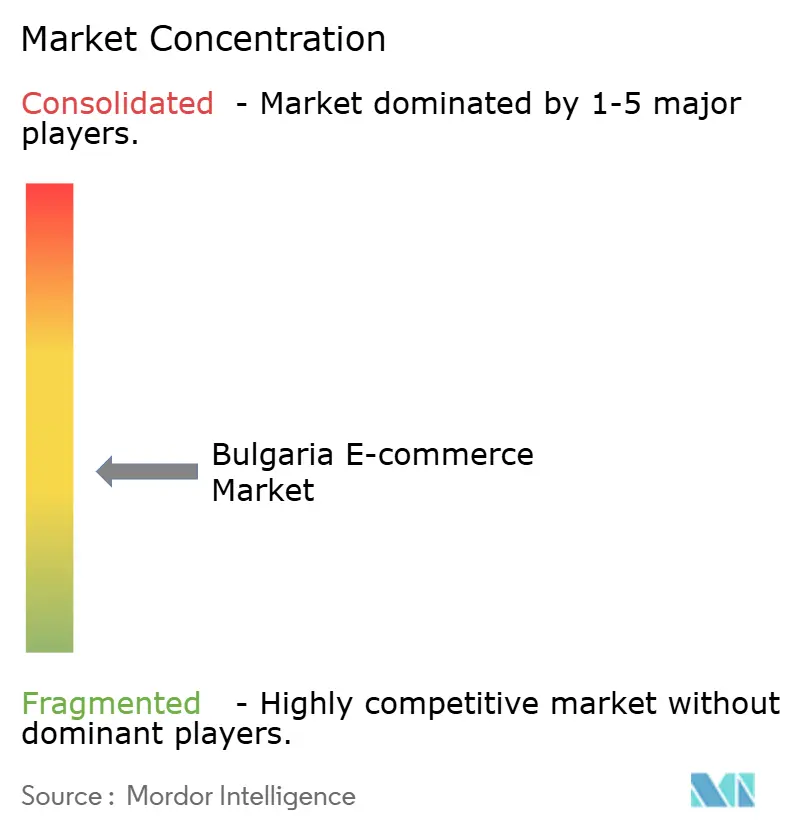
| Market Concentration | Medium |
Major Players *Disclaimer: Major Players sorted in no particular order Image © Mordor Intelligence. Reuse requires attribution under CC BY 4.0. | |
Bulgaria E-commerce Market Analysis by Mordor Intelligence
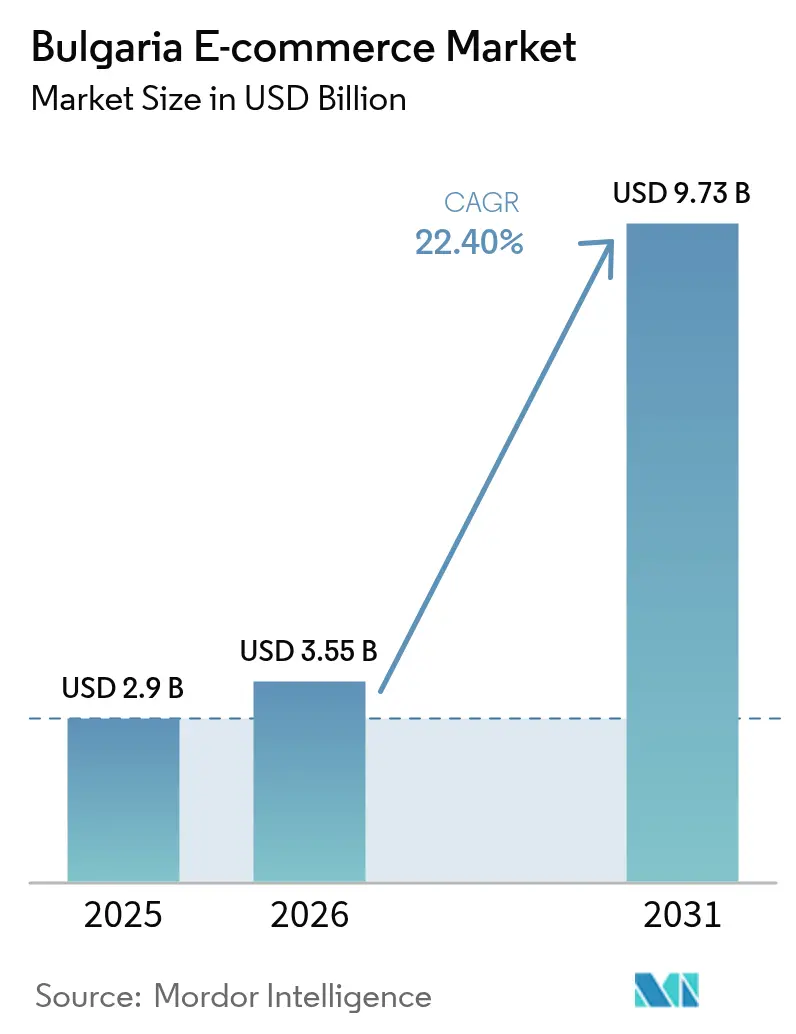
The Bulgaria e-commerce market size was valued at USD 2.90 billion in 2025 and estimated to grow from USD 3.55 billion in 2026 to reach USD 9.73 billion by 2031, at a CAGR of 22.40% during the forecast period (2026-2031). Expansion is driven by widespread internet coverage, higher mobile-wallet usage, and sustained investment in last-mile logistics infrastructure. The shift from cash-on-delivery to digital wallets is accelerating checkout conversion rates, while cross-border regulatory harmonization is opening new customer pools across the region. Competitive intensity is rising as regional champions double down on loyalty programs and proprietary delivery networks, prompting merchants to upgrade digital storefronts and invest in data-driven personalization to defend market share. Partnerships between platforms, couriers, and fintechs are increasingly pivotal to unlocking scale advantages in a fragmented ecosystem.
Key Report Takeaways
- By product category, fashion and apparel led with 24.12% revenue share in 2025, while food and beverages are forecast to expand at a 28.95% CAGR to 2031.
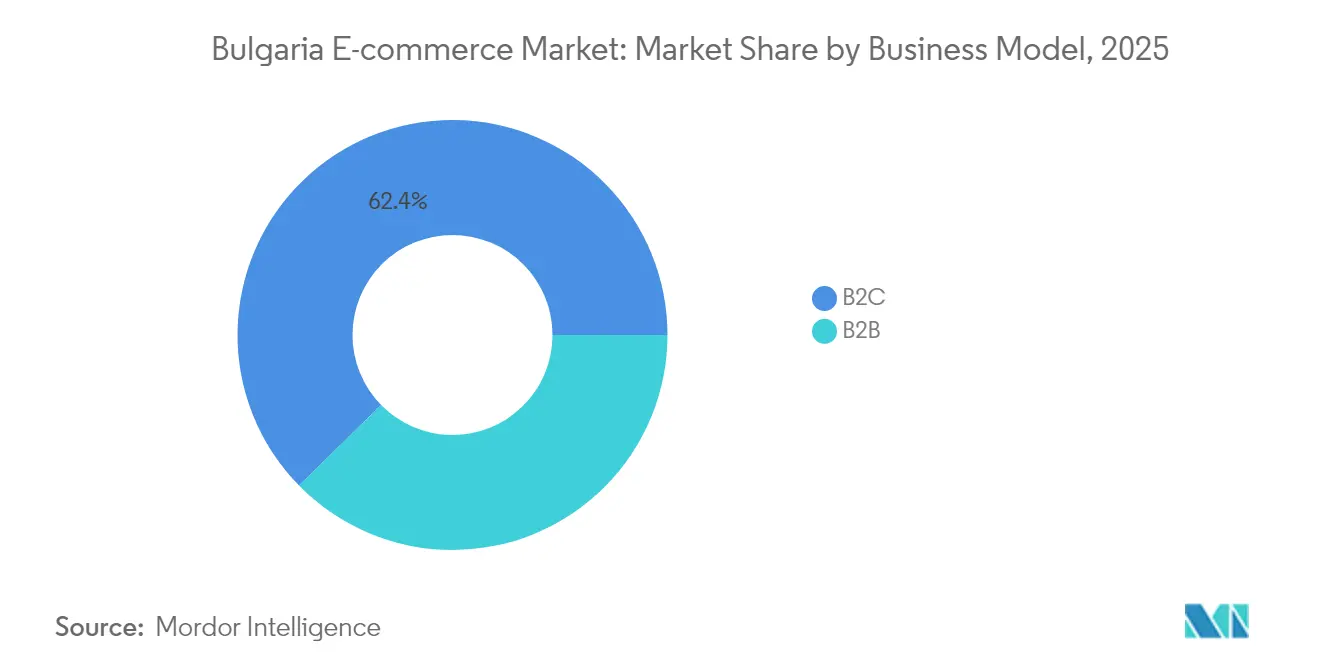
- By business model, the B2C segment held 62.35% of the Bulgaria e-commerce market share in 2025; the B2B segment records the highest projected CAGR at 25.8% through 2031.
- By device type, smartphones captured 55.45% of transactions in 2025 and are projected to extend their lead at a 24.6% CAGR to 2031.
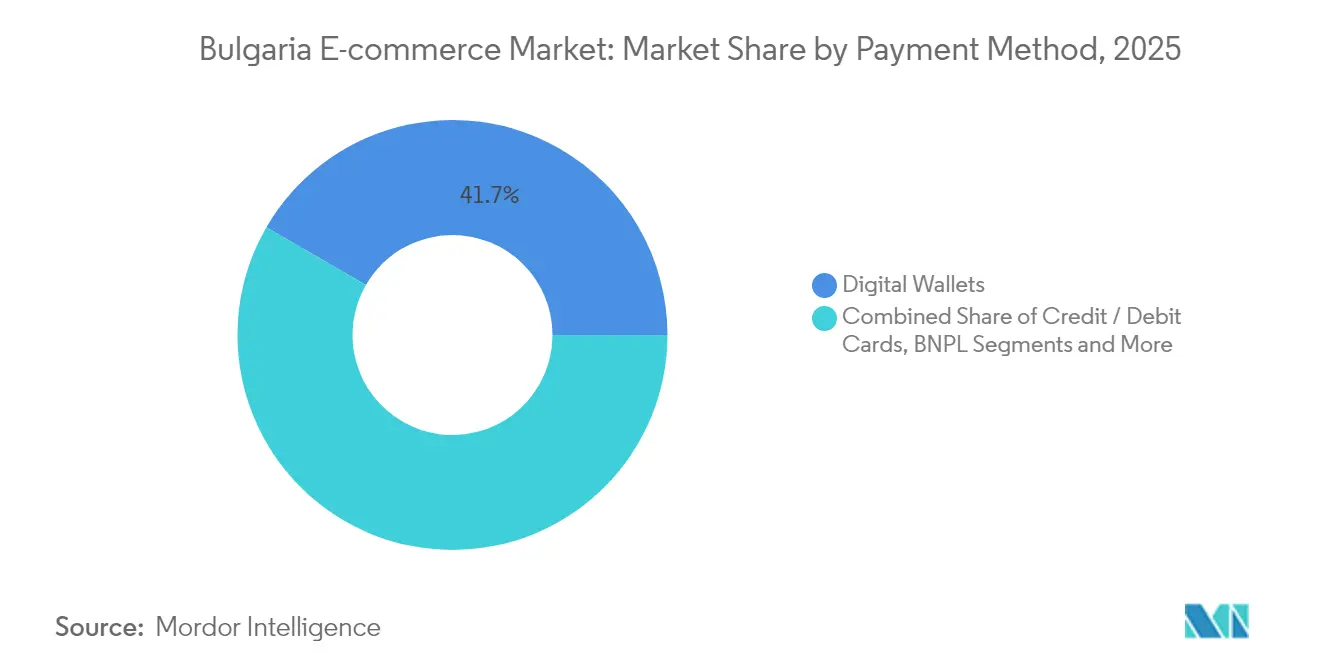
- By payment method, digital wallets accounted for 41.65% of the Bulgaria e-commerce market size in 2025, while Buy Now Pay Later adoption is advancing at a 27.7% CAGR through 2031.
Note: Market size and forecast figures in this report are generated using Mordor Intelligence’s proprietary estimation framework, updated with the latest available data and insights as of 2026.
Bulgaria E-commerce Market Trends and Insights
Drivers Impact Analysis*
| Driver | (~) % Impact on CAGR Forecast | Geographic Relevance | Impact Timeline |
|---|---|---|---|
| Surging mobile-wallet adoption | +5.2% | National, with higher penetration in urban centers | Medium term (2-4 years) |
| Expansion of EU cross-border e-commerce rules | +4.3% | National, with emphasis on border regions | Long term (≥ 4 years) |
| Next-day delivery race led by local 3PL start-ups | +3.8% | Urban centers, with gradual expansion to secondary cities | Short term (≤ 2 years) |
| Rise of TikTok-driven social commerce conversions | +3.5% | National, with concentration among 16-34 age demographic | Medium term (2-4 years) |
| Bulgaria-specific VAT threshold incentives for micro-sellers | +2.7% | National, with emphasis on emerging entrepreneurial hubs | Medium term (2-4 years) |
| EU Digital Identity Wallet rollout – frictionless checkout | +2.1% | National, with initial adoption in major urban centers | Long term (≥ 4 years) |
| Source: Mordor Intelligence | |||
Surging mobile-wallet adoption transforms payment landscape
Penetration of mobile wallets reached 16.1% in 2024 and is rising as contactless acceptance spreads across retail and service sectors. Domestic providers such as A1 Wallet position themselves alongside global players Apple Pay and Google Pay, enabling merchants to offer seamless in-app and in-store payments. The July 2024 market entry of Kuady, which staffed more than 100 specialists in Sofia to enhance identity verification and fraud management, further underlines the strategic importance of Bulgaria within regional fintech. Growing consumer familiarity with tokenized transactions is lowering checkout abandonment and nudging shoppers away from cash on delivery.
Expansion of EU cross-border e-commerce rules reshapes boundaries
Harmonized VAT procedures, including the Import One-Stop-Shop (IOSS), have simplified customs clearance and reduced administrative overhead for merchants targeting cross-border buyers. [1]Momchil Antov, “Challenges to Customs Imposed by the New EU VAT Rules,” World Customs Journal, worldcustomsjournal.org Bulgarian sellers can now plug into neighboring markets at lower compliance cost, while foreign competitors gain easier access to local consumers. eMAG reports that the number of Romanian traders exporting through its platform to Bulgaria doubled to more than 12,000 in 2024. The broader EU agenda to mitigate unsafe imports and unfair pricing is expected to keep compliance demands high through the decade. [2]European Commission, “Tackling Challenges in E-commerce Imports,” commission.europa.eu
Next-day delivery race redefines customer expectations
Agile local 3PLs deploy route-optimization algorithms and dense urban micro-depots to compress delivery windows. eMAG’s Sameday courier unit lifted revenue 32% while shortening average delivery times. DHL’s May 2025 acquisition of IDS Fulfilment extends full-service capabilities to small and medium merchants, signaling a strategic pivot toward integrated e-commerce logistics. Accelerated service standards in metropolitan areas create pressure to extend similar performance into secondary cities over the next two years.
Rise of TikTok-driven social commerce conversions
Short-form video is blurring the line between entertainment and purchase, elevating impulse buying in categories such as fashion and beauty. Mobile devices generated 77% of retail site traffic and 68% of online orders in 2024. Specialized aggregators help local merchants optimize TikTok Shop listings, while omnichannel retailers redirect budgets toward video content and influencer collaborations to defend share of wallet among Gen Z shoppers.
Restraints Impact Analysis*
| Restraint | (~) % Impact on CAGR Forecast | Geographic Relevance | Impact Timeline |
|---|---|---|---|
| Residual cash-on-delivery preference inflating returns | -3.2% | National, with higher impact in rural areas | Medium term (2-4 years) |
| Courier capacity bottlenecks in rural Rhodope and Danube regions | -2.8% | Rural Rhodope and Danube regions | Short term (≤ 2 years) |
| Under-indexed digital skills among 55+ shoppers | -2.1% | National, with higher impact in rural areas | Long term (≥ 4 years) |
| Persistent customs delays on AliExpress inflows | -1.7% | National | Medium term (2-4 years) |
| Source: Mordor Intelligence | |||
Residual cash-on-delivery preference inflates returns
Approximately 40% of Bulgarian online commerce continues to settle in cash, leading to elevated refusal and return rates that squeeze merchant margins. Fashion returns run between 2% and 27% depending on product type, forcing brands to invest in reverse-logistics systems and predictive sizing tools to contain costs. Loyalty rewards for pre-payment and dynamic pricing that discount digital payments are gradually nudging shoppers to switch.
Courier capacity bottlenecks limit rural market penetration
Sparse population density and mountainous terrain in the Rhodope region and parts of the Danube plain inflate per-parcel delivery costs. Service gaps translate into longer lead times and higher shipping fees, perpetuating an urban-rural consumption divide. The European Bank for Reconstruction and Development flags transport upgrades as critical for unlocking rural e-commerce potential. [3]European Bank for Reconstruction and Development, “Bulgaria Country Strategy 2025-30,” ebrd.com Emerging solutions such as pick-up drop-off networks and micro-fulfillment hubs are being piloted but have yet to scale.
*Our forecasts treat driver/restraint impacts as directional, not additive. The impact forecasts reflect baseline growth, mix effects, and variable interactions.
Segment Analysis
By Business Model: B2B momentum accelerates digital procurement
The B2C segment retained 62.35% of 2025 transaction value, yet the B2B channel is forecast to grow at 25.8% CAGR from 2026 to 2031 as enterprises digitize sourcing workflows. Corporate buyers seek consumer-grade usability, prompting platforms to add workflow automation, spend analytics, and embedded financing. Specialized vertical marketplaces in construction and manufacturing integrate inventory management and invoicing to streamline procurement across fragmented supplier bases. The technology sector anchors B2B expansion, with information and communication technology transactions accounting for half of merger and acquisition deals in 2024.
Sustained foreign capital inflows into e-procurement software underscore the segment’s strategic value. Payment gateways tailored to multi-user purchasing hierarchies and standing-order scheduling reduce back-office friction, deepening supplier lock-in. As more firms centralize spend, the Bulgaria e-commerce market size traced to B2B catalogs is expected to climb steadily, widening platform revenue per customer while reinforcing switching costs.



By Device Type: Mobile-first shopping reshapes engagement
Smartphones commanded 55.45% of transactions in 2025, outpacing desktops and laptops, and their contribution is projected to climb at 24.6% CAGR through 2031. Retailers invest in progressive web apps, fingerprint authentication, and auto-fill checkouts to match rising expectations. Video-rich product pages optimized for vertical viewports accelerate discovery, while one-click wallet integrations compress payment flow. The Bulgaria e-commerce market size attributed to mobile channels is therefore set to expand faster than overall industry revenue.
Desktops still serve high-involvement purchases that require in-depth comparison, yet their share is slipping as screen sizes grow and mobile browser experiences improve. Tablets and voice-enabled devices form a small but rising cohort, pointing to future multi-modal commerce opportunities. Retailers adopt responsive design and unified session tracking to ensure frictionless transitions between devices, protecting conversion rates as browsing patterns fragment.
By Payment Method: Digital wallets lead as BNPL surges
Digital wallets secured 41.65% share of online transaction value in 2025. Their ascent reflects enhanced trust in tokenized payments and the rollout of near-field communication point-of-sale terminals in physical stores, which habituates users to wallet ecosystems that also power online checkouts. The Bulgaria e-commerce market share tied to Buy Now Pay Later is the fastest rising, expanding at 27.7% CAGR, buoyed by flexible installment options that appeal to younger consumers without traditional credit lines. Higher average order values on BNPL-enabled sites improve retailer margins and inventory turns.
Credit and debit cards remain a core tender type, particularly among mid-income households, while cash on delivery continues to fade outside older rural customer segments. Merchant strategies that blend rewards, instant cash-backs, and transparent fee disclosures promote wallet stickiness and limit chargeback risk.
By B2C Product Category: Food and beverages reshape urban commerce
Fashion and apparel dominated 2025 with 24.12% share, a position cemented by social-commerce discovery and same-day return lockers that reduce size-related purchase anxiety. The food and beverages segment, however, is projected to rise at 28.95% CAGR, reflecting urban consumers’ demand for rapid replenishment and the entrance of quick-commerce players promising sub-30-minute delivery. The Bulgaria e-commerce market size for grocery baskets is supported by rapid urbanization and dual-income households seeking convenience.
Consumer electronics holds a stable base, driven by steady device upgrade cycles and bundle promotions that integrate extended warranties. Beauty and personal care benefits from subscription replenishment models and influencer-led tutorials that convert viewers into repeat buyers. Furniture and home goods gain traction as augmented-reality previews reassure shoppers about fit and finish. Toys, DIY supplies, and media contribute a diversified tail, with specialty niches broadening as consumer trust deepens.
Geography Analysis
Sofia, Plovdiv, and Varna account for the majority of online spending, supported by dense logistics networks, reliable broadband, and a digitally literate consumer base. Competitive intensity in these hubs drives rapid adoption of membership programs and value-added services such as time-slot delivery guarantees. Platforms use these urban theaters to pilot innovations before rolling them out to secondary cities. The Bulgaria e-commerce market size concentrated in metropolitan zones underscores the importance of targeted warehousing and localized marketing strategies.
Eurozone accession targeted for 2025 and advancing Schengen integration are expected to tighten financial confidence and streamline cross-border shipping. Harmonized payment rails will cut foreign exchange friction, while common customs protocols should shorten delivery lead times, boosting cross-border order volumes. A new foreign-investment approval regime introduced in February 2025 signals state intent to protect strategic infrastructure, yet still welcomes capital that enhances digital capacity. Investors in payment processors, data centers, and fulfillment hubs evaluate regulatory clarity as a key risk control.
Rural areas, especially in the Rhodope Mountains and along the Danube, face higher delivery costs and slower broadband. These regions host older populations with lower digital skills, limiting conversion rates. Public funding earmarked for fiber expansion and road rehabilitation aims to shrink the access gap, while courier firms experiment with parcel lockers at petrol stations and community centers to cut last-mile expenses. As infrastructure projects conclude, the Bulgaria e-commerce industry is projected to achieve a more balanced geographic sales spread, even though urban leadership will persist.
Regulatory Landscape
Bulgaria's e-commerce framework is anchored by the Electronic Commerce Act and consumer-protection rules applied to distance selling, with the Commission for Consumer Protection (CCP) positioned as a key enforcement body for online-trade compliance. A major recent step was the entry into force on 21 November 2025 of amendments to the Electronic Communications Act that implement the EU Digital Services Act (DSA) nationally, raising compliance requirements for intermediary services and platform governance (for example, notice-and-action processes and transparency duties) for marketplaces serving Bulgarian users.
Consumer contracting for digital content and digital services is governed by the Law on the Provision of Digital Content and Digital Services and the Sale of Goods (effective 1 January 2022), which shapes remedies, conformity, and trader obligations for digital offers bundled with or sold through e-commerce channels. Alongside EU rules such as the anti-geo-blocking Regulation (EU) 2018/302 and harmonized VAT procedures (including IOSS), Bulgaria's policy agenda also connects to the European Commission's 2025 Digital Decade country roadmap, which lists 60 measures supported by a EUR 2.19 billion budget envelope, supporting digitization and SME adoption programs that affect merchant onboarding, payments, and operational compliance.
Value Chain Analysis
The Bulgaria e-commerce value chain starts with merchants and brands sourcing inventory (domestic and cross-border) and building storefront presence through own web/app channels or via marketplaces. Enterprise participation data shows the channel split: in 2024, 16.2% of Bulgarian enterprises sold online, with 11.6% using their own website/app and 7.1% selling via marketplaces (for example, eMAG and Alibaba). This creates a two-track route to market where platforms concentrate demand, search, and checkout, while independent stores keep more control over merchandising and customer data.
Payments and compliance sit between checkout and fulfillment, with wallets and reporting requirements increasingly shaping operations. On the compliance side, amendments to Regulation No. H-18 published in the State Gazette in May 2025 reinforced fiscal reporting requirements for online stores (including the ability to issue electronic fiscal receipts), and platform-operator reporting under EU rules such as DAC7 channels seller information to the National Revenue Agency, pushing merchants and platforms to invest in integrated order, invoicing, and tax workflows. Fulfillment and last-mile delivery cluster around hubs such as Sofia, Plovdiv, and Varna, with a widening mix of courier home delivery, parcel lockers, and pick-up points used to balance speed and cost, particularly as delivery performance expectations rise in urban areas while rural routes remain structurally more expensive.
Competitive Landscape
The top 10 online retailers hold only 21.5% of B2C transaction value, confirming a moderately fragmented arena. [4]Bulgarian E-commerce Association, “PASSPORT 2024: The E-commerce Industry in Bulgaria,” beabg.com eMAG leads regional incumbents with a 2023 turnover of RON 7.824 billion (USD 1.72 billion) and continues to widen its moat via an integrated ecosystem spanning Genius loyalty, Sameday logistics, and HeyBlu financial services. Specialized platforms such as Technopolis and Fashion Days emphasize category depth to defend share against broad-assortment rivals. Amazon and Allegro test price elasticity in branded electronics and home goods, compressing margins and prompting local players to focus on localized customer support and same-day pick-up options.
Technology capabilities increasingly separate winners from median performers. Artificial-intelligence engines personalize landing pages and dynamic pricing engines fine-tune promotions at SKU level. The 2024 acquisition of rush-management startup Rush by UK-based Shop Circle underlines the race to absorb specialized software that reduces cart abandonment. Regional couriers expand locker networks and experiment with drone zone mapping, while payment providers integrate spend analytics to bolster merchant decision-making.
Strategic moves during the review period include eMAG’s EUR 180 million (USD 198 million) capacity expansion announced in June 2024, aimed at reinforcing inventory depth and accelerating next-day coverage. DHL’s acquisition of IDS Fulfilment in May 2025 positions the global logistics leader to compete for SME clients needing turnkey warehousing and delivery. Fintech entrants such as Paysera Checkout provide multicurrency support ahead of euro adoption, positioning merchants for seamless cross-border billing.
Bulgaria E-commerce Industry Leaders
eMAG (Dante International SA)
OLX Group / Bazar.bg
Technopolis Bulgaria EAD
Fashion Days Group
Amazon.com Inc.
- *Disclaimer: Major Players sorted in no particular order

Market Opportunities and Future Outlook
A clear whitespace exists in scaling professional fulfillment and cross-border delivery capacity for merchants that still depend on fragmented logistics coverage outside the main hubs. Recent capital deployment provides evidence of where capacity is expanding: Austrian Post completed the acquisition of a 70% stake in Bulgarian fulfillment and logistics provider euShipments.com in March 2026, and JYSK Bulgaria started construction of a EUR 45 million highly automated warehouse tower in the Bozhurishte Industrial Zone in April 2026, increasing logistics capacity by nearly 50%. Metro Bulgaria also signed a long-term agreement with CTP in April 2026 to build a EUR 25 million logistics center in Sofia (planned opening in January 2027), reinforcing cold-chain and retail replenishment capabilities that support grocery and other fast-moving categories sold online.
Opportunities also extend to merchant enablement and compliance-driven software upgrades as more sellers formalize operations across webshops and marketplaces. With 16.2% of enterprises reporting online sales in 2024 and a meaningful share still not digitized, there is room for platforms, payment providers, and enablers to package store creation, fraud controls, e-invoicing/fiscal receipt integration (Regulation No. H-18), and cross-border VAT tooling into turnkey offers for SMEs. On the demand side, the market shows room to deepen digital payment penetration where cash on delivery persists, and to broaden local-first shopping into larger assortment and cross-border baskets, especially as EU harmonized VAT and platform governance requirements (DSA implementation in November 2025) standardize key operating rules for marketplaces active across neighboring countries.
Recent Industry Developments
- May 2026: eMAG Group announced an investment program of around EUR 300 million for the next fiscal year, targeting logistics and delivery infrastructure alongside AI and financial services. The spending focus reinforces vertical integration across marketplace, fulfillment, and fintech, increasing competitive pressure on local retailers and couriers to match service levels and tooling.
- May 2025: DHL acquired IDS Fulfilment, expanding its SME e-commerce logistics offer with added warehousing capabilities, including temperature-controlled operations and supporting software. The move strengthens end-to-end fulfillment options for merchants, particularly in categories such as online grocery where handling requirements and delivery reliability are decisive.
- June 2024: eMAG announced a EUR 180 million capacity expansion program to deepen inventory and improve next-day delivery coverage. The investment signaled continued emphasis on proprietary logistics scale as a differentiator, shaping how Bulgarian merchants weigh marketplace partnerships versus building standalone fulfillment capacity.


Research Methodology Framework and Report Scope
Market Definition and Coverage
We define the Bulgaria e-commerce market as the value of online transactions completed by end users in Bulgaria for physical goods and paid services, across B2C and B2B digital storefronts, regardless of the device used to place the order.
Scope exclusions: We exclude peer-to-peer classifieds, in-game micro-payments, and the commissions that marketplace operators retain.
Segmentation Overview
- By Business Model
- B2C
- B2B
- By Device Type
- Smartphone / Mobile
- Desktop and Laptop
- Other Device Types
- By Payment Method
- Credit / Debit Cards
- Digital Wallets
- BNPL
- Other Payment Method
- By B2C Product Category
- Beauty and Personal Care
- Consumer Electronics
- Fashion and Apparel
- Food and Beverages
- Furniture and Home
- Toys, DIY and Media
- Other Product Categories
Data Sources, Market Sizing, and Validation
Desk Research
Desk research helped us set the guardrails on what should be counted as e-commerce value in Bulgaria and what should not, before we model the numbers. We leaned on public sources such as the National Statistical Institute of Bulgaria for household and internet-use indicators, the Bulgarian National Bank for payment trends and FX context, and Eurostat for digital economy and cross-border online buying signals.
To keep the market logic realistic, we also reviewed sources such as the European Commission digital policy and VAT guidance, U.S. International Trade Administration country commercial guides for category mix cues, and industry association publications that describe online retail volume and shopper behavior. Company filings, investor presentations, and reputable local press were used to sanity-check direction of growth, fulfillment investments, and category momentum. In parallel, we used paid subscriptions for company financials and news tracking, and for import-export shipment level checks where cross-border fulfillment materially affects sales. This list is not exhaustive, and many other sources were used for data collection, validation, and research clarification.
Primary Interviews and Surveys
Expert interviews and surveys with CXOs, functional and unit leaders, and managers from online retailers, marketplaces, payment providers, logistics operators, and technology service firms in Bulgaria are used to test secondary indicators. Respondents help clarify average order value, payment mix, returns, cross-border orders, and channel shifts in the Bulgarian market. Conflicting views are rechecked, and the agreed evidence is used to triangulate assumptions and final analysis.
Distribution of primary research fieldwork respondents
| Company type | Respondent position |
|---|---|
| Top tier: 28% | CXOs: 18% |
| Mid tier: 47% | Functional/Unit leaders: 32% |
| Smaller Players: 25% | Managers: 50% |
Market-Sizing & Forecasting
Sizing starts with a top-down rebuild of Bulgaria online commerce value using demand pool logic, where internet shopper penetration and ARPU-style spending cues are used to form a realistic addressable online spend, which is then filtered through category mix and payment completion behaviors. That core view is subsequently stress-tested with selective bottom-up approximations such as sampled seller GMV ranges, channel checks across major storefront types, and simple ASP times order volume calculations where interview inputs were strong.
A few practical inputs were treated as key fingerprints for this market, including smartphone-led ordering share, delivery speed expectations (such as next-day fulfillment), return rates in high-churn categories, cross-border share of online purchases, and the local shift toward online payments versus cash on delivery. When a variable had limited public visibility, we applied bounded ranges from interviews and then checked whether the implied spend per online shopper stayed reasonable against Bulgaria income and consumption patterns.
For forecasting, we relied on scenario analysis anchored on macro and digital adoption drivers, and the scenarios were tied to specific levers like online buyer growth, ARPU progression, and the pace of cross-border expansion. Assumptions were kept transparent so a reader can reproduce the path from shopper base to transaction value, and then adjust only a few levers to see how the market outlook moves.
Data Validation & Update Cycle
Validation was handled through triangulation across independent signals, where model outputs were compared against observable indicators like online buyer penetration, payment mix shifts, and logistics capacity and service levels. Outliers were reviewed in a second pass, and when a number looked inconsistent with the known shopper base or category behavior, we reopened the underlying assumption and rechecked it with fresh desk reading or follow-up calls.
Before sign-off, the full model is reviewed step by step so that unit logic, currency handling, and growth paths are internally consistent across the historical period and forecast years. Reports are refreshed annually, with interim updates when material events change demand or transaction behavior, and a final pre-delivery review is completed to ensure clients receive the latest updated view.
Mordor Intelligence's Bulgaria Ecommerce Market Sizing Compared With Other Published Estimates
Published market values for Bulgaria e-commerce do not always match because different authors count different transaction types and they also choose different years, currencies, and price assumptions. In practice, the biggest differences come from whether the figure is closer to B2C only or includes B2B portals, whether it counts only goods or also paid services, and whether cross-border online purchases are treated as part of local market demand.
The gap drivers in the table mainly reflect scope and normalization choices, including how marketplace value is handled, whether peer-to-peer and classifieds activity is blended into the total, and how EUR-based local volumes are converted to USD for a specific year. Some sources also publish a single-point forecast number without showing the underlying buyer base and spend logic, which makes it harder to validate the implied ARPU and align it with payment completion trends and fulfillment constraints. This approach is used in the same discipline applied by Mordor Intelligence for the base-year build and forecast alignment.
Benchmark comparison
| Source | Market Size | Gaps in Research Methodology |
|---|---|---|
| Mordor Intelligence | USD 2.90 B (2025) | |
| Industry Association A | USD 2.53 B (2025) | Reported in EUR as B2C online sales of products and services and then converted to USD, which can shift the value depending on FX timing and may exclude B2B storefront transactions. |
| Industry Report B | USD 2.42 B (2024) | Uses a 2024 B2C volume figure and a forecast frame, which tends to sit lower than a 2025 base year view and may differ on whether marketplace GMV is fully counted versus netted for fees. |
Across the three figures, the spread is explained more by what is included and the year and currency basis than by any single growth assumption. By keeping the value tied to paid online transactions and then cross-checking it against shopper penetration, spend levels, and cross-border buying signals, the resulting market size stays traceable to clear variables and repeatable steps.


Key Questions Answered in the Report
How large is the Bulgaria e-commerce market today?
The market stands at USD 3.55 billion in 2026 and is projected to reach USD 9.73 billion by 2031 as internet penetration and digital-wallet usage climb.
Which payment method is growing fastest in Bulgaria?
Buy Now Pay Later solutions are advancing at a 27.7% CAGR through 2031, outpacing all other tender types and driving higher average order values.
What share of transactions occur on mobile devices?
Smartphones accounted for 55.45% of online purchases in 2025 and are expected to extend their share as mobile-first site optimization improves.
Which product category is expected to lead growth to 2031?
Food and beverages show the fastest trajectory, with 28.95% CAGR, supported by urban quick-commerce operations offering sub-30-minute deliveries.
How competitive is the Bulgarian e-commerce landscape?
The top 10 platforms hold roughly 21.5% of B2C sales, indicating moderate fragmentation and ample space for specialized or regional entrants.
What role do EU regulations play in market expansion?
Harmonized VAT rules and streamlined customs processes under the Import One-Stop-Shop allow Bulgarian merchants to access EU customers more efficiently while attracting foreign sellers to the domestic consumer base.
Page last updated on:


 Your data is secure and never sold or shared.


