
India Connected Helmet Market Size and Share
Market Overview
| Study Period | 2019 - 2031 |
|---|---|
| Forecast Data Period | 2026 - 2031 |
| Base Year Market Size (2025) | USD 6.91 Million |
| Market Size (2026) | USD 9.18 Million |
| Market Size (2031) | USD 38.09 Million |
| Growth Rate (2026 - 2031) | 32.91 % |
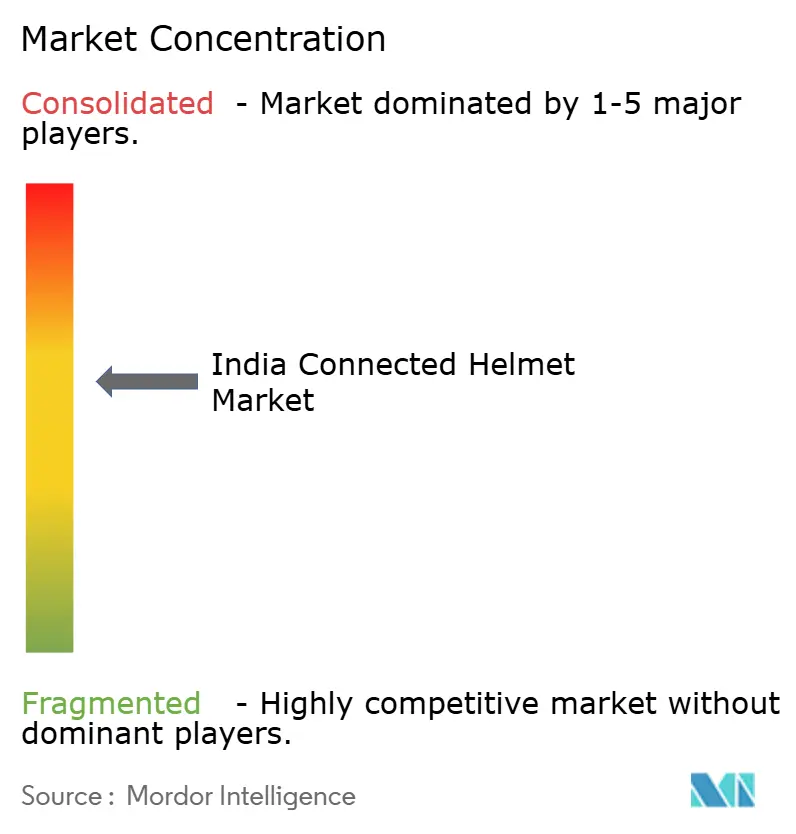
| Market Concentration | Medium |
Major Players *Disclaimer: Major Players sorted in no particular order Image © Mordor Intelligence. Reuse requires attribution under CC BY 4.0. | |
India Connected Helmet Market Analysis by Mordor Intelligence
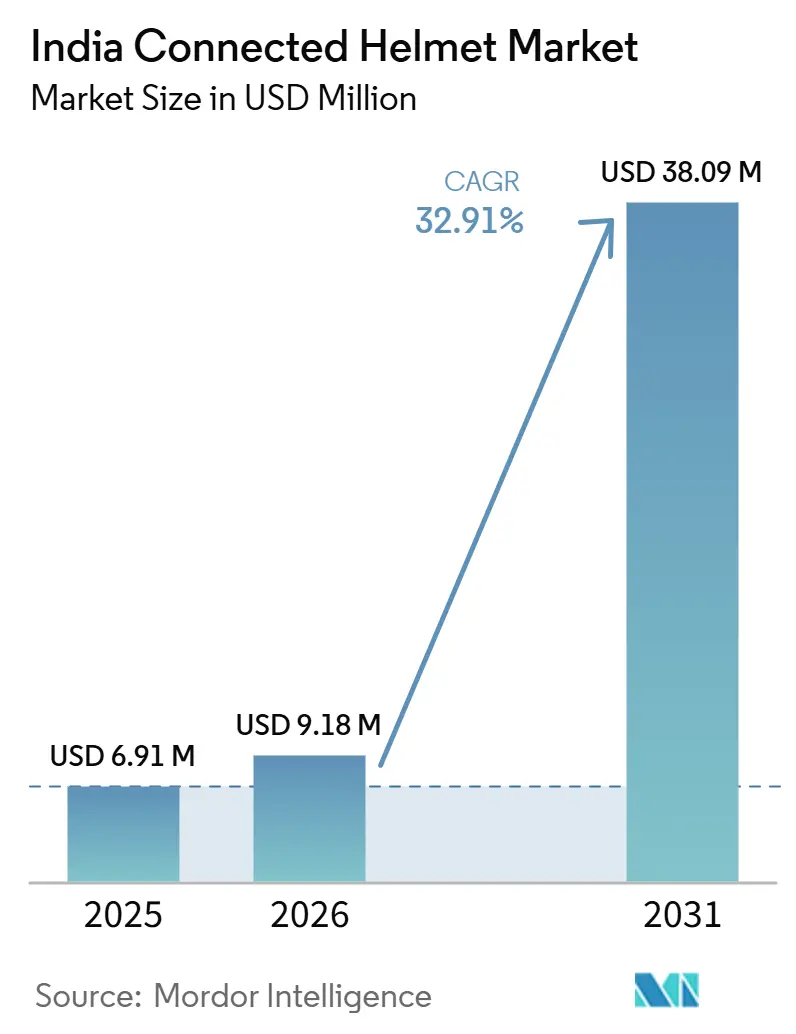
The India connected helmet market size was valued at USD 6.91 million in 2025 and is estimated to grow from USD 9.18 million in 2026 to reach USD 38.09 million by 2031, at a 32.91% CAGR over 2026-2031. Motorcycle headgear has evolved from being seen merely as crash protection to an integral data hub, connecting riders, fleets, and insurers within a broader mobility ecosystem. In India, the enforcement of safety codes, a surge in mid-premium motorcycle sales, and widespread adoption by gig-economy fleets are driving helmets into the mainstream. Premium OEMs are now offering head-up-display (HUD) helmets as lucrative accessories, while e-commerce platforms are tightening retail margins. Additionally, insurers are testing premium rebates for riders who provide verified wear-detection logs.
Key Report Takeaways
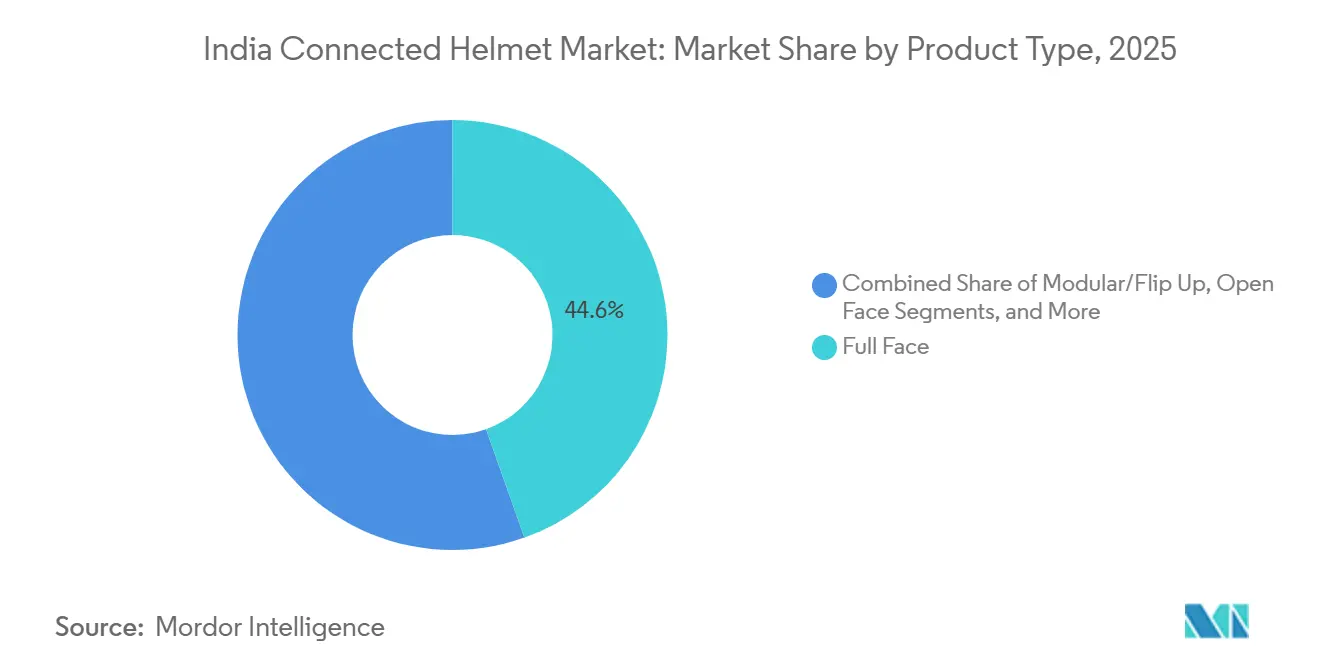
- By product type, full face helmets led with 44.56% of India's connected helmet market share in 2025, while smart HUD-Integrated variants are projected to grow at a 33.14% CAGR through 2031.
- By technology level, bluetooth-only units captured 39.28% of revenue in 2025, while multi-sensor ADAS suites are projected to advance at a 33.48% CAGR through 2031.
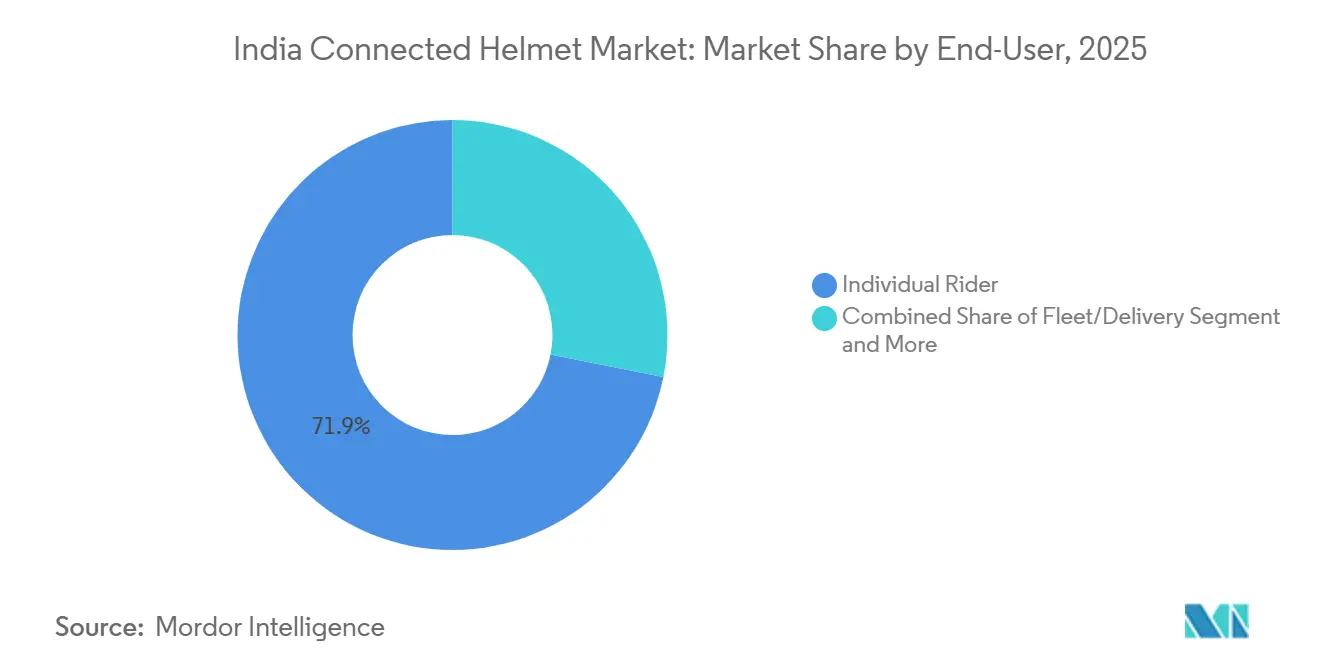
- By end user, individual riders dominated the India connected helmet market with a 71.88% share in 2025, whereas fleet and delivery applications will grow at a 33.94% CAGR.
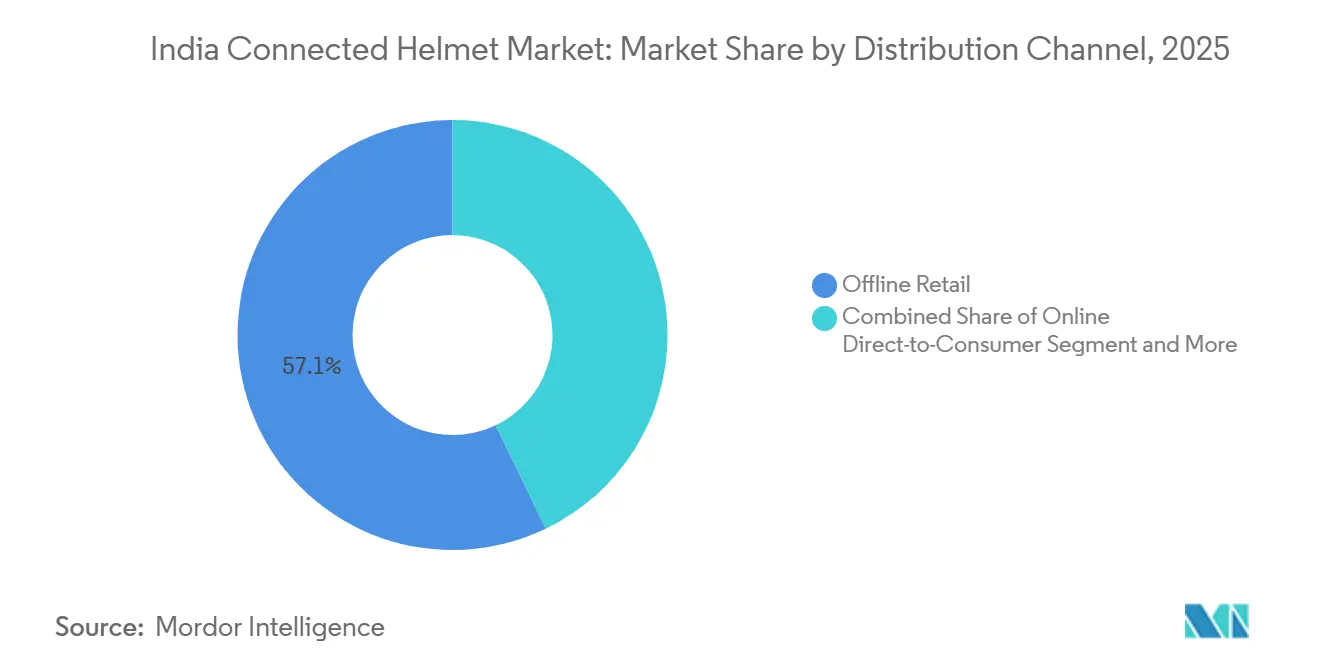
- By distribution, offline retail captured 57.13% of the market in 2025; direct-to-consumer e-commerce is poised for a 34.65% CAGR.
- By price range, economy helmets accounted for 47.51% of India's connected helmet market share in 2025, but premium models are on track to grow at a 33.26% CAGR.
Note: Market size and forecast figures in this report are generated using Mordor Intelligence’s proprietary estimation framework, updated with the latest available data and insights as of January 2026.
Future direction is shaped by developments occurring across multiple countries and regions, with India contributing to the overall trajectory. The outlook on worldwide connected helmet market reflects how these are expected to evolve collectively.
India Connected Helmet Market Trends and Insights
Drivers Impact Analysis*
| Driver | (~) % IMPACT ON CAGR FORECAST | GEOGRAPHIC RELEVANCE | IMPACT TIMELINE |
|---|---|---|---|
| Rising Adoption of Motorcycle ADAS and HUD Helmets | +12.5% | National, with early gains in South India, Maharashtra, Karnataka | Medium term (2-4 years) |
| Stricter BIS Safety Standards and Penalty Hikes | +8.7% | National, with stricter implementation in urban centers | Short term (≤ 2 years) |
| Growth in Mid-Premium Motorcycle Sales | +6.2% | National, concentrated in Tier-I and Tier-II cities | Medium term (2-4 years) |
| V2X Chips Enable Group-Ride Networks | +4.8% | Urban corridors, highway networks, major metropolitan areas | Long term (≥ 4 years) |
| Expansion of Direct-to-Consumer E-Commerce | +3.9% | National, with higher penetration in urban markets | Short term (≤ 2 years) |
| Insurance Discounts for Connected-Helmet Use | +2.1% | National, pilot programs in select states | Medium term (2-4 years) |
| Source: Mordor Intelligence | |||
Rising Adoption of Motorcycle ADAS and HUD-Enabled Helmets
Premium OEMs are embedding augmented-reality displays, mesh networking, and radar receivers inside helmets to deliver navigation, proximity alerts, and group-ride communication without handle-bar mounts. TVS Motor’s Aegis Rider Vision projects speed and route data onto a µOLED visor, while Ultraviolette’s UV Crossfade links Cardo mesh and on-board radar to F77 motorcycles, forming a closed safety loop. Premium motorcycle sales have increased, accounting for a significant portion of total two-wheeler volumes, indicating a growing buyer interest [1]“Two-Wheeler Sales FY26,”, Society of Indian Automobile Manufacturers, siamindia.com. However, the performance of these sales is still dependent on consistent 5G coverage, which remains inconsistent on Tier-II highways.
Stringent BIS Safety-Standard Enforcement and Penalty Hikes
In a bid to enhance compliance and safety, the Bureau of Indian Standards (BIS) has intensified its efforts, conducting plant audits and executing random market seizures[2]“IS 4151:2015 Enforcement Update,”, Bureau of Indian Standards, bis.gov.in. They have also imposed penalties for repeat offenders. These stringent measures are nudging manufacturers towards adopting traceable, app-verified smart shells. Every new two-wheeler sold will come bundled with BIS-certified helmets, integrating helmets into the vehicle's bill of materials. Additionally, states like Maharashtra are bolstering central fines with measures like license suspensions. This not only elevates compliance rates but also paves the way for more advanced, value-added connected models.
Growth in Mid-Premium Motorcycle Sales
The GST on motorcycles with a certain engine capacity was reduced, leading to lower ex-showroom prices and a boost in spending on discretionary accessories. Royal Enfield's accessory bundles and Sena's Mesh Communicator highlight that riders view connectivity as an integral part of their bike's identity. New electric entrants like Ather and Ultraviolette are furthering this ecosystem approach, connecting helmets to OTA dashboards and ride-logging applications.
Integration of V2X Chips Enabling Group-Ride Networks
Mesh protocols are transitioning from premium communicators to integrated helmets, enabling countless riders to exchange hazard information. Riders of Ultraviolette now benefit from radar-driven overtaking alerts via Cardo's mesh network. Meanwhile, Royal Enfield, in collaboration with Sena, offers the 50S model, which facilitates multiple channels over long distances. While spectrum allocation rules still grapple with standardizing V2X frequencies, early adopters are reaping the benefits of instantaneous convoy coordination.
Restraints Impact Analysis*
| RESTRAINT | (~) % IMPACT ON CAGR FORECAST | GEOGRAPHIC RELEVANCE | IMPACT TIMELINE |
|---|---|---|---|
| High Upfront Costs | -4.3% | National, more pronounced in rural and Tier-III markets | Short term (≤ 2 years) |
| Limited Battery Life | -2.8% | National highways, touring routes, rural connectivity corridors | Medium term (2-4 years) |
| Patchy 4G/5G Coverage | -2.1% | Rural highways, remote touring destinations, border regions | Medium term (2-4 years) |
| Cultural Discomfort with Full Face Design | -1.6% | Rural markets, traditional user segments, hot climate regions | Long term (≥ 4 years) |
| Source: Mordor Intelligence | |||
High Upfront Cost Versus Conventional ISI Models
Smart lids are significantly more expensive compared to plain ISI helmets, creating a substantial premium that deters cost-conscious riders. Steelbird's ROX has achieved significant sales at a lower price point, emphasizing the market's price sensitivity. Even electric vehicle (EV) buyers show resistance to higher prices, prompting brands like Ather to either reduce the prices of their Halo model or offer retrofit kits in bundles to meet their sales targets.
Patchy 4G/5G Coverage on Tier-II/III Highways
India, despite its extensive 5G network, struggles with low teledensity in rural areas, which hampers overall connectivity and digital inclusion in these regions. Moreover, only some villages benefit from a strong 4G signal, limiting access to high-speed internet and related services. Delays in crash alerts raise concerns about the reliability of eCall, a system designed to enhance safety by providing immediate assistance during emergencies. Consequently, fleets are opting for Bluetooth-only compliance checks, missing out on the potential of autonomous crash detection, which could significantly improve response times and safety measures.
*Our forecasts treat driver/restraint impacts as directional, not additive. The impact forecasts reflect baseline growth, mix effects, and variable interactions.
Segment Analysis
By Product Type: Robust Full Face Adoption Underpins Feature Integration
Full face designs delivered 44.56% of India's connected helmet market share in 2025, thanks to highway safety norms and OEM bundling on bikes above 125 cc. HUD-integrated variants, though nascent, will post a 33.14% CAGR as TVS, Ultraviolette, and MT bring µOLED displays and action cameras into ECE-22.06 shells. Tourers gravitate towards modular lids for their convenience, while open-face models reign in crowded, warm metros, despite offering less protection.
As battery density enhances and prices fall, the market for HUD helmets in India is set to surge. However, challenges persist: many smart helmets weigh more than the domestic guideline allows, potentially leading to neck strain during extended use.



By Technology Level: Bluetooth Foundation Catalyzes Multi-Sensor Suites
Bluetooth-only units accounted for 39.28% of revenue in 2025, as low-cost retrofit kits allow riders to upgrade existing shells for INR 2,500-5,999. Nevertheless, helmets with multi-sensor ADAS suites will log a 33.48% CAGR to 2031 as insurers demand crash-data feeds and regulators contemplate eCall mandates.
India's market for ADAS-enabled connected helmets is poised to grow significantly, contingent on the stabilization of service quality through cellular modules and cloud analytics. However, fragmentation persists in peer-to-peer networks due to inter-brand protocol discrepancies—namely between Cardo, Sena, and proprietary OEM stacks—impeding the sharing of wide-area hazards.
By End User: Individual Riders Remain Core While Fleet Demand Scales
Individual buyers accounted for 71.88% of demand in 2025, driven by millions of two-wheelers on the road and aspirational accessory purchases among metro commuters. Yet fleet demand will expand at a 33.94% CAGR as delivery majors formalize safety checklists that tie rider incentives to verified helmet usage.
Driven by mandatory dual-helmet regulations on new bike sales and telematics initiatives spearheaded by insurers, the market for India connected helmets, primarily linked to fleets, is projected to experience significant growth.
By Distribution Channel: Digital Acceleration Challenges Showroom Dominance
Brick-and-mortar stores controlled 57.13% of 2025 shipments because riders value try-on fit and immediate availability. Direct-to-consumer portals, however, will post a 34.65% CAGR as brands capture dealer margin and bundle finance or protection plans online.
E-commerce could capture a significant share of India's connected helmet market if OEMs pivot to selling bundled accessories through online platforms. These platforms, tailored to align with bike ownership profiles and service histories, bolster the long-term value of their customer relationships.
By Price Range: Entry Tiers Seed Demand, Premium Lines Lift Margins
Economy SKUs under INR 3,000 owned 47.51% of revenue in 2025, but premium shells above INR 10,000 will outgrow them at a 33.26% CAGR on rising mid-premium bike penetration and status-driven touring culture.
In India, helmet industry players grapple with a polarized market: on one end, price-sensitive commuters, and on the other, tech-savvy tourers. This leaves a narrow band of volume in the mid-range segment, pushing mid-tier entrants to carve out a niche through enhanced comfort or advanced air filtration.
Geography Analysis
Metros and Tier-I cities—namely Delhi-NCR, Mumbai, Bangalore, Pune, Chennai, and Hyderabad—are set to drive a significant share of sales, buoyed by rising incomes, stricter traffic enforcement, and a higher density of premium motorcycles. The connected helmet market in these urban centers is poised for substantial growth, thanks to OEM accessory bundles that entice buyers at the point of vehicle purchase.
Meanwhile, Tier-II cities like Jaipur, Lucknow, and Coimbatore account for a notable share of the market, bolstered by e-commerce's reach and social media's sway. However, these regions trail the metros in adoption. This delay is attributed to gaps in 4G coverage, which hinder real-time features, and a heightened price sensitivity that nudges riders towards retrofit Bluetooth kits.
Tier-III towns and rural areas make up the remaining share. Their penetration largely depends on fleet deployments. For instance, Zomato’s initiative with Bluetooth helmets demonstrates that centrally procured helmets can break through household budget constraints. However, for broader adoption of smart helmets, average selling prices (ASPs) need to dip further, and battery life must extend to cover inter-village commutes without the need for midday recharging.
Analysis of the connected helmet market by Mordor Intelligence spans multiple other regional evaluations across Europe, supported by country-level insights for China, Japan, South Korea, and United States, wherein local market conditions keep varying from one country to another.
Competitive Landscape
Studds Accessories and Steelbird, with a significant combined annual capacity and strong ties to OEMs, dominate the market, accounting for a substantial share of branded volumes. However, both companies refrain from disclosing their revenues from connected helmets, leaving an opportunity for nimble disruptors. Vega's collaboration with Ather on the Halo Bit helmet indicates that even second-tier players are keen to partner with EV brands for software integration.
Start-ups like Altor Smart Mobility are securing fleet orders by incorporating AI wear-detection into their budget-friendly helmets. International brands such as LIVALL, HJC, and Shoei are entering the market through online specialist importers, targeting riders who typically invest heavily in their gear.
Intellectual property stakes are rising. Steelbird has secured a utility patent for its magnetic-buckle auto-power module, Shellios boasts the PUROS anti-pollution blower patent, and Ultraviolette is claiming firmware OTA rights for its bike-to-helmet radar alerts. However, the lack of a nationwide crash-data clearinghouse in India hampers insurers' ability to fully leverage usage-based discounts, dampening potential first-mover benefits.
India Connected Helmet Industry Leaders
Studds Accessories Limited
Steelbird Hi-Tech India Ltd.
Vega Auto Accessories Limited
JMD Helmets Pvt. Ltd.
LIVALL Riding
- *Disclaimer: Major Players sorted in no particular order

Recent Industry Developments
- April 2026: ReiseMoto inked a distribution deal with MT Helmets, securing its status as the brand's official distributor across India. This collaboration not only broadens ReiseMoto's portfolio of riding gear but also enhances the accessibility of MT's offerings nationwide. To commemorate the partnership, ReiseMoto introduced the MT Stinger 2 in India, branding it as an affordable, safety-centric full-face helmet.
- November 2025: Ultraviolette launched the UV Crossfade, introducing India's first radar-linked AR helmet. This innovative helmet integrates augmented reality (AR) technology with radar systems, offering enhanced safety and situational awareness for riders. The UV Crossfade represents a significant advancement in motorcycle safety gear, combining cutting-edge technology with practical functionality.


India Connected Helmet Market Report Scope
The India connected helmet market report is segmented by product type (full face, modular/flip-up, open face, half helmet, and off-road/ motocross), end user (individual rider, passenger, and fleet/delivery) technology level (bluetooth-only, integrated audio/comms, and HUD/AR display, crash detection and eCall, ADAS sensor suite, and multi-feature), and distribution channel (offline retail, online direct-to-consumer, and OEM accessory bundles). The market forecasts are provided in terms of value (USD) and volume (units).
| Full Face |
| Modular / Flip-up |
| Open Face |
| Half Helmet |
| Off-road / Motocross |
| Smart HUD-Integrated |
| Bluetooth-Only |
| Integrated Audio / Comms |
| HUD / AR Display |
| Crash Detection and eCall |
| ADAS Sensor Suite |
| Multi-Feature (All-in-One) |
| Individual Rider |
| Passenger |
| Fleet / Delivery |
| Offline Retail |
| Online Direct-to-Consumer |
| OEM Accessory Bundles |
| Economy |
| Mid-Range |
| Premium |
| By Product Type | Full Face |
| Modular / Flip-up | |
| Open Face | |
| Half Helmet | |
| Off-road / Motocross | |
| Smart HUD-Integrated | |
| By Technology Level | Bluetooth-Only |
| Integrated Audio / Comms | |
| HUD / AR Display | |
| Crash Detection and eCall | |
| ADAS Sensor Suite | |
| Multi-Feature (All-in-One) | |
| By End User | Individual Rider |
| Passenger | |
| Fleet / Delivery | |
| By Distribution Channel | Offline Retail |
| Online Direct-to-Consumer | |
| OEM Accessory Bundles | |
| By Price Range | Economy |
| Mid-Range | |
| Premium |


Key Questions Answered in the Report
What is the projected value of the India connected helmet market by 2031?
The India connected helmet market size is on track to reach USD 38.09 million by 2031, growing at a 32.91% CAGR.
Which product category will grow the fastest?
HUD-integrated full-face helmets are forecast to log a 33.14% CAGR through 2031, outpacing all other product types.
How large is the opportunity among fleet and delivery operators?
Fleet and delivery demand is expected to climb from 28.1% share in 2025 to about 40% by 2031 as platforms like Zomato embed connectivity into safety compliance.
What remains the main barrier to adoption?
Upfront cost relative to basic ISI models remains the biggest restraint, especially in price-sensitive rural areas.
Are insurance discounts available for connected helmets?
Pilot programs in select states offer premium reductions when verified usage data confirms helmet compliance during rides.
Page last updated on:


 Your data is secure and never sold or shared.


