
Connected Helmet Market Size and Share
Market Overview
| Study Period | 2019 - 2031 |
|---|---|
| Market Size (2026) | USD 1.11 Billion |
| Market Size (2031) | USD 2.57 Billion |
| Growth Rate (2026 - 2031) | 18.26 % |
| Fastest Growing Market | Asia-Pacific |
| Largest Market | Asia-Pacific |
| Market Concentration | Medium |
Major Players *Disclaimer: Major Players sorted in no particular order Image © Mordor Intelligence. Reuse requires attribution under CC BY 4.0. | |
Connected Helmet Market Analysis by Mordor Intelligence
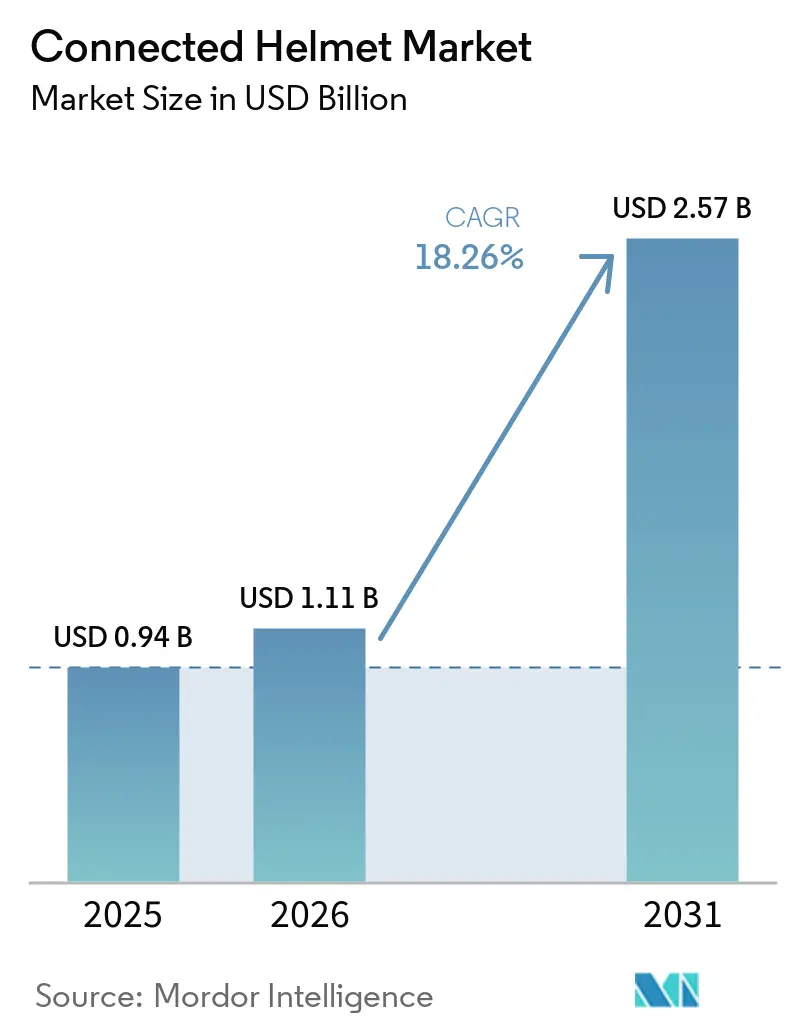
The connected helmet market size was valued at USD 0.94 billion in 2025 and is estimated at USD 1.11 billion in 2026, and is projected to reach USD 2.57 billion by 2031, growing at a CAGR of 18.26% over 2026-2031. Three key factors drive this expansion: regulatory mandates that transition crash-notification systems from optional accessories to essential safety infrastructure; the rollout of V2X technology, enabling cellular carriers to monetize spectrum ahead of fully autonomous vehicle adoption; and insurers leveraging real-time telematics to reduce claims costs more effectively than offering premium discounts to attract cautious drivers. Product design is evolving from hardware-focused differentiation to cloud-connected ecosystems, with companies securing recurring data revenue and gaining a competitive edge over hardware-only competitors. The Asia-Pacific region leads in volume growth as China and India deploy connected fleets, while Europe focuses on specification enhancements driven by e-call legislation. In North America, growth is supported by insurance incentives, as there is no federal crash notification mandate. Although price challenges remain, subsidies from fleet operators and insurers are helping reduce overall costs for end users.
Key Report Takeaways
- By product type, full-face helmets accounted for 47.21% of 2025 revenue; AR-HUD variants are expected to post the fastest 19.22% CAGR through 2031.
- By end user, individual riders accounted for 68.32% of the market in 2025, whereas commercial fleets are projected to grow at an 18.98% CAGR over the same period.
- By distribution channel, offline specialty and superstores dominated with 73.19% of 2025 sales; e-commerce is set to expand at a 20.08% CAGR to 2031.
- By connectivity, Bluetooth-only systems accounted for 55.41% of 2025 revenue, while 5G and C-V2X solutions are forecast to grow at a 22.32% CAGR through 2031.
- By geography, Asia-Pacific accounted for 47.26% of 2025 revenue and is also the fastest-growing major market, with a 19.65% CAGR expected through 2031.
Note: Market size and forecast figures in this report are generated using Mordor Intelligence’s proprietary estimation framework, updated with the latest available data and insights as of January 2026.
Market Trends and Insights
Drivers Impact Analysis of Connected Helmet Market*
| Driver | ( ~ )% Impact on CAGR Forecast | Geographic Relevance | Impact Timeline |
|---|---|---|---|
| 5G Rollout Enabling Low-Latency V2X | +3.5% | APAC core, spill-over to North America and Europe | Medium term (2-4 years) |
| Mandatory E-Call & Crash Alerts | +3.2% | Europe, North America, and expanding to APAC | Medium term (2-4 years) |
| AR-HUD Navigation Integration | +2.9% | North America, Europe, premium APAC markets | Long term (≥ 4 years) |
| Motorcycle ADAS Adoption Growth | +2.8% | Global, early uptake in developed markets | Long term (≥ 4 years) |
| Fleet Safety Programmes for Ride-Sharing & Delivery | +2.1% | Global urban centers, chiefly APAC and North America | Short term (≤ 2 years) |
| Telematics-Based Insurance Discounts | +1.8% | Europe, North America, emerging in APAC | Medium term (2-4 years) |
| Source: Mordor Intelligence | |||
Rapid 5G Rollout Enabling Low-latency V2X
A Valeo prototype demonstrated sub-millisecond V2X latency, showing that helmet-mounted antennas can meet ETSI TS 124 486 performance standards even without a direct line-of-sight to a base station. South Korea's extensive urban 5G SA coverage enabled a stable mesh network for a group of riders at highway speeds, a capability beyond the reach of Bluetooth technology[1]“Motorcycle V2X Performance Trial July 2025,”, 5G Automotive Association, 5gaa.org. In China, C-V2X modules became mandatory for all new connected vehicles, with municipal subsidies now extending to two-wheeler fleets, driving demand across multiple cities. However, infrastructure coverage remains a critical factor for success; delays in rural areas of Africa and Latin America may concentrate growth opportunities within a limited period.
Mandatory E-call and Crash-notification Mandates
EN 16072 obliges automatic crash alert systems on powered two-wheelers sold in the EU, shifting connected helmets from optional accessories to regulatory requirements [2]“EN 16072:2025 E-Call Requirements,”, European Telecommunications Standards Institute, etsi.org. In Japan, a fleet pilot reduced emergency response times and decreased severe injury hospitalizations within a short period. In India, a proposed regulation requiring two helmets per new motorcycle could significantly expand the addressable market for connected helmets, provided state-level enforcement is effective. However, implementation challenges in North America may limit the initial impact there.
Integration of AR-HUDs for Real-time Navigation
Shoei’s GT-AIR 3 Smart incorporates a waveguide positioned outside critical impact zones while maintaining ECE 22.06 certification [3]“GT-AIR 3 Smart Product Sheet,”, Shoei Co. Ltd., shoei.co.jp. DigiLens’ holographic waveguide patent enables the integration of HUDs into modular helmet shells that were previously too compact for optical systems. Direct visor projection eliminates the reliance on vibrating handlebar screens. Additionally, BMW’s ConnectedRide Navigator provides turn-by-turn navigation directly to the P1 GS helmet via the multifunction controller. A significant cost reduction is expected to enhance accessibility, though challenges such as battery drain and glare in tropical lighting conditions persist.
Growing Adoption of Motorcycle ADAS Platforms
Riders frequently miss dashboard alerts, underscoring the need for helmet-level warnings, as highlighted by the Connected Motorcycle Consortium. Automakers, while testing V2M systems, have noted a decrease in blind-spot collision risks after embedding Qualcomm-powered C-V2X chips into their prototype bikes. These chips enable real-time communication between vehicles and motorcycles, enhancing situational awareness and safety. By presenting these alerts directly in the riders' line of sight, helmets significantly enhance the effectiveness of ADAS, bolstering the demand for such integrated solutions.
Restraints Impact Analysis of Connected Helmet Market*
| Restraint | ( ~ )% Impact on CAGR Forecast | Geographic Relevance | Impact Timeline |
|---|---|---|---|
| High Cost vs. Standard Helmets | -2.8% | Global, notably price-sensitive APAC | Short term (≤ 2 years) |
| Short Battery Life & Thermal Issues | -2.1% | Global, especially hot-climate regions | Medium term (2-4 years) |
| No Interoperability Standards | -1.9% | Global, fragmented across regions | Long term (≥ 4 years) |
| Privacy & Cybersecurity Risks | -1.6% | Europe, North America | Medium term (2-4 years) |
| Source: Mordor Intelligence | |||
High ASP versus Conventional Helmets
Sena’s Specter was introduced at a premium price point, while uncertified modular alternatives are significantly more affordable. This price gap often causes riders to delay purchases until subsidies are available. Shoei’s pricing reflects a focus on luxury rather than catering to the mass-market safety segment. In India, Studds’ SMK connected helmet line is priced notably higher than entry-level helmets. This price difference continues to limit market penetration, even in the world’s largest two-wheeler market.
Limited Battery Life and Thermal Management
Current flagship devices, under continuous LTE use, often fail to last beyond several hours, falling short of a full day's use. This presents a notable limitation for users who depend on their devices throughout the day. Intelligent Cranium's latest model, featuring thermoelectric cooling, maintains interior temperatures at safe levels, enhancing performance and safety. However, this improvement adds significant weight to the device, potentially affecting portability. While solid-state batteries are expected to deliver a substantial increase in energy density in the future, budget models continue to face heat dissipation issues in warmer environments, underscoring the ongoing need for advancements in thermal management technologies.
*Our forecasts treat driver/restraint impacts as directional, not additive. The impact forecasts reflect baseline growth, mix effects, and variable interactions.
Connected Helmet Market Segment Analysis
By Product Type:
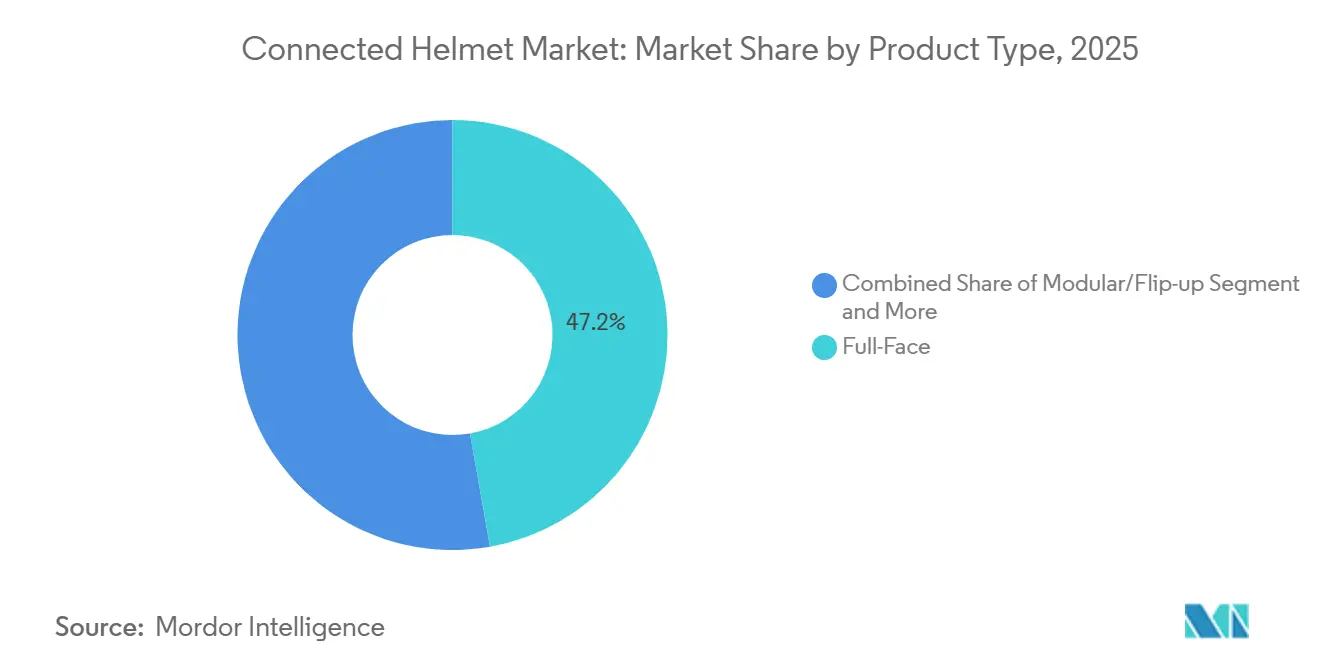
Full-Face Dominance Meets AR InnovationFull-face units held 47.21% of the connected helmet market share in 2025. They remain the benchmark for safety and the reference platform for new connectivity layouts. The connected helmet market size for HUD-Integrated/AR designs is projected to expand at 19.22% CAGR as regulatory rules continue to favor maximum cranial coverage. AR-HUD models, though accounting for only a small share of volumes, are expected to grow significantly, driven by wafer-thin waveguides that now meet energy-absorption standards.
Moderate growth is observed in modular shells, which are increasingly favored by touring commuters. These helmets now feature factory-installed mesh radios, such as the Sena Specter. In contrast, open-face and half helmets remain primarily influenced by price and space limitations, resulting in modest adoption of connectivity features. Off-road helmet variants incorporate dust-proof modules that connect to adventure bike navigation consoles. This segment maintains a stable niche among rally and trail riders.



By End User:
Fleets Narrow the GapIndividual riders comprised 68.32% of 2025 turnover, but price sensitivity caps premium uptake. Delivery fleets are scaling fastest, targeting an 18.98% CAGR, driven by evidence that a USD 500 helmet can cut insurance and downtime costs by multiples across a two-year refresh window.
Subsidy models alter buyer economics: insurers provide hardware at no cost to collect data, while fleets accept higher average selling prices in exchange for reduced liability. Passenger helmets remain a small share of the market, as pillion mandates are inconsistent across regions. Fleet volumes, however, generate secondary demand when used helmets enter the private resale channel at discounted prices, drawing late adopters into the market.
By Distribution Channel:
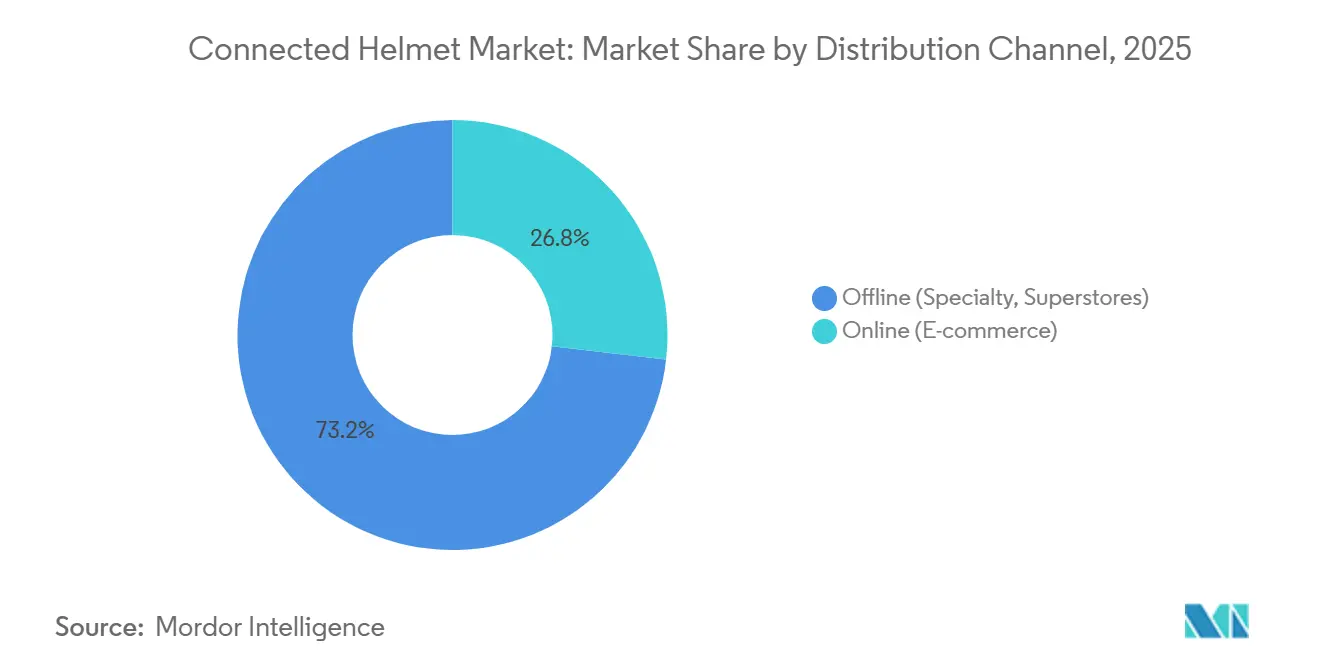
Online Gathers MomentumOffline specialty shops accounted for 73.19% of revenue in 2025 because riders still prefer physical fit checks. Yet e-commerce is sprinting at 20.08% CAGR as virtual sizing tools cut return rates. Direct-to-consumer models also retain control over firmware updates and push accessory sales after checkout.
Studds’ Spain hub, operational since FY 2027, trims EU lead times to under 2 weeks and boosts online conversion among younger buyers. Retailers that cannot add post-sale digital services risk margin squeeze as manufacturers court customers directly.
By Connectivity Technology:
Cellular Position Secures Future UpsideBluetooth-only lines accounted for 55.41% of revenue in 2025 and still dominate the commuter end of the connected helmet market. The connected helmet market for 5G and C-V2X helmets is predicted to triple by 2029 as e-call regulations force a shift from 2G or 3G to IMS-capable modules. The connected helmet market share commanded by Bluetooth is forecast to slide below 40% by 2031.
Fleet operators favor LTE or 5 G to pipe crash data into dispatch dashboards, and Sena’s Wave Intercom converts that connectivity into subscription revenue. Europe’s 2027 IMS deadline cements cellular as the compliance path, setting a brisk retrofit cycle. Unlimited-range group chat and SOS geofencing also widen appeal among touring clubs that previously settled for range-limited mesh.
Geography Analysis
APAC Connected Helmet Market
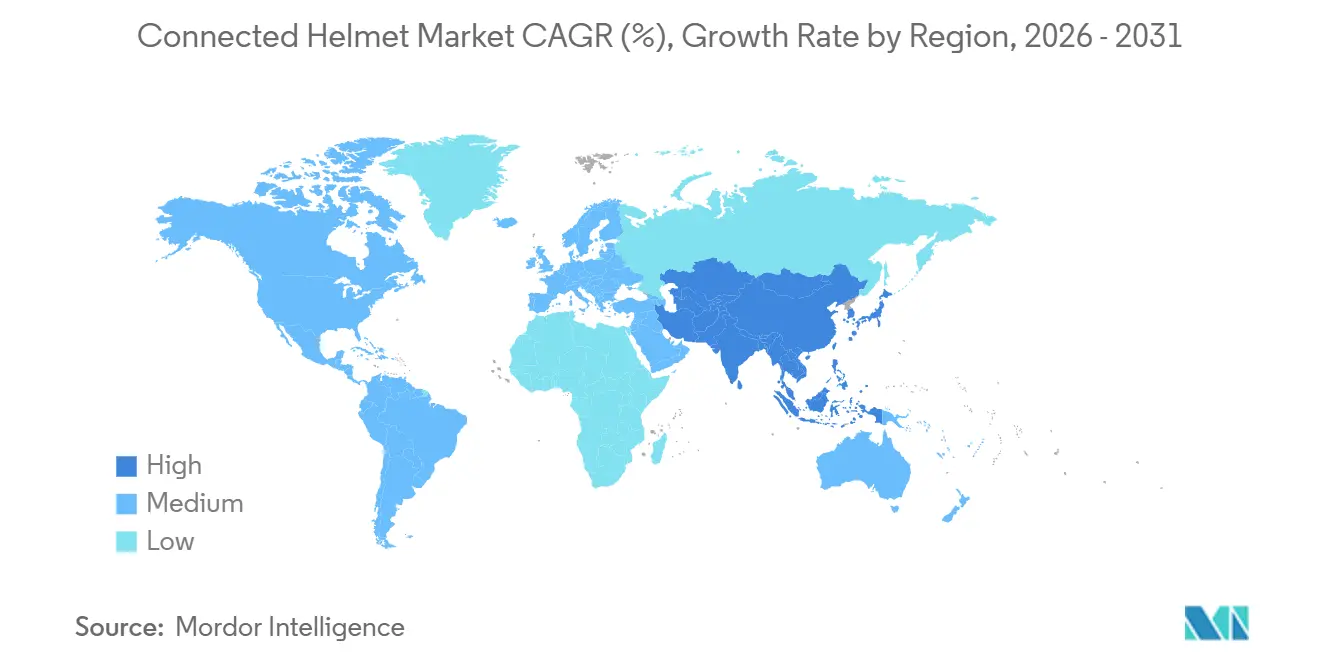
Asia-Pacific accounted for 47.26% of 2025 global revenue and is projected to maintain a 19.65% CAGR through 2031. China introduced a significant number of 4G helmets to delivery fleets across various cities, greatly reducing accidents in certain areas, with provincial subsidies supporting the initiative. If implemented, India's proposed twin-helmet regulation could significantly expand annual market opportunities. Meanwhile, 5G trials in major Japanese cities have improved emergency response times. South Korea's advanced 5G network sets the benchmark for open-road latency in helmet V2X technology.
Europe Connected Helmet Market
Europe accounted for a significant share of sales, with regulations mandating cellular crash notifications in the near future. Germany, France, Italy, Spain, and the United Kingdom collectively account for a substantial portion of the regional volume. Capital inflows, such as recent equity investments, indicate a shift toward technology-integrated product launches.
The Americas and MEA Connected Helmet Market
North America accounted for a notable share of revenue, driven by the touring and recreational segments, which prioritize long-range communication systems. However, the lack of a federal e-call policy means adoption largely depends on insurer incentives. In South America, motorcycle-taxi riders are early adopters of telematics, while the Middle East’s climate conditions are fostering research and development in cooling solutions. In Africa, the primary focus is on theft tracking rather than crash data, creating a niche market for GPS-focused units.
Mordor Intelligence provides coverage of the connected helmet market across other key regional markets, including Europe, each with their regulatory frameworks and demand patterns. Detailed country-level analysis extends to South Korea, United States, China, Japan, and India incorporating local coverage and market participation, as required.

Competitive Landscape
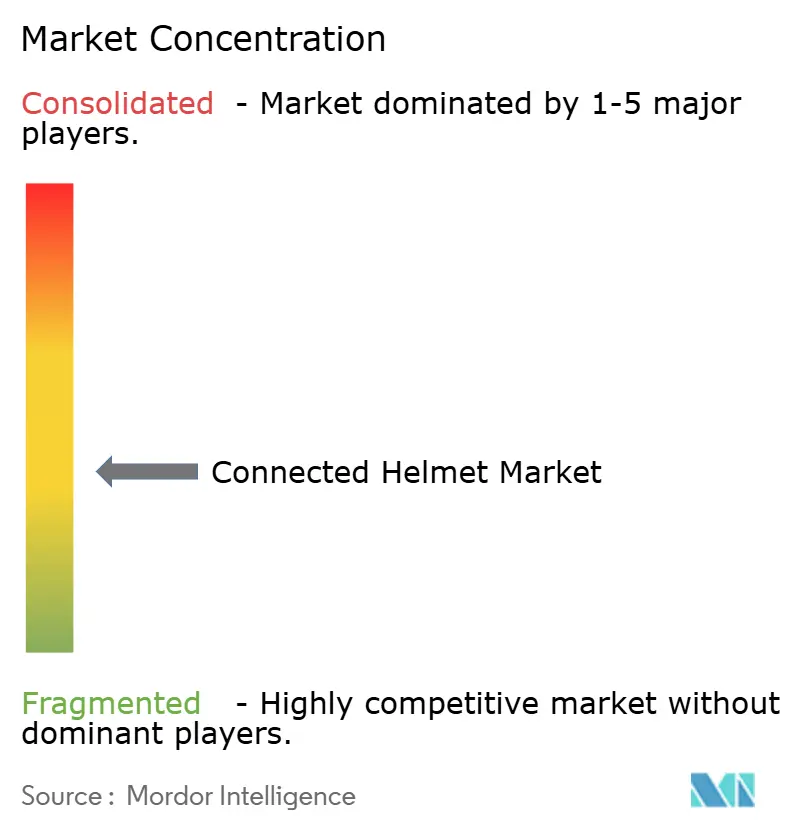
The global market concentration remains moderate, with no single vendor holding a significant share. Sena and Cardo lead in communication modules; however, proprietary protocols limit cross-brand group chat functionality. BMW uses its ConnectedRide COM P1 GS to integrate the motorcycle interface into the OEM system rather than the helmet, reducing the brand's visibility to hardware suppliers. Studds captures a notable share of global helmet volume by combining vertical integration with cost leadership and enhancing European distribution through its Spanish subsidiary.
Component specialists such as DigiLens generate revenue across multiple brands by licensing sub-2-mm waveguides that address HUD bulk limitations. Fleet-telematics companies like RiderDome avoid retail channels entirely, offering hardware at cost to drive adoption of analytics subscriptions. This shift toward data services places pressure on hardware-only players, compelling them to form partnerships or risk losing market share.
Interoperability and privacy remain critical areas of opportunity. Brands that implement open APIs and on-device data segregation could attract customers concerned about vendor lock-in or data privacy. Neglecting these issues may result in regulatory penalties within the EU and increased churn among digitally aware riders.
Connected Helmet Industry Leaders
Shoei Co. Ltd.
Sena Technologies
Schuberth GmbH
Forcite Helmet Systems (GoPro, Inc.)
Jarvish Inc.
- *Disclaimer: Major Players sorted in no particular order
Connected Helmet Market Companies Covered in this Report
- Shoei Co. Ltd.
- Sena Technologies
- Schuberth GmbH
- Forcite Helmet Systems (GoPro, Inc.)
- Jarvish Inc.
- Dainese SpA
- HJC Europe S.A.R.L.
- LIVALL Tech Co. Ltd.
- CrossHelmet
- Bell Sports Inc.
- Studds Accessories Ltd.
- TORC Helmets

Recent Industry Developments in Connected Helmet Market
- June 2026: Canyon unveiled the Stingr Smart Helmet prototype, featuring a built-in heads-up display (HUD) powered by the Canyon Predict safety system. The HUD, positioned inside a retractable visor, displays road hazards, other road users' behavior, group-ride dynamics, and recommended riding behavior, helping riders identify potential hazards beyond their immediate field of view.
- June 2026: AVRO Helmets announced a smart helmet platform for Indian riders, integrating emergency-response features into protective headgear. The platform aims to improve rider safety and reduce post-accident response times through faster access to emergency assistance.
- May 2025: GoPro and AGV unveiled a co-branded smart helmet that marries action-camera electronics with a premium Italian shell.


Global Connected Helmet Market Report Scope
The connected helmet market report is segmented by product type (full face, modular/flip-up, open face, half helmet, off-road/adventure, and HUD-Integrated/AR), end user (individual rider, passenger, and fleet/delivery), distribution channel (offline retail and online direct-to-consumer), connectivity technology (bluetooth-only, cellular/4G-LTE, and 5G and C-V2X), and geography (North America, South America, Europe, Asia-Pacific, and Middle East and Africa). The market forecasts are provided in terms of value (USD).
| Full-Face |
| Modular/Flip-up |
| Open-Face/Half |
| Off-road/Adventure |
| HUD-Integrated/AR |
| Rider (Individual) |
| Passenger |
| Commercial Fleet and Delivery |
| Offline (Specialty, Superstores) |
| Online (E-commerce) |
| Bluetooth-Only |
| Cellular/4G-LTE |
| 5G and C-V2X |
| North America | United States |
| Canada | |
| Rest of North America | |
| South America | Brazil |
| Argentina | |
| Colombia | |
| Rest of South America | |
| Europe | Germany |
| France | |
| Italy | |
| Spain | |
| United Kingdom | |
| Rest of Europe | |
| Asia-Pacific | China |
| India | |
| Japan | |
| South Korea | |
| Rest of Asia-Pacific | |
| Middle East and Africa | Saudi Arabia |
| United Arab Emirates | |
| South Africa | |
| Rest of Middle East and Africa |
| By Product Type | Full-Face | |
| Modular/Flip-up | ||
| Open-Face/Half | ||
| Off-road/Adventure | ||
| HUD-Integrated/AR | ||
| By End-user | Rider (Individual) | |
| Passenger | ||
| Commercial Fleet and Delivery | ||
| By Distribution Channel | Offline (Specialty, Superstores) | |
| Online (E-commerce) | ||
| By Connectivity Technology | Bluetooth-Only | |
| Cellular/4G-LTE | ||
| 5G and C-V2X | ||
| By Geography | North America | United States |
| Canada | ||
| Rest of North America | ||
| South America | Brazil | |
| Argentina | ||
| Colombia | ||
| Rest of South America | ||
| Europe | Germany | |
| France | ||
| Italy | ||
| Spain | ||
| United Kingdom | ||
| Rest of Europe | ||
| Asia-Pacific | China | |
| India | ||
| Japan | ||
| South Korea | ||
| Rest of Asia-Pacific | ||
| Middle East and Africa | Saudi Arabia | |
| United Arab Emirates | ||
| South Africa | ||
| Rest of Middle East and Africa | ||


Key Questions Answered in the Report
What is the size of the connected helmet market in 2026?
The connected helmet market size stands at USD 1.11 billion in 2026.
How fast is the connected helmet market expected to grow?
The market is projected to register an 18.26% CAGR from 2026 to 2031.
Why are fleet operators adopting connected helmets faster than individuals?
Fleets replace helmets every two years and earn sizable insurance and downtime savings that justify higher prices.
What technology shift is most critical for future connected helmet features?
Transition from Bluetooth to 5 G and C-V2X connectivity enables low-latency V2X alerts and unlimited-range group communication.
Page last updated on:





