
Hungary Management Consulting Services Market Size and Share
Market Overview
| Study Period | 2020 - 2031 |
|---|---|
| Forecast Data Period | 2026 - 2031 |
| Base Year Market Size (2025) | USD 1.02 Billion |
| Market Size (2026) | USD 1.08 Billion |
| Market Size (2031) | USD 1.41 Billion |
| Growth Rate (2026 - 2031) | 5.48 % |
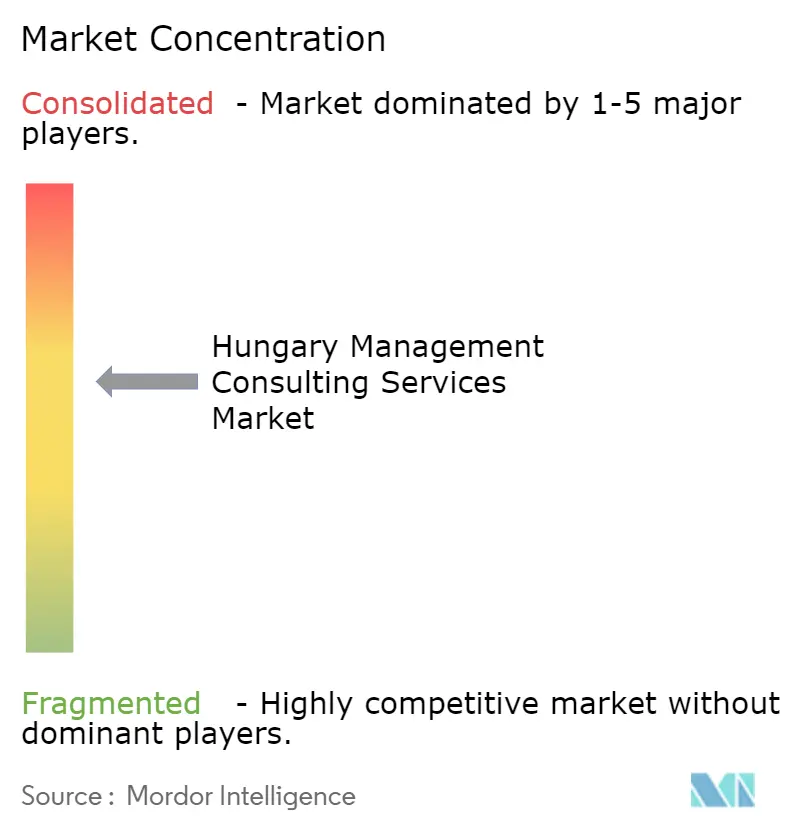
| Market Concentration | Medium |
Major Players *Disclaimer: Major Players sorted in no particular order Image © Mordor Intelligence. Reuse requires attribution under CC BY 4.0. | |
Hungary Management Consulting Services Market Analysis by Mordor Intelligence
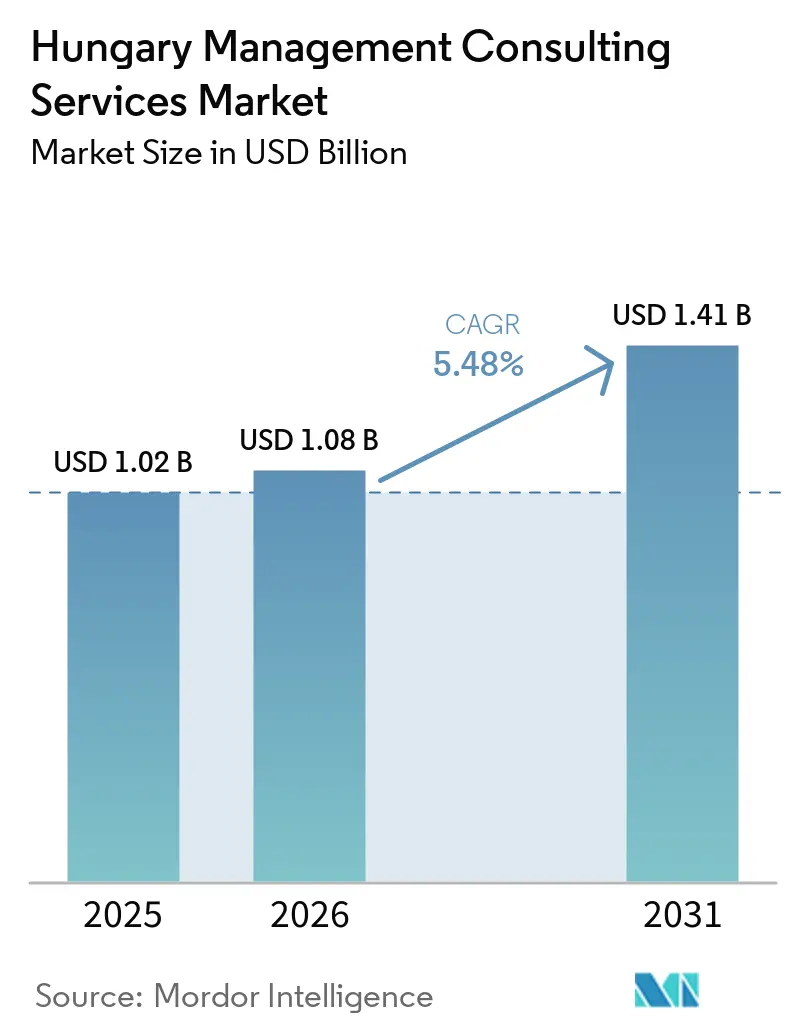
The Hungary management consulting services market size is expected to increase from USD 1.02 billion in 2025 to USD 1.08 billion in 2026 and reach USD 1.41 billion by 2031, growing at a CAGR of 5.48% over 2026-2031. This steady expansion reflects Hungary’s role as a Central European consulting hub, the pull of EU-funded digital-transformation programs, and sustained near-shoring by German automotive original equipment manufacturers. Clients upgraded IT risk frameworks after the EU Digital Operational Resilience Act, while demand for advisory on corporate sustainability, AI governance, and integrated tax incentives lifted fee volumes. Multinational OEM capital programs in Debrecen and Kecskemét created multi-year mandates for site selection, supplier localization, and workforce upskilling, and state aid for innovation continued to draw large transformation projects to Hungary management consulting services market. Advisory firms, however, grappled with a structural IT-talent gap that pushed wages up and forced adoption of hybrid and offshore delivery to preserve margins in the Hungary management consulting services market.
Key Report Takeaways
- By consulting service line, Digital Transformation Consulting led with a 30.14% share of the Hungary management consulting services market in 2025, while Risk and Compliance Consulting is forecast to expand at a 5.74% CAGR through 2031.
- By organization size, large enterprises held 58.37% of Hungary management consulting services market share in 2025; small and medium-sized enterprises are projected to grow at a 5.52% CAGR to 2031.
- By delivery model, on-site engagements commanded 61.27% of 2025 revenue, yet remote and virtual consulting is the fastest-growing format at a 5.87% CAGR through 2031.
- By end-user industry, the public sector accounted for 18.69% of 2025 revenue, whereas healthcare is set to post the highest segment CAGR at 5.61% through 2031.
Note: Market size and forecast figures in this report are generated using Mordor Intelligence’s proprietary estimation framework, updated with the latest available data and insights as of January 2026.
Hungary Management Consulting Services Market Trends and Insights
Drivers Impact Analysis*
| Driver | (~) % Impact on CAGR Forecast | Geographic Relevance | Impact Timeline |
|---|---|---|---|
| Rising EU-Funded Digital-Transformation Programs | +1.2% | National, concentrated in Budapest and university cities (Debrecen, Szeged, Pécs) | Medium term (2-4 years) |
| Accelerating Cloud-First Migration Among SMEs | +0.9% | National, with early adoption in Budapest and Western Hungary | Short term (≤ 2 years) |
| Expanding Demand for ESG Due-Diligence Consulting | +0.8% | National, spill-over to Central European subsidiaries | Medium term (2-4 years) |
| Generous Corporate Tax Incentives for Innovation Projects | +0.7% | National, highest uptake in automotive and electronics clusters (Győr, Kecskemét, Debrecen) | Long term (≥ 4 years) |
| Near-Shoring of German OEM R&D Mandates to Hungary | +0.6% | Regional, focused on automotive hubs (Kecskemét, Debrecen, Győr, Miskolc) | Medium term (2-4 years) |
| EU Digital Operational Resilience Act (DORA) Compliance Consulting | +0.5% | National, concentrated in Budapest financial district | Short term (≤ 2 years) |
| Source: Mordor Intelligence | |||
Rising EU-Funded Digital-Transformation Programs
Hungary drew HUF 30 billion (USD 84.75 million) of SME digitalization grants in 2025, and the broader EU Cohesion Fund channels EUR 22 billion (USD 24.86 billion) of projects through 2027, locking in advisory demand for grant preparation, milestone verification, and post-implementation audits.[1] Consultancies design feasibility studies and technology-stack selection for AI, cybersecurity, and super-computing centers that support Budapest’s data-hub ambition. Deloitte, IFUA Horváth, and WTS Klient monetize simplified cost-option rules by bundling grant writing with implementation oversight, translating funding calls into multi-year revenue streams Although the 2026 parliamentary election introduces short-term uncertainty, multi-annual EU envelopes shield project pipelines, enabling the Hungary management consulting services market to maintain momentum.
Accelerating Cloud-First Migration Among SMEs
Only 21% of Hungarian SMEs used cloud services in 2024 versus the 34% EU average, creating a sizable addressable market for migration roadmaps, architecture redesign, and change-management assignments.[2] DIMOP Plus covers up to 50% of eligible cloud costs, letting consultancies tie success-based pricing to grant capture. Accenture expanded its Budapest headcount in 2025 to service SAP and Oracle workload moves to Google Cloud and Microsoft Azure, signaling a capacity build-out that boutique firms struggle to match. The Magyar Nemzeti Bank tracked 210 profitable fintechs in 2025, each requiring cloud-native advisory on payment gateways and blockchain integration.[3]
Expanding Demand for ESG Due-Diligence Consulting
The Corporate Sustainability Reporting Directive and Hungary’s ESG Act impose first reports in 2026, compelling firms to quantify Scope 3 emissions, align disclosures with European Sustainability Reporting Standards, and prepare for assurance audits. KPMG and PwC lead multi-year retainers, yet IFUA Horváth earned a 2025 Green Wheel Award for sector-specific ESG credentials that resonate with family-owned companies wary of Big Four rigidity. Grant Thornton and Moore Hungary scaled ESG teams to advise automotive suppliers responding to OEM carbon-neutral targets, and integrated legal-tax-sustainability squads help clients map revenue, capex, and opex to the EU Taxonomy.
Generous Corporate Tax Incentives for Innovation Projects
Hungary’s 9% corporate income tax rate pairs with a 10% R&D credit, delivering an 11.3% effective saving when local taxes are included. Development tax incentives let investors offset up to 80% of liability for 13 years, and WTS Klient’s new State Aid practice structures individual government decisions that grant subsidies up to 60% in Just Transition regions Consultancies now model Qualified Domestic Minimum Top-up Tax impacts to safeguard incentives under OECD Pillar Two rules, anchoring Hungary management consulting services market engagements with cross-border tax teams.
Restraints Impact Analysis*
| Restraint | (~) % Impact on CAGR Forecast | Geographic Relevance | Impact Timeline |
|---|---|---|---|
| Persistent Domestic IT-Talent Shortage | -0.7% | National, acute in Budapest and automotive clusters (Kecskemét, Debrecen, Győr, Miskolc) | Long term (≥ 4 years) |
| Highly Price-Sensitive SME Client Base | -0.5% | National, concentrated in SME-dense regions (Central Hungary, Western Transdanubia) | Medium term (2-4 years) |
| Shrinking EU Cohesion-Fund Envelope Post-2027 | -0.3% | National, stronger impact on less-developed Eastern counties | Long term (≥ 4 years) |
| Heightened Regulatory Scrutiny on Public Procurement Tenders | -0.2% | National, focused on public-sector consulting contracts | Short term (≤ 2 years) |
| Source: Mordor Intelligence | |||
Persistent Domestic IT-Talent Shortage
Budapest carried 22,000 unfilled IT roles in 2025, and automotive hubs lacked 8,000 embedded engineers, inflating compensation and compressing consulting margins.[4] EY, IBM, and Capgemini compete for the same profiles, while mid-tier firms open Romanian or Ukrainian delivery centers to meet deadlines. Government social-tax allowances ease hiring costs for researchers but do not close the structural supply gap, so firms partner with universities on co-created curricula that yield talent only in the medium term.
Highly Price-Sensitive SME Client Base
SMEs negotiate fixed fees of EUR 5,000-20,000 (USD 5,650-22,600), well below Big Four rate cards, pressuring consultancies to standardize outputs and limit senior time.[5] Thin retail and logistics margins turn advisory into a discretionary spend; hence local boutiques bundle grant applications with implementation to share funding risk. Digital directories list 29 agencies charging as little as USD 30 per hour, highlighting downward price pressure across Hungary management consulting services market.
*Our forecasts treat driver/restraint impacts as directional, not additive. The impact forecasts reflect baseline growth, mix effects, and variable interactions.
Segment Analysis
By Consulting Service Line: Digital Transformation and Risk Compliance Sustain Momentum
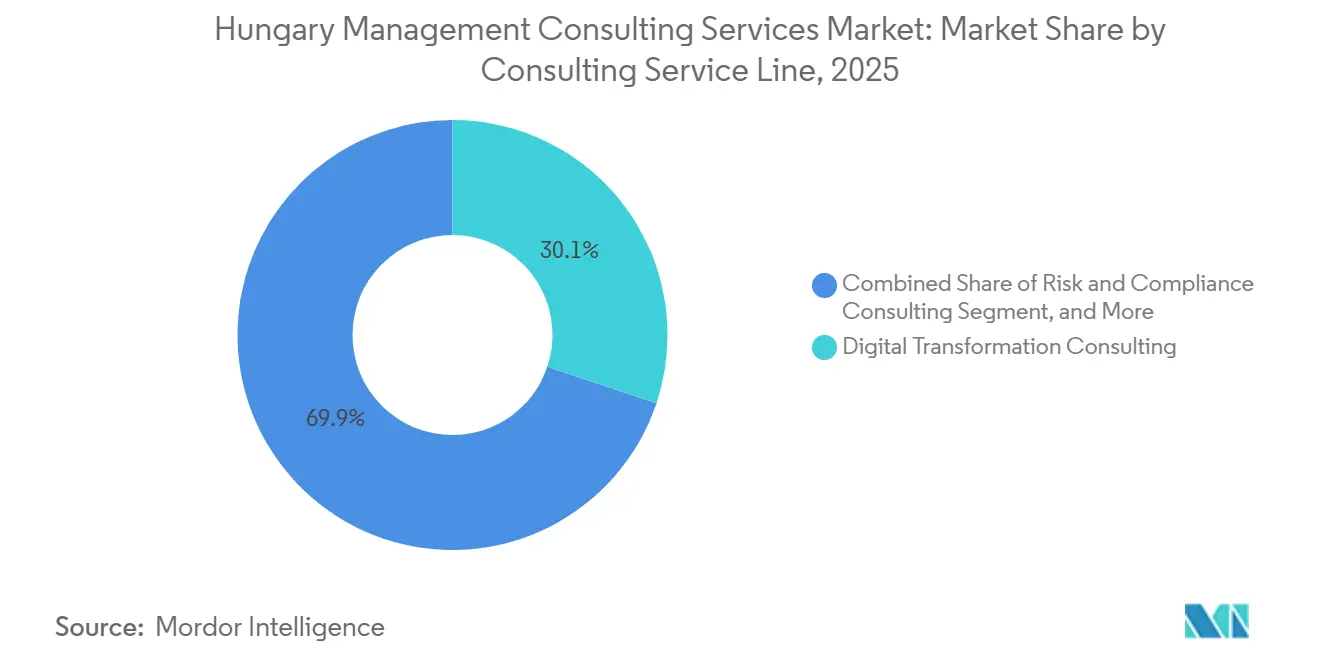
Digital Transformation Consulting represented the largest slice of the Hungary management consulting services market size at 30.14% in 2025. Demand stems from DORA-driven IT risk overhauls, cloud migrations, and Industry 4.0 roadmaps that integrate sensor data with legacy ERP platforms. Over the forecast, Risk and Compliance Consulting is set to outpace all other lines with a 5.74% CAGR, as overlapping mandates from DORA, the Corporate Sustainability Reporting Directive, and the EU AI Act encourage clients to commission integrated compliance playbooks rather than siloed projects.
Clients in automotive, banking, and energy increasingly request end-to-end programs that mix regulatory interpretation, technology enablement, and change-management, expanding ticket sizes while shortening sales cycles for the Hungary management consulting services market. Strategy Consulting fees remain resilient but face competition from in-house analytics teams that license subscription data tools directly from providers once gated behind premier firms. Proprietary benchmarking databases and AI-aided scenario models help global strategy houses defend margins. Operations Consulting holds a stable but slower-growing niche because Six Sigma and lean methodologies are mature, while HR and Financial Advisory services fluctuate with hiring cycles and M&A volumes. Niche lines such as real-estate advisory and innovation management attract boutique specialists who leverage local relationships to win single-source awards.

By Organization Size: SMEs Accelerate on Subsidy Support
Large enterprises delivered 58.37% of revenue in 2025, but their share inches downward as procurement teams renegotiate master service agreements, pushing hourly rates toward Western European benchmarks. Hybrid engagement models, in which Big Four firms supply audit and tax while digital boutiques tackle transformation, erode incumbents’ wallet share yet expand the overall Hungary management consulting services market because total advisory spend rises in absolute terms.
The SME segment grows faster, supported by EU-funded vouchers that cover advisory costs for digitalization, sustainability, and export expansion. Consultancies cultivate repeatable playbooks, low-touch delivery, and template libraries to serve many smaller clients profitably. Despite elevated churn, the pipeline remains healthy because roughly 22,000 micro-enterprises become first-time consulting buyers each year when public tenders open. Fintech startups, most classified as SMEs, require specialized guidance on blockchain architecture and MiCA compliance, offering premium project rates that offset bargain-priced engagements in traditional sectors.
By Delivery Model: Remote and Hybrid Engagements Gain Ground
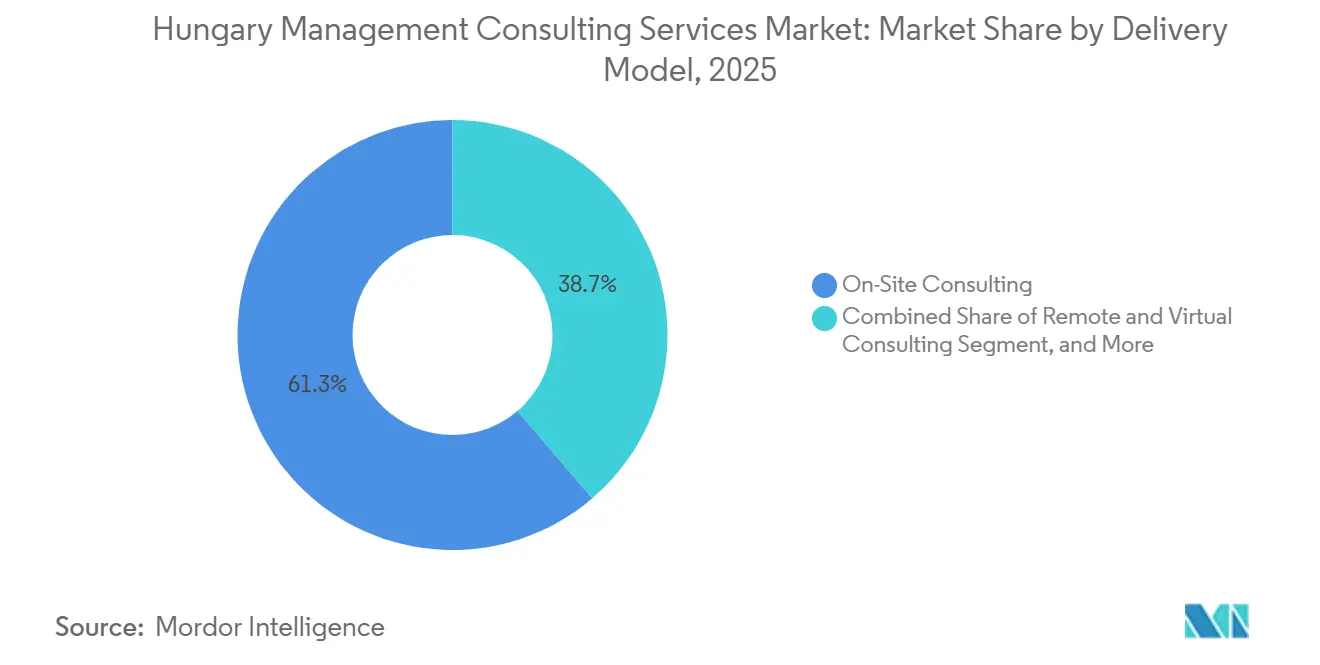
On-site work still generates 61.27% of the Hungary management consulting services market size because factory audits, R&D lab visits, and executive workshops demand physical presence. Even so, remote delivery posts the quickest expansion at a 5.87% CAGR thanks to grant-funded cloud platforms, improved video-conferencing bandwidth, and client insistence on lower travel costs. Firms now embed remote modules into every proposal, reserving in-person time for milestones that benefit most from co-location.
Hybrid engagements dominate mid-market projects, blending virtual sprints with on-site validations. Big Four firms publish discount schedules tied to remote hours, while boutiques use full-remote pricing to undercut competitors. Quality assurance becomes critical: senior partners invest in virtual-facilitation coaching, junior teams access digital playbooks, and engagement letters contain service-level clauses covering response times and collaboration-tool uptime. As remote acceptability rises, consultancies expand reach beyond Budapest into Debrecen, Szeged, and Pécs without adding bricks-and-mortar overhead, reinforcing a more even geographic spread of the Hungary management consulting services market.
By End User Industry: Public Sector Remains Anchor, Healthcare Emerges Fastest
Public-sector programs supplied 18.69% of 2025 revenue, anchored by e-government, shared services, and smart-city initiatives under DIMOP Plus. Ministries award multi-year framework contracts covering project-management offices, benefits-realization audits, and cybersecurity roadmaps, ensuring a predictable baseline for consulting volumes.
Healthcare is the fastest-growing user, projected at a 5.61% CAGR as a 2024 decree forces all hospitals to integrate centralized information systems by January 2026. The DIGIVITALITY project and TeleHealthAid pilots unlock advisory roles in cost-effectiveness analysis, vendor selection, and reimbursement modeling. Manufacturing, especially automotive and electronics, delivers consistent Industry 4.0 demand, though growth moderates as factories internalize lean know-how. Banking and insurance engagements spike ahead of the June 2026 AI sub-strategy deadline set by the Magyar Nemzeti Bank, drawing risk-management specialists. Energy, retail, and professional services round out the Hungary management consulting services market, with circular-economy and omnichannel projects adding incremental fees.
Geography Analysis
Budapest contributes an estimated 60-65% of Hungary management consulting services market revenue because the capital concentrates financial institutions, ministry headquarters, and shared-service centers. Nevertheless, Debrecen, Győr, Kecskemét, Miskolc, Szeged, and Pécs capture a rising share as OEM investments shift east and south. BMW’s EUR 2 billion (USD 2.2 billion) Debrecen plant and Mercedes-Benz’s EUR 55 million (USD 60 million) Kecskemét R&D center yield long-tail advisory mandates in supplier development, training, and logistics optimization.
Western Transdanubia, anchored by Audi Győr, demands continuous operations consulting, while Eastern counties benefit from up to 60% regional-aid intensity that incentivizes greenfield plants and boosts state-aid advisory volumes. Central Hungary satellites such as Gödöllő attract shared-service centers seeking lower rents close to Budapest talent. Southern Transdanubia lags on absolute spend yet holds promise for consultants versed in EU Just Transition projects targeting post-coal economic renewal.
University cities deepen the talent pipeline: PwC, WTS Klient, and COSMO CONSULT sponsor data-science and tax courses in Debrecen and Szeged, easing recruitment pain while embedding brand loyalty among graduates. Across all regions, hybrid delivery lets boutiques based in the capital service clients nationally, balancing the geographic footprint of the Hungary management consulting services market.
Competitive Landscape
The Hungary management consulting services market remains moderately fragmented. The Big Four and three global strategy houses control roughly 40-45% of billings, but domestic specialists match them in public-sector tenders and SME assignments. KPMG processed more than 350 R&D tax certifications in 2025 and is positioned for HUF 50 billion (USD 141.25 million) of Jedlik Programme renewable-energy grants. PwC, EY, and Deloitte race to scale AI governance practices ahead of June 2026 banking deadlines, leveraging cloud partnerships with Microsoft, Google, and AWS to deliver managed-service offerings.
Mid-tier technology consultancies such as Hiflylabs capture predictive-analytics and automation projects often overlooked by larger firms. WTS Klient expands incentives advisory to guide multinational investors through complex subsidy layers. Századvég and GKI translate policy fluency and Hungarian-language expertise into competitive advantage for government projects, while ProHorizont and Logframe win cost-sensitive SME grants with lean structures.
Digital-native agencies listed on freelance platforms disrupt pricing, offering USD 30-70 hourly rates and pure-remote delivery. To defend premiums, incumbents build proprietary data lakes, closed AI models, and benchmarking portals that reduce labor intensity. Acquisition pipelines remain active as global firms eye niche ESG or circular-economy boutiques to fill capability gaps and lock in talent, shaping the next phase of the Hungary management consulting services market.
Hungary Management Consulting Services Industry Leaders
-
KPMG Advisory Limited Liability Company
-
PricewaterhouseCoopers Auditing Limited Liability Company
-
Ernst and Young Advisory Limited Liability Company
-
McKinsey and Company Budapest Limited Liability Company
-
Deloitte Private Company Limited
- *Disclaimer: Major Players sorted in no particular order
Recent Industry Developments
- January 2026: Curtis, Mallet-Prevost, Colt and Mosle LLP associated with François d’Ornano’s Budapest practice to form Curtis d'Ornano Európai Közösségi Jogászi Iroda, signaling greater competition for cross-border FDI advisory.
- January 2026: KPMG Hungary expanded its grant-advisory team to pursue HUF 50 billion (USD 141.25 million) of Jedlik renewable-energy subsidies.
- January 2026: Hiflylabs closed a HUF 207 million (USD 0.58 million) R&D project, deploying more than 250 AI experts across 500 engagements.
- January 2026: The Ministry of Health launched the DIGIVITALITY project to create digital-health reimbursement frameworks.
Hungary Management Consulting Services Market Report Scope
The Hungary Management Consulting Services Market Report is Segmented by Consulting Service Line (Strategy Consulting, Operations Consulting, HR Consulting, Financial Advisory Consulting, Digital Transformation Consulting, Risk and Compliance Consulting, and Other Consulting Service Lines), Organization Size (Large Enterprises, and Small and Medium-Sized Enterprises), Delivery Model (On-Site Consulting, Remote and Virtual Consulting, and Hybrid Consulting), End User Industry (IT and Telecommunications, Manufacturing, Energy and Resources, Public Sector, Healthcare, Banking and Insurance, and Other End User Industries), and Geography. The Market Forecasts are Provided in Terms of Value (USD).
| Strategy Consulting |
| Operations Consulting |
| HR Consulting |
| Financial Advisory Consulting |
| Digital Transformation Consulting |
| Risk and Compliance Consulting |
| Other Consulting Service Lines |
| Large Enterprises |
| Small and Medium-Sized Enterprises |
| On-Site Consulting |
| Remote and Virtual Consulting |
| Hybrid Consulting |
| IT and Telecommunications |
| Manufacturing |
| Energy and Resources |
| Public Sector |
| Healthcare |
| Banking and Insurance |
| Other End User Industries |
| By Consulting Service Line | Strategy Consulting |
| Operations Consulting | |
| HR Consulting | |
| Financial Advisory Consulting | |
| Digital Transformation Consulting | |
| Risk and Compliance Consulting | |
| Other Consulting Service Lines | |
| By Organization Size | Large Enterprises |
| Small and Medium-Sized Enterprises | |
| By Delivery Model | On-Site Consulting |
| Remote and Virtual Consulting | |
| Hybrid Consulting | |
| By End User Industry | IT and Telecommunications |
| Manufacturing | |
| Energy and Resources | |
| Public Sector | |
| Healthcare | |
| Banking and Insurance | |
| Other End User Industries |
Key Questions Answered in the Report
What is the current size of the Hungary management consulting services market?
The Hungary management consulting services market size reached USD 1.02 billion in 2025 and is projected to hit USD 1.41 billion by 2031.
Which consulting service line is growing the fastest in Hungary?
Risk and Compliance Consulting is forecast to register the quickest growth at a 5.74% CAGR through 2031 as companies navigate overlapping EU regulations.
How is remote consulting evolving in Hungary?
Remote and virtual delivery is expanding at a 5.87% CAGR because SMEs purchase cloud tools with EU grants and large firms seek to cut travel expenses.
Why are SMEs increasingly hiring consultants?
EU programs such as DIMOP Plus reimburse up to 50% of digital-transformation costs, allowing smaller companies to access advisory services once reserved for large enterprises.
Which industries will drive new consulting demand through 2031?
Healthcare, driven by hospital information-system mandates and digital-health reimbursement schemes, is expected to post the highest end-user CAGR at 5.61%.
What challenges limit consulting growth in Hungary?
A persistent shortage of IT specialists inflates wages and narrows margins, while price-sensitive SME buyers often push for fixed-fee or success-based contracts.