
HR Shared Services Software Market Size and Share
Market Overview
| Study Period | 2020 - 2031 |
|---|---|
| Market Size (2026) | USD 37.71 Billion |
| Market Size (2031) | USD 58.95 Billion |
| Growth Rate (2026 - 2031) | 9.35 % |
| Fastest Growing Market | Asia-Pacific |
| Largest Market | North America |
| Market Concentration | Low |
Major Players *Disclaimer: Major Players sorted in no particular order Image © Mordor Intelligence. Reuse requires attribution under CC BY 4.0. | |
HR Shared Services Software Market Analysis by Mordor Intelligence
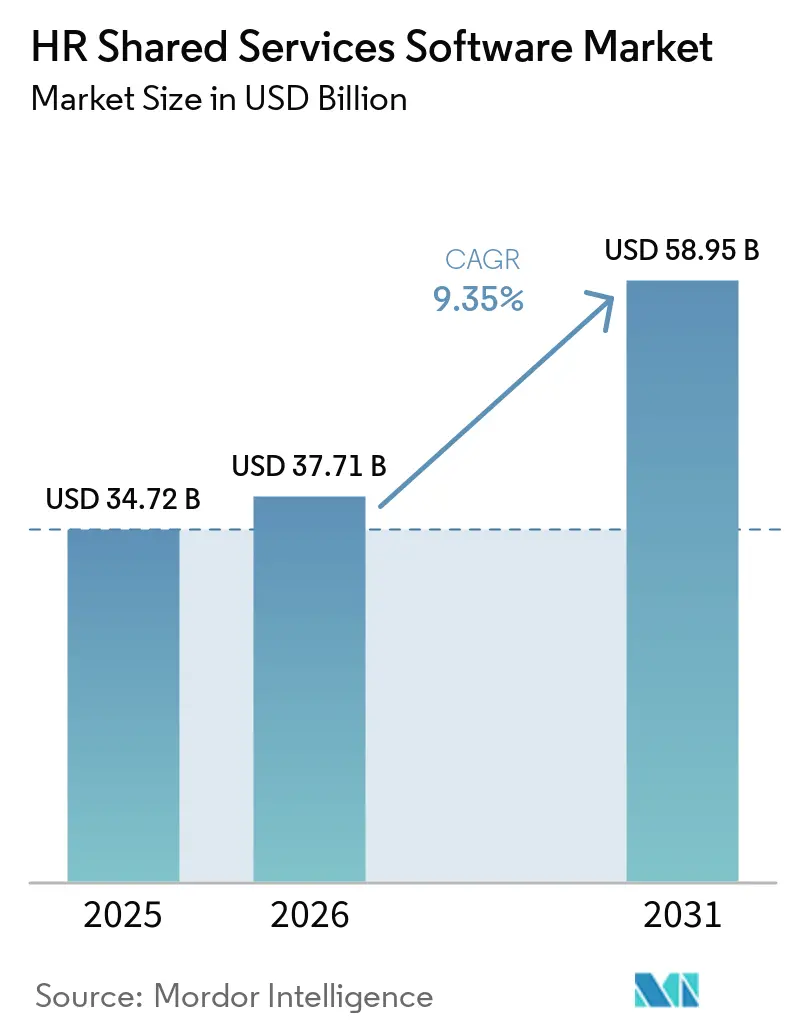
The HR shared services software market size is expected to increase from USD 34.72 billion in 2025 to USD 37.71 billion in 2026 and reach USD 58.95 billion by 2031, growing at a CAGR of 9.35% over 2026-2031. Growth is being supported by the push to digitize HR operations, faster adoption of AI-led case management, and stricter regulations that make fragmented HR processes more expensive to run. Organizations are increasingly treating shared services software as the operating layer that allows fewer HR staff to support a larger employee base through self-service and automation. Software buying decisions are also shifting toward platforms that can handle agentic workflows, compliance audits, and multilingual support across large multinational footprints. That change is raising the bar for incumbent vendors and reducing the time legacy on-premises systems have to remain competitive. It is also accelerating product differentiation as vendors race to demonstrate measurable value in automation, governance, and employee support.
Key Report Takeaways
- By deployment model, cloud-based delivery accounted for 66.12% share of the HR shared services software market in 2025, while hybrid deployment is projected to grow at 11.75% through 2031.
- By enterprise size, large enterprises contributed 62.50% of 2025 revenue, while medium-sized enterprises are expected to record the highest CAGR of 12.31% through 2031.
- By application, core HR and employee self-service accounted for 24.80% of 2025 revenue, while workflow automation and employee journeys are projected to grow at 13.52% through 2031.
- By end-user industry, information technology and telecom held 29.00% share in 2025, while healthcare and life sciences are projected to expand at 13.12% through 2031.
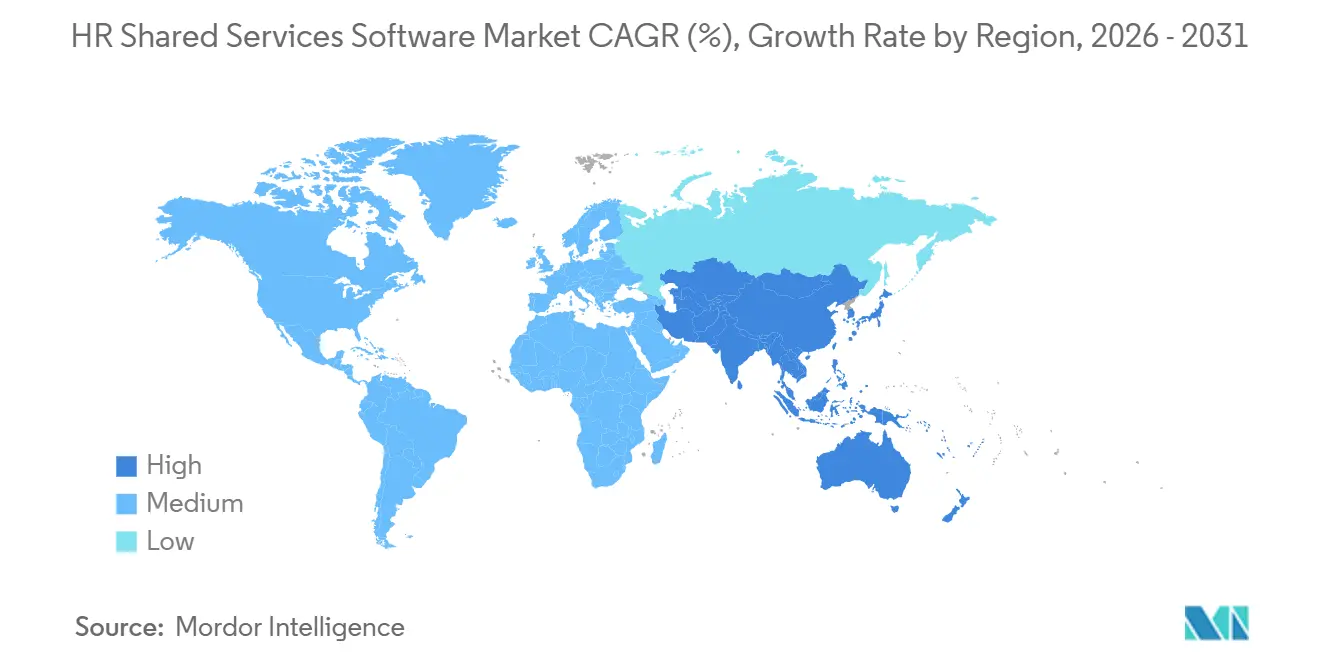
- By geography, North America retained 42.00% of the 2025 revenue OF HR shared services software market, while Asia-Pacific is projected to advance at a 14.25% CAGR through 2031.
Note: Market size and forecast figures in this report are generated using Mordor Intelligence’s proprietary estimation framework, updated with the latest available data and insights as of January 2026.
Market Trends and Insights
Drivers Impact Analysis of HR Shared Services Software Market*
| Driver | (~) % Impact on CAGR Forecast | Geographic Relevance | Impact Timeline |
|---|---|---|---|
| AI-Enabled Case Resolution and Knowledge Retrieval | +2.5% | Global, concentrated in North America and Western Europe, with accelerating uptake in India and Southeast Asia | Short term (≤ 2 years) |
| Expansion of Employee Self-Service Expectations | +1.8% | Global, strongest in North America, UK, and Australia, with fast-growing demand in South Korea and Japan | Short term (≤ 2 years) |
| Centralization of Multi-Country HR Operations | +1.5% | Global, most impactful for organizations headquartered in North America and Europe with APAC and South American subsidiaries | Medium term (2-4 years) |
| Rising Compliance Burden Across Payroll, Leave, and Employee Documentation | +1.2% | EU and UK, with spillover to North America and APAC | Medium term (2-4 years) |
| Cross-Functional Workflow Automation for Joiner-Mover-Leaver Journeys | +0.8% | Global, concentrated in large enterprises in North America, EU, and APAC core markets | Medium term (2-4 years) |
| Demand For Multilingual Shared-Service Support After Mergers and Acquisitions | +0.5% | Global, with spillover to Middle East and Africa and South America in post-merger integration contexts | Long term (≥ 4 years) |
| Source: Mordor Intelligence | |||
AI-Enabled Case Resolution and Knowledge Retrieval Accelerates Tier-0 Deflection
The biggest shift in the HR shared services software market is the move from advisory AI to agentic AI that can resolve cases without human escalation. Oracle introduced Fusion Agentic Applications for HR in April 2026, using coordinated AI agents that can work across policy hierarchies, approval flows, and employee records to complete actions end to end.[1] ServiceNow also extended its HRSD release in December 2025 with agentic flows that use retrieval-augmented generation for tier-0 queries and critical case routing. As deflection rates rise, the cost base of shared service centers falls, allowing more HR staff to shift into employee relations and advisory work.[2] That is lifting the ROI bar in the HR shared services software market for platforms that cannot prove case resolution at scale.
Expansion of Employee Self-Service Expectations Reshapes Platform Architecture
Employee expectations in HR shared services have evolved dramatically. By 2026, employees want far more than simple password resets or pay-stub downloads; they expect portals to handle complex multi-step requests, such as recalculating leave after maternity return, confirming equity grants during role changes, and updating benefits after life events, without HR desk intervention. Microsoft highlighted this shift with its Employee Self-Service Agent, built on Copilot, which unified HR, IT, and campus services into a single enterprise-wide experience, resulting in measurable ticket deflection.[3] Enterprise HR-AI budgets surged to USD 1.6 million in 2026, a tenfold increase from 2023, driven by use cases such as onboarding automation, HR document creation, and AI-assisted workflows. Meanwhile, SHRM emphasized that frontline and deskless workers make up 80% of the global workforce, prompting vendors to prioritize mobile-first, biometric-authenticated, and SMS-accessible support layers rather than browser-only portals.[4]
Centralization of Multi-Country HR Operations Creates Demand For Unified Platforms
The cost of running country-by-country HR operations has become much harder to justify for multinational employers, and that is supporting the HR shared services software market. Organizations with workforces spread across many jurisdictions are centralizing HR and payroll, appointing global compliance owners, and moving toward platforms with built-in country localizations. This creates a second problem: one platform can now hold contracts, payroll records, performance data, and immigration information for tens of thousands of employees across many countries. That risk is forcing vendors to make identity-layered, role-based access control a core product feature rather than an optional compliance add-on. EU pay transparency rules, effective by June 2026, are pushing employers to unify HR data across legal entities to support real-time pay-gap reporting and required disclosures.
Rising Compliance Burden Across Payroll, Leave, and Employee Documentation Drives Platform Adoption
Regulatory complexity has moved from the background to the center of software buying in the HR shared services software market. In the UK, rules effective April 6, 2026, require employers to retain 6 years of detailed holiday pay records, and weak recordkeeping can expose them to unlimited fines under enforcement from the Fair Work Agency. EU pay transparency obligations, effective in June 2026, are also forcing employers to run cross-entity pay-gap analyses and report them through a unified data layer. GDPR enforcement tied to employee data processing has resulted in 191 fines totaling EUR 360,807,141 (USD 389.7 million), and the European Data Protection Board's 2026 coordinated action is focused on employer transparency obligations. That makes audit trails, rule libraries, document retention controls, and policy enforcement features more central to vendor selection across the HR shared services software market.
Restraints Impact Analysis of HR Shared Services Software Market*
| Restraint | (~) % Impact on CAGR Forecast | Geographic Relevance | Impact Timeline |
|---|---|---|---|
| Data Privacy and Sensitive Employee Record Exposure | -1.5% | Global, most acute in EU, UK, and Brazil | Medium term (2-4 years) |
| Integration Friction Across HRIS, Payroll, Identity, and Document Systems | -1.2% | Global, concentrated in North America and Europe where complex multi-vendor stacks are most prevalent | Short term (≤ 2 years) |
| Weak Process Ownership and Poor Data Harmonization Limit ROI | -0.8% | Global, most pronounced in organizations in APAC and South America undergoing first-generation HCM transformation | Medium term (2-4 years) |
| Governance Risk From Agentic AI In High-Stakes HR Decisions | -0.7% | EU, North America, and Australia | Long term (≥ 4 years) |
| Source: Mordor Intelligence | |||
Data Privacy and Sensitive Employee Record Exposure Elevates Deployment Risk
HR shared services platforms consolidate salary, health, disciplinary, immigration, and performance data in a single system, which increases the risk profile of the HR shared services software market. That concentration creates both a larger attack surface and a more serious compliance burden for buyers. The CMS Law tracker recorded 191 employee-data fines totaling EUR 360,807,141 (USD 389.7 million), and the 2026 coordinated action from the EDPB has tightened attention on employer transparency. Italy's data protection authority also issued a warning in 2026 regarding a Slack-based stress-detection tool, citing a risk of future GDPR Article 9 violations even without a confirmed breach. As a result, procurement cycles in the HR shared services software market are taking longer, as legal, privacy, and security teams require ISO 27001, DPIA, and sub-processor evidence before signing contracts.
Integration Friction Across HRIS, Payroll, Identity, and Document Systems Delays Value Realization
Integration remains one of the most persistent execution risks in the HR shared services software market. A 2025 survey of 1,000 employers found that integration capability was the most influential factor in HR and benefits software purchase decisions. The same study revealed that 1 in 8 employers spent 4 or more hours each week on manual data entry caused by integration gaps, adding more than USD 8 billion in annual operating costs. Other research found that up to 60% of HRIS data migration projects experience major delays or budget overruns, often due to avoidable data-mapping failures. Poor integrations not only delay deployment in the HR shared services software market, but they also feed bad data into AI workflows and weaken employee trust before adoption reaches a steady state.
*Our forecasts treat driver/restraint impacts as directional, not additive. The impact forecasts reflect baseline growth, mix effects, and variable interactions.
HR Shared Services Software Market Segment Analysis
By Deployment Model:
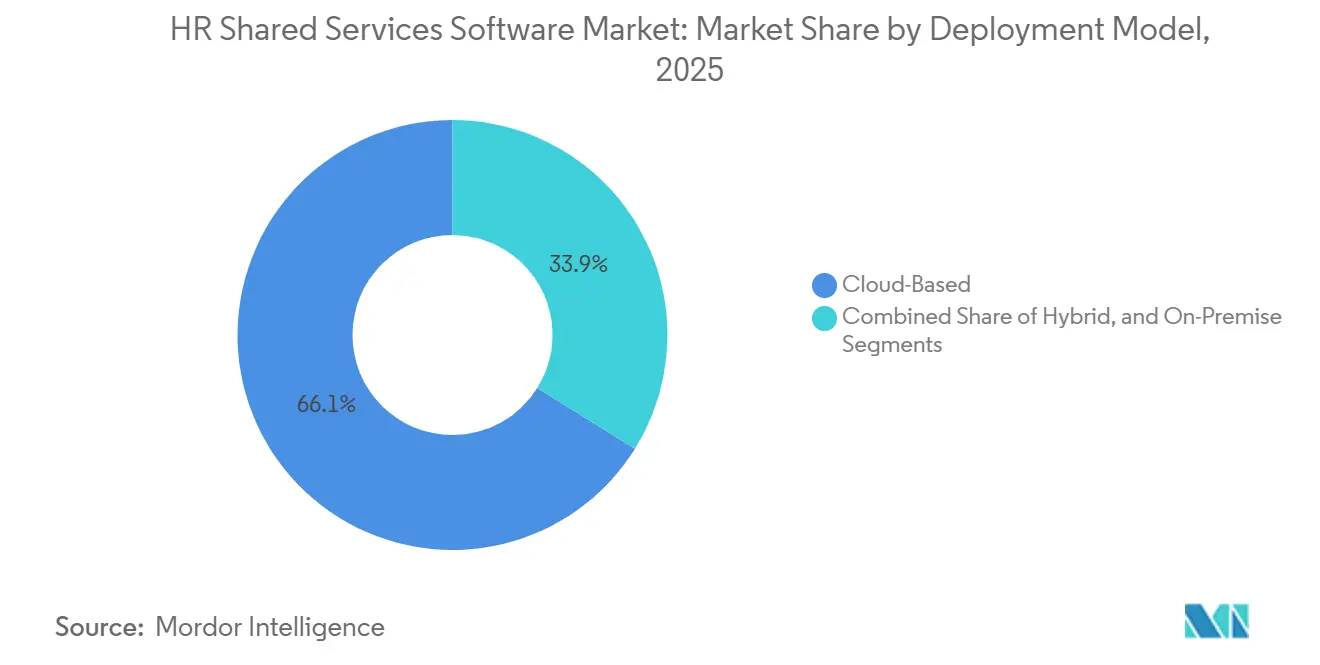
Hybrid Adoption Signals Maturation Beyond Pure CloudCloud-based deployment accounted for 66.12% of the HR shared services software market in 2025, making it the standard choice across enterprise HR operations. Enterprises continue to favor cloud because feature updates arrive faster there, especially for AI, automation, and agentic service tools. Hybrid deployment remains the fastest-growing model and is projected to grow at 11.75% through 2031. That pattern reflects a practical response to data-residency and audit needs rather than a retreat from cloud.
The HR shared services software market for hybrid deployment is projected to expand at a 11.75% CAGR through 2031 as organizations split workloads across cloud and on-premises environments. In regulated settings, payroll and identity data often stay in private infrastructure while service delivery, analytics, and AI capabilities move into cloud layers. This mix is becoming more common in sectors and countries where sensitive employee records cannot be fully migrated to public cloud environments. On-premise deployments continue to lose ground in new projects because legacy ERP links and long license cycles slow migration decisions. The result is a more mature HR shared services software market, where deployment choices are increasingly driven by workload sensitivity and governance needs.

By End User Enterprise Size:
Mid-Market Expansion Broadens The Buyer BaseLarge enterprises accounted for 62.50% of 2025 revenue in the HR shared services software market. That lead reflects the scale economics of shared service centers, centralized SLA management, and multi-country payroll orchestration. These organizations can spread software spending across very large employee populations and many legal entities. They also place greater weight on multilingual support, depth of compliance, and breadth of workflow when selecting platforms.
Medium-sized enterprises are projected to grow at 12.31% CAGR through 2031, making them the fastest-growing buyer group in this segmentation. Cloud delivery and modular pricing are opening access to case management, document handling, and analytics for firms that previously could not justify the costs of enterprise-grade deployment. Many of these buyers are entering the HR shared services software market during their first acquisition or international expansion, which means they often have little legacy shared services infrastructure to unwind. That makes them attractive greenfield opportunities for incumbent and challenger vendors alike. ISG found that 84% of organizations planned to change their HR sourcing model within 2 years, with the expansion of internal shared services identified as a major lever
By Application:
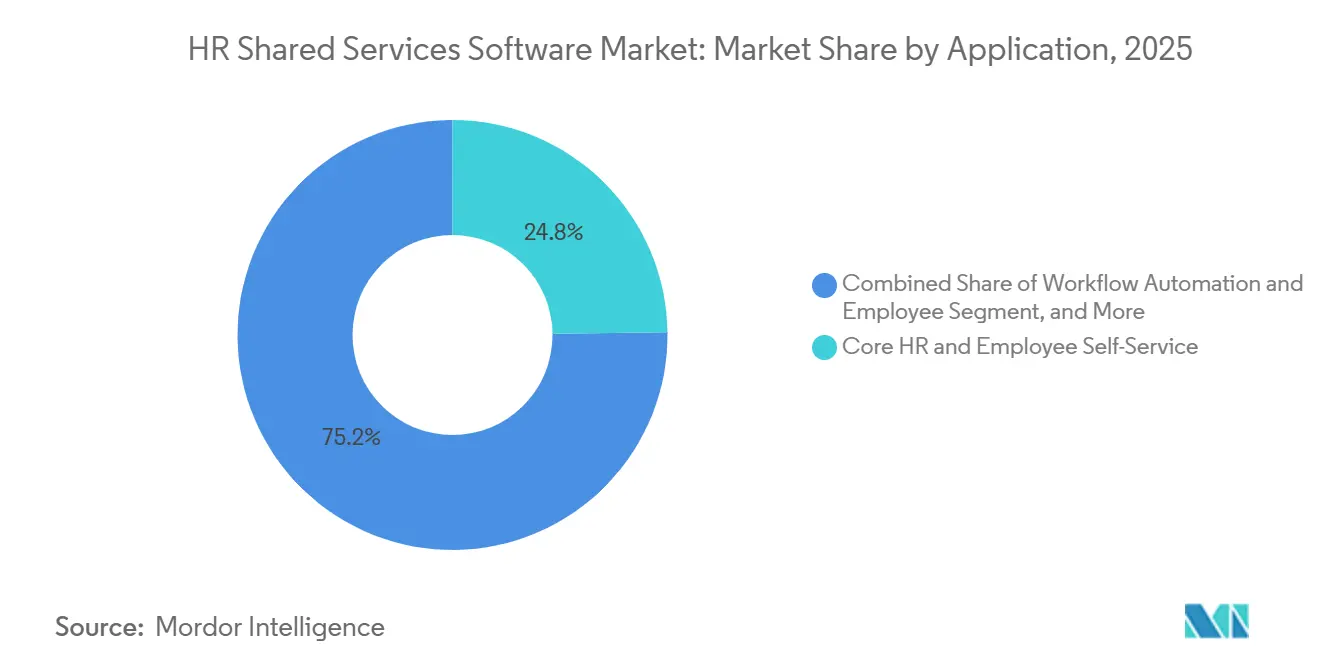
Workflow Automation Becomes Core InfrastructureCore HR and employee self-service accounted for 24.80% of 2025 revenue and remained the foundation of application spending in the HR shared services software market. Workflow automation and employee journeys are projected to expand at 13.52% through 2031, making it the fastest-growing application area. The HR shared services software market for workflow automation and employee journeys is projected to expand at a 13.52% CAGR through 2031 as enterprises connect HR events to IT, finance, and compliance systems. This reflects a shift from static employee portals toward event-driven processes tied directly to the employee record.
Joiner-mover-leaver workflows sit at the center of this change because a single role move can trigger payroll updates, access changes, equipment provisioning, and compliance documentation across multiple systems. Platforms that can run these cross-functional steps natively usually defend stronger pricing because they reduce manual handoffs and control failure points. Case management and ticketing remain a steady contributor across large-enterprise and mid-market deployments in the HR shared services software market. Document management and e-signature are also becoming more important as payroll, leave, and pay transparency obligations require stronger records. Research shows that 56% of HR professionals still do not formally measure the success of their AI investments, which leaves room for analytics and reporting tools to gain more traction.
By End-User Industry:
Healthcare And Life Sciences Emerges As A Growth EngineInformation technology and telecom held 29.00% of 2025 revenue, the largest vertical share in the HR shared services software market. The segment benefited from long-standing investment in digital HR operations and from the concentration of global capability centers in technology-intensive economies. These employers often manage distributed workforces that fit well with the shared-services model, and they adopted centralized case management and self-service processes earlier than most sectors.
The healthcare and life sciences sector is projected to grow at a 13.12% CAGR through 2031, making it the fastest-growing end-user vertical. Growth is linked to credential management, shift-based staffing, union compliance, and employee retention pressures that are difficult to manage through manual HR processes. A major example was the GBP 1.2 billion (USD 1.56 billion), 15-year contract awarded in October 2025 to replace the Electronic Staff Record and manage payroll for 1.9 million NHS employees in England and Wales. BFSI, industrial manufacturing, retail and e-commerce, and government and public sector also remain meaningful contributors to the HR shared services software market. HIPAA in the United States and NHS digital standards in the United Kingdom continue to shape architecture and access-control choices in healthcare deployments.
Geography Analysis
North America HR Shared Services Software Market
North America held 42.00% of the HR shared services software market in 2025, maintaining the region's lead. The region benefits from large enterprise budgets, mature shared service center models, and a dense software vendor base. Buying behavior also favors SaaS procurement and faster deployment of AI-led workflows in employee support. Many HR professionals in the US states with workforce-related AI laws were unaware of those rules, which helps explain why buyers want stronger compliance guardrails in their platforms. Canada adds another layer of complexity through province-level payroll and leave rules and bilingual workplace needs in Quebec, which supports demand for enterprise-grade systems.
Europe and South America HR Shared Services Software Market
Europe remained the second-largest regional market for HR shared services software. GDPR and the EU AI Act have raised the minimum standard for governance, auditability, and transparency across HR platforms used in the region. Coordinated enforcement actions have increased scrutiny of employer transparency obligations in employee data processing. Germany and the United Kingdom anchor regional demand, and the UK's holiday pay recordkeeping rules, effective April 6, 2026, created a near-term trigger for document management modules. South America remains smaller, but Brazil and Argentina are seeing increased interest from multinationals seeking compliant regional HR data platforms.
APAC and MEA HR Shared Services Software Market
Asia-Pacific is projected to grow at 14.25% CAGR through 2031, the fastest regional pace in the HR shared services software market. Growth is being supported by India's expanding IT hiring base, the digitization of China's manufacturing workforce, and healthcare HR modernization across Southeast Asia. Surveys show that 75% of organizations in the region were already using AI in HR, and 63% expected AI budgets to rise in 2026, although only 11% felt fully prepared to scale AI across the enterprise. The Middle East, led by Saudi Arabia and the UAE, and parts of Africa, especially South Africa and Nigeria, remain earlier-stage opportunities tied to conglomerate expansion, multinational subsidiaries, and demand for compliance-ready HR infrastructure.
Competitive Landscape
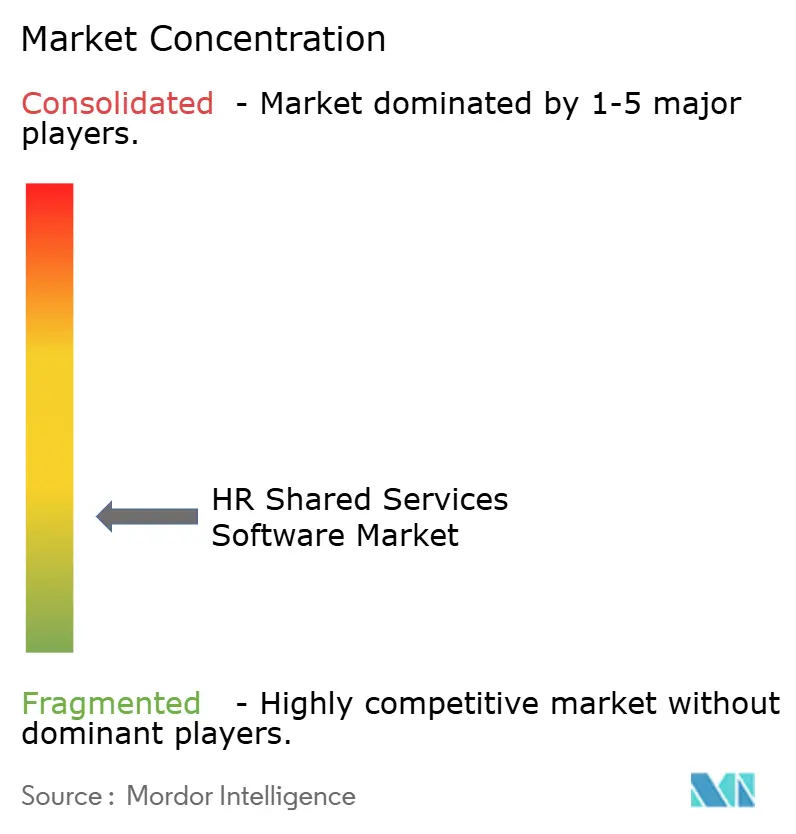
The HR shared services software market stayed fragmented at the enterprise tier in 2026. Workday, UKG, and Dayforce competed for large-enterprise programs on suite breadth, AI capability, and geographic coverage. The mid-market was much more fragmented, with more than 15 credible vendors competing on price, feature depth, and regional fit. This split means leadership in the HR shared services software market depends on both platform breadth and execution in local and vertical use cases. Buyers are increasingly testing whether vendors can support governance-ready AI, multi-country workflows, and multilingual service delivery within a single environment.
Workday further consolidated its platform in the HR shared services software market through its May 2026 expansion with Google Cloud and its November 2025 acquisition of Sana. Those moves were aimed at making Workday the daily operating layer for HR and finance work rather than a back-end system. UKG followed a similar orchestration path through its Gemini Enterprise Agent Gallery launch in April 2026 and its broader AI partnership with Google Cloud in October 2025. Paychex also moved to protect its mid-market position with the May 2026 launch of the WISE AI platform, which it linked to decades of payroll and HR data.
Challenger activity is also reshaping the HR shared services software market, especially where buyers want faster deployment or a narrower use-case fit. Rippling extended automation across HR, payroll, IT, and finance through natural-language actions, while Deel moved into SaaS lifecycle management through its Sastrify acquisition in May 2026. Competition is also shifting toward proof of governance, with buyers asking for documented AI controls, audit trails, and human review steps before approving automation in sensitive HR workflows. This keeps the enterprise tier moderately concentrated, but it also leaves room for specialists that can solve healthcare, public-sector, or post-merger service needs faster than broad-suite vendors.
HR Shared Services Software Industry Leaders
-
Workday, Inc.
-
UKG Inc.
-
Dayforce, Inc.
-
Paycom Software, Inc.
-
Paylocity Holding Corporation
- *Disclaimer: Major Players sorted in no particular order
HR Shared Services Software Market Companies Covered in this Report
- Workday, Inc.
- UKG Inc.
- Dayforce, Inc.
- Paycom Software, Inc.
- Paylocity Holding Corporation
- BambooHR LLC
- HiBob Ltd.
- Darwinbox Digital Solutions Private Limited
- Cezanne HR Limited
- Neocase Software
- Rippling People Center Inc.
- Factorial HR, S.L.
- SAP SuccessFactors
- Zalaris ASA
- Ramco Systems Limited
- Servicenow
- Deel Inc.
- PayFit SAS
- Paychex, Inc.
- Neocase Software
Recent Industry Developments in HR Shared Services Software Market
- May 2026: Workday and Google Cloud expanded their strategic partnership to integrate AI agents for HR and finance directly into employees' daily workflows, combining Workday's Agent System of Record with Google Cloud's Gemini Enterprise platform and enabling Workday, Google Cloud, and third-party agents to operate within a unified governance architecture. This marks a significant shift from co-sell partnerships to deep co-engineering of agentic HR infrastructure.
- May 2026: Paychex launched WISE (Workforce Intelligence Strengthened by Expertise), an AI platform that combines 5 decades of proprietary HR and payroll data with agentic workflow execution across HR reporting, predictive analytics, and autonomous task completion. The platform targets mid-market buyers who need enterprise-grade AI without dedicated AI operations teams.
- May 2026: Deel acquired Sastrify, a Cologne-based SaaS procurement and management platform, extending its HR operating system into software lifecycle management and creating a capability for identity-linked SaaS cost control triggered by employee joiner-mover-leaver events across 150 countries.
- April 2026: Oracle introduced Fusion Agentic Applications for HR, deploying coordinated teams of specialized AI agents that access unified enterprise data, approval hierarchies, and policy workflows to make and execute HR decisions autonomously. This represents Oracle's first production-grade agentic HR offering built directly into Oracle Fusion Cloud HCM.
Global HR Shared Services Software Market Report Scope
The HR Shared Services Software market refers to technology solutions that consolidate HR service delivery into centralized platforms, covering functions such as employee self-service, case management, workflow automation, document management, payroll and benefits support, workforce analytics, and learning assistance. Delivered through cloud-based, on-premise, and hybrid models, these platforms serve large and medium-sized enterprises across industries including BFSI, healthcare, IT and telecom, retail, manufacturing, government, and others. The core purpose of this market is to enhance HR efficiency, ensure compliance, improve employee engagement, and provide data-driven insights that optimize workforce productivity and organizational performance.
The HR Shared Services Software market report is segmented by Deployment Model (Cloud-Based, On-Premise, and Hybrid), Enterprise Size (Large Enterprises, and Medium-Sized Enterprises), Application (Core HR and Employee Self-Service; Case Management and Ticketing; Workflow Automation and Employee Journeys; Document Management and E-Signature; Workforce Analytics and Reporting; Payroll and Benefits Support; Talent and Learning Support), End-user Industry (BFSI, Healthcare and Life Sciences, Information Technology and Telecom, Retail and E-commerce, Industrial Manufacturing, Government and Public Sector, and Other End-user Industries), and Geography (North America, South America, Europe, Asia-Pacific, Middle East, and Africa). The Market Forecasts are Provided in Terms of Value (USD).
Segmentation Overview
| Cloud-Based |
| On-Premise |
| Hybrid |
| Large Enterprises |
| Medium-Sized Enterprises |
| Core HR and Employee Self-Service |
| Case Management and Ticketing |
| Workflow Automation and Employee Journeys |
| Document Management and E-Signature |
| Workforce Analytics and Reporting |
| Payroll and Benefits Support |
| Talent and Learning Support |
| BFSI |
| Healthcare and Life Sciences |
| Information Technology and Telecom |
| Retail and E-commerce |
| Industrial Manufacturing |
| Government and Public Sector |
| Other End-user Industries |
| North America | United States |
| Canada | |
| Mexico | |
| South America | Brazil |
| Argentina | |
| Rest of South America | |
| Europe | Germany |
| United Kingdom | |
| France | |
| Italy | |
| Spain | |
| Russia | |
| Netherlands | |
| Rest of Europe | |
| Asia-Pacific | China |
| Japan | |
| India | |
| South Korea | |
| Australia and New Zealand | |
| Rest of Asia-Pacific | |
| Middle East | Saudi Arabia |
| United Arab Emirates | |
| Rest of Middle East | |
| Africa | South Africa |
| Nigeria | |
| Rest of Africa |
| By Deployment Model | Cloud-Based | |
| On-Premise | ||
| Hybrid | ||
| By End User Enterprise Size | Large Enterprises | |
| Medium-Sized Enterprises | ||
| By Application | Core HR and Employee Self-Service | |
| Case Management and Ticketing | ||
| Workflow Automation and Employee Journeys | ||
| Document Management and E-Signature | ||
| Workforce Analytics and Reporting | ||
| Payroll and Benefits Support | ||
| Talent and Learning Support | ||
| By End-user Industry | BFSI | |
| Healthcare and Life Sciences | ||
| Information Technology and Telecom | ||
| Retail and E-commerce | ||
| Industrial Manufacturing | ||
| Government and Public Sector | ||
| Other End-user Industries | ||
| By Geography | North America | United States |
| Canada | ||
| Mexico | ||
| South America | Brazil | |
| Argentina | ||
| Rest of South America | ||
| Europe | Germany | |
| United Kingdom | ||
| France | ||
| Italy | ||
| Spain | ||
| Russia | ||
| Netherlands | ||
| Rest of Europe | ||
| Asia-Pacific | China | |
| Japan | ||
| India | ||
| South Korea | ||
| Australia and New Zealand | ||
| Rest of Asia-Pacific | ||
| Middle East | Saudi Arabia | |
| United Arab Emirates | ||
| Rest of Middle East | ||
| Africa | South Africa | |
| Nigeria | ||
| Rest of Africa | ||
Key Questions Answered in the Report
What is the current size and forecast of the HR shared services software market?
The HR shared services software market was valued at USD 34.72 billion in 2025, is estimated at USD 37.71 billion in 2026, and is forecast to reach USD 58.95 billion by 2031 at a 9.35% CAGR.
Which deployment model leads HR shared services software adoption?
Cloud-based delivery led with 66.12% share in 2025, while hybrid deployment is projected to grow the fastest at 11.75% through 2031.
Why are enterprises investing more in HR shared services software?
Enterprises are investing to digitize HR operations, increase self-service, deploy AI-led case resolution, and handle stricter compliance requirements through one governed platform.
Which application area is growing the fastest in HR shared services software?
Workflow automation and employee journeys is the fastest-growing application segment with a projected 13.52% CAGR through 2031, reflecting demand for cross-functional employee workflows.
Which end-user sector is creating the strongest growth opportunity?
Healthcare and life sciences is projected to grow at 13.12% through 2031 as providers deal with credentialing, shift-based staffing, union compliance, and retention pressure.
Which region is growing the fastest for HR shared services software?
Asia-Pacific is the fastest-growing region with a 14.25% CAGR through 2031, supported by IT hiring in India, manufacturing digitization in China, and enterprise SaaS adoption across Southeast Asia.