
North America HR Service Delivery Platform Market Size and Share
Market Overview
| Study Period | 2020 - 2031 |
|---|---|
| Forecast Data Period | 2026 - 2031 |
| Base Year Market Size (2025) | USD 6.82 Billion |
| Market Size (2026) | USD 7.48 Billion |
| Market Size (2031) | USD 12.15 Billion |
| Growth Rate (2026 - 2031) | 10.19 % |
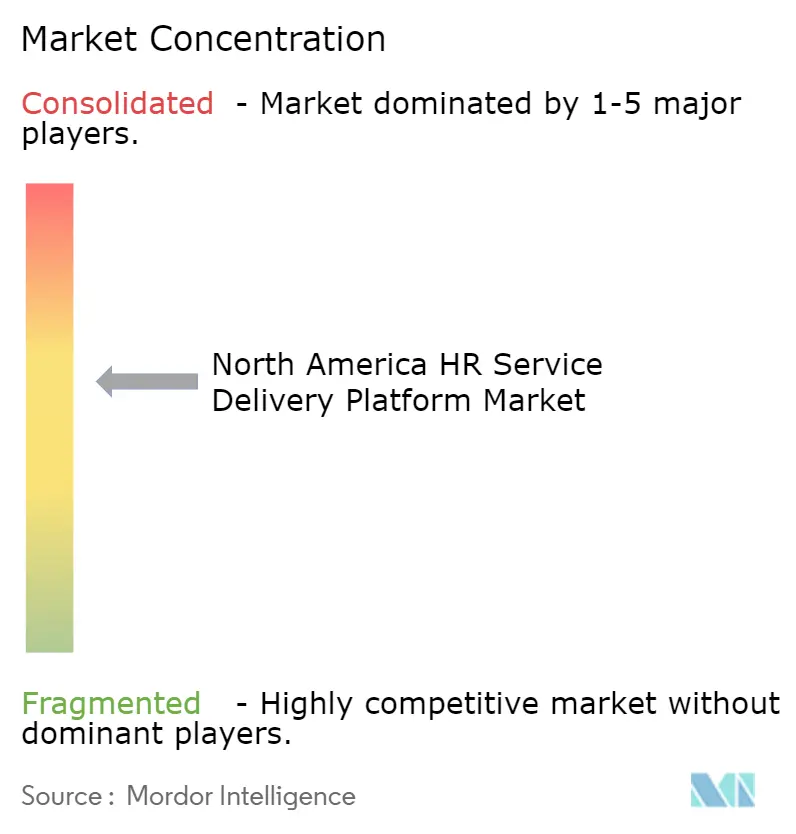
| Market Concentration | Medium |
Major Players *Disclaimer: Major Players sorted in no particular order Image © Mordor Intelligence. Reuse requires attribution under CC BY 4.0. | |
North America HR Service Delivery Platform Market Analysis by Mordor Intelligence
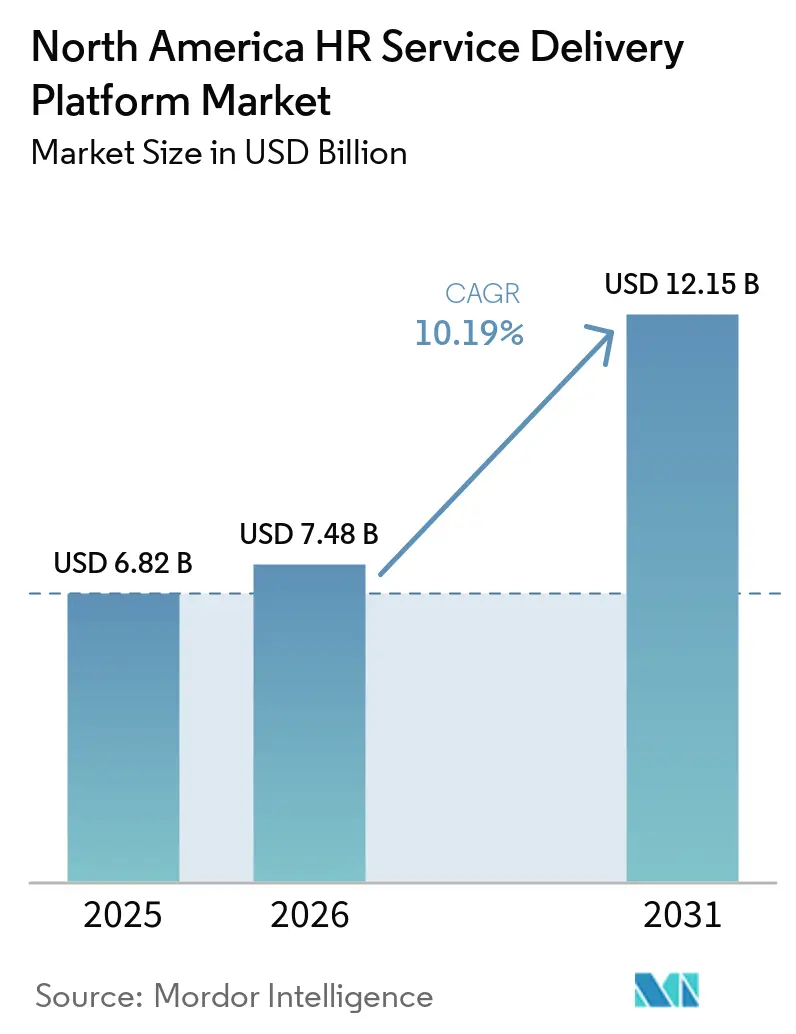
The North America HR service delivery platform market size is projected to expand from USD 6.82 billion in 2025 and USD 7.48 billion in 2026 to USD 12.15 billion by 2031, registering a CAGR of 10.19% between 2026 and 2031. Growth is being supported by enterprise moves to retire fragmented HR systems and replace them with unified cloud platforms that connect payroll, case management, workforce planning, and employee experience. The North America HR service delivery platform market is also being shaped by a broader role for HR technology within business operations, where service delivery now supports staffing decisions, financial coordination, and compliance execution, rather than only administrative processing. Enterprise HR-AI budgets indicate that automation spending has moved well beyond trial deployments and into operating budgets. Demand is also rising as self-service, workflow automation, and real-time analytics become standard requirements for large employers managing hybrid workforces across jurisdictions. Regulatory pressure tied to pay transparency, privacy controls, and algorithmic accountability is adding urgency to software upgrades while also expanding the need for implementation, integration, and managed services.
Key Report Takeaways
- By component, software held 71.82% of the North America HR service delivery platform market share in 2025, while services are projected to expand at a 12.47% CAGR through 2031.
- By deployment model, cloud-based deployment accounted for 65.30% of the market share in 2025, while hybrid deployment is projected to grow at a 11.93% CAGR through 2031.
- By end-user enterprise size, large enterprises captured 61.90% of the market in 2025, while SMEs are projected to expand at a 13.11% CAGR through 2031.
- By end-user industry, IT and telecom held 29.40% share in 2025, while healthcare and life sciences are projected to advance at a 12.69% CAGR through 2031.
- By geography, the United States held 78.60% share of the North America HR service delivery platformmarket in 2025, while Canada is projected to grow at an 11.41% CAGR through 2031.
Note: Market size and forecast figures in this report are generated using Mordor Intelligence’s proprietary estimation framework, updated with the latest available data and insights as of January 2026.
Market Trends and Insights
Drivers Impact Analysis of North America HR Service Delivery Platform Market*
| Driver | (~) % Impact on CAGR Forecast | Geographic Relevance | Impact Timeline |
|---|---|---|---|
| Cloud Migration from Legacy Human Resources Stacks | +2.5% | Global, concentrated in the United States and Canada | Short term (≤ 2 years) |
| Rising Demand For Unified Employee Self-Service and Case Management | +1.8% | United States and Canada core markets | Medium term (2-4 years) |
| Need For Real-Time Workforce Analytics and Workflow Automation | +1.5% | United States and Canada, spill-over to Mexico | Medium term (2-4 years) |
| Hybrid and Distributed Work Models Expanding Digital Human Resources Touchpoints | +1.2% | United States and Canada core, spill-over to Mexico | Short term (≤ 2 years) |
| European Union Pay Transparency Directive Forcing Harmonized Job and Pay Data | +0.8% | United States and Canada, multinationals with EU subsidiaries | Short term (≤ 2 years) |
| Skills-Based Workforce Planning and Internal Talent Mobility | +0.6% | United States and Canada | Long term (≥ 4 years) |
| Source: Mordor Intelligence | |||
Cloud Migration from Legacy Human Resources Stacks
Cloud migration remains the clearest near-term driver of the North America HR service delivery platform market, as enterprises seek to replace disconnected HR tools with unified systems that support service delivery, payroll, and analytics in a single environment. SAP introduced SuccessFactors Enterprise Service Management in 2025 to connect HR case handling with intelligent self-service, reflecting the vendor's broader move toward integrated cloud service layers rather than isolated modules.[1] Workday expanded Sana in 2026 across HR and finance workflows, demonstrating that major platforms are now being designed for action-taking automation rather than only system-of-record tasks. Microsoft also deployed its Employee Self-Service Agent to connect knowledge and workflow sources across SharePoint, Workday, and ServiceNow through a single interface, supporting the shift away from fragmented legacy stacks. This migration is creating follow-on demand for connectors, payroll integrations, and workflow orchestration, as most enterprises are not replacing every core system at once. The result is that cloud migration is lifting software demand while also extending revenue opportunities for implementation and managed service providers across the North America HR service delivery platform market.
Rising Demand for Unified Employee Self-Service And Case Management
Demand for unified employee self-service and case management is rising because employers want faster issue resolution without adding service desk headcount across the North America HR service delivery platform market. IBM stated that its AskHR platform now automates more than 80 HR tasks and handles more than 2.1 million employee conversations each year, which shows that AI-led self-service can operate at enterprise scale rather than as a pilot feature. SAP launched SuccessFactors Enterprise Service Management in 2025 and later extended service resolution capabilities through Joule assistants, reinforcing the move toward a single platform for case intake, routing, and employee support. Microsoft’s Employee Self-Service Agent also showed how employers are trying to remove system switching by bringing HR knowledge and transaction support into a single conversational interface. As these tools improve, case deflection is moving beyond a cost measure and becoming part of service quality because HR teams can spend more time on sensitive or complex workforce issues. Documentation, audit trails, and employee access controls are also driving organizations toward purpose-built HR case tools rather than generic ticketing systems.[2]
Need for Real-Time Workforce Analytics and Workflow Automation
Real-time analytics and workflow automation are becoming core purchase criteria, as employers want HR data to support staffing, compliance, and financial decisions as they occur. In 2026, 62% of C-suite executives were dissatisfied with how people data connected to business performance, further strengthening the case for analytics embedded directly in workforce systems. ADP launched new ADP Assist agents in January 2026 for workforce planning, compliance monitoring, and employee engagement, demonstrating that automation is moving into operational tasks rather than remaining limited to reporting dashboards.[3] In March 2026, ADP also opened a curated AI agents destination in its marketplace, which signaled that workflow automation is becoming part of the broader HCM operating environment rather than a single-feature add-on. This shift is changing buying behavior because organizations increasingly want systems that can analyze people data and trigger next actions across the employee lifecycle. That is keeping analytics, orchestration, and AI-enabled workflow design central to demand in the North America HR service delivery platform market.
Hybrid and Distributed Work Models Expanding Digital Human Resources Touchpoints
Hybrid and distributed work models continue to increase the number of HR interactions that must be handled digitally across the North America HR service delivery platform market. In 2026, 55% of global employees worked in the office 3-4 days per week, while fully remote work fell to 10%, which confirmed that hybrid work had become a stable operating model rather than a temporary phase. In 2026, 83% of large enterprises, 88% of midsize businesses, and 94% of small businesses offered hybrid arrangements, indicating how widely decentralized workforce management had spread. This shift increases demand for mobile-first portals, real-time absence management, policy acknowledgment workflows, and location-aware compliance features, as many routine interactions no longer occur face-to-face. Self-service deployment and integration of HR support into everyday productivity environments both align with this pattern by meeting employees where they are in their daily digital tools. As employee touchpoints become more frequent and distributed, platform utilization rises, supporting continued expansion in the North America HR service delivery market.
Restraints Impact Analysis of North America HR Service Delivery Platform Market*
| Restraint | (~) % Impact on CAGR Forecast | Geographic Relevance | Impact Timeline |
|---|---|---|---|
| Data Privacy and Cross-Border Employee Data Controls | -1.2% | United States and Canada, multinational employers with EU footprint | Short term (≤ 2 years) |
| Integration Complexity With Legacy Enterprise Resource Planning and Payroll Systems | -0.9% | United States and Canada core, spill-over to Mexico | Medium term (2-4 years) |
| European Union Artificial Intelligence Act and Algorithmic Accountability For Employment Decisions | -0.5% | United States and Canada, multinationals deploying AI-driven HR tools in EU | Medium term (2-4 years) |
| Data Sovereignty and Regional Hosting Requirements | -0.4% | Canada and Mexico, national regulatory impact | Long term (≥ 4 years) |
| Source: Mordor Intelligence | |||
Data Privacy And Cross-Border Employee Data Controls
Data privacy and cross-border employee data controls are slowing procurement because employers must review how payroll, case data, and compensation records move across jurisdictions in the North America HR service delivery platform market. California’s amended CCPA regulations, effective January 1, 2026, required certain employers to conduct formal privacy risk assessments before processing HR data tied to significant privacy risk, including automated decision-making uses.[4] For multinational employers, employee data transfers between the EU and North American systems also require structured compliance mechanisms, which adds legal review and vendor audit work before contracts are signed. This tends to favor larger platforms that can present a more unified compliance posture across GDPR, CCPA, and PIPEDA requirements. Smaller or niche tools can still compete on features, but they face a longer sales cycle when procurement teams prioritize privacy certifications and data-handling controls. The result is not lower demand, but slower deployment and a higher compliance burden for buyers and vendors alike.
Integration Complexity With Legacy Enterprise Resource Planning And Payroll Systems
Integration complexity with legacy ERP and payroll systems remains a major execution constraint, as many large employers still rely on older finance, payroll, and time systems that were not built for continuous AI-led workflows. In Q1 2026, 29% of HR platform evaluators cited integration failures as the main reason for dissatisfaction with current vendors, and those failures created 5-10 hours of manual data reentry and reconciliation each pay period. In April 2026, fragmentation across HR, payroll, and time systems was identified as the main barrier to realizing full AI value in HR because disconnected systems limit reliable action across the employee lifecycle. Release changes can add to the burden, as integration teams must continually retest workflows as vendor APIs and payroll interfaces evolve. Buyers also tend to underestimate integration cost during early ROI planning, which stretches project timelines and delays value realization. This makes integration depth, middleware readiness, and deployment support critical decision factors in the North America HR service delivery platform market.
*Our forecasts treat driver/restraint impacts as directional, not additive. The impact forecasts reflect baseline growth, mix effects, and variable interactions.
North America HR Service Delivery Platform Market Segment Analysis
By Component:
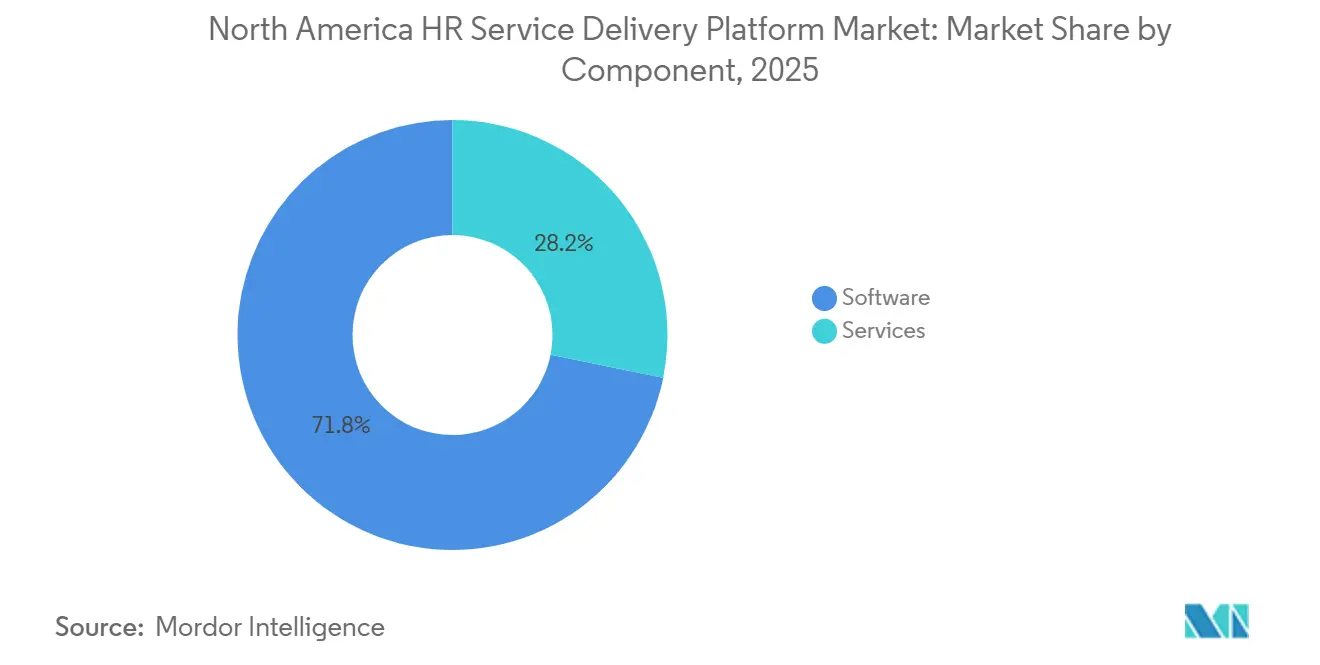
Services Revenue Accelerating As Managed Operations Gain TractionSoftware held a 71.82% share of the market in 2025, making it the largest component of the North America HR service delivery platform market. Core HR, payroll, and compensation, and employee service management modules remain the base of buyer spending because they handle the highest-volume processes across large and mid-sized organizations. Buyers are also directing more software spend toward people analytics, talent management, and workforce management as they replace separate dashboards and point tools with functions embedded inside daily workflows. Product releases in 2025 and 2026 clearly showed this direction, with enterprise service management and autonomous HCM capabilities moving more service resolution and decision support into the software layer itself. This keeps software as the revenue anchor because enterprises prefer broad suites that reduce switching across systems and tighten data consistency.
Services are projected to grow at a 12.47% CAGR through 2031, making it the fastest-moving component segment in the North America HR service delivery platform market. In April 2026, new managed solutions were launched with dedicated teams that administer payroll and HR operations on behalf of clients, which reflects rising demand for managed support rather than one-time implementation work. Other providers also made bundled HR services generally available in February 2026, combining technology with hands-on HR support for smaller employers seeking execution support. AI governance, payroll administration, data stewardship, and post-go-live tuning all require ongoing support, which means services revenue should remain strong even when software deployment cycles become more efficient.
By Deployment Model:
Hybrid Deployment Normalizes As A Strategic Architecture ChoiceCloud-based deployment accounted for 65.30% of the North America HR service delivery platform market share in 2025, which confirmed SaaS as the leading delivery model. The cloud model continues to appeal because it supports faster feature updates, better employee access, and easier rollout of AI-enabled workflows across large workforces. It also aligns with current buying preferences for unified platforms that connect core HR, self-service, and analytics across departments. On-premises environments remain relevant for a smaller group of organizations in government, defense, and tightly regulated financial settings where data-handling restrictions are stricter. Even so, the North America HR service delivery industry continues to move toward cloud-led operating models because most new automation capabilities are being built there first.
Hybrid deployment is projected to expand at a 11.93% CAGR through 2031, making it the fastest-growing deployment approach. Large employers often retain older on-premises ERP or payroll systems while moving employee self-service, analytics, and service management to the cloud. That pattern is turning hybrid architecture into a deliberate design choice rather than a temporary midpoint between legacy and full SaaS. The emerging edge-to-cloud model extends this logic further, enabling employers to run employee-facing AI interactions through cloud interfaces while routing sensitive records through more controlled environments. This helps explain why hybrid adoption is rising alongside cloud growth in the North America HR service delivery platform market instead of disappearing as migration advances.
By End User Enterprise Size:
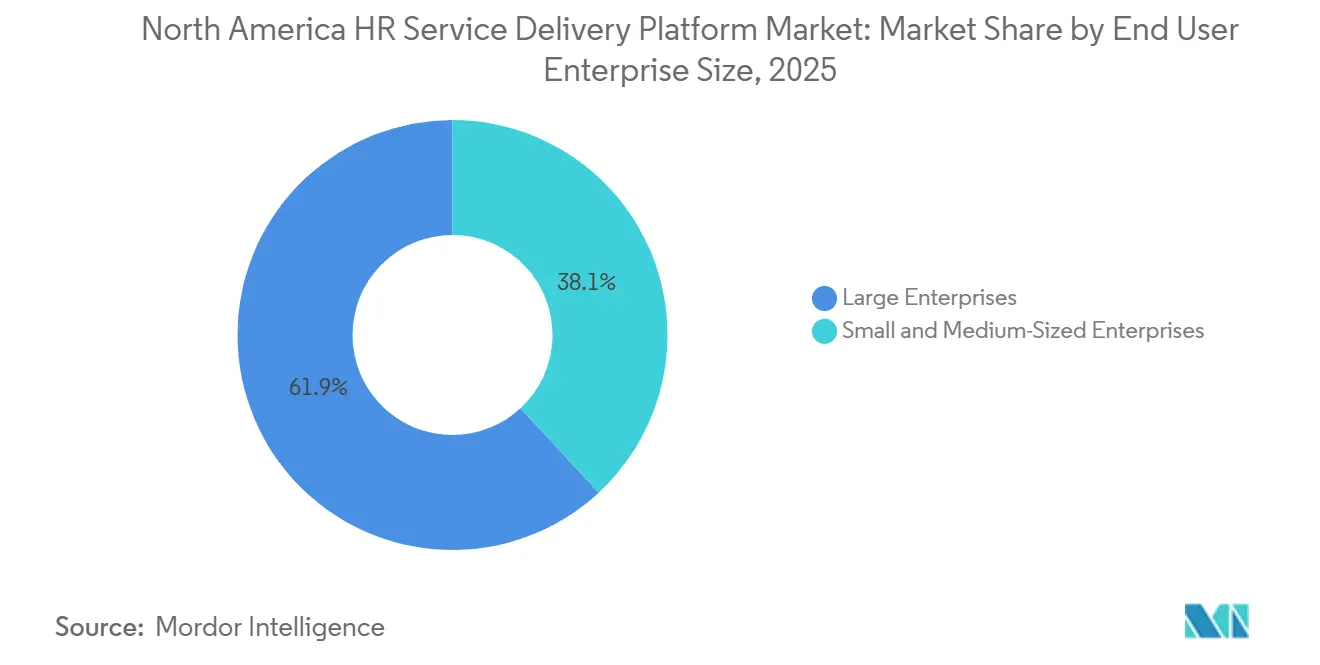
SMB Demand Is Pulling In Tier-1 PlatformsLarge enterprises captured 61.90% of the North America HR service delivery platform market in 2025, reflecting their higher contract values, broader module adoption, and more complex compliance needs. These organizations manage multi-state payroll, broad benefits structures, and large employee populations, so they gain greater immediate value from end-to-end HCM and service-delivery platforms. In May 2026, enterprise AI benchmarks were raised by making the Sana Self-Service Agent available in Microsoft 365 Copilot for eligible customers, bringing HR and finance support into a tool employees already used every day. Other providers also extended agentic functionality in 2026, reinforcing the view that enterprise buyers now expect automation embedded in core workflows rather than sitting at the edge of the system. For that reason, large enterprises remain the main revenue base for the North America HR service delivery market even as other customer groups accelerate.
SMEs are projected to grow at a 13.11% CAGR through 2031, making them the fastest-growing segment of the enterprise market. In late 2025, new solutions were expanded to support businesses of different sizes, and the HRScale launch in 2026 showed how major vendors are simplifying deployment and services for smaller buyers. Further momentum was added in May 2026 with the launch of QuickBooks Workforce as an agentic, end-to-end HCM solution for small and mid-market businesses. Variable pricing, faster setup, and better contractor workflow support are making advanced payroll, compliance, and talent tools accessible to organizations that previously viewed them as enterprise-only products.
By End-User Industry:
Healthcare And Life Sciences Shows The Fastest ExpansionIT and telecom held a 29.40% share in 2025, making it the largest end-user vertical in the North America HR service delivery platform market. This sector employs large, often globally distributed workforces, frequently changes team structures, and is comfortable with rapid software adoption. It therefore tends to drive the use of people analytics, talent management, and skills-based planning tools because workforce visibility has direct operating value. Expanded AI workflow strategies and connected self-service architectures align well with the needs of technology employers seeking HR support embedded in digital work environments. This keeps IT and telecom at the forefront of adoption in the North America HR service delivery industry, as the sector values speed, integration, and workforce intelligence.
The healthcare and life sciences sector is projected to grow at a 12.69% CAGR through 2031, making it the fastest-growing vertical. In February 2026, nearly 90% of the largest U.S. healthcare systems were reported to be using staffing and scheduling platforms, highlighting the sector’s reliance on workforce management tools designed for complex shifts and labor rules. The 2026 Health Care Workforce Scan also stated that AI-powered credential matching and predictive demand forecasting were active investment priorities, aligning with the need for more specialized service-delivery capability within hospitals and health systems. Other regulated verticals follow distinct demand patterns: BFSI emphasizes compensation governance, manufacturing requires bilingual and cross-border payroll alignment, and government prioritizes secure cloud eligibility and controlled deployment models. Those differences support broad demand across the North America HR service delivery market, but healthcare stands out because staffing pressure, credential compliance, and scheduling complexity are increasing simultaneously.
Geography Analysis
United States HR Service Delivery Platform Market
The United States accounted for 78.60% of the North America HR services delivery market share in 2025, making it the clear revenue center of the region. In Q1 2026, 67% of U.S. organizations evaluated payroll platform alternatives, up from 52% in Q4 2025, with compliance gaps and integration failures driving much of that review activity. That level of switching matters because it pushes employers away from fragmented payroll tools and toward broader service delivery suites that can better handle multi-state policy and pay requirements. In March 2026, U.S. federal agencies were reported to be moving toward consolidating more than 100 HR systems onto a modern cloud platform, which extended demand beyond the private sector into public-sector procurement. U.S.-based multinationals also faced the June 2026 deadline under the EU Pay Transparency Directive, which increased pressure to harmonize job structures, pay data, and reporting workflows across existing HCM environments.
Canada HR Service Delivery Platform Market
Canada is projected to grow at a 11.41% CAGR through 2031, making it the fastest-growing geography in the North America HR service delivery platform market. Demand in Canada is shaped by a more localized compliance environment that includes provincial employment rules, bilingual workforce needs, privacy obligations, and data-handling expectations that often require more configuration than U.S.-centric platforms provide. In 2026, 59.1% of Canadian HR professionals reported using AI tools daily or weekly, with analytics and reporting and recruitment and screening as the leading use cases, pointing to rising demand for more advanced platform capabilities. In January 2026, new year-end filing support was added for Canada, including T4, T4A, RL-1 filings, and indigenous employee tax exemptions, reinforcing the localization trend.
Mexico HR Service Delivery Platform Market
Mexico remained the smallest country segment, but it held strategic importance because nearshoring-led manufacturing growth is increasing workforce management complexity and platform demand. Mandatory CFDI electronic payroll rules, PTU profit-sharing calculations, and IMSS social insurance obligations all make local compliance more specialized than a standard U.S. deployment model can support. In January 2026, native payroll was expanded to Mexico, and broader expansion plans for smaller businesses signaled that leading vendors were treating Mexico as an active part of regional platform strategy rather than a secondary market. As manufacturers standardize HR environments across U.S., Canadian, and Mexican operations, Mexico should play a larger role in the North America HR service delivery platform market over the forecast period.
Competitive Landscape
The North America HR service delivery platform market had a moderately concentrated upper tier and a highly active mid-market in 2026. Workday, ADP, and UKG remained the strongest names among large enterprises, while Rippling, Dayforce, Paycom, Paylocity, BambooHR, and HiBob competed more aggressively across mid-market and SMB accounts. The clearest strategic pattern across 2025 and 2026 was the race to embed agentic AI into the platform core rather than offer automation only as a side feature. In 2026, new AI agents were launched across several platforms, including Sana in March, new agents in January and March, the WISE platform in May, and People Assist, which was placed in Google Cloud’s Gemini Enterprise Agent Gallery in April. That changed the basis of competition because buyers increasingly want vendors that can resolve requests, guide decisions, and execute tasks rather than just store records.
The April 2025 acquisition of Paycor reduced the number of independent mid-market challengers and strengthened bundled payroll and workforce management competition. In November 2025, a definitive agreement was signed to acquire Pipedream, underscoring the strategic importance of integration capability for cross-system automation. In April 2026, recruiting automation was expanded with the addition of Grayscale Labs, and in May 2026, QuickBooks Workforce was launched as an end-to-end HCM solution for smaller employers. Deel continued to blur the line between HR service delivery and employer-of-record support by targeting globally distributed teams that traditional HCM vendors had not prioritized as heavily.
White-space opportunities remained strongest in tri-country delivery across the United States, Canada, and Mexico, in AI governance for employment decisions, and in healthcare-focused workforce management designed for mid-market buyers. Darwinbox strengthened its position as an emerging challenger by raising USD 140 million in March 2025 and another USD 40 million in August 2025 to support product development and North America expansion. Compliance posture is becoming a more visible differentiator because enterprise buyers want audit trails, configurable data residency, and policy controls alongside AI capability. Vendors that can combine those controls with local payroll depth, case management, and automation breadth should gain the strongest position in the North America HR service delivery platform market.
North America HR Service Delivery Platform Industry Leaders
-
Automatic Data Processing, Inc.
-
Workday, Inc.
-
UKG Inc.
-
Dayforce, Inc.
-
Paylocity Holding Corporation
- *Disclaimer: Major Players sorted in no particular order
North America HR Service Delivery Platform Market Companies Covered in this Report
- Workday, Inc.
- Automatic Data Processing, Inc.
- Ultimate Kronos Group, Inc.
- Dayforce, Inc.
- Paycom Software, Inc.
- Paylocity Holding Corporation
- Paychex, Inc.
- Paycor HCM, Inc.
- Bamboo HR LLC
- Hi Bob Limited
- Gusto Inc.
- Darwinbox Digital Solutions Private Limited
- Rippling People Center Inc.
- Deel Inc.
- Papaya Global Ltd.
- Remote Technology, Inc.
- isolved Inc.
- ServiceNow, Inc.
- Namely, Inc.
- Workable Technology Limited
Recent Industry Developments in North America HR Service Delivery Platform Market
- May 2026: Workday and Google Cloud expanded their strategic partnership to integrate Workday's Agent System of Record with Google Cloud's enterprise agent platform, making the Sana Self-Service Agent available within Gemini Enterprise for eligible customers in early access, with Workday Data Cloud available to early adopter customers.
- May 2026: Paychex launched WISE, Workforce Intelligence Strengthened by Expertise, an agentic AI platform built on five decades of proprietary Paychex workforce data, delivering context-aware intelligence and autonomous task execution across HCM, payroll compliance, and workforce management workflows.
- May 2026: Workday announced Sana for IT Service Management, automating employee on- and off-boarding, software provisioning, and HR-IT shared workflows, with availability for early adopter customers expected in the second half of 2026.
- May 2026: Workday integrated the Sana Self-Service Agent into Microsoft 365 Copilot, making it generally available for eligible Workday and Microsoft customers and enabling employees to complete HR and finance tasks without leaving Microsoft 365.
North America HR Service Delivery Platform Market Report Scope
The North America HR Service Delivery Platform market refers to integrated solutions that streamline and centralize human resource operations across organizations in the United States, Canada, and Mexico. These platforms cover core HR functions, employee service management and helpdesk, payroll and compensation, workforce management, talent management, people analytics and reporting, and learning and development, supported by both software and services. Delivered through cloud-based, on-premises, and hybrid deployment models, they serve large enterprises and SMEs across industries such as BFSI, healthcare, IT and telecom, retail, manufacturing, government, and others. The primary objective of this market is to enhance HR efficiency, reduce administrative overhead, improve employee engagement, ensure compliance, and provide data-driven insights that support workforce productivity and organizational growth in the North American region.
The North America HR Service Delivery Platform market report is segmented by Component (Software, [Core Human Resources, Employee Service Management and Helpdesk, Payroll and Compensation, Workforce Management, Talent Management, People Analytics and Reporting, Learning and Development] and Services), Deployment Model (Cloud-Based, On-Premises, and Hybrid), Enterprise Size (Large Enterprises, and Small and Medium-Sized Enterprises), End-user Industry (BFSI, Healthcare and Life Sciences, Information Technology and Telecom, Retail and E-commerce, Industrial Manufacturing, Government and Public Sector, and Other End-user Industries), and Geography (United States, Canada, and Mexico). The Market Forecasts are Provided in Terms of Value (USD).
Segmentation Overview
| Software | Core Human Resources |
| Employee Service Management and Helpdesk | |
| Payroll and Compensation | |
| Workforce Management | |
| Talent Management | |
| People Analytics and Reporting | |
| Learning and Development | |
| Services |
| Cloud-Based |
| On-Premises |
| Hybrid |
| Large Enterprises |
| Small and Medium-Sized Enterprises |
| BFSI |
| Healthcare and Life Sciences |
| Information Technology and Telecom |
| Retail and E-commerce |
| Industrial Manufacturing |
| Government and Public Sector |
| Other End-user Industries |
| United States |
| Canada |
| Mexico |
| By Component | Software | Core Human Resources |
| Employee Service Management and Helpdesk | ||
| Payroll and Compensation | ||
| Workforce Management | ||
| Talent Management | ||
| People Analytics and Reporting | ||
| Learning and Development | ||
| Services | ||
| By Deployment Model | Cloud-Based | |
| On-Premises | ||
| Hybrid | ||
| By End User Enterprise Size | Large Enterprises | |
| Small and Medium-Sized Enterprises | ||
| By End-user Industry | BFSI | |
| Healthcare and Life Sciences | ||
| Information Technology and Telecom | ||
| Retail and E-commerce | ||
| Industrial Manufacturing | ||
| Government and Public Sector | ||
| Other End-user Industries | ||
| By Geography | United States | |
| Canada | ||
| Mexico |
Key Questions Answered in the Report
What is the 2026 size of the North America HR service delivery platform market?
The North America HR service delivery platform market stands at USD 7.48 billion in 2026 and is forecast to reach USD 12.15 billion by 2031, growing at a CAGR of 10.19% over 2026-2031.
Which component leads revenue, and which one is growing the fastest?
Software led with a 71.82% share in 2025, while services is projected to post the fastest growth at a 12.47% CAGR through 2031.
Why are HR service delivery platforms gaining traction across North America?
Enterprises are consolidating legacy systems into cloud platforms, expanding employee self-service, and adopting workflow automation and real-time analytics to improve compliance and operating efficiency.
Which country contributes the most revenue in the region?
The United States leads regional demand with a 78.60% share in 2025 because of enterprise density, multi-state payroll complexity, and stronger early adoption across regulated industries.
Which customer group is expanding fastest?
SMEs are projected to grow at a 13.11% CAGR through 2031 as pricing becomes more accessible and major vendors launch simplified HCM and managed-service offerings for smaller employers.
Which vertical shows the strongest growth outlook?
Healthcare and life sciences is the fastest-growing end-user segment, with a projected 12.69% CAGR through 2031, driven by staffing shortages, credential tracking, and scheduling complexity.