
High Throughput Process Development Market Size and Share
Market Overview
| Study Period | 2020 - 2031 |
|---|---|
| Market Size (2026) | USD 18.16 Billion |
| Market Size (2031) | USD 27.63 Billion |
| Growth Rate (2026 - 2031) | 8.78 % |
| Fastest Growing Market | Asia-Pacific |
| Largest Market | North America |
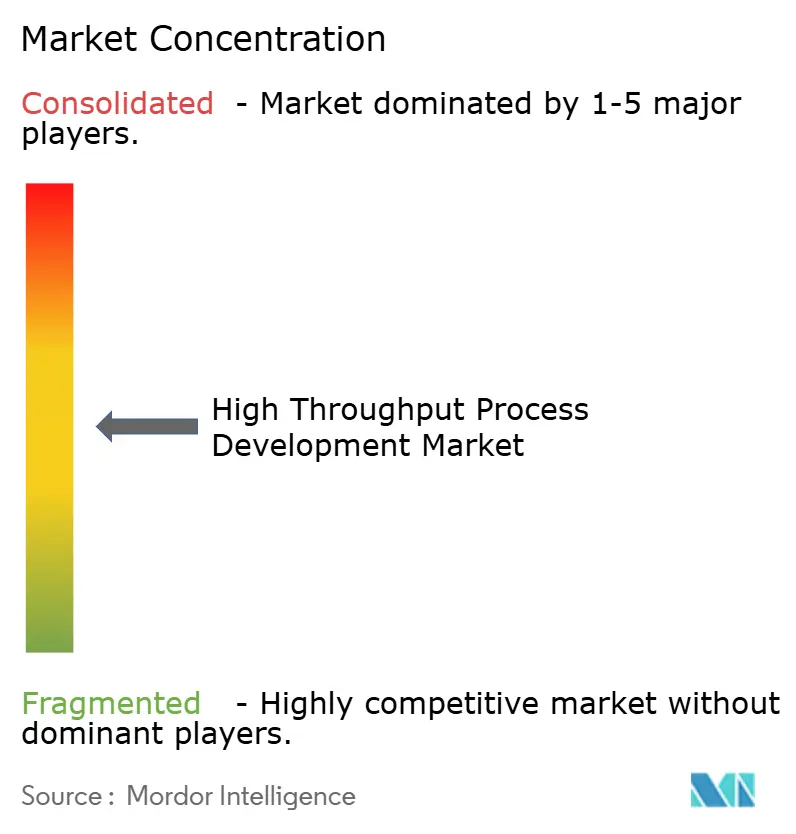
| Market Concentration | Medium |
Major Players *Disclaimer: Major Players sorted in no particular order Image © Mordor Intelligence. Reuse requires attribution under CC BY 4.0. | |
High Throughput Process Development Market Analysis by Mordor Intelligence
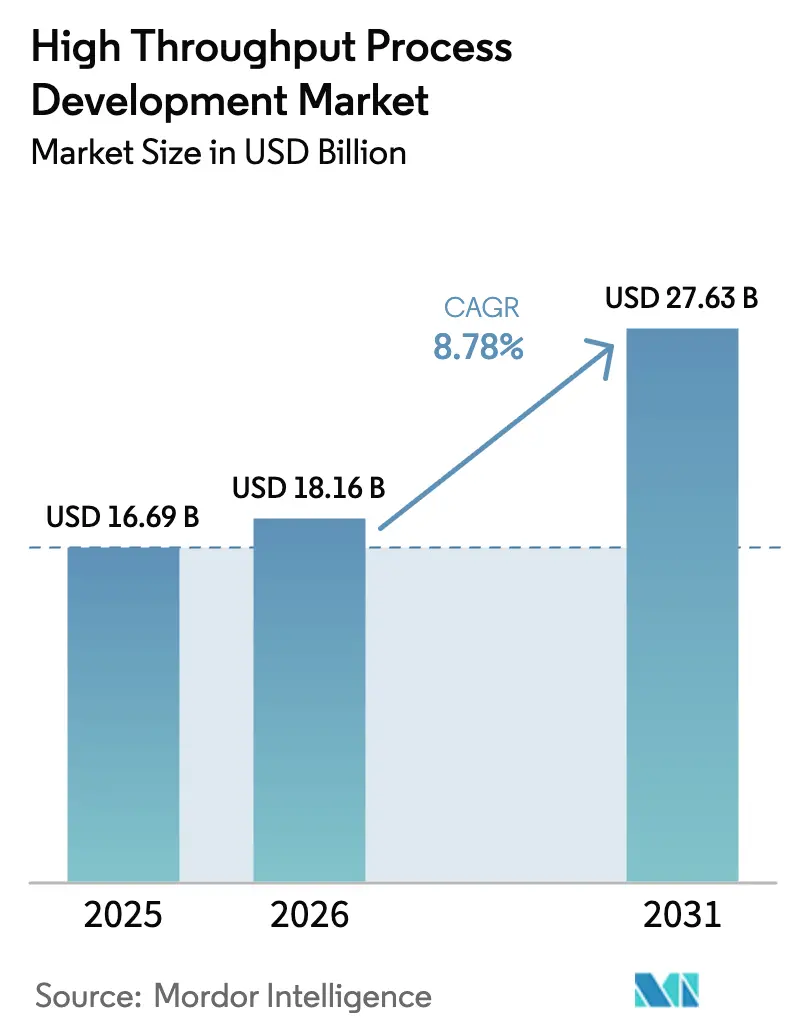
High Throughput Process Development market size in 2026 is estimated at USD 18.16 billion, growing from 2025 value of USD 16.69 billion with 2031 projections showing USD 27.63 billion, growing at 8.78% CAGR over 2026-2031.
Demand for miniaturized automated platforms, rising biologics approvals, and regulatory encouragement for advanced manufacturing are accelerating uptake across biopharma R&D and production settings. Chromatography innovations that support continuous downstream processing, wider adoption of predictive analytics, and an expanding contract development footprint are reshaping competitive strategies. The United States and Europe benefit from regulatory clarity and capital inflows, while Asia-Pacific is gaining momentum through large-scale public investment and improved local supply chains. Environmental scrutiny of single-use plastics and persistent shortages of digitally skilled staff remain the prime counterweights to growth.
Key Report Takeaways
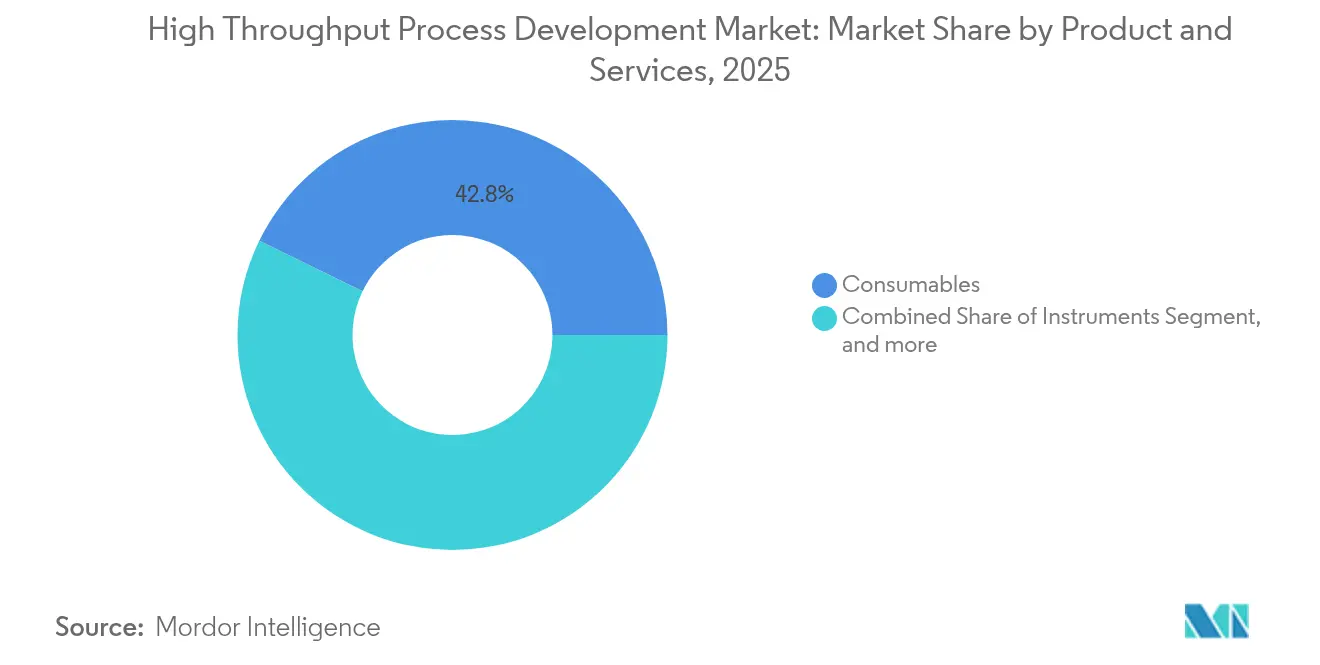
- By product & services type, consumables led with 42.78% of the high throughput process development market share in 2025; software solutions are forecast to expand at an 11.42% CAGR to 2031.
- By technology, chromatography commanded 51.12% share of the high throughput process development market size in 2025 and is advancing at a 9.19% CAGR through 2031.
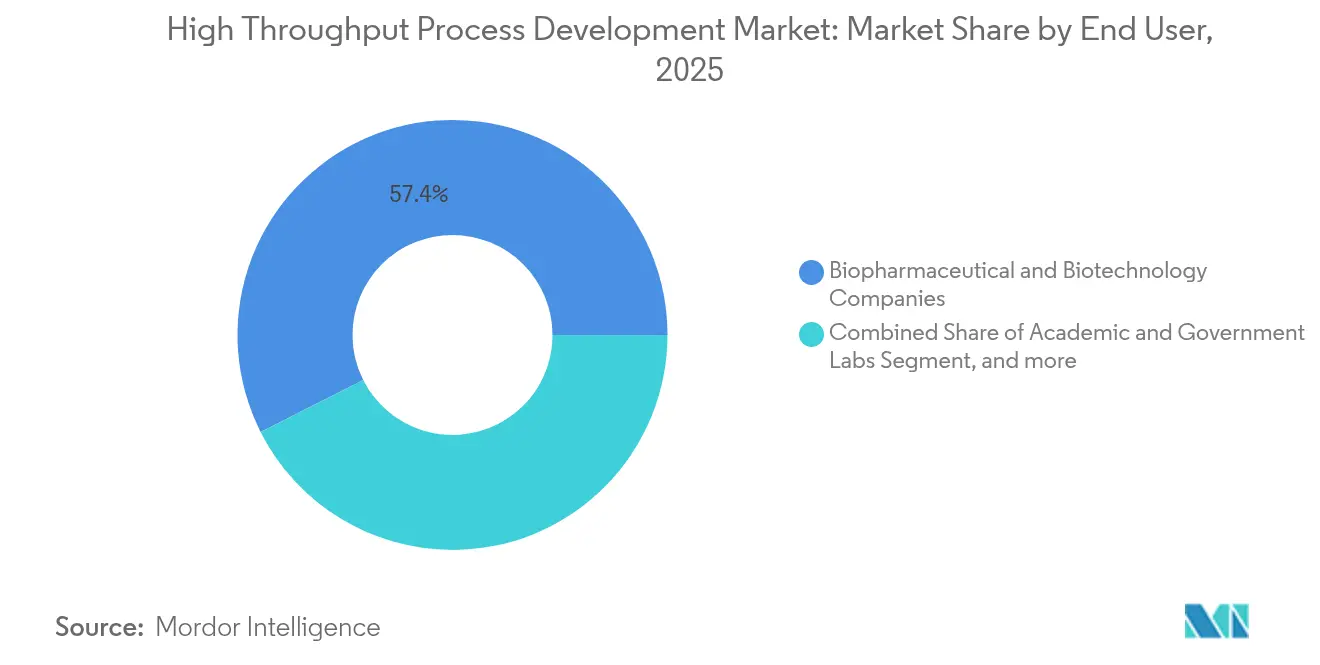
- By end user, biopharmaceutical and biotechnology companies held 57.44% revenue share in 2025, while contract research and manufacturing organizations are projected to grow at a 12.24% CAGR during 2026-2031.
- By geography, North America accounted for 39.12% share of the high throughput process development market in 2025; Asia-Pacific is set to register the highest regional CAGR at 10.67% through 2031.
Note: Market size and forecast figures in this report are generated using Mordor Intelligence’s proprietary estimation framework, updated with the latest available data and insights as of 2026.
Market Trends and Insights
Drivers Impact Analysis of High Throughput Process Development Market*
| Driver | (~) % Impact on CAGR Forecast | Geographic Relevance | Impact Timeline |
|---|---|---|---|
| Accelerated Demand for Next-Gen Biologics | +2.1% | Global, concentrated in North America & EU | Medium term (2-4 years) |
| Cost Pressure in Biomanufacturing | +1.8% | Global, particularly acute in Asia-Pacific | Short term (≤ 2 years) |
| Shift Toward Continuous and Intensified Processing | +1.6% | North America & EU lead, APAC adoption rising | Long term (≥ 4 years) |
| Miniaturized, Single-Use Technologies | +1.4% | Global, early uptake in North America | Medium term (2-4 years) |
| AI-Driven Analytics and Automation | +1.2% | North America & EU core, spill-over to APAC | Long term (≥ 4 years) |
| Near-Shoring and Supply Chain Resilience | +0.9% | North America & EU with regional hubs | Medium term (2-4 years) |
| Source: Mordor Intelligence | |||
Accelerated Demand for Next-Gen Biologics
The FDA cleared 33 new biological products in 2024, including several gene and cell therapies, underscoring the rapid evolution of therapeutic pipelines.[1]Center for Biologics Evaluation and Research, “BLA Approvals 2024,” fda.govComplex modalities require smaller, configurable development platforms capable of parallel experimentation, which is expanding uptake of high-throughput bioreactor arrays. Flexible facilities let manufacturers pivot between low-volume personalized treatments and larger commercial runs without lengthy changeovers. Companies are building modular plants dedicated to next-generation antibodies, such as Kyowa Kirin’s USD 530 million site in North Carolina.[2]Kyowa Kirin Co. Ltd., “Kyowa Kirin to Build North Carolina Biologics Plant,” kyowakirin.com These investments shorten development cycles and reduce material waste, boosting adoption of micro-scale screening tools.
Cost Pressure in Biomanufacturing
Health-system price controls and intensifying biosimilar rivalry continue to squeeze margins, pushing firms toward process intensification and outsourcing. Continuous bioprocessing platforms decrease plant footprints and utility costs, while strategic offloading to Asian CDMOs lowers capital exposure. Firms such as WuXi and Samsung have added mammalian and antibody-drug conjugate suites to meet global demand, leveraging regional cost advantages. Artificial-intelligence engines embedded in supervisory control systems improve resource utilization by double-digit percentages, supporting real-time cost governance. Although single-use components carry higher material prices, they remove cleaning validation expenses and limit cross-contamination risk for multi-product lines.
Shift Toward Continuous and Intensified Processing
Regulators explicitly encourage continuous production; the FDA’s Advanced Manufacturing Technologies Designation Program fast-tracks novel hardware and analytical solutions. Perfusion bioreactors now reach cell densities above 100 million cells/mL, increasing volumetric productivity and curbing media consumption. Multicolumn continuous chromatography modules complement upstream gains, cutting buffer use and cycle times. North American sites adopt these systems to retrofit legacy plants, while Asian greenfield projects specify intensified flows from day one. Integrated upstream-downstream skids demonstrate processing time reductions near 60% and yield improvements above 30%, validating the economics of end-to-end continuous lines.
Rising Demand for Miniaturized, Single-Use Technologies
Micro-scale tools multiply experimental throughput and minimize reagent use. An MDPI study documented automated RNA-Seq preparation of 24 samples within 11.5 hours when coupled to parallel miniature bioreactors. Scalability from 15 mL to 250 mL supports early clone ranking and media optimization without compromising performance. Environmental concerns are steering suppliers toward recyclable polymers and lower-impact resins ahead of new USP requirements effective 2026. Microfluidic chips are emerging to manipulate picoliter volumes, allowing thousands of process variants to be screened daily and accelerating data generation for machine-learning models.
Restraints Impact Analysis of High Throughput Process Development Market*
| Restraint | (~) % Impact on CAGR Forecast | Geographic Relevance | Impact Timeline |
|---|---|---|---|
| High Capital Investment and Infrastructure Needs | -1.9% | Global, acute in emerging markets | Short term (≤ 2 years) |
| Talent Shortage in Automation and Data Science | -1.5% | North America & EU core, spreading to APAC | Medium term (2-4 years) |
| Data Integration Challenges Across Scales | -0.8% | Global | Long term (≥ 4 years) |
| Environmental Concerns Over Single-Use Plastics | -0.6% | EU leading, North America following | Medium term (2-4 years) |
| Source: Mordor Intelligence | |||
High Capital Investment and Infrastructure Needs
Setting up a full-scope high-throughput process development center can demand USD 50–100 million in equipment, cleanrooms, and analytics. Compliance with multiple regulatory regimes adds validation and documentation expenses. Modular plant concepts mitigate risk by breaking construction into discrete skids deployable in phases. Resilience allocated USD 225 million for a modular drug-product complex that can be reconfigured rapidly to different modalities. Cloud-based data environments lower on-premise information-technology costs, but cybersecurity and qualification overhead persist, limiting smaller entrants.
Talent Shortage in Automation and Data Science
Digital bioprocessing needs engineers fluent in control theory, coding, and biochemistry, yet the pipeline of qualified staff falls short. The National Institute for Bioprocessing Research and Training (NIBRT) reports rising demand for programming skills alongside classic upstream expertise.[3]National Institute for Bioprocessing Research and Training, “Talent Needs in Biopharma Manufacturing,” nibrt.ie Companies escalate internal academies and university partnerships to reskill operators on Python, R, and SQL. Automation partly offsets labor gaps but also raises the bar for technical proficiency, creating a self-reinforcing shortage cycle. Regions that combine government grants with academic curricula, such as Ireland and Singapore, are making incremental progress but capacity constraints continue to cap throughput expansions.
*Our forecasts treat driver/restraint impacts as directional, not additive. The impact forecasts reflect baseline growth, mix effects, and variable interactions.
High Throughput Process Development Market Segment Analysis
By Product & Services Type:
Software Drives Digital TransformationThe software category represents the fastest-expanding component of the high throughput process development market, growing at an 11.42% CAGR on rising demand for real-time analytics and digital twins. Consumables preserved a 42.78% share of the high throughput process development market in 2025 as single-use bags, filters, and prepacked columns remain indispensable for rapid setup. Instruments maintain steady momentum with automated liquid handlers and multicolumn chromatography skids supporting intensified workflows. Services are becoming more attractive as firms outsource specialized statistical modeling, chemometrics, and validation tasks to concentrate capital on core assets.
Digital platforms integrate disparate data sources, apply machine-learning models to optimize parameters, and enable remote collaboration among globally distributed teams. Regulatory guidance on software assurance clarifies expectations for algorithm transparency, reducing adoption hesitancy. The high throughput process development market size for software applications is projected to widen in tandem with continuous processing because control algorithms must reconcile upstream and downstream operations in near real time. Consumables growth remains tied to the transition toward flexible facilities, though suppliers are redesigning plastics to meet tightening environmental standards.



By Technology:
Chromatography Maintains DominanceChromatography retained 51.12% share of the high throughput process development market size in 2025 growing at an 9.19% CAGR, underpinned by the ubiquity of Protein A affinity steps in monoclonal antibody production. Waters launched its BioResolve Protein A column with seven-fold sensitivity gains, enabling earlier detection of titer changes that inform feed strategies. Continuous multicolumn formats such as simulated moving bed, commercialized by KNAUER, cut buffer use and shorten process times. Ion-exchange and hydrophobic-interaction variants address emerging modalities like antibody-drug conjugates, while inline sensors measure product quality attributes to ensure regulatory compliance.
Upstream intensification amplifies the load entering purification trains, requiring higher-capacity resins and smarter scheduling algorithms. Chromatography vendors differentiate through ligand stability, lower elution volumes, and resin recyclability. Alternative separation technologies, including membrane adsorbers and precipitation, gain niche traction but have yet to match chromatography’s versatility. As continuous purification converges with perfusion culture, integration readiness keeps chromatography at the center of process development strategies within the high throughput process development market.
By End User:
CRO/CMO Segment AcceleratesBiopharma and biotech companies controlled 57.44% of spending in 2025, driven by internal pipeline priorities and platform manufacturing strategies. Contract research and manufacturing organizations are the most dynamic end-user group, advancing at a 12.24% CAGR as sponsors adopt asset-light models to conserve capital. Large CDMOs build integrated suites that span cell-line development to commercial fill-finish, appealing to emerging firms lacking infrastructure. Academic and government laboratories remain critical for method innovation and standards development, providing open data that feed industry benchmarking efforts.
The high throughput process development market increasingly revolves around partnership ecosystems. Sponsors supply molecular blueprints and clinical insight, while CDMOs provide scale-up expertise and global regulatory interfaces. Automation enables CDMOs to run multiplexed projects concurrently, improving facility utilization. As regulatory submissions demand richer process understanding, CDMOs invest in advanced analytics to ensure each candidate meets evolving quality requirements. Talent shortages present a bottleneck; therefore, strategic alliances include staff secondment and joint training modules to secure skills pipelines.
Geography Analysis
North America High Throughput Process Development Market
North America led the high throughput process development market with a 39.12% revenue contribution in 2025, supported by sizeable capacity investments such as Lonza’s USD 1.2 billion Vacaville acquisition that added 330,000 L of mammalian capacity. The United States benefits from responsive regulatory pathways that endorse advanced manufacturing, spurring early adoption of continuous bioprocessing and AI-driven control software. Government grants and workforce initiatives further bolster the region’s competitiveness.
Europe High Throughput Process Development Market
Europe sustains strong innovation in purification chemistry, analytics, and sustainability practices. Environmental directives accelerate the pivot toward recyclable single-use systems and carbon-efficient operations. The region also contributes to global harmonization of standards, which supports technology exports to emerging markets. Investment flows target both legacy hubs in Germany and Ireland and expanding clusters in Central and Eastern Europe that offer competitive cost structures.
APAC, MEA and South America High Throughput Process Development Market
Asia-Pacific delivers the fastest growth at a 10.67% CAGR through 2031, propelled by China’s USD 4.17 billion national biomanufacturing program and Japan’s biotech revitalization roadmap. Singapore and South Korea act as regional centers of excellence for cell and gene therapies. Local CDMOs secure global contracts, reinforced by advantageous cost bases and improving regulatory transparency. Despite expansion, shortages in experienced automation engineers temper project timelines. South America and the Middle East & Africa trail but show rising interest as governments seek domestic biologics production to lower import dependency and strengthen health security.
Value Chain Analysis
The value chain starts with inputs such as cell culture media, buffers, chromatography resins, single-use assemblies, and sensors, and then spans instrument OEMs including automated liquid handlers, miniature bioreactor arrays, chromatography skids, and analytical platforms. Software providers sit across this layer as well, offering data infrastructure, DoE tools, and model-based control. In practice, validation-ready analytics and process analytical technology (PAT) capabilities are a key bottleneck, because they connect high-throughput experiments to scale-up decisions and CMC documentation. As a result, more value concentrates in integrated instrument-plus-software stacks and application support, rather than in hardware alone.
The execution layer is typically handled by system integrators, CDMOs, and specialist service providers, which convert platform capabilities into standardized workflows for biopharma and biotech end users. This also shifts some of the capital and talent burden away from sponsors, while creating recurring supply-chain sensitivities around single-source vulnerabilities in specialty consumables (resins, filters, and qualified polymers) and interoperability between lab and manufacturing data systems. Outsourcing relationships with CDMOs, along with vendor application labs and centers of excellence, increasingly bridge early process screening to transfer packages for clinical and commercial manufacturing.
Competitive Landscape
The high throughput process development market is moderately fragmented, with established chromatography and bioreactor suppliers competing alongside digital-native entrants. Automation capability, data interoperability, and sustainability credentials weigh more heavily in purchasing decisions than legacy throughput metrics. Sartorius and Siemens announced plans to integrate supervisory control software with single-use bioreactors to deliver plug-and-play intensified production lines. Similar collaborations pair hardware innovators with algorithm specialists to accelerate product rollouts and reduce validation burdens.
Large suppliers leverage scale to bundle consumables, instruments, and software into unified platforms. Mid-size firms carve out niches in microfluidics, digital twins, or eco-designed plastics. The FDA’s Advanced Manufacturing Technologies Designation Program grants early engagement with reviewers, offering smaller innovators a route to credibility and market entry. Competitive positioning thus hinges on the ability to demonstrate regulatory-ready documentation and measurable sustainability gains. White-space opportunities persist in integrating continuous downstream operations, developing recyclable polymer alternatives, and linking laboratory data directly to enterprise resource planning for end-to-end traceability within the high throughput process development market.
High Throughput Process Development Industry Leaders
Agilent Technologies
Thermo Fischer Scientific
Danaher Corporation
Bio Rad Laboratories Inc.
GE Healthcare
- *Disclaimer: Major Players sorted in no particular order
High Throughput Process Development Market Companies Covered in this Report
- Danaher
- Sartorius Stedim Biotech SA
- Merck
- Thermo Fisher Scientific
- Agilent Technologies
- Waters Corporation
- Bio-Rad Laboratories
- PerkinElmer
- Eppendorf
- Tecan Group
- Repligen
- 3M
- GE Healthcare Life Sciences
- Pall
- Shimadzu
- Hamilton Company
- KBI Biopharma
- WuXi App Tec
- BioCentriq
- Premas Biotech
Read Analysis of High Throughput Process Development Companies

Market Opportunities and Future Outlook
White space is concentrated where high-throughput experimentation links directly to scalable manufacturing decisions with defensible data integrity. Integrated platforms that combine upstream mini-bioreactor screening, continuous downstream development (including multicolumn chromatography), and PAT-enabled analytics that support CMC-ready evidence are where suppliers can differentiate. Software remains a central value pool because it shortens iteration cycles and supports traceable parameter optimization, with platforms that unify DoE, predictive modeling, and digital-twin style simulation acting as the orchestration layer across instruments, data lakes, and quality systems.
A practical near-term catalyst is the current wave of capacity build-outs and retrofits in biopharma manufacturing, which enlarges the installed base for process-development tools and analytical instrument upgrades. Opportunities also show up in regionalization of process-development capability and services, particularly where new facilities and sponsor portfolios drive demand for standardized, regulator-aligned analytical workflows. For example, Agilent Technologies and Veeda Lifesciences established a Center of Excellence in Bengaluru (May 2026) focused on high-throughput, compliance-oriented analytical work for GLP-1 and complex biologics, pointing to continued demand for packaged analytical services and method-transfer playbooks in Asia-Pacific. In parallel, intensified and continuous processing raises demand for high-throughput resin screening, inline analytics, and automation that can handle higher cell-density upstream outputs and tighter downstream scheduling. Sustainability and materials compliance add further whitespace in redesigning single-use consumables and qualification documentation, as end users scrutinize plastics footprints and suppliers respond with lower-impact materials and more transparent lifecycle data.
Recent Industry Developments in High Throughput Process Development Market
- June 2026: Thermo Fisher Scientific launched Orbitrap Tribrid Apex, Orbitrap Excedion, and Orbitrap Exploris GC S mass spectrometers at ASMS 2026 to scale high-resolution accurate-mass technology in biopharma. The launch expands high throughput process development workflows with high-end MS platforms, improving analytical capability. The action strengthens biopharma analytical capabilities and data quality in HTPD pipelines.
- June 2026: Agilent Technologies announced partnership with Sound Analytics to integrate 1290 Infinity III LC and 6495D Triple Quadrupole MS with LeadScape software for high-throughput DMPK research. The integration offers combined MS and software for HTPD analytics. Enhances data interoperability and throughput for regulatory-ready workflows.
- May 2026: Agilent Technologies launched a joint Center of Excellence with Veeda Lifesciences in Bengaluru to support high-throughput, regulatory-aligned analytical workflows for GLP-1 and complex biologics. The CoE accelerates HTPD capabilities and regulatory readiness. Expands regional HTPD service footprint and collaboration with CROs/biopharma.


High Throughput Process Development Market Report Scope and Research Methodology
Market Definition and Coverage
For this study, the high throughput process development market covers the revenue generated from tools and services that help speed up bioprocess and analytics development by running many small, controlled experiments in parallel to select better conditions faster.
Scope exclusions: We exclude full scale commercial manufacturing execution, and we do not count routine bulk manufacturing operations that happen after process development handoff.
Segments Covered in This Report
- By Product & Services Type
- Consumables
- Instruments
- Automated Liquid Handlers
- Chromatography Systems
- Other Instruments
- Services
- Software
- By Technology
- Chromatography
- Affinity
- Ion-exchange
- Size-Exclusion & Membrane Chromatography
- UV-Visible Spectroscopy
- Other Technologies
- Chromatography
- By End User
- Biopharmaceutical & Biotechnology Companies
- Contract Research & Manufacturing Organization
- Academic & Government Labs
- By Geography
- North America
- United States
- Canada
- Mexico
- Europe
- Germany
- United Kingdom
- France
- Italy
- Spain
- Rest of Europe
- Asia-Pacific
- China
- Japan
- India
- Australia
- South Korea
- Rest of Asia-Pacific
- Middle East & Africa
- GCC
- South Africa
- Rest of Middle East & Africa
- South America
- Brazil
- Argentina
- Rest of South America
- North America
Data Sources, Market Sizing, and Validation
Desk Research
Desk research is used to map what is being bought for high throughput process development workflows and to separate it from general lab automation spend that is not tied to process development. We start with public sources that anchor demand and activity signals, such as FDA biologics approvals and guidance, NIH funding data, USP and NIST reference materials for analytical methods, and OECD and World Bank indicators that help frame life science investment cycles.
We then review company annual reports, earnings call transcripts, investor presentations, product catalogs, and reputable press coverage to understand product mix, typical pricing logic, and how suppliers describe use cases in upstream, downstream, and analytics. Patent databases are screened to track miniaturized bioreactors, chromatography automation, and lab software workflow themes, and a paid subscription for company financials and a paid patent database are used to cross-check financial splits and innovation direction. The sources named above are illustrative and not exhaustive, and many other public documents were also referred to for data collection, validation, and clarification.
Primary Interviews and Surveys
Primary work is used to turn the desk view into a workable model by confirming what customers actually purchase, how platforms are bundled across instruments, software, consumables, and services, and how adoption differs by lab maturity and outsourcing intensity. We speak with process development scientists, lab automation leads, procurement teams, and service providers across key regions so that pricing ranges, pull-through assumptions, and refresh timing are aligned to real buying behavior.
Distribution of primary research fieldwork respondents
| Company type | Respondent position | Region |
|---|---|---|
| Top tier: 29% | CXOs: 17% | APAC: 44% |
| Mid tier: 49% | Functional/Unit leaders: 33% | EMEA: 30% |
| Smaller Players: 22% | Managers: 50% | Americas: 26% |
Market-Sizing & Forecasting
Sizing is built using a top-down and bottom-up approach, with the top-down view starting from the addressable bioprocess development workload and then assigning spend to high throughput methods using penetration style assumptions. The model is anchored on a short set of practical inputs, including the number of active bioprocess development programs, the mix of upstream versus downstream experimentation, replacement cycles for automated lab instruments, consumables pull-through per run, and the share of services used for method development and analytics support.
Those totals are corroborated with selective bottom-up checks, such as a sampled roll-up of supplier revenue linked to relevant product lines, channel feedback on typical average selling price bands, and cross-checks using lab expansion and capacity addition signals. When a supplier does not disclose clean splits, revenue is allocated using catalog mapping and segment commentary, which is then tuned using interview feedback and consistency checks across regions. Forecasting uses scenario analysis, supported by a light multivariate regression lens that links demand to biologics pipeline activity, R and D budgets, and lab automation adoption, and then it is reviewed for realism against expected budget cycles.
Data Validation & Update Cycle
Validation is done by comparing the model outputs with independent signals, such as biologics pipeline momentum, observable lab automation investment themes, and price direction for core instruments and consumables. When outputs look unusual, the drivers are rechecked, and assumptions are revisited if regional totals do not reconcile with known activity patterns.
Before sign-off, the model goes through multi-step analyst review, and re-contacts are triggered if a key variable shifts, such as a noticeable change in outsourcing rates or platform pricing. Reports are refreshed annually, with interim updates for material events like major product launches or regulatory changes that affect process development intensity. Right before delivery, we do a fresh pass so clients receive the latest updated view.
Mordor Intelligence's High Throughput Process Development Market Sizing Compared With Other Published Estimates
Published market values for high throughput process development can differ because each publisher defines what counts as process development spend in its own way, and then applies different pricing, currency timing, and base-year assumptions. It also matters how often the underlying inputs are revisited, because new platforms and workflows can move adoption faster than an older model reflects.
Some external estimates expand totals by blending in broader high-throughput screening activity and general discovery automation revenue. In Mordor Intelligence, the count is limited to process development workflows across instruments, consumables, software, and services, and it is refreshed through recurring checks on pull-through, average selling price movement, and user adoption patterns.
Benchmark comparison
| Source | Market Size | Gaps in Research Methodology |
|---|---|---|
| Mordor Intelligence | USD 16.69 B (2025) | |
| Global Market Tracker A | USD 11.25 B (2024) | Uses an earlier base year and appears to apply a narrower spend pool, which can undercount service revenue and consumables pull-through tied to repeated development runs. |
| Industry Publisher B | USD 0.72 B (2026) | Treats the category as a smaller platform subset and mainly emphasizes tools, which can leave out integrated software value and service spend that is often purchased alongside process development systems. |
The comparison points to two recurring drivers, where one set of estimates broadens the market into adjacent discovery screening, and another narrows it into a small platform-only bucket. By keeping the revenue streams tied to process development workflows and validating key inputs through repeatable checks, the result is easier to reconcile to clear variables and to reproduce over time.


Key Questions Answered in the Report
What is driving demand in the high throughput process development market?
Rising approvals of complex biologics and regulatory support for continuous manufacturing are encouraging biopharma firms to adopt automated, miniaturized platforms that shorten development timelines.
Which product segment is growing the fastest?
Software solutions are expanding at an 11.42% CAGR through 2031 as companies integrate digital twins and predictive analytics into routine process development.
Why is Asia-Pacific considered the growth engine?
Government funding programs, cost advantages, and improving regulatory systems are propelling the region to a projected 10.67% CAGR, the highest worldwide.
How do continuous bioprocessing technologies cut costs?
Perfusion and multicolumn chromatography systems increase volumetric productivity, reduce buffer consumption, and shrink facility footprints, producing measurable operational savings.
What are the main obstacles to wider adoption?
High upfront capital needs and a shortage of personnel skilled in automation and data science impede rapid scale-out, though modular plants and targeted training are easing these constraints.
How intense is competition among suppliers?
The market remains moderately fragmented; differentiation now hinges on advanced automation, data integration, and sustainable materials rather than basic throughput specifications.
Page last updated on:





