
Healthcare Data Warehousing Market Size and Share
Market Overview
| Study Period | 2020 - 2031 |
|---|---|
| Market Size (2026) | USD 9.23 Billion |
| Market Size (2031) | USD 23.41 Billion |
| Growth Rate (2026 - 2031) | 20.46 % |
| Fastest Growing Market | Asia-Pacific |
| Largest Market | North America |
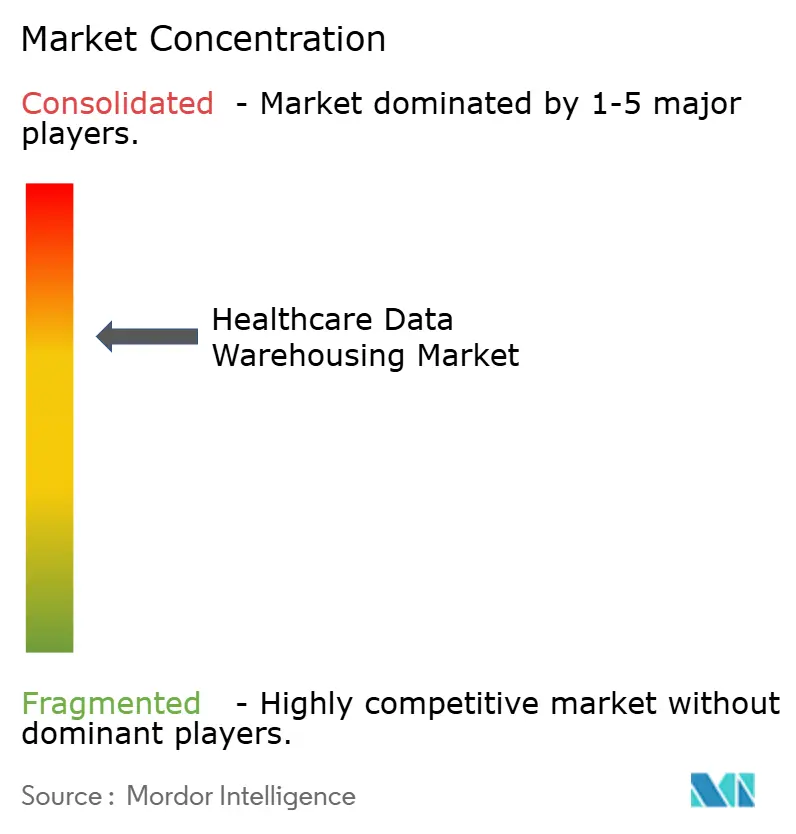
| Market Concentration | Medium |
Major Players *Disclaimer: Major Players sorted in no particular order Image © Mordor Intelligence. Reuse requires attribution under CC BY 4.0. | |
Healthcare Data Warehousing Market Analysis by Mordor Intelligence
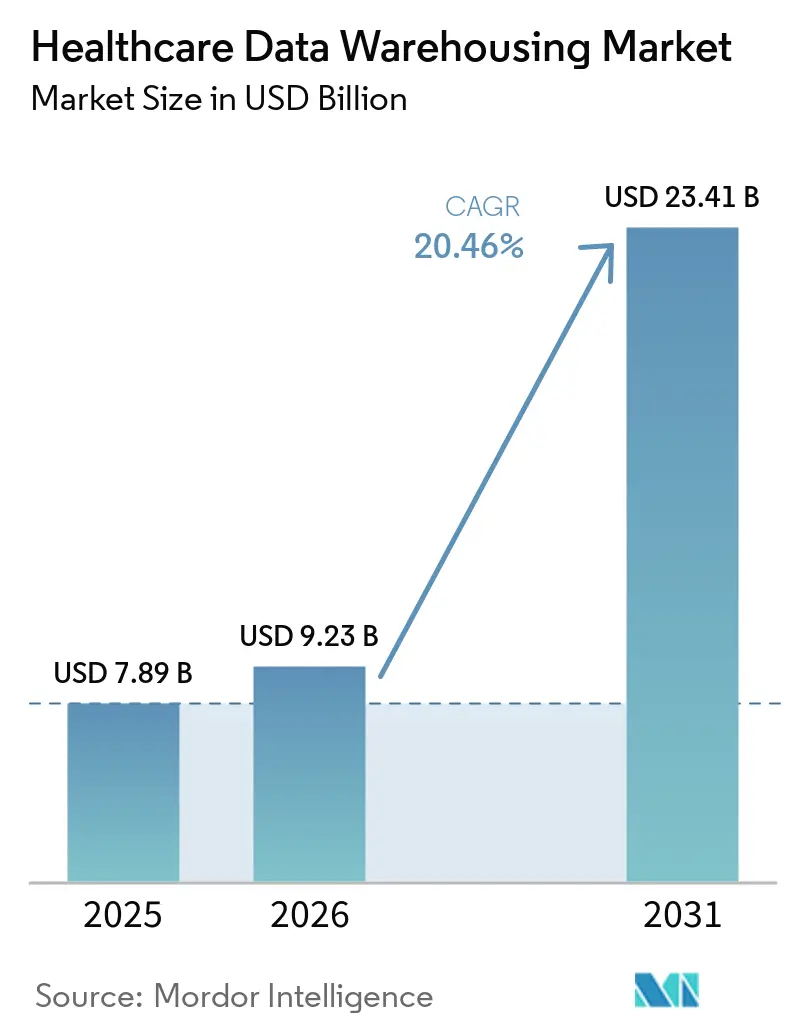
The healthcare data warehousing market is expected to increase from USD 7.89 billion in 2025 to USD 9.23 billion in 2026 and reach USD 23.41 billion by 2031, growing at a CAGR of 20.46% over 2026-2031. The healthcare data warehousing market is moving beyond routine digitization because regulatory compliance now requires patient data to be stored in systems that can be queried and shared through standardized APIs. The CMS Interoperability and Prior Authorization Final Rule makes FHIR-backed, queryable patient repositories a compliance requirement for affected organizations from January 2026 onward. ONC’s 2026 standards bulletin also expands the structured data elements that certified health IT products must capture and exchange, which raises the need for broader and more durable warehouse architectures. At the same time, AI inference, clinical analytics, and population health programs are pushing buyers toward warehouse environments that support scalable compute, cleaner data pipelines, and faster retrieval across claims, clinical, and administrative records. The result is a healthcare data warehousing market where compliance, AI readiness, and operating efficiency increasingly shape vendor selection, spending priorities, and long-term modernization road maps.
Key Report Takeaways
- By component, software led with 52.64% revenue share in 2025, while services are expected to expand at 22.70% CAGR through 2031.
- By deployment mode, cloud-based deployment held 50.33% share in 2025, while hybrid deployment recorded the highest projected CAGR at 23.57% through 2031.
- By application, financial data warehousing accounted for 46.24% of the healthcare data warehousing market size in 2025, while clinical data warehousing is projected to advance at a 24.72% CAGR through 2031.
- By end-user, healthcare providers held 43.71% of the healthcare data warehousing market share in 2025, while healthcare payers are projected to have a CAGR at 23.67% through 2031.
- By geography, North America captured 45.87% share in 2025, while Asia-Pacific is expected to grow at a 24.39% CAGR through 2031.
Note: Market size and forecast figures in this report are generated using Mordor Intelligence’s proprietary estimation framework, updated with the latest available data and insights as of January 2026.
Market Trends and Insights
Drivers Impact Analysis of Healthcare Data Warehousing Market*
| Driver | (~) % Impact on CAGR Forecast | Geographic Relevance | Impact Timeline |
|---|---|---|---|
| Growing Regulatory Mandates for Healthcare Interoperability | +2.5% | North America and EU, with early gains in GCC | Short term (≤ 2 years) |
| Accelerating Shift Toward Value-Based Reimbursement Models | +3.2% | North America core, spill-over to Western Europe | Medium term (2-4 years) |
| Exponential Growth of Multimodal Healthcare Big Data | +4.1% | Global | Long term (≥ 4 years) |
| Rapid Adoption of Cloud-Native Data Warehouse Platforms | +3.6% | Global, led by North America and APAC | Short term (≤ 2 years), Medium term (2-4 years) |
| Integration of SDoH and Patient-Generated Data into Analytics | +1.8% | North America and EU, spill-over to APAC | Medium term (2-4 years) |
| Early Investments in Privacy-Preserving Analytics Frameworks | +1.2% | North America and EU | Long term (≥ 4 years) |
| Source: Mordor Intelligence | |||
Growing Regulatory Mandates for Healthcare Interoperability
The healthcare data warehousing market is seeing direct support from interoperability rules that now carry firm implementation expectations. CMS-0057-F requires impacted payers to support Prior Authorization, Provider Access, and Payer-to-Payer APIs, and those interfaces depend on persistent patient data stores that can be queried in standardized ways.[1]Centers for Medicare & Medicaid Services, “CMS Interoperability and Prior Authorization Final Rule (CMS-0057-F),” Centers for Medicare & Medicaid Services, cms.govThis changes the spending logic for both payers and providers because data warehousing is no longer treated as a back-office improvement that can be deferred. Organizations that only meet the surface API requirement can satisfy the rule in narrow terms, but those taking a longer view are using the same investment to support analytics, population health, and AI development from the same repository. ONC’s standards bulletin for 2026 broadens the structured data set for certified health IT products, which expands the amount of clinical, administrative, and related data that must be ingested and stored in a reliable form.[2]Office of the National Coordinator for Health Information Technology, “ONC Standards Bulletin 2026-1,” HealthIT.gov, healthit.gov That combination gives the healthcare data warehousing market a regulatory floor for investment that is less tied to normal budget timing and more tied to compliance exposure.
Accelerating Shift Toward Value-Based Reimbursement Models
The healthcare data warehousing market is also being shaped by reimbursement models that depend on ongoing measurement of quality, utilization, and outcomes. CMS value-based programs require providers to track performance against benchmark populations, and that work depends on combining claims, clinical, and operational data at a level that standard EHR reporting tools do not consistently support. The 2025 finalized MIPS Value Pathways guide keeps the 75% data completeness threshold in place through at least the 2028 performance period, which increases the need for data environments that can aggregate and validate multi-source records on a continuous basis. In practice, this means providers in accountable care, bundled payment, and similar programs need warehouse-backed score tracking rather than periodic manual reporting. The effect is cumulative because poor measurement in one contract period can affect future payment performance and create stronger pressure to improve attribution, stratification, and reporting workflows. As a result, the healthcare data warehousing market is increasingly tied to payment reform as much as to pure IT modernization.
Exponential Growth of Multimodal Healthcare Big Data
The healthcare data warehousing market is expanding as healthcare data moves well beyond structured clinical documentation. Genomics, diagnostic imaging, remote patient monitoring, and wearable device streams are creating mixed data environments that traditional warehouse models alone were not designed to manage at scale. A 2026 study in Scientific Reports validated federated microservices with blockchain-backed auditability as a workable model for privacy-preserving and scalable healthcare analytics across distributed environments.[3]M. Harshith, Z. A. Ansari, S. Fatima et al., “Federated Microservices Architecture With Blockchain for Privacy-Preserving and Scalable Healthcare Analytics,” Scientific Reports, doi.org That direction matters because organizations are now handling structured claims, unstructured notes, semi-structured imaging metadata, and time-series sensor data in the same analytical setting. The response is often not a full replacement of existing warehouse systems, but a layered architecture that combines conventional warehousing with lakehouse and federation patterns to preserve governance while expanding scale. This broadening data mix keeps the healthcare data warehousing market tied to long-term demand for stronger engineering, metadata management, and cross-domain integration.
Rapid Adoption of Cloud-Native Data Warehouse Platforms
The healthcare data warehousing market is steadily shifting toward cloud-native platforms because buyers increasingly view cloud architecture as an enabler of AI and not only a hosting choice. Warehouses in the cloud give health systems and payers elastic compute for natural language querying, clinical summarization support, faster data transformation, and broader analytics across high-volume datasets. In January 2026, Innovaccer and Snowflake announced a strategic partnership that integrated Innovaccer’s healthcare intelligence platform with Snowflake’s AI data cloud, and joint customers reported nearly 30% faster data integration timelines and 20% to 25% infrastructure cost savings. Those results show why cloud adoption is moving from a cost discussion to a speed and capability discussion. Hybrid patterns still remain important where protected health information must stay under tighter local control, but even those models rely on cloud capacity for compute-heavy analytics and model execution. This keeps the healthcare data warehousing market closely aligned with broader cloud platform investment and with the need to support AI workloads at production scale.
Restraints Impact Analysis of Healthcare Data Warehousing Market*
| Restraint | (~) % Impact on CAGR Forecast | Geographic Relevance | Impact Timeline |
|---|---|---|---|
| High Upfront and Maintenance Costs of Large-Scale DW Infrastructure | -2.3% | Global, more acute in MEA and South America | Short term (≤ 2 years), Medium term (2-4 years) |
| Shortage of Skilled Health Data Engineers and Informaticists | -1.8% | North America and Western Europe most impacted | Medium term (2-4 years) |
| Data Quality Issues from Legacy Clinical Systems | -1.5% | Global, particularly acute in APAC and South America | Short term (≤ 2 years), Medium term (2-4 years), Long term (≥ 4 years) |
| Rising Cyber-Security Insurance Premiums Squeezing Budgets | -0.9% | North America primary, EU secondary | Short term (≤ 2 years), Medium term (2-4 years) |
| Source: Mordor Intelligence | |||
High Upfront and Maintenance Costs of Large-Scale DW Infrastructure
The healthcare data warehousing market still faces a major drag from the cost of building and maintaining large-scale data environments across fragmented clinical systems. Organizations rarely start from a clean architecture because EHR platforms, laboratory systems, imaging archives, and payer records often sit in separate systems with different update cycles and inconsistent interfaces. Research published in Frontiers in Digital Health identifies legacy system integration as a central challenge in healthcare data warehouse programs because middleware, API management, and governance tooling all add continuing expense rather than one-time expense. Migration to cloud-native models can reduce some long-run complexity, but the transition itself often requires pipeline redesign, source mapping, and validation work that many organizations must fund before benefits appear. The budget strain becomes sharper when cybersecurity, regulatory compliance, and analytics modernization are financed from the same pool. The healthcare data warehousing market therefore continues to see slower adoption among buyers that recognize the strategic value of warehousing but struggle to absorb the full cost of integration and maintenance.
Shortage of Skilled Health Data Engineers and Informaticists
The healthcare data warehousing market is also constrained by the narrow supply of specialists who understand data engineering and healthcare-specific standards at the same time. Building reliable warehouse pipelines in healthcare requires technical knowledge of interoperability formats, privacy controls, ontology mapping, and clinical workflows, which limits the hiring pool compared with general enterprise data work. The challenge does not end at deployment because warehouse environments need continuing stewardship, documentation, validation, and quality monitoring as source systems change. The American Hospital Association’s 2026 Health Care Workforce Scan states that health systems are shifting toward longer-term workforce strategies for digital and analytics roles because demand remains high relative to available talent. When those roles remain unfilled, organizations are more likely to rely on managed services, postpone broader use cases, or operate with rising technical debt in their pipelines and governance processes. This slows execution across the healthcare data warehousing market even when demand conditions remain strong.
*Our forecasts treat driver/restraint impacts as directional, not additive. The impact forecasts reflect baseline growth, mix effects, and variable interactions.
Healthcare Data Warehousing Market Segment Analysis
By Component:
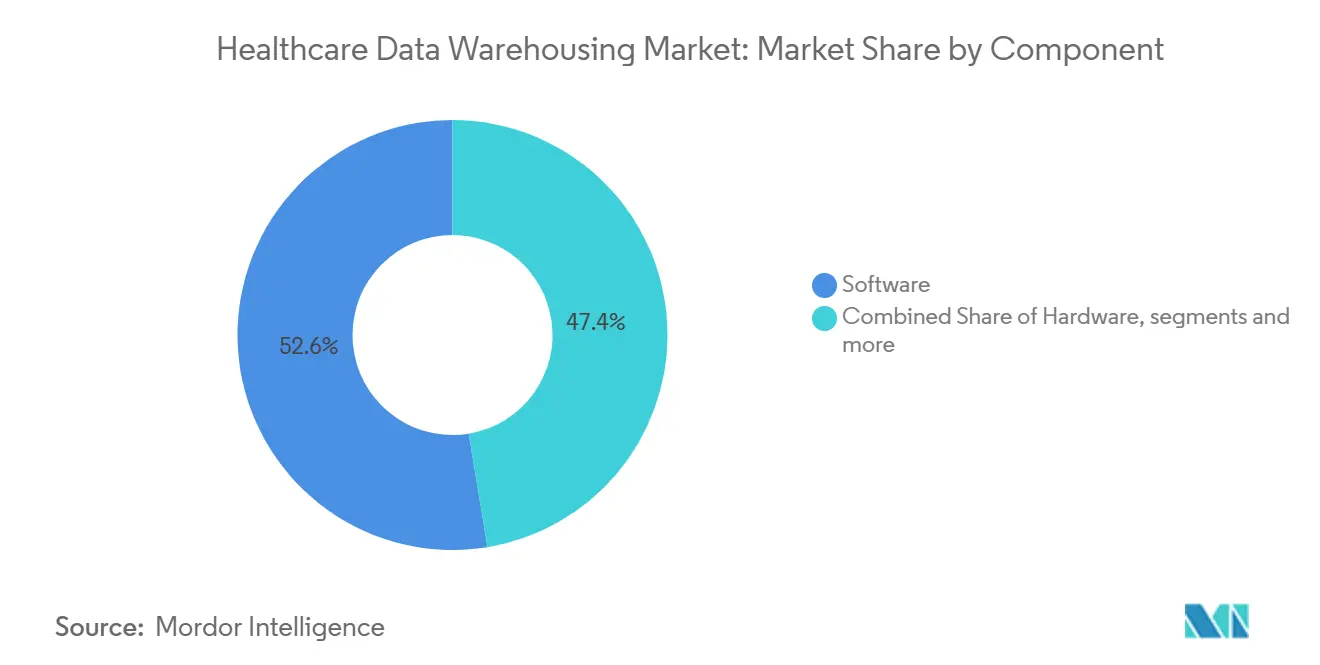
Services Growth Signals a Shift to Managed-Model ArchitecturesThe software segment held 52.64% of the healthcare data warehousing market share in 2025, which reflected buyer preference for integrated platforms that combine ETL tools, clinical data models, governance functions, and analytics in one environment. This lead was reinforced by enterprise buyers that wanted fewer integration gaps and faster deployment across multi-facility health systems. In the healthcare data warehousing industry, software platforms also gained ground because they reduced the need to assemble separate tools for ingestion, modeling, and reporting. Large providers and payers favored platforms that could support both compliance reporting and broader analytics from the same data foundation.
That position did not remove the need for hardware, but it did narrow hardware demand to more selective use cases. Local infrastructure remains relevant in government health agencies, academic medical centers, and other settings where control over compute and storage stays a top requirement. The services segment is expected to grow at the fastest pace, with 22.70% CAGR through 2031, as health systems convert large one-time implementation projects into recurring managed service relationships. Those agreements are attractive because they cover deployment support, HIPAA-oriented maintenance, training, and workflow alignment while reducing the pressure to build large internal engineering teams. This pattern shows the healthcare data warehousing market shifting from product ownership alone toward operating models that bundle technology and ongoing execution.



By Deployment Mode:
Cloud Leads, Hybrid Gains Ground at the Sovereignty BoundaryCloud-based deployment held 50.33% of the healthcare data warehousing market in 2025, making it the leading deployment model as providers and payers sought more scalable infrastructure. The main appeal of cloud deployment was not only lower hardware dependence, but also easier access to elastic compute for AI, analytics, and high-volume data processing. For the healthcare data warehousing industry, cloud environments also simplified expansion across distributed organizations that needed a common platform for claims, clinical, and administrative records. This has kept cloud adoption closely tied to enterprise modernization programs rather than isolated infrastructure refresh cycles.
Hybrid deployment is anticipated to expand at the fastest pace, with a 23.57% CAGR through 2031, because many organizations still need a mixed model for governance and performance reasons. Sensitive protected health information often remains in certified local or private environments, while compute-heavy analytics and model workloads move to cloud clusters. This architecture is especially relevant in jurisdictions with stronger data residency expectations and in research-heavy institutions managing large imaging and genomics workloads.
By Application:
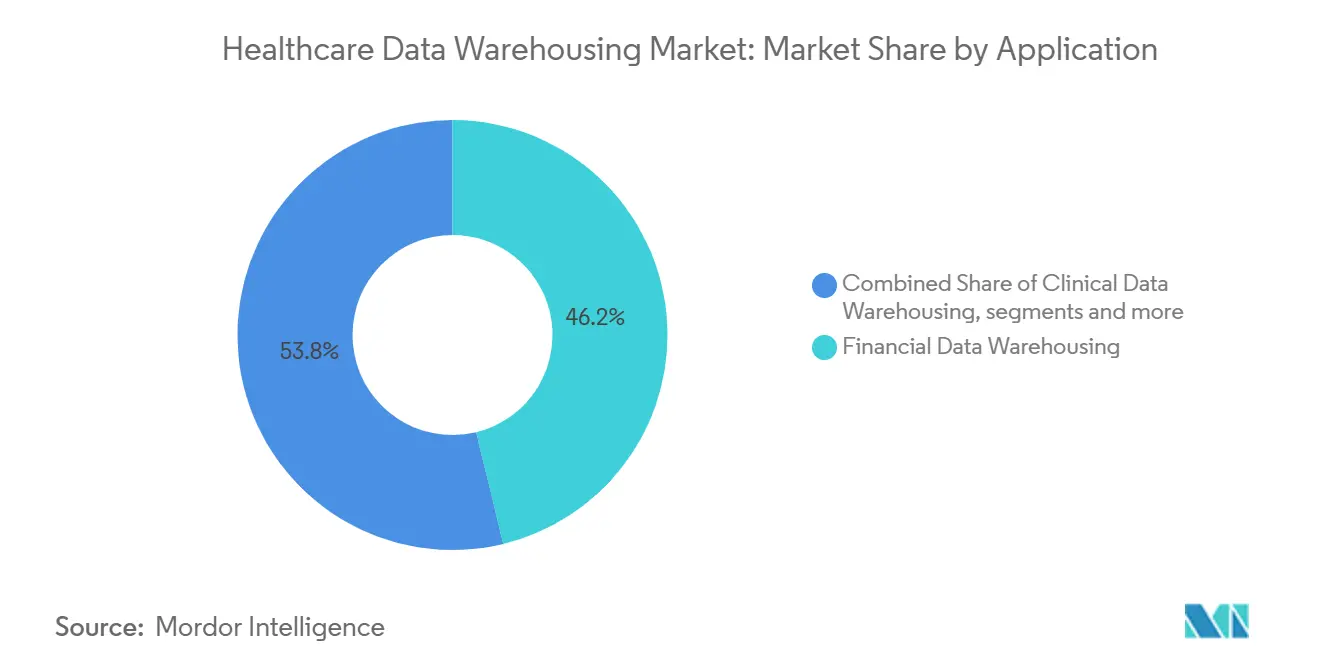
Financial Data at the Core, Clinical AI Redefines the Growth FrontierFinancial data warehousing accounted for 46.24% of application demand in 2025, which showed how strongly revenue cycle visibility and reimbursement control still shape investment decisions. Health systems continue to prioritize claim denial analysis, payer contract management, cost attribution, and performance tracking under alternative payment models because those functions have direct operating impact. The healthcare data warehousing market therefore still draws a large share of demand from finance-linked use cases that require current, cross-functional data. Administrative and operational warehousing also remains important because staffing, scheduling, and supply chain decisions increasingly depend on the same enterprise data foundation.
Clinical data warehousing is projected to record the fastest growth, with a 24.72% CAGR through 2031, as providers expand AI-assisted diagnostics, real-world evidence programs, and longitudinal patient analytics. This shift shows the healthcare data warehousing market moving from backward-looking measurement toward higher-value clinical decision support and research use cases. Clinical warehouse demand is also rising because precision medicine, imaging analytics, and integrated patient records require clean and queryable datasets across institutions and time periods. These factors are redefining where the next wave of application spending will concentrate in the healthcare data warehousing market.
By End-User:
Providers Anchor Volume, Payers Accelerate Fastest on Mandate-Driven DemandHealthcare providers held 43.71% of end-user demand in 2025, which kept them as the largest customer group in the healthcare data warehousing market. Large health systems, integrated delivery networks, and academic medical centers drove that position by consolidating fragmented reporting layers into broader enterprise platforms. Even so, demand is not limited to the largest institutions because community and regional systems face many of the same reporting and interoperability obligations with smaller internal teams. In April 2025, Health Catalyst introduced Ignite Spark for community, regional, and specialty health systems, which showed that vendors are tailoring warehouse offerings for organizations that need faster deployment and lower operating complexity.
Healthcare payers are projected to grow at the fastest pace, with a 23.67% CAGR through 2031, as API mandates and value-based care models raise the need for persistent, FHIR-ready data infrastructure. Payers have to manage claims, utilization, care management, and member data in one operating environment, which makes warehousing central to compliance and service delivery. Government agencies and research institutions remain smaller in volume, but their demand is durable because surveillance, epidemiology, and multi-omics research all depend on long-lived data infrastructure. This keeps the healthcare data warehousing market broad across buyer types even as provider and payer demand remains the main source of scale.
Geography Analysis
North America and Europe Healthcare Data Warehousing Market
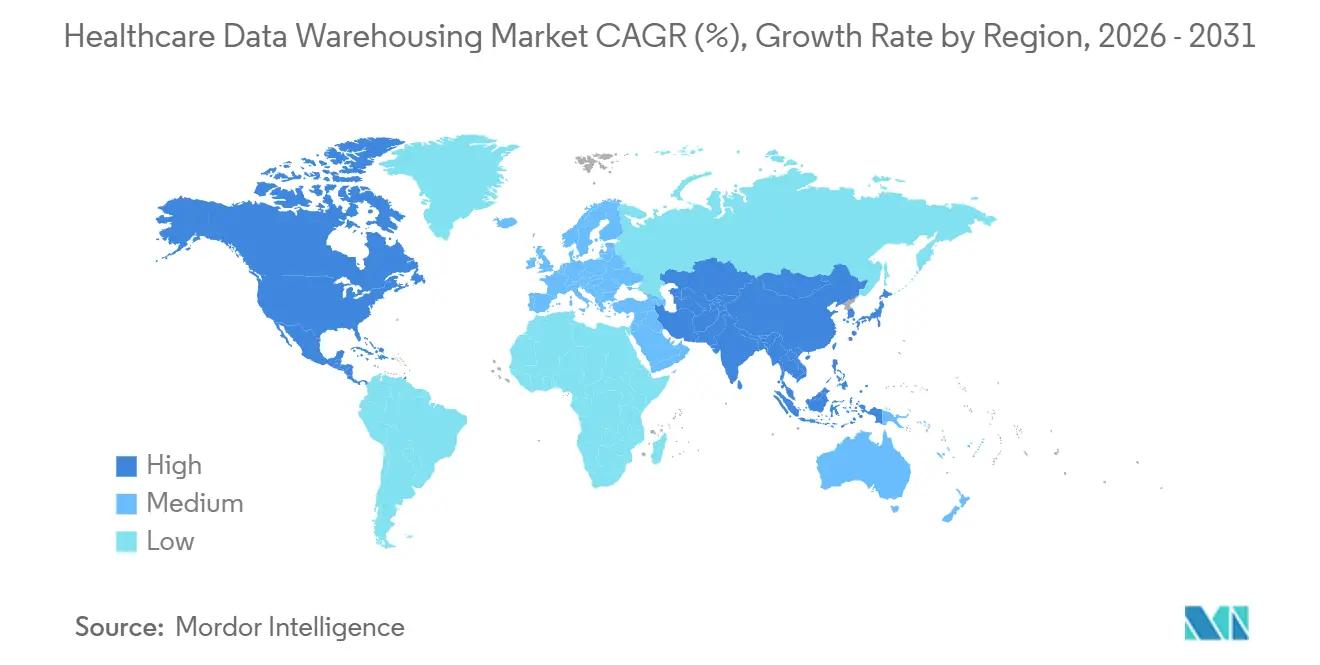
North America accounted for 45.87% of the global healthcare data warehousing market in 2025, which made it the clear regional leader. The United States anchors this position through its dense base of large health systems, high EHR penetration, and strong regulatory pressure around interoperability and data access. Canada and Mexico remain smaller contributors, but both are expanding as national and regional digital health strategies move forward. The healthcare data warehousing market in North America also benefits from deeper vendor presence, stronger cloud adoption, and a larger installed base of enterprise analytics programs. Europe ranked second, with Germany, the United Kingdom, and France leading demand as providers and payers balance modernization goals with GDPR-driven controls on data residency and sharing.
APAC Healthcare Data Warehousing Market
Asia-Pacific is the fastest-growing region and is projected to expand at a 24.39% CAGR through 2031, giving it the strongest growth profile in the healthcare data warehousing market size. India’s Ayushman Bharat Digital Mission is building a national health data layer that supports interoperability across public and private providers, which creates structural need for population-scale data repositories. China’s hospital grading digitization standards are also supporting demand because hospitals need stronger data platforms to meet compliance, workflow, and reporting expectations. Japan adds a different growth path through federated and privacy-aware analytics models that help institutions collaborate on AI and research without fully centralizing sensitive records.
MEA and South America Healthcare Data Warehousing Market
The Middle East and Africa and South America remain smaller in total size, but they present distinct openings within the healthcare data warehousing market. In the GCC, national AI programs and sovereign data strategies are supporting larger enterprise warehouse projects, particularly in the United Arab Emirates and Saudi Arabia. Oracle, Cleveland Clinic, and G42 announced a strategic partnership in May 2025 to build an AI-based global healthcare delivery platform for the United States and the UAE, which highlights the role of sovereign and cross-border infrastructure in this region. In South America, Brazil and Argentina remain the main demand centers, with public budget limits slowing some projects while private network digitization continues to support new warehouse adoption.

Competitive Landscape
The healthcare data warehousing market is moderately consolidated at the enterprise tier, where Oracle, Microsoft, Snowflake, IBM, and SAP have the broadest installed presence. Their position is supported by cloud scale, healthcare compliance credentials, deep enterprise relationships, and integration with existing EHR and database environments. These vendors are strongest with large health systems and payer organizations that want wide platform coverage across ingestion, storage, analytics, governance, and security. At the same time, the healthcare data warehousing market still leaves room for healthcare-focused competitors that win on workflow fit, prebuilt clinical models, and service depth. This keeps competition active even though the largest vendors hold the advantage in reach and platform breadth.
A clear strategy pattern in the healthcare data warehousing market is platform expansion through product interoperability and migration support. In February 2026, Snowflake made its Openflow Connector for Oracle generally available, which supports near-real-time change data capture from Oracle databases into Snowflake and directly addresses migration from legacy warehouse environments. These moves show how major vendors are competing through modernization paths that lower friction for customers with entrenched legacy systems.
Healthcare-native specialists such as Health Catalyst, InterSystems, and Optum compete by linking warehousing more directly to clinical and operational outcomes. Health Catalyst’s first quarter 2026 results showed the pressure and opportunity in this model as the company continued moving clients from its legacy DOS platform to the cloud-native Ignite ecosystem while managing revenue transition effects. That transition reflects a broader reality in the healthcare data warehousing market, where vendors built around earlier on-premise architectures now have to finance migration while still supporting legacy clients. Pure cloud-native entrants are widening the performance gap in AI-linked workloads, but they still need to prove long-term trust, clinical depth, and scaled delivery. As a result, competition is centered less on basic storage and more on who can combine compliance, interoperability, and AI-ready execution in a way that large healthcare buyers can adopt with limited disruption.
Healthcare Data Warehousing Industry Leaders
Oracle
IBM
Microsoft Corporation
SAP SE
Epic Systems Corporation
- *Disclaimer: Major Players sorted in no particular order
Healthcare Data Warehousing Market Companies Covered in this Report
- Allscripts
- Amazon Web Services Inc.
- Atos SE
- Cloudera Inc.
- Dell Technologies
- Epic Systems
- GE Healthcare
- Health Catalyst
- IBM
- Intersystems
- Koninklijke Philips
- Mckesson
- Microsoft
- Optum
- Oracle
- SAP
- SAS Institute
- Siemens Healthineers
- Snowflake Inc.
- Teradata Corporation

Recent Industry Developments in Healthcare Data Warehousing Market
- March 2026: Verily Health (formerly Verily Life Sciences) secured a USD 300 million investment round led by Series X Capital, with participation from Alphabet and UCHealth, to advance its precision health AI platform strategy. The company simultaneously restructured from an LLC to a corporation and rebranded to accelerate its AI-native platform for harmonizing healthcare data, deploying actionable intelligence into research and clinical workflows.
- February 2026: Transform Shared Services Organization (TSSO) migrated its EHR and clinical applications to Oracle Cloud Infrastructure (OCI) in Canada, gaining access to Oracle's AI Data Platform and machine-learning services for improved care decision support and cross-regional health service continuity.
- January 2026: Innovaccer and Snowflake announced a strategic partnership integrating Innovaccer's Gravity Healthcare Intelligence Platform with Snowflake's AI Data Cloud for Healthcare & Life Sciences and Cortex AI. Joint customers reported a nearly 30% reduction in data integration timelines and 20% to 25% infrastructure cost savings, with the platform enabling AI deployment in production months faster than prior architectures.


Global Healthcare Data Warehousing Market Report Scope
According to the report’s scope, the healthcare data warehousing market refers to the industry focused on solutions and platforms that collect, integrate, store, and manage large volumes of healthcare data from multiple sources, such as electronic health records, claims systems, laboratories, and medical devices. These solutions enable healthcare organizations to support analytics, reporting, regulatory compliance, population health management, and data-driven decision-making.
The healthcare data warehousing market is segmented into component, deployment mode, application, end-user, and geography. By component, the market is segmented into hardware, software, and services. By deployment mode, the market is segmented into on-premise, cloud-based, and hybrid. By application, the market is segmented into financial data warehousing, clinical data warehousing, operational and administrative data warehousing, and research and population health data warehousing. By end-user, the market is segmented into healthcare providers, healthcare payers, government and public health agencies, and research and academic institutions. By geography, the market is segmented into North America, Europe, Asia-Pacific, the Middle East and Africa, and South America. The report also covers the estimated market sizes and trends for 17 countries across major regions globally. The report offers values (USD) for all the above segments.
| Hardware |
| Software |
| Services |
| On-Premise |
| Cloud-Based |
| Hybrid |
| Financial Data Warehousing |
| Clinical Data Warehousing |
| Operational and Administrative Data Warehousing |
| Research and Population Health Data Warehousing |
| Healthcare Providers |
| Healthcare Payers |
| Government and Public Health Agencies |
| Research and Academic Institutions |
| North America | United States |
| Canada | |
| Mexico | |
| Europe | Germany |
| United Kingdom | |
| France | |
| Italy | |
| Spain | |
| Rest of Europe | |
| Asia-Pacific | China |
| Japan | |
| India | |
| Australia | |
| South Korea | |
| Rest of Asia-Pacific | |
| Middle East and Africa | GCC |
| South Africa | |
| Rest of Middle East and Africa | |
| South America | Brazil |
| Argentina | |
| Rest of South America |
| By Component | Hardware | |
| Software | ||
| Services | ||
| By Deployment Mode | On-Premise | |
| Cloud-Based | ||
| Hybrid | ||
| By Application | Financial Data Warehousing | |
| Clinical Data Warehousing | ||
| Operational and Administrative Data Warehousing | ||
| Research and Population Health Data Warehousing | ||
| By End-User | Healthcare Providers | |
| Healthcare Payers | ||
| Government and Public Health Agencies | ||
| Research and Academic Institutions | ||
| By Geography | North America | United States |
| Canada | ||
| Mexico | ||
| Europe | Germany | |
| United Kingdom | ||
| France | ||
| Italy | ||
| Spain | ||
| Rest of Europe | ||
| Asia-Pacific | China | |
| Japan | ||
| India | ||
| Australia | ||
| South Korea | ||
| Rest of Asia-Pacific | ||
| Middle East and Africa | GCC | |
| South Africa | ||
| Rest of Middle East and Africa | ||
| South America | Brazil | |
| Argentina | ||
| Rest of South America | ||


Key Questions Answered in the Report
What is the current size of the healthcare data warehousing space?
The healthcare data warehousing market reached USD 7.89 billion in 2025 and stands at USD 9.23 billion in 2026. It is forecasted to reach USD 23.41 billion by 2031 at a 20.46% CAGR.
Which component category leads spending today?
Software led with 52.64% share in 2025 because buyers favored integrated platforms that combine ETL, modeling, governance, and analytics capabilities.
Which deployment model is growing the fastest?
Hybrid deployment is expected to grow the fastest at 23.57% CAGR through 2031 as organizations balance cloud scalability with data residency and protected health information controls.
Which region shows the strongest growth outlook?
Asia-Pacific is the fastest-growing regional segment with a projected 24.39% CAGR through 2031, supported by large national digitization programs and modern cloud-native buildouts.
Page last updated on:





