
Kitchen Furniture And Fixtures Market Size and Share
Market Overview
| Study Period | 2020 - 2031 |
|---|---|
| Market Size (2026) | USD 182.70 Billion |
| Market Size (2031) | USD 213.16 Billion |
| Growth Rate (2026 - 2031) | 3.13 % |
| Fastest Growing Market | Asia Pacific |
| Largest Market | North America |
| Market Concentration | Low |
Major Players *Disclaimer: Major Players sorted in no particular order Image © Mordor Intelligence. Reuse requires attribution under CC BY 4.0. | |
Kitchen Furniture And Fixtures Market Analysis by Mordor Intelligence
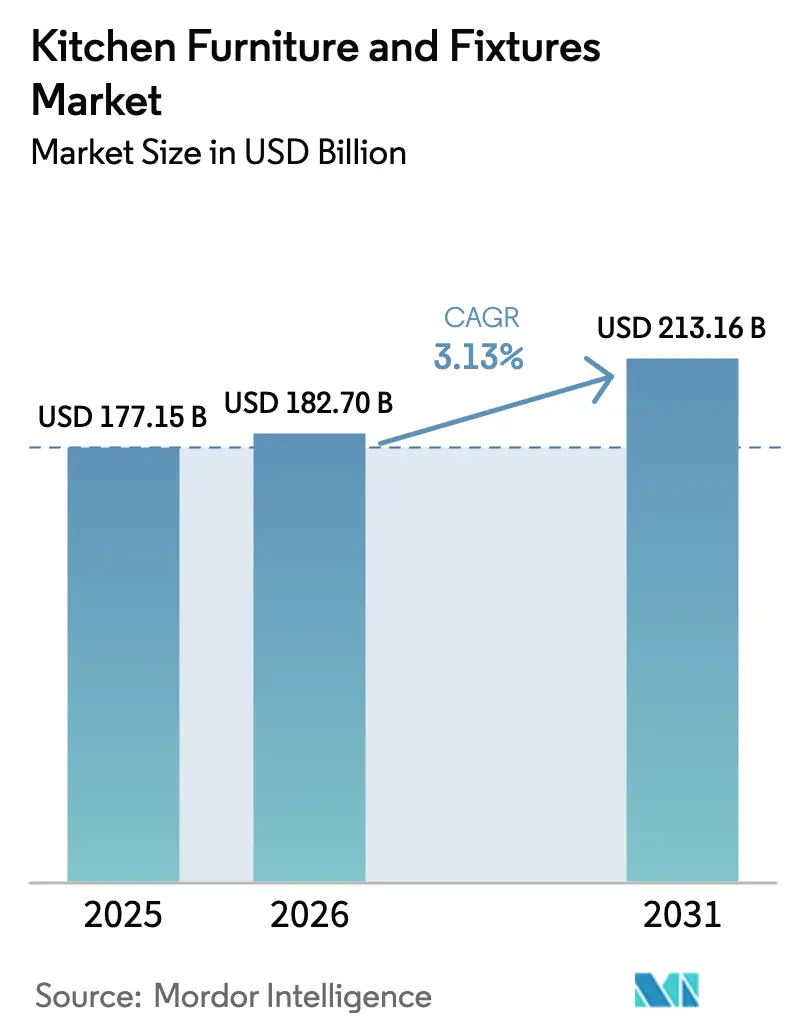
The kitchen furniture and fixture market size is expected to grow from USD 177.15 billion in 2025 to USD 182.70 billion in 2026 and is forecast to reach USD 213.16 billion by 2031 at a 3.13% CAGR over 2026–2031. This growth is driven by a combination of mature demand factors, including aging housing stock that requires renovations and upgrades, as well as standardized procurement practices in commercial and institutional projects. The increasing adoption of modular and smart-ready kitchen solutions is further driving market expansion, as these offerings offer flexibility, efficiency, and technological integration. Manufacturers are also responding to margin pressures from rising input costs and tariff exposure by offering pre-engineered products that reduce jobsite complexity and labor requirements. In addition, growing regulatory compliance requirements for formaldehyde emissions and low-VOC content are pushing the market toward factory-controlled materials and finishes, which streamline quality assurance and documentation processes. In the commercial sector, particularly hospitality and multi-family developments, there is a clear trend toward standardized kitchenettes and kit-of-parts casework. These solutions help accelerate project timelines, improve speed to occupancy, and stabilize fitout schedules, reinforcing demand growth across both residential and commercial segments.
Key Report Takeaways
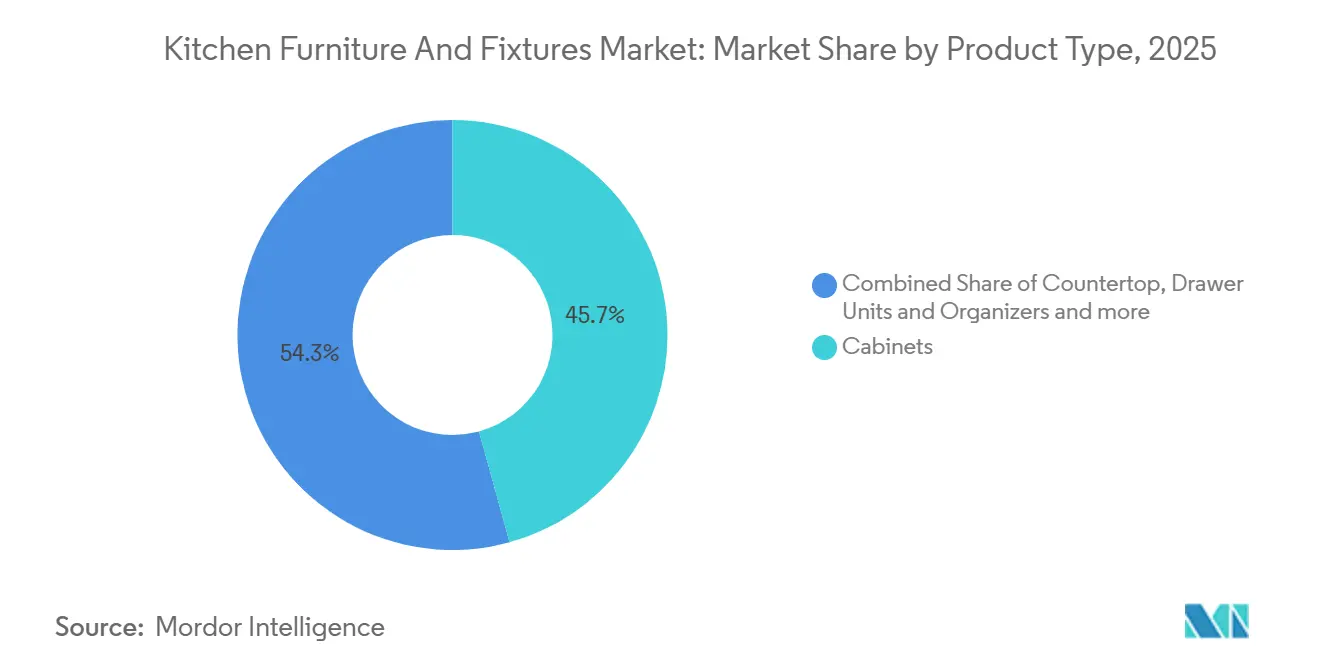
- By product type, cabinets led with 45.73% of the kitchen furniture and fixtures market share in 2025, while kitchen islands posted the fastest growth at a 3.81% CAGR through 2031.
- By material, wood-based substrates held 45.91% of the kitchen furniture and fixtures market share in 2025, while plastic and laminates recorded the highest growth at a 3.67% CAGR.
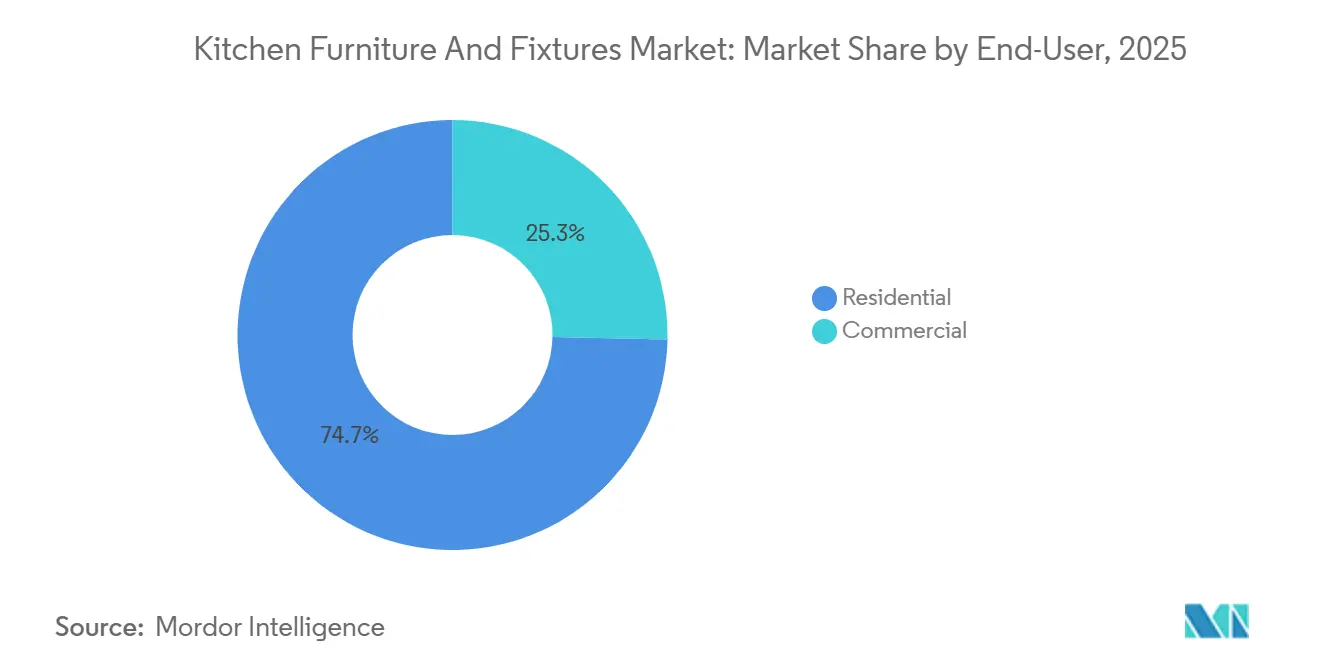
- By end-user, residential accounted for 74.67% of the kitchen furniture and fixtures market share in 2025, while commercial applications advanced at a 4.12% CAGR.
- By distribution channel, offline captured 76.68% of the kitchen furniture and fixtures market share in 2025, while online expanded at a 4.54% CAGR.
- By geography, North America represented 32.41% of the kitchen furniture and fixtures market share in 2025, while Asia-Pacific posted the fastest trajectory at a 4.91% CAGR.
Note: Market size and forecast figures in this report are generated using Mordor Intelligence’s proprietary estimation framework, updated with the latest available data and insights as of January 2026.
Global Kitchen Furniture And Fixtures Market Trends and Insights
Drivers Impact Analysis*
| Driver | (~) % Impact on CAGR Forecast | Geographic Relevance | Impact Timeline |
|---|---|---|---|
| Accelerating Shift to Modular & Pre-Engineered Kitchen Systems | +0.9% | Global, with early gains in North America, Northern Europe, and the Asia-Pacific urban centers | Medium term (2-4 years) |
| Kitchen-Centric Home Renovation Spending | +0.8% | North America and Europe leaders, emerging in the Asia-Pacific Tier II cities | Short term (≤ 2 years) |
| Shift Toward Modular & Smart Kitchens | +0.7% | North America, Europe, and the Asia-Pacific | Medium term (2-4 years) |
| Growth of Outdoor Kitchen Installations | +0.4% | Primarily North America, with emerging markets in the Middle East | Long term (≥ 4 years) |
| Contract-Led Demand from Hospitality & Foodservice Projects | +0.6% | Global, concentrated in North America, the Middle East, and the Asia-Pacific | Medium term (2-4 years) |
| Functional Upgrades Through Smart Fixtures & Storage Hardware | +0.5% | North America, Europe, and the Asia-Pacific | Medium term (2-4 years) |
| Source: Mordor Intelligence | |||
Accelerating Shift To Modular And Pre-Engineered Kitchen Systems
Factory-built modules compress design and installation timelines and reduce jobsite errors, which is valuable where skilled labor supply is tight and wage rates are elevated. Large-format players sustain standardized ranges at scale and pair them with centralized procurement that stabilizes pricing and keeps throughput resilient in 2026. Integrated lighting, power management, and sensor-ready features are increasingly built into casework platforms so installers can complete jobs with fewer site visits and less specialized commissioning. Software-led configuration and CNC machining continue to raise precision and repeatability, which helps configured-to-order programs scale without excessive lead-time risk in the kitchen furniture and fixtures market. Environmental rules, such as the United States Environmental Protection Agency’s TSCA Title VI Formaldehyde Emission Standards for Composite Wood Products, require composite wood panels and finished goods to meet strict emission limits, undergo third-party testing, and be certified and labeled as compliant, effectively normalizing low-VOC substrates and finishes as baseline specifications for 2026 projects[1]. Compliance with these standards reinforces the value of factory-controlled production, as off-site manufacturing ensures consistent material quality, regulatory adherence, and safer end products.
Kitchen-Centric Home Renovation Spending
Kitchen scopes remain the focal point of homeowner budget allocation as households prioritize storage, workflow, lighting, and code-compliant ventilation upgrades. In 2025, over half of United States homeowners undertook renovations, with kitchens among the top investments. Median spending on large kitchen remodels was around USD 55,000, while high-end projects exceeded USD 150,000, and homeowners increasingly relied on contractors, keeping kitchen upgrades a central focus of renovation budgets [2]. Remodeling outlays signaled solid momentum in 2025, which supported pipelines for cabinets, fixtures, and surfaces that anchor the kitchen bill of materials. Associations report that minor kitchen improvements often deliver stronger cost recovery than major gut renovations, sustaining demand for cabinet refacing and hardware refreshes in the kitchen furniture and fixtures market. Contractors continue to include price and schedule safeguards as material and logistics conditions evolve, and homeowners favor pre-engineered options that limit change orders and site disruption, while lumber pricing and tariffs remain watchpoints that can shift project timing and scope selection across regions.
Shift Toward Modular And Smart Kitchens
Smart-ready casework moves into mainstream specifications as designers integrate task lighting, soft-close systems, and sensor-enabled drawers that boost access and usability. The United States EPA’s ENERGY STAR Smart Home Energy Management Systems program highlights connected appliances that automate and optimize energy use, supporting the adoption of smart, networked devices, key enablers for modular and technology-driven kitchens[3]. Extended-stay and hospitality pilots refine repeatable templates that reduce energy use and enhance operating visibility, which then inform residential and mixed-use standards. Specifiers navigate interoperability concerns by favoring compact ecosystems and cabinet-embedded features that minimize commissioning complexity at handover. Building codes also push toward connected controls in commercial settings, accelerating the adoption of demand-control ventilation and integrated lighting across high-capacity kitchens. Manufacturers that align compliant substrates with integrated power and lighting lift total value without raising on-site complexity in the kitchen furniture and fixtures market.
Contract-Led Demand From Hospitality And Foodservice Projects
Hospitality, build-to-rent, and foodservice operators prioritize standardized kitchenette kits that reduce fitout variability, which keeps plant utilization healthy when retail channels soften. Extended-stay properties and multi-family units favor compact modular configurations that fit consistent footprints and speed unit turnover across programs. Suppliers address these needs with pre-integrated lighting, code-compliant surfaces, and quick-install hardware that help project teams reduce punch lists and accelerate closeout. Export-oriented producers with automated lines and software-driven configuration can serve multi-country programs and route around tariff-exposed inputs when needed. Reinvestment cycles in hotels and foodservice continue to refill pipelines in 2026, which supports steady order flow for cabinetry, fixtures, and related surfaces in the kitchen furniture and fixtures market.
Restraints Impact Analysis*
| Restraint | (~) % Impact on CAGR Forecast | Geographic Relevance | Impact Timeline |
|---|---|---|---|
| Cost Inflation in Engineered Wood, Stone & Metal Inputs | -0.6% | Global, most acute in North America and Europe | Short term (≤ 2 years) |
| Skilled Installer Shortages | -0.4% | North America, Europe, and the emerging Asia-Pacific | Medium term (2-4 years) |
| Stricter Formaldehyde & VOC Limits | -0.2% | North America and Europe, spreading to the Asia-Pacific | Medium term (2-4 years) |
| Anti-Dumping Tariffs on Flat-Pack Imports | -0.3% | North America, with select EU actions | Short term (≤ 2 years) |
| Source: Mordor Intelligence | |||
Cost Inflation In Engineered Wood, Stone, And Metal Inputs
Lumber and panel volatility raises budget risk and pushes designers toward standardized, pre-finished components that limit rework and waste on site. Company disclosures in 2025 highlighted elevated export duty burdens and the flow-through of input pressures across downstream millwork and cabinetry lines. Engineered stone and quartz costs remain sticky due to resin inputs and logistics factors, which lead some projects to consider alternative surfacing strategies in the kitchen furniture and fixtures market. Compliance for formaldehyde emissions and low-VOC finishes remains an added cost, yet it enables factory control and clear documentation for code reviews. Distributors respond with inventory planning and supplier consolidation to stabilize pricing, while pass-through to end buyers remains uneven when competition is intense.
Skilled Installer Shortages
Trade labor scarcity remains a gating factor for kitchen throughput as contractors compete for licensed electricians and experienced installers, which raises wage rates and extends completion timelines. The shift toward pre-engineered and modular systems reduces on-site hours and compresses schedules, which helps mitigate bottlenecks in busy urban markets. Developers of multi-family and hospitality assets increasingly favor prefabricated modules that reduce field labor dependence during tight construction windows. Training and apprenticeship initiatives are expanding but will take time to restore capacity, so project planning in 2026 continues to emphasize predictable installation paths in the kitchen furniture and fixtures market[4]. Manufacturers invest in plant automation and quick-install hardware to move assembly hours from the jobsite to the factory floor and stabilize cycle times.
*Our forecasts treat driver/restraint impacts as directional, not additive. The impact forecasts reflect baseline growth, mix effects, and variable interactions.
Segment Analysis
By Product Type: Functional Diversification Meets Design Premiumization
Cabinets accounted for 45.73% of the kitchen furniture and fixtures market revenue in 2025, reflecting their dual role as essential storage infrastructure and the primary visual anchor in both residential and commercial spaces. Flat-pack and modular cabinet formats are increasingly adopted as e-commerce and direct-to-consumer models improve transparency and shorten lead times, supporting steady market momentum. Kitchen islands are the fastest-growing segment, expanding at a 3.81% CAGR, driven by open-plan layouts, multiuse work zones, and integrated power and cooking features. Hospitality and multi-family developments often include islands and peninsula configurations with pre-integrated outlets, lighting, and seating to streamline installation and align with standardized layouts. Hardware, fixtures, and task lighting are playing a growing role in kitchen performance, with soft-close systems and integrated illumination enhancing usability and ergonomics. These trends collectively reinforce the importance of design-led functionality and convenience in shaping consumer and commercial preferences.
Countertops and fixtures continue to capture a significant share of project budgets, as surface durability, hygiene, and water management are critical to everyday function and perceived quality. Resilient, low-maintenance surfaces with a premium appearance are increasingly preferred, while sinks, faucets, and lighting are specified for water efficiency, accessibility, and ease of service. Hardware and accessories remain key margin drivers for suppliers, with consistent finishes, damping quality, and integrated lighting delivering tangible performance improvements valued by homeowners and operators. Modular inserts, organization systems, and space-saving solutions are being refined to maximize storage in small-footprint kitchens without compromising functionality. This combination of functional upgrades, ergonomic enhancements, and design-focused features supports broad product mix resilience across the kitchen furniture and fixtures market. Overall, market growth is reinforced by innovations that balance efficiency, aesthetics, and long-term usability.

By Material: Engineering’s Triumph Over Tradition
Wood-based materials accounted for 45.91% of kitchen furniture and fixtures revenue in 2025, driven by buyer preferences for longevity, repairability, and premium finishes in semi-custom and custom programs. Engineered wood panels provide consistent machining tolerances and reliable fastener performance, making them ideal for modular systems and flat-pack logistics. Compliance with formaldehyde and VOC regulations is steering demand toward factory-finished substrates and low-emitting adhesives, simplifying documentation and inspections. Material choices increasingly balance durability, price stability, and the ability to integrate lighting and hardware without compromising structural integrity. These trends support both residential and commercial applications, where long-lasting, high-quality finishes remain a priority. Overall, wood-based materials continue to dominate due to their versatility, performance, and aesthetic appeal.
Plastic and laminates are the fastest-growing segment, expanding at a 3.67% CAGR as high-pressure laminates and thermofoil-wrapped components offer improved scratch resistance and moisture performance for busy homes and commercial kitchens. Their adoption is also influenced by supply chain resilience, providing alternatives when solid wood availability is affected by tariffs or freight constraints. Laminates and thermofoil solutions ensure color consistency across production batches and allow quick replacements in commercial fleets requiring uniformity. Metal cabinets occupy a niche role in high-hygiene environments, such as commercial foodservice, where cleanability and heat resistance are critical. Glass and ceramic elements are increasingly used in backsplashes and accent areas, delivering reflective finishes and easy-to-clean surfaces that enhance lighting and maintenance in compact spaces. Together, these material trends reflect a market-wide shift toward predictable, code-compliant, and performance-driven finishes in kitchen furniture and fixtures.
By End-User: Residential Resilience Versus Commercial Velocity
Residential end users accounted for 74.67% of kitchen furniture and fixtures demand in 2025, driven by upgrade cycles in aging housing stock and a focus on layout efficiency, storage, and accessible design. Homeowners continued to prioritize kitchen improvements as renovation spending remained strong, supported by home equity cushions and a preference for stay-in-place strategies during high-interest-rate conditions. Minor renovations and cabinet refacing often deliver higher cost recovery at resale compared with full gut remodels, sustaining demand for cabinet fronts, hardware, and lighting upgrades. Accessibility features, including pull-out shelves and easier-to-reach storage, are increasingly adopted in multigenerational households and aging-in-place retrofits. These trends support a balanced mix of price points and product tiers tailored to diverse project scopes.
Commercial applications grew at a 4.12% CAGR, led by hospitality, multi-family turnkey units, and foodservice back-of-house upgrades that standardize specifications. Extended-stay hospitality formats now incorporate compact kitchenettes in a growing share of rooms, while multi-family projects deploy repeatable layouts that simplify procurement and installation. Foodservice programs prioritize high-throughput, easy-to-clean casework with integrated lighting and storage that withstands heavy use and speeds nightly resets. Code compliance is a key driver in commercial installations, with energy management, ventilation, and other controls often pre-integrated for faster commissioning. These factors support durable demand across both new-build and retrofit schedules. Collectively, the commercial segment benefits from standardized solutions that reduce complexity, accelerate timelines, and enhance operational efficiency.
By Distribution Channel: Offline Dominance Under Digital Siege
Offline channels accounted for 76.68% of kitchen furniture and fixtures revenue in 2025, driven by specialty showrooms, builder networks, and professional channels that manage complex scoping, templating, and code documentation for high-stakes projects. In-person design consultations remain critical for premium projects, while builder-direct procurement captures volume through negotiated programs on standardized models. Retailers and home centers adjust assortments and price points to address tighter budgets, balancing inventory and tariff pressures that affect mid-market offerings. Suppliers with modular ranges and quick-ship inventories gain share as contractors focus on controlling schedules and minimizing change orders. The industry continues to rely on offline coordination to integrate appliances, ventilation, and finishes for intricate projects.
Online channels recorded the fastest growth, expanding at a 4.54% CAGR, as visualization tools and direct-to-consumer models allow buyers to explore configurations and pricing earlier in the decision process. Mobile apps and web-based configurators help reduce returns and increase buyer confidence by simulating fit and color under realistic lighting. Flat-pack, RTA-compatible products benefit most from online sales, while fully custom millwork remains tied to offline channels due to templating and site coordination needs. Online-direct players are enhancing transparency around lead times and installation support, gradually increasing the addressable market. As AR and configurator tools improve, the overall channel mix is slowly rebalancing. Despite this growth, professional networks and in-person coordination continue to play a critical role in complex or high-value scopes.
Geography Analysis
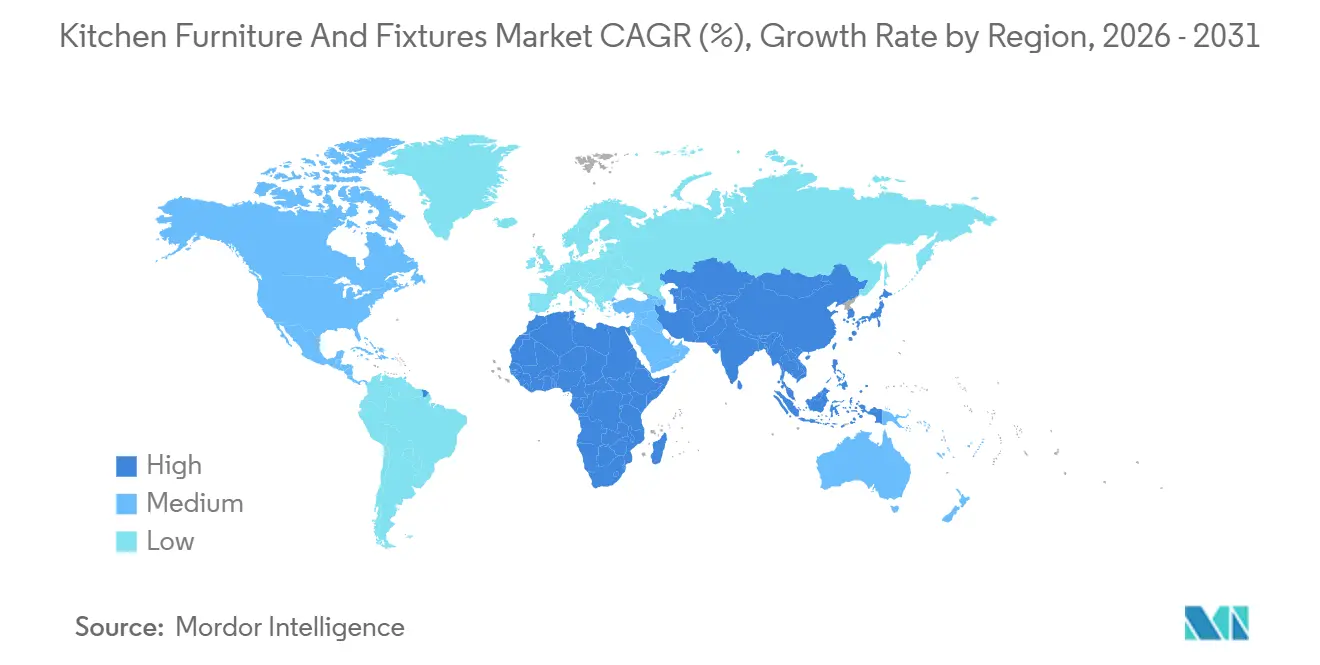
North America accounted for 32.41% of global kitchen furniture and fixtures revenue in 2025, as remodeling outlays remained resilient, supporting steady program pipelines. Home improvement spending stayed strong despite slower overall home sales in a high-interest-rate environment. Professional channels and service-led assortments stabilized cabinet and fixture orders. Tariff shifts and lumber price movements shaped pricing and delivery plans, keeping value-engineered designs and modular kits in focus. Warmer states saw growth in outdoor kitchen adoption, where integrated cooking and refrigeration zones became increasingly practical year-round.
Europe sustained a significant share of global activity, with strong modular penetration in core markets such as Germany. Macro softness and slower discretionary spending weighed on overall consumer demand in 2025. Automated production lines and configured-to-order software enabled competitive pricing and shorter lead times for large retailers and contract programs. Suppliers adapted sourcing to meet environmental certifications and trade restrictions while maintaining throughput for private-label ranges. Showrooms increasingly integrated smart-ready features and sustainable materials into mainstream modular kitchen offerings, reflecting cross-border design diffusion.
Asia-Pacific posted the fastest growth, with a 4.91% CAGR through 2031, driven by urbanization, rising household incomes, and the adoption of builder-standard modular kitchens. Export-oriented clusters balanced domestic demand with global shipments, while tariff regimes influenced sourcing of hardware and flat-pack casework. Developers emphasized speed, repeatability, and durability in compact floor plans, reinforcing the use of engineered substrates and pre-finished components. Configured-to-order modules optimized through software and validated with visualization tools became standard before production. These trends strengthened the region’s leadership in modular kitchen penetration and mixed-channel sales heading into 2026.
Regulatory Landscape
Regulation increasingly centers on indoor air quality, product safety/performance, and market-access compliance, influencing material selection and factory documentation for kitchen cabinets, casework, and related fixtures. In the European Union, Commission Regulation (EU) 2023/1464 sets a formaldehyde emission limit of 0.062 mg/m3 for furniture and wood-based articles placed on the EU market, with enforcement effective 6 August 2026. This is pushing brands and private-label suppliers to qualify low-emitting composite panels, adhesives, and finishes that can be consistently verified in production.
In Asia, product standards and conformity requirements add another layer of compliance management for global suppliers. China implemented QB/T 2531-2025 for kitchen furniture on 1 February 2026 (superseding QB/T 2531-2010), while India applies mandatory BIS licensing under Furniture Quality Control Order pathways for covered furniture categories (for example, storage units under IS 17634) for manufacturing, imports, and sale. In North America, formaldehyde and VOC expectations are reinforced by the US EPA TSCA Title VI composite wood requirements, and industry standards and planning guidelines such as KCMA A161.1-2022 for factory-assembled kitchen and vanity cabinets, along with NKBA Kitchen and Bath Planning Guidelines (which reference ICC ANSI A117.1 and CSA B632 for accessibility-related design), shape specification and procurement in both residential and commercial projects.
Value Chain Analysis
The value chain starts with raw materials (wood-based panels, veneers, laminates, metals, engineered stone/quartz, and chemical inputs for coatings/adhesives), moves into component production (doors/fronts, carcasses, drawers, hardware, sinks/faucets/lighting), and then shifts to assembly and finishing at cabinet and fixture plants. Factory-controlled finishing and compliance documentation are taking on more weight as buyers specify low-emission substrates and finishes, while automation (CNC machining and configured-to-order workflows) supports modular and flat-pack output that reduces jobsite labor intensity.
Distribution relies on a mix of professional channels (builders/contractors, kitchen dealers, showrooms), mass retail, and e-commerce for RTA and modular lines, with installation services and templating acting as key downstream nodes for higher-complexity projects. Logistics reliability remains a constraint: Q1 2026 container dwell times at major European ports such as Rotterdam, Hamburg, and Antwerp were reported at 11.4 days, and OTIF performance across logistics corridors at 72-76% versus 89% in 2019. This is reinforcing the use of regional warehousing, inventory buffering, and supplier consolidation. The chain is also being reshaped through platform consolidation and vertical integration, highlighted by the 2026 completion of the MasterBrand and American Woodmark combination and other 2026 deals that connect manufacturing capacity with retail and digital routes to market.
Competitive Landscape
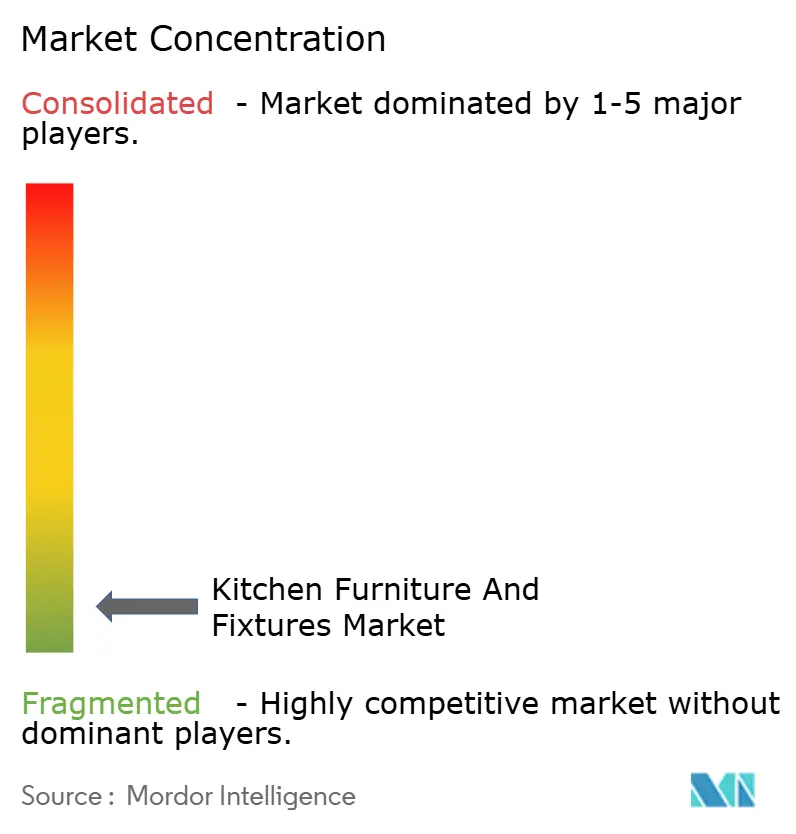
The kitchen furniture and fixtures market remains highly fragmented, with the leading players capturing only a modest portion of overall revenue. Regional specialists and vertically integrated contract manufacturers continue to thrive by aligning closely with local codes, design preferences, and service expectations. Companies differentiate themselves through tight supply chain control, from material sourcing to in-house finishing, which helps manage volatility and maintain predictable lead times. Compliance-ready substrates and documented emissions testing have become essential for cross-border sales and public-sector procurement. Leading firms leverage scale in procurement and manufacturing while coordinating broad supplier networks to keep everyday price points competitive. Meanwhile, local and regional players focus on agility and service excellence to sustain their presence in niche markets.
Inter IKEA Group continues to apply its scale advantage across sourcing and production, ensuring competitive pricing across global markets. Other major players refine channel strategies to balance dealer-based assortments with big box and mass-market demand, while navigating input costs and trade dynamics. European leaders advance modular efficiencies and automation as part of footprint optimization to protect margins amid softer consumer demand. Hardware and lighting integration by top casework brands has increased perceived value without adding complexity during installation, contributing to steadier project close rates in professional channels. Supply chains increasingly emphasize sustainability, transparency, and traceable materials to meet evolving customer expectations. These approaches collectively reinforce resilience in a fragmented and competitive market environment.
Several strategic themes emerged in 2026 that shaped industry priorities. Modular hospitality concepts have expanded from pilot projects to full program implementations, supporting suppliers of compact kitchenettes and quick-install casework. Software-enabled visualization and configured-to-order workflows shorten sales cycles, reduce returns, and improve cash conversion while stabilizing backlogs. Trade compliance and material transparency have become baseline requirements for large buyers, enabling participation in public-sector and multi-country programs. Emissions documentation and low-VOC finishes now play a central role in procurement decisions, reflecting heightened regulatory and sustainability focus.
Kitchen Furniture And Fixtures Industry Leaders
-
Inter IKEA Group
-
MasterBrand Cabinets Inc.
-
American Woodmark Corp.
-
Masco Corp. (KraftMaid)
-
Nobilia GB Ltd.
- *Disclaimer: Major Players sorted in no particular order
Market Opportunities and Future Outlook
Compliance-driven material shifts create a monetization path for suppliers that can industrialize low-emission substrates and finishes with repeatable documentation, particularly as the EU formaldehyde limit approaches under Commission Regulation (EU) 2023/1464 on 6 August 2026. This requirement increases the value of factory-finished cabinet programs, verified composite wood inputs, and traceable supply chains for wood-based articles, favoring manufacturers and distributors that can bundle compliant product lines with specification support for professional buyers.
Fixtures and integrated kitchen packages also create room for differentiation in a category where capacity expansion and localized manufacturing are already visible. In India, Kohler announced a planned INR 800 crore investment over three financial years to scale manufacturing and expand its retail presence, while Carysil commenced commercial production of additional stainless steel sink capacity (an added 70,000 units per year, taking total annual capacity to 250,000 units) and outlined a broader INR 300 crore capex plan at Bhavnagar to expand sinks, appliances, and faucets. These moves support broader kitchen-bill-of-material offerings, including water-saving and easy-service fixtures that fit standardized residential and contract kitchen programs, while also reducing reliance on long and volatile import supply lines for high-volume sink and faucet categories.
Recent Industry Developments
- May 2026: MasterBrand, Inc. completed its all-stock merger with American Woodmark Corporation on May 28, 2026, and the combined company operates under the MasterBrand, Inc. name. The transaction consolidates North American cabinetry manufacturing and distribution capacity under one platform, reshaping negotiating leverage with pro channels and large accounts. Integration priorities around footprint and procurement also influence lead times and assortment availability for stock and semi-custom cabinet lines.
- August 2025: MasterBrand and American Woodmark announced a definitive agreement to combine in an all-stock transaction, targeting USD 90 million in annual run-rate cost synergies by the end of year three after closing. The planned combination signaled accelerated consolidation in residential cabinetry, with a larger multi-brand portfolio aimed at improving coverage across price tiers and channels. It also reinforced the strategic value of scale in managing input-cost volatility and trade exposure.
- May 2024: MasterBrand acquired Supreme Cabinetry Brands for USD 520 million to broaden its cabinetry portfolio across kitchen and bath. The deal added premium and semi-custom offerings that complement mass and mid-market lines, supporting upsell paths in renovation-driven demand. It also strengthened MasterBrand's ability to serve dealer and builder programs with differentiated styling and construction options.
Research Methodology Framework and Report Scope
Market Definition and Coverage
This market covers the value of kitchen furniture and kitchen fixtures sold for residential and commercial kitchens, counted at the point where products are supplied to the market in each country and then summed globally.
Scope exclusions: Loose dining furniture and stand-alone kitchen appliances are not counted unless they are sold as part of the defined kitchen furniture and fixtures scope.
Segmentation Overview
- By Product Type
- Cabinets (Base, Wall , Tall/Pantry)
- Countertop
- Drawer Units & Organizers
- Backsplashes & Panels
- Shelving & Storage Units (Open Shelves, Closed Storage Units, Corner Units)
- Kitchen Islands (Fixed, Mobile, Multi-functional)
- Fixtures (Sinks, Faucets, Lighting Fixtures)
- Hardware & Accessories (Handles & Knobs, Hinges, Drawer Slides, Pull-out Systems, Racks)
- Others (Waste Bins, Modular Inserts, Soft-close Systems)
- By Material
- Wood (Solid,Engineered,Bamboo / Reclaimed)
- Metal (Stainless Steel, Aluminum)
- Plastic & Laminates
- Glass & Ceramics
- Composites
- By End-User
- Residential
- Commercial
- By Distribution Channel
- Offline
- Specialty Stores & Showrooms
- Home-Improvement / DIY Chains
- Furniture Retailers
- Builders / Contractors
- Online
- By Geography
- North America
- Canada
- United States
- Mexico
- South America
- Brazil
- Peru
- Chile
- Argentina
- Rest of South America
- Europe
- United Kingdom
- Germany
- France
- Spain
- Italy
- BENELUX (Belgium, Netherlands, and Luxembourg)
- NORDICS (Denmark, Finland, Iceland, Norway, and Sweden)
- Rest of Europe
- Asia-Pacific
- India
- China
- Japan
- Australia
- South Korea
- South East Asia (Singapore, Malaysia, Thailand, Indonesia, Vietnam, and Philippines)
- Rest of Asia-Pacific
- Middle East And Africa
- United Arab Emirates
- Saudi Arabia
- South Africa
- Nigeria
- Rest of Middle East And Africa
- North America
Data Sources, Market Sizing, and Validation
Desk Research
Desk work started by mapping the kitchen build and remodel cycle to measurable, public signals, and then matching those signals to furniture and fixture demand. We relied on national housing starts and permits dashboards, national statistics office outputs for construction and household spending, and customs and tariff portals for furniture and metal hardware trade flows. We also referenced standards and product notes from bodies such as ISO, along with plumbing code references, to keep product boundaries consistent when fixtures and hardware are included.
To anchor the business side, we reviewed company annual reports, investor decks, and public catalogs to understand product mix and pricing logic across cabinets, countertops, sinks, taps, and accessories. For cross checks, we used paid subscriptions for company financials and intelligence, a patent database to spot direction in materials and hinge or slide systems, and an import-export shipment-level database where trade visibility was needed. These examples are not exhaustive, and many other public and paid sources were also used for data collection, validation, and clarification.
Primary Interviews and Surveys
Primary work was used to confirm what share of kitchen projects are new builds versus replacements, and how bills of materials shift by price band and channel. We spoke with manufacturers, distributors, installers, retailers, and commercial project stakeholders across APAC, EMEA, and the Americas, so assumptions on volumes, typical order sizes, and pricing movements could be tested and then corrected.
Distribution of primary research fieldwork respondents
| Company type | Respondent position | Region |
|---|---|---|
| Top tier: 33% | CXOs: 18% | APAC: 46% |
| Mid tier: 47% | Functional/Unit leaders: 27% | EMEA: 32% |
| Smaller Players: 20% | Managers: 55% | Americas: 22% |
Market-Sizing & Forecasting
The core model is built using a top-down demand pool, where housing completions, renovation activity, and commercial fit-out cycles are translated into kitchen project counts, and then into furniture and fixture value. To keep the totals realistic, we corroborate the top-down results with selective bottom-up approximations using sampled average selling prices times implied unit volumes for key items like base cabinets, wall cabinets, countertops, sinks, faucets, and common hardware packs.
Inputs that matter in this market include new housing starts and permits, remodel spend trends, urban household formation, kitchen replacement cycles, mix shifts between stock and custom cabinetry, and material price direction for wood panels, metal hardware, and stone or composite surfaces. Where detailed unit data is patchy, gaps are handled by using proxy ratios from similar countries (for example, projects per 1,000 households), and then re-checking with interviews so the proxy does not override local market realities. For forecasting, scenario analysis is used around construction outlook, interest rate sensitivity, and remodeling confidence, and the final growth path is aligned to what primary respondents see in order books and channel inventory behavior.
Data Validation & Update Cycle
Validation is done by triangulating the model against independent signals, such as construction spending trends, furniture and fixtures trade movement, and category-level pricing direction. Outliers are flagged through variance checks across regions, and then reviewed again to determine whether the issue is a scope mismatch, a currency conversion timing effect, or a one-time demand shock.
Before sign-off, the numbers go through a multi-step analyst review, and re-contacts are triggered when an assumption moves beyond a reasonable range versus the latest market signals. Reports are refreshed annually, with interim updates when material events shift construction activity or input costs, and a final freshness pass is completed right before delivery so clients receive the latest updated view.
Mordor Intelligence's Global Kitchen Furniture and Fixtures Market Size Compared With Other Published Estimates
Published market values for this space often differ because firms do not count the same basket of items, and they also choose different timing for currency and price updates. Even when the same terms are used, one study may focus mainly on cabinets, while another mixes in fixtures, fittings, and adjacent kitchen components.
The biggest gap drivers we see are whether hardware and accessories are included alongside furniture, how residential versus commercial demand is weighted, and whether trade and local production are reconciled to avoid double counting. Some estimates push a longer forecast with steady price lift, while others assume a flatter pricing path during slow construction years, which changes the base value quickly. Another common difference is refresh cadence, where price series for panels, metals, and stone surfaces are not updated at the same time across publishers.
Benchmark comparison
| Source | Market Size | Gaps in Research Methodology |
|---|---|---|
| Mordor Intelligence | USD 182.70 B (2026) | |
| Industry Publisher A | USD 182.70 B (2024) | Uses an earlier base year and a broader category label that mixes furniture with fixtures and fittings, which can blur what is counted as a kitchen-specific installation versus general home goods. |
| Trade Release B | USD 57.00 B (2024) | Focuses on kitchen furniture production and trade for a narrower product set, and it may also treat certain related items under furniture only, which keeps the value far lower than a furniture-plus-fixtures view. |
The spread in values is mainly explained by scope and timing, not by a single math choice. When cabinets, countertops, sinks, faucets, and common kitchen hardware are counted consistently and then checked against construction and trade signals, the estimate stays traceable to real demand drivers, which is the approach applied by Mordor Intelligence.
Key Questions Answered in the Report
What is the kitchen furniture and fixtures market size and growth outlook through 2031?
The kitchen furniture and fixtures market size is estimated at USD 182.70 billion in 2026 and is projected to reach USD 213.16 billion by 2031 at a 3.13% CAGR, reflecting a mature category shaped by modular adoption and commercial standardization.
Which product categories are leading the growth in global kitchen programs?
Cabinets lead revenue with a 45.73% share in 2025, while kitchen islands record the fastest growth at a 3.81% CAGR through 2031 as open-plan layouts and multiuse work zones drive larger, feature-rich islands.
How is the channel mix evolving for kitchen furniture and fixtures?
Offline channels still dominate with a 76.68% share in 2025 because showroom consultation and installation coordination are critical, while online is the fastest-growing at a 4.54% CAGR through 2031 due to visualization tools and direct-to-consumer models.
What end-user segment contributes most to global demand?
Residential accounted for 74.67% of demand in 2025 due to ongoing upgrade cycles and aging housing stock, while commercial leads on growth with a 4.12% CAGR through 2031 tied to hospitality and multi-family programs.
Which regions are shaping demand dynamics?
North America contributed the largest share at 32.41% in 2025 on remodeling strength, while Asia-Pacific shows the fastest growth at 4.91% through 2031 on urbanization and builder-standard modular formats.